



Blog Post Writing Framework: From Keyword Research to Publishing


Key Takeaways
- Following a structured framework from keyword research to publishing ensures consistent quality and better results than random content creation.
- Understanding your target readers’ needs, pain points, and search behaviour is fundamental to creating content that resonates and performs well.
- Effective keyword research goes beyond search volume; it involves understanding search intent, competition analysis, and building topic clusters for long-term content success.
- Well-researched, thoroughly edited content that provides genuine value consistently outperforms hastily published posts in both reader engagement and search rankings.
- Successful blog posts require attention to SEO elements, visual design, technical performance, and promotional strategy, not just good writing.
- Tracking performance metrics and reader feedback enables continuous refinement of your content strategy and writing process.
Creating content that performs well in today’s SEO-driven world requires publishing intelligently rather than publishing more. Blogs now have to serve several masters at once as algorithms change and user behavior changes: they must satisfy technical SEO requirements, appeal to readers, and match user intent. This is where things quickly become overwhelming for companies, agencies, and content teams. You are strategizing, optimizing, and publishing for performance in addition to writing. And, you’re wasting time and money if your process isn’t designed for that.
Blogging without a structure often leads to chaos. You start with a good idea, maybe even a strong headline, but by the time it’s published, it’s either missing critical SEO components or doesn’t connect with readers. Multiply that mistake across dozens of posts and the damage compounds fast. Rankings stall. Traffic feels random. Content audits turn into cleanup projects instead of growth opportunities.
This is exactly why following a blog post writing framework is not optional anymore; it is essential. A framework acts as a quality control system. It ensures every post is built with intent, supported by research, structured for search visibility, and designed to perform long after publishing. You stop guessing and start diagnosing. You know why a post works, why it doesn’t, and what to fix.
In this guide, we break down a structured, scalable blog writing framework that covers every critical stage, from keyword research to performance tracking. It is designed to help teams create high-impact blogs consistently, without relying on luck or last-minute fixes.
How a Blog Framework Improves Results
Even if it isn’t obvious, almost every high-performing blog you’ve read followed a defined process. Blogs that consistently rank, attract leads, and build authority are rarely accidental. They are the result of planning, preparation, and disciplined execution. Without a structured blog post writing framework, content teams operate like a ship without a rudder; movement happens, but direction is missing. A framework gives marketers, agencies, and founders a shared system to produce reliable, results-driven content while reducing friction across planning, writing, and publishing.
Most blog failures can be traced back to structural gaps. Writing often begins without keyword alignment, on-page SEO elements are missed, or the content fails to support any funnel stage. This doesn’t just weaken search performance; it confuses readers. A disciplined SEO blog writing process ensures content satisfies both human expectations and algorithmic requirements. It also gives editors and SEO teams a consistent checklist for reviewing quality before anything goes live.
At scale, a framework becomes a growth tool. It allows teams to assign briefs, distribute tasks, and evaluate performance across multiple blogs without starting from scratch. With built-in checkpoints like CTA placement, internal linking, and intent alignment, a framework removes guesswork and accelerates execution. The difference between random publishing and revenue-generating content is rarely talent; it’s structure.
Step 1: Keyword Research & Search Intent
The foundation of any successful blog post is understanding what your audience is actively searching for and why they are searching for it. Keyword research has evolved far beyond checking monthly search volume. Today, it’s about identifying phrases that align with real user needs, decision stages, and content expectations. Tools like Semrush, Ahrefs, or Google Keyword Planner help uncover opportunities, but the real value comes from interpreting the data. Search volume tells you demand, while keyword difficulty, CPC, and trend data reveal competition, commercial value, and longevity. A strong blog post writing framework always begins by balancing all four.
To make keyword research more effective, focus on intent-first thinking:
- Prioritize long-tail queries that signal clarity of need, not just popularity
- Cross-check SERP features (PAA, featured snippets, videos) to understand content format expectations
- Review ranking URLs, not just keywords, to see what Google already trusts
- Group keywords by intent, not topic alone
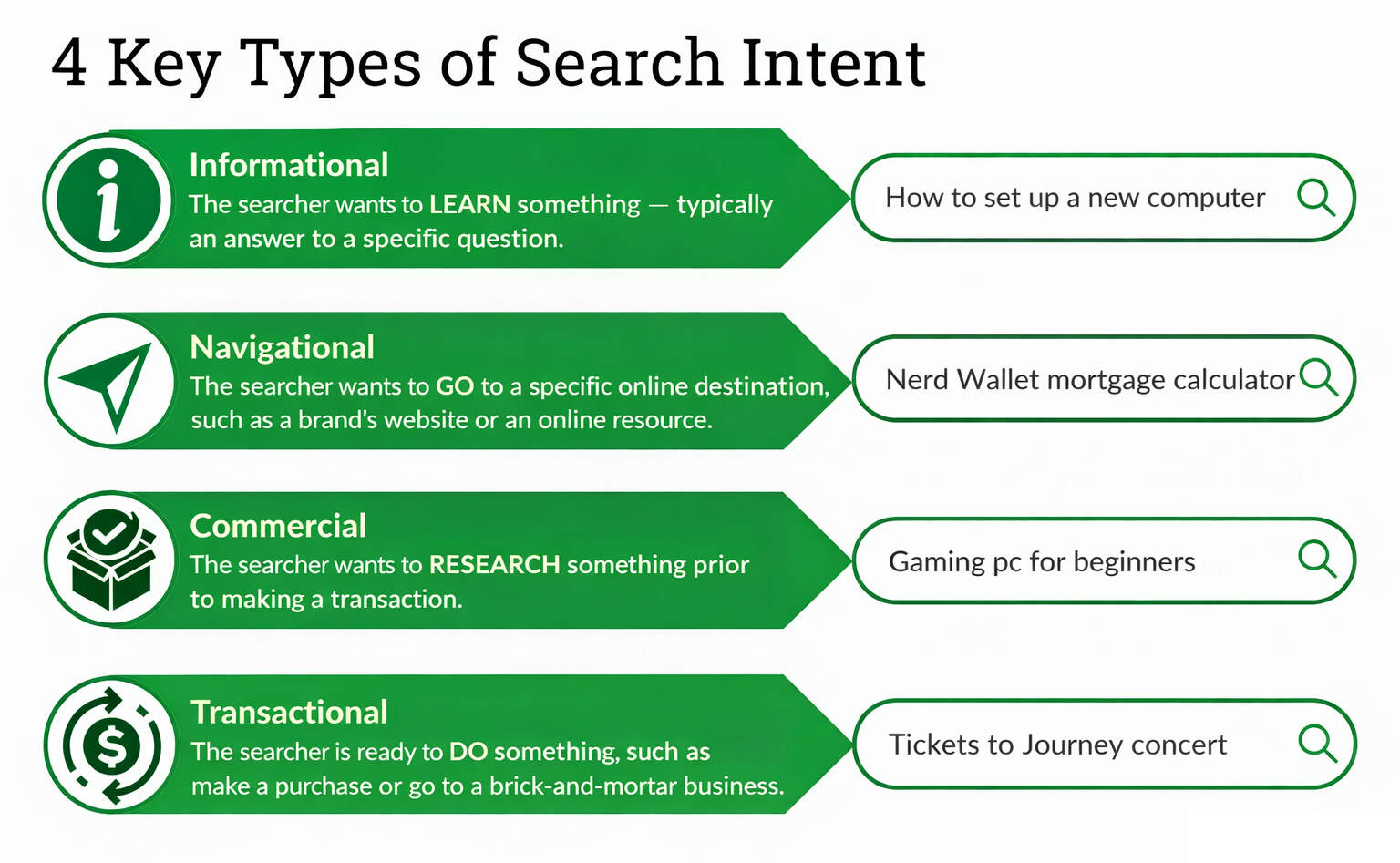
Once you’ve shortlisted keywords, map search intent carefully. Is the query informational, commercial, or transactional? This decision shapes everything that follows, including headlines, depth, CTA placement, and even visuals. Someone searching “blog writing step-by-step” expects guidance, while “best blog content agency” signals evaluation and readiness to act. Intent alignment is what turns visibility into engagement.
Finally, connect each keyword to a content goal and funnel stage. Use a simple spreadsheet to track intent type (TOFU, MOFU, BOFU), post angle, and internal linking opportunities. This prevents overlap and supports topic clusters rather than isolated posts. When done well, keyword research for blog posts becomes more than a ranking tactic; it becomes a strategic roadmap that guides your entire content ecosystem.
Step 2 – Competitor & SERP Analysis
Before drafting a single paragraph, study what is already ranking. The SERP is not just a list of competitors; it’s Google’s real-time feedback on what it believes satisfies search intent. Search your primary keyword in incognito mode and review the top 5–10 results closely. Pay attention to content length, title structure, subheadings, use of visuals, author credibility, and content format. Is Google rewarding how-to guides, list-based posts, or long-form tutorials? Your goal is not to reinvent the format, but to meet expectations first and then outperform them.
To deepen this analysis, tools like Frase or Surfer SEO can benchmark your draft against ranking pages. These platforms surface missing semantic terms, unanswered questions, and weak topical coverage. Go a step further by analyzing “People Also Ask” boxes and featured snippets. These SERP elements often reveal subtopics Google considers essential. Including them improves your chances of earning visibility beyond traditional blue links, especially in zero-click searches.
The real opportunity lies in identifying gaps. If competitors all publish similar surface-level guides, that’s your opening. Add original data, expert commentary, visuals, or proprietary frameworks. Even content that is marginally better often outranks established pages. Internal linking is another overlooked signal. If top-ranking posts link to service pages or related guides, mirror that structure strategically. Smart SERP analysis helps you create the most complete answer, not just another article.
Competitive SERP Comparison Snapshot
| Metric | Competitor A | Competitor B | Competitor C | Opportunity |
| Word count | 1,400 | 1,800 | 1,200 | Create deeper coverage |
| Backlinks | Medium | High | Low | Support with outreach |
| H2 depth | Shallow | Moderate | Shallow | Add structured sections |
| FAQs included | No | Yes | No | Add intent-driven FAQs |
| Visual assets | Few | Moderate | None | Include charts/screenshots |
How to Use This Comparison to Outperform Competitors
This type of comparison is not about copying what already exists; it’s about identifying where competitors stop short. The goal is to build a page that feels more complete, more helpful, and more deliberate than anything currently ranking. If competitors rely on word count alone, depth and structure become your advantage. If they include FAQs but lack visuals, strong charts or screenshots can set your content apart. Treat each gap as an opportunity to add clarity, not clutter. When SERP analysis informs decisions at this level, your blog shifts from competing on keywords to competing on usefulness, which is exactly what search engines reward over time.
Step 3: Blog Outline & Content Brief Creation
This stage is where most blogs either gain clarity or quietly fall apart. An outline is not just a writing aid; it’s a decision-making filter. Before a single sentence is written, the post needs a clear job to do. Is it meant to attract first-time visitors, support a buying decision, or position expertise? Once that purpose is clear, structure follows naturally. A strong outline mirrors how readers think, not how writers brainstorm. Each H2 should answer a specific question a user might ask next, creating a logical progression rather than a collection of disconnected sections. This is what keeps readers moving instead of skimming.
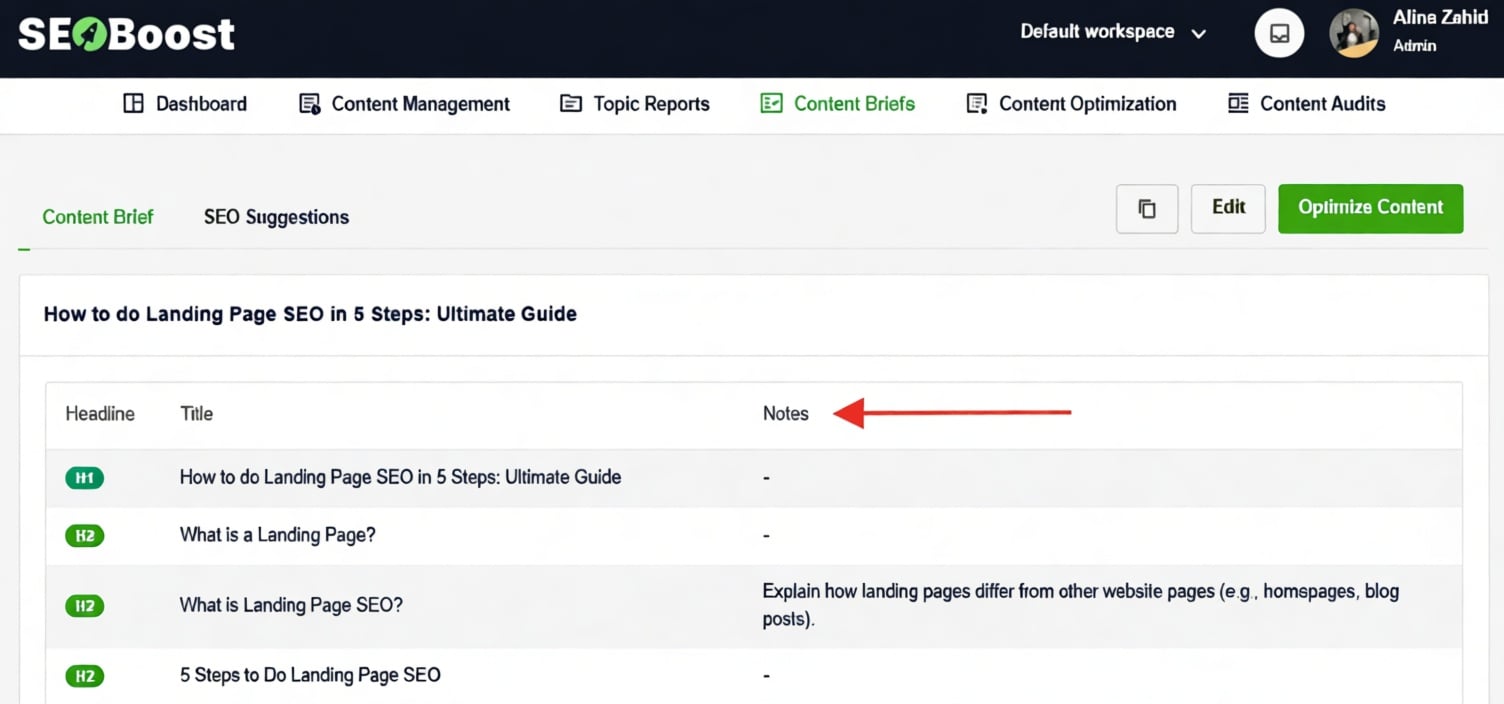
Think of the content brief as a control room for the blog. It translates strategy into execution and prevents guesswork later. A good brief defines the primary keyword, supporting terms, internal links, external references, CTA placement, and visual cues upfront. It also assigns rough word limits to prevent sections from ballooning or being rushed. When structure reflects real SERP patterns, such as guides, comparisons, or checklists, the writing phase becomes faster and more focused, while still supporting on-page SEO for blogs.
A simple content brief should answer five questions before writing begins:
- What is the goal?
- Who is the reader?
- What intent does this page serve?
- What must be included to compete?
- What action should the reader take next?
When briefs are shared early through tools like Google Docs or Notion, feedback happens before writing, not after. For agencies, this enables scale without chaos. For solo marketers, it prevents drift. Without a brief, writing reacts. With one, content executes with purpose.
Step 4: Write With Users and SEO in Balance
Every blog post is written twice, even if the writer doesn’t realize it. The first draft is written for the algorithm. The second is written for the reader. Most content fails because it never reconciles the two. Some posts chase rankings so aggressively that they forget humans are reading. Others read beautifully but lack structure, making them invisible in search. The goal at this stage is not compromise; it’s alignment. A strong opening should immediately confirm intent for the reader while naturally introducing the primary keyword early enough to signal relevance without sounding forced.
The easiest way to spot imbalance is to listen to your own writing. Algorithm-heavy content sounds stiff, repetitive, and overly cautious. Reader-only content often wanders, lacks hierarchy, and buries the point. Writing that performs well sits in the middle. It uses natural language, varied sentence length, and real examples while quietly reinforcing relevance through semantic phrasing. Secondary terms should appear because they belong there, not because a checklist demands them. When structure is sound, keywords tend to fit without effort.
A simple litmus test before publishing:
- If you removed every keyword highlight, would the post still read smoothly?
- If you removed every heading, would the reader still follow the logic?
If the answer to both is yes, you’ve found the balance. Formatting, visuals, and consistent tone then do the rest of the work. Screenshots, charts, and embedded proof reduce cognitive load and increase retention. Write like a human first. Refine like a strategist second. That’s how a blog post writing framework turns clarity into rankings.
Step 5: On-Page SEO Optimization
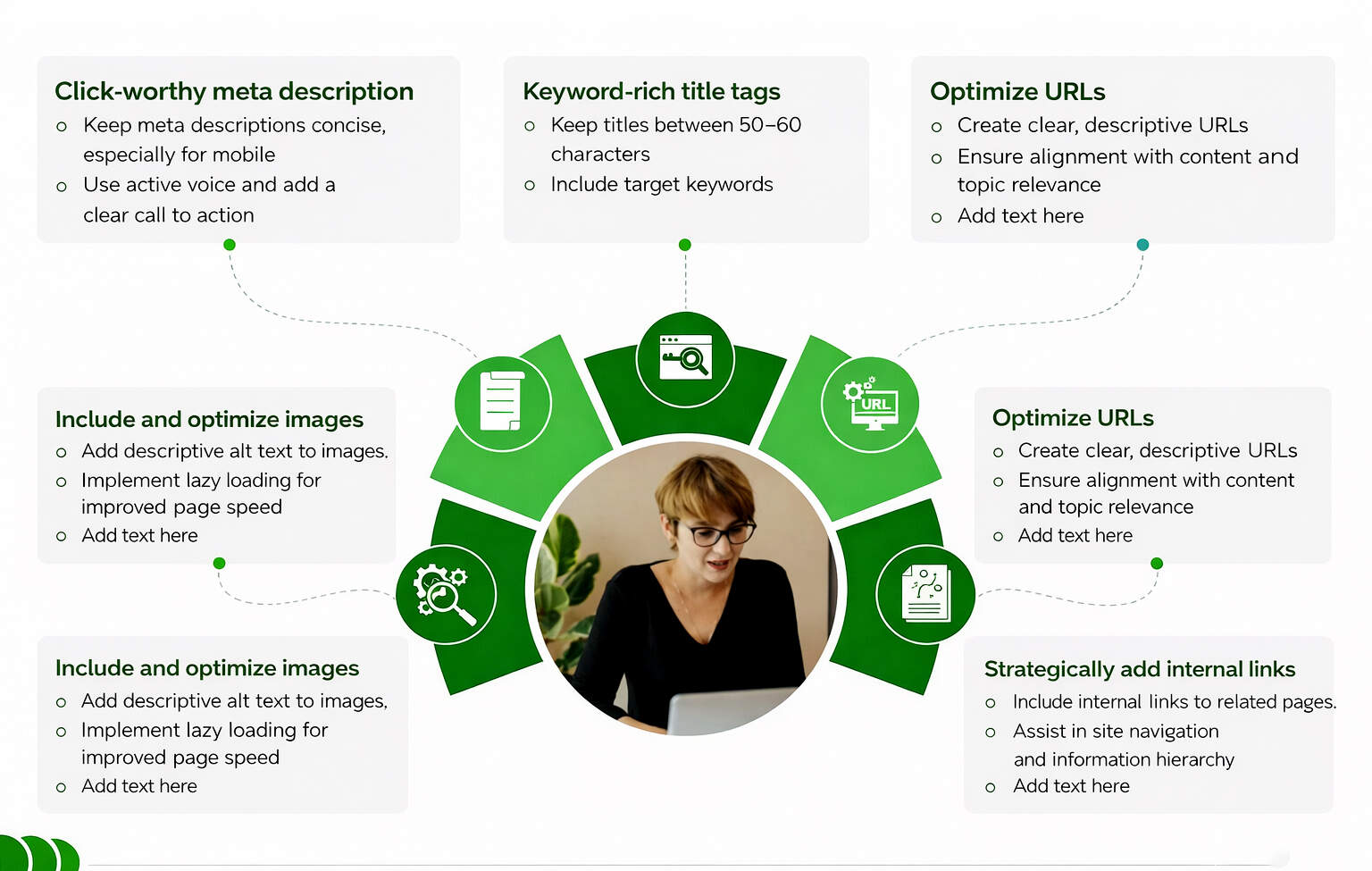
Once your draft is polished, you’re not done yet; now it’s time to optimize. On-page SEO bridges the gap between what you’ve written and how Google (and readers) find it. Start with your meta title: it should be under 60 characters, include the primary keyword, and be compelling enough to earn clicks. Follow with a meta description (under 155 characters) that reinforces value and urgency. Both act as your SERP pitch; treat them like ad copy.
Next, check your URL slug. It should be short, descriptive, and keyword-rich (e.g., /blog-post-writing-framework). Optimize your headings using proper tag hierarchy: H1 is your title, H2s for major sections, and H3s for supporting points. Sprinkle LSI keywords like “internal linking strategy” or “on-page SEO for blogs” into subheads and body copy; Google uses this to understand topical relevance.
Images matter too. Rename file names (not img_1223.jpg), compress them, and always add alt text. Google Images drives a surprising amount of organic traffic. Implement schema markup where relevant using tools like Rank Math or Schema Builder, especially for FAQ, Article, or How-To formats. Add internal links to relevant service or blog pages to strengthen authority and keep users on-site longer.
Finally, preview your post in the CMS. Does it scan well? Are CTAs placed logically? Does it load fast on mobile? Use tools like PageSpeed Insights and WAVE for technical checks. Great writing is half the battle. Optimization ensures it gets seen, indexed, and clicked.
Step 6 – Publishing & CMS Execution
Publishing your blog is not a single click; it’s a final quality assurance pass. Open your CMS (e.g., WordPress or Webflow) and begin your formatting. Make sure spacing between paragraphs, subheadings, bullet points, and media follows a consistent visual rhythm. Double-check your headings: there should be only one H1, multiple H2s, and nested H3s where appropriate. This structure improves both user readability and accessibility.
Add your featured image; ideally 1200×628 pixels for social shares, and ensure it’s optimized for speed. Include a compelling alt tag that uses relevant terms such as “blog post structure for SEO.” Don’t forget to include your internal links using appropriate anchor text. Link to service pages, cornerstone blogs, or related posts within the same content silo. This improves site crawlability and keeps users engaged across multiple posts.
Next, preview your post on both desktop and mobile. Formatting often breaks on smaller screens, which hurts user experience and SEO. Then check the loading time using tools like GTmetrix or Google PageSpeed Insights. If the blog loads slowly, compress media or delay loading non-critical elements. Once everything looks perfect, schedule the post or publish immediately; then submit it to Google Search Console for indexing.
Publishing isn’t the end of your job; it’s the launchpad. Great formatting and CMS setup make the difference between “just published” and “ready to rank.”
Step 7 – SEO Tracking After Publishing
Once a blog goes live, it quietly enters a testing phase most teams never notice. Google doesn’t immediately reward or reject content; it observes. In the first few weeks, impressions often rise before clicks, rankings fluctuate without settling, and traffic feels inconsistent. This stage is frequently misread as failure, when in reality it is evaluation. Submitting the URL to Search Console simply makes the page eligible. What follows is a probation period where Google measures relevance, engagement, and stability. Posts that show slow, steady impression growth during this phase often outperform pages that spike briefly and vanish.
A useful way to think about this phase is as a timeline rather than a scorecard.
- In the first 30 days, visibility is being tested.
- Between days 30 and 60, engagement signals are weighed.
- After 60 days, refinement opportunities become clear.
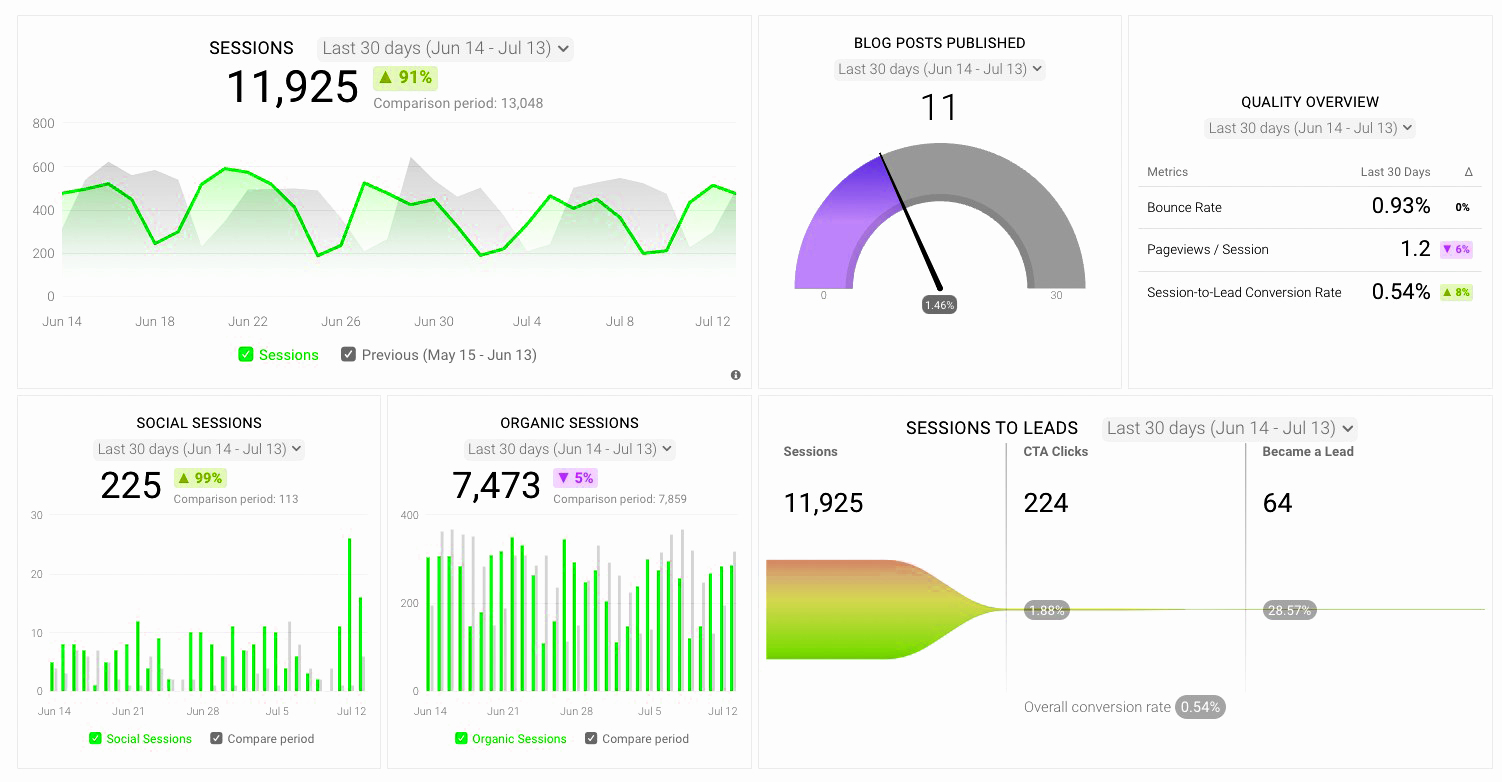
During this window, analytics tell a more honest story than rankings alone. High bounce rates usually signal intent mismatch, not poor writing. Strong scroll depth with low CTA interaction often points to timing or framing issues. These are not immediate fixes; they are diagnostic signals. Most blogs stagnate because teams collect data without interpreting it.
The most meaningful gains happen after the data stabilizes. Around the 60–90 day mark, patterns become reliable enough to act on. Titles can be refined for stronger click-through rates, internal links adjusted to guide navigation, and visuals refreshed to support clarity. In many cases, redistribution through email or social channels outperforms rewriting. When blogs are treated as evolving assets rather than finished deliverables, performance compounds. The difference between average and high-performing content is rarely talent; it’s attention after publishing.
Step 8 – Common Mistakes to Avoid
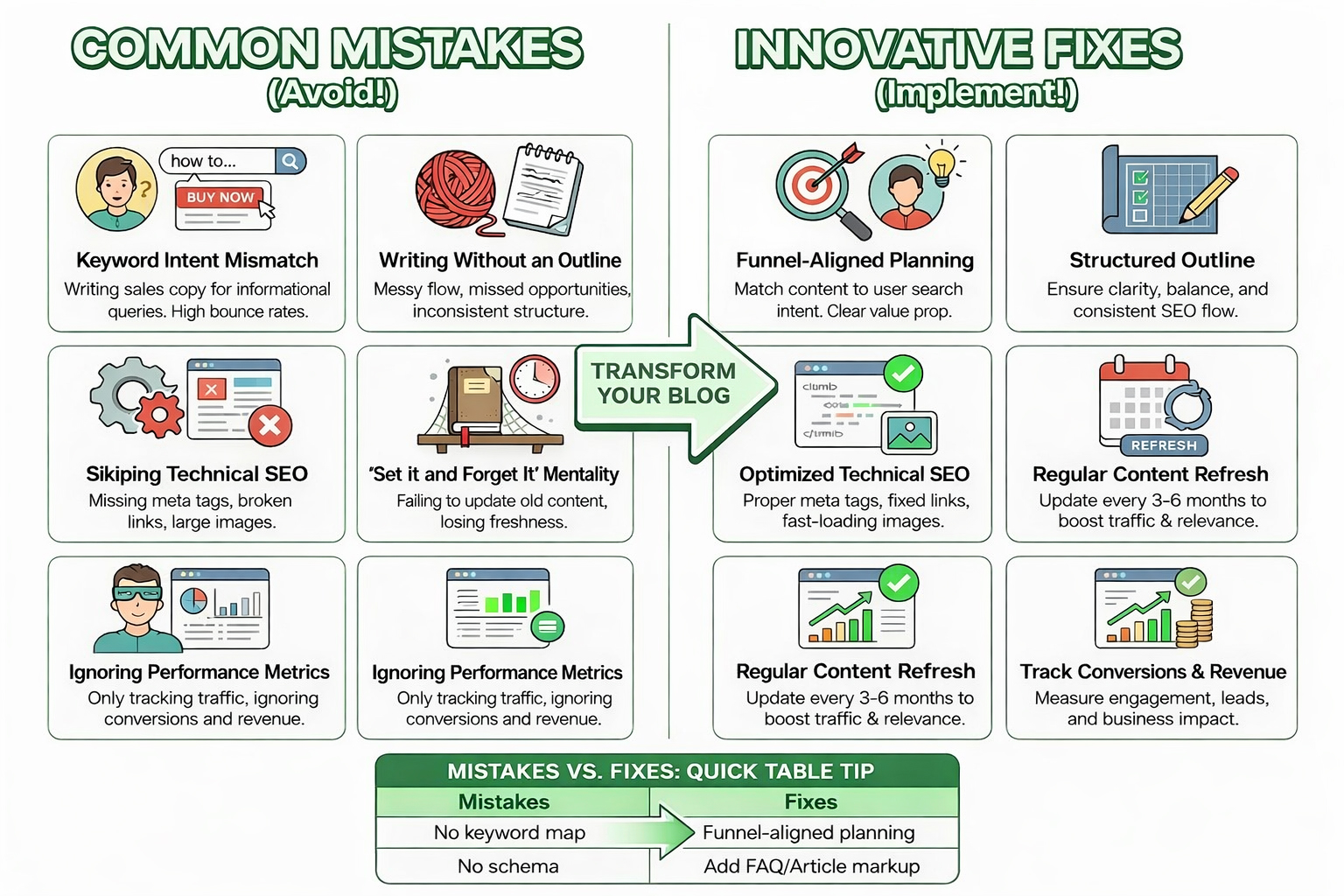
1. When traffic arrives but leaves immediately
This is often a symptom of intent mismatch rather than weak writing. If readers bounce quickly, the content likely answers a different question than the one they searched for. Fixing this usually starts with revisiting intent mapping and adjusting the introduction, headings, and flow so the page aligns with expectations. A strong blog writing framework helps prevent this issue by anchoring every section to a clear purpose from the start.
2. When the article feels long but lacks direction
This almost always points to missing structure. Posts written without a defined outline tend to repeat ideas, drift off-topic, or bury key insights. Refining the SEO content structure by tightening H2 focus, improving hierarchy, and ensuring each section answers a specific user question can dramatically improve clarity and engagement without rewriting everything.
3. When rankings stall despite solid content
In many cases, technical gaps are holding the page back. Missing meta tags, weak heading hierarchy, broken internal links, or heavy images quietly limit visibility. These issues rarely cause dramatic drops, but they cap growth. A disciplined framework ensures these checks are handled consistently before publishing.
4. When older posts slowly lose traction
This is content decay, not failure. Search behavior evolves, competitors update, and information ages. Blogs reviewed and refreshed periodically regain momentum faster than new posts published without context. A reliable framework builds in review cycles instead of treating publishing as the final step.
5. When success is measured only by traffic
Pageviews alone rarely tell the full story. Engagement depth, assisted conversions, and user flow matter more. Blogs built with a clear framework reveal their value only when performance is evaluated beyond raw numbers.
Wrapping It Up
A successful blog post doesn’t start with a blank page; it begins with a plan. This blog post writing framework is built to help you create content that ranks, educates, converts, and compounds in value over time. It’s not about writing faster; it’s about writing smarter. Each step you follow brings clarity, reduces friction, and ensures your blog is built to perform in a competitive search environment.
You create more than just content when you regularly conduct keyword research, map intent, adhere to structured outlines, optimize for search engines, and monitor post-publishing metrics. One that grows, changes, and gets better with each post. This translates into higher ROI, greater visibility, and greater authority for both agencies and small business owners.
Stop improvising if you’re tired of speculating about whether your blog will succeed. Adopt this structure. Track performance and make it better with experience. Update frequently. You only need a few excellent posts that remain effective, not dozens of average ones. A good blog post concludes with a call to action. A great one begins with a framework.
Ready to Turn Blog Chaos into a Conversion Machine?
You’ve seen the framework. You’ve read the strategy. Now it’s time to put it into action; with the experts by your side. Whether you’re managing a brand, scaling an agency, or writing solo; your next blog doesn’t need more words, it needs more structure.
Don’t hit “publish” and hope. Build blogs that rank, convert, and compound; every time; with eSign Web Services. We specialize in turning underperforming blogs into SEO assets that drive measurable results. From content strategy to technical SEO, our team helps you unlock the full potential of every post.
Call us now to get started; and let’s build a blog strategy that actually works. Talk to an Expert at eSign Web Services
Frequently Asked Questions
Question: How long does it typically take to write a blog post using this framework?
Answer: Writing a blog post with this framework is not quick work, and that is intentional. For a 1,500–2,000 word article, most writers spend six to eight hours in total. Time is split between research, outlining, writing, and refining the tone. The writing stage takes the longest because the focus is on clarity, structure, and natural flow rather than speed. Complex subjects or SEO-heavy posts may take longer, especially during the first few attempts.
Question: What is the most important step in this framework that beginners often skip?
Answer: Most beginners rush into writing without properly understanding what readers are actually searching for. They skip keyword intent and audience context, assuming good writing alone will perform well. This usually leads to articles that sound fine but attract little traffic. Knowing why someone searches a topic shapes structure, depth, and wording. Without that insight, even well-written posts often miss the mark and fail to gain traction in search results.
Question: Can this framework work for different types of blogs?
Answer: Yes, the framework adapts well across different blog types because it is built on structure, clarity, and intent. A personal blog may lean more into storytelling and reflection, while a business blog focuses on authority and trust. Niche blogs often emphasize depth and specificity. The foundation remains the same, but the tone, examples, and emphasis shift depending on the audience. That flexibility is what keeps the framework practical rather than rigid.
Question: How do I balance SEO requirements with a natural writing tone?
Answer: The balance comes from separating writing and optimization into two mental steps. First, write as if no search engine exists, focusing only on clarity and flow. After that, review the content to place keywords where they naturally fit. Forced placement usually harms readability and trust. When the structure is solid and the ideas are clear, keywords tend to blend in naturally without damaging the human feel of the article.
Question: Should I follow the entire framework for every blog post?
Answer: The full framework is best used for cornerstone articles, long-form content, or posts meant to rank over time. For smaller updates, announcements, or opinion pieces, you can simplify parts of the process. As you gain experience, research and outlining also become faster. The key is knowing when depth is required and when speed is acceptable, without abandoning the principles that keep content structured and readable.
Question: How do I know when a blog post is ready to publish?
Answer: A post is ready when it feels complete rather than polished to exhaustion. Ask whether it answers the main question clearly, flows logically, and reads naturally aloud. Check that headings guide the reader and that nothing feels rushed or over-explained. SEO elements should support the content, not dominate it. If the article feels calm, coherent, and purposeful, it is usually ready to go live.
Question: What should I do if my published posts are not getting traffic?
Answer: Low traffic does not always mean poor writing. Often the issue lies in search intent mismatch or weak keyword targeting. Review whether the article truly answers what people expect from that query. Check headlines, meta descriptions, and internal linking. Sometimes content simply needs time, but in other cases, small adjustments in focus or structure can unlock visibility that was already close to happening.
Question: Can a blog rank without keyword research?
Answer: Ranking without keyword research can happen, but it is inconsistent and hard to repeat. Keyword research reveals actual demand and phrasing used by real users. Without it, writing becomes guesswork. Some posts may succeed by chance, but most will not sustain traffic. Research reduces risk by aligning content with real searches, making results more predictable and easier to scale across multiple articles.
Question: Should blogs be written for users or search engines?
Answer: Users always come first. Search engines are designed to reward content that satisfies readers, not content that follows mechanical rules. When writing focuses on clarity, relevance, and usefulness, SEO signals usually fall into place naturally. Writing purely for algorithms often leads to stiff, over-optimized content that fails to engage. Strong user experience is the most reliable long-term SEO strategy available.
Question: How important is publishing consistency for SEO?
Answer: Consistency matters because it builds trust over time. Regular publishing signals reliability to both readers and search engines. It also helps establish topical authority within a subject area. Inconsistent posting slows momentum and makes growth unpredictable. Consistency does not mean posting frequently at any cost. It means maintaining a steady rhythm that you can realistically sustain while preserving content quality.
Author Details

Ashwani Kumar Sharma
Ashwani has been actively involved in SEO services since 2005. His expertise and distinctive work approaches have made him one of the most experienced and trusted SEO experts in the industry. He is a certified SEO and Google Ads professional. He also has strong business development skills in advanced SEO, PPC, and digital marketing strategies.


