



Google’s Search Generative Experience (SGE): How It Changes SEO Forever

Key takeaways
- SGE shifts SEO focus from clicks toward visibility, authority, and trust inside search-generated answers.
- Informational traffic declines, but higher-intent commercial and decision-stage searches continue driving meaningful conversions.
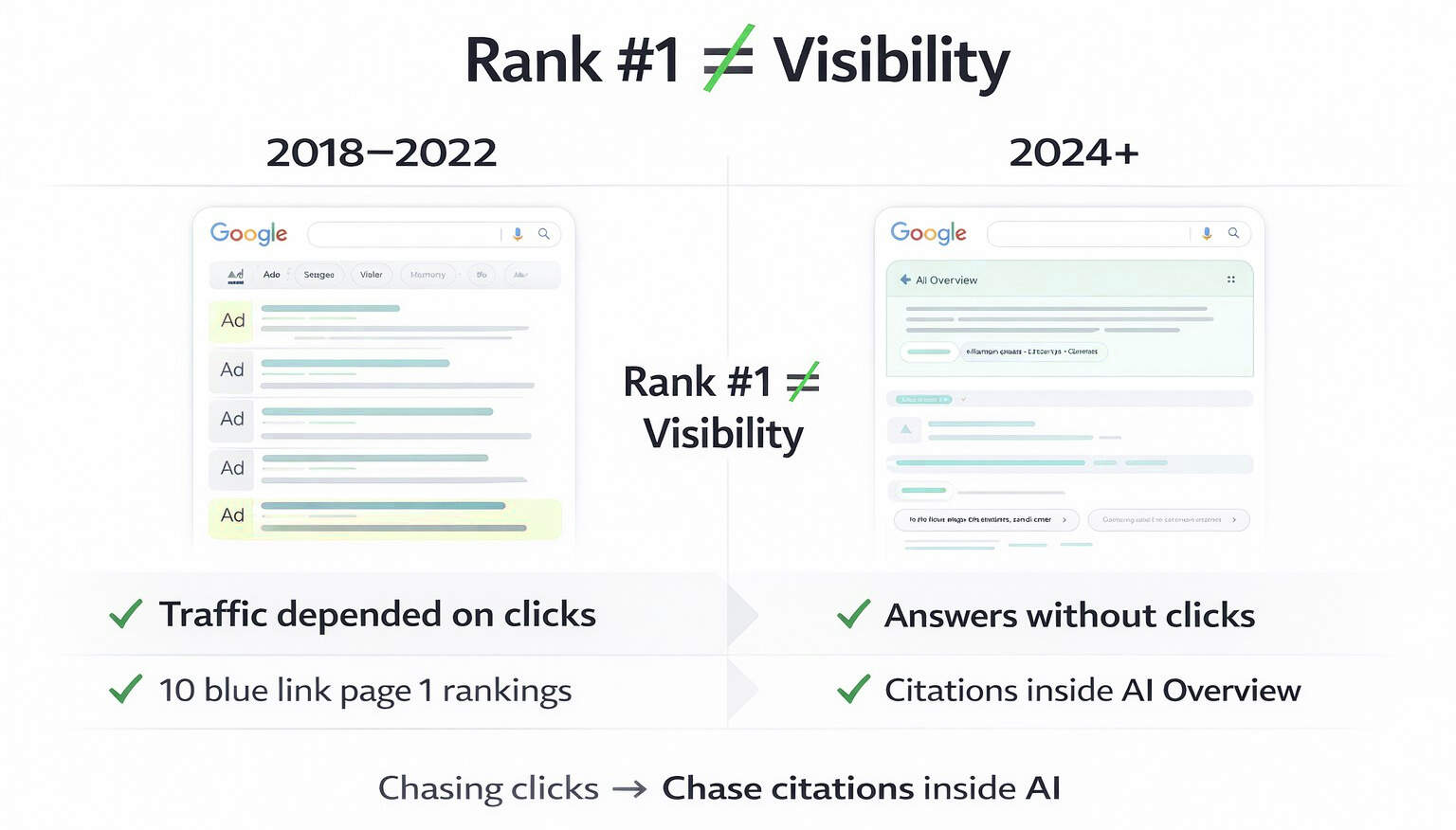
- Ranking first no longer guarantees attention when AI summaries answer queries before users scroll.
- Content depth, originality, and real-world experience matter more than keyword placement or publishing frequency.
- Brand mentions within SGE build passive trust and increase branded searches over time.
- SEO success now includes impressions, influence, and assisted conversions, not only sessions and click-through rates.
- Integrated SEO, content, PR, and UX strategies outperform isolated optimization tactics in an AI-driven search environment.
Search used to be predictable. You optimized pages, gained rankings, drove traffic, and measured progress with traffic graphs that moved up and to the right. That model worked wonders for SEO for years. But that is not the reality businesses are facing today. Google is reimagining not only what types of news its users can find, but also how publishers present news. Google’s Search Generative Experience (SGE) is the biggest change in search behaviour since mobile-first indexing.
Instead of functioning solely as a gateway to websites, Google becomes the answer to millions of questions right within its search results, thanks to AI-powered search results that generate summaries. This feels quicker and easier for users. For businesses, it introduces uncertainty. Clicks decline. Attribution gets blurry. The same SEO playbooks stop working. Many small companies and startups are forced to wonder, a fact that users no longer click at all – is SEO still important?
The short answer is yes; but not as we used to know it. Google’s Search Generative Experience (SGE) isn’t getting rid of SEO; it’s changing the definition of what it means to be seen. Rankings alone are no longer enough to command attention. Power, clarity, and trust are the new arbiters of which brands are referenced, remembered, or ignored. This article explains how SGE changes SEO, why conventional SEO strategies come up short, and what actual growth opportunities there are for businesses that understand or quickly evolve into the new way of doing business conceptually, rather than scrambling to catch up years late once consumer preferences and behaviors have settled.
What Google’s SGE Really Is?
Google’s Search Generative Experience (SGE) marks a shift from being a directory of links to an answer engine driven by massive language models. Rather than presenting 10 blue links and forcing users to piece together answers, SGE provides AI-powered search results by extracting context from a diverse set of authoritative sources, delivering a unified answer directly within search results. This is part of Google’s broader investment in Generative AI for search, focused on minimizing friction and enabling faster decision-making for users. It’s not like the system spits out the page that ranks No. 1; it considers topical depth, clarity, authority, and trust signals before determining which content influences AI-powered search results.
This change is intuitive for the user. No longer do people have to open five tabs just to comprehend a subject. Google’s aim, of course, is clarity and economy, even if that translates into zero-click searches. Here is where SGE and organic search start to diverge. Visibility is increasingly within the SERP, not only on websites. Brands are no longer competing to be just first or on the first page. They are now also vying for that zero position, where brands are being chosen by a Google algorithm and Google AI search experience as the answer to human questions.
That said, Google’s Search Generative Experience (SGE) is not a one-size-fits-all substitute for search. Transactional, navigational, and local searches still dominate on mobile and remain heavily dependent upon websites, reviews, and physical proximity. The most disruption is in informational searches, where Google is confident it can answer the query without sending traffic elsewhere. This nuance is important before assuming that the Google SGE SEO impact affects all SEO tactics equally.
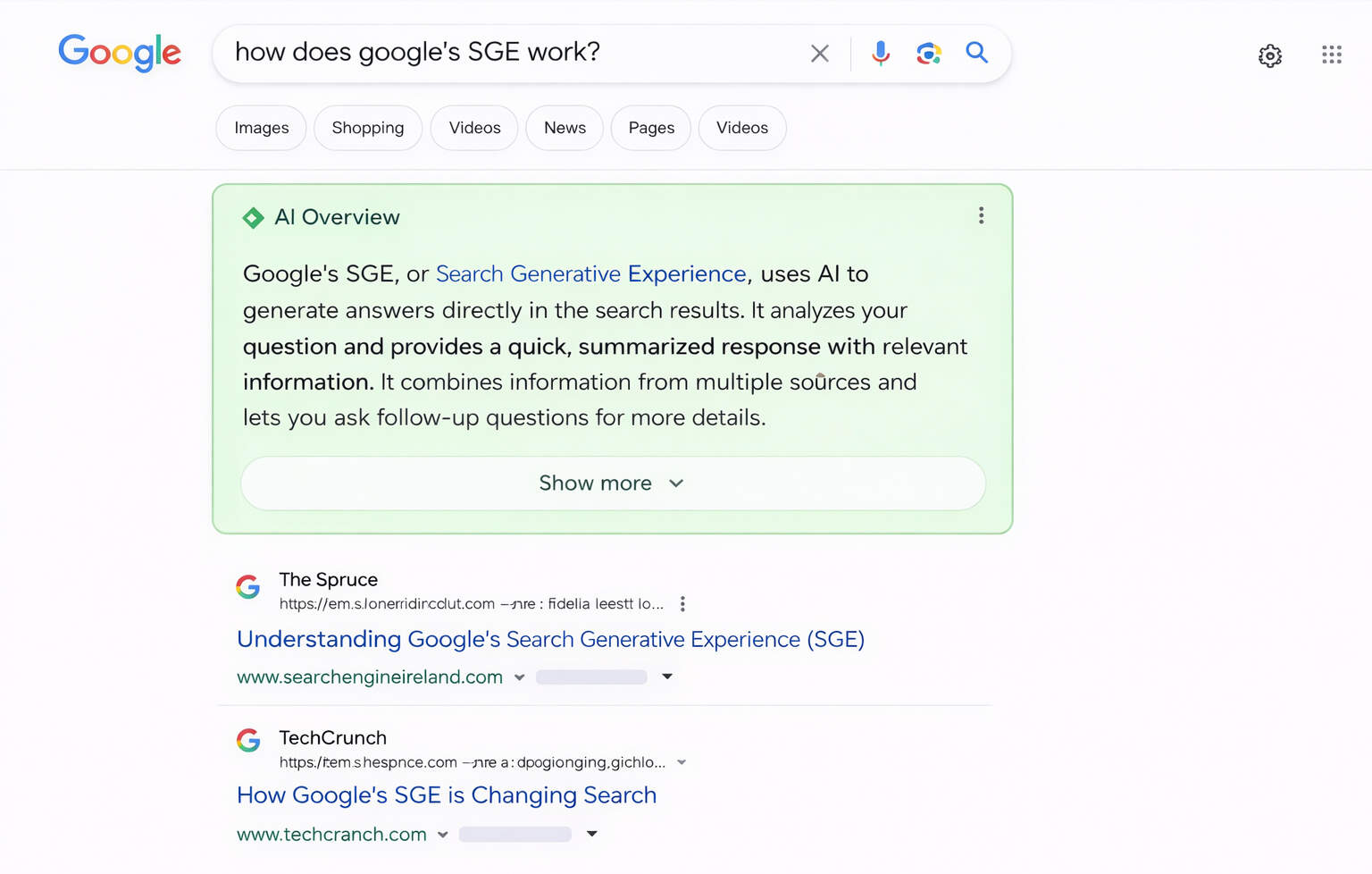
One of the most visible reflections of Google SGE SEO impact is that being top-ranked on SERPs no longer necessarily means traffic. Even page-one results can lose clicks if Google’s Search Generative Experience (SGE) answers the query above. That creates a new problem: visibility without engagement. SEO is no longer measured only in sessions or click-through rate. Instead, visibility inside AI-generated results, credibility, and influence start to matter more.
Meanwhile, outdated tactics crumble under SGE’s evaluation model. Keyword stuffing, thin rewrites, and formulaic blog posts provide little value to AI systems that prioritize meaning over repetition. Search Generative Experience SEO is based on understanding, not manipulation. Pages created purely to match keyword queries often fail because they don’t offer clarity, depth, or original analysis.
Here’s why that shift is so disruptive in practice:
- SERP real estate shrinks: AI summaries, modules, and visual elements can push organic results further down, weakening the advantage of ranking alone.
- Citation volatility increases: SGE can reference different sources depending on query wording, device context, and follow-up prompts, making visibility less predictable.
- Entity trust beats exact-match tactics: Consistent brand and author signals across the web increasingly matter alongside on-page relevance.
- “Quotable” clarity wins: Definitions, steps, comparisons, and clean structure are easier for AI to extract and reuse than padded writing.
- Updating beats publishing volume: Improving a few key pages with sharper intent and better structure can outperform frequent thin publishing.
- Topical gaps get exposed quickly: Shallow coverage is easier for SGE to bypass in favor of deeper topic ecosystems.
- UX and credibility are tied together: Distracting layouts, weak author transparency, or thin proof can undermine trust even when the content ranks.
Generic content suffers the most. If your article says the same thing hundreds of others already say, there’s no reason for SGE to cite it; AI search results Google rewards difference. Content gains relevance through original frameworks, first-hand experiences, expert opinions, and data-backed perspectives. In this context, SEO becomes less about gaming the system and more about earning influence.
How SGE Changes Content Strategy Forever
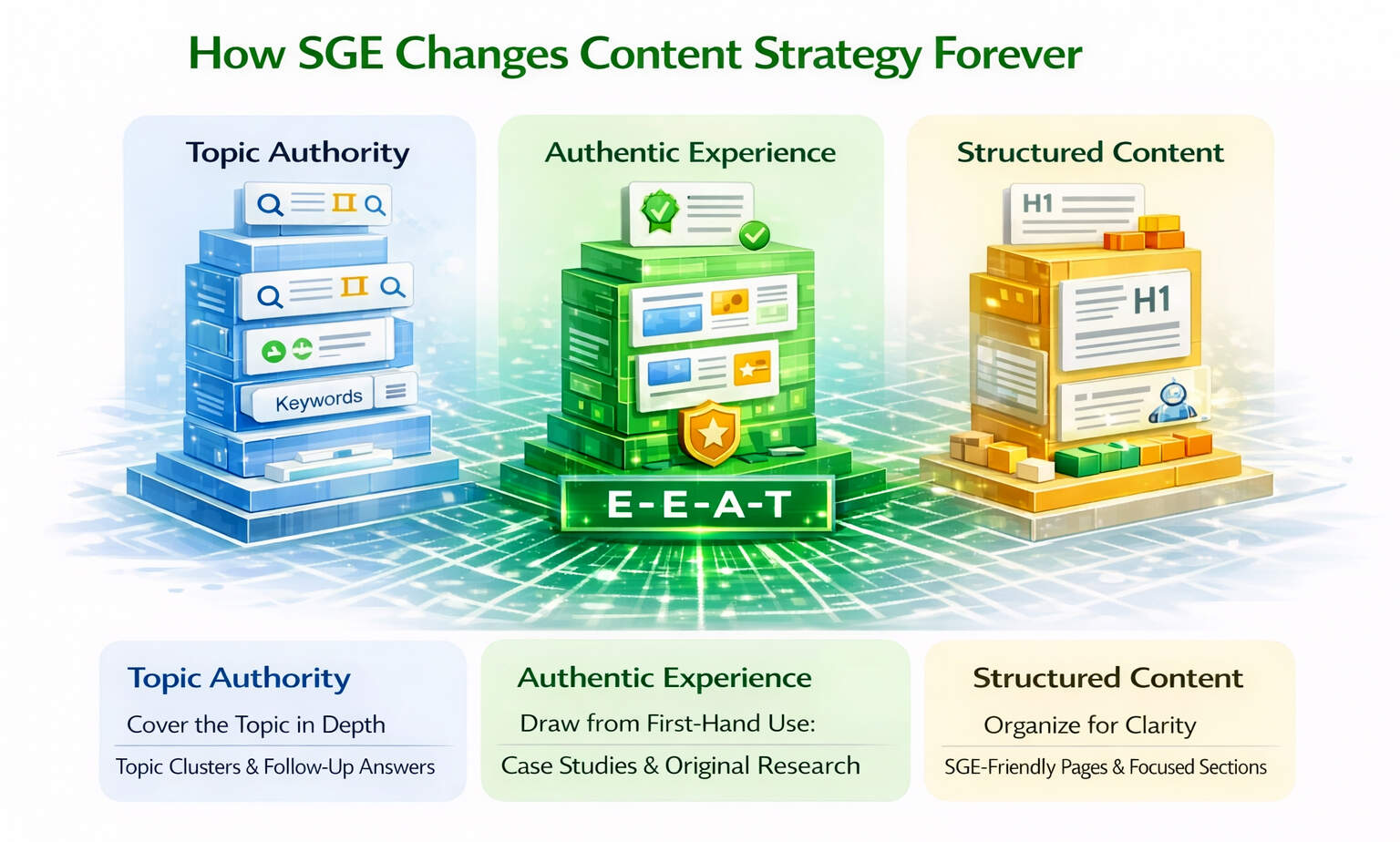
One of the most significant changes in how SGE approaches SEO is the shift from single pages to topic authority. One pithy blog post isn’t enough anymore. Google’s Search Generative Experience (SGE) looks for brands that consistently cover a topic in depth, addressing follow-up questions and related issues across an ecosystem of interconnected content. That indicates mastery of the subject, not just the page level.
Experience has become a defining factor, too. Google’s focus on E-E-A-T closely aligns with how generative AI in search systems assesses trust. Content based on real-life use, case studies, original research, or practitioner perspective stands out. While AI search results Google can summarize information, they struggle to imitate lived experience. That’s a clear advantage for businesses genuinely operating in the spaces they write about.
Structure matters more than you might think. Google AI search experience systems can readily understand and correctly reference content when it includes clear headings, logical flow, succinct explanations, and well-organized sections. It’s easier for AI to interpret pages that are easy for humans to read. In a world driven by Google’s Search Generative Experience (SGE), even clarity is treated as a ranking signal.
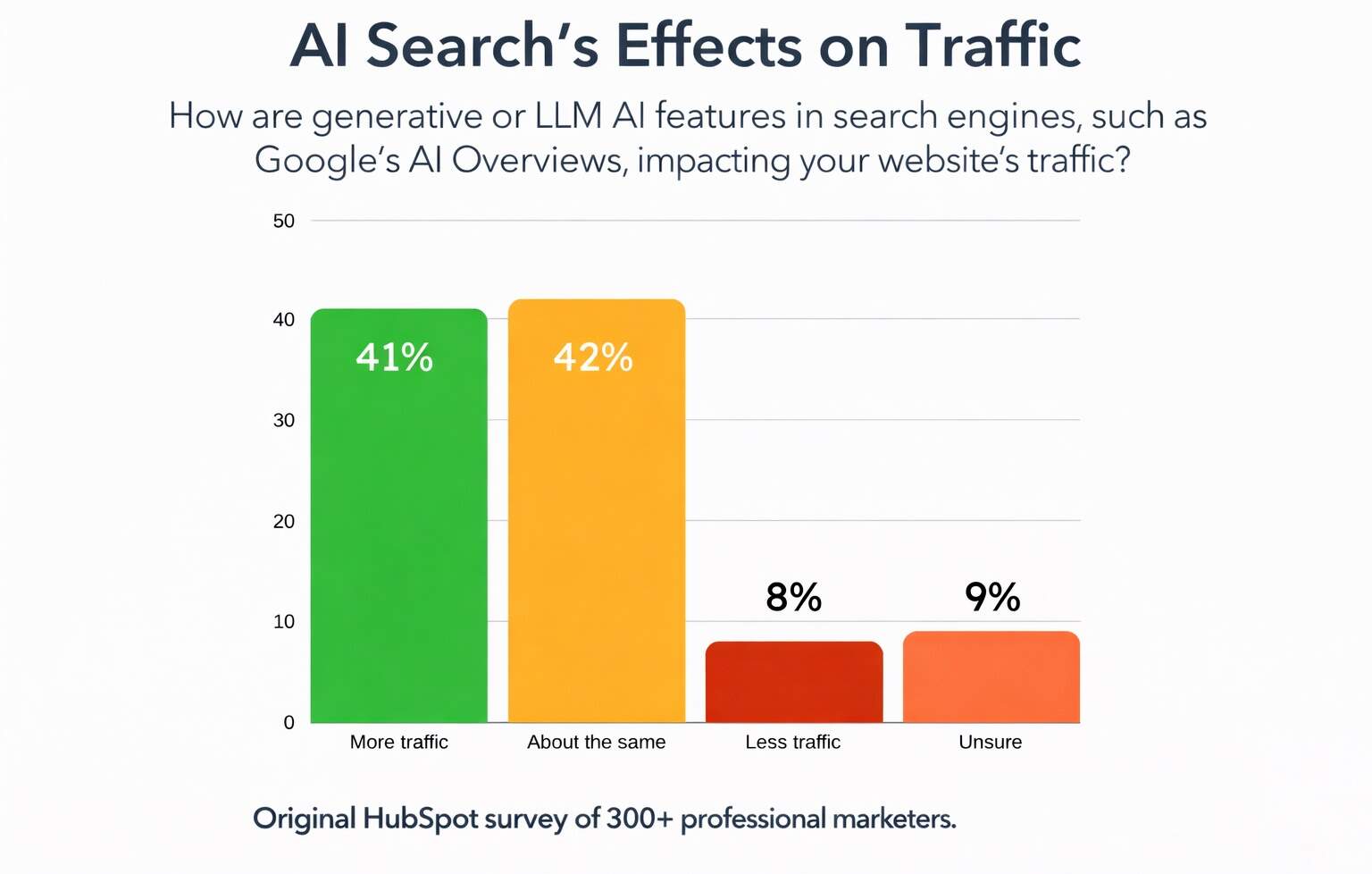
As AI search results from Google become more visible, the way people discover and choose websites starts to shift. The biggest change is psychological as much as technical: users feel like they already “got the answer,” so clicking becomes a decision, not a default habit. That can look like a traffic drop on paper, but the reality is more nuanced once you separate volume from value, especially under Google’s Search Generative Experience (SGE).
- Traffic: Informational clicks often decline because users get a usable summary directly in the SERP. However, the visits that still happen are usually more intentional. Google’s Search Generative Experience (SGE) tends to filter out casual browsing and surface users who are closer to comparing options, validating trust, or taking action. This is where many teams notice that AI search results Google delivers fewer sessions, but a higher share of decision-stage visitors.
- CTR: Click-through rate becomes less reliable as a success metric because the layout changes the meaning of “visibility.” A page can be performing well, yet receive fewer clicks simply because the user’s first interaction is with an AI summary, not a list of links. In many cases, repeated exposure inside AI-powered search results builds familiarity without immediate visits, which can later increase branded searches and strengthen conversion confidence when users finally click.
- Measurement: Analytics now require context and better attribution thinking. A drop in sessions does not automatically mean performance is worse. Conversion rate, lead quality, assisted conversions, and downstream revenue can improve even when volume softens. For modern tracking, teams also need to evaluate visibility signals that show how often content is appearing within SGE and organic search performance, not only how many clicks it receives.
To stay accurate in this environment, teams need to stop treating traffic as the only scoreboard. The more useful question becomes: are you gaining visibility where decisions are made, and are the users who arrive more likely to convert? When reporting reflects intent, influence, and outcomes together, performance becomes clearer even in a world where fewer clicks can still produce stronger growth.
How SEO Strategy Must Evolve for SGE
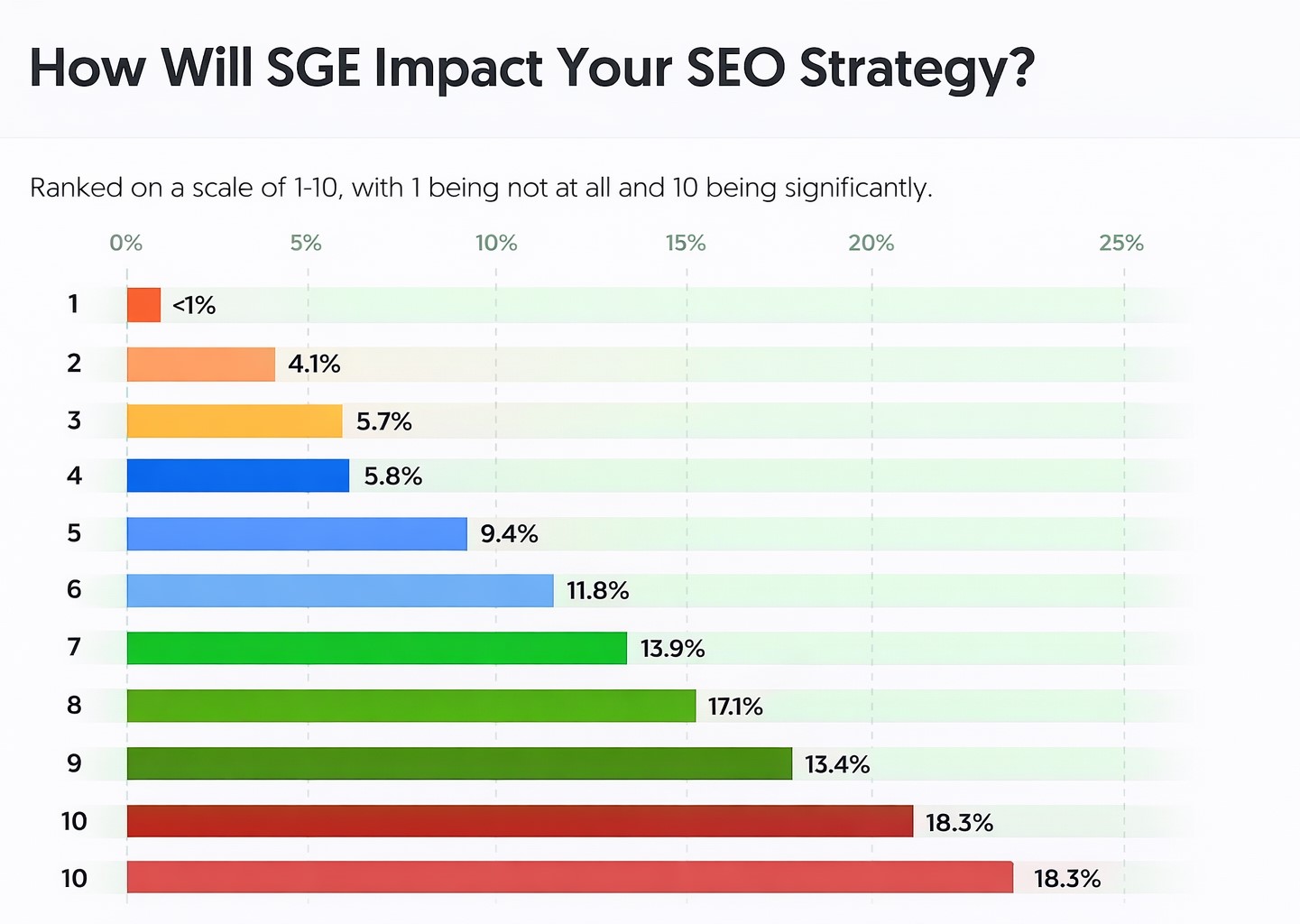
Winning in Google’s Search Generative Experience (SGE) begins with wisely and adequately responding to genuine questions. Content should prioritize solving problems and guiding users through clear next steps, rather than padding pages just to hit a word count. Pages that directly tackle “why,” “how,” and “what happens next” naturally align with generative AI in search summaries.
Trust signals must go beyond blog posts. Experience, expertise, authority, and trust need to be visible across author bios, case studies, citations, reviews, and brand mentions. The Google AI search experience evaluates credibility across the entire site—not just one page at a time. Weak signals in one area can undermine otherwise strong content in other areas.
Ironically, the best way to optimize for AI search results on Google is to stop writing for algorithms. Human-first content that is useful, honest, and easy to read consistently outperforms. AI systems reward clarity, relevance, and authenticity. In today’s environment, SEO strategy is more about strong, meaningful communication than about technical tricks.
Where Real SEO Opportunities Now Exist
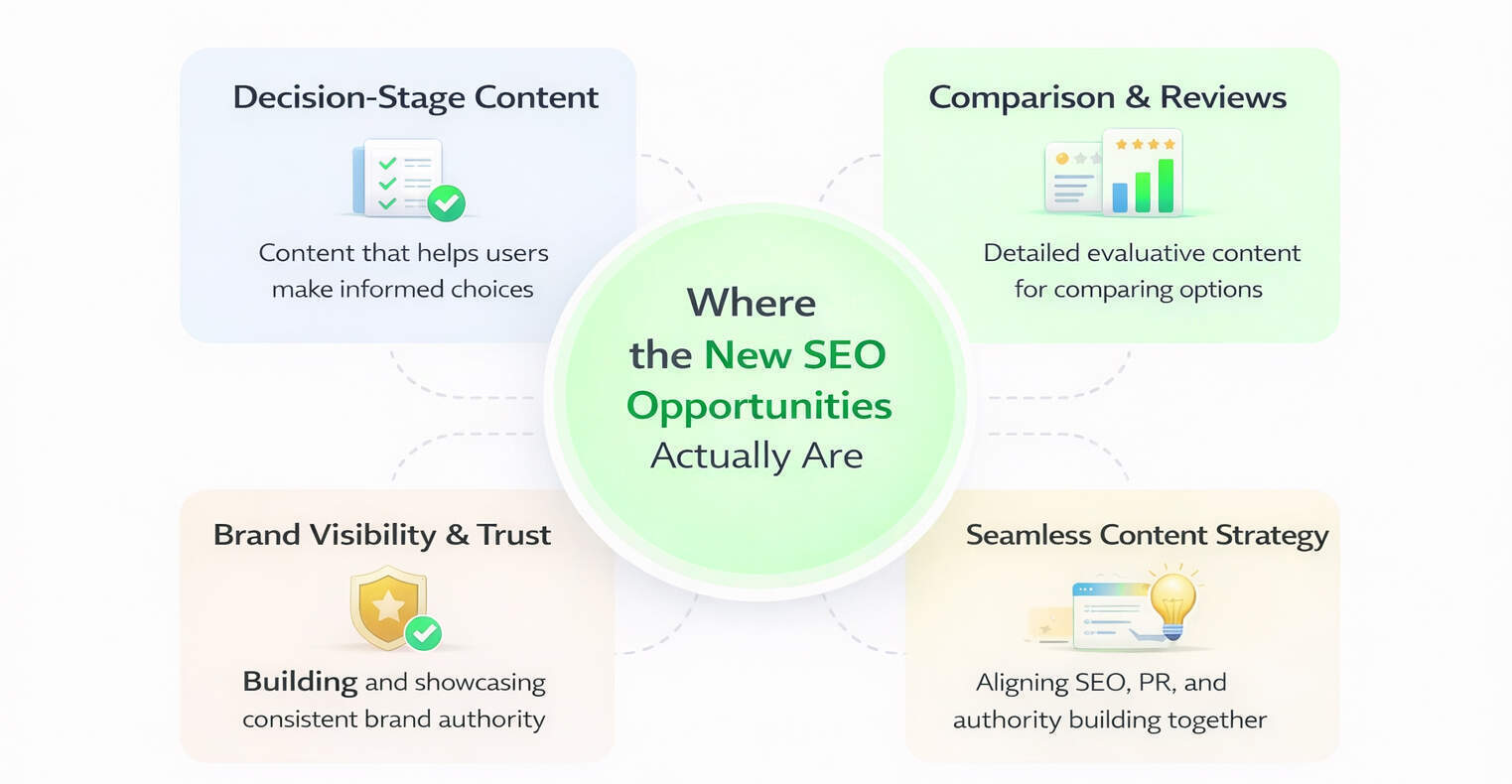
While SGE reshapes how informational queries are handled, it also redirects value toward areas where user intent is stronger and decisions are closer. Commercial, comparison, and decision-stage content continue to drive meaningful traffic because users still need depth before choosing a product, service, or provider. When people compare pricing, evaluate features, or assess credibility, they want detail, nuance, and reassurance; things AI summaries cannot fully replace. As a result, clicks in these moments tend to be fewer but far more valuable. Conversion rates often rise because visitors arrive with clearer expectations and a defined goal, making this content especially important for revenue-focused growth.
At the same time, brand visibility becomes a long-term asset rather than a byproduct of rankings. When users repeatedly see the same brand referenced in SGE answers, trust develops quietly but consistently. Even without immediate clicks, familiarity grows. Over time, this leads to increased branded searches, faster decision-making, and reduced friction in the buying process. SEO, therefore, plays a larger role in shaping perception and credibility, not just capturing demand at the moment it appears.
The brands that benefit most from this shift take an integrated approach. SEO no longer works in isolation. Content strategy, PR, UX, and authority-building must reinforce each other. SGE rewards consistency across touchpoints, from how a brand explains ideas to how it delivers real experiences. Businesses that align messaging, expertise, and usability across channels are better positioned for the future of SEO; a future defined less by technical tricks and more by trust, logical, and earned relevance.
The Ending Thoughts
Google’s shift toward generative answers doesn’t signal the end of SEO. It signals the end of lazy SEO. The era of publishing surface-level content and relying on rankings alone is fading fast. Google’s Search Generative Experience (SGE) rewards brands that provide real clarity, credible expertise, and meaningful insight. Visibility now happens before the click, not after it. That reality forces businesses to rethink how they define success.
What matters moving forward isn’t traffic volume by itself. Its influence. It’s whether your brand is trusted enough to be surfaced inside AI-generated answers. It’s whether users recognize your name when they are ready to decide. SGE filters out noise and amplifies authority. For businesses that invest in depth, experience, and intent-driven content, this shift creates leverage, not loss.
The companies that win in this new search landscape won’t be chasing algorithms. They’ll be building understanding. They’ll measure impact beyond clicks, align SEO with brand strategy, and treat content as an asset rather than output. If you want to understand how your website performs in an SGE-driven environment—and where you’re gaining or losing visibility—now is the right time to act.
Prepare Your SEO for the SGE Era
Search is changing faster than most businesses realize, and waiting for clarity often means falling behind. If you’re unsure how Google’s Search Generative Experience (SGE) is affecting your visibility, traffic quality, or brand presence, the smartest next step is to get an objective view of where you stand.
A focused SEO audit can reveal whether your content is being positioned as a trusted source, where you’re losing visibility to AI-generated answers, and which opportunities still exist for high-intent growth. This is not about chasing rankings. It’s about understanding influence, authority, and real performance in an SGE-driven search environment.
Get a free SEO audit with eSign Web Services to evaluate your current strategy, uncover gaps, and identify practical next steps aligned with how search actually works today.
Frequently Asked Questions (FAQs)
Question: Does SGE mean SEO is dead?
Answer: No, SEO isn’t dead, it’s transforming. Google’s Search Generative Experience (SGE) upends how search results are presented, but it doesn’t eliminate the need for strong content. The emphasis is shifting from chasing rankings to building legitimate authority, trust, and usefulness. AI-generated results depend on trustworthy sources, so brands that demonstrate expertise, experience, and accuracy still matter. SEO today rewards depth, originality, and brand strength—rather than old-school optimization tricks.
Question: Will SGE reduce website traffic?
Answer: For certain informational queries, yes—Google’s Search Generative Experience (SGE) can deliver direct answers in search results, bypassing clicks. But the remaining traffic tends to have higher intent. Users who do click are often further along in their journey and more likely to convert. Instead of focusing solely on volume, businesses should measure the Google SGE SEO impact by tracking traffic quality, user engagement, and conversions.
Question: Could companies decide that blogging is too risky due to SGE?
Answer: Not at all. Blogging still holds value, but the expectations are higher. Generic or shallow content likely won’t perform in the Search Generative Experience SEO environment. Blogs should deliver unique insights backed by experience, real-world data, or expert opinions. When content aligns with specific user intent—educational, commercial, or decision-making—it builds authority and increases the chances of being cited in AI-powered search results.
Question: How is it possible for content to be referenced in SGE results?
Answer: Google’s Search Generative Experience (SGE) tends to cite content that is clear, factual, and well-structured. Pages that provide direct answers, use logical headings, and rely on credible sources are easier for AI systems to understand and trust. Most importantly, creating genuinely useful content for people—not algorithms—is key to being featured in AI search results Google displays.
Question: Does SGE affect local SEO?
Answer: Local SEO is generally less impacted than informational SEO. Searches with local intent still depend on Google Maps, reviews, proximity, and business listings. When people look for nearby services, they want instant options or directions—areas where Google’s Search Generative Experience (SGE) has limited influence. For service businesses, maintaining accurate listings and strong local reviews remains a winning strategy in SGE and organic search.
Question: Do keywords still matter in the era of SGE-SEO?
Answer: Yes, but they’re no longer the primary focus. Keywords help signal relevance, but Google’s Search Generative Experience (SGE) emphasizes topic coverage, user intent, and semantic context. Today’s SEO means deeply covering a subject, naturally answering questions, and writing in conversational language. While keywords play a supporting role, their exact placement is less critical than the overall usefulness of your content.
Question: So how should SEO success be measured now?
Answer: Success should go beyond traffic numbers. Metrics like brand search volume, assisted conversions, lead quality, user engagement, and broader visibility are more accurate indicators. In a Generative AI in search world, fewer clicks don’t mean lower impact. If your SEO drives awareness, trust, and high-quality leads, it’s still highly valuable—despite lower sessions.
Question: Will SGE mean the end of SEO and the rise of paid advertising?
Answer: No. Paid ads and SEO are still tightly connected. Even strong ads need trusted landing pages, compelling messaging, and authority-building SEO. Without credibility, ad performance suffers. SEO builds long-term brand strength that ads alone can’t replace. In fact, how SGE changes SEO makes the bond between organic and paid strategies even stronger.
Question: Is SGE just for big brands?
Answer: Not at all. While large brands may benefit from existing authority, smaller brands with specialized expertise and focused content can still surface in AI-powered search results. Google’s Search Generative Experience (SGE) prioritizes content that’s useful and accurate, not just who published it. In many cases, niche expertise gives smaller businesses a competitive edge in intent-driven searches.
Question: What’s the biggest SEO mistake in the SGE era?
Answer: Publishing thin, keyword-stuffed content is a major misstep. In a generative search world, shallow pages don’t deliver value and are often skipped over. Google’s Search Generative Experience (SGE) favors content that’s clear, credible, and truly helpful. The winning formula now is to solve real problems, offer deep explanations, and guide users with meaningful insights. Brands stuck in outdated tactics risk losing their place in the Google AI search experience altogether.
Author Details

Ashwani Kumar Sharma
Ashwani has been actively involved in SEO services since 2005. His expertise and distinctive work approaches have made him one of the most experienced and trusted SEO experts in the industry. He is a certified SEO and Google Ads professional. He also has strong business development skills in advanced SEO, PPC, and digital marketing strategies.


