



Meta Advantage+ Campaigns Explained: Setup, Optimization & ROI Strategy

Key Takeaways
- Automation scales faster only when tracking, creative quality, budgets, and goals provide clean learning signals.
- Meta Advantage+ works best with enough conversions, data, and patience to let machine learning stabilize.
- Creative volume beats targeting because varied ads give Meta AI more opportunities to find buyers.
- Frequent budget or audience changes reset learning, causing volatility that looks like poor campaign performance.
- Advantage+ is a lever, not a fix for weak offers, broken tracking, or poor websites.
- Real ROI comes from validating Meta reports against GA4 data and actual business profit trends.
- Successful scaling focuses on daily profit, contribution margins, and long-term customer quality, not screenshots alone.
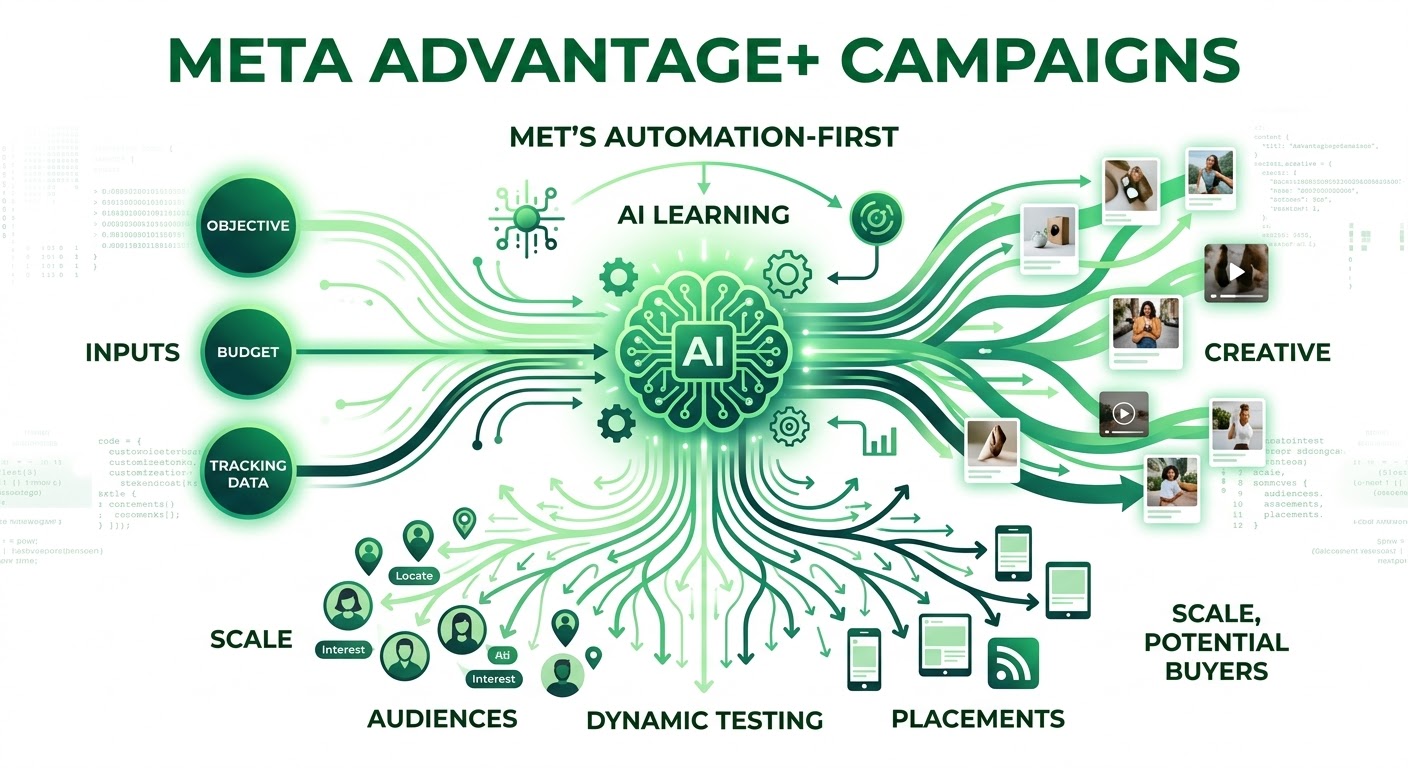
Meta Advantage+ campaigns are Meta’s automation-first advertising model that reduces manual controls and uses AI to identify high-intent buyers faster and at scale. Instead of manually controlling audiences, placements, and bids, advertisers focus on providing clean inputs; goals, creative, budget, and tracking; while Meta’s ad automation system manages delivery and optimization.
This efficiency can be powerful when used correctly, but costly when fundamentals are weak. When data quality, creative, and tracking are strong, Meta Advantage+ campaigns often scale faster and more consistently than traditional manual campaign structures. When tracking, creative quality, or offers are weak, automation accelerates ad spend without improving real business outcomes. This dynamic is common across Meta automated ad campaigns that rely heavily on machine learning.
What many advertisers misunderstand is that automation does not replace strategy; it assumes strategy is already in place. Meta’s algorithm can optimize distribution, but it cannot fix unclear messaging, low-converting landing pages, or inconsistent conversion signals. The system amplifies what you feed it. Strong inputs compound performance. Weak inputs compound waste.
This guide breaks Advantage+ down like an operator would: what it is (and isn’t), when it makes sense to use, how to launch it cleanly, how to optimize without sabotaging learning, and how to measure ROI without lying to yourself.
What Are Meta Advantage+ Campaigns?
Meta Advantage+ campaigns are Meta’s automation-first campaign structure that minimizes manual controls and allows Meta’s AI to identify potential buyers more efficiently. Instead of tightly controlling audiences and placements, advertisers provide clean inputs; objective, budget, creative, and tracking, and the algorithm dynamically tests combinations. This approach mirrors how modern Meta automated ad campaigns function: broader reach, faster learning, and heavier reliance on data quality.
What Meta Advantage+ campaigns are not is just as important to understand. Meta Advantage+ campaigns are not a quick fix for weak offers, poor creative quality, or broken tracking systems. It also doesn’t guarantee cheaper CPAs. Think of Meta Advantage+ campaigns as a performance lever, not a performance solution. When your inputs are strong, Meta’s machine learning compounds performance and improves delivery efficiency over time. If they’re weak, spend accelerates without profit, something Meta itself has warned advertisers about in automation-heavy environments.
What Advantage+ is good at is scale. By testing more audience, placement, and creative combinations than a human could manually manage, it unlocks reach that traditional setups often miss. This is especially true when paired with AI-powered Facebook ads logic, where the system prioritizes probability of conversion over rigid rules.
Just an actionable check: Before using Advantage+, confirm you have at least one stable conversion event and the ability to refresh creative monthly. Without those, automation becomes guesswork.
When Advantage+ Makes Sense & When Not
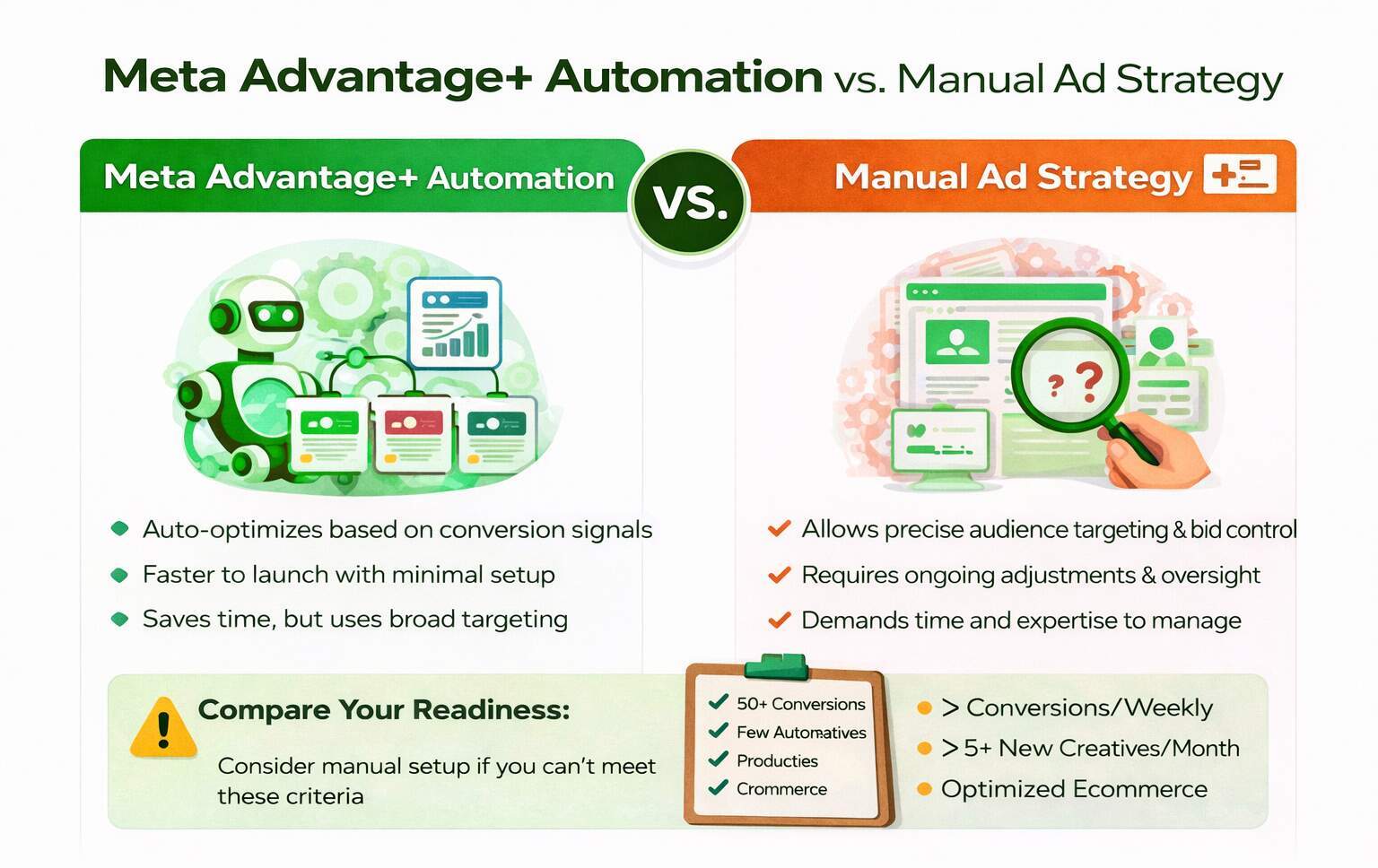
Meta Advantage+ campaigns perform best when there is enough conversion data for Meta’s algorithm to learn performance patterns quickly. Ecommerce brands with consistent purchase volume, competitive pricing, and smooth checkout flows tend to benefit most. Accounts running Meta Advantage+ ecommerce ads with at least 50 weekly conversions typically see more stable delivery because the system has enough signal density to optimize performance effectively.
On the flip side, Advantage+ struggles in environments where control matters more than scale. Highly regulated industries, ultra-niche B2B targeting, or early-stage funnels without conversion history can suffer. In those cases, manual setups provide clarity while data accumulates. This is especially true when a strong b2b SEO Strategy is still being developed, as paid automation performs best when supported by clearly defined audience intent and content alignment. Automation does not replace strategy; it assumes a clear strategy is already in place.
Another often overlooked success factor is creative production capacity. Meta Advantage+ campaigns require consistent creative volume to maintain performance. If you can’t consistently feed new angles, formats, and hooks, performance plateaus quickly. Meta’s own guidance notes that creative diversity is one of the strongest predictors of success in automated delivery systems.
Actionable checklist:
- Do you generate conversions weekly?
- Can you launch 5–10 creatives per month?
- Is your website conversion-optimized?
If your account lacks weekly conversions, consistent creative output, or a conversion-optimized website, delay using Advantage+. Build data, improve creatives, and strengthen your funnel before relying on automation.
Setup: A Clean Advantage+ Launch Blueprint
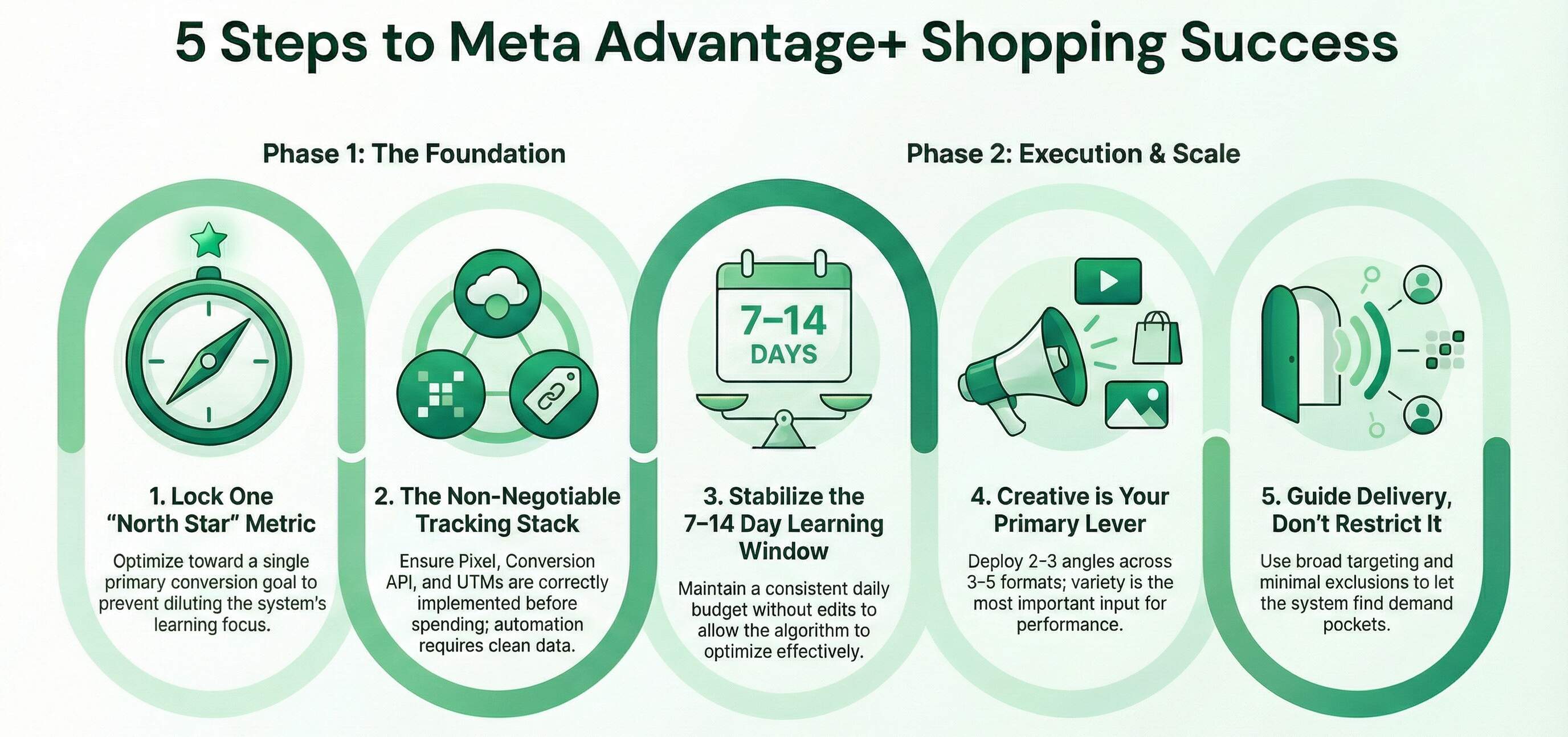
Step 1: Lock the goal + success metric
Start by selecting one primary conversion goal. Whether it’s purchases, leads, or sales-qualified actions, the Meta Advantage+ campaign setup performs best when optimized toward a single success signal.
Avoid evaluating Meta Advantage+ campaigns across too many KPIs at once, as this weakens optimization focus. Choose one “north star” metric and one or two supporting metrics. When advertisers dilute focus, the system struggles to learn. This principle applies directly to how to set up Meta Advantage+ campaigns correctly.
Step 2: Tracking foundation (non-negotiable)
Before scaling ad spend aggressively, confirm that your tracking is accurate and reliable. Meta Advantage+ campaigns depend heavily on clean conversion data to learn, optimize delivery, and improve advertising performance.
Your foundation should include:
- Pixel installed correctly:Meta Pixel properly installed across all pages and verified using Meta Events Manager.
- Core events firing properly: Ensure core events like purchase, lead, and add-to-cart trigger accurately every time.
- Conversion API implemented: Implement Conversion API to send server-side event data alongside browser pixel tracking.
- Consistent UTM structure: Use consistent UTM parameters to track campaign, source, medium, and performance.
Tracking checklist:
Meta ad automation depends on stable inputs to learn and optimize effectively. Set a daily budget you can run consistently for 7–14 days without edits. Frequent increases or cuts reset learning and create volatility across Meta Advantage+ campaigns, making performance harder to read. Your budget must also be high enough to generate meaningful weekly conversion signals. If conversions are too sparse, results swing unpredictably, and optimization becomes guesswork. During learning, consistency beats aggression every time.
Step 4: Creative structure (the real lever)
Creative quality and diversity are the most important inputs for Meta Advantage+ performance optimization. The system performs best when it can test variety, not when it’s forced to rely on one or two ads. Aim for 2–3 clear angles (price, benefit, proof, urgency), delivered across 3–5 formats, such as UGC, demos, testimonials, or before/after creatives. Build multiple hooks per angle. Follow one rule: one idea per ad. Feed variety, not hope.
Step 5: Audience signals without over-controlling
Even with automation, you can still guide delivery; just don’t suffocate it. Use existing customer exclusions where needed, lean into broad targeting with clean conversion signals, and layer in warm audiences only if your funnel supports it. Avoid stacking too many audience rules early. Over-controlling targeting limits exploration, slows machine learning, and undermines Meta Advantage+ best practices. The goal is direction, not restriction; let the system find demand pockets you wouldn’t manually target.
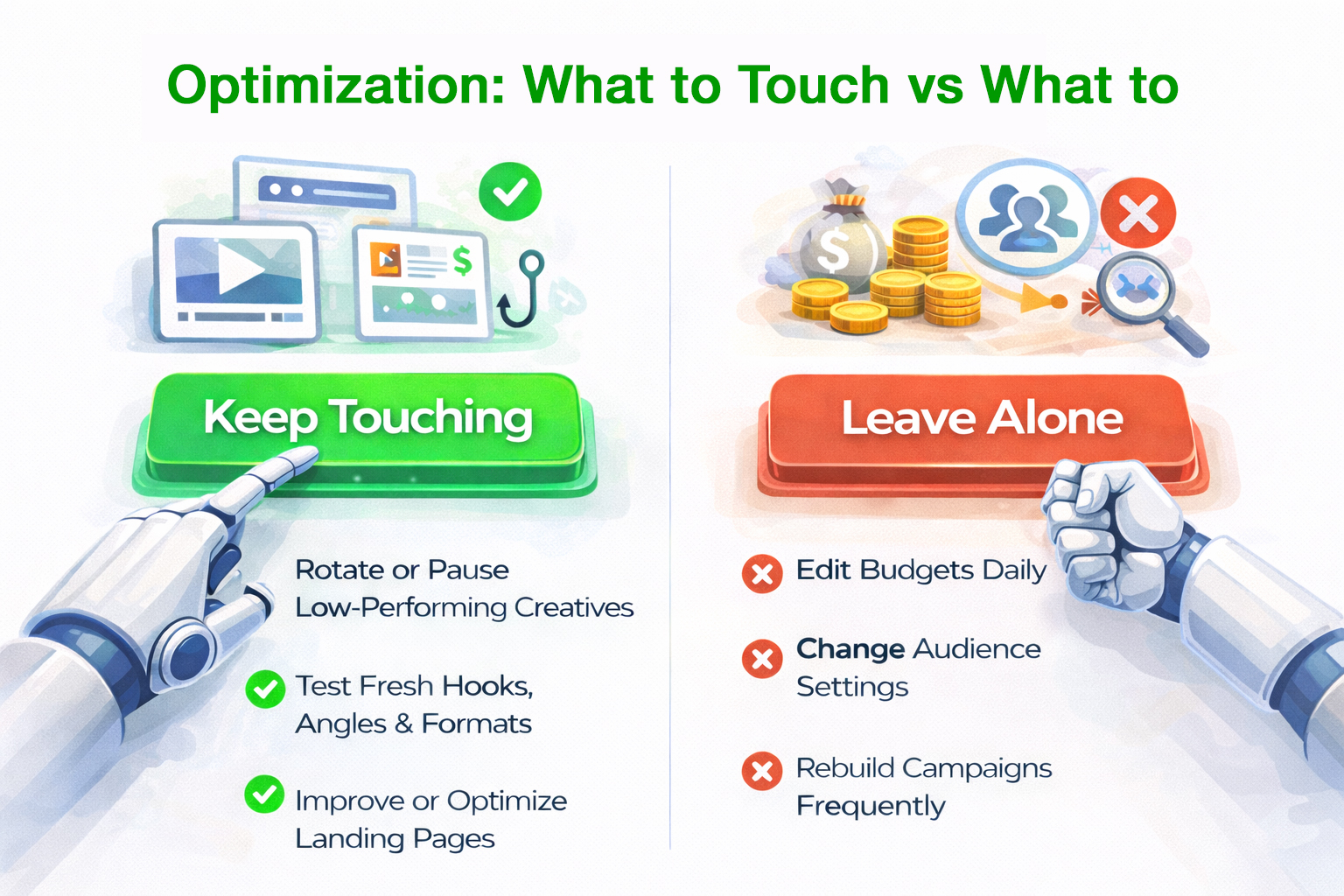
Optimization: What to Adjust vs Leave
Optimizing Meta Advantage+ campaigns is about discipline, not constant activity or frequent changes. The fastest way to damage Meta Advantage+ campaign performance is frequent and unnecessary changes. Advantage+ relies on stable inputs to learn patterns across audiences, placements, and creatives. When advertisers change too many variables at once, the system never exits volatility. This is why many Meta automated ad campaigns look “inconsistent” when the real issue is over-intervention.
The highest-impact lever you should touch is creative. Refreshing hooks, rotating angles, and introducing new formats give the algorithm fresh signals without resetting learning. Landing page improvements also compound results. Improving load speed, clarity, and trust often increases conversion rate more reliably than raising budgets, especially for Conversion-focused Meta ads.
What you should leave alone are daily budget edits, frequent audience changes, and campaign rebuilds. These actions reset learning and destabilize delivery. Following Meta Advantage+ best practices means optimizing in planned cycles rather than reacting emotionally to short-term swings. Meta Advantage+ campaigns reward patience when paired with strong creative, clean tracking, and stable budgets.
Weekly focus checklist:
- Rotate or pause underperforming creatives
- Add new hooks or angles
- Review the landing page conversion friction
- Scale budgets gradually (10–20% max)
- Avoid audience and structure changes
ROI Strategy: Measuring Advantage+ Ads
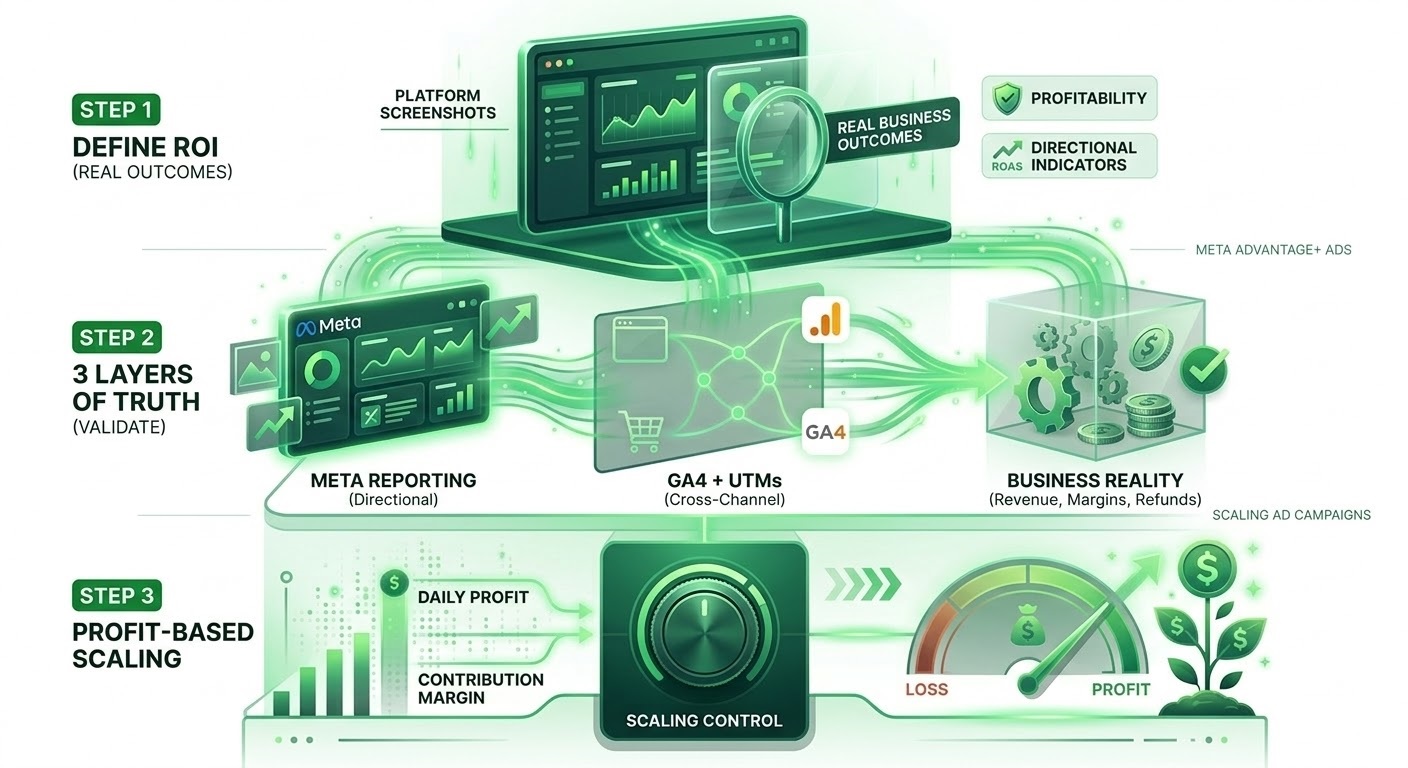
Step 1: Define ROI the right way
ROI measurement must be grounded in real business outcomes, not platform screenshots alone. Basic formulas like ROI and ROAS are useful, but platform-reported revenue can be inflated; especially in Facebook ecommerce advertising. Use these numbers as directional indicators, not the final truth. The goal is understanding profitability, not chasing surface-level efficiency inside Meta Advantage+ campaigns.
Step 2: Use three layers of truth
Accurate ROI measurement requires looking beyond one dashboard. Use three layers together.
Layer 1: Meta reporting shows directional performance inside Meta Advantage+ campaigns, but often over-attributes conversions. It’s useful for spotting creative trends and scaling signals, but should not be treated as the single source of truth.
Layer 2: GA4 + UTMs add cross-channel context and reality checks. With properly structured GA4 event tracking and consistent UTM tagging, marketers can validate attribution, uncover assisted conversions, and spot performance gaps that platform dashboards often miss.
Layer 3: Business reality—revenue, margins, refunds, and cash flow; is the final authority. If these layers disagree, trust the business numbers. Sustainable growth depends on profitability and liquidity, not just reported ROAS or conversion volume.
Step 3: Profit-based scaling
Scale Meta Advantage+ campaigns based on daily profit and contribution margin, not ROAS alone. Track contribution margin, allowable CPA, and blended ROAS across Meta Advantage+ ecommerce ads. Only increase spends when profit scales with it. This mindset is essential for responsibly Scaling Meta ad campaigns without creating revenue that looks good but doesn’t actually compound business growth.
Mistakes That Kill Advantage+ Performance
- No creative volume → When you run only a few ads, the system doesn’t have enough options to learn what actually works.
- Broken tracking → If Pixel or CAPI data is inaccurate, Meta optimizes toward the wrong actions instead of real sales.
- Budget panic edits → Constantly increasing or cutting budgets resets learning and causes inconsistent, confusing performance.
- Weak landing page → Ads may drive traffic, but slow load times, unclear messaging, or low trust stop people from converting.
- Judging too early → Turning ads off too quickly can kill potential winners before they’ve had time to perform properly.
- Optimizing for cheap clicks → Low-cost clicks often bring low-intent users who are unlikely to buy or convert.
- Ignoring customer quality → High refunds, low order value, or poor retention can make results look good while profits suffer.
Closing Thoughts
Automation can drive strong ROI when Meta Advantage+ campaigns are treated as a structured system, not a short-term gamble. Advantage+ isn’t designed for constant tinkering or emotional decision-making. It rewards advertisers who give it what it needs: clean and reliable tracking, steady budgets that allow learning to stabilize, and a consistent flow of high-quality creative. When those fundamentals are in place, automation compounds performance. When they’re not, it simply accelerates wasted spend.
Most brands do not fail because Meta Advantage+ campaigns “do not work.” They fail because teams panic-edit too early, chase short-term fluctuations, and reset learning before the system has a fair chance to find efficiency. Instead of asking, “How do we scale faster?” the better question is, “What’s limiting performance right now?” Fixing one constraint; tracking accuracy, creative fatigue, landing page friction, or budget instability, often unlocks better results than increasing spend ever could.
If you’re serious about scaling without guesswork, the smartest next move isn’t launching another campaign. It’s getting clarity. eSign Web Services offers a structured Meta ads audit that pinpoints exactly where Advantage+ is breaking down, and what to fix first; so you can scale with confidence, protect profitability, and turn automation into a predictable growth engine rather than an expensive experiment.
Turn Automation Into a Growth Engine
Stop guessing and start scaling with confidence. Get a profit-focused Advantage+ audit from eSign Web Services to uncover what’s limiting performance. Request a free quote to scale Meta ads with clarity, not costly trial-and-error.
Frequently Asked Questions
Question: What is a Meta Advantage+ campaign?
Answer: Meta Advantage+ campaigns are automation-first ad campaigns where Meta’s system takes control of targeting, placements, and delivery to optimize for conversions. Instead of manually defining audiences and rules, advertisers provide strong inputs—campaign objective, budget, creatives, and accurate tracking. Meta then tests combinations at scale to find what performs best. Advantage+ works best when conversion data is reliable and there’s enough creative variety to give the algorithm room to learn.
Question: Is Advantage+ the same as Advantage+ Shopping Campaigns (ASC)?
Answer: No. Advantage+ is a broader suite of automation tools across Meta Ads, including audience expansion, placements, and creative optimizations. Advantage+ Shopping Campaigns (ASC) are a specific campaign type designed primarily for ecommerce and purchase optimization. Many advertisers use “Advantage+” to refer only to ASC, but automation features can be applied beyond shopping campaigns, including lead generation and other objectives.
Question: When should I use Advantage+ instead of manual targeting?
Answer: Advantage+ works best when you have solid conversion tracking, consistent conversion volume, and a clear offer that already performs. It’s ideal for scaling efficiently without heavy manual controls. Manual targeting may still be better for early-stage accounts, niche audiences, regulated industries, or when testing new markets. If your data quality is weak or volume is low, start with manual setups before transitioning to Advantage+.
Question: How much budget do I need for Advantage+ to work?
Answer: There’s no fixed budget requirement, but Advantage+ needs enough spend to generate consistent conversion signals each week. If spend is too low, learning becomes unstable and performance fluctuates. Choose a daily budget you can maintain for at least 7–14 days without interruption. Once results stabilize, scale gradually. Sudden budget cuts or spikes can reset learning and reduce efficiency.
Question: How many creatives should I run in Advantage+?
Answer: More creatives significantly improve Advantage+ performance. The system thrives on variety across formats, hooks, messaging angles, and visuals. Aim to launch with at least 5–10 strong ads, then refresh regularly. Limited creative options restrict testing and cause fatigue faster. Advantage+ doesn’t “fix” weak ads—it identifies winners faster when given enough inputs to compare and optimize effectively.
Question: How long should I wait before optimizing or turning ads off?
Answer: Avoid judging results too early. Advantage+ needs time and data to stabilize performance. Turning ads off prematurely can kill potential winners before learning completes. A better approach is to evaluate after a set threshold—such as a specific number of conversions or 5–7 days of consistent spend. Look for trends, not day-to-day volatility, before making major changes.
Question: What changes should I avoid making too often?
Answer: Frequent budget changes, constant audience tweaks, and rebuilding campaigns repeatedly can reset learning and destabilize performance. Advantage+ performs best with steady inputs and structured optimization cycles. Instead of daily micro-edits, optimize weekly and focus on high-impact areas: creative quality, offer clarity, landing page conversion rate, and controlled scaling. Stability allows the system to make smarter delivery decisions over time.
Question: How do I track real ROI from Advantage+ campaigns?
Answer: Don’t rely solely on Meta’s reported metrics. Combine Meta data with UTMs, GA4, and CRM insights to validate performance. Track real business outcomes such as revenue, profit margin, refunds, and repeat purchases. Use profit-based KPIs like allowable CPA or contribution margin. If ROAS looks strong but profitability doesn’t improve, revisit tracking accuracy or refine your offer and funnel.
Question: Should I use Advantage+ for lead generation businesses?
Answer: Yes, but lead quality must be monitored closely. Advantage+ can generate volume quickly, which may reduce quality if qualification isn’t controlled. Improve results with stronger form questions, landing page filters, CRM tracking, and fast follow-up. Measure success by lead-to-sale rate and pipeline value—not just CPL. For longer sales cycles, evaluate ROI over extended attribution windows.
Question: What’s the biggest reason Advantage+ fails for brands?
Answer: Most failures stem from weak fundamentals. Broken tracking, low conversion volume, poor landing pages, unclear offers, or limited creative all undermine performance. Advantage+ amplifies what already exists—good or bad. Automation can’t fix a non-converting website or confusing value proposition; it just spends budget faster. Fix the foundation first, then use Advantage+ to scale what’s already working.
Author Details

Ashwani Kumar Sharma
Ashwani has been actively involved in SEO services since 2005. His expertise and distinctive work approaches have made him one of the most experienced and trusted SEO experts in the industry. He is a certified SEO and Google Ads professional. He also has strong business development skills in advanced SEO, PPC, and digital marketing strategies.


