



SEO in 2026: Key predictions from SEO experts

Key Takeaways
- SEO in 2026 prioritizes AI visibility, authority signals, and inclusion within generative search answers.
- Entity-based SEO and brand credibility outweigh traditional domain authority and backlink volume.
- Zero-click searches redefine success, shifting focus from traffic to trusted brand presence.
- GEO optimizes content for AI summarization, retrieval, and citation across inte nnnnnnnnlligent search interfaces.
- Content depth and topical authority outperform high-volume publishing and keyword-stuffing strategies.
- UX, engagement signals, and structured data shape how AI systems evaluate content trustworthiness.
- Multimodal, multi-platform discovery expands SEO beyond Google into video, voice, and communities.
In 2026, the traditional SEO playbook isn’t just outdated; it’s actively holding brands back. The way people discover information online is changing fast, and SEO in 2026 looks nothing like the keyword-and-rank strategies of the past. Earlier, search engine optimization was mainly about pushing web pages higher in Google results. Today, discovery is being reshaped by AI-powered search engines that deliver direct, summarized answers instead of long lists of links.
This shift signals the future of search engine optimization, where visibility depends on how clearly both humans and machines can understand your content, expertise, and brand identity. With Generative AI in search reading multiple sources to create instant responses, brands must structure their content to be easy to scan, easy to verify, and easy for machines to reuse with confidence. Clarity and credibility are no longer optional; they are the foundation of discoverability.
The growing influence of Google Search Generative Experience (SGE) shows how search results are becoming more conversational, contextual, and answer-driven. The Future of SEO is no longer about gaming algorithms or chasing rankings. It’s about building real authority, demonstrating genuine expertise, and earning trust at scale. In 2026, businesses that invest in clear content structure, accurate information, and strong brand signals will stay visible and relevant, while those clinging to outdated tactics risk fading into the background of an AI-first search world.
What SEO Is No Longer About in 2026
SEO in 2026 is no longer about chasing rankings, keywords, or raw traffic. As AI-powered search, zero-click results, and multi-platform discovery reshape user behavior, brands must rethink optimization. Visibility now depends on authority, entity recognition, and how often your expertise is selected, summarized, and trusted across intelligent search experiences.
Here’s what SEO is no longer about; and what replaces it.
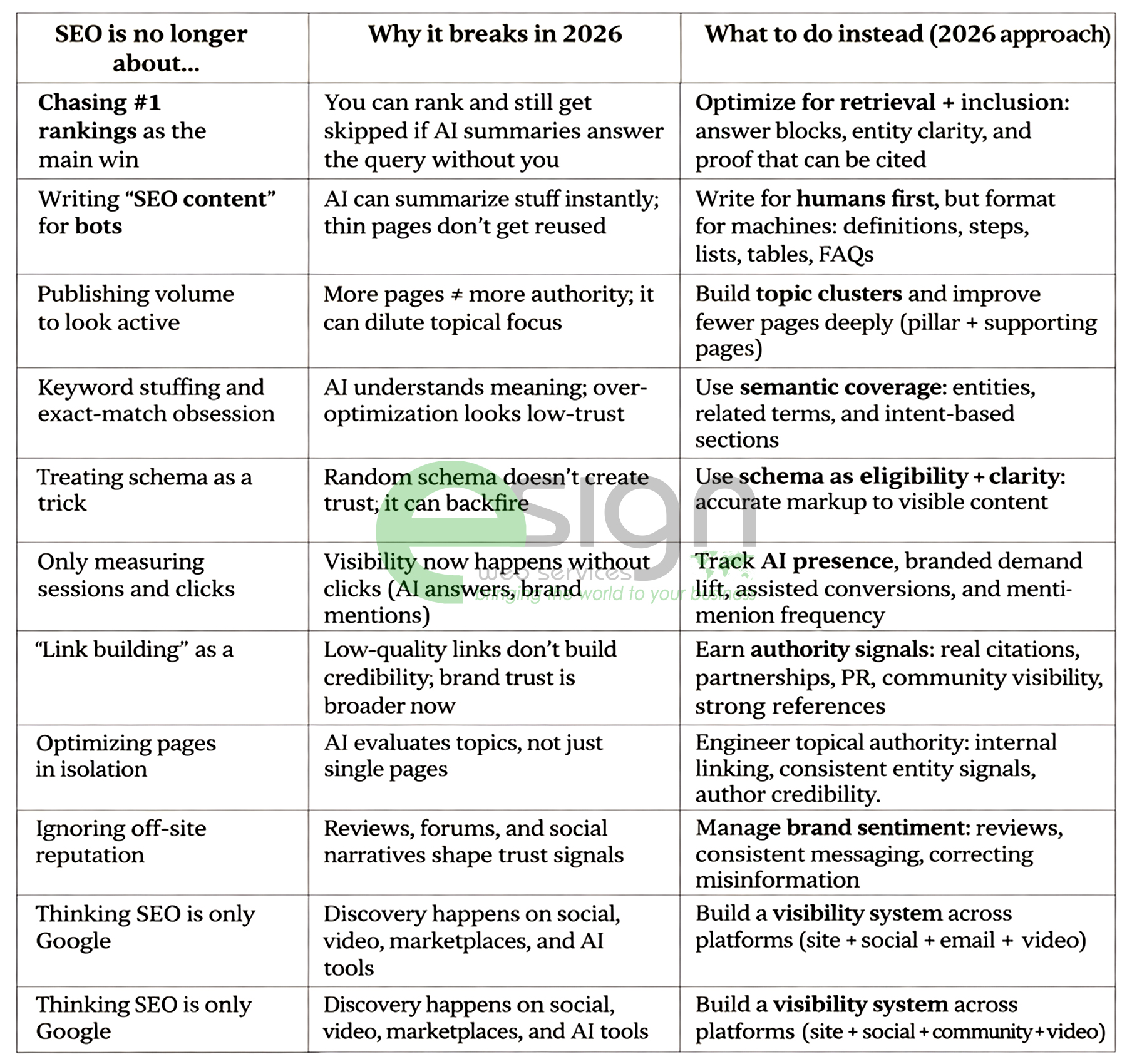
The future of SEO is not about manipulating rankings, but about engineering trust, authority, and discoverability across AI-driven ecosystems. Brands that shift from traffic-chasing to building reusable expertise and entity-level credibility will dominate visibility in 2026; across search, social, and every emerging discovery interface.
1: AI Will Be the Primary Search Interface
The way users discover information is shifting from traditional blue-link results to AI-generated summaries that provide instant, contextual answers. Instead of browsing multiple pages, users increasingly rely on AI-powered search engines to deliver clear, conversational responses at the point of need. This change reflects the broader future of search engine optimization, where search journeys are guided by intelligent systems rather than static result pages.
As conversational and contextual answers dominate discovery, the role of Search engine optimization in 2026 evolves from simply ranking web pages to actively influencing how information is selected, summarized, and presented by AI systems. Content visibility is no longer measured only by clicks, but by whether your brand is trusted enough to be included within AI-generated responses. This marks one of the most important SEO trends for 2026.
With the rise of Generative AI in search, content must be citation-worthy, accurate, and clearly structured so AI systems can confidently reference it in summaries. Traditional keyword-heavy optimization alone is no longer enough. The Future of SEO rewards brands that produce reliable, well-organized, and verifiable information that AI can reuse at scale.
In SEO in 2026, success belongs to businesses that design content for both human understanding and machine interpretation, ensuring consistent online visibility, stronger brand credibility, and long-term relevance in AI-first search environments.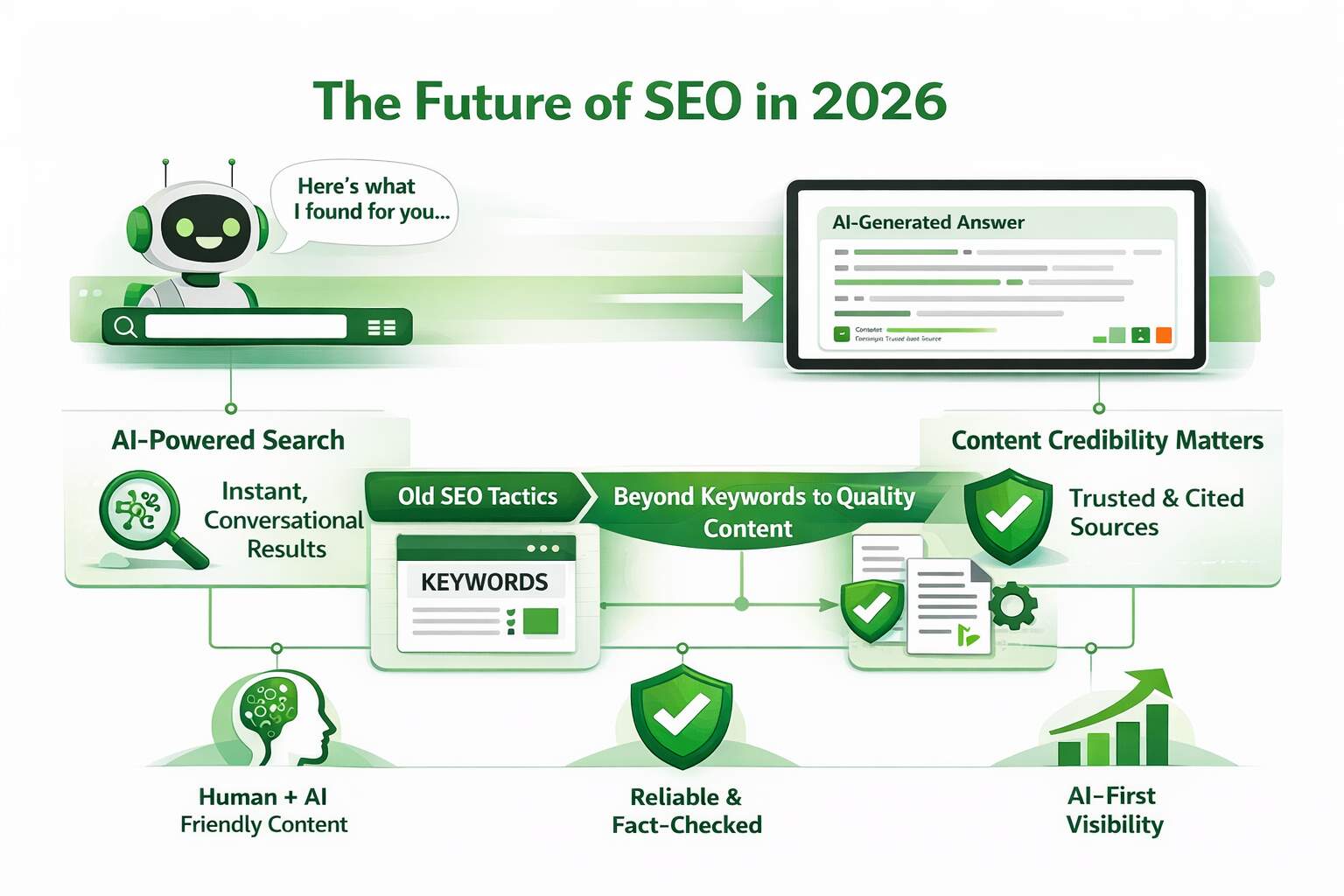
2: Entity Authority Over Domain Authority
In SEO in 2026, search systems focus less on how powerful a website domain looks and more on whether a brand, company, or expert is recognized as a trusted “entity.” This approach is known as Entity-based SEO, which means search engines try to understand real people, brands, and topics as connected entities in a knowledge network. This reflects the future of search engine optimization, where credibility is built through a consistent identity and expertise across the web, not just on a single website.
According to SEO expert predictions, brands that clearly define what they stand for and what topics they specialize in will gain more visibility than those that publish random content. In Search engine optimization in 2026, your brand must be mentioned regularly across websites, social platforms, and professional profiles so AI systems can confidently identify who you are and what you represent. The Future of SEO favors businesses that build trust through clear messaging, real expertise, and a strong digital presence. In SEO in 2026, authority comes from being recognized as a reliable source, not just from collecting links.
3: Zero-Click Search Will Become the Default
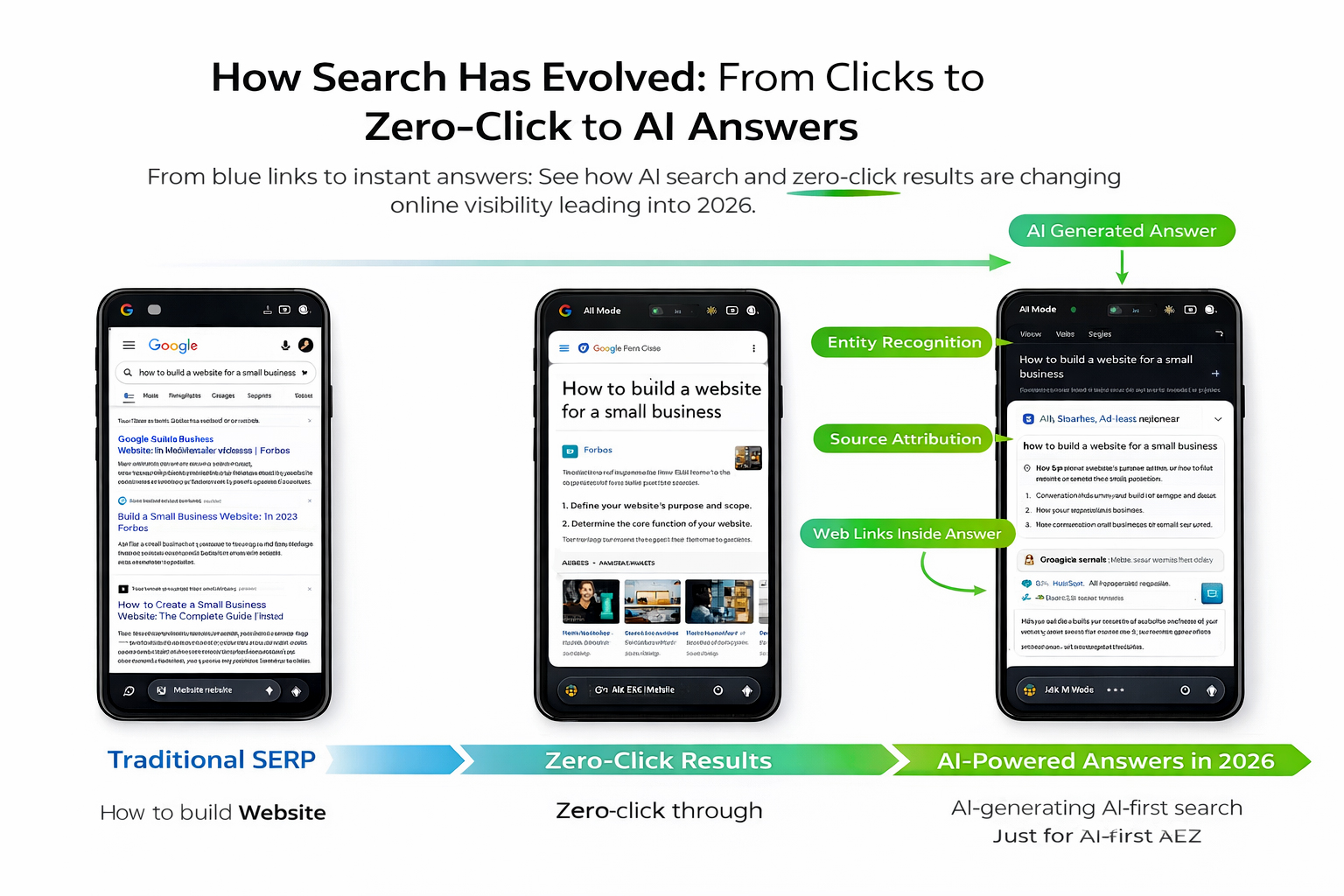
In SEO in 2026, a large number of searches end without the user visiting any website. These are called Zero-click searches, where answers appear directly on the search results page or inside AI chat-style interfaces. This reflects a major shift in the future of search engine optimization, where visibility and brand recognition are becoming more important than raw website traffic alone. As AI-powered search engines provide instant answers, users may still see your brand mentioned or quoted even if they do not click through to your site.
The Future of SEO, therefore, requires businesses to think beyond clicks and focus on being included in AI-generated summaries. From a Search engine optimization in 2026 perspective, success is measured by how often your expertise appears in these answer boxes and summaries. This trend aligns with broader SEO trends for 2026, where influence and trust replace simple traffic numbers as key performance indicators. In SEO in 2026, brands that focus only on traffic may miss the bigger picture of long-term authority and visibility within AI-driven search environments.
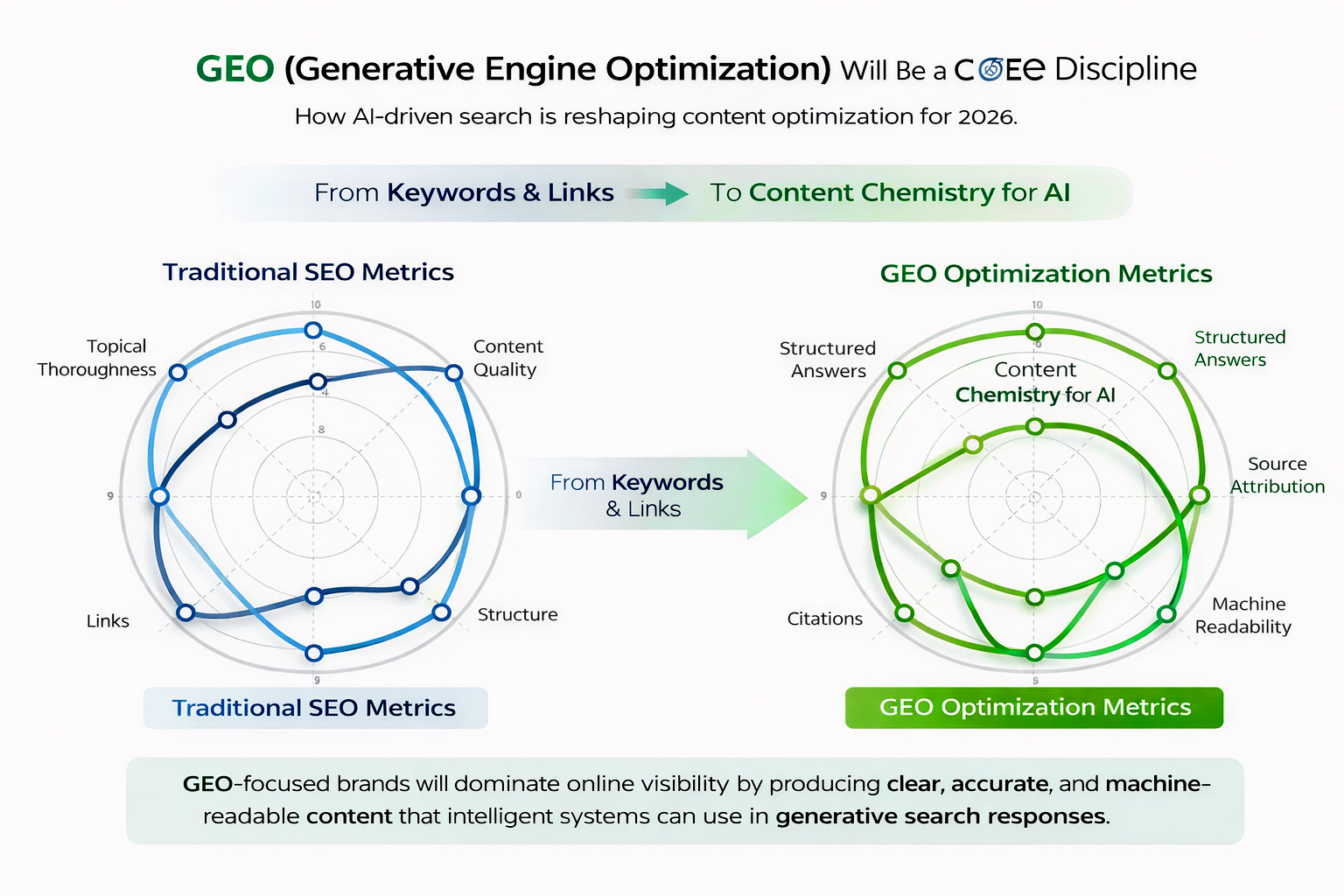
4: GEO Will Be a Core SEO Discipline
SEO in 2026 is evolving. Generative Engine Optimization (GEO) ensures content is clear, factual, and machine-readable, helping AI understand and summarize information for smarter, more visible search results.
- SEO in 2026 is no longer only about ranking web pages. It is also about helping AI-powered search engines understand, summarize, and reuse your content in AI-generated answers. This shift reflects the broader future of search engine optimization, where machines play a direct role in delivering information to users.
- Generative Engine Optimization (GEO) focuses on making content simple, factual, and clearly structured so that Generative AI in search can easily extract key points. Instead of long, confusing paragraphs, content should provide direct answers first, followed by short explanations and helpful details.
- According to SEO expert predictions, brands that adapt their content for AI summarization will gain stronger online visibility and authority. This trend is one of the most important SEO trends for 2026, as AI systems increasingly decide which sources are shown or referenced in responses.
- In Search engine optimization in 2026, GEO works alongside traditional SEO methods like keywords and on-page optimization, but it adds a new layer focused on machine-readability.
- The Future of SEO depends on how well brands prepare content for both people and intelligent systems, ensuring long-term discoverability and trust in AI-driven search environments.
Brands adopting GEO gain an edge in AI-driven search. Optimizing content for both humans and machines strengthens visibility, authority, and long-term SEO relevance in the evolving AI-focused landscape.
5: Quality Over Content Quantity
In SEO in 2026, the focus is shifting from publishing large volumes of short content to creating fewer but more valuable resources. This change reflects the broader future of search engine optimization, where quality, clarity, and real usefulness matter more than how often you publish.
- SEO trends for 2026 show that search engines now prefer content that provides deep, meaningful answers rather than generic, surface-level articles.
- With the rise of AI-powered search engines, content is judged by how well it solves real user problems and offers unique insights.
- As Generative AI in search combines information from multiple sources, it is more likely to select content that demonstrates clear expertise and practical value.
- The Future of SEO rewards brands that create strong, in-depth guides rather than chasing every keyword with thin content.
- SEO is building a small number of authoritative resources helps improve online visibility, trust, and long-term relevance.
The future of search engine optimization is about becoming a dependable source of knowledge, not just a frequent publisher. In SEO in 2026, brands that invest in deep, well-researched content will build stronger brand credibility, attract higher-quality audiences, and remain visible across AI-driven search environments. This depth-first approach creates lasting trust and positions your business as a reliable authority in your industry.
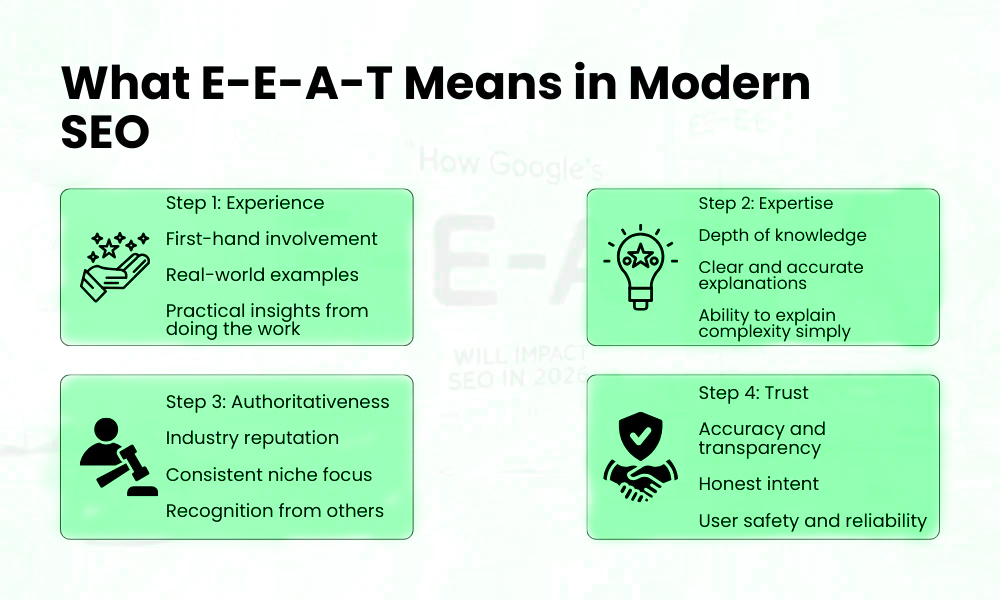
6: E-E-A-T Will Evaluate at the Entity Level
In Search engine optimization in 2026, Experience, Expertise, Authoritativeness, and Trustworthiness (E-E-A-T) are evaluated not just for individual pages, but for the overall reputation of a brand or author. This means search systems look at how your business is perceived across the web, including reviews, mentions, and professional profiles. According to SEO expert predictions, brands that demonstrate real-world experience and transparent authorship are more likely to be trusted by AI-powered search engines. This trend is part of the Future of SEO, where credibility is built through consistent, honest representation across platforms.
In SEO in 2026, businesses must show that real people with real expertise stand behind their content. This is especially important as Generative AI in search relies on trusted sources to create accurate summaries. The future of search engine optimization, therefore, encourages brands to invest in thought leadership, customer trust, and public credibility. Strong reputations help ensure that your content is selected and referenced in AI-generated answers.
7: UX and Engagement Drive Visibility
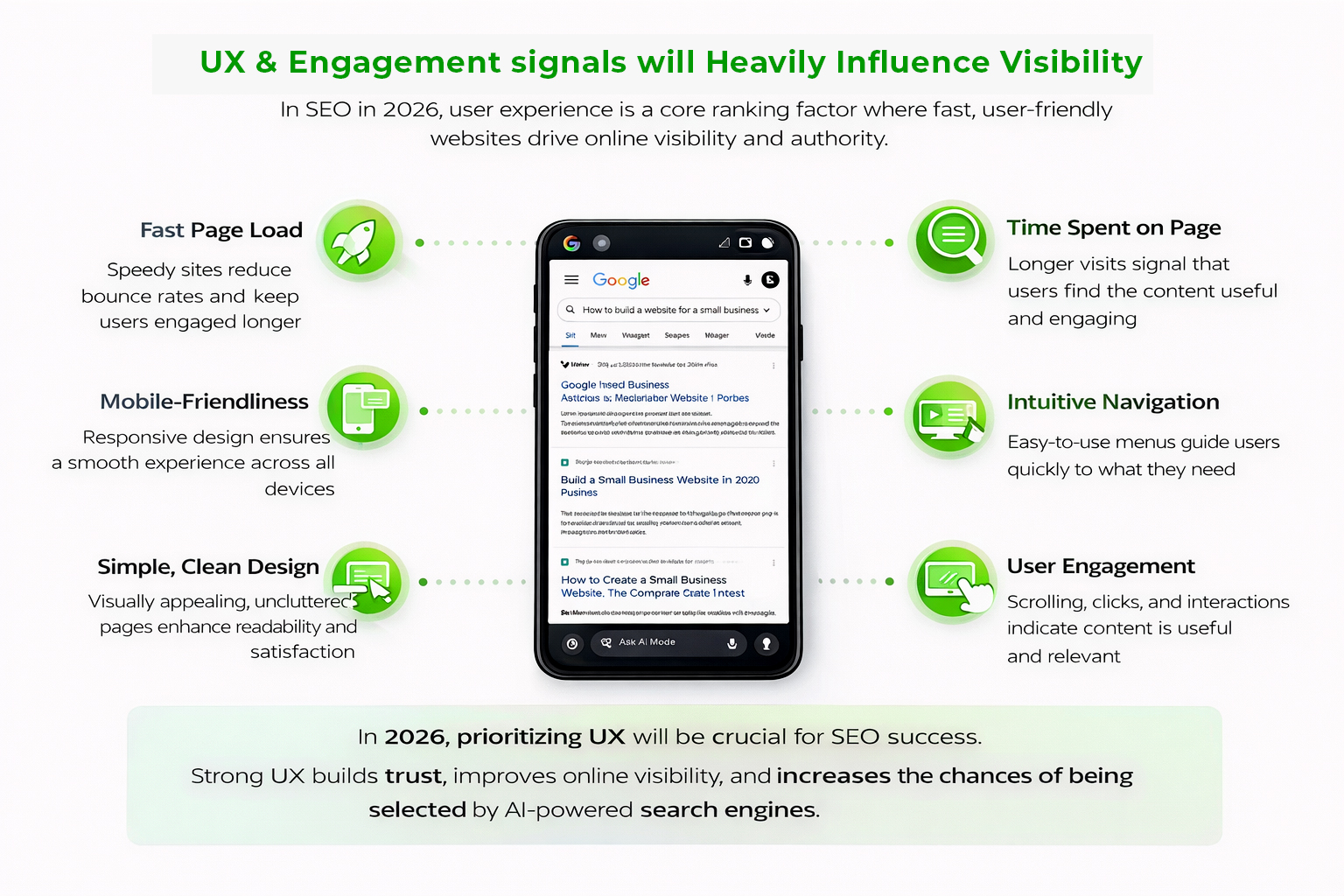
SEO in 2026 will be different with user experience is no longer just a design concern; it is a core ranking and visibility factor. The future of SEO is closely tied to how real users experience your website, from speed and layout to how helpful the content feels.
Key UX & Engagement Factors
- AI-powered search engines evaluate content quality based on user behavior. If visitors find your site easy to use and valuable, it sends positive signals about relevance and trust.
- In Search engine optimization in 2026, engagement signals like time spent on page, scrolling, and whether users find answers quickly help systems judge content usefulness.
- This reflects major SEO trends for 2026, where usability and content value work together to shape online visibility and brand credibility.
- As Generative AI in search looks for reliable sources to summarize, websites that consistently offer smooth experiences are more likely to be referenced in AI-generated answers.
- The Future of SEO rewards brands that invest in fast-loading pages, clean design, simple navigation, and mobile-friendly layouts.
The future of search engine optimization is becoming more experience-driven. SEO in 2026, strong UX builds trust, improves online visibility, and increases the chances of being selected by AI-powered search engines. Brands that prioritize user experience today will gain long-term authority, while those that ignore UX risk losing relevance in an increasingly AI-led search environment.
8: Structured Data Improves AI Retrieval
In SEO in 2026, structured data helps search systems understand what your content means, not just what words it contains. Structured data is a way to label information so that AI-powered search engines can clearly identify details such as your business name, services, authors, or products. This does not directly improve rankings, but it improves how content is interpreted and reused by Generative AI in search. The Future of SEO relies on clarity, and structured data provides it for machines.
In Search engine optimization in 2026, brands that use accurate, honest, structured data make it easier for AI systems to include their information in summaries and answers. This aligns with SEO expert predictions that technical clarity will become a basic requirement for visibility. The future favors businesses that make their content easy for both humans and machines to understand. In SEO in 2026, structured data becomes part of what it means to be “eligible” for AI-driven discovery.
9: Traditional SEO Metrics Lose Influence
In SEO in 2026, traditional metrics like keyword rankings and raw session counts no longer tell the full story. As the search landscape shifts toward a Zero-Click environment, a drop in website traffic does not necessarily indicate failure; rather, it often means your brand has become the definitive answer within an AI interface. To measure true influence this year, businesses must pivot to Visibility-First KPIs that track how often they are synthesized by AI, rather than just how frequently they are clicked.
To remain competitive, your 2026 SEO dashboard should prioritize these three metrics:
- Share of Model (SoM): This replaces “Share of Voice.” It measures the percentage of time an LLM (such as Gemini, ChatGPT, or Perplexity) includes your brand or content in its generated responses for a specific topic or category.
- Citation & Mention Frequency: In an era of AI Overviews, success is defined by how often your domain is cited as a primary source. High citation frequency signals to search engines that your “Entity” is a trusted authority.
- Branded Search Lift: As users interact with AI summaries, they often perform follow-up “branded searches” to learn more about a cited company. A rise in people searching specifically for your brand name is now the strongest indicator that your top-of-funnel AI visibility is working.
By focusing on assisted conversions and pipeline influence rather than just blue-link clicks, brands can demonstrate the ROI of their content even when users never leave the search results page.
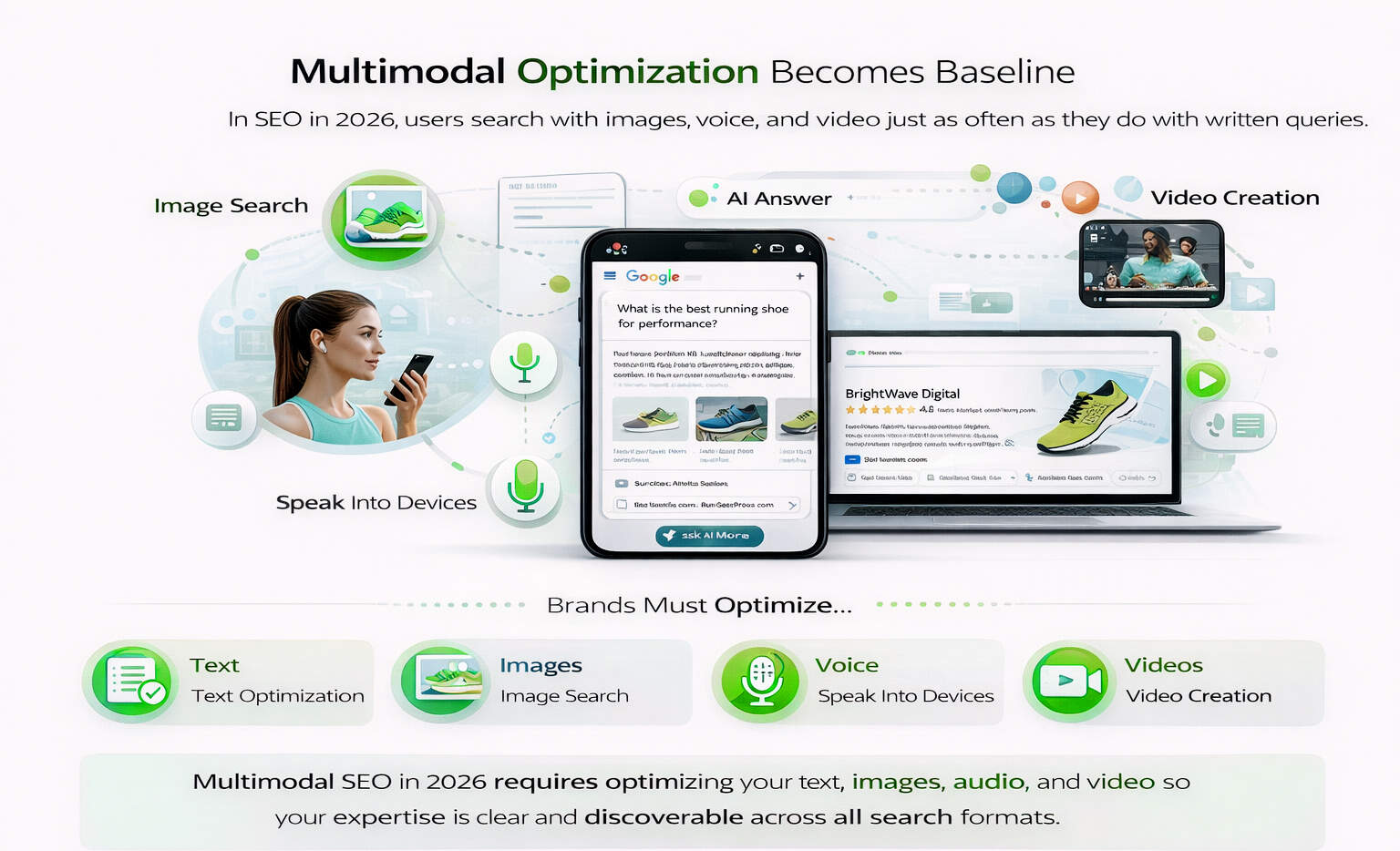
10: Multimodal Optimization Becomes Standard
The Future of SEO is no longer limited to text. In SEO in 2026, people search using images, voice, and video as often as they use written queries. This includes voice and visual search, where users speak into devices or use pictures to find information. As AI-powered search engines interpret different content formats, businesses must ensure their images, videos, and audio content are easy to understand and properly described. Video SEO becomes especially important, as videos are increasingly used to explain products, services, and complex ideas.
In Search engine optimization in 2026, providing clear text summaries and transcripts helps Generative AI in search accurately interpret multimedia content. The future of search engine optimization favors brands that communicate clearly across formats, ensuring their expertise is accessible no matter how users choose to search. In SEO in 2026, multimodal content is not an add-on; it is a baseline requirement for visibility.
11: Search Beyond the Google Ecosystem
In SEO in 2026, search is no longer limited to Google alone. People discover information on social media, video platforms, online communities, and specialized apps. This reflects the future, where visibility depends on having a consistent presence across multiple platforms. AI-powered search engines also consider information from these sources when evaluating brand credibility.
According to SEO expert predictions, businesses that rely on a single platform for discovery face a greater risk as user behavior continues to fragment. In Search engine optimization in 2026, building a presence on platforms like video channels, social networks, and industry communities supports long-term authority. The Future of SEO is about creating a connected brand presence wherever your audience searches for answers. In SEO in 2026, a strong multi-platform strategy ensures your brand remains visible in an increasingly decentralized search environment.
Bottom Lines: SEO Rewards Real Authorit
The evolution of SEO in 2026 shows that search is no longer about technical tricks or chasing algorithms. The Future of SEO rewards brands that focus on trust, clarity, and real expertise. As AI-powered search engines and Generative AI in search reshape how information is delivered, businesses must ensure their content is accurate, well-structured, and genuinely helpful. The future of search engine optimization is built on being understood and trusted by both humans and intelligent systems.
In Search engine optimization in 2026, visibility comes from being a reliable source, not just from ranking on a page. According to SEO expert predictions, brands that invest in authority, transparency, and user-focused experiences will lead in this new environment. In SEO in 2026, success belongs to those who build lasting credibility and shape the answers that define their industry.
Get Your AI-Ready SEO Roadmap
Not sure how your current SEO stacks up for 2026? eSign Web Services has got your back! Get a personalized, AI-ready SEO roadmap that shows where you’re visible in AI answers, zero-click results, and entity-based search, and exactly what to fix first. Get My SEO 2026 Roadmap Today!
Frequently Asked Questions (FAQs)
Question: Will SEO still be relevant in 2026?
Answer: Yes. SEO will remain critical in 2026, but its role will evolve. Success will focus less on raw rankings and traffic and more on visibility, authority, and inclusion in AI-generated answers. SEO will help brands appear across search results, AI Overviews, voice search, and discovery platforms. The goal shifts from “getting clicks” to being trusted, referenced, and remembered wherever users seek information.
Question: Is AI replacing SEO experts?
Answer: No. AI is not replacing SEO experts—it’s changing how they work. AI can automate tasks like content drafts, technical checks, and data analysis, but it lacks strategic judgment. Human expertise is still required for defining search intent, building trust, aligning SEO with business goals, and making nuanced decisions. In 2026, SEO professionals evolve into strategists, editors, and brand stewards rather than execution-only operators.
Question: How will Google AI Overviews affect organic traffic?
Answer: AI Overviews may reduce some direct clicks, especially for simple informational queries. However, they also increase brand exposure, credibility, and assisted conversions. Being cited or referenced builds trust earlier in the user journey. Even if users don’t click immediately, they remember brands they see repeatedly. In 2026, organic success is measured not just by clicks, but by visibility, recall, and downstream impact.
Question: Should businesses stop focusing on keywords in 2026?
Answer: No. Keywords still matter, but their role changes. Instead of being the primary optimization target, keywords support intent mapping and topic understanding. SEO in 2026 focuses on solving problems, answering questions, and covering topics comprehensively. Keywords help identify demand and structure content, but success depends on relevance, depth, and clarity rather than exact-match optimization or keyword density tactics.
Question: How important will backlinks be in 2026 SEO?
Answer: Backlinks will remain important, but quality and context outweigh volume. In 2026, links act more as entity validation signals—confirming expertise, authority, and real-world relevance. Mentions from trusted, relevant sources help AI systems understand who you are and why you matter. A few meaningful citations from credible platforms are more valuable than large numbers of generic or low-quality links.
Question: Will small businesses be able to compete in AI-driven search?
Answer: Yes. Small businesses can compete effectively by focusing on clear expertise, strong local signals, and tightly defined authority. AI-driven search rewards specificity, authenticity, and trust. Local relevance, consistent branding, real experience, and community presence give smaller brands an advantage. In 2026, you don’t need to be the biggest—you need to be the most relevant and credible for your audience.
Question: How do you measure SEO success in 2026?
Answer: Classic metrics like impressions, rankings, and conversions still matter, but they’re no longer enough. Add visibility metrics such as AI inclusion and citations, branded search growth, assisted conversions, and brand mentions across trusted platforms. Track a fixed set of queries and monitor how often your brand appears in AI answers. If traffic drops but branded demand rises, you’re evolving—not failing.
Question: Will content automation dominate SEO?
Answer: Automation will assist content creation, but it won’t dominate SEO alone. AI can speed up research, outlines, and drafts, yet originality, expertise, and lived experience remain essential. Search systems prioritize content that demonstrates real understanding and trustworthiness. In 2026, automation is a support tool—not a replacement. The strongest content blends AI efficiency with human insight, credibility, and perspective.
Question: Why do brand reputation and sentiment affect SEO now?
Answer: AI systems synthesize trust from the broader web—reviews, forums, social platforms, news, and consistent brand information. Negative sentiment or conflicting messaging can reduce trust or distort how a brand is presented in AI responses. In 2026, SEO overlaps with PR and community management. You don’t just rank pages—you shape how your brand is understood across the digital ecosystem.
Question: What should businesses prioritize first for 2026 SEO?
Answer: Start with fundamentals: technical health, crawlability, clear site structure, and strong topical clusters. Then improve content formatting with answer blocks, proof points, and E-E-A-T signals. Clean up entity consistency and implement accurate schema. Finally, strengthen distribution through social and email. Prioritize changes that increase trust, clarity, and reuse across platforms—not just publishing more pages.
Author Details

Ashwani Kumar Sharma
Ashwani has been actively involved in SEO services since 2005. His expertise and distinctive work approaches have made him one of the most experienced and trusted SEO experts in the industry. He is a certified SEO and Google Ads professional. He also has strong business development skills in advanced SEO, PPC, and digital marketing strategies.


