



Why Rankings Drop Even When SEO “Looks Right” (Hidden Signals Explained)

Key Takeaways
- Rankings can slide even with clean SEO because users behave differently across the SERP.
- Engagement drops, CTR declines, and shorter dwell time create hidden signals that weaken relevance.
- Intent shifts silently; your format may stop matching what searchers and Google reward.
- SERP features and AI summaries can reduce clicks even when impressions stay stable.
- Technical drift like redirects, slow scripts, and crawl waste causes instability and indexing friction.
- Entity trust matters; inconsistent branding and weak authorship dilute perceived expertise and authority.
- Core updates reweight signals; winners satisfy faster with clarity, proof, and stronger structure.
- Use the R.A.L. Ranking Check to diagnose issues before making broad, risky changes.
When you’ve gone through all the necessary checks, yet you can’t shake the feeling that something’s off when your rankings start to drop. Your titles and H1s are aligned, Core Web Vitals seem fine, and your pages pass audits without a hitch. So, why is the organic traffic heading in the wrong direction? It can be frustrating when the tools suggest everything is on point, but your results tell a different story. Many teams find themselves caught in this dilemma, endlessly fine-tuning the basics of their pages while the real issue lies in subtler signals that don’t scream for attention. These quieter factors can slowly chip away at your visibility week after week, leaving you wondering what’s actually going wrong.
In the modern search landscape, it’s all about the user experience rather than just completing a checklist. People are looking for quick, clear, and trustworthy answers, not just fancy features like schema markup. Search engines pay attention to how users interact with content, such as what they click, how long they scroll, and when they leave a page. All these little behaviors influence many decisions that lead to your SEO performance decline. So, even if your audit scores look great, you might still notice a drop in your search rankings if you’re not focused on providing what users really want. Underneath, a mix of behavioral shifts, SERPs layout changes, technical drift, and trust issues serves as hidden SEO signals that explain the slide.
Choose Your Journey; Skip to what hurts most:
- Rankings sliding but traffic still okay? Jump to Behavioral & Engagement Signal Shifts
- CTR down but impressions steady? Jump to Search Intent Evolution
- Indexing feels unstable or pages “wobble”? Jump to Technical Signals That Quietly Degrade Performance
- You publish a lot but don’t feel trusted? Jump to Entity Authority & Trust Dilution
This blog reveals why rankings drop, even when SEO looks clean, by unpacking engagement, intent shifts, infrastructure issues, entity clarity, updates, and competition. Learn to read live signals, not static audits, and prioritize smarter fixes.
Behavioral & Engagement Signal Shifts
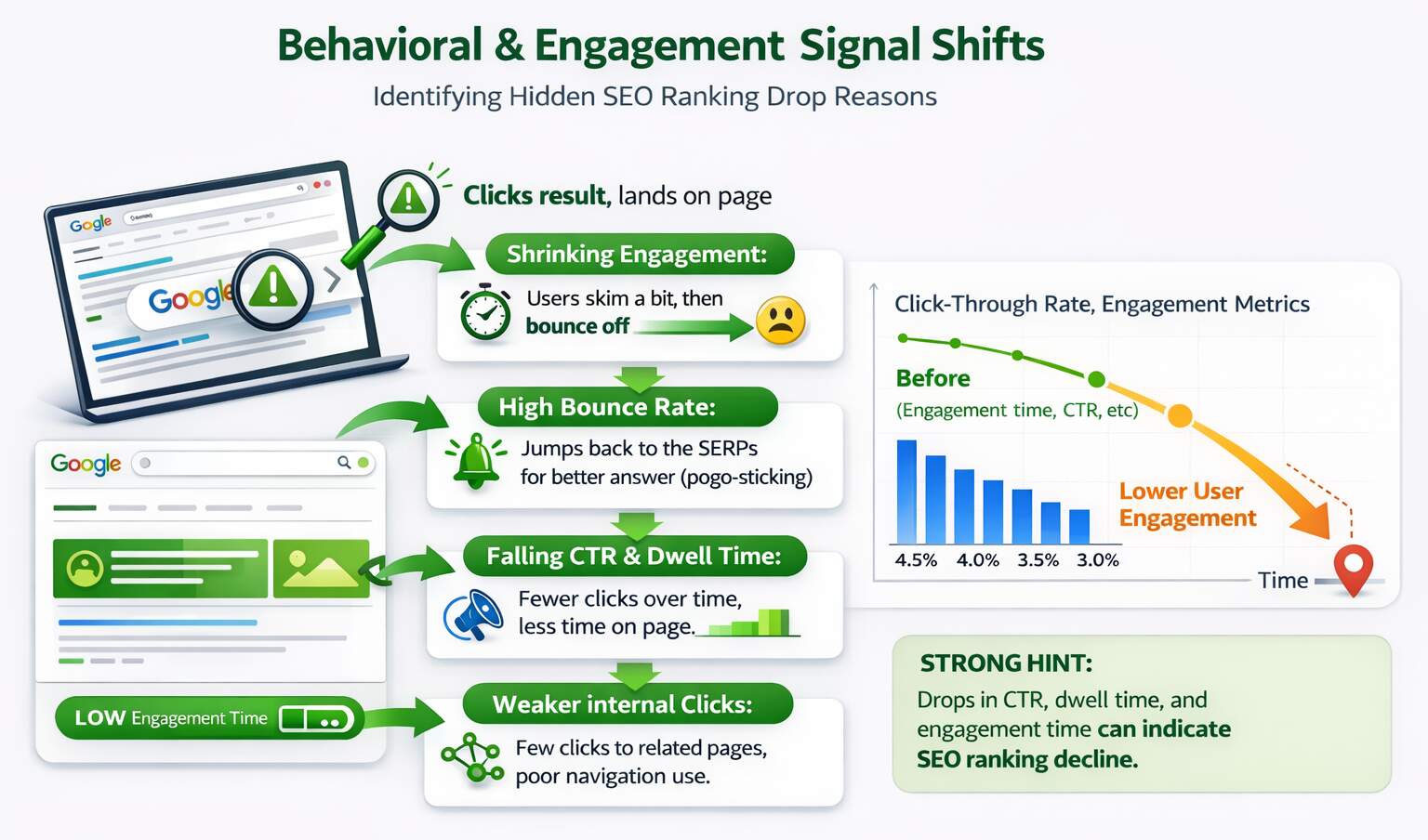
When you’re trying to understand why rankings drop even though SEO “looks fine,” behavior is usually the first suspect. The numbers don’t shout, they whisper, but those whispers add up. Watch for:
- Shrinking engagement time – Users skim a bit, then bounce. That’s one of the strongest SEO ranking drop reasons, because it tells Google, “This page didn’t really help.”
- Falling click-through rate (CTR) – Impressions hold, but fewer people choose your snippet. If your CTR drops below current SEO benchmarks, Google may interpret that as a relevance issue.
- Shorter dwell time and pogo-sticking – People click in, don’t see what they expected, then jump back to the SERPs to try someone else. That’s classic hidden SEO signals behavior.
- Weaker internal navigation usage – Fewer clicks to related pages suggest the journey feels like a dead end instead of a useful path.
Individually, these look like minor UX annoyances; together, they quietly signal to algorithms that your result isn’t the best bet anymore. When you fix layout, intros, and snippets so real humans stay longer and click deeper, those same signals start working for you instead of slowly driving SEO performance decline across your most important pages.
Pause and test this now:
- Open 3 pages that lost visibility.
- Compare engagement time vs. site average.
- Did CTR dip while impressions stayed steady?
- Does the first screen answer the query immediately?
If two answers raise concern, you’ve likely found one of the real SEO ranking drop reasons. Add in shorter dwell time and fewer internal clicks, and that behavioral pattern becomes strong enough to influence positions over weeks. Fixing this isn’t about adding keywords, it’s about reshaping the first 40 seconds of experience. Clear answer. Strong promise. Obvious next step. When users stay longer and click deeper, the algorithm gets a new signal set, and that’s how you reverse subtle SEO performance decline before it turns into a visible drop.
What Is Search Intent Evolution In SEO?
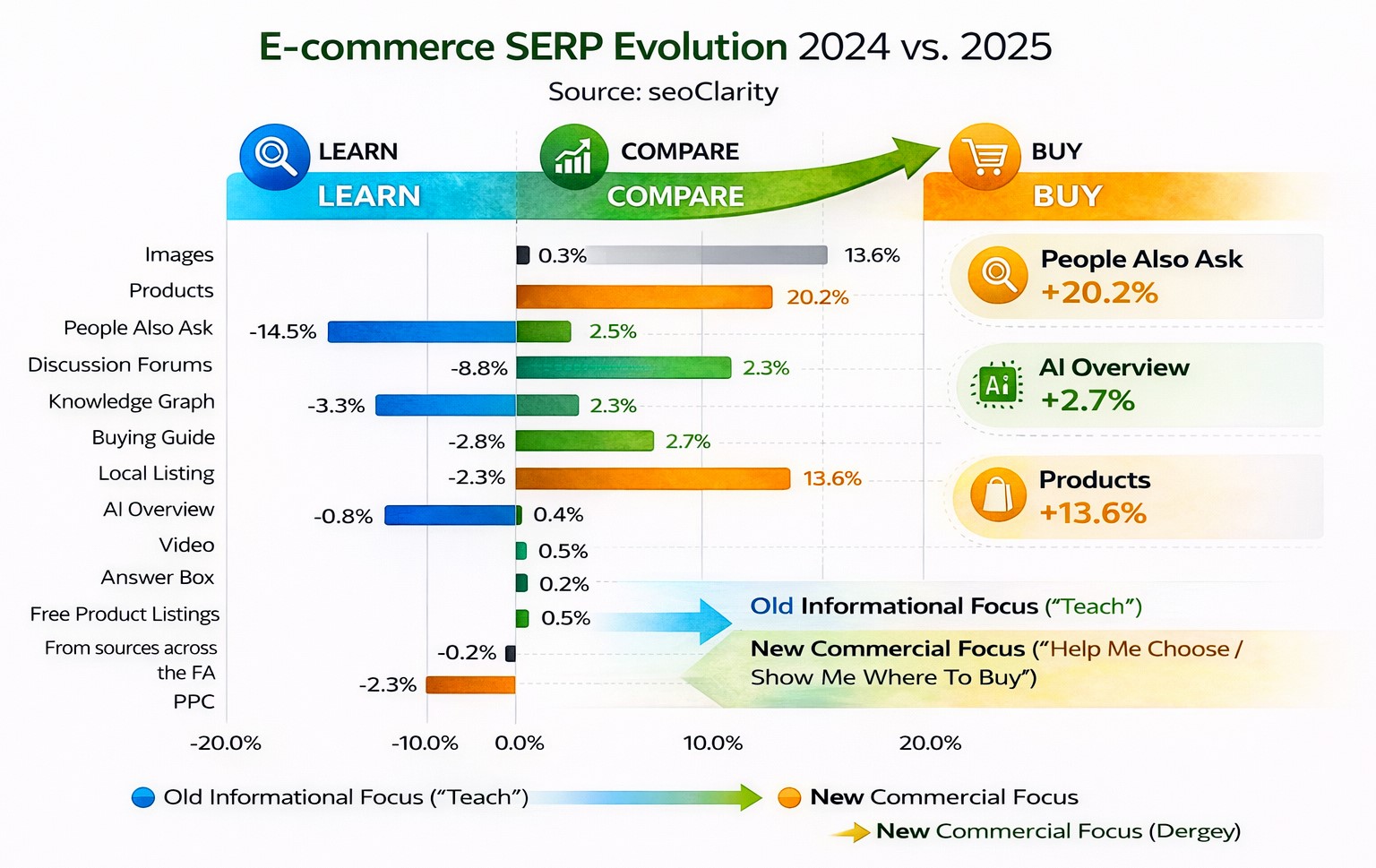
Search intent doesn’t stay frozen; that’s a sneaky reason why rankings drop on pages that once performed well. A query that used to be mostly “teach me” can evolve into “help me choose” or “show me where to buy.” When that happens, content built for yesterday’s job becomes misaligned today. The result is a subtle search intent mismatch: you still rank for a while, but users feel your format isn’t quite what they needed, and their behavior quietly favors newer, better-aligned pages.
You’ll see SERPs change long before tools complain. AI overviews, richer snippets, and different page types appear, reflecting updated expectations. Competitors refresh articles with clearer comparisons, updated examples, and sharper CTAs while you keep running an “evergreen guide” from 2021. Their updates often improve content freshness signals that algorithms use to decide which answer feels most relevant right now. When user behavior reinforces that relevance, what looks like random, sudden ranking loss is really your content being out-evolved, piece by piece.
Adapting means treating the live SERPs like your brief. Audit page one: Is it dominated by how-tos, comparisons, or product pages? If features show quick answers, design sections that can feed those elements, too. Refresh outdated sections with current data and scenarios to keep your content freshness signals competitive. When you deliberately match format and depth to updated expectations, you turn a sudden ranking loss into a nudge to realign and regain visibility, rather than a mysterious punishment.
Technical Factors That Degrade SEO
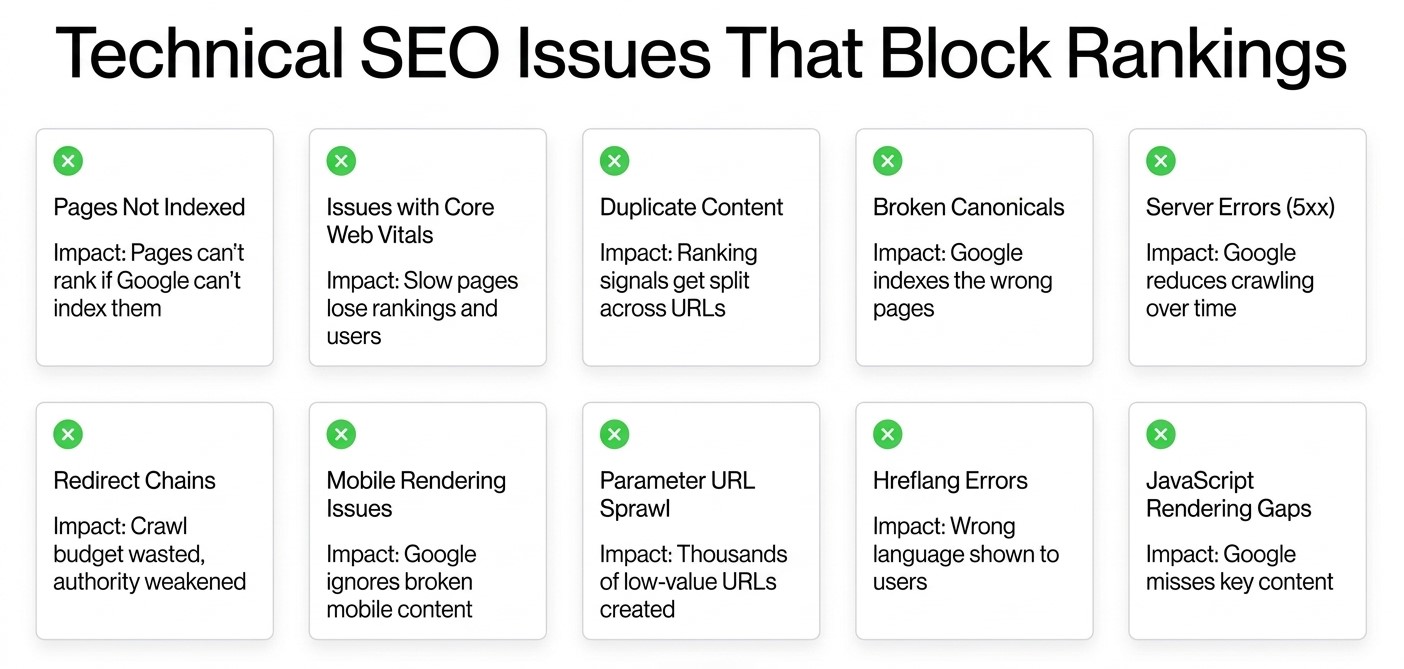
Technical problems rarely explode; they accumulate, and that slow buildup explains why rankings drop when content seems fine. Redirect chains grow, internal links break, sitemaps drift, and scripts pile on. Crawlers start wasting time. Users feel friction. That combination becomes technical SEO issues that quietly destabilize indexing and visibility, especially on larger sites where small errors repeat across templates.
Scenario: A SaaS site adds a chatbot, sticky banner, and two analytics scripts in one quarter. Desktop feels fine in the office. On a mid-range Android, key pages now take 6+ seconds to become usable. Bounce rate climbs, rankings soften, and nobody ties it back to “just one more script.” That’s how performance drift turns into real Google ranking fluctuations and eventually crawl budget problems.
1-Minute Technical Audit
- Crawl top pages: 404s, redirect chains, orphan URLs
- Check indexing for top revenue URLs in Search Console
- Test 3 key pages on a real phone over mobile data
Do This / Don’t Do This
- Do: Remove or defer non-critical scripts on core templates
- Do: Keep sitemaps clean and only include indexable pages
- Don’t: Trust “loads fine for me” on desktop
- Don’t: Let parameters and duplicates balloon unchecked
Micro-CTA: Make a “Top 20 URLs” sheet and mark: speed, index status, internal links, and errors. This becomes your stabilization list.
Entity Authority & Trust Dilution
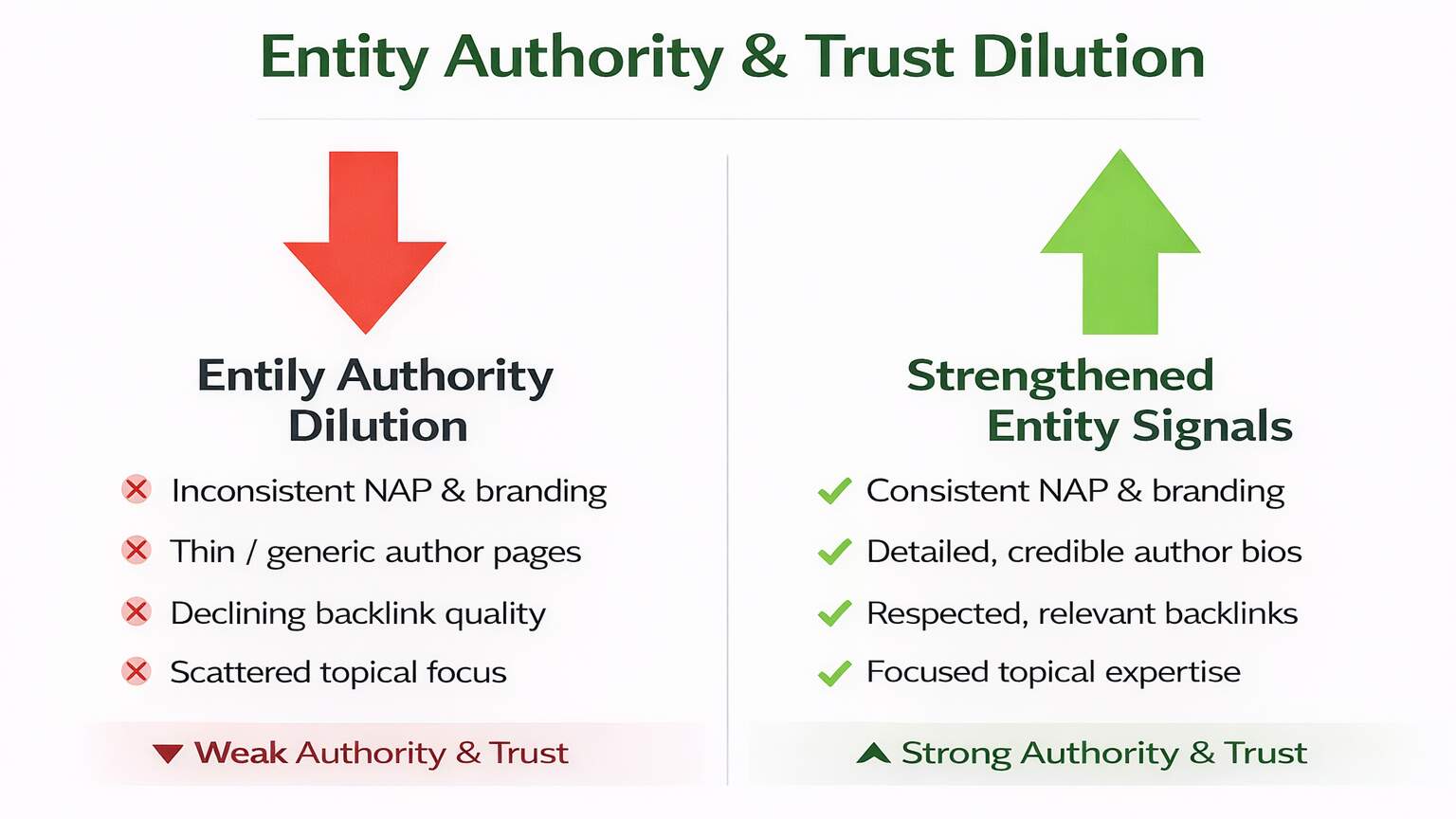
Even if your pages look solid, why rankings drop can often be traced back to how clearly the web understands who is behind them. Search engines rank entities as much as URLs, and when your brand signals are messy, trust erodes. Watch for:
- Inconsistent NAP and branding – Different names, addresses, or taglines across profiles and directories fuel entity authority decline and make you look less legitimate.
- Thin or generic author and about pages – If it’s unclear who’s speaking, why they’re credible, or what your organization actually does, algorithms hesitate to treat you as a strong source.
- Declining backlink quality – Losing links from respected sites while gaining random, low-value mentions quietly accelerates SEO performance decline.
- Scattered topical focus – Publishing on everything and nothing makes it harder for systems to see you as an expert in anything.
Tightening entity signals, consistent branding; the kind that builds real-world recognition and trust; stronger author presence, richer About/Contact pages, and focused topical coverage help search engines join the dots. Over time, that clarity makes your brand easier to trust, easier to cite, and much harder to quietly replace when results are reshuffled.
Algorithm & Core Update Recalibration
Core updates feel like chaos, but they’re usually Google remixing the ranking recipe, and that directly changes why rankings drop or climb. They don’t add one “new trick”; they rebalance familiar ingredients like depth, usefulness, UX, trust, speed, and entity clarity. Micro-scenario: You didn’t change a thing, but a competitor refreshed one guide, tightened the opening, and added proof. After the update, that “small” difference gets amplified and your page slides. That’s the algorithm doing what it’s designed to do: pick the result that satisfies faster.
Myth-buster: “We got penalized.” Most of the time, you didn’t. Your page just lost the tiebreakers. AI-driven layers make those tiebreakers sharper. Models help interpret queries, detect vague filler, and favor pages that are easy to summarize, grounded, and specific, what people call AI ranking factors in real life. Thin, repetitive pages that once “survived” become fragile because they’re harder to trust and harder to extract clean answers from.
The Signal Stack Meter
Ask: what got weaker on your page relative to winners?
- Clarity: Does the answer show up in the first screen?
- Credibility: Do you show proof near claims?
- Cohesion: Does the page flow logically or feel stitched?
- Comfort: Is mobile reading smooth or irritating?
- Confidence: Do users stay, scroll, and click deeper?
Smart teams treat drops like diagnostics, not drama. They compare winners vs. losers, isolate repeatable traits, and ship changes in small waves so results are measurable.
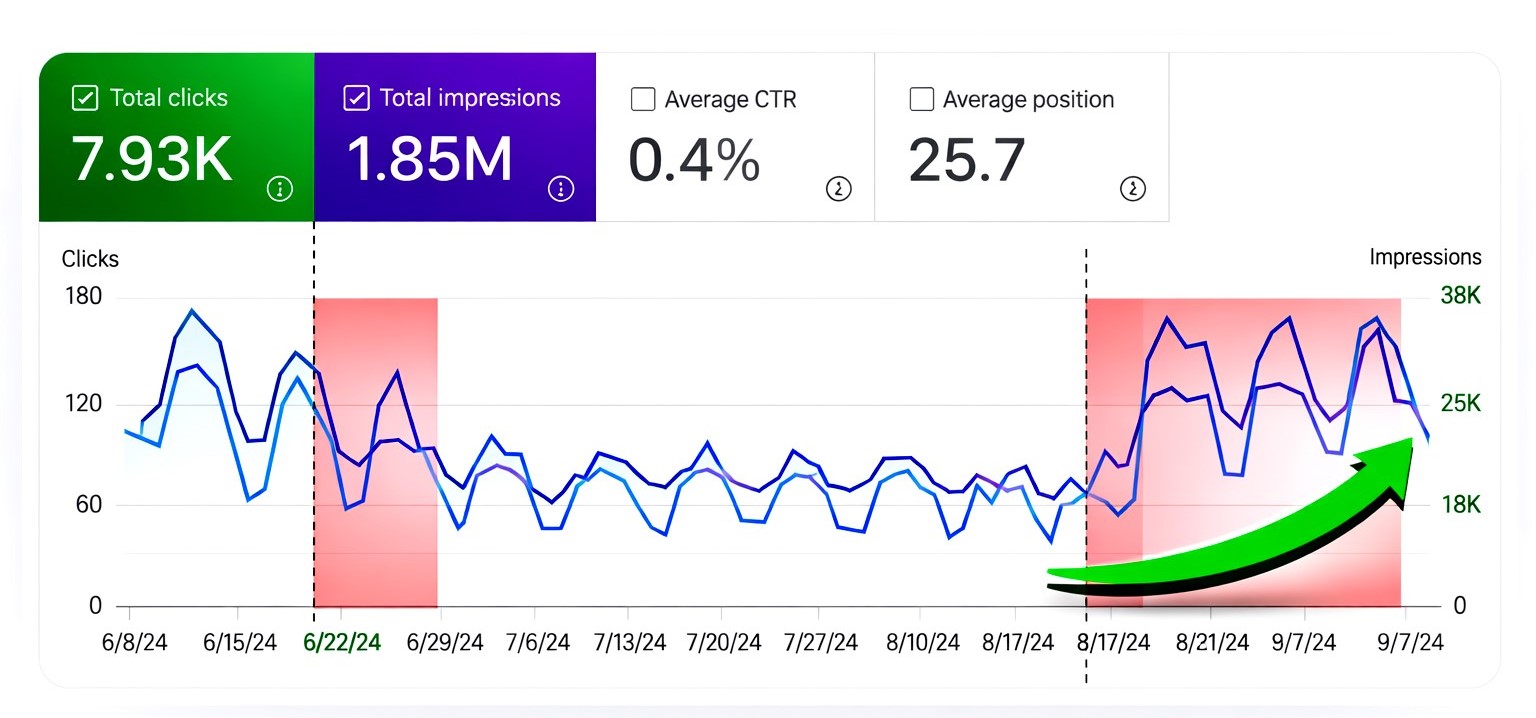
Micro-CTA: Screenshot today’s SERP for your top 3 queries and save it, your recovery plan starts with seeing what Google is now rewarding. That’s how you earn Google core update recovery without chasing rumors or resetting everything in panic.
The Bottom Lines
In most cases, there isn’t a single dramatic reason why rankings drop; it’s how behavior, intent, infrastructure, trust, and updates stack up. Users click different results, SERPs evolve, technical friction creeps in, competitors refresh content, and algorithms rebalance how they weigh it all. If you only stare at title tags, links, and scores from tools, you miss the deeper story. That’s how teams end up “fixing SEO” while traffic, leads, and revenue continue sliding in the wrong direction.
The flip side: once you understand these layers, ranking drops become explainable and fixable. You watch engagement and CTR for early warning, track how intent and features shift on page one, and keep a close eye on the health of your site’s crawlability and performance. You tighten entity signals so systems easily understand who you are and what you’re an expert in. You treat each major update as feedback on your content and UX standards rather than as random punishment, causing endless sudden ranking loss conversations.
From there, you move away from panic reactions and toward planned, high-impact improvements. You prioritize the pages and clusters that matter most to the business and adjust them based on real signals, not guesswork. Over months, that approach doesn’t just reverse the decline in SEO performance; it builds a site that’s harder to shake with every new feature or core update. That’s the real win: not dropping, but always knowing how to read what’s happening and what to do next when why rankings drop stops being a mystery and becomes a solvable problem.
Stop Guessing, Start Diagnosing
Want to know exactly which layer is breaking; behavior, intent, technical, or authority, so you fix the right thing first? We’ll prioritize the top actions for the pages that matter most. Call us today to get a free quote from eSign Web Services.
Frequently Asked Questions (FAQs)
Question: Why do rankings fluctuate even without algorithm updates?
Answer: Rankings fluctuate because search systems continuously evaluate engagement signals, competitor performance, and evolving user intent. Even without official algorithm announcements, subtle recalibrations occur regularly. Changes in click-through rate, dwell time, or content freshness may influence ranking adjustments. Competitors updating content or improving engagement metrics can also impact position shifts. Search environments remain dynamic, and stability requires ongoing optimization. Monitoring performance trends instead of reacting to short-term fluctuations helps maintain perspective and avoid unnecessary changes that may harm long-term ranking performance.
Question: Why do rankings drop even when nothing changes on my site?
Answer: Rankings can drop even if you didn’t touch your site because search results are relative, not static. Competitors may have updated their content, improved structure, added fresh data, or enhanced UX. Google’s systems also evolve constantly, refining how they evaluate intent satisfaction and trust. Even small changes in SERP layout—like AI answers or new features—can shift attention. Staying still in SEO often means slowly losing ground to more proactive competitors.
Question: Are backlinks still critical in 2026 SEO?
Answer: Backlinks still matter because they signal authority and credibility. However, they no longer guarantee top rankings on their own. If your content lacks clarity, trust signals, or intent alignment, stronger backlinks may not compensate. Modern search evaluates context, usefulness, and user satisfaction alongside link equity. Think of backlinks as a credibility amplifier—but the content must first deliver value, depth, and trustworthiness to sustain rankings.
Question: Does content freshness affect rankings for evergreen topics?
Answer: Content freshness matters even for evergreen subjects because user expectations and contextual trends evolve. Outdated examples, statistics, or references reduce perceived relevance. Search engines detect content updates and evaluate whether pages remain accurate and valuable. Competitors who refresh similar topics may gain stronger engagement signals. However, freshness alone does not override authority. Strategic updates that improve clarity, expand depth, and align with current search intent strengthen ranking stability. Regular content audits ensure evergreen pages maintain credibility and competitive positioning within evolving algorithmic evaluation systems.
Question: How do AI Overviews influence ranking fluctuations?
Answer: AI Overviews can influence visibility by redistributing clicks across search results. When generative summaries answer queries directly, traditional organic listings may experience reduced traffic, impacting engagement signals indirectly. Lower click-through rates and shorter dwell times can influence ranking recalibration. Additionally, AI systems prioritize authoritative and contextually complete content for inclusion. Pages excluded from summaries may lose comparative advantage. Adapting content structure for extractability and entity clarity improves inclusion probability. Understanding generative search behavior is essential for diagnosing ranking shifts in the AI era.
Question: Can minor technical issues cause major ranking drops?
Answer: Yes, minor technical inconsistencies can compound over time and reduce visibility. Broken internal links, improper canonical tags, indexing misconfigurations, or slow page performance may not appear critical individually but collectively weaken crawl clarity and trust signals. Search engines rely on structured interpretation, and technical instability introduces ambiguity. Gradual performance degradation often precedes noticeable ranking declines. Conducting routine technical audits prevents silent structural decay. Addressing small issues early protects long-term ranking stability and prevents compounded algorithmic recalibration that becomes more difficult to reverse.
Question: How does search intent mismatch impact rankings?
Answer: Search intent mismatch occurs when content no longer aligns with dominant user expectations for a query. If search results increasingly favor transactional pages while your content remains informational, ranking strength declines. Algorithms analyze user behavior patterns to determine which formats satisfy intent most effectively. Intent evolution may shift gradually without obvious signals. Regularly reviewing SERP composition helps identify these changes. Updating structure, adding transactional elements, or enhancing informational clarity restores alignment. Maintaining intent relevance is essential for sustaining ranking consistency.
Question: Should rankings be monitored daily?
Answer: Daily monitoring may create unnecessary anxiety due to normal volatility. Rankings fluctuate frequently based on user location, personalization, and minor algorithm recalibrations. Weekly and monthly trend analysis provides more meaningful insight into performance stability. Sudden significant drops require investigation, but small variations are common. Evaluating traffic patterns, engagement signals, and conversion metrics alongside rankings ensures balanced interpretation. Long-term trend evaluation prevents reactive decisions that may harm performance. Strategic monitoring focuses on sustained patterns rather than isolated daily fluctuations.
Question: Do core updates permanently damage rankings?
Answer: Core updates do not permanently damage rankings but recalibrate signal weighting. Websites experiencing declines often face shifts in authority evaluation, engagement metrics, or intent alignment. Recovery requires structured analysis rather than panic-driven changes. Identifying which signals lost relative strength helps guide improvement. Enhancing content depth, technical stability, and trust signals supports gradual recovery. Core updates favor websites aligned with evolving quality standards. Long-term improvements typically restore competitive positioning over time when implemented strategically and consistently.
Question: What is the first step after noticing a ranking drop?
Answer: The first step is structured diagnosis rather than immediate modification. Analyze traffic trends, engagement metrics, SERP changes, competitor updates, and technical health before implementing changes. Identify whether the decline affects specific keywords, categories, or site-wide performance. Reviewing search intent alignment and content freshness provides clarity. Technical audits detect crawl or indexing issues. Comparing backlink profiles ensures trust stability. Careful assessment prevents unnecessary modifications that may worsen performance. Data-driven investigation creates a clear recovery roadmap aligned with modern algorithmic evaluation systems.
Author Details

Ashwani Kumar Sharma
Ashwani has been actively involved in SEO services since 2005. His expertise and distinctive work approaches have made him one of the most experienced and trusted SEO experts in the industry. He is a certified SEO and Google Ads professional. He also has strong business development skills in advanced SEO, PPC, and digital marketing strategies.


