



Augmented Reality (AR) & Virtual Reality (VR) in Marketing: Real Use Cases in 2026

Key Takeaways
- AR in Marketing is the easiest place to start, especially for mobile shoppers who want quick previews.
- VR works best for big decisions, where tours and demos cut long explanations and speed up choices.
- The best AR in marketing use cases are simple: try-ons, “see it in my room,” and scan-to-learn packaging.
- Good immersive marketing strategies focus on being helpful, fast, and easy to use, not fancy or complicated.
- Track results properly: measure opens, taps, completion, and CTA clicks before saying it “worked.”
- Keep it smooth for users: make files light, use browser-based tools, and add a backup option.
- Scale only after proof: test one page for 30 days, improve it, then expand to more pages and channels.
Marketing in 2026 is less “look at this” and more “step inside this.” If your product page still depends on a carousel and hopes buyers are forced to imagine fit, size, texture, or “what happens next.” When people must guess, they slow down. And when they slow down, conversions drop.
That’s why Augmented Reality in Marketing is moving from “cool demo” to a practical growth tool. Instead of describing benefits, you let prospects test them: place a sofa in their room, preview a paint color in real lighting, or scan packaging to see setup steps. VR helps when the decision is bigger: tour a space before booking, explore a product before scheduling a call, or walk through a complex service process.
Here’s the reality check: Baymard’s analysis of 50 studies shows average cart abandonment is 70.22%. You can’t retarget your way out of doubt forever. The faster fix is confidence. In this blog, you’ll learn real 2026 use cases, how to choose AR vs. VR, and how to track ROI so you can prove results, not just impress your team.
Why AR & VR Matter for Startups in 2026
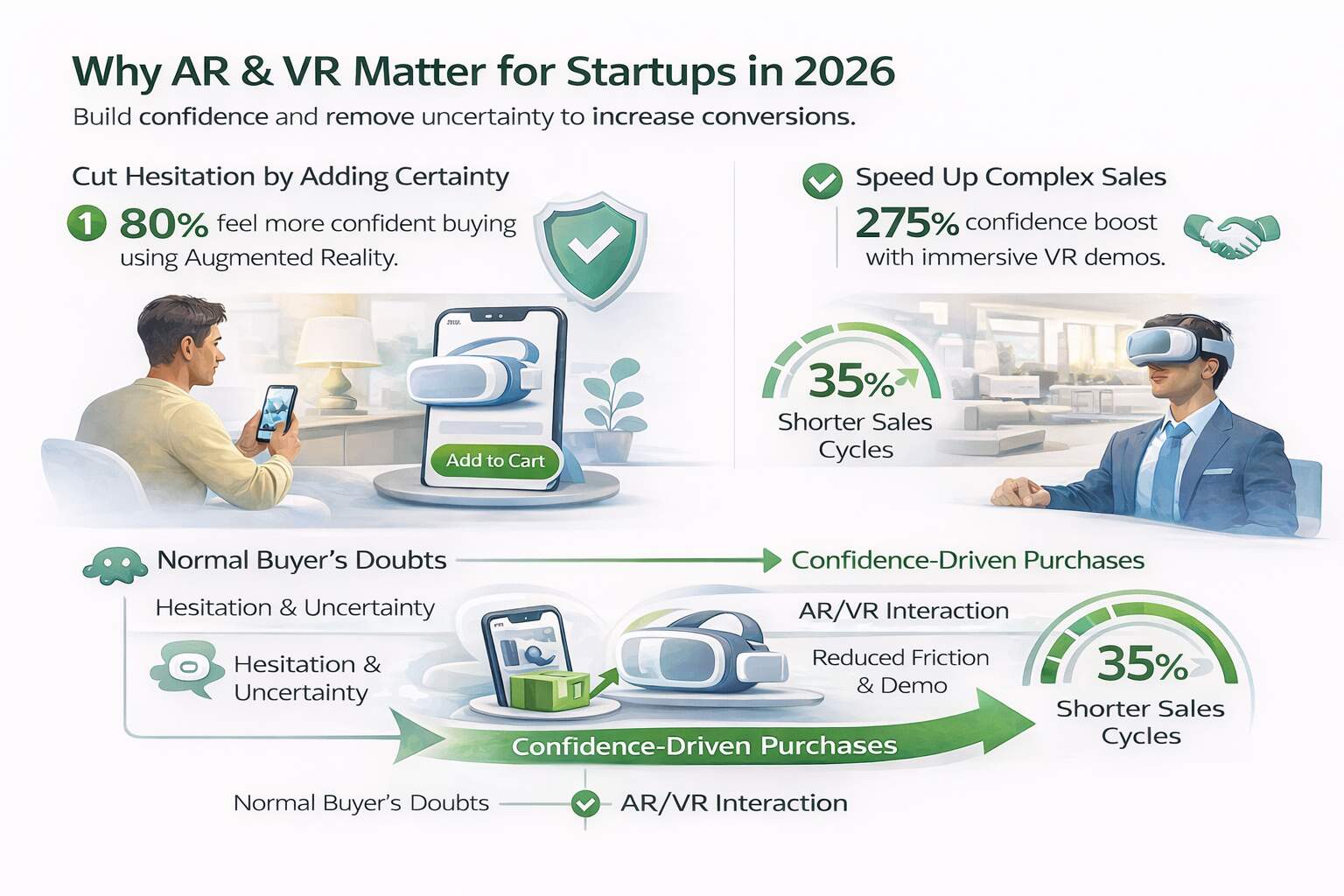
In 2026, customers don’t only compare price. They compare certainty. When people can’t picture fit, scale, or outcome, they hesitate. That hesitation shows up as fewer add-to-carts, fewer form fills, and more “I’ll think about it.” This is where Augmented Reality in Marketing earns its place. It turns “I hope it works” into “I can see it working.” That reduces mental effort and helps people decide faster.
AR also builds confidence fast. Snap’s research found 80% of shoppers felt more confident using AR tools, and about two-thirds were less likely to return items after using AR. That matters because confidence doesn’t just increase conversions; it can also reduce refunds and support requests.
VR matters when the purchase is complex, expensive, or emotional, like real estate, travel, premium services, or B2B demos. PwC found VR learners were 275% more confident applying what they learned than classroom learners. That same confidence effect helps prospects understand faster and commit sooner.
Real AR Marketing Use Cases in 2026
When uncertainty stops people from making purchases, clear information helps them decide. In 2026, the best use of Augmented Reality in marketing focuses on reducing hesitation when buyers are unsure. Instead of showcasing flashy technology, smart brands use AR to provide visual confirmation that encourages action.
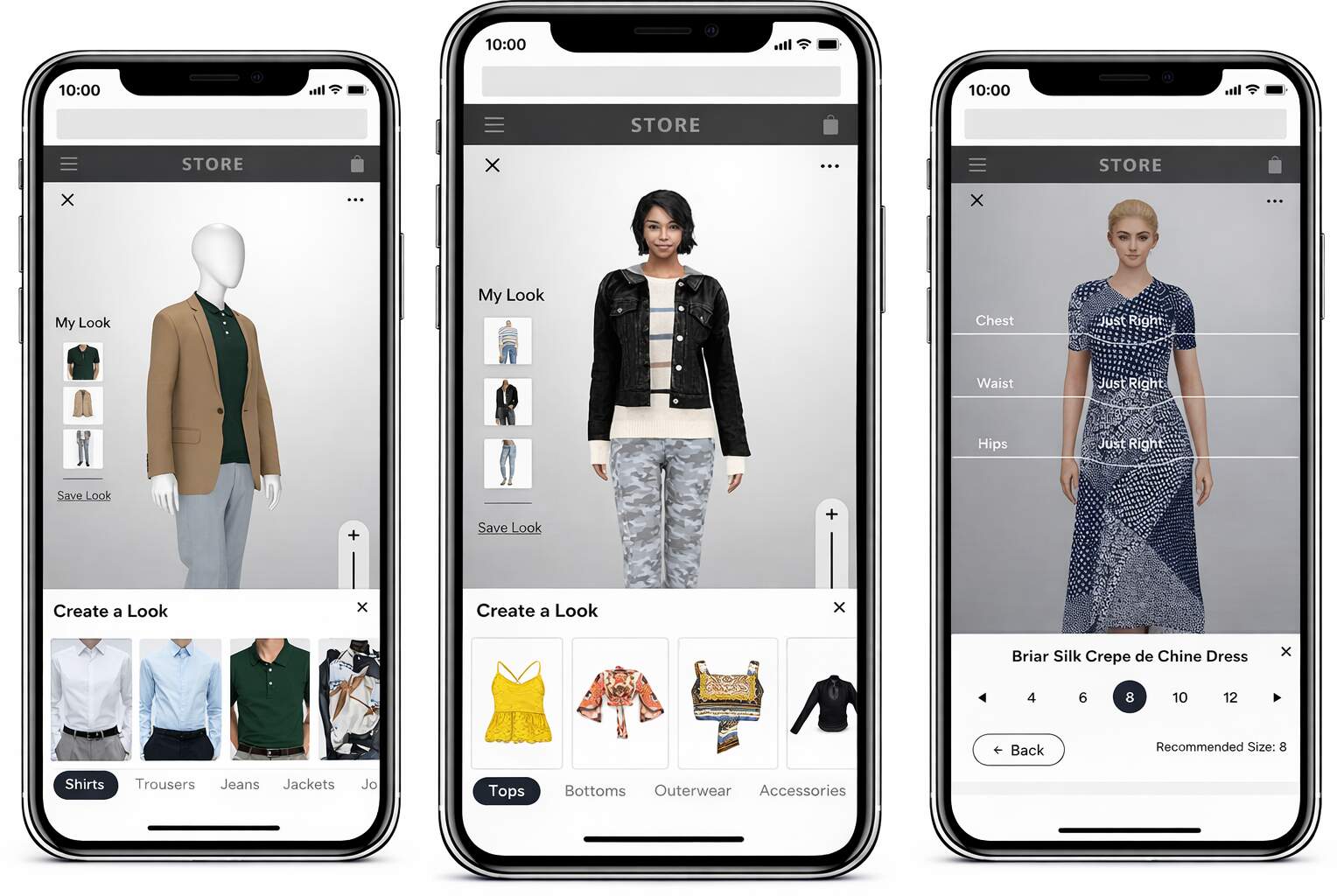
- Virtual try-ons for retail: Brands that sell beauty products, eyewear, fashion, and accessories use augmented reality (AR) to help customers choose the right sizes and colors. This method is very effective in marketing, especially on mobile product pages.
View-in-room placement: Furniture and home decor brands leverage AR product visualization to let customers place items in real spaces before purchase. This reduces guesswork and accelerates checkout decisions. - Packaging-triggered support: Brands can use WebAR experiences in browsers to scan packaging. This allows them to launch tutorials, start warranty registration, or show cross-sell suggestions.
- Service previews: Contractors and home service brands show before-and-after images to help potential customers see what the results will look like. This allows them to visualize the outcome before asking for quotes.
The main point is confidence. When customers can interact with products instead of just imagining them, they hesitate less. Using Augmented Reality in marketing can turn product pages into interactive tools that help people make decisions. This not only boosts engagement but also supports revenue growth.
Real VR Marketing Use Cases in 2026
VR works best when “feeling it” changes the decision. The smartest VR marketing examples don’t try to build a metaverse. They build understanding. A guided VR demo can recreate your best sales pitch: show the value, show the difference, then offer one next step.
That’s why virtual showroom marketing can work so well for B2B and premium retail. It gives prospects a consistent, guided experience even when your team is not live. It can also reduce long back-and-forth calls because the demo answers questions visually.
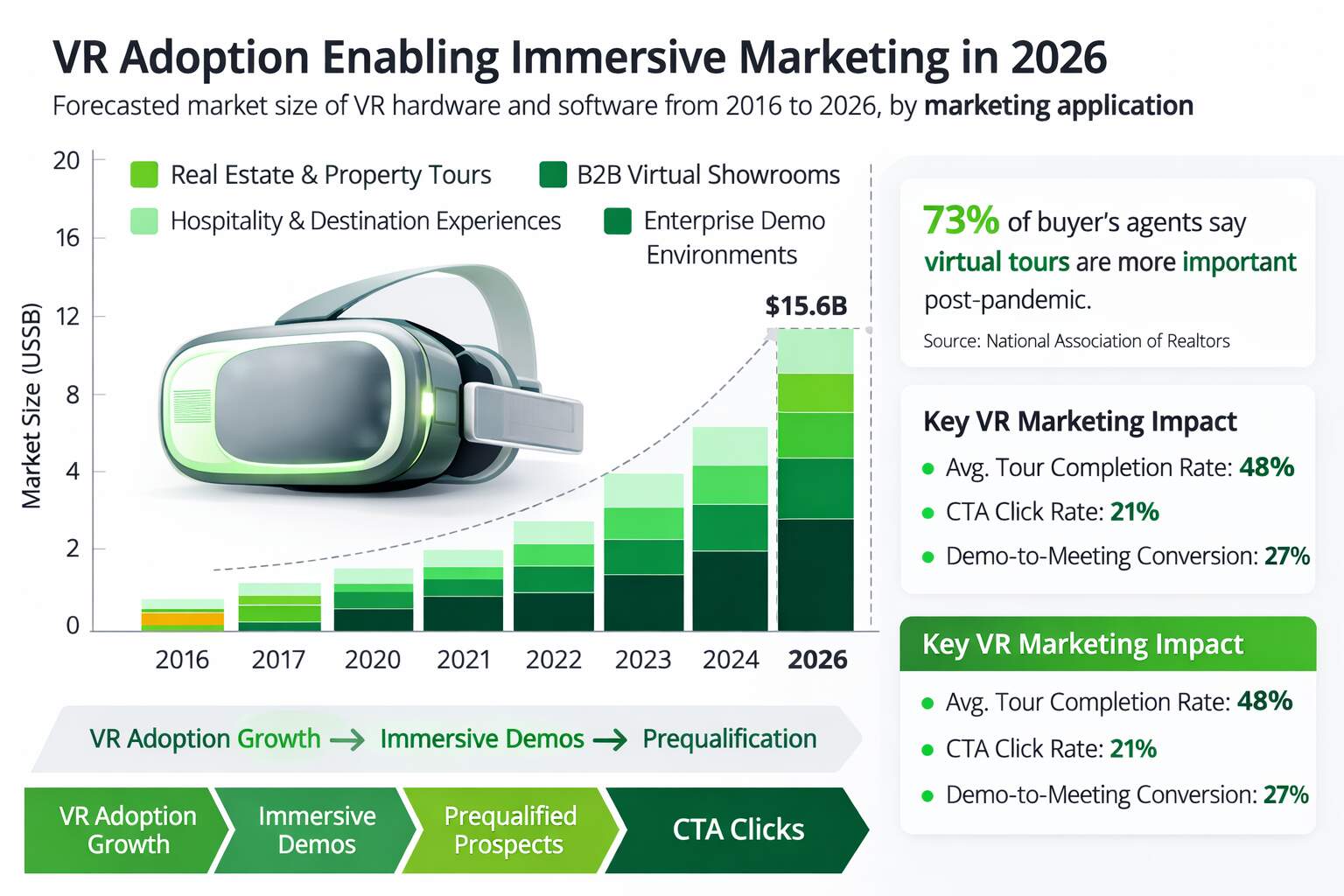
VR is especially strong for property and travel. A National Association of Realtors survey found 73% of buyer’s agents said virtual tours became more important since the pandemic began. Pair that with 360 virtual tours, hotspots, and clear CTAs, and you reduce wasted showings while improving lead quality.
AR vs VR: Right Choice for Small Businesses
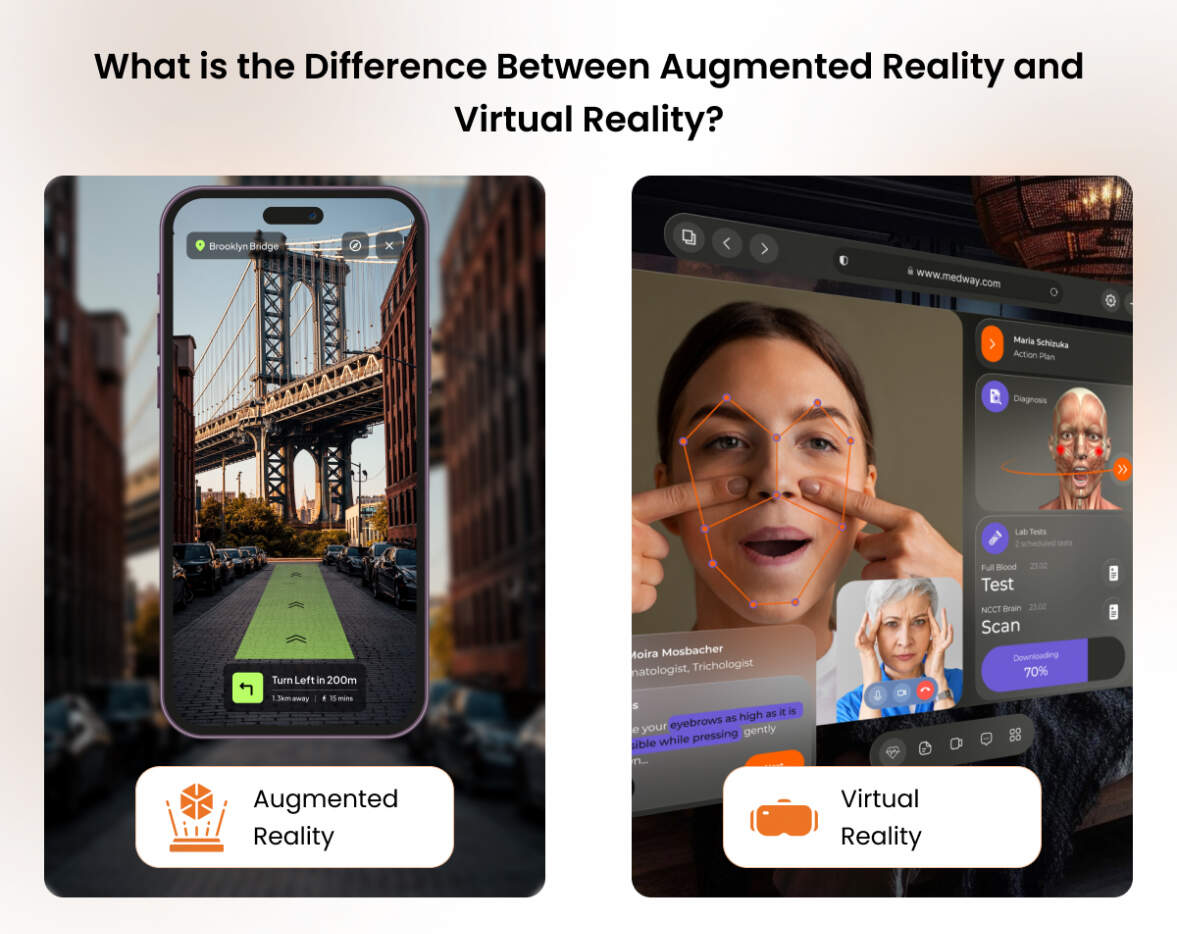
If you’re deciding between AR and VR, focus on what your main challenge is instead of following trends. Use AR when it’s important to reach people quickly, especially those using phones. Mobile AR marketing often works better than asking people to “download our app” because it’s easier to use, and more usage is the goal. Choose VR when you want to create a full experience, like for properties, travel, training, showrooms, or complex tasks, where immersing users is more effective than lengthy explanations.
Use this simple rule: Augmented Reality (AR) helps people make decisions, while Virtual Reality (VR) helps them commit. Link the decision to customer confidence and one key performance indicator (KPI). If customers wonder, “Will this fit or look right?” focus on AR product visualization. If they ask, “What does it feel like?” focus on VR. Remember, immersive technology won’t improve a poor offer; it just makes the reality clearer and faster to see.
Decision checklist: Start with one page, one audience, one key performance indicator (KPI), and one 30-day test. If you have limited resources, begin by testing immersive technology for startups using augmented reality (AR) first because it usually has a quicker rollout. After that, add virtual reality (VR), as it helps simplify important decisions. This approach uses Augmented Reality in Marketing effectively: focus on quick wins first, create deeper experiences next, and then scale up.
The goal of choosing between AR and VR is to solve the right problem, not to choose the more impressive technology. Immersion tools are necessary where hesitation occurs, not everywhere for small businesses. “What’s trending” isn’t the true question. “Where are we losing confidence in the buying journey?” is the question. Finding that point of friction makes choosing between AR and VR much easier and more strategic.
| Decision Factor | Choose AR When… | Choose VR When… |
| Primary goal | You want quick confidence on a product/service choice | You want deeper commitment for a high-stakes decision |
| Best for | Mobile-first shoppers and fast-moving funnels | High-consideration sales that need “experience it” clarity |
| Typical use | Mobile AR marketing previews (try-on, view-in-room) | Tours, demos, walkthroughs, simulations |
| Buying questions it answers | “Will this fit / look right / work in my space?” | “What does it feel like / how does it work in real life?” |
| Setup effort | Lower (often browser-based) | Higher (more production + experience design) |
| Speed to launch | Faster pilots and quick iterations | Slower, but stronger impact per experience |
| Best industries | Ecommerce, home services, retail, local businesses | Real estate, travel, training, complex B2B, premium retail |
| What to measure | Opens → interactions → add-to-cart / leads | Completion → hotspots → CTA clicks / sales velocity |
The best course of action is timing and intent, not AR vs. VR. Start where confidence falters, confirm findings with a single, targeted test, and only grow once impact has been demonstrated. Immersion tools become growth assets rather than experimental costs when they are selected based on customer inquiries rather than industry hype. Clarity will surpass complexity in 2026, and brands that use immersion strategically will increase conversion rates, scale more effectively, and establish enduring credibility.
Cost, Accessibility & Implementation Barriers
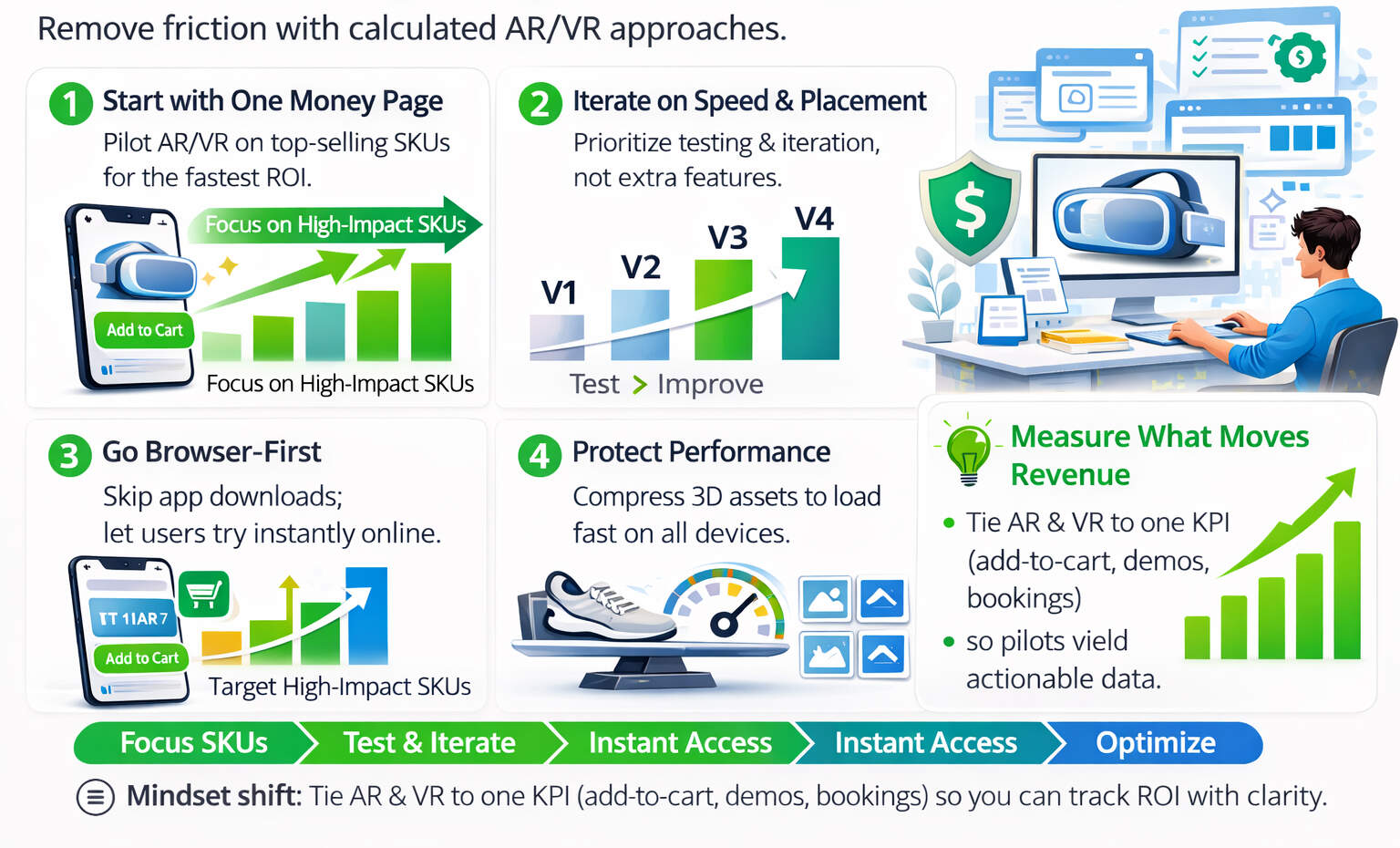
Immersive marketing is no longer “only for big brands,” but it still punishes sloppy execution. The biggest barrier isn’t cost, it’s focus. If you build AR or VR without a specific conversion problem to solve, you’ll end up with something that looks impressive and performs vaguely. The goal is to remove friction where buyers hesitate, not to create a tech showcase. When Augmented Reality in Marketing is tied to one measurable KPI (add-to-cart, demo requests, bookings), it becomes a performance asset you can defend in any budget conversation.
- Start with one money page: Pilot on best-selling or high-return SKUs where uncertainty is already costing you revenue.
- Budget for iteration, not a “big launch”: Version one is rarely the winner: speed, prompts, and placement improve results more than extra features.
- Go browser-first: App downloads are friction. Browser-based experiences lift usage because people can try instantly.
- Protect performance: Heavy 3D assets can become a new bounce trigger. Compress models and test on mid-range phones.
- Design for everyone: Add fallbacks (video, images, or standard product views) so no customer hits a dead end.
Here’s the mindset shift: treat immersive experiences like landing pages. They need clarity, speed, and measurement, not just creativity. For teams building immersive technology for startups, controlled pilots reduce risk and increase learning speed. The brands that win in 2026 won’t be the ones with the most immersive features. They’ll be the ones that ship the right experience, measure it properly, refine it monthly, and scale only what moves revenue.
How AR & VR Impact Conversion Rates
Conversion improvement through immersive tools isn’t about novelty; it’s about reducing cognitive load. When customers can inspect, rotate, place, or experience a product digitally, decision friction decreases. That’s fundamentally how AR improves conversion rates in practical terms.
- Visual confirmation reduces doubt: shoppers can instantly validate size, fit, or compatibility.
- Higher engagement signals stronger intent: Interaction depth becomes a measurable qualification metric.
- Lower return rates: When expectations match reality, post-purchase dissatisfaction drops.
- Stronger trust signals: Interactive previews reinforce transparency and credibility.
- Faster decisions in high-consideration sales: VR demos compress explanation cycles and reduce repetitive sales conversations.
For performance-focused marketers, this means treating immersion as a conversion lever rather than a branding experiment. Measure engaged versus non-engaged user behavior and track revenue per visitor to validate impact. When deployed correctly, Augmented Reality in Marketing improves clarity, and clarity is one of the strongest predictors of conversion performance.
Measuring ROI from AR & VR Campaigns
Start by setting a baseline for your return on investment (ROI) before launching augmented reality (AR) or virtual reality (VR) projects. Track key metrics such as conversion rate, revenue per visitor, lead quality, and time-to-close for your target page. Next, set up website tracking for important actions like opening, interacting, sharing, and clicking calls to action (CTAs). This approach helps you turn immersive experiences into measurable tools that can be justified in budget discussions. If you can’t link interactions to results, you are just funding a demonstration, not a solid strategy.
Focus on measuring how deeply users engage with your virtual showroom marketing, not just how many visit. Track how many complete the experience, which spots they click on, and where they leave. Monitor the rates of adding items to the cart and returning them, based on different user groups. If you can, test results by showing half of the users an immersive experience and not showing it to the other half. This will help you see the true impact. If a holdout test isn’t possible, at least compare users who engage with the experience against those who don’t, and look for consistent differences.
Checklist for Reporting:
– Weekly: Track adoption rate, interaction depth, and CTA clicks.
– Monthly: Measure conversion lift, assisted conversions, and identify drop-off points.
– Quarterly: Assess the impact on returns, support tickets, and pipeline speed.
Keep your dashboards simple and consistent so stakeholders can trust clear trends. Use these insights to enhance prompts, simplify user paths, and create tighter experiences until performance becomes predictable.
Strategic Implementation Plan for Startups
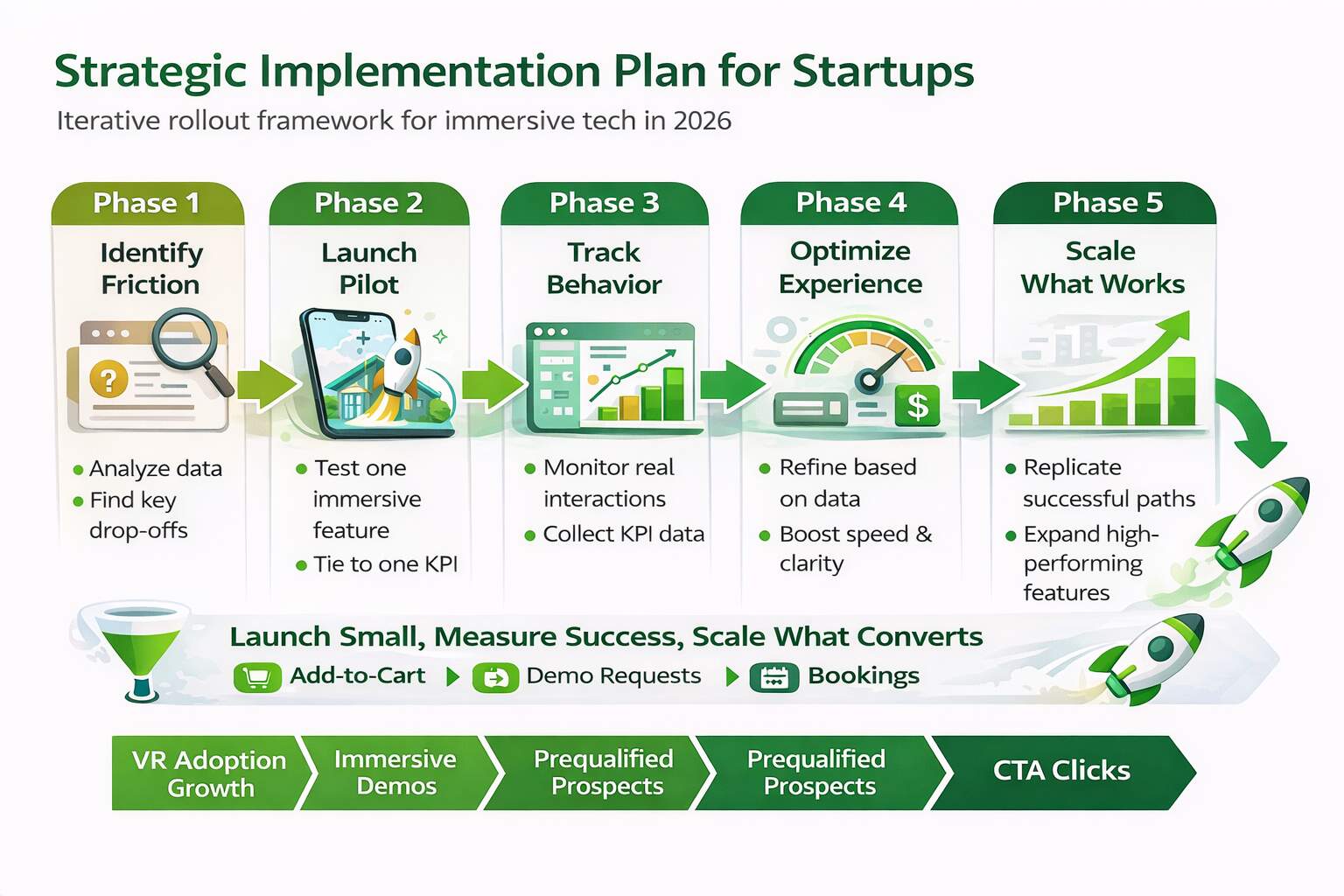
Adopting immersive tech works best when it’s treated like a rollout, not a one-off experiment. Instead of testing random ideas across your site, start with a clear objective and build proof step-by-step. That’s how Augmented Reality in Marketing becomes scalable: you launch small, learn fast, and expand only when the numbers support it. Think of it like performance marketing, your first goal is not perfection, it’s learning what actually reduces hesitation and increases action.
- Phase 1: Identify friction points: Look at your data. Where are people hesitating? Is it on product pages, pricing pages, or demo booking forms? Choose one page where doubt is clearly affecting conversions.
- Phase 2: Launch a focused pilot: Add one immersive feature designed to solve one problem. For example, a “view in your space” button to answer size concerns. Tie it to one KPI, like add-to-cart or lead submissions.
- Phase 3: Instrument tracking events: Measure real behavior. Track how many people open the experience, interact with it, and complete the next step. Without tracking, you’re guessing.
- Phase 4: Optimize based on data: Improve what matters. Adjust button placement, simplify instructions, speed up load times, and remove friction where users drop off.
- Phase 5: Expand strategically: Only scale what shows a clear lift. If it increases conversions or reduces hesitation, replicate it across similar pages or campaigns.
Channel alignment is where many teams slip. If an ad promises “try it in your space,” the landing page must deliver that instantly, without extra scrolling or confusing steps. When your messaging stays consistent across ads, email, and pages, your immersive marketing strategies stop being “experiments” and start behaving like reliable growth assets. In 2026, the real advantage will come from disciplined implementation: build one strong experience, measure it properly, refine it, then scale what works with confidence.
Conclusion: Immersion Is the New Standard
By 2026, immersive technology will no longer be a novelty layer used to attract attention. It serves as a filter to distinguish between serious purchasers and infrequent browsers. Customers are less likely to hesitate when they can see, place, try, or explore before making a purchase. That is the true potential of Augmented Reality in marketing. People aren’t persuaded to want something they don’t need by it. Because uncertainty is eliminated at the precise moment it arises, it enables the right buyers to proceed more quickly.
The most intricate experiences won’t be created by the winning brands. The most practical ones will be constructed by them. A flashy virtual world that doesn’t lead anywhere can be outperformed by a basic augmented reality preview that responds to the question, “Will this fit?” The key is discipline: start small, measure clearly, optimize consistently. When immersive tools are tied to real KPIs, they become revenue drivers, not experimental side projects.
It’s time to take deliberate action if you’re prepared to transform immersive concepts into quantifiable growth. The opportunity lies in correctly implementing trends, not in following them. Let’s create experiences that boost clarity, dispel uncertainty, and grow with assurance.
Build Immersive Experiences That Actually Convert
If you’re ready to move beyond “cool demos” and build AR/VR that actually drives leads and sales, eSign Web Services can help. We’ll map the friction points in your funnel, design the right immersive experience for your audience, and make sure it’s fast, trackable, and built for ROI—not just visuals.
Want a practical rollout plan you can launch in weeks, not months? Request a quote today or call us now, and we’ll help you turn Augmented Reality in Marketing into a measurable revenue channel.
Frequently Asked Questions (FAQs)
Question: Do AR and VR experiences improve customer memory and brand recall?
Answer: Yes, immersive experiences significantly strengthen brand recall because they actively involve the user. Unlike static ads or images, AR and VR require participation, which increases cognitive engagement. When customers explore a product in 3D or interact with a virtual environment, the experience becomes memorable. This deeper engagement improves long-term brand recognition, increases repeat visits, and boosts word-of-mouth referrals. In competitive markets, memorable experiences often influence final buying decisions.
Question: Can AR and VR reduce product return rates for eCommerce businesses?
Answer: One of the main reasons for product returns is unmet expectations. AR allows customers to visualize size, fit, color, and placement before purchasing, reducing uncertainty. When buyers clearly understand what they are getting, they make more confident decisions. This minimizes mismatches between expectation and reality. Lower return rates not only save operational costs but also improve customer satisfaction and long-term trust in the brand.
Question: How can small businesses test AR or VR without large investments?
Answer: Start small and strategic. Implement AR on one high-traffic product page or create a single virtual walkthrough for a key service. Use scalable WebAR platforms that don’t require full app development. Measure performance changes in engagement and conversions before expanding. A phased testing approach reduces financial risk while allowing businesses to gather real data. Immersive marketing should be validated through measurable results, not assumptions.
Question: Does immersive marketing work for service-based businesses?
Answer: Yes, service businesses can use immersive tools to demonstrate results rather than just describe them. For example, a home renovation company can show before-and-after simulations, and a fitness studio can provide virtual class previews. When customers see outcomes clearly, hesitation decreases. Visualizing transformation builds confidence and accelerates decision-making. Immersive previews make intangible services feel tangible and more trustworthy.
Question: Which industries benefit the most from AR and VR marketing?
Answer: Industries where visualization influences buying decisions benefit the most. Real estate, fashion, beauty, home improvement, automotive, tourism, and B2B equipment sectors often see strong results. Any business that relies on demonstrating scale, placement, or experience can gain an advantage. If customers typically ask, “How will this look or work?”, immersive tools can directly answer that question and improve conversion likelihood.
Question: Can AR and VR improve social media marketing performance?
Answer: Yes, immersive experiences can increase engagement rates on social platforms. AR filters, interactive previews, and virtual try-ons encourage users to spend more time interacting with content. This extended interaction signals value to social algorithms, potentially improving visibility. Users are also more likely to share interactive experiences with friends, which expands organic reach. Immersive content creates participation rather than passive scrolling.
Question: How does immersive marketing influence emotional buying decisions?
Answer: Immersive experiences create stronger emotional connections because users feel involved. When customers virtually experience a product, they develop a sense of ownership before purchasing. Emotional engagement often reduces comparison behavior and speeds up decisions. Instead of evaluating purely on price, buyers focus on perceived value and experience. Emotional confidence plays a major role in final conversion outcomes.
Question: Is immersive marketing accessible for older or less tech-savvy users?
Answer: Modern AR experiences are designed to work directly within mobile browsers, making them simple and intuitive. Clear instructions and seamless integration reduce technical barriers. While VR may require headsets, AR-based experiences are widely accessible through smartphones. Businesses should prioritize ease of use to ensure adoption across all demographics. Accessibility is essential for maximizing impact.
Question: What mistakes should businesses avoid when implementing AR or VR?
Answer: The most common mistake is prioritizing novelty over strategy. Immersive tools must solve a real customer problem, such as uncertainty or a lack of clarity. Poor optimization, slow loading speeds, or lack of analytics tracking can reduce effectiveness. Businesses should align AR and VR experiences with clear conversion goals and measurable KPIs. Strategy must guide implementation.
Question: Will immersive marketing become a standard expectation in the future?
Answer: As technology adoption increases and costs decrease, immersive experiences will become more common. Customers are already growing accustomed to interactive shopping and virtual previews. Businesses that adopt early gain competitive positioning and brand differentiation. Over time, immersive marketing may shift from being innovative to being expected, particularly in highly competitive industries where experience influences buying decisions.
Author Details

Ashwani Kumar Sharma
Ashwani has been actively involved in SEO services since 2005. His expertise and distinctive work approaches have made him one of the most experienced and trusted SEO experts in the industry. He is a certified SEO and Google Ads professional. He also has strong business development skills in advanced SEO, PPC, and digital marketing strategies.


