



Entity-Based SEO Explained: How Google Understands Brands, People & Topics

Key Takeaways
- Google treats authors like entities; make your bylines consistent so your expertise connects everywhere.
- Add a real bio with proof, not fluff, so readers and Google trust you faster.
- Use one author name format across site, socials, and profiles to avoid identity confusion.
- Write naturally about your experience in-topic; semantic signals grow when you explain clearly.
- Build topic clusters under the same author to strengthen authority instead of scattering content.
- Link to an author page with credentials, work examples, and clear areas of focus.
- Keep author info updated; freshness and consistency help maintain long-term trust signals.
If you have ever published a page that should have ranked; solid keywords, clean structure, even decent backlinks, but still watched it stall, you are not imagining things. Search no longer rewards pages simply for saying the “right words” in the “right places.” Something deeper is happening behind the scenes, and it is quietly changing how visibility is earned.
Google now spends far more effort trying to understand what a page is about than which phrases appear on it. It looks for real-world meaning: who is being discussed, what they do, how topics connect, and whether that understanding holds up across the web. This explains why some brands show up repeatedly for related searches they never explicitly targeted, while others keep rewriting pages without moving the needle.
At the center of this shift is entity-based SEO. Instead of treating content as isolated blocks of text, Google identifies brands, people, locations, and topics as recognizable entities, then maps their relationships. That understanding allows search results to feel more confident, contextual, and increasingly answer-driven.
This matters even more today because a growing share of searches never result in a click. Users form opinions, shortlist options, and make decisions directly on the results page. If Google cannot clearly understand what your content represents, your brand is filtered out before visibility even begins.
Understanding Entity-Based SEO
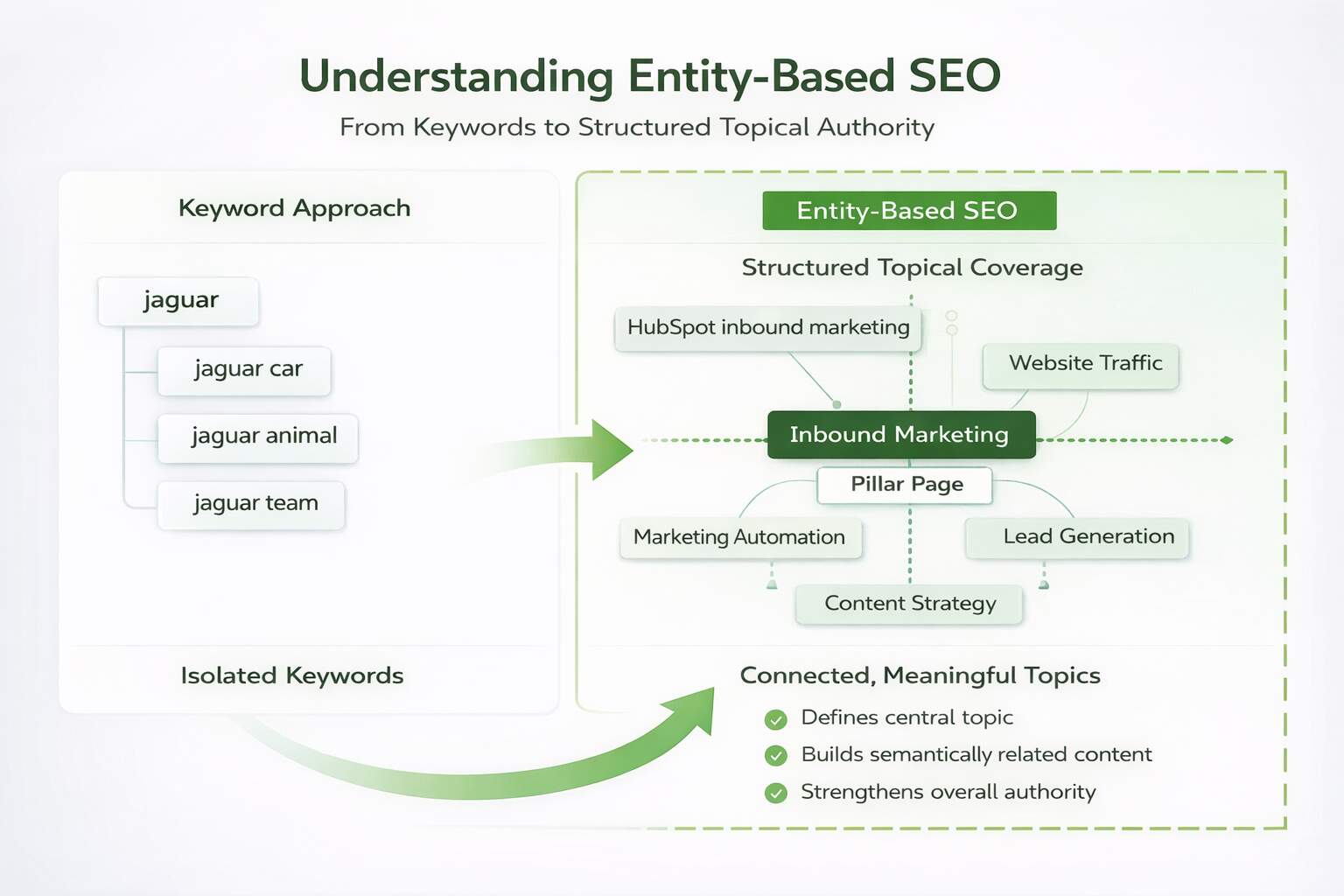
Entity-based SEO shifts optimization away from chasing isolated phrases and toward helping search engines understand real-world meaning. Instead of asking, “Which keywords are present?”, Google increasingly asks, “What is this about, and how does it connect to everything else I already know?” This approach emphasizes clarity, consistency, and relationships so content can be interpreted accurately at scale.
- Entity-based SEO focuses on defining what a page, brand, or topic represents, rather than relying on repeated keyword usage.
- An entity is a uniquely identifiable thing, such as a business, person, product, service, location, or concept, that Google can recognize consistently across the web.
- Entities act as stable references, remaining the same even when wording, phrasing, or language changes.
- Keywords function as text patterns, while entities represent meaning and identity, which is a core principle of semantic SEO.
- These entities and their attributes are stored and connected within Google’s systems through knowledge graph SEO.
- Clear entity connections help Google evaluate relevance, authority, and context, strengthening long-term brand authority SEO instead of short-term rankings.
When entities are clearly defined and consistently reinforced, Google can interpret content with greater confidence. This makes it easier for pages to rank for related searches, support broader topic visibility, and remain stable as search algorithms continue to evolve.
Brands, People & Topics in Google
Google does not “read” a website the way a human does. It builds understanding by assembling signals from many places, then testing whether those signals tell a consistent and reliable story. Brands, people, and topics are evaluated slightly differently, but all depend on clarity, consistency, and reinforcement across the web. This is the practical foundation of entity-based SEO in modern search.
How Google Understands Brands
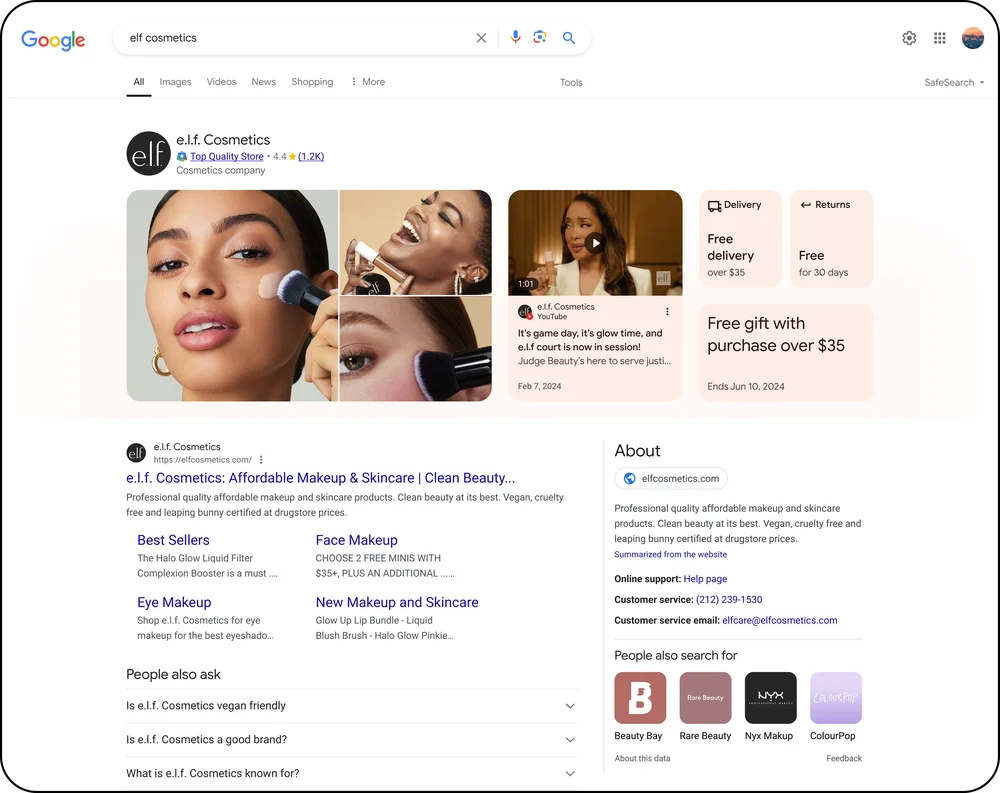
Google doesn’t “understand” brands the way people do—it verifies them through patterns. When your name, services, and positioning appear consistently across your site and the wider web, Google can confidently treat you as one clear entity. That confidence improves relevance, trust, and visibility through Google entities SEO.
- Google looks for one clear identity connected to your business name, what you sell, and how you position it.
- Using the same brand name and consistent naming formats helps Google merge signals into one entity, not multiple “versions” of you.
- Repeating stable service descriptions (what you do + who it’s for + outcome) makes your relevance easier to confirm across pages.
- A consistent value proposition (your “why choose us”) strengthens recognition and reduces ambiguity in competitive SERPs.
- Consistency across your website, Google Business Profile, and citations is a core requirement of Google entities SEO.
- When these signals align, Google can confidently connect your brand to industries, use cases, and commercial intent, improving long-term brand authority SEO.
Brand clarity is an SEO multiplier. If your messaging changes across pages or platforms, Google’s entity signals fragment, and your authority weakens. Standardize your name, service language, and positioning across your website, profiles, and citations. Strong consistency powers Google entities SEO and helps Google rank you with confidence.
How Google Understands People
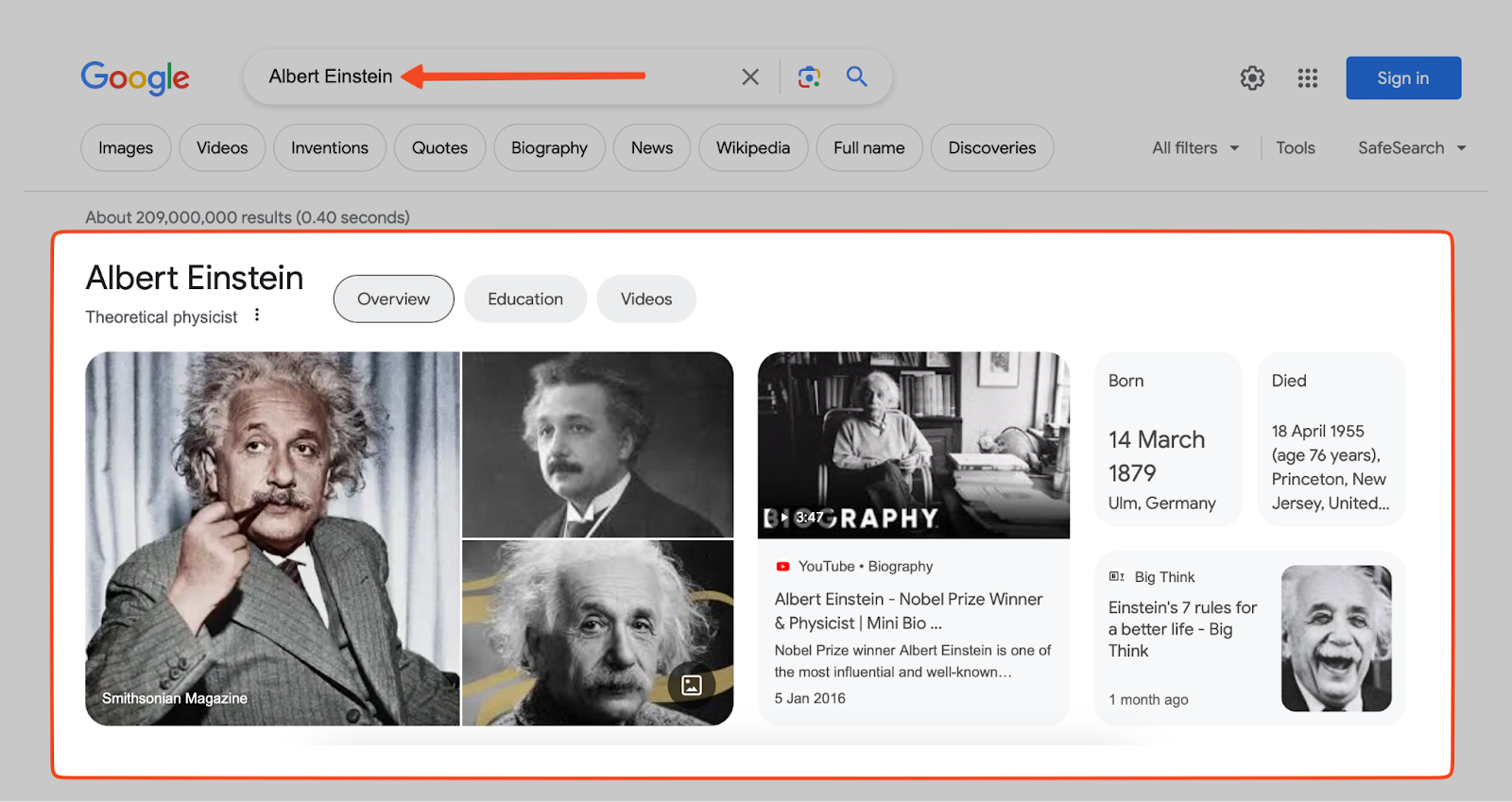
Google doesn’t just read content—it identifies who is behind it. When authors are clearly named, consistently described, and repeatedly linked to specific topics, Google can treat them as credible entities. Strong author signals reduce ambiguity, improve trust, and support E-E-A-T style evaluation in modern search.
- People are treated as entities with defined roles, expertise areas, and topical associations.
- Clear author attribution (name + author page + byline) helps Google understand who is responsible for the content.
- Bios with credentials (experience, niche, proof) strengthen why their perspective matters on that topic.
- Consistent references to the same person across pages help Google consolidate identity, not fragment it.
- When an author is repeatedly connected to a subject using natural, explanatory language, Google reinforces trust and relevance through semantic SEO.
- Linking authors to related content clusters builds stronger topic-author alignment over time.
If your content has expertise but your authors are invisible, Google can’t confidently assign credibility. Make authors discoverable, consistent, and clearly tied to the topics they write about. Strong person-entity signals—bylines, bios, author pages, and topic alignment—help search engines trust the source, not just the words.
How Google Understands Topics
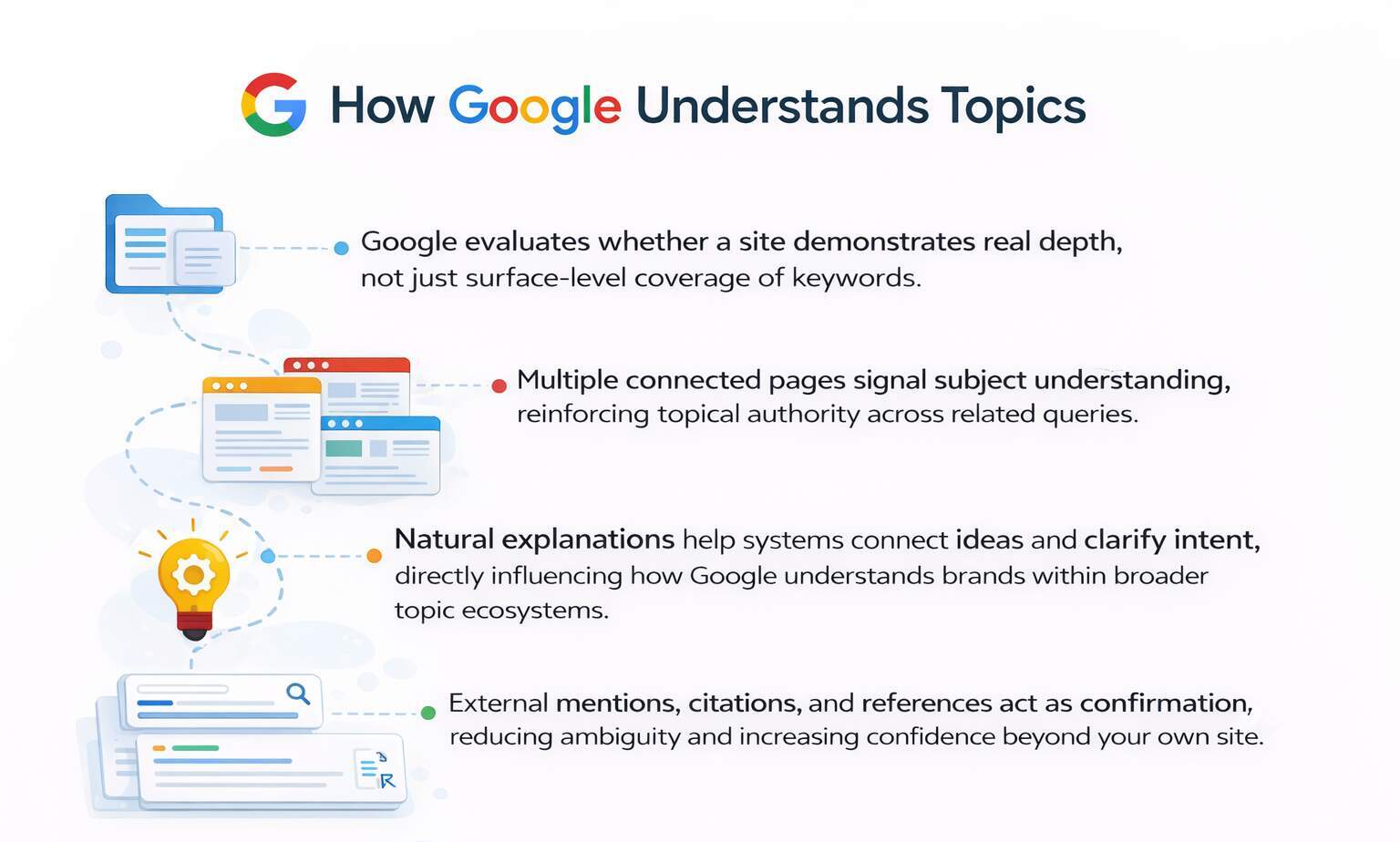
- Google evaluates whether a site demonstrates real depth, not just surface-level coverage of keywords.
- Multiple connected pages signal subject understanding, reinforcing topical authority SEO across related queries.
- Natural explanations help systems connect ideas and clarify intent, directly influencing how Google understands brands within broader topic ecosystems.
- External mentions, citations, and references act as confirmation, reducing ambiguity and increasing confidence beyond your own site.
Entity-Based SEO vs. Traditional SEO
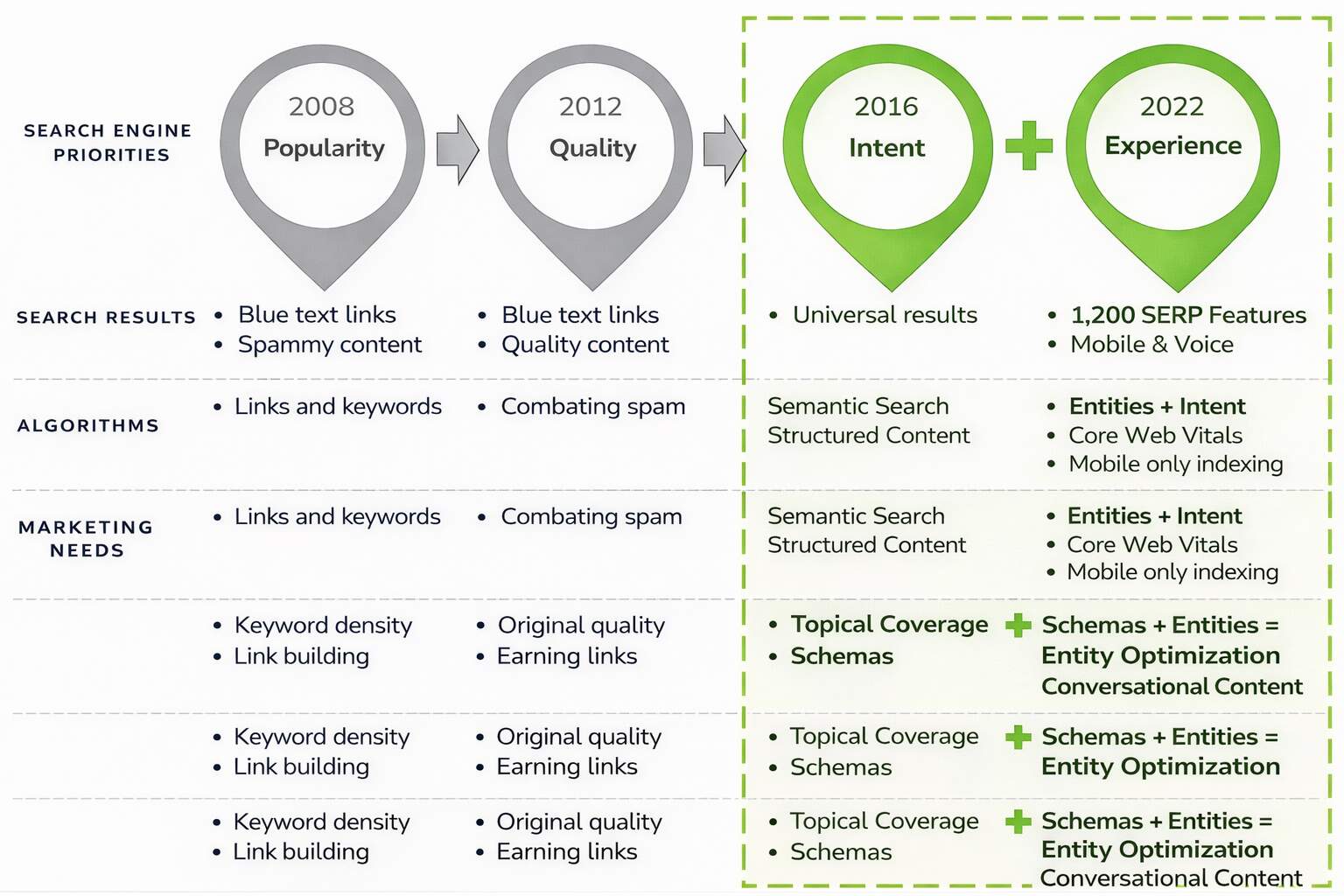
Traditional keyword optimization is not obsolete, but it no longer operates in isolation. Google still uses keywords to understand query intent, yet rankings are no longer decided by wording alone. What matters more is whether Google can clearly understand what a page represents, who it is for, and how it connects to broader topics. This shift explains why two pages targeting the same keyword can perform very differently, even when their on-page optimization looks similar.
As search results become more contextual and answer-driven, Google favors pages that demonstrate clarity, depth, and consistency. Keyword-focused pages often succeed at triggering discovery, but they struggle to earn trust if they lack broader context. Entity-focused pages, on the other hand, help Google reduce ambiguity, which is essential when results are summarized, blended, or shown without a traditional click.
| Traditional Keyword SEO | Entity-Based SEO |
| Focuses on exact keyword phrases and specific word matching to trigger relevance | Focuses on meaning, entities, and concepts to understand what the content represents |
| Optimizes pages in isolation, treating each URL as a standalone ranking opportunity | Builds interconnected topic ecosystems where pages support and reinforce each other |
| Measures success by rankings for single terms or narrow keyword targets | Measures success by topical visibility, coverage breadth, and overall trust |
| Relies on keyword density and placement rules within titles, headings, and body text | Relies on contextual clarity, explanations, and relationships between concepts |
| Sensitive to wording changes and algorithm updates that affect phrase matching | More resilient during algorithm changes due to stronger understanding signals |
| Optimized primarily for blue-link results and traditional organic listings | Optimized for AI summaries, panels, rich results, and answer-driven SERPs |
This difference is reflected in user behavior. The top five organic results capture over 69% of clicks. These pages typically succeed not because they repeat phrases well, but because Google understands them with confidence.
A modern SEO strategy accepts that keywords open the door, but entity-based SEO determines whether Google trusts your content enough to surface it broadly, consistently, and beyond exact-match searches.
How to Optimize for Entity-Based SEO
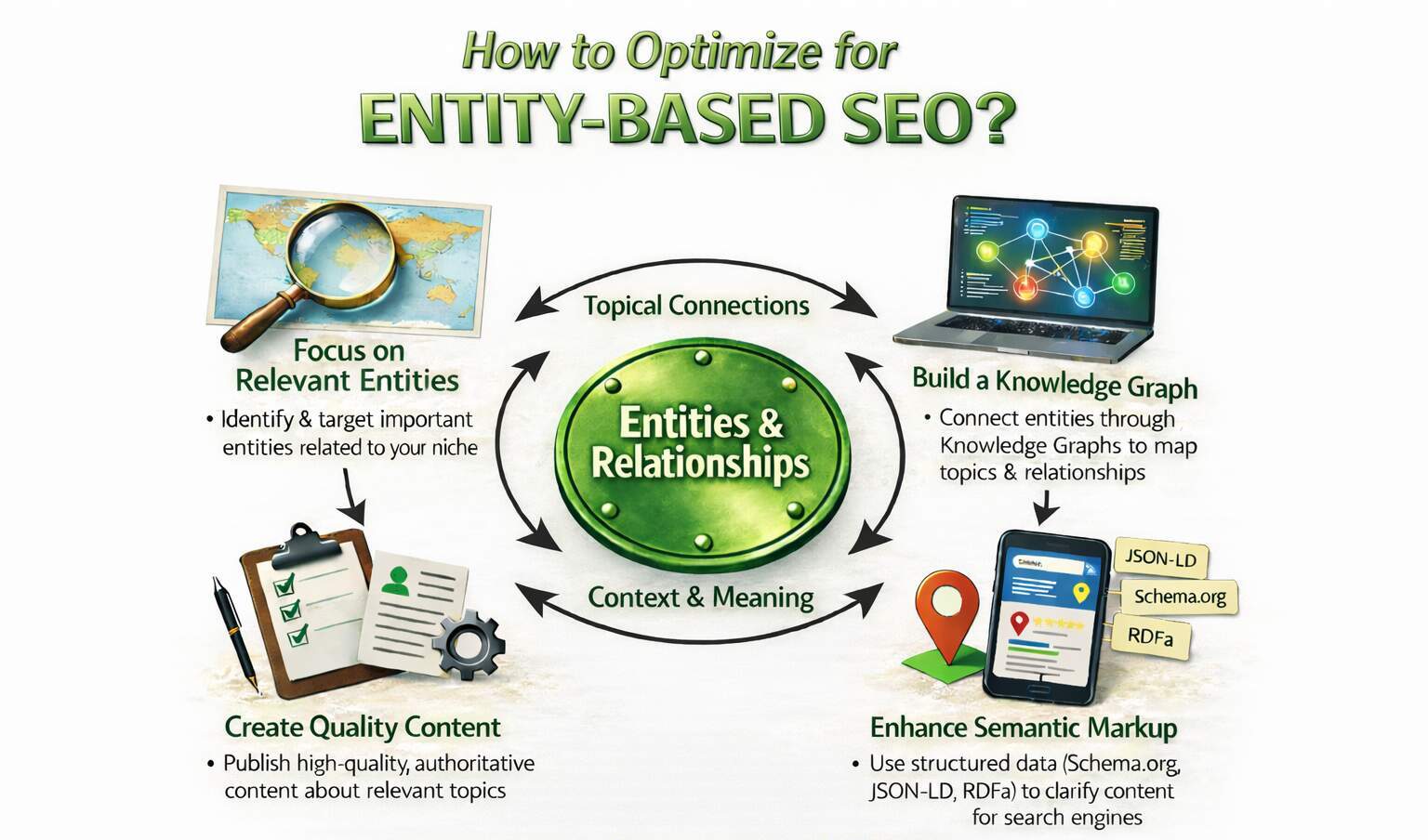
Optimizing for entity understanding is not about chasing trends or rewriting pages every time keywords shift. It is about creating a clear, consistent structure that helps search engines confidently understand who you are, what you offer, and how your content connects. This practical framework is designed for businesses that want stable, long-term visibility by reducing ambiguity and strengthening topical clarity across their website.
Step 1: Define Your Core Entities
Start by clearly defining your core entities: your brand, services, audience, and primary topics. These definitions should be consistent across your homepage, service pages, About section, and supporting content. Using the same names, descriptions, and positioning helps search engines recognize these elements as a single, unified concept, which directly supports entity optimization and prevents fragmented understanding.
Step 2: Build Topical Clusters
Once your core entities are defined, build topical clusters around them. Publish supporting content such as definitions, use cases, comparisons, and frequently asked questions that naturally connect to your main services or themes. This approach reinforces relationships between topics and demonstrates depth, making it easier for search engines to interpret subject relevance and authority.
Step 3: Use Structured Data Where Relevant
Structured data provides an additional layer of clarity. Apply structured data SEO for elements like organizations, people, products, and FAQs where appropriate. Google confirms that structured data helps systems better understand content and enables enhanced search features when implemented correctly
Step 4: Write for Understanding, Not Density
Focus on explaining ideas clearly rather than repeating terms to meet arbitrary density targets. Well-structured explanations improve comprehension for users and help search engines accurately interpret meaning, intent, and relationships between concepts.
Step 5: Strengthen External Signals
Finally, reinforce your entity signals beyond your website. Earn consistent mentions, citations, and references from relevant and credible sources that associate your brand with its core topics. These external confirmations strengthen trust and reduce ambiguity across the wider web.
Warning! Schema and structure won’t fix weak content or confusing messaging. If your ideas aren’t clear and consistent, technical tweaks alone won’t help much.
Common Entity-Based SEO Mistakes to Avoid
Entity-based SEO does not fail because the concept is flawed. It fails when businesses apply surface-level tactics without fully committing to clarity and consistency. These mistakes usually look harmless in isolation, but together they prevent Google from forming strong, confident connections between your brand, content, and topics. Avoiding the following issues is essential if you want search engines to trust and understand what your site represents.
-
Chasing Keywords Without Context
Focusing only on keyword targets often leads to content that technically “matches” search terms but fails to explain anything meaningful. Pages built this way tend to repeat phrases without defining concepts, relationships, or intent. As a result, Google struggles to understand how the content fits into a broader topic, limiting relevance and long-term visibility even if rankings briefly improve.
-
Inconsistent Brand Information
Using different brand names, service descriptions, or positioning across pages and platforms creates confusion for search engines. When Google encounters conflicting signals, it cannot confidently identify a single, trusted entity. This inconsistency weakens recognition, reduces trust, and makes it harder for your site to be associated with its primary topics or industry.
-
Thin Content Clusters
Publishing standalone articles without supporting content limits topical depth. Without related pages reinforcing definitions, use cases, and subtopics, Google cannot map authority around a subject. Thin clusters make content easier to ignore and harder to connect to broader search intent.
-
Overusing Schema Without Substance
Structured data helps clarify content, but it cannot replace quality explanations. Adding schema to weak or unclear pages provides minimal benefit. Without strong content underneath, structured data has little context to reinforce.
The Future of Search Is Entity-First
Search is steadily shifting away from ranking pages based purely on keywords and toward systems that prioritize understanding. Google’s results increasingly aim to answer questions, summarize perspectives, and guide decisions without requiring users to click through multiple links. In this environment, clarity becomes more valuable than clever optimization. Search engines want to understand what a brand represents, how topics connect, and whether that understanding remains consistent across the web. When clarity is missing, even technically optimized pages struggle to earn sustained visibility.
This evolution explains why entity-based SEO is becoming foundational rather than optional. Google relies on identifiable entities to reduce uncertainty when generating AI-driven summaries, featured explanations, and blended results. Pages that clearly define concepts, demonstrate depth, and reinforce relationships across content are easier for search systems to trust. Over time, these pages surface for broader queries, even when the exact wording was never targeted.
As AI-powered search expands, visibility is increasingly granted to sources that feel reliable enough to summarize. That decision depends on how well Google can model intent, context, and authority. Brands that invest in explanation, consistency, and topical depth make themselves easier to reference without distortion. The future of search favors entities that are understandable, not just indexable, because understanding is what allows systems to confidently recommend, summarize, and prioritize information.
Performance Tracking Plan
30 Days
- Monitor impressions and query variety in Search Console
- Check crawl and indexing consistency across key pages
- Identify early signs of broader keyword coverage beyond primary targets
- Review internal link discovery and crawl paths
- Validate structured data implementation and error-free status
60 Days
- Track growth in non-branded and branded query coverage
- Review engagement signals across topic clusters
- Compare ranking stability between clustered and standalone pages
- Measure changes in average position for related query groups
- Evaluate click behavior from informational versus navigational queries
90 Days
- Assess ranking stability during core or broad updates
- Measure AI-result visibility and SERP feature inclusion
- Analyze long-tail query growth driven by entity clarity
- Review brand-led search trends and recognition signals
- Identify content gaps limiting further topical expansion
Wrapping It Up
Search visibility today is less about manipulating signals and more about earning understanding. Google is no longer just ranking pages; it is evaluating whether a brand, person, or topic can be trusted to represent information accurately. This shift places clarity at the center of sustainable SEO performance. Businesses that define who they are, explain what they do, and consistently reinforce their topics create fewer gaps for search systems to misinterpret.
This is where entity-based SEO becomes a competitive advantage. Instead of reacting to every algorithm update or keyword trend, entity-focused strategies build durable visibility by aligning content with how search engines actually process information. Over time, this approach leads to broader keyword coverage, more stable rankings, and stronger inclusion in AI-driven search experiences. It also reduces dependency on short-term tactics that lose effectiveness as search evolves.
For small businesses and growing brands, the opportunity is clear. You do not need to publish endlessly or chase every phrase. You need to be understandable. That means consistency, depth, and intent-driven explanations that help both users and search systems see the same story.
Stop Guessing. Start Being Understood.
If your rankings fluctuate, visibility drops after updates, or your content never appears in AI-driven results, the issue isn’t effort—it’s alignment. eSign Web Services helps brands replace keyword chasing with clarity-driven SEO that search engines actually trust. By structuring content and entity signals the way Google understands them, they turn fragmented pages into durable authority.
Contact our team today or get a free quote and see how entity-focused SEO can deliver visibility that lasts.
Frequently Asked Questions
Question: What is entity-based SEO in simple terms?
Answer: Entity-based SEO is about helping Google clearly understand what your content represents, not just which keywords it uses. Instead of focusing on repeated phrases, it focuses on defining real-world things like brands, people, services, and topics. When Google understands these entities and their relationships, it can match your content to relevant searches more confidently, even when users phrase queries differently or use related terms instead of exact keywords.
Question: How does entity-based SEO differ from traditional keyword SEO?
Answer: Traditional keyword SEO focuses on matching specific phrases to search queries, often relying on exact wording. Entity-based SEO focuses on meaning, context, and relationships between topics. Keywords still matter, but they act as signals within a broader system. Entity-based SEO helps Google understand what your business or content is, not just what words appear on a page, resulting in more stable and flexible visibility over time.
Question: Do small businesses really need entity-based SEO?
Answer: Yes, especially small businesses and startups. Entity-based SEO helps Google recognize your brand and services clearly, even if you lack high domain authority. When your content consistently defines who you are and what you do, you can compete without aggressive keyword tactics. This approach rewards clarity and relevance, which benefits businesses that focus on expertise and consistency rather than large content volumes or heavy link-building.
Question: Is entity-based SEO the same as semantic SEO?
Answer: They are closely related but not identical. Semantic SEO focuses on understanding search intent and topic meaning, while entity-based SEO focuses on identifiable concepts like brands, people, locations, and services. Semantic SEO helps explain what a topic means, whereas entity-based SEO helps Google recognize what or who is being discussed. In practice, effective modern SEO uses both approaches together to improve understanding and relevance.
Question: How does Google identify entities on a website?
Answer: Google identifies entities through consistent naming, contextual language, internal linking, structured data, and external references. When your website clearly explains your business, services, and topics using consistent terminology, Google can map those concepts as entities. Mentions from other websites and accurate business information across platforms also help reinforce entity recognition and reduce confusion about what your brand represents.
Question: Does schema markup guarantee better rankings with entity-based SEO?
Answer: No, schema markup does not guarantee better rankings. It helps search engines understand your content more clearly, but it cannot replace strong content or authority. Schema acts as a supporting signal that reinforces entity relationships. If your content is thin or unclear, structured data alone will not improve performance. Schema works best when paired with well-written, informative content and consistent entity signals across your site.
Question: How long does entity-based SEO take to show results?
Answer: Entity-based SEO usually delivers gradual results rather than immediate ranking jumps. Google needs time to build confidence in your brand and topics by observing consistency across pages and external sources. Early signs often include broader keyword visibility, improved relevance, and more stable rankings. For most businesses, noticeable impact appears over several months as entity relationships become clearer and more trusted.
Question: Can entity-based SEO help with AI-powered search results?
Answer: Yes. AI-powered search systems rely heavily on understanding entities and their relationships. When your content clearly defines topics, brands, and concepts, it becomes easier for AI systems to summarize, reference, or recommend it. Entity-based SEO improves the likelihood that your content is included in AI-generated answers because it reduces ambiguity and provides structured, trustworthy context for automated systems.
Question: What are common mistakes businesses make with entity-based SEO?
Answer: Common mistakes include inconsistent brand naming, publishing isolated articles without topical depth, and overusing keywords without explaining concepts clearly. Some businesses rely too heavily on schema while neglecting content quality. Others fail to align internal pages around core topics. These issues prevent Google from forming strong entity connections, limiting visibility even if traditional SEO elements appear technically correct.
Question: How can a startup begin using entity-based SEO effectively?
Answer: Startups should begin by clearly defining their brand, services, and core topics across their website. Use consistent language, create supporting content around main subjects, and explain concepts thoroughly. Add structured data where appropriate, but prioritize clarity in writing. Over time, strengthen external mentions and citations. This approach builds entity recognition steadily and supports long-term visibility without relying on short-term keyword tactics.
Author Details

Ashwani Kumar Sharma
Ashwani has been actively involved in SEO services since 2005. His expertise and distinctive work approaches have made him one of the most experienced and trusted SEO experts in the industry. He is a certified SEO and Google Ads professional. He also has strong business development skills in advanced SEO, PPC, and digital marketing strategies.


