



How to Use AI in Google Ads without Giving Up Campaign Control

Key Takeaways
- AI and automation are now baked into Google Ads, so the practical question is not if to use AI but where to automate and where to keep human control.
- AI is able to process a massive amount of data about auctions, audiences, conversions and context at a speed and scale that would be impossible for a human advertiser to do manually.
- Automation is only as good as the goals, conversion data, values, budgets and constraints you have entered into it.
- Advertisers should retain control over business objectives, campaign economics, conversion definitions, budget allocation, creative strategy, brand positioning, and lead-quality assessment.
- More automation does not automatically mean better performance.
- Conversion tracking is the foundation of effective Google Ads automation. If the wrong actions are treated as valuable conversions, AI can optimize efficiently toward the wrong outcome.
- Lead-generation advertisers should distinguish between conversion quantity and qualified lead quality.
- Clear commercial objectives such as acceptable CPA, ROAS, CAC, margins and customer value should guide smart bidding.
- AI-generated creativity should speed up testing, not replace brand and fact-checking.
- Best Google Ads operating model = human-led strategy + high quality data + AI assisted execution + continuous human oversight.
Google Ads is becoming increasingly automated. Google Ads can now adjust bids, expand reach, assemble ad combinations, and distribute spending across different channels with far less manual input. That can save time and uncover opportunities a busy campaign manager might miss. It can also make advertisers uneasy. When automation starts making more decisions, how do you know those decisions support your business? A campaign can report more conversions while bringing in enquiries your sales team cannot use. Lower acquisition costs can look encouraging until customer quality falls. The challenge is deciding what to delegate and what requires your judgement.
In this blog we will explain how to use AI in Google Ads while keeping control of objectives, budgets, conversion tracking, creative direction and commercial performance. You’ll learn where automation can help, which safeguards matter and how to assess results outside the dashboard. With real-world examples and a framework that will help you make better decisions as your campaigns evolve.
What AI Actually Does Inside Google Ads
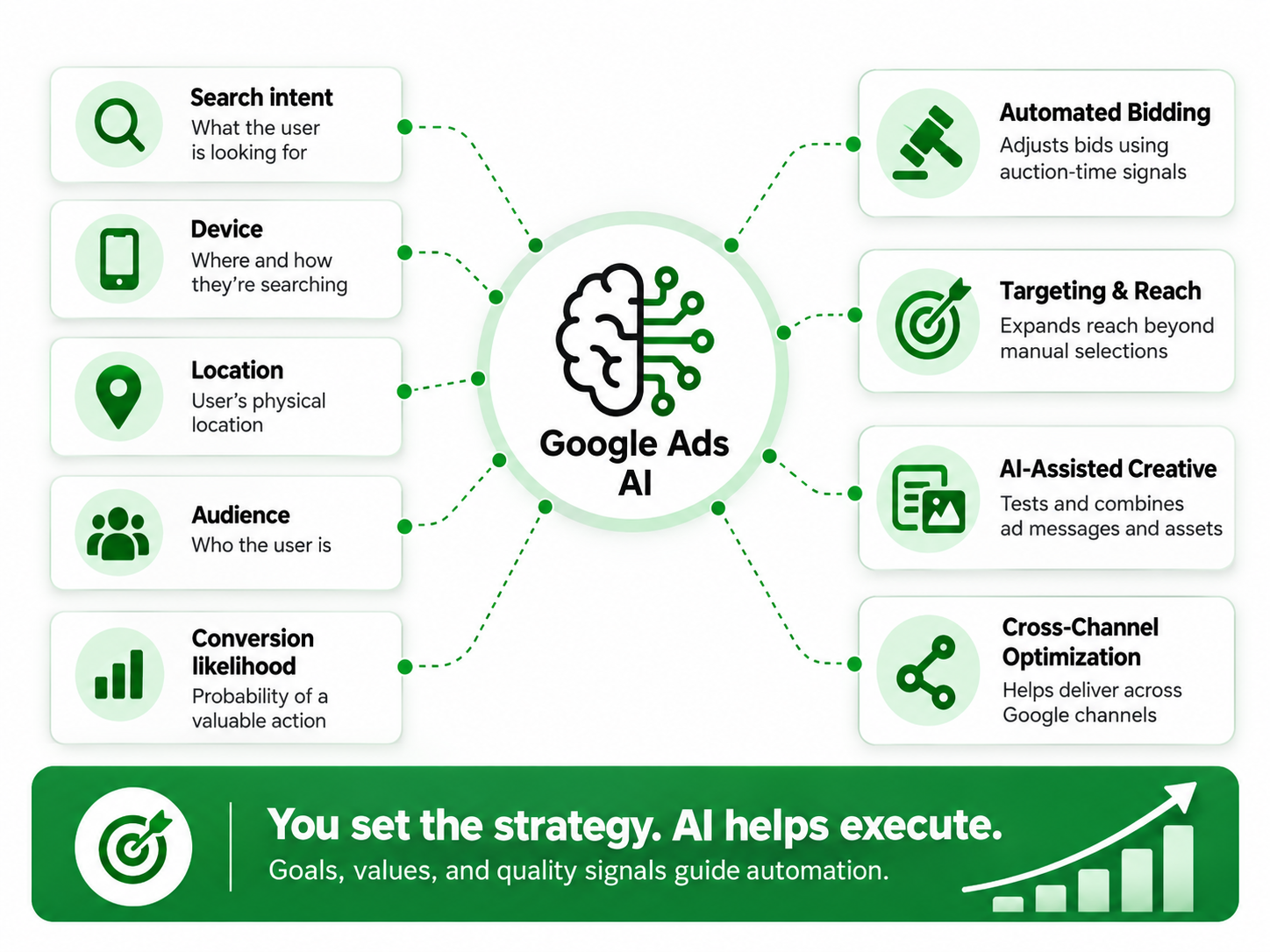
Google Ads AI is made of a variety of systems that impact bidding, targeting, creative assets and delivery. Knowing what roles they play can help you decide what options to turn on and what results to look into more deeply.
Automated Bidding
Google Ads Smart Bidding uses a variety of signals available at auction time to predict a likely conversion or the amount of conversion value that can be generated, and then adjust bids according to these predictions. The strategies are maximise Conversions, maximise Conversion Value, Target CPA and Target ROAS. The advertiser sets the objective and budget, and the system determines how to bid for each individual query. These strategies target rather than guarantee a certain outcome for each conversion.
Automated Targeting and Reach
Some campaign features can reach people beyond your initial keyword or audience selections. For example, AI Max for Search campaigns can expand search matching using information from keywords, assets, and landing pages. Expansion may uncover relevant demand, but advertisers still need to examine whether the resulting traffic fits their services and customer profile.
AI-Assisted Creative
AI features can suggest or generate text and visual assets, while responsive search ads assemble combinations of supplied headlines and descriptions. These are different functions: generating a new message is not the same as selecting an existing one. Both require suitable inputs and a review of what customers actually see.
Cross-Channel Campaign Optimization
Performance Max can serve across Google inventory, including Search, YouTube, Display, Discover, Gmail, and Maps. It uses your goals and inputs to guide delivery across these environments. That reduces the need to manage every placement separately, but channel distribution remains something to inspect when evaluating results.
The Biggest Mistake: Confusing Automation with Strategy
Automation can make decisions quickly. It cannot independently know everything that makes a customer valuable to your business. A contractor may prefer larger commercial projects over small repair enquiries. A retailer may need to prioritise products with healthy margins rather than popular items that barely cover fulfilment costs. Neither preference becomes a useful advertising instruction until the account reflects it through goals, values, messaging, and campaign structure.
If your campaign rewards every inquiry equally, the system has little reason to distinguish a suitable buyer from someone requesting a service you do not provide. It may achieve the assigned conversion objective while disappointing the sales team. A sound Google Ads AI strategy begins with a clear definition of success. Specify which customers you want, what action indicates genuine interest, and what you can afford to pay. Then configure automation to support those decisions.
Where Advertisers Should Keep Control
Effective AI Google Ads management requires clear ownership. Someone must remain accountable for what the campaign is trying to achieve and whether the resulting customers justify the investment.
Business and Campaign Objectives
Choose the commercial priority before selecting the bidding approach. Generating enquiries, acquiring profitable customers, increasing repeat purchases, and entering a new market are different objectives. A campaign designed for one should not automatically be judged against another.
Budget Allocation
Management should decide how much the business can invest and which services or markets deserve that investment. Forecasts can inform this decision, but they do not account for every cash-flow constraint, staffing limitation, or competing business expense.
Conversion Definitions
A purchase, qualified enquiry, brochure download, and page visit represent different levels of intent. Decide which actions deserve bidding priority. Counting every interaction as an equally valuable conversion can obscure the difference between customer interest and commercial progress.
Brand and Creative Strategy
Humans should define the offer, positioning, tone, and claims the business can support. AI can develop variations within those boundaries. It should not determine whether your company competes on specialist expertise, affordability, speed, or another promise without a considered marketing decision.
Commercial Economics
Understand how advertising costs connect to customer acquisition. Cost per click affects lead cost, but qualification and close rates determine how many leads become customers. Customer acquisition cost must then be assessed against margins and customer value. Google Ads campaign control depends on understanding this full relationship.
Conversion Tracking Is the Foundation of AI-Powered Google Ads
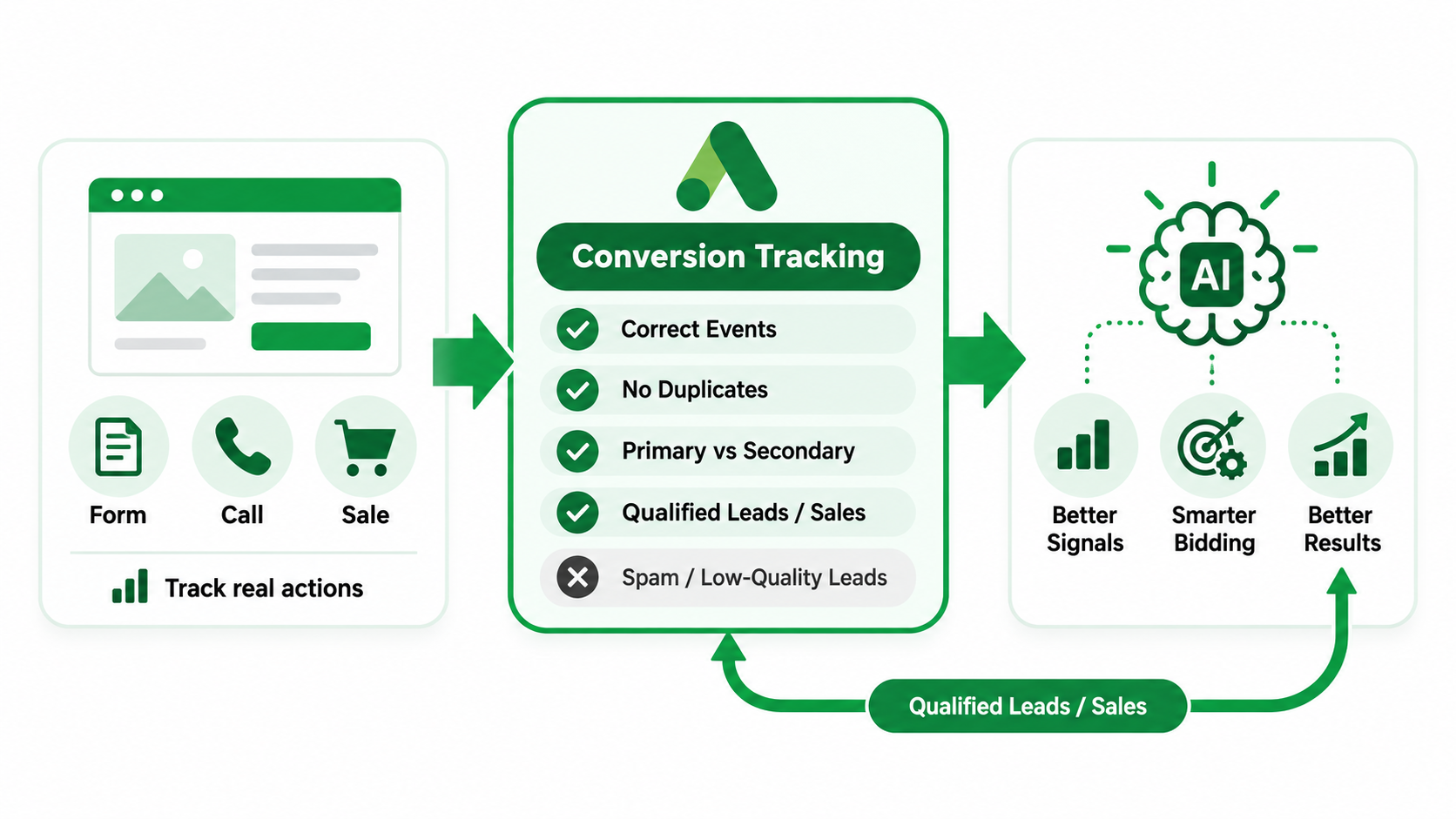
Conversion tracking tells the system which actions count as success. Before expanding automation, check that important events are recorded correctly and that reported outcomes match what actually happens in the business.
AI Learns From the Conversions You Define
A form submission is useful evidence, but it does not necessarily represent a potential customer. Spam, duplicate enquiries, job applications, and unsuitable requests can inflate conversion totals. Check that tracking fires after a successful action rather than a button click alone. Also investigate duplicate events, particularly when the same outcome is measured through multiple integrations.
Separate Primary and Secondary Actions
Primary conversion actions are used for bidding when their associated goal is selected. Secondary actions generally support observation rather than bidding, making them useful for measuring less important interactions. An important exception applies to custom goals: actions included in them can influence bidding even when labelled secondary. Review both the action settings and the goals each campaign actually uses. A label alone does not explain the complete configuration.
Feed Better Business Outcomes Back Into Google Ads
Where feasible, connect advertising with qualified leads, completed sales, revenue, or meaningful conversion values. Offline outcomes can help close the gap between an initial website enquiry and the eventual customer result. Choose a signal your team can record consistently and return promptly. A deeper conversion is useful only if its definition, measurement, and reporting are dependable.
How to Use Smart Bidding without Losing Financial Control
Automated bidding and spending limits perform different jobs. Your bidding strategy influences how the campaign competes; your budget governs the amount available to spend.
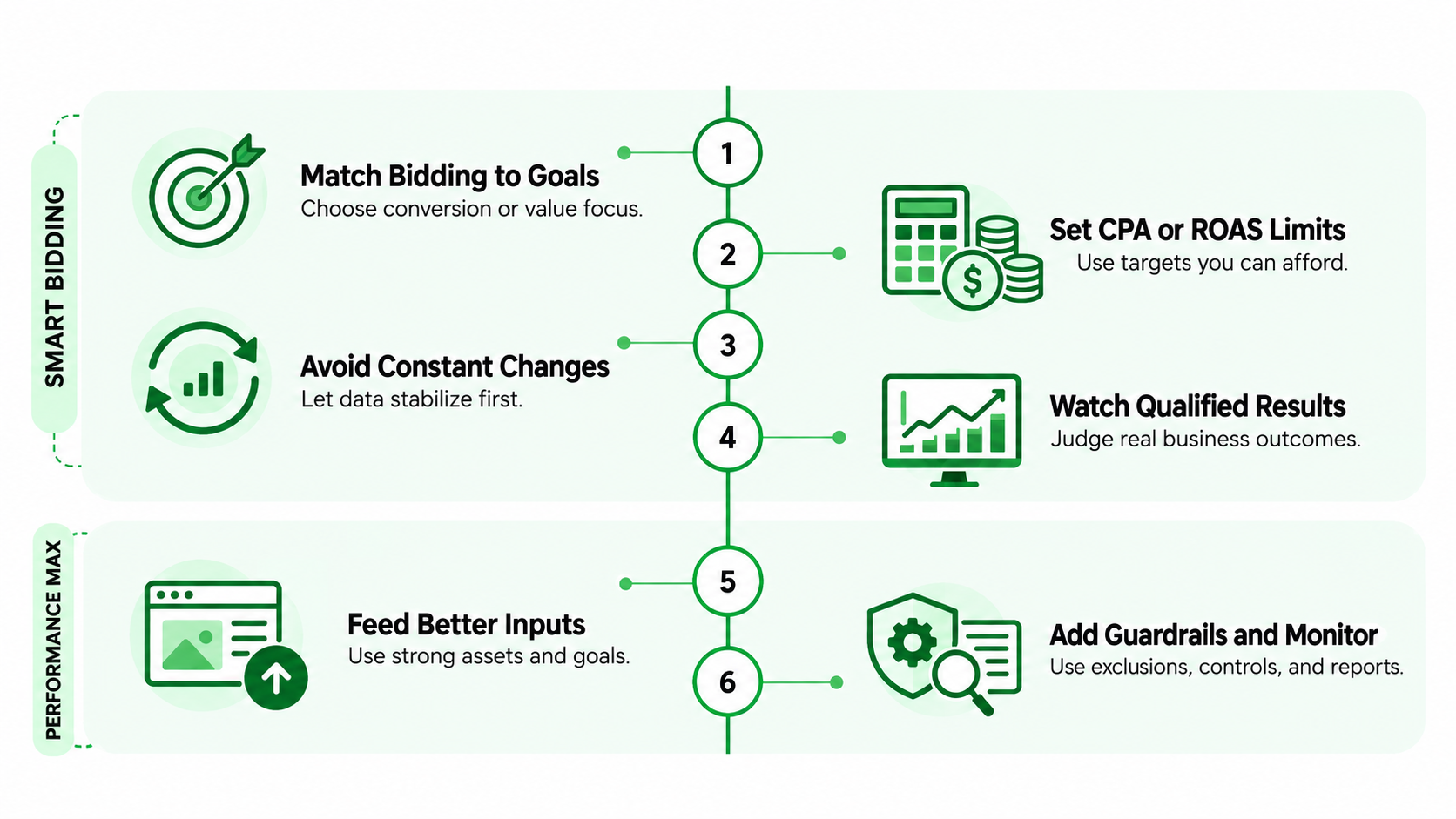
Select the Strategy Based on the Business Objective
Conversion-focused strategies suit objectives where the number of meaningful actions matters. Value-focused strategies are more appropriate when recorded values reliably distinguish more valuable outcomes. Avoid adopting value-based bidding simply because it sounds more advanced. Arbitrary values can misrepresent your priorities just as easily as poorly chosen conversion actions.
Know Your Acceptable CPA or ROAS
Cost per acquisition, or CPA, should reflect what you can afford for the conversion being measured. Return on ad spend, or ROAS, compares recorded conversion value with advertising spend; it does not automatically represent profit. Remember that an average daily budget is not a strict daily cap. For most campaigns, daily charges can reach twice that amount, subject to applicable monthly limits. Account for this variation when planning cash flow.
Don’t Overreact to Short-Term Fluctuations
Allow for the time between an ad interaction and its eventual conversion. Recent results may look weaker because some outcomes have not yet been recorded.
Avoid changing budgets, targets, goals, and creativity simultaneously. Document meaningful changes and evaluate them after sufficient data has accumulated, while acting promptly on genuine tracking failures or obvious wasted spend.
Watch the Business Outcome
A lower CPA can be disappointing if the campaign now produces fewer qualified buyers. Conversely, a higher enquiry cost may be acceptable when more enquiries become profitable customers. The same principle applies when lowering Google Ads CPC without losing leads: savings should preserve the quality of the opportunities your budget generates. Review platform efficiency alongside sales outcomes. The most useful question is whether acquisition remains commercially worthwhile.
Performance Max: Automation with Guardrails
Performance Max gives Google substantial responsibility for delivery. Its usefulness depends on the goals, assets, information, and restrictions you supply.
Give the System Better Inputs
Provide accurate product or service information, relevant landing pages, strong creative assets, and suitable conversion goals. Where appropriate, add first-party data and audience signals. Audience signals guide the system; they do not restrict delivery exclusively to the selected groups. Performance Max may reach people outside those signals when it predicts they will support the campaign goal.
Use Available Controls and Exclusions
Review location settings, brand exclusions, negative keywords, and URL controls available for your configuration. Their scope differs, so verify which inventory and behaviour each setting affects. Final URL expansion deserves particular attention. Decide whether automated landing-page selection suits your campaign, and exclude unsuitable destinations such as careers pages or irrelevant services. Guardrails should reflect actual business limitations without unnecessarily blocking valuable demand.
Monitor What the Campaign Is Actually Producing
Use search insights, available search-term reporting, asset reports, location results, and the channel performance report to investigate delivery. Channel reporting can show how results are distributed across Google’s inventory. Then connect those observations with sales quality. More reported conversions from a particular channel do not settle whether the campaign is attracting customers your business wants.
Practical check: Before launching Performance Max, ask whether every eligible landing page accurately represents an offer you currently want to advertise.
Use AI for Keywords and Search Expansion without Ignoring Intent
Broader matching can help you reach relevant searches that a manually assembled keyword list misses. It also increases the importance of understanding why someone searched and whether you offer answers that are needed.
Broad Match Can Discover Additional Queries
Broad match can extend reach beyond close variations of a keyword. With suitable Smart Bidding and reliable conversion data, it may identify useful combinations of intent and context. AI Max for Search campaigns adds further search expansion and asset optimization capabilities. Its text customization and Final URL expansion settings can be switched off individually, allowing advertisers to choose which functions suit their campaign.
Search Terms Still Matter
Review available search terms for recurring intent patterns, not just individual words. A commercial maintenance company might attract homeowners seeking small repairs even when the searches sound relevant. Compare those patterns with enquiry quality and spending. Reporting does not expose every query, so use it alongside landing-page data and sales feedback.
Negative Keywords Remain Strategic
Negative keywords prevent ads from showing on unwanted searches. They can filter out irrelevant services, employment questions or information requests that are not relevant to the campaign. Use exclusions with care. But a broad word blocked out of context can also take away good searches. Re-examine the effect of exclusions as services, offers and customer demand evolve.
Use AI-Generated Ads without Losing Your Brand Voice
AI can reduce drafting time, but persuasive advertising still depends on accurate promises and a clear understanding of the customer. Creative review should be part of AI PPC management, rather than an occasional cleanup task.
Use AI for Variations
Give the tool a useful brief: customer type, service, offer, proof, tone, and restrictions. Then request variations that explore different reasons to buy. For example, a business software campaign could test easier on boarding against reduced administrative work. These are meaningful customer benefits, provided the product can deliver them.
Keep Humans Responsible for the Message
Review pricing, availability, claims, eligibility, and landing-page consistency before approving assets. Check the combined impression as well as each individual headline. An ad promising rapid installation should not direct users to a page explaining a lengthy booking process. Likewise, a genuine advantage should not become an unsupported “best” or “guaranteed” claim during generation.
Don’t Let Every Competitor Sound the Same
Generic prompts tend to produce generic benefits. “Reliable service” and “great results” offer little reason to choose one advertiser over another.
Use details customers actually care about: specialist experience, a clearly explained process, suitable service coverage, or a distinctive offer. Specific, supportable information gives AI better material and makes the final message more credible.
Lead Generation Requires More Human Oversight Than Conversion Counts Suggest
For service businesses, a conversion often marks the start of a sales process. It does not confirm that the person is suitable, ready to buy, or likely to become a customer.
Consider a hypothetical comparison from the outline:
| Outcome | Campaign A | Campaign B |
| Leads | 100 | 60 |
| Cost per lead | $30 | $45 |
| Qualified leads | 10 | 30 |
| Customers | 2 | 8 |
| Advertising spend per customer | $1,500 | $337.50 |
Campaign B produces fewer enquiries at a higher lead cost, yet its advertising spend per acquired customer is substantially lower. Actual profitability would still depend on customer revenue, margins, and other acquisition costs.
Connect Ads to the Sales Funnel
Track progression from lead to qualified lead, opportunity, customer, and revenue. Agree on what each stage means so sales and marketing evaluate the same outcomes. When visitors arrive but fail to enquire, identifying where the marketing funnel loses potential leads can help distinguish targeting problems from unclear offers or difficult forms. Also consider follow-up performance. Suitable leads can be lost through slow responses or poor handling, so campaign quality and sales execution should be assessed together.
Give AI Better Quality Signals
Import meaningful CRM or offline outcomes where feasible. Enhanced conversions for leads can use hashed customer information to improve the connection between ad interactions and subsequent results. Keep imports consistent and check their diagnostics. Avoid allowing missing sales records or inconsistent qualification practices to turn useful feedback into another unreliable signal.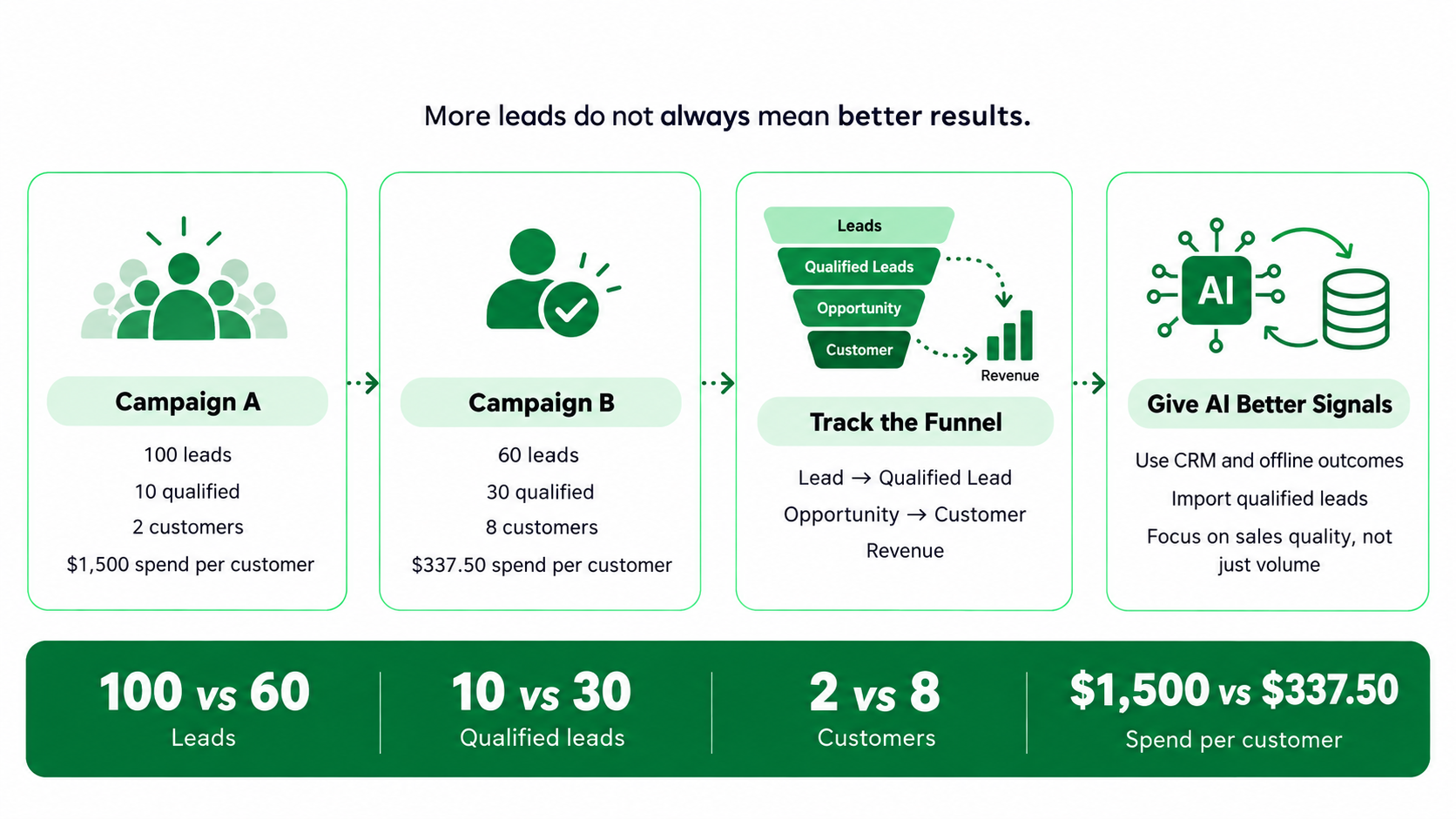
A Practical Human + AI Google Ads Framework
A workable framework makes responsibilities clear. It gives automation room to handle frequent decisions while keeping commercial priorities visible throughout campaign management.
1. Define the Business Goal
Write a measurable objective that reflects the business need. “Generate qualified enquiries for commercial projects” is more useful than “get more conversions.” Include the customer type, relevant service or product, and the outcome your team will use to judge success.
2. Fix Conversion Tracking
Test important actions and compare recorded events with actual submissions, purchases, or calls. Investigate duplicates and missing records. Confirm which goals each campaign uses before asking automation to optimise against them.
3. Establish Campaign Economics
Set acceptable acquisition costs using margins, customer value, qualification rates, and sales performance. Distinguish a lead-cost target from a customer-acquisition target. Record the conditions under which the business can increase spending and when it should pause expansion.
4. Give AI High-Quality Inputs
Supply relevant assets, accurate offers, suitable landing pages, and trustworthy customer information. Make the advertised service easy to understand. Automation has a better chance of finding valuable demand when the account and website communicate the same proposition.
5. Automate High-Volume Decisions
Use automation to manage frequent decisions, such as adjusting bids for individual auctions and testing combinations of approved headlines and descriptions. Following a structured A/B testing framework helps you establish what to compare and how to judge the outcome. Where supported, use campaign experiments to make comparisons more informative than a simple before-and-after judgement.
6. Keep Strategic Guardrails
Maintain control over budgets, geography, exclusions, campaign goals, claims, and business priorities. Review automatic recommendation settings and understand which changes may be applied. Document material adjustments so unexpected performance changes can be investigated.
7. Review Lead and Revenue Quality
Use sales feedback to evaluate whether enquiries fit your target customer and progress through the funnel. For retailers, assess returns, cancellations, and margins where relevant. Automated Google Ads campaigns should be judged against outcomes that survive beyond the initial conversion report.
8. Continuously Improve the Inputs
Use findings to improve tracking, creative, offers, and landing pages. Correct recurring misunderstandings that attract unsuitable enquiries. Effective Google Ads optimization is an ongoing process of improving the information and customer experience that automation depends on.
Common Mistakes When Using AI in Google Ads
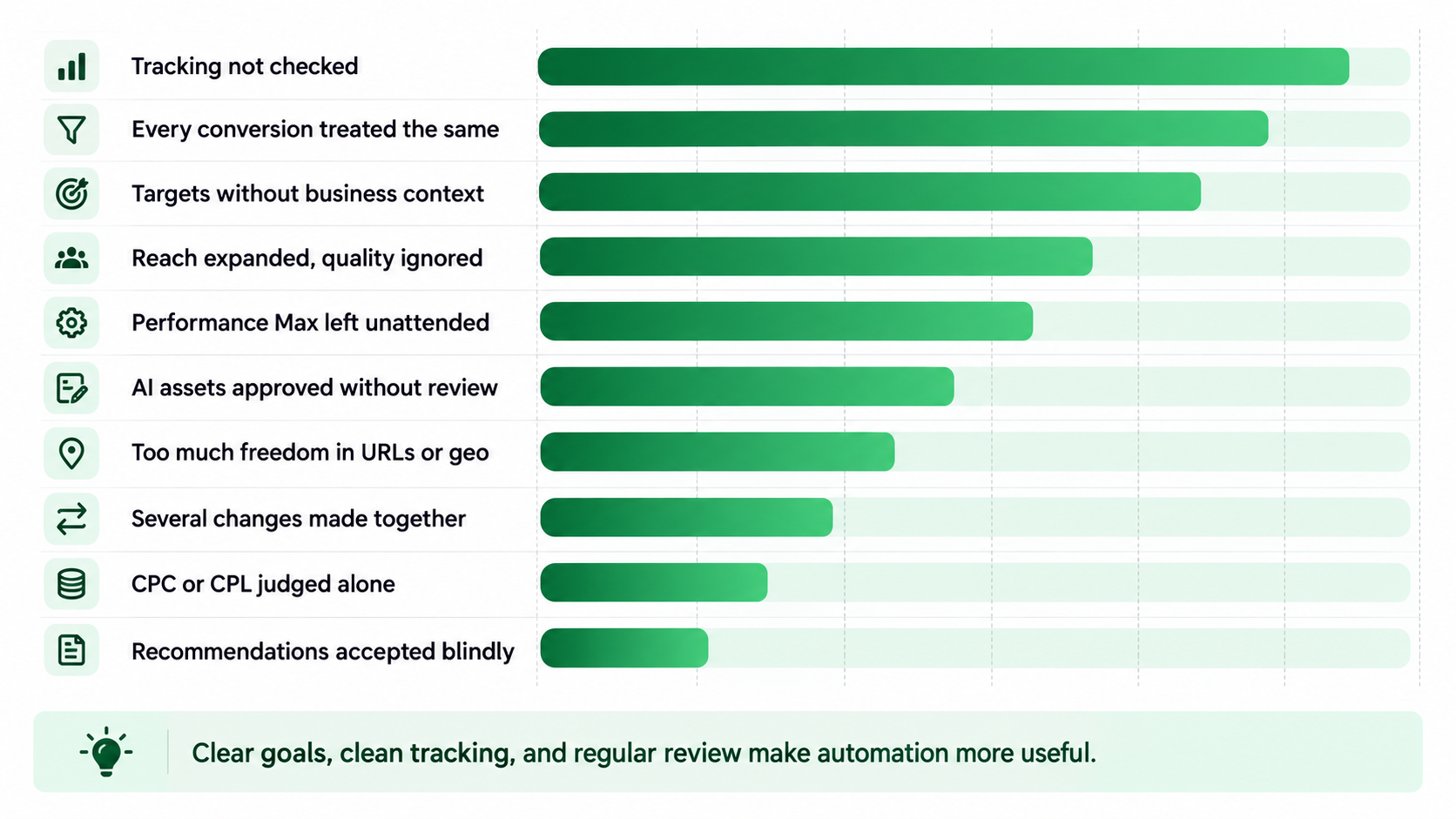
Most automation problems begin with unclear goals or incomplete feedback. These mistakes make it harder to distinguish a useful automated decision from an efficient pursuit of the wrong objective.
- Launching before checking tracking: Duplicate or missing events distort the information used for optimisation.
- Treating every conversion equally: Minor interactions can distract bidding from qualified enquiries or purchases.
- Choosing targets without commercial context: An attractive dashboard target may be unrealistic or unprofitable.
- Expanding reach while ignoring quality: Additional leads are useful only when the business can serve them.
- Leaving Performance Max unattended: Goals, exclusions, assets, and delivery still need regular review.
- Approving generated assets without checking them: Incorrect promises can damage trust and attract unsuitable customers.
- Allowing unnecessary freedom: Unreviewed URL expansion or geography settings can create avoidable mismatches.
- Changing several variables together: This makes it difficult to identify what caused a performance shift.
- Judging success by CPC or CPL alone: Cheap traffic and cheap enquiries do not establish customer profitability.
- Accepting recommendations without a business reason: A suggested change should support your objective before it is adopted.
Good PPC automation has defined responsibilities. The system handles selected tasks, while the advertiser checks whether its decisions remain useful as business conditions change.
How to Measure Whether Google Ads AI Is Actually Helping
Measurement should connect delivery with customer quality and financial outcomes. Review these layers together, using consistent definitions and allowing sufficient time for conversions and sales to develop.
Platform Metrics
Monitor impressions, clicks, cost per click, conversion rate, conversions, CPA, conversion value, and ROAS. These help identify changes in reach, efficiency, and recorded outcomes. Alongside Google Ads reporting, interpreting GA4 data for better ad decisions can help you examine what visitors do after clicking, including where they leave the conversion journey.
Compare equivalent periods and account for changes in goals or tracking. A rise in conversions is difficult to interpret if the definition changed during the comparison.
Quality Metrics
For lead generation, review qualified lead rate, cost per qualified lead, opportunity rate, and lead-to-customer rate. These show whether apparent efficiency continues through the sales process.
Use consistent qualification rules. Otherwise, differences between sales teams or reporting periods may look like campaign changes when they are actually measurement differences.
Business Metrics
Assess customer acquisition cost, revenue, margins, customer value, and overall marketing efficiency. ROAS based on revenue should be considered alongside the costs of providing the product or service.
Platform attribution assigns credit for outcomes; it does not by itself prove every outcome was incremental. Where feasible, use controlled tests to investigate the additional business value advertising creates.
The Future Isn’t Manual vs Automated Google Ads
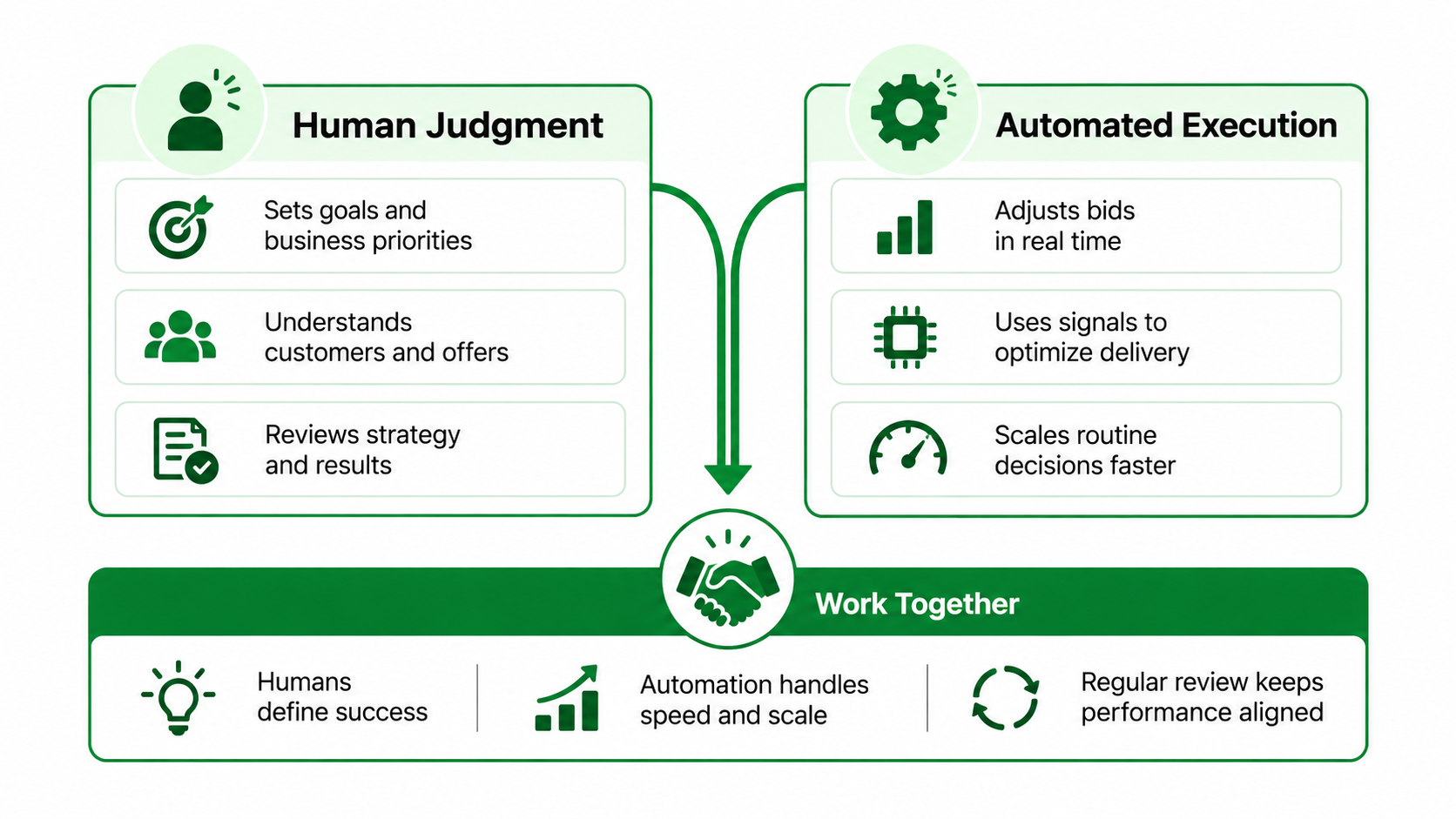
The useful question is how human judgment and automated execution should work together. Rejecting every automated feature can limit efficiency, while unrestricted delegation can weaken accountability. Bidding, asset creation, analysis, and delivery are already heavily supported by automation. Further developments are likely to change how campaigns are operated, although the pace and usefulness of individual features will vary. Advertisers should assess each capability against a clear need rather than assuming every new feature deserves immediate adoption.
Customer understanding, positioning, commercial judgment, and experiment design become more valuable as routine execution becomes easier. Someone still needs to identify a worthwhile offer, understand buyer objections, and decide what growth the business can support. The strongest campaign manager will connect automated activity with those decisions and recognise when better inputs or a different strategy are needed.
Conclusion
Using automation effectively starts with knowing what a valuable outcome looks like for your business. A platform can adjust bids, explore additional demand, and test creative combinations, but it needs dependable goals and data to make those decisions useful. Advertisers remain responsible for budgets, customer priorities, brand promises, and the financial limits within which campaigns should operate. Those responsibilities become more important as automation takes on more execution, because errors in the setup can influence many decisions before anyone notices.
The practical approach is to give automated systems clear instructions, suitable inputs, and appropriate boundaries, then evaluate what they produce. Work with the platform team on platform metrics as well as revenue, margins, customer acquisition and review qualified leads. When necessary, make conscious changes to allow for conversion delays and improve the underlying offer and customer experience. The key to campaign management is knowing the result you want and having the proof you need to decide if advertising is helping you get there.
Want to Improve Google Ads Performance Without Losing Control of Your Campaigns?
Build campaigns around qualified customers, reliable tracking and budgets that support your business goals. Our eSign Web Services team will help you align your Google Ads strategy, automation, creative direction, and performance measurement to your priorities. Contact our team to discuss a campaign approach that improves efficiency while keeping commercial decisions in focus.
Frequently Asked Questions
Question: How does Google Ads use AI today?
Answer: AI is able to help with auction time bidding, search matching, audience expansion, asset creation and campaign delivery. Role depends on campaign type and enabled features. Advertisers supply objectives, budgets, conversion data, and creative inputs. Those inputs direct execution, but it’s people who determine accuracy, customer quality and resulting business performance.
Question: Is everything automatic with Google Ads AI?
Answer: Google Ads can do a lot of the execution for you, but it can’t determine your commercial priorities, or validate every customer outcome. Goals, budgets, tracking, messaging and performance assessment still need a human eye. More automation reduces some manual work, but makes clear instructions, good inputs and regular review even more important.
Question: How can I benefit from Smart Bidding while still keeping control of my budget?
Answer: Establish a budget your business can afford, choose a strategy that matches your goal for conversions, and monitor your spending versus results. Note that average daily budgets are averages, not set daily amounts. CPA and ROAS targets guide bidding, not guarantee results. Before you increase investment or change campaign targets, assess the quality and profitability of your customers.
Question: Is Performance Max fully automatic?
Answer: Carry out Max automates bidding and delivery on Google inventory, but advertisers still provide goals, budgets, assets, landing pages and audience signals. Additional boundaries are available exclusions and settings. Review channel performance, search insights, conversion quality and business results. The large scale of automation does not negate the need for configuration and constant supervision.
Question: Should I use broad matches with Google Ads Intelligence?
Answer: Broad match can help you find relevant searches outside of a narrow keyword list, especially with the right Smart Bidding and reliable conversion tracking. Its value depends on your goal, offer and measurement. Test expansion carefully, review available search terms, keep exclusions appropriate, and measure success by qualified customers, not just traffic.
Author Details

Ashwani Kumar Sharma
Ashwani has been actively involved in SEO services since 2005. His expertise and distinctive work approaches have made him one of the most experienced and trusted SEO experts in the industry. He is a certified SEO and Google Ads professional. He also has strong business development skills in advanced SEO, PPC, and digital marketing strategies.


