



Your Rankings Are Stable but Organic Clicks Are Falling: Is AI Search the Reason?

Key Takeaways
- Stable rankings do not guarantee stable organic clicks because CTR, SERP layout, search demand, query mix, and user behavior can change independently of rankings.
- AI Overviews and other AI-powered search experiences can reduce the need to click for some queries, particularly straightforward informational searches.
- AI should not automatically be blamed. Paid results, featured snippets, changing search demand, competitors, seasonality, and SERP changes can produce similar patterns.
- The strongest diagnostic signal is often stable rankings + stable impressions + falling CTR and clicks.
- Businesses should analyze losses by query, page, intent, device, and branded vs non-branded searches before changing their SEO strategy.
- Content should increasingly provide something worth clicking for, including original research, expert insight, tools, case studies, data, deeper analysis, or commercial value.
- SEO performance should ultimately be judged by qualified traffic, leads, conversions, and revenue, not traffic volume alone.
- The response to AI search should be to evolve SEO, not abandon it.
A business can hold its place on Google and still lose the visitors those rankings once brought. The change may show up on pages that answer common questions: they continue to appear in results, but fewer people open them. An AI Overview might answer enough of the question before someone reaches your listing. A crowded results page, a less compelling title, or changing demand could produce the same pattern. Blaming AI too quickly may lead you to improve the wrong thing.
In this blog, we examine what it means to see organic clicks falling while rankings hold steady. You will learn how to find the pages and queries behind the loss, check whether AI features appear for those searches, and rule out other causes. We will then look at ways to give people a stronger reason to visit and measure whether those changes bring back valuable clicks and leads.
Why Stable Rankings Don’t Guarantee Stable Organic Traffic
A ranking tells you where your page appeared in a set of results. It does not tell you how many people searched, what else appeared above your listing, whether they noticed it, or whether they needed to visit a website at all.
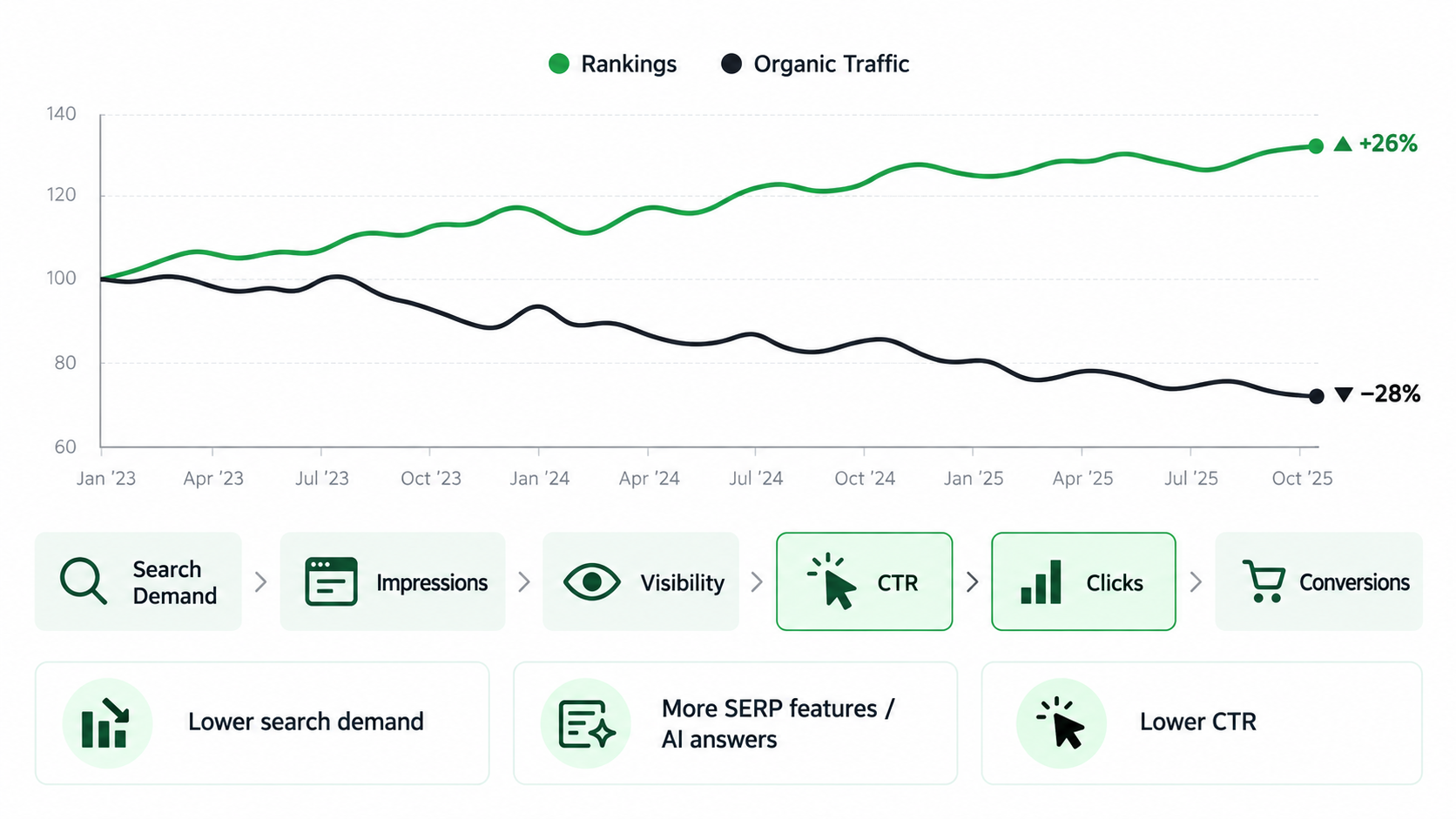
Organic traffic follows a longer path: search demand → impressions → visibility → click-through rate → clicks → conversions. If one part changes, visits or leads can fall while the position shown in a report looks much the same.
Rankings Are Only One Part of the Equation
Suppose a page remains third for an important query. If fewer people search for that topic this month, the page may receive fewer impressions and clicks. If demand remains steady but Google displays an answer above the standard results, people may see your listing and choose not to open it. A competitor’s clearer title can also attract clicks without changing your position.
The observation rankings are stable but traffic dropping therefore calls for more than another rank check. Determine whether the page is being shown less often, clicked less often, or attracting visitors who behave differently once they arrive.
Why Average Position Can Be Misleading
Search Console’s average position combines multiple appearances across queries, pages, devices, and locations. It is not a fixed position for your whole website. Gains on broad questions can offset losses on searches that used to bring enquiries.
For example, a company may hold an average position near five while its main service page slips on a valuable comparison query. At the same time, a blog gains impressions on a general definition. The combined number looks stable, but the visits most likely to become customers may be falling. When Google rankings are stable but traffic down describes your report, inspect the underlying queries rather than relying on the average.
CTR Is Often the Missing Signal
Click-through rate, or CTR, measures the share of impressions that turn into clicks. If a page receives 10,000 impressions and 500 clicks, its CTR is 5%. If it still receives 10,000 impressions but only 300 clicks, CTR has fallen to 3%.
That pattern makes declining organic CTR one of the first things to investigate. It tells you fewer people chose the result when it appeared. It does not tell you whether the cause was AI, another search feature, a competing listing, or a change in what users wanted.
Is AI Search Really Reducing Organic Clicks?
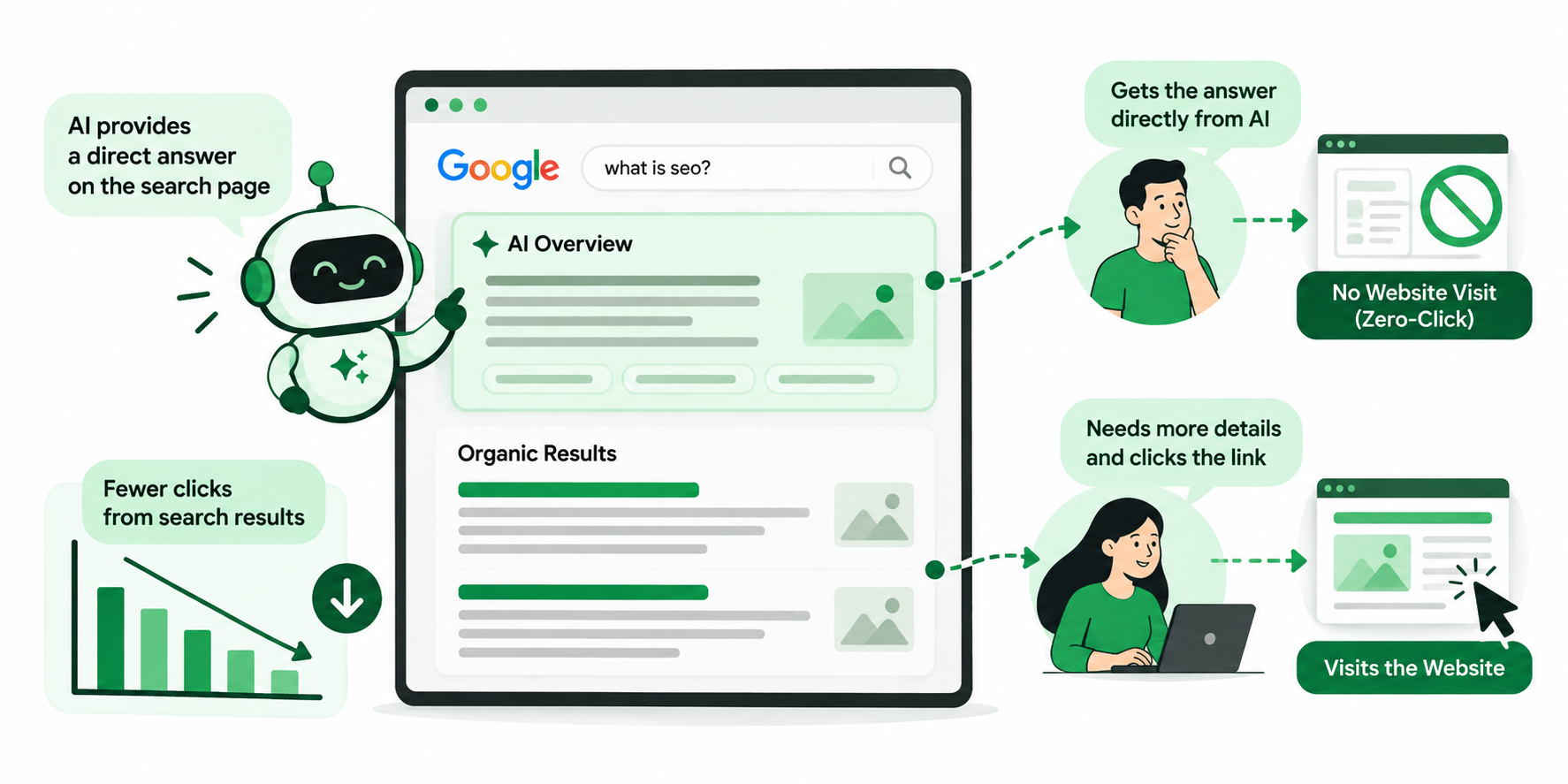
Yes, AI search can reduce clicks for some queries, but it will not affect every page in the same way. A person who gets a complete answer on the results page may have no reason to visit. Someone comparing providers, checking evidence, or making a purchase decision may still need to open several websites.
A Pew Research Center analysis of U.S. Google searches found that users clicked traditional results less often when an AI summary appeared than when it did not. That finding supports a closer look at AI, but it cannot establish how much of one company’s traffic decline the feature caused.
How AI Answers Can Change Click Behavior?
The familiar route was often query → search result → website → answer. An AI-assisted route may be a query → AI answer → follow-up question → possible website visit. The person may still click, but later in the research process or for a more specific need.
Some searches end without any website visit. These zero-click searches are especially relevant when the answer is short and widely available. For other tasks, an AI answer may introduce the subject while linked pages provide the depth needed to make a decision.
Which Searches Are Most Exposed?
Clicks are most at risk when someone can complete their task on the results page. A definition, a simple fact, or a short set of instructions may need no further explanation. For example, a user asking what CTR means may get everything they need from a brief answer. Someone asking why CTR fell on their service page still needs help interpreting their data.
Generic articles face similar pressure when they repeat advice available elsewhere. A summary can cover their main points without losing much. Detailed comparisons are different: a person choosing a provider may still need prices, limitations, examples, and evidence before deciding.
AI Overviews do not appear for every query, and other search features can also reduce clicks. To assess the AI Overviews traffic impact, examine the searches where your pages lost visits. If the answer shown on Google completes the user’s task, that page has a greater risk of losing the click.
Which Searches Still Give Users Strong Reasons to Click?
People are more likely to visit a website when they need to examine evidence, compare options, or use something tailored to their situation. Let’s explore some of the examples below:
- Original Research: Readers may want to check the data, methods, and full findings before trusting or using a headline conclusion.
- Detailed Comparisons: A short answer can name the main differences. A full comparison can explain costs, limitations, and which option suits different needs.
- Case Studies: Real examples show the starting problem, the work completed, and the outcome. Those details help readers judge whether the approach applies to them.
- Interactive Tools: A user may need to enter information, change assumptions, and explore possible outcomes. They must visit the page to do that.
- Calculators: A CTR calculator, for example, can show how changes in impressions or click rates affect visits using the reader’s own figures.
- Templates: A downloadable checklist or reporting template helps someone put advice into practice rather than simply read about it.
- Expert Analysis: Some decisions depend on context. Readers may visit for an explanation of tradeoffs, exceptions, and what to prioritize.
- Products and Services: Buyers often need specifications, deliverables, pricing information, proof of results, and a clear way to enquire.
- High-Intent Commercial Research: Someone close to a decision may compare providers, read reviews, examine examples, and check whether an offer fits their requirements.
A page earns the click when it helps the reader take the next step. For instance, defining an SEO audit may take one paragraph. Showing which reports to check, how to interpret conflicting signals, and which fixes to prioritize gives a business a reason to visit and keep reading.
What the evidence means: Seeing an AI Overview on a query makes AI a plausible contributor. It does not prove that every lost click went to that feature.
Don’t Blame AI Until You Rule Out These Other Causes
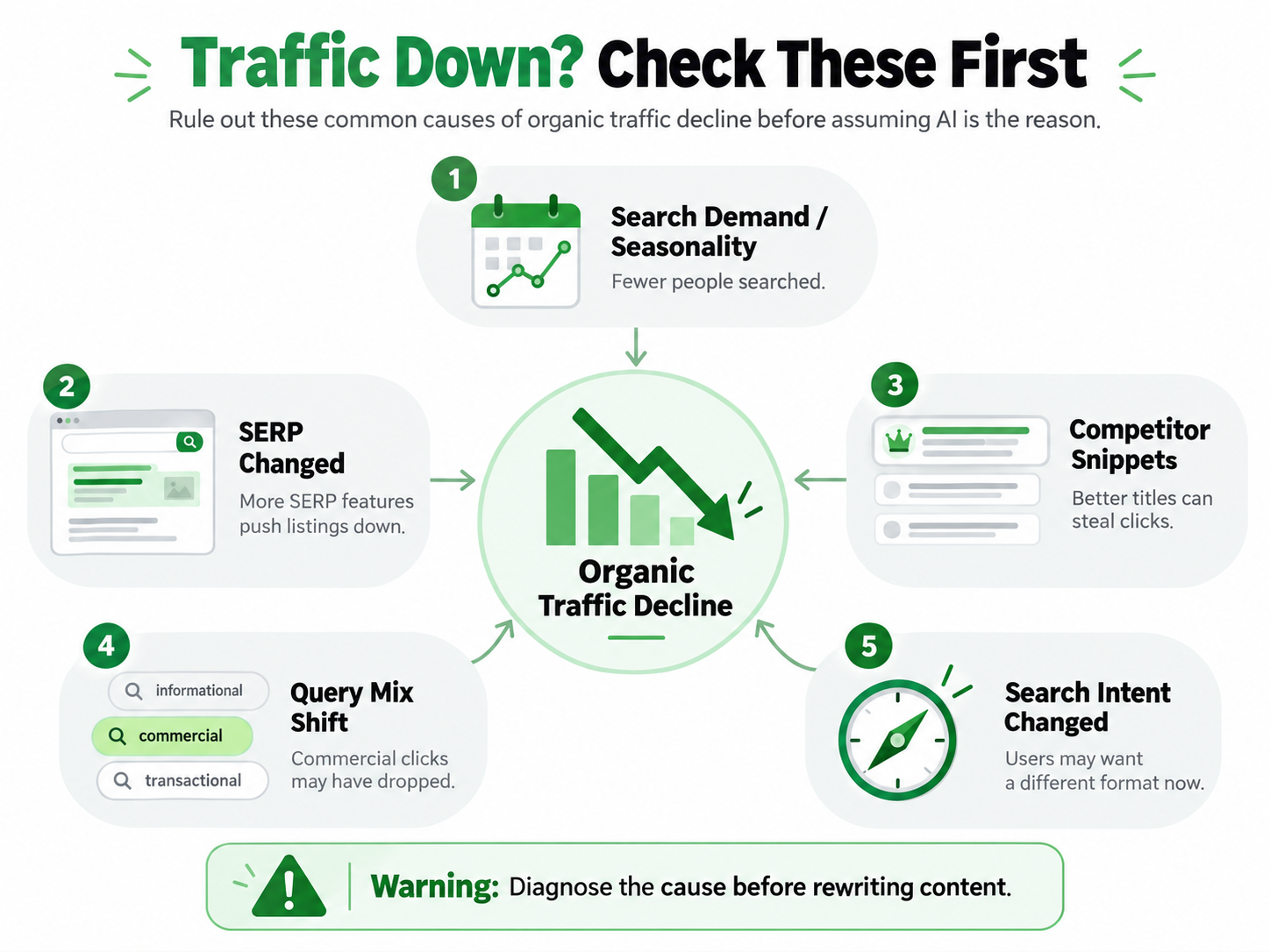
An organic search traffic decline can have several explanations. The right response depends on whether demand, visibility, the results page, or user intent changed. Rule out these causes before rewriting pages to address an assumed AI problem.
Search Demand or Seasonality Changed
A page can hold the same position and receive fewer visits if fewer people make the search. Seasonal businesses see this regularly, but demand can also shift because of industry news, customer needs, or changes in the language people use.
Compare the affected period with the same period a year earlier. Look at impressions for the queries losing clicks and check whether interest in the subject has moved more broadly. If impressions and clicks fall together while CTR stays similar, lower demand deserves attention.
The SERP Changed Around You
The search engine results page, or SERP, can become more crowded even when your standard organic position stays stable. Ads, local packs, featured snippets, videos, shopping results, forums, and AI answers can all affect what a user sees first.
Inspect the actual results for your most affected queries on mobile and desktop. A listing that is technically third among organic results may sit well below several other elements on a phone screen. That difference matters to the person searching, even if a ranking report does not show it clearly.
Competitors Improved Their Search Snippets
A competitor does not always need to outrank you to take a larger share of clicks. Its title may address the problem more directly, include a useful detail, or make the page’s value clearer. Your own listing may have become too broad for the query.
Compare the titles and descriptions users actually see. Ask whether your result clearly explains what they will gain by opening it. A title should be specific and accurate, and the page must deliver on its promise.
Your Query Mix Changed
A site can gain visibility for general questions while losing clicks from searches closer to a purchase. The overall average position may remain steady because those movements offset one another. Business results may still suffer if the lost queries previously brought qualified prospects.
Separate branded and non-branded queries, then review informational and commercial searches within each group. This helps reveal whether the lost clicks came from people researching a broad topic or from potential customers looking for your services. If organic traffic declining is concentrated in broad informational searches, it calls for a different priority than a loss on service-related searches.
Search Intent Changed
A page may continue to rank even as users increasingly prefer a different type of answer. They might want a recent comparison, a video demonstration, a local provider, or a practical tool rather than a general article.
Look at the current results and the pages attracting attention. Then ask whether your content still serves the task behind the query. If the need has changed, updating the page’s substance or format may be more useful than adding more keywords.
How to Diagnose Whether AI Search Is Affecting Your Traffic
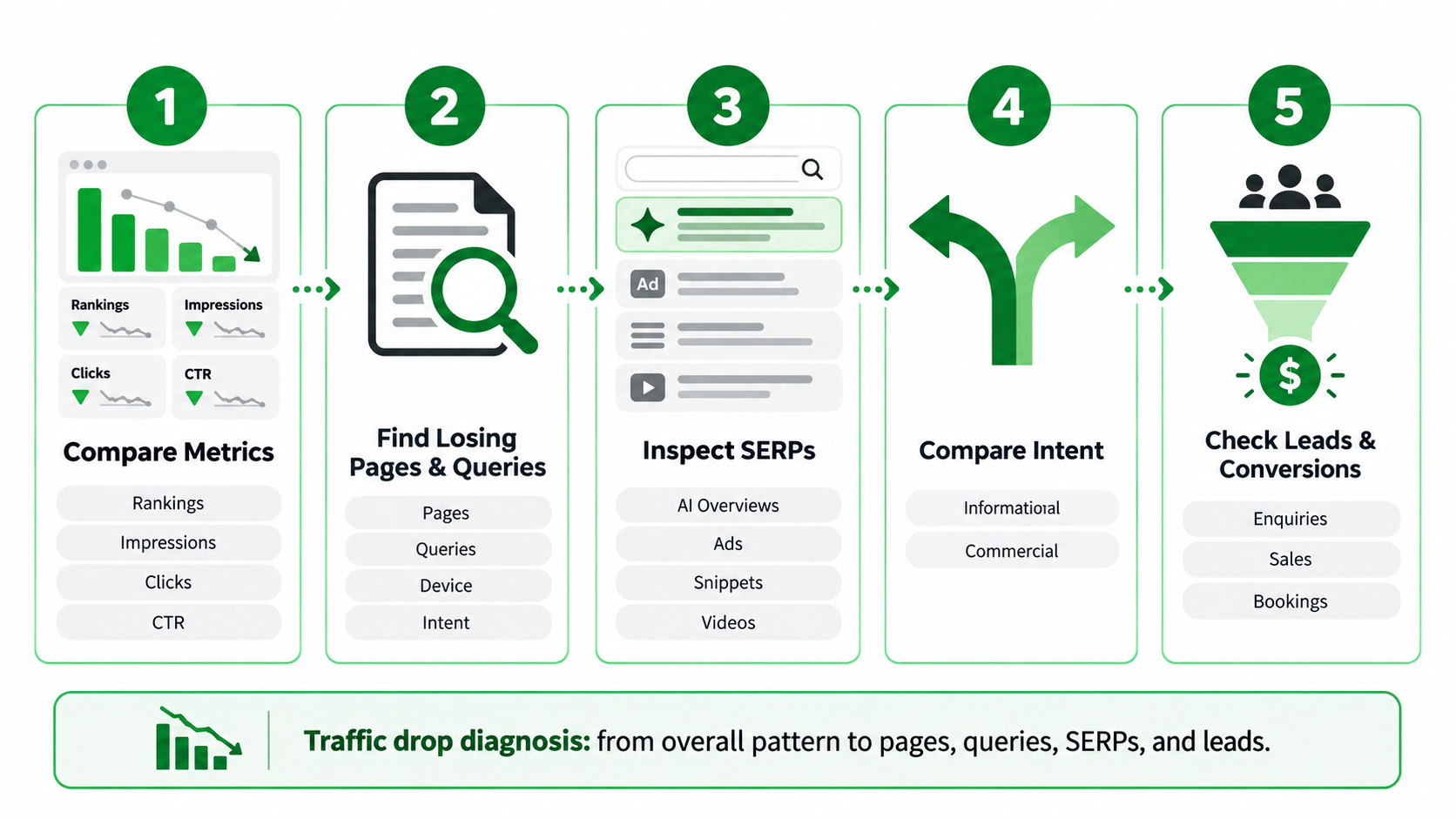
A useful diagnosis moves from the overall traffic pattern to specific pages, queries, and results. Google Search Console traffic analysis shows where clicks changed. Reviewing the search results and what visitors do after arriving helps explain why those changes matter.
Step 1 – Compare Rankings, Impressions, Clicks and CTR
In Google Search Console, open the Performance report, select Web search, and compare the affected period with a comparable earlier period. If your business is seasonal, add a year-over-year comparison. Examine all measures together rather than judging the change from clicks alone.
| Pattern | Area to Investigate |
| Positions and clicks fall | Losses on particular pages or queries |
| Impressions fall while positions appear stable | Demand, seasonality, or query coverage |
| Visits fall while leads stay steady | Whether the lost visitors were less qualified |
| Visits and leads both fall | Pages and queries behind the commercial loss |
These are investigative signals, not automatic verdicts. Stable impressions and positions with lower CTR locate the loss between an appearance and a click. They do not establish which feature or behavior caused it.
Step 2 – Find the Queries and Pages Losing Clicks
Sort affected pages by their loss of clicks. Open each important page and inspect the queries that previously brought visitors. Give extra attention to searches tied to enquiries or sales, even if their traffic volume is smaller than that of broad informational terms.
Break the data down by device, country, branded and non-branded searches, and user intent. A mobile decline limited to a few basic questions calls for a different response than lost clicks on a core service page across every device.
Step 3 – Inspect the Actual SERPs
For queries with meaningful CTR losses, examine what now appears in the results. Note AI Overviews, ads, featured snippets, videos, local listings, forums, and competing pages. Check whether your page appears as a link within an AI answer and where the standard result sits on the screen.
Search Console’s Generative AI performance report can show impressions for pages linked in AI Overviews and AI Mode, including breakdowns by page, date, device, and country. It does not provide a separate count of clicks from those features or calculate how many visits they displaced. Treat its data as context for investigating possible AI search traffic loss, rather than as a precise measure of it.
Step 4 – Compare Informational vs Commercial Losses
Group affected searches by the user’s purpose. A person looking for a definition is at a different stage from someone comparing services or seeking a provider. If most lost clicks came from generic questions while service pages remain healthy, the change may have limited commercial impact.
If high-intent queries lose clicks and enquiries together, investigate more urgently. Examine their visible results, the promise made by your snippets, and whether the landing pages still answer the questions a potential customer needs resolved.
Step 5 – Check Leads and Conversions
Search Console shows what happened in Google results. Analytics and lead records help show what happened after people reached the website. Compare the affected landing pages with enquiries, sales, bookings, or other useful actions.
Do not expect Search Console clicks and Analytics sessions to match exactly. They count different events and can be affected by tracking setup and consent choices. The key question is whether the traffic loss also reduced qualified business opportunities.
What to Do When Pages Still Rank but Get Fewer Clicks
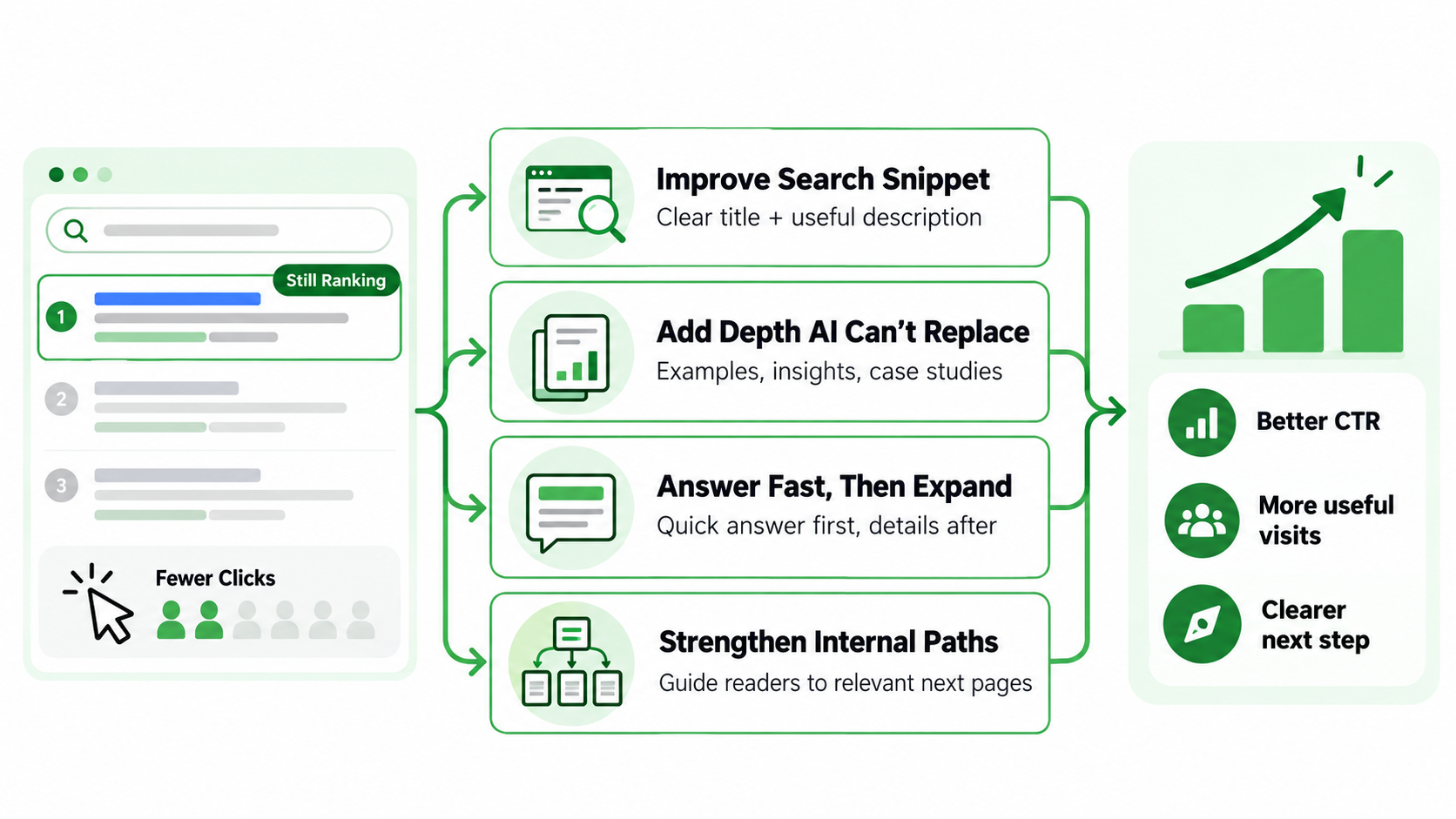
Once the cause is clearer, focus on pages with meaningful losses. Creating more content will not automatically fix SEO CTR decline on pages that already appear in results. Review what the listing promises, what the page delivers, and where the visitor can go next.
- Improve the Search Result Proposition: A title and description should make the page’s value clear to someone scanning the results. Check whether they match the user’s intent, distinguish the page from competing results, and accurately describe what the person will find.
- Make Content Harder to Replace With an AI Summary: A generic explanation can be summarized quickly. A useful page goes further with relevant examples, original observations, detailed comparisons, expert reasoning, tools, or case studies supported by evidence. For this topic, a worked example showing how impressions, CTR, clicks, and leads changed would help a reader interpret their own figures. Add depth where it helps solve the problem. Extra words alone will not make a page more valuable.
- Answer Quickly, Then Give Readers a Reason to Continue: Give a direct answer near the beginning. A reader asking whether AI can reduce clicks should learn that it can, under certain conditions, without having to reach the end of the article. Then develop the answer with context, evidence, examples, limitations, and practical next steps. A clear opening serves someone who needs a quick explanation. The deeper material serves someone who needs to decide what to change.
- Strengthen Internal Links and Commercial Pathways: A content cluster strategy can connect an initial explanation to more detailed guides, comparisons, and service pages. Each link should help readers continue the task they came to complete, rather than send them to a loosely related page.
Traffic Is No Longer the Only SEO KPI That Matters
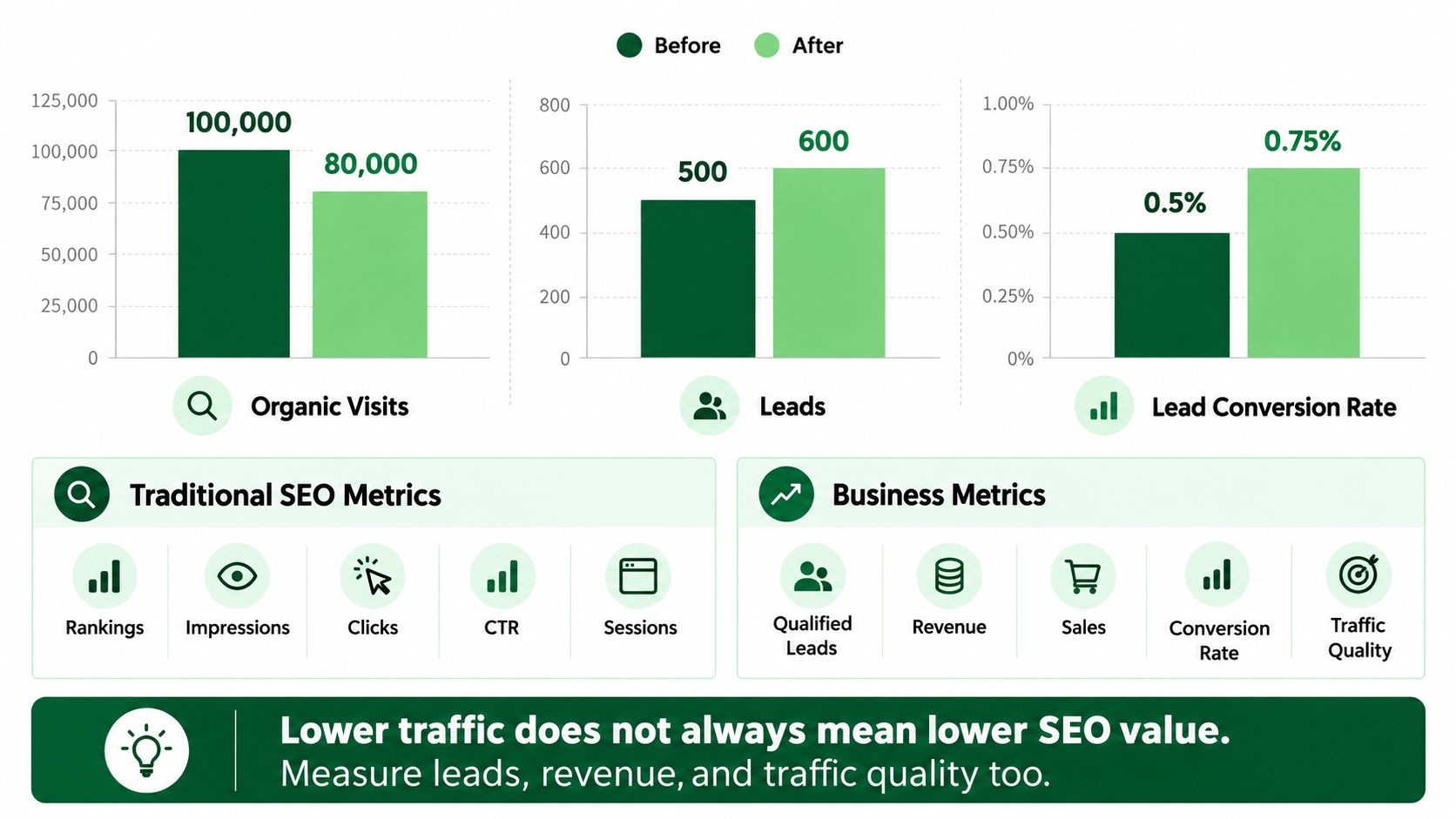
Visits matter, but their value matters too. Consider this illustrative example:
| Period | Organic Visits | Leads | Lead Conversion Rate |
| Before | 100,000 | 500 | 0.5% |
| After | 80,000 | 600 | 0.75% |
Visits declined by 20%, while leads increased by 20%. The example does not suggest that losing traffic is always good. It shows why the effect on qualified enquiries must be checked before calling every decline a business setback.
Continue Measuring Traditional SEO Metrics
Keep tracking rankings, impressions, clicks, CTR, and organic sessions. Each helps locate a different change. Impressions show how often pages appear, CTR shows how often people choose them, and visits show how many reach the site.
Review these figures for important pages and query groups rather than stopping at a sitewide total. A decline on a high-value service query can be hidden by gains on less relevant searches.
Add Business and AI-Search Metrics
Measure qualified leads, sales, revenue, and the actions taken by visitors to affected landing pages. Where reliable data is available, also observe branded demand, relevant AI mentions or citations, and identifiable referrals from AI services. Search Console’s AI-feature impressions add visibility context, but they are not a complete measure of AI search organic traffic.
Traffic quality also depends on what happens after the click. If traffic is not turning into leads, examine what visitors experience after they click. The page may attract the wrong audience, leave important questions unanswered, or make the next step unclear.
So, Is AI Search the Reason Your Organic Clicks Are Falling?
Possibly. AI becomes a stronger hypothesis when rankings and impressions remain broadly steady, CTR falls, informational queries account for most of the lost clicks, and AI answers appear for those queries. Comparatively healthy commercial pages add useful context.
None of those signals alone proves the cause. An AI Overview may appear at the same time as stronger competing snippets, more ads, or changing demand. Search Console’s AI-feature data can show visibility, but it does not calculate how many clicks a feature took from your pages. When you see organic clicks falling, examine the complete journey from impression to click to conversion. The answer may be AI, another search change, or several factors together. Knowing the difference helps you fix the right problem.
Conclusion
Stable rankings and fewer clicks do not necessarily mean your SEO work has failed. AI-generated answers can reduce visits for some informational searches, especially when users get enough detail without opening a website. Ads, other search features, competitors, seasonality, changing intent, and lower demand can create similar patterns. The first task is to identify the pages and queries behind the decline, then compare their impressions, positions, CTR, and business outcomes.
Once you understand the loss, you can respond with more precision. Improve listings that no longer give people a clear reason to click. Strengthen pages with examples, evidence, and details that help readers make a decision. Connect related information so visitors can take a useful next step. Keep measuring enquiries and revenue alongside traffic. The aim is to reach the right audience and help them choose your business, whether they first discover it through a traditional result or an AI-assisted answer.
Are steady rankings still failing to bring the valuable traffic and leads your business needs?
If your rankings are steady but valuable visits are slipping, examine the pages and queries behind the change before revising your strategy. eSign Web Services can review search performance, content, and conversion paths to identify practical improvements that support qualified traffic, enquiries, and long-term growth.
Frequently Asked Questions
Question: Why are my organic clicks falling even though my rankings are stable?
Answer: Your average position may be steady while demand, CTR, or the mix of queries bringing visibility changes. AI answers and other results page features may also affect clicks. Compare the same pages and queries across similar periods, looking at impressions, position, CTR, and clicks together before deciding what caused the decline.
Question: Can Google AI Overviews reduce organic traffic?
Answer: Yes. An AI Overview may answer a question well enough that some users do not visit a website. The effect varies by query. Someone seeking a definition may stop at the summary, while someone comparing products or providers may still click for details. Inspect the searches that lost visits before estimating the impact.
Question: How can I tell if AI search is causing my CTR to decline?
Answer: Find queries with steady impressions and positions but lower CTR, then inspect their results for AI Overviews. Check whether affected pages receive AI-feature impressions in Search Console. These observations support an investigation, but they do not prove exactly how many clicks AI displaced. Also review ads, competing listings, and changing intent.
Question: Should I update pages that still rank but receive fewer clicks?
Answer: Update a page when you identify a problem it can solve. A vague title may need greater specificity. A basic article may need examples or decision support. A commercial page may need clearer proof and next steps. Prioritize pages tied to leads, record your changes, and measure whether clicks and enquiries improve.
Question: Should SEO success still be measured by organic traffic?
Answer: Yes, but traffic should be considered alongside its quality. Clicks and sessions show how many people reached the site. Enquiries, sales, and revenue show what those visits contributed. A decline in low-intent visits has a different business meaning from losing customers who were ready to compare or buy.
Author Details

Ashwani Kumar Sharma
Ashwani has been actively involved in SEO services since 2005. His expertise and distinctive work approaches have made him one of the most experienced and trusted SEO experts in the industry. He is a certified SEO and Google Ads professional. He also has strong business development skills in advanced SEO, PPC, and digital marketing strategies.


