



How to Create Content That Ranks in Google’s Generative AI Era

Key Takeaways
- AI-era SEO content wins when it’s structured, trustworthy, and clearly connected across topics.
- Google generative AI results favor sites with depth, entities, and consistent topical authority.
- EEAT content strategy and visible expertise are now core ranking inputs, not extras.
- Semantic SEO content built around entities, not just keywords, drives long-term visibility.
- Smart internal linking strategy turns scattered posts into a coherent knowledge system.
- Ongoing content freshness and content pruning are required to stay AI-citation worthy.
- Success now depends on being a source AI trusts to explain, not just a page that ranks.
If your organic traffic graph looks flat or, worse, slowly sagging while you’re still publishing blogs, fixing technical issues, and chasing keywords, you’re not alone. Many teams in B2B content marketing are putting in thoughtful, consistent effort and showing real know-how, even with AI reshaping how visibility works. The reason is simple: Google’s AI Overviews and generative experiences are quietly rewriting how visibility actually works. In many verticals, independent studies show that AI layers can reduce organic clicks by 15–60%, depending on the query type and intent. That doesn’t mean SEO is over. It means the old definition of “ranking” is now incomplete.
Google’s own announcements about generative search make one thing clear: the goal is to help users understand topics faster, with fewer clicks and more context. In that model, your content is no longer just a result competing for position. It becomes a potential source feeding AI-generated answers. If your pages are shallow, disconnected, or anonymous, they get skipped. If they’re structured, credible, and clearly focused, they get surfaced and cited. This shift is especially visible in competitive industries and b2b content marketing, where buyers rely heavily on detailed explanations before they ever speak to sales.
This is where AI-era SEO content gives you an edge. You’re no longer writing only for humans and crawlers. You’re writing for systems that synthesize meaning. The real question isn’t “How do I rank a post?” anymore, but “How do I become the site Google trusts to explain this topic?”
Google’s Generative AI and Its Impact on Search
Google’s Search Generative Experience (and AI Overviews) takes search beyond the old ‘ten blue links’ and gives people clear, easy-to-understand explanations. Instead of simply ranking documents, Google now aggregates, summarizes, and contextualizes information inside the SERP. Research from multiple studies shows that in some verticals, generative layers can depress organic clicks by 18–64%, especially for informational queries where the AI answer fully satisfies intent. That’s a brutal hit for sites still optimizing only for old-school listings.
At the same time, search behavior is evolving. People no longer type “CRM tools.” They ask questions like, “What’s the best CRM for a 5-person real estate team that needs automation?” Users expect context, trade-offs, and direction in a single interaction. Content that only half-answers those composite questions simply doesn’t cut it. This is where AI search optimization diverges from traditional SEO: it prioritizes completeness, clarity, and usefulness over mechanical keyword coverage.
Google’s own documentation on how it uses generative content and evaluates pages emphasizes quality, helpfulness, and policy compliance over scale. Practically, that means your site has to earn a role in Google generative AI results by being demonstrably accurate, clearly structured, and strongly aligned with user intent. You’re no longer competing only on position; you’re competing on whether your content is safe and smart enough to be quoted.
Build Content Around Entities & Topics, Not Just Keywords
Traditional SEO was fairly successful at targeting individual keywords. In the generative AI era, that mindset loses hard. Modern search systems care less about isolated phrases and more about how well you cover an entire topic space. That’s where entity-based SEO and topical authority content come in. Instead of scattering posts across random keywords, you build interconnected clusters that explain a subject as thoroughly as a specialist would.
According to guidance and testing from major SEO platforms, search engines use semantic relationships, how concepts, brands, and subtopics connect; to identify true authorities. This is the backbone of semantic SEO content. When your site offers a pillar page on a core theme and multiple supporting pieces that answer sub-questions, comparisons, and edge cases, Google sees more than pages. It considers a knowledge map.
Practically, that means mapping topics like a product manager, not a keyword tool. A cybersecurity company doesn’t just publish “what is cybersecurity” and call it a day. It covers frameworks, sectors, compliance, pricing models, implementation challenges, and mistakes; each piece linked logically back to the core. This structure also jumps-starts intent mapping, letting you match informational posts, comparison content, and bottom-of-funnel pages to different stages in the journey. The endgame isn’t ranking for one query. It’s making your domain the obvious reference point for everything in that niche.
Make Google’s EEAT Obvious
Google has made it painfully clear: faceless, generic content is not what its systems want to amplify. Its Search Quality Rater Guidelines and public commentary repeatedly emphasize Experience, Expertise, Authoritativeness, and Trustworthiness (EEAT) as critical signals. A solid EEAT content strategy isn’t just theoretical; it’s visible directly on the page. It lives on the page, where both users and AI systems can see it.
That starts with expert-led content. Articles attributed to people who actually do the work; SEOs, CMOs, product specialists, consultants; instantly carry more weight than anonymous, byline-free pages. Layer on concrete proof: screenshots from tools, anonymized client scenarios, step-by-step breakdowns, and real numbers (not hypothetical “Company A/B/C” fluff). Those elements show lived experience, not just rewritten theory.
Authority and trust also depend on brand signals: consistent NAP data for local businesses, a real “About” page, visible contact paths, third-party mentions, and reviews. These aren’t just CRO niceties; they’re credibility anchors. Finally, content freshness has become non-negotiable. Outdated statistics or tactics can stop your page from being used in AI answers, even if it still ranks. In this environment, AI-era SEO content is more like a product than a post; it needs maintenance, iteration, and versioning to stay worthy of citation.

Write for Extraction: Structure Content So AI Can Use It
Large language models and AI layers don’t read pages like humans. They look for patterns, structure, and clearly labeled meaning. That’s why guides on how to write for SGE and AI search keep stressing hierarchy, clarity, and scannability. If your content looks like one giant paragraph, don’t expect an AI engine to easily parse definitions, steps, or outcomes.
In practice, writing for extraction means using a clean H2/H3 structure, short paragraphs, and a clear separation of “what/why/how.” You lead major sections with a direct answer, then follow with context, nuance, and examples. That format works for readers and gives AI a safe summary candidate. Want to be pulled into Google generative AI results? Make it incredibly obvious where the answer is and how it’s supported.
Logic matters as much as layout. When your argument flows cleanly from problem to analysis to solution, models can identify and mirror that structure. This is where AI search optimization intersects with classic UX writing: concrete subheadings, plain-language explanations, and avoiding jargon when it doesn’t add precision. You’re essentially pre-formatting your content so that, when Google’s systems look for something to quote, your page feels like a clean, labeled dataset; not a messy wall of text.
Optimize the Page Experience: On-Page + UX Still Decide Rankings
Even with AI in the middle, Google still leans hard on behavior signals and performance to validate quality. If people bounce, struggle, or never engage, that’s a negative vote on your content’s usefulness. Google’s own performance guidance shows that mobile pages that take longer than a few seconds to load experience dramatically higher abandonment rates. That’s not just a UX problem; it’s a ranking and extractability problem.
This is where page experience and internal linking strategy quietly drive visibility. Internally, you’re building pathways that connect related topics, pushing authority toward core commercial URLs and helping AI understand how your content fits together. Externally, you’re making sure the experience doesn’t break the moment someone arrives from an AI-enhanced search: a clean layout, readable typography, no intrusive pop-ups, and clear calls to action.
A practical on-page checklist for AI-era SEO content includes:
- Intent-aligned title, H1, and intro (no bait-and-switch).
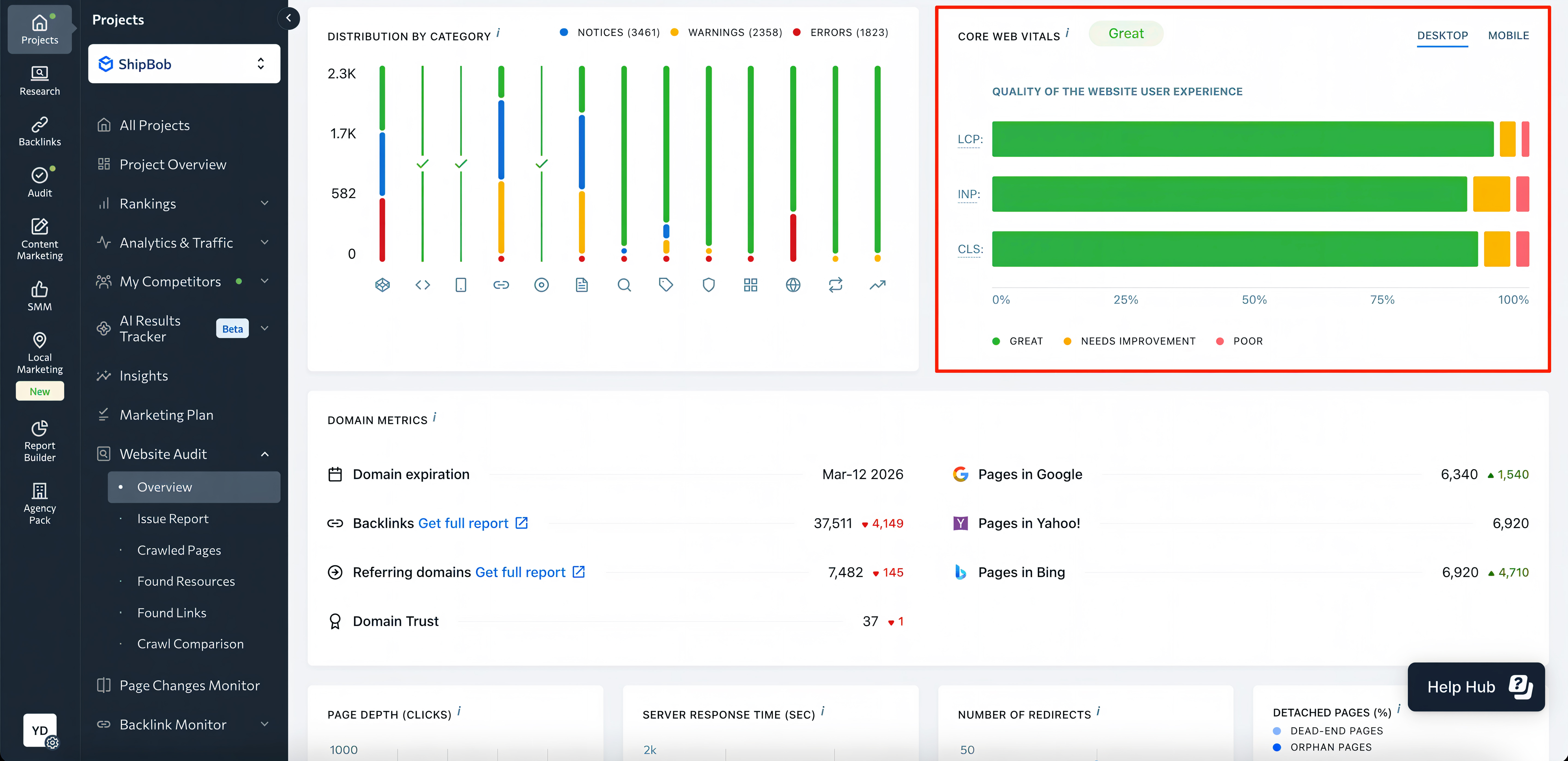
- Fast, stable mobile experience with good Core Web Vitals.
- Logical navigation depth for key service or product pages.
- Visual clarity that supports skimming and deep reading.
None of this is glamorous. But when AI systems decide which sources to trust and show, they lean on the same signals humans do: Does this page look like it knows what it’s doing? If the answer feels like “not really,” your optimization elsewhere won’t save it.
Simple Content System That Works in the Generative AI Era
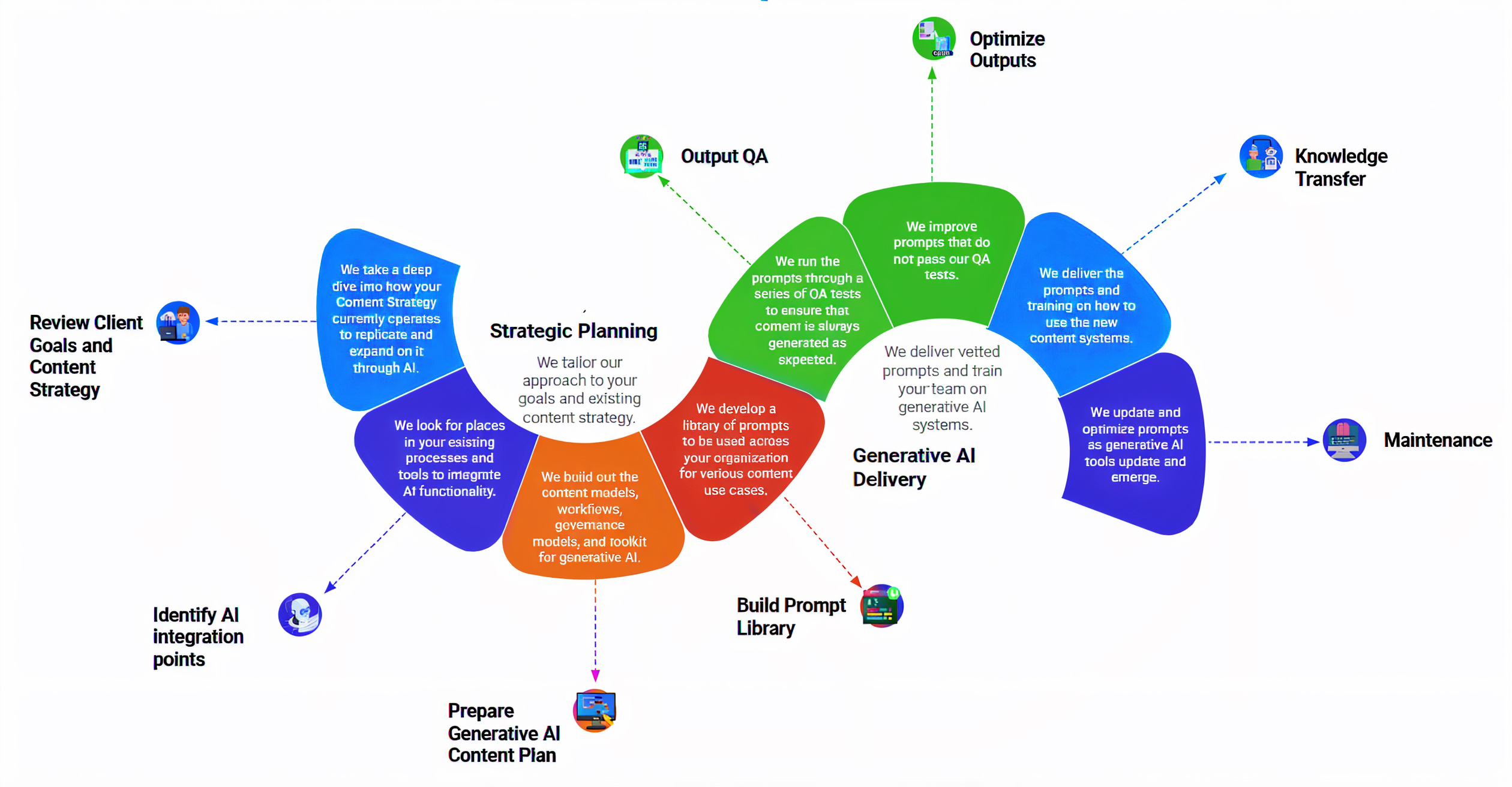
You don’t beat AI-driven SERPs with random campaigns. You beat them with a system. The most resilient teams treat SEO as a continuous intelligence loop instead of a task list. That loop starts with intent mapping across your actual buyer journey, not just what a keyword tool spits out. Sales calls, customer emails, and support tickets become more valuable than generic “SEO content ideas” lists.
From there, each piece you publish must justify its existence. Does it answer a real, high-value question? Is it genuinely better than what’s already ranking? Does it reflect real experience or just paraphrase whatever’s already out there? If the answer is no, you don’t publish; yet. You refine until it is. Over time, this approach creates a library of topical authority content that’s hard for competitors and AI to ignore.
Measurement closes the loop. Instead of obsessing only over positions, you track impressions, assisted conversions, pipeline influence, and where your URLs appear when AI summaries trigger. Underperformers don’t just sit; they’re improved, merge, or removed through deliberate content pruning, often starting with tightening how you write each blog post. At that point, AI-era SEO content stops being trial-and-error. It becomes a compounding asset that gets smarter, sharper, and more aligned with real demand every quarter.
Visuals, Data, and Structured Signals Built for AI
Words alone aren’t the full story anymore. Google’s own explanations of generative search emphasize helping people “understand a topic faster,” not just giving them more text. Visuals, structured summaries, and markup help both users and AI systems quickly decode your content. This is where structured data and smart visualization quietly pull extra weight.
Think in terms of “explainers at a glance.” For example, you might embed a pie chart showing how your organic traffic mix changed before and after AI Overviews, with a caption tying it to strategy changes. Or include a side-by-side table comparing traditional “10 blue links” SERPs versus AI-enhanced layouts and what that means for click opportunity. Screenshots of Search Console showing impression gains despite click softness can also reframe performance conversations with stakeholders.
Technically, schema markup (FAQ, Article, Organization, Product, Review, etc.) gives Google machine-readable context about who you are, what the page covers, and how it connects to your brand. That doesn’t guarantee inclusion in generative experiences, but it lowers ambiguity. When combined with a consistent internal linking strategy, these signals help generative systems see your site not as a collection of isolated posts, but as a structured, trustworthy dataset. In an environment where zero-click behavior is rising, being the dataset that powers the answer is a defensible position.
Action Checklist: Turning Strategy into Execution
Here’s a practical checklist you can actually implement without turning this into a giant rebuild:
- Map 3–5 core topic clusters that directly support revenue.
- Audit existing content for EEAT, depth, and content freshness.
- Consolidate overlapping posts and remove deadweight through deliberate content pruning.
- Add visible expert attribution and proof elements to your key pages.
- Tighten your internal linking strategy around money pages and cluster pillars.
- Implement basic structured data on high-impact content and service pages.
- Track impressions, AI-triggered SERP appearances, and assisted conversions; not just rankings.
Done consistently, this shifts your SEO from hoping to rank to building a durable presence inside whatever AI-powered interface Google rolls out next.
Summary: What Actually Wins in the Generative AI Era
In the generative AI era, the sites that keep winning won’t be the ones pushing out the most content, but the ones publishing with intention. Volume without direction just feeds the noise. What actually stands out now is a clear strategy, consistent depth, and signals that prove real expertise instead of surface-level rewrites.
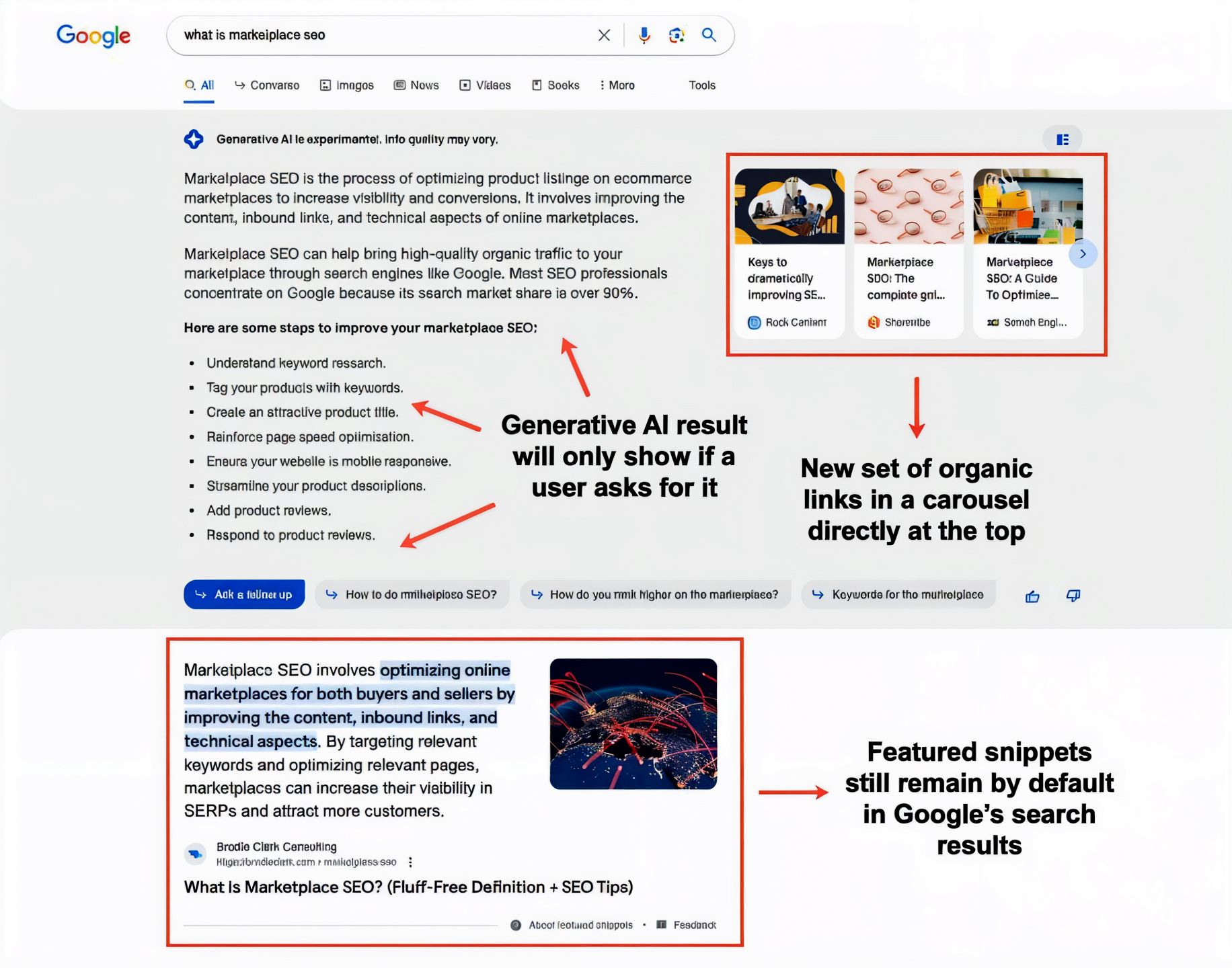
AI-era SEO content isn’t about “writing for robots” or trying to game Google’s latest feature. Search results are now a blend of summaries, citations, carousels, and interactive elements. Your job is to make your brand the most useful, trustworthy source that systems feel confident pulling from.
That means content that understands context, addresses full problems instead of partial questions, and reflects lived experience, not regurgitated advice. It also means clear structure, clean intent match, and evidence that a real expert stands behind what’s being said.
When your pages reliably answer high-value questions better than anything else on the SERP, you’re no longer just fighting for a blue link. You’re competing to be included in the explanation, the recommendation, and the short list of sources AI is comfortable showing to users. That’s the real win condition now.
Turn Your Content Into Something AI Can’t Ignore
If AI Overviews keep stealing the spotlight while your content just “ranks quietly,” it’s time to stop guessing and start dissecting. Instead of another fluffy audit, you need a forensic look at what Google and its generative layer actually see when they crawl your site.
With an AI-era content audit from eSign Web Services, you get a sharp, prioritized view: which pages are worth doubling down on, which ones are dragging the whole domain down, and which clusters could become your unfair advantage. No buzzwords, no vanity slides; just a clear map of how to turn your existing content into the material AI wants to quote, not skip.
Request Your AI-Era SEO Content Audit and 90-Day Roadmap
Frequently Asked Questions
Author Details

Ashwani Kumar Sharma
Ashwani has been actively involved in SEO services since 2005. His expertise and distinctive work approaches have made him one of the most experienced and trusted SEO experts in the industry. He is a certified SEO and Google Ads professional. He also has strong business development skills in advanced SEO, PPC, and digital marketing strategies.


