



AI Latent Space Optimization (LSO): How Google Understands Concepts, Not Keywords


Key Takeaways
- Modern search matches intent and conceptual meaning, not exact keyword repetition or phrase density.
- AI Latent Space Optimization focuses on clarity, structure, and semantic completeness over surface-level optimization tactics.
- Pages rank stronger when they fully explain definitions, tradeoffs, examples, and real-world applications.
- Keyword stuffing weakens positioning because repetition without meaning reduces clarity and trust.
- Concept-complete content can rank across multiple query variations without matching exact phrasing.
- Strong structure, consistent terminology, and decision frameworks improve AI summarization and placement confidence.
- Zero-click and AI summaries reward pages that are easy to extract, condense, and reuse.
- Sustainable SEO now prioritizes teaching clearly and aligning with intent over chasing isolated keywords.
Search has grown up. It doesn’t “read” pages like a human scanning for exact strings. It interprets relationships between ideas inside AI-driven search systems, which is why a page can rank without repeating the same phrase you’re obsessing over. Google has said BERT helped it better understand one in 10 searches. In short: matching intent beats matching letters.
That’s where AI Latent Space Optimization (LSO) comes in. Think of it as the playbook for showing search engines what you mean, not what you typed. This is the backbone of concept-based SEO: building structurally clear content, semantically complete, and easy for machines to summarize, compare, and trust; especially when users skim (and they do: 43% admit they skim blog posts).
Here’s what this looks like in real life: a startup writes “customer churn reduction” while users search “stop people from canceling.” If your content explains the concept deeply, Google can connect the dots, because it’s modeling how Google understands concepts, not counting your keyword frequency. Quick action steps: first, define your core idea in plain language; second, support it with adjacent subtopics; third, remove any lines written “for bots” instead of people.
Understanding Latent Space
Latent space is a map where ideas live as “positions” defined by meaning and context. Instead of treating words as the unit of value, Google can treat concepts as coordinates. That’s why a page can answer “best CRM for nonprofits” even if it says “donor database tool” more often. In latent space SEO, closeness = similarity of meaning, not matching phrasing.
Once you get that, semantic relevance becomes the goal: you’re building a page that sits near the right “cluster” of ideas. This also explains why thin rewrites fail. They look different on the surface, but land in the same shallow neighborhood. Meanwhile, pages that describe “what it is, who it’s for, tradeoffs, setup, and mistakes” occupy a stronger position. That’s the difference between being “mentioned” and being “selected.”
Quick micro-checklist you can use today: first, list 5 alternative ways a customer might describe the same problem; second, answer all 5 with the same core explanation; third, add one concrete scenario (pricing, workflow, or decision). That’s AI Latent Space Optimization (LSO) in practice; teaching the system the idea, not decorating the page with terms.
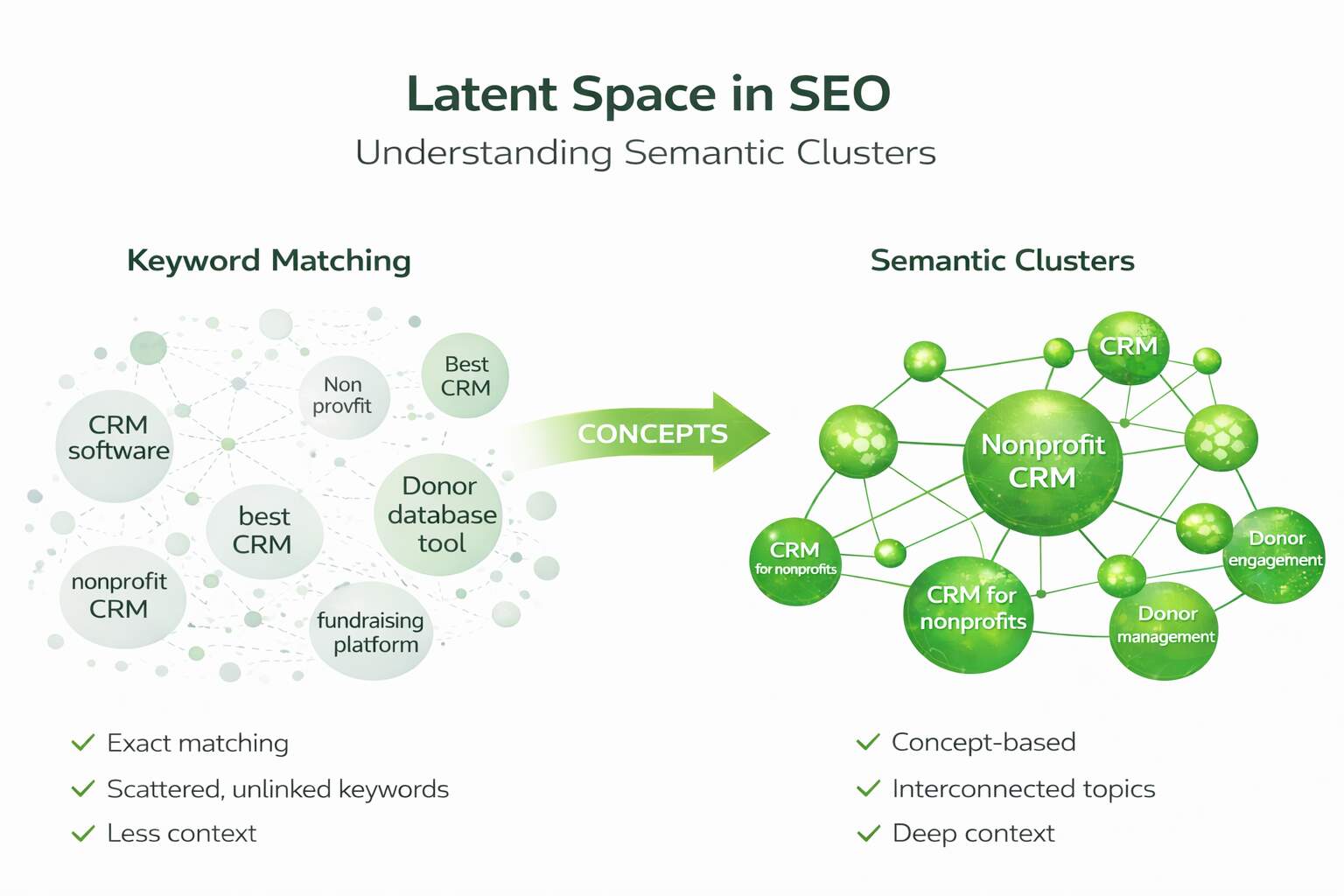
How Google Matches Ideas, Not Words
Google no longer evaluates pages by scanning for repeated words. Instead, it focuses on how ideas connect, how clearly a topic is explained, and whether the content aligns with real user intent. This shift explains why some well-written pages rank without heavy keyword repetition, while others quietly disappear.
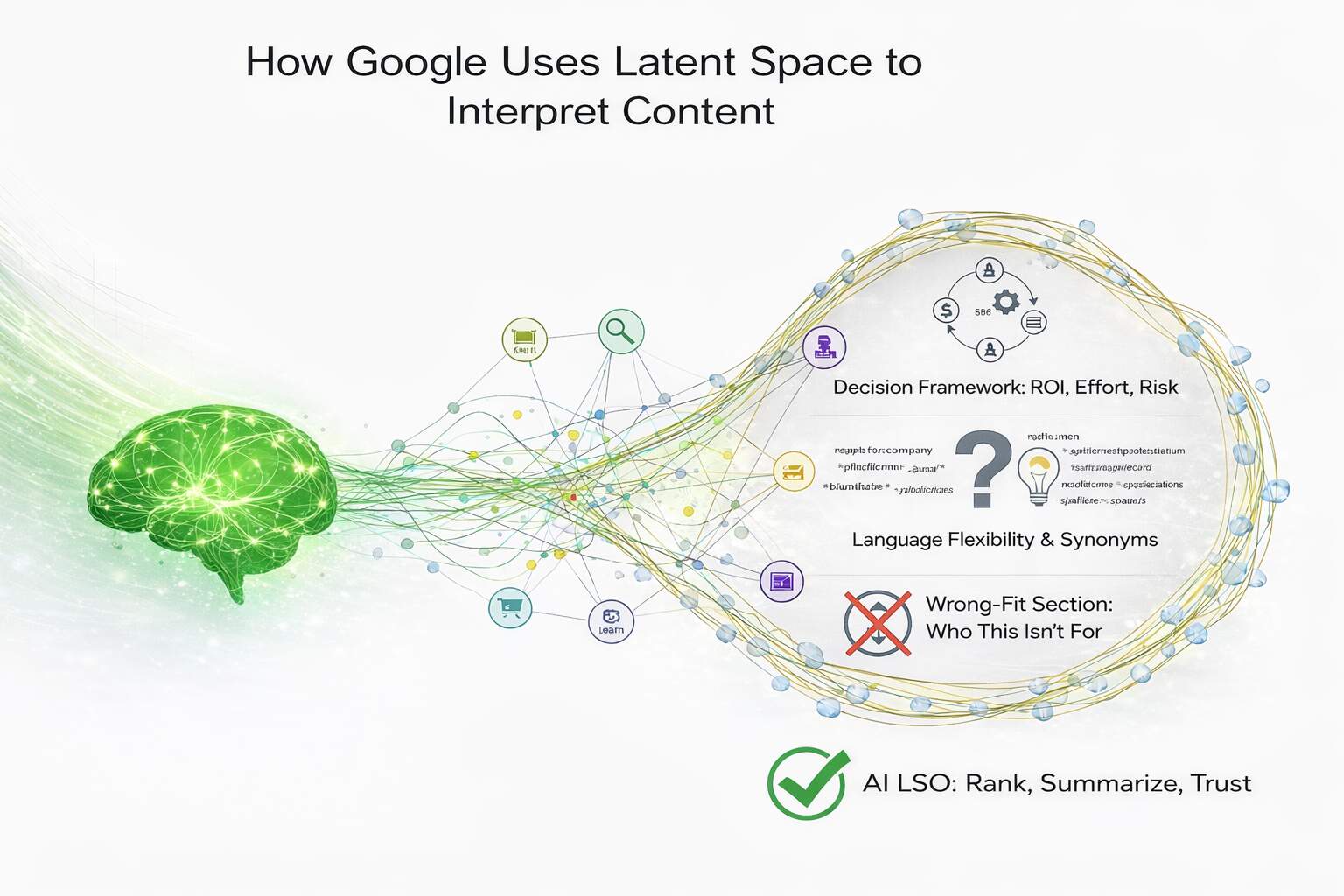
- Google evaluates relationships between ideas, not isolated terms. It examines how entities, attributes, and concepts naturally co-occur in useful explanations. This is why a guide that links pricing models, onboarding effort, ROI, and risks often beats a page that repeats “best software” dozens of times. This process is driven by AI search understanding powered by advanced AI search models.
- Language flexibility is no longer a liability. When content is conceptually strong, synonyms, paraphrasing, and regional phrasing still resolve to the same underlying meaning. Your writing does not need to sound mechanical to rank because search systems are no longer running a literal string-matching contest.
- Intent clarity matters more than phrasing precision. Pages that clearly match the user’s purpose are easier for Google to place correctly. Strong content signals intent through structure and logic rather than keyword density.
Practical action steps aligned with intent:
- Identify the real “job to be done” behind the query (buy, compare, fix, learn).
- Add a simple decision framework explaining what to choose when conditions change.
- Include a “wrong-fit” section that clarifies who should not choose this option, reinforcing relevance and trust.
When content explains ideas clearly and completely, Google can position it with confidence across many query variations. By aligning structure, intent, and meaning, AI Latent Space Optimization (LSO) becomes a repeatable process rather than a black box, and your content becomes easier to rank, summarize, and trust.
Why Keywords Don’t Win Anymore
Repeating a phrase doesn’t automatically strengthen meaning. If the supporting context is weak, repetition just creates noise. That’s why keyword-stuffed pages feel like they’re “about something,” but can’t explain it. Over time, this approach gets punished because it’s brittle: it ranks only when the query matches the page’s exact wording. And that’s a shrinking advantage in modern search.
Exact-match obsession also leads to shallow pages, thin definitions, no tradeoffs, no examples, and no adjacent concepts. If you want a brutal stat that explains the stakes: Ahrefs found 96.55% of pages in their index get zero search traffic from Google. Most content doesn’t lose because it “used the wrong keyword.” It loses because it didn’t earn a strong conceptual position.
So yes, concept-based SEO beats both keywordless SEO fantasies and keyword-stuffing habits, because understanding the value of keyword selection in SEO is what connects search intent, content relevance, and sustainable rankings. Your action steps:
- replace repeated phrases with clarifying sentences,
- add one section that answers “why this matters,”
- add one section that answers “how to do it.”
That’s AI Latent Space Optimization (LSO), removing manipulation and amplifying meaning.
If your content reads “optimized” but can’t be explained by a salesperson in 20 seconds, Google will struggle to place it confidently, too.
How Content Builds Authority
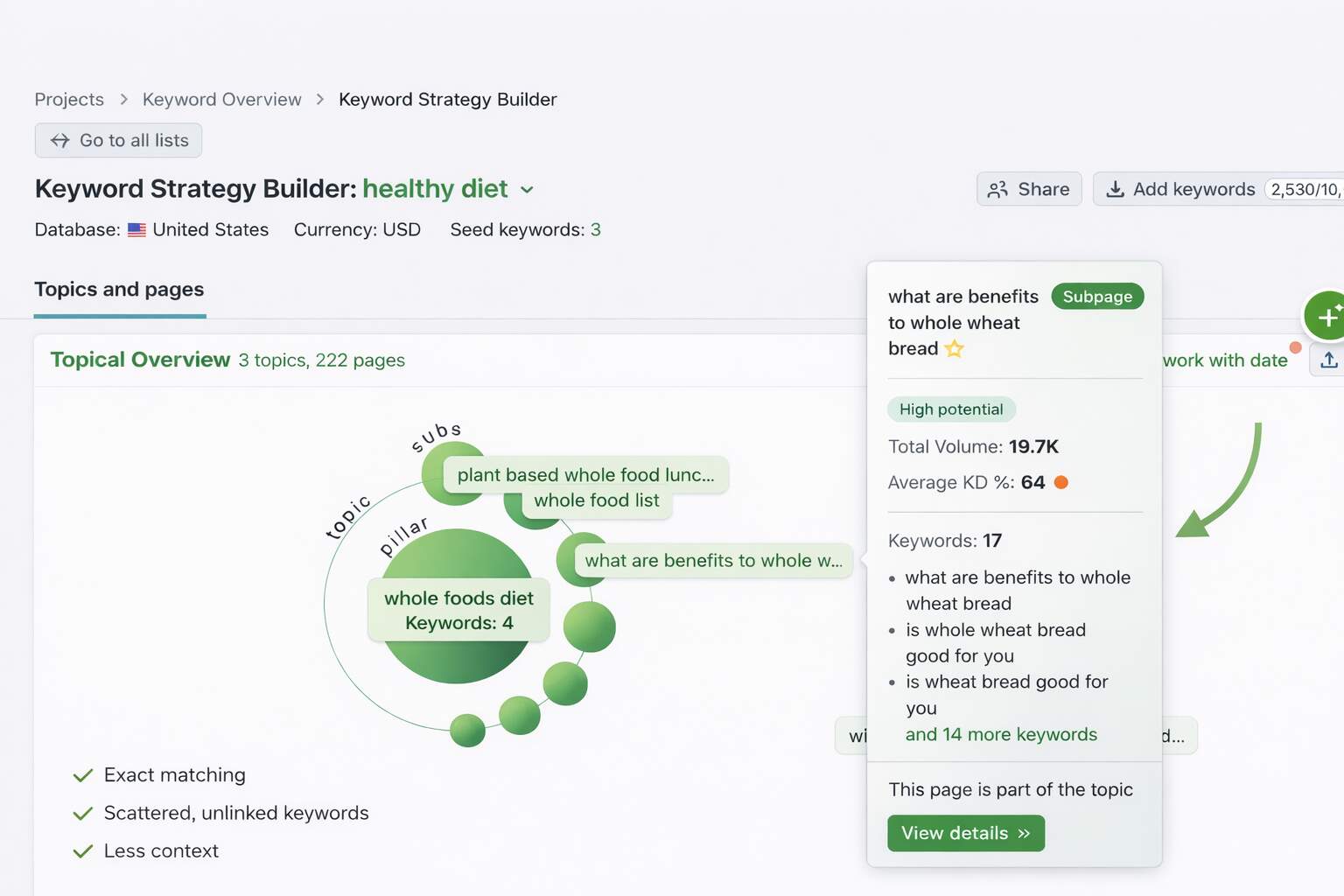
Content gains strength when it’s conceptually complete: it defines the idea, explains the edges, and connects it to related subtopics naturally. That’s how you become the page Google trusts when users ask the same thing 12 different ways. This is where semantic search optimization stops being theory and turns into a practical writing discipline: completeness, clarity, and consistency.
Topic coverage matters because meaning is reinforced through neighborhoods of related ideas. If you publish one page on “B2B lead generation” but ignore targeting, qualification, offer design, and measurement, you look like a partial answer. Meanwhile, Google’s people-first guidance emphasizes creating content that’s helpful for users; not content designed to manipulate rankings Helpful content tends to be concept-rich by default.
Action steps:
- Write a “definition + example + counterexample” trio,
- Add a mini FAQ inside the page for implied questions,
- Include one metric or benchmark to ground the claims.
Do that, and AI Latent Space Optimization (LSO) becomes a repeatable content QA process. Bonus: if you want clicks, remember the top result can pull massive CTR, as average CTR and conversion rate benchmarks show that position #1 captures a disproportionate share of attention.
The distribution of organic clicks makes this clear:
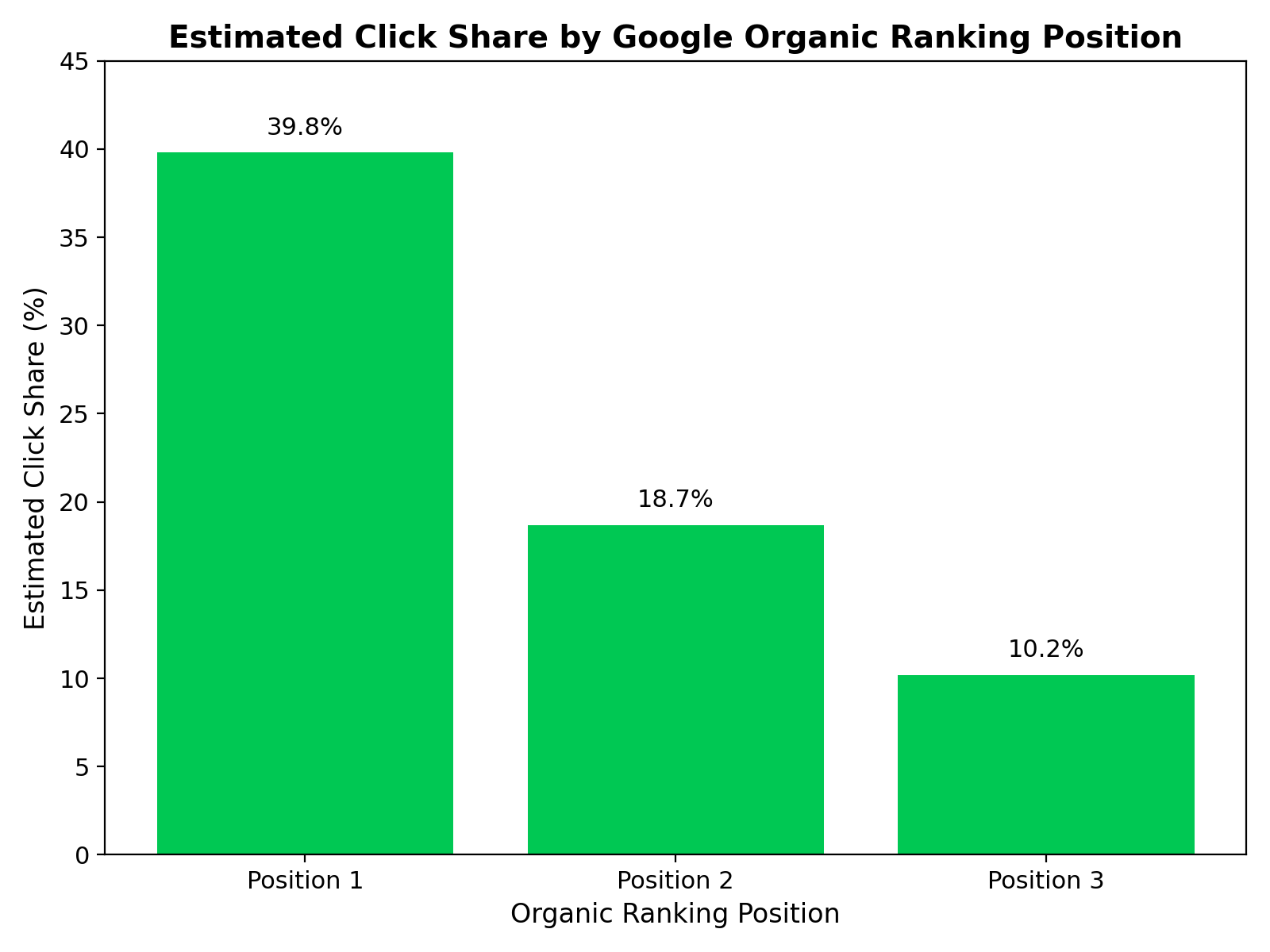
This is why concept completeness isn’t theoretical, when you earn position #1, the traffic impact compounds.
What LSO Changes About Content Strategy
The shift is simple but uncomfortable for many teams: stop publishing more and start explaining better. Content is no longer rewarded for volume or keyword frequency. It wins when it teaches a concept so clearly that both users and AI systems can extract, summarize, and trust it without friction.
- Depth replaces density. Instead of asking “Did we use the keyword enough times?”, the better question is “Did we fully explain the idea?” Pages built for AI Latent Space Optimization (LSO) focus on completeness; definitions, context, tradeoffs, and examples, making them easier for search systems to interpret and reuse.
- Structure becomes a ranking signal. Headings, logical flow, scoped sections, and clean transitions are not cosmetic. They help both humans and machines understand what matters. This is where latent space SEO quietly upgrades your workflow: briefs evolve from keyword lists into structured concept maps.
- Keywords shift roles. Keywords still matter, but mainly as labels and entry points. The real work happens in how the underlying idea is explained. Strong content builds around meaning first, then uses keywords to guide, not dominate, the narrative.
- Editorial planning becomes intent-driven. Modern strategies prioritize teaching, not targeting. Pages are designed to answer variations of the same question instead of chasing individual phrases, making them more resilient to search changes.
Action steps to bake into every content brief:
- Add a concept coverage checklist: definition, process, tradeoffs, examples, and pitfalls.
- Reserve one paragraph for the “why now” context, so the relevance is clear.
- Include one mini-case (“Here’s what this looks like for a 10-person SaaS”) to anchor theory in reality.
When content is built arounds clarity and structure, it stops being a one-off asset and becomes a scalable system. That’s when AI Latent Space Optimization (LSO) moves from buzzword territory into a repeatable content production advantage.
LSO for AI-Powered SERPs
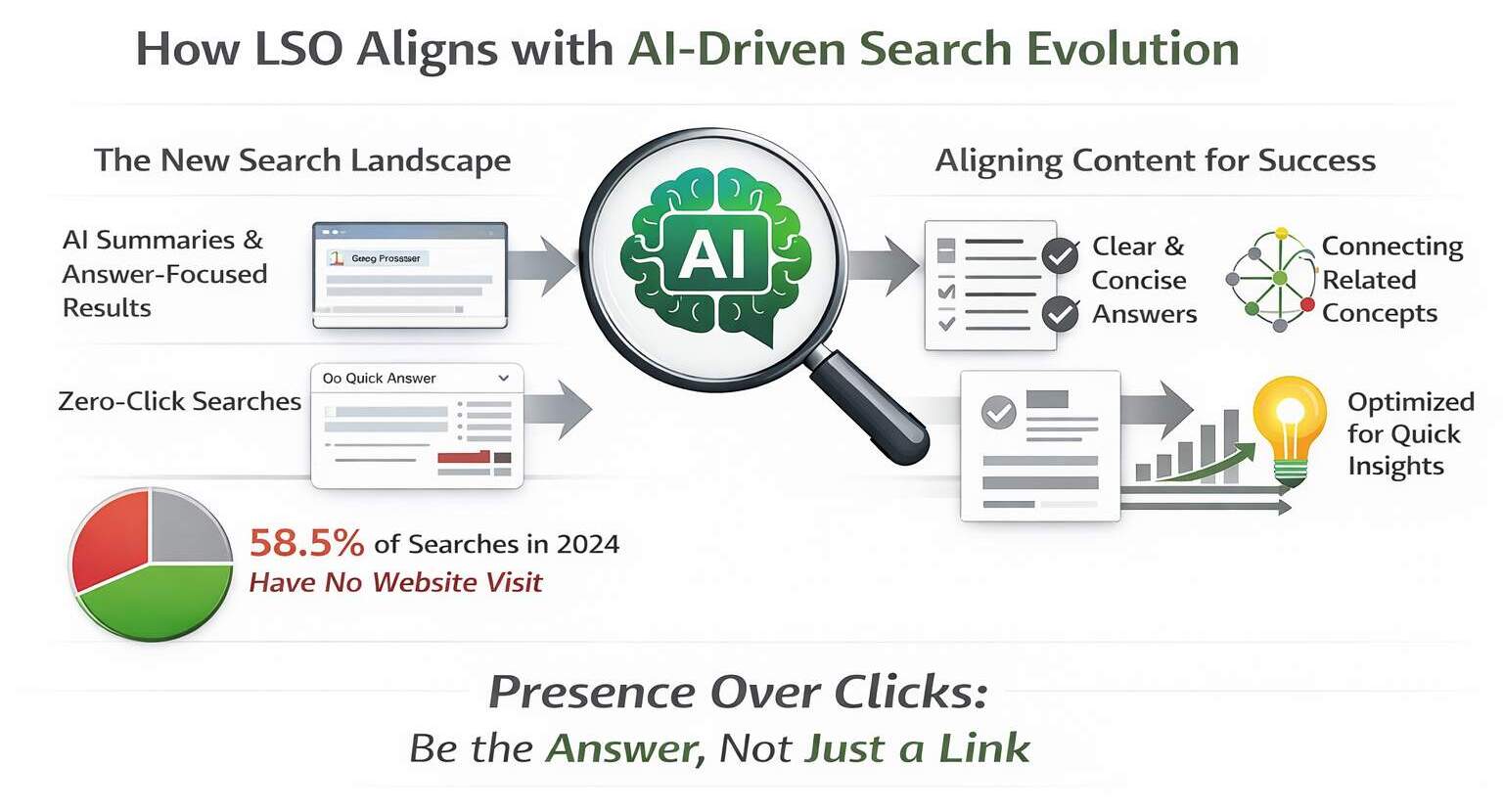
Search results are no longer just lists of links. AI-powered summaries and answer-first SERPs prioritize content that can be quickly understood, condensed, and reused. Pages that clearly define an idea, show how it connects to related concepts, and strip away filler are far easier for systems to summarize or reference. That’s why AI search understanding now matters just as much as traditional ranking signals.
The rise of zero-click searches creates new opportunities for brands to earn visibility and trust without relying solely on clicks. When users get answers directly on the results page, success isn’t always measured by traffic. It’s measured by presence. Research shows that a majority of searches end without a click, including Semrush data indicating that 58.5% of U.S. searches in 2024 resulted in no website visit. If your content isn’t structured to be the answer, it never enters the conversation.
What to do next:
- Build sections that are easy to summarize, such as “Key steps,” “Common pitfalls,” or “What to know before choosing.”
- Place one clear, authoritative definition near the top to anchor meaning immediately.
- Add a simple table or framework that can stand alone inside an AI-generated overview.
When this becomes standard practice, semantic search optimization stops feeling like an extra layer of work. At that point, AI Latent Space Optimization (LSO) simply becomes the engine driving how your content earns visibility; whether or not a click ever happens.
SERP / Competitor Snapshot
Most search results fail not because they are wrong, but because they are incomplete. When you look closely at what ranks today, patterns emerge. Pages often answer part of the question while ignoring context, decision-making, or real-world constraints. This gap is exactly where AI Latent Space Optimization (LSO) creates an advantage. Instead of competing on surface-level formats, it focuses on explaining the full concept in a way search systems can confidently interpret and reuse.
| Query Type | What Ranks Today | Typical Weak Spot | Your LSO Angle | What to Add |
| “What is X” | Glossaries + thin intros | No depth or examples | Teach the concept fully | Definition + example + pitfalls |
| “X vs Y” | Listicles | No decision logic | Frame tradeoffs clearly | A decision matrix + use-cases |
| “How to do X” | Step guides | Misses edge cases | Cover intent variants | “If/then” scenarios + FAQs |
| “Best X for SMB” | Reviews | Generic criteria | Tie to SMB constraints | Budget/time/skills constraints |
This snapshot shows why concept-based SEO consistently outperforms format-driven content. Pages that explain how, why, and when something applies are easier for Google to place across multiple queries. By aligning content with AI search understanding, you stop chasing individual rankings and start owning the topic space. That is the practical power of AI Latent Space Optimization (LSO); not gaming the SERP, but earning relevance across it.
Do This / Avoid This
Tactical SEO decisions still matter, but they only work when they support meaning, not when they try to manufacture relevance. The difference between content that survives algorithm shifts and content that quietly fades often comes down to a few repeatable habits. When you apply AI Latent Space Optimization (LSO) correctly, these habits help search systems understand what your page is truly about, not just what terms appear on it.
The table below highlights practical actions that strengthen semantic relevance and common mistakes that weaken AI search understanding, even when traditional SEO boxes appear checked.
| Do This | Avoid This |
| Write a crisp definition early, then expand with examples | Hiding meaning behind buzzwords |
| Cover adjacent topics that naturally surround the concept | Publishing “one-page wonder” content with no depth |
| Add decision logic (“choose X when…”) | Stuffing the same phrase into every header |
| Use scenarios that match SMB constraints (budget, time, skills) | Writing for crawlers instead of readers |
| Keep terminology consistent across pages | Constantly changing labels for the same idea |
When teams focus on clarity, structure, and intent, optimization becomes simpler and more durable. Pages built around explanation instead of manipulation are easier for AI-driven search systems to trust and reuse. Over time, this approach compounds, turning AI Latent Space Optimization (LSO) from a tactic into a long-term content advantage rather than a short-term ranking trick.
Performance Tracking Plan
30 days
- Indexation check + query coverage (GSC)
- Measure impressions, CTR, and average position on target intent variations
- Track engagement: scroll depth, time on page, exits
60 days
- Refresh based on queries driving impressions, but low CTR
- Add 2–3 FAQ-driven sub-sections if users are searching adjacent questions
- Expand internal linking from related posts and service pages
90 days
- Publish 2 supporting cluster posts targeting adjacent concepts
- Test title/meta variants to lift CTR (keep one change at a time)
- Compare assisted conversions vs baseline (leads influenced by blog visits)
Wrapping it up
Google has clearly moved beyond asking whether a page uses the right phrase. The real question now is whether the content genuinely explains the idea behind the search. Pages that are easy to understand, easy to summarize, and difficult to misinterpret are far more likely to earn consistent visibility across changing algorithms and AI-driven results.
Treating AI Latent Space Optimization (LSO) as a content quality standard helps future-proof your SEO by prioritizing meaning, intent, and structure over surface-level tactics. When your content teaches rather than targets, it becomes easier for search systems to trust, reuse, and surface it across many query variations.
Turn Clarity Into Rankings That Last
If your content still depends on keyword repetition, it is already misaligned with how Google measures relevance today. Modern search rewards clear ideas, strong intent alignment, and structure built for AI interpretation. eSign Web Services helps businesses rebuild SEO around how search systems truly understand content. If you want rankings that withstand algorithm changes and AI-driven SERPs, start by requesting a free quote or speaking with the team today.
Frequently Asked Questions (FAQs)
Question: How is LSO different from traditional keyword-based SEO?
Answer: Traditional SEO often treats exact phrasing as the target. LSO is about making the underlying idea unmistakable: definition, context, examples, and related concepts. When search systems group similar meanings together, a concept-complete page can rank for many variations even if the exact wording differs. The work shifts from “placement” to “clarity.”
Question: Does LSO mean keywords no longer matter at all?
Answer: Keywords still matter as labels and entry points, especially for humans scanning a page and for initial query alignment. But they’re no longer the main proof of relevance. Weak explanations with perfect keywords won’t hold up. Use keywords to signal the topic, then use strong surrounding context to prove the meaning and usefulness.
Question: How does Google use latent space to understand content?
Answer: Google’s models place content in a “meaning space” based on relationships among concepts, entities, and intent patterns learned from vast amounts of data. Pages that explain the same concept end up close together, even with different wording. That helps Google infer relevance and match content to queries without relying on literal phrase matching.
Question: Why does keyword stuffing hurt performance in latent space models?
Answer: Stuffing adds repetition without adding meaning, which can blur clarity and reduce trust. Latent space systems care about semantic signals: definitions, relationships, and completeness. Over-optimized text often reads unnatural, avoids real explanations, and fails to provide evidence or nuance; the result: weaker positioning and poorer extractability for summaries.
Question: What type of content performs best under LSO principles?
Answer: Content that teaches: clear guides, frameworks, comparisons, and FAQ-style resources. The best performers define the concept, show examples, address edge cases, and connect related topics logically. If someone could learn the topic from your page alone and make a decision, you’re aligned with LSO-style evaluation and AI summary selection.
Question: How does LSO affect content structure and writing style?
Answer: It rewards coherence. Clean sections, consistent terminology, and clear transitions help models map meaning. Writing should be natural and specific, with mini-scenarios that show how the concept behaves in the real world. Instead of “optimizing headers,” you optimize comprehension: definitions, steps, tradeoffs, and common mistakes.
Question: Is LSO mainly relevant for AI-powered search features?
Answer: It’s crucial for AI summaries and answer-style SERPs, but it also influences traditional rankings because semantic understanding powers matching and relevance. As systems lean more on meaning, concept alignment impacts whether you’re trusted, summarized, or surfaced; even when the user never clicks. LSO helps future-proof content across formats.
Question: Can small businesses benefit from Latent Space Optimization?
Answer: Yes, because it rewards clarity over sheer volume. A niche business that explains a topic better than big generic sites can become the “best answer” for specific intent. The win is focused expertise: consistent definitions, real examples, and practical guidance. That’s how smaller brands earn visibility without chasing endless keywords.
Question: How should businesses start applying LSO today?
Answer: Start by auditing your top pages: are they explaining concepts or just targeting phrases? Upgrade pages by adding definition paragraphs, decision logic, examples, and adjacent subtopics. Keep terminology consistent across related pages. Then build supporting cluster articles around the same concept neighborhood. Over time, your content becomes easier to match, trust, and reuse.
Author Details

Ashwani Kumar Sharma
Ashwani has been actively involved in SEO services since 2005. His expertise and distinctive work approaches have made him one of the most experienced and trusted SEO experts in the industry. He is a certified SEO and Google Ads professional. He also has strong business development skills in advanced SEO, PPC, and digital marketing strategies.


