


AI-Generated vs. Human-Created Social Media Content: What Should Brands Use?

Key Takeaways
- AI can help brands create social media content faster, but speed alone does not guarantee relevance, originality, or audience connection.
- Human-created content remains valuable for storytelling, emotional nuance, brand personality, cultural awareness, and sensitive communication.
- AI works best for repetitive or scalable tasks such as idea generation, caption variations, repurposing, and first drafts.
- Brands should avoid publishing AI-generated content without review because factual errors, generic messaging, and tone problems can weaken trust.
- Human oversight helps ensure AI-assisted content matches brand voice, campaign goals, audience expectations, and platform context.
- The right approach is usually not AI versus humans, but a workflow where technology supports human creativity and strategic judgment.
- Different content types require different levels of human involvement, depending on their complexity, visibility, and reputational risk.
- Brands should evaluate content performance using engagement, conversions, audience response, and brand consistency rather than production speed alone.
AI tools have made social media content much quicker and easier to produce. Brands can now generate captions, post ideas, video scripts, visuals, and multiple variations in a matter of minutes. That kind of speed is helpful when teams are expected to stay active across several platforms. But social media ha
s never been only about publishing often. People follow brands because something catches their attention, feels useful, makes them laugh, teaches them something, or gives them a reason to join the conversation. Those moments still rely heavily on personality, timing, emotion, and a real understanding of the audience.
In this blog, we will compare AI-generated social media content and human-created social media content, look at where each works best, and explain how brands can build a balanced content workflow. Instead of treating AI and human creativity as two opposing choices, we will look at where automation genuinely saves time and where human judgment still matters most.
Why Brands Are Using More AI in Social Media Content Creation
Managing social media has become a much bigger job than it used to be. A brand may need Instagram posts, LinkedIn updates, short videos, captions, campaign variations, replies, and fresh ideas every week. For a small team, keeping up with that pace while handling other marketing work can quickly become difficult.
This growing workload is one of the main reasons AI content creation has become so appealing. It can take over parts of the production process that used to take up a large amount of time.
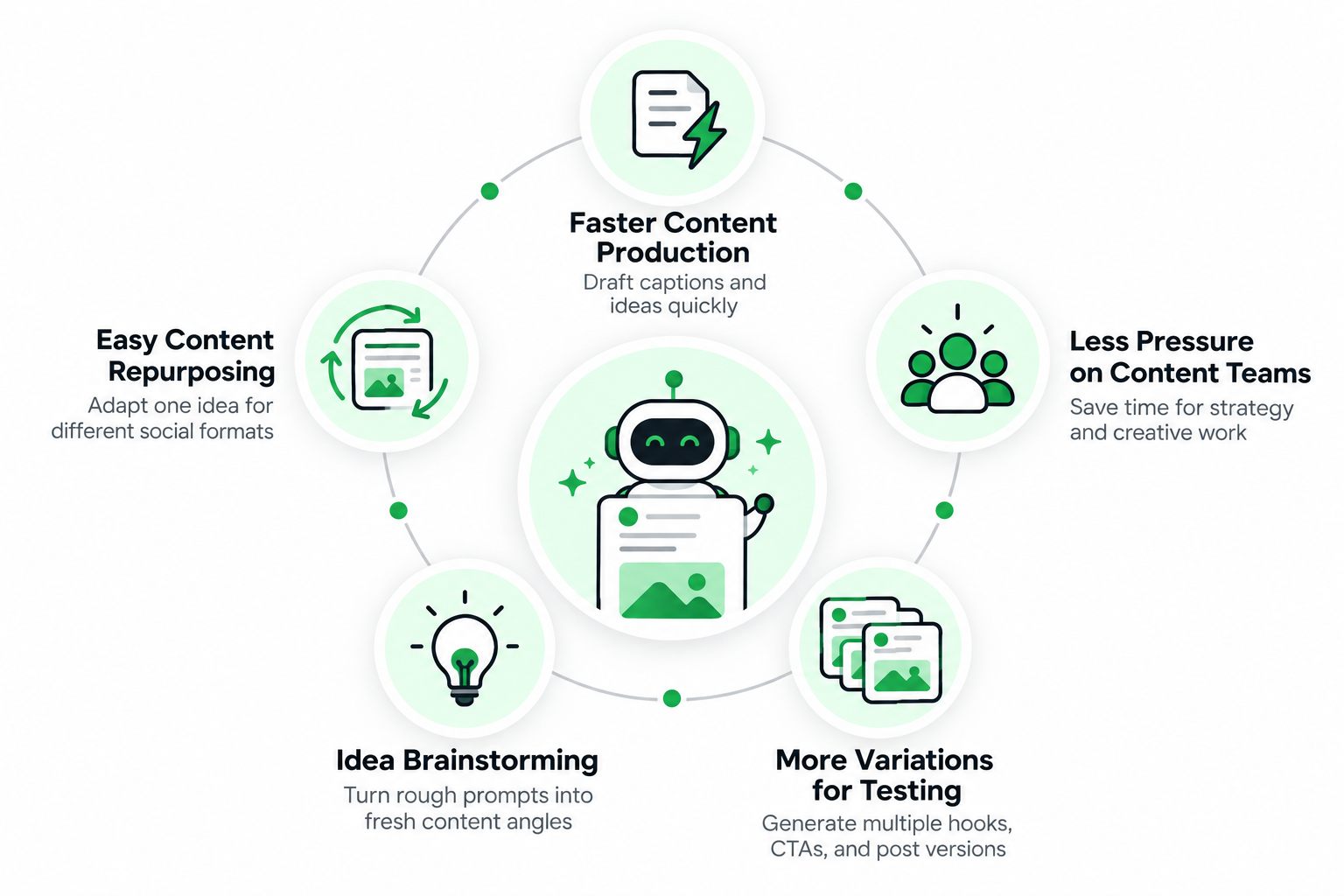
- Faster Content Production: One of AI’s clearest strengths is speed. A marketer can provide a topic, product detail, or campaign idea and get several caption or headline options almost immediately. The first version may not be ready to publish, but it gives the writer something to react to. Instead of starting with a blank page, the team can begin with a rough direction and spend more time improving the idea.
- Reduced Pressure on Content Team: There’s a lot more to social media teams than just writing posts. They may also plan campaigns, coordinate graphics, schedule content, respond to comments, review results, and work with other departments. Using AI writing tools for routine drafting or brainstorming can take some of that pressure off. The point is not to remove writers or social media managers from the process. It is to free up more time for work that needs deeper thinking.
- More Variations for Testing: Sometimes the difference between two posts comes down to the hook, headline, CTA, or a few words in the opening. Creating several variations manually can become repetitive. AI can quickly produce alternative versions for testing. The marketing team can then choose the strongest options and refine them before they are published.
Where AI-Generated Social Media Content Works Well
The value of AI content for brands becomes much clearer when it is used for specific jobs instead of being expected to handle the full creative process. Some social media tasks are repetitive, organizational, or based on adapting existing material, which makes them a good fit for AI assistance.
- Caption Alternatives and Drafts: Taking the time to write multiple captions for the same promo/subject is a lot. Artificial intelligence can give you a good starting point by creating different versions based on the platform, audience, tone, or length. A social media manager can then choose the strongest version, remove anything too generic, add brand-specific details, and make the wording sound more natural.
- Repurposing Existing Content: Brands often have useful material sitting in blogs, webinars, case studies, reports, interviews, and videos. AI can help pull out parts that could work as shorter social posts. A detailed blog can be an educational post, a carousel outline, a question series, or a short video script. Human editing can then make each version feel right for the platform.
- Social Content Calendars: AI can also help organize ideas into a working content calendar. It might suggest how educational, promotional, community, and brand-focused posts could be spread across the month. The final calendar should still be reflective of real campaigns, resources, customer needs, and business priorities. AI can help with the structure, but the marketing team should decide what is actually worth publishing.
Where AI-Generated Content Can Fall Short
Speed is helpful, but social content also has to feel like it belongs to the brand. This is where fully automated production can start to cause problems. AI can produce clean, polished copy that still feels ordinary, misses the point, or says something the brand would never naturally say.
- It might sound generic: AI generally uses language patterns it knows. Without enough direction, it can produce captions full of predictable phrases, broad claims, unnecessary excitement, and wording that could belong to almost any company. This becomes more obvious when a brand publishes generated content regularly. A single post might sound acceptable, but over time the overall feed can begin to feel repetitive.
- It May Miss Brand Personality: Strong brands usually have a recognizable way of speaking. Some sound playful and relaxed, while others are direct, technical, reassuring, bold, or understated. AI does not automatically understand those differences. Without good examples and careful editing, brand voice consistency can easily disappear from one post to the next.
- Too Much Automation Can Make a Brand Feel Distant: People usually do not follow a brand because they want to read endless polished promotional messages. They want useful information, personality, conversation, stories, and sometimes a glimpse of the people behind the company.
When social media automation takes over too much of the communication, those human details can disappear. The account may stay active while becoming less interesting to follow.
What Human-Created Social Media Content Still Does Better
AI can imitate many writing styles, but human content creators bring experience, judgment, personal observation, and an understanding of situations that is still difficult to automate fully. Those strengths become especially important when a brand wants people to remember the content rather than simply scroll past it.
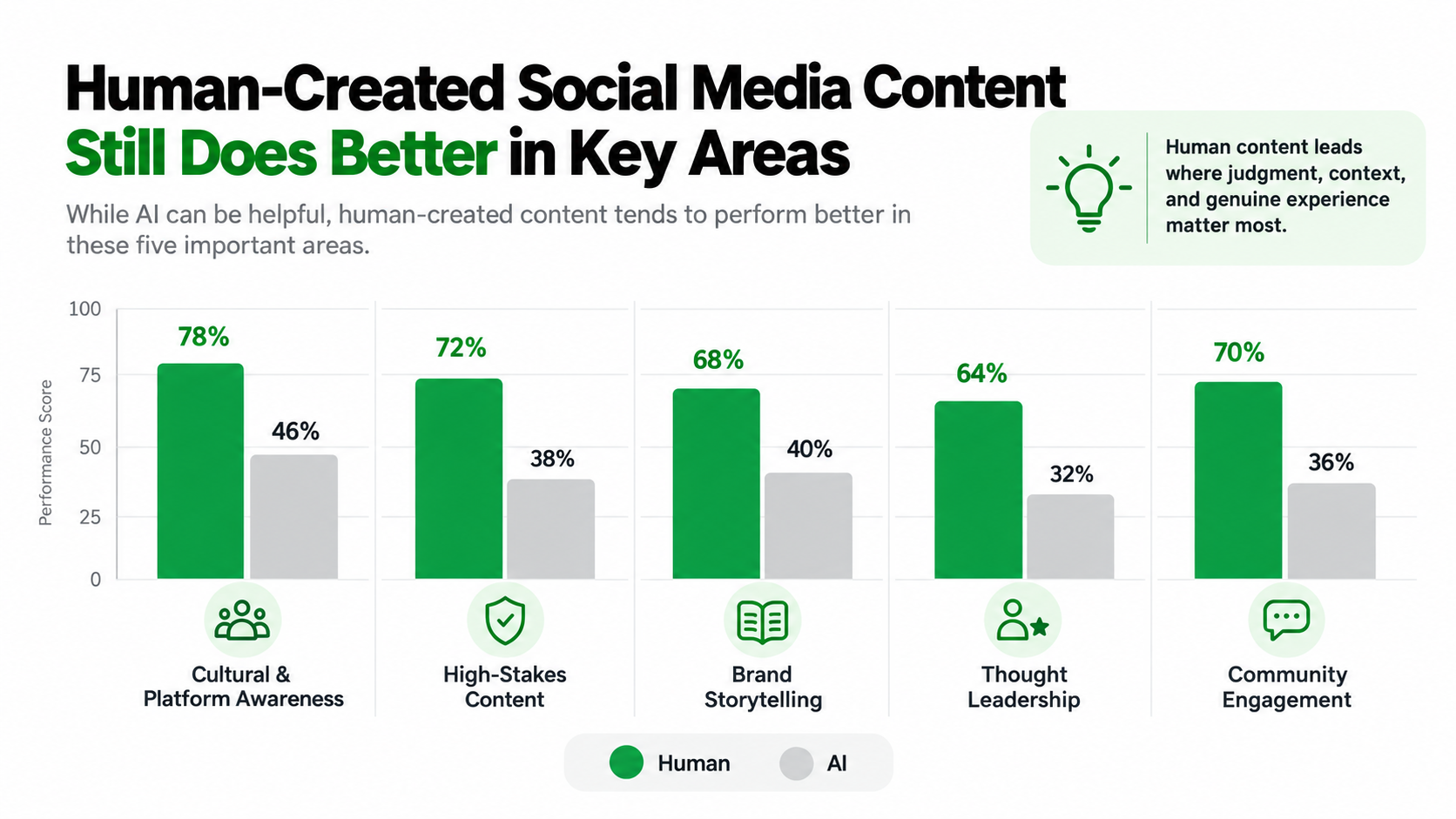
- Cultural and Platform Awareness: A post that works well on LinkedIn may feel completely wrong on TikTok or Instagram. Trends, jokes, formats, expectations, and conversations also move quickly. Human creators who actively use these platforms are often better at spotting those differences and deciding when a trend suits the brand and when it is better left alone.
- Where Human-Created Content Matters Most: Some posts carry more weight than others. A routine product reminder is very different from a CEO statement, a response to criticism, or a campaign built around a sensitive issue. The more visible, personal, or high-risk the content becomes, the more important human involvement is.
- Brand Storytelling: Strong social media storytelling depends on real detail. Founder experiences, employee stories, customer journeys, business milestones, and lessons learned feel more believable when they come from genuine experience. AI can help improve the structure or shorten a story, but the substance should come from people who actually know it.
- Thought Leadership: Thought leadership should contain a real point of view. Repeating information that already exists everywhere does little to show expertise. Industry professionals can share observations, lessons, disagreements, predictions, or examples from their work. AI can help organize those ideas, but the expertise should come from someone who genuinely knows the subject.
- Community Engagement: Comments and direct conversations often include context that a generic automated reply cannot fully understand. If a customer asks a deep question, they deserve a deep answer. You should not always give the same standard response to someone sharing a personal experience. Human involvement makes these exchanges feel more thoughtful and genuine.
AI vs Human Content: What Is the Real Difference?
The AI vs. human content discussion becomes more useful when both are compared based on what they actually bring to the process. Neither is automatically better at every type of task.
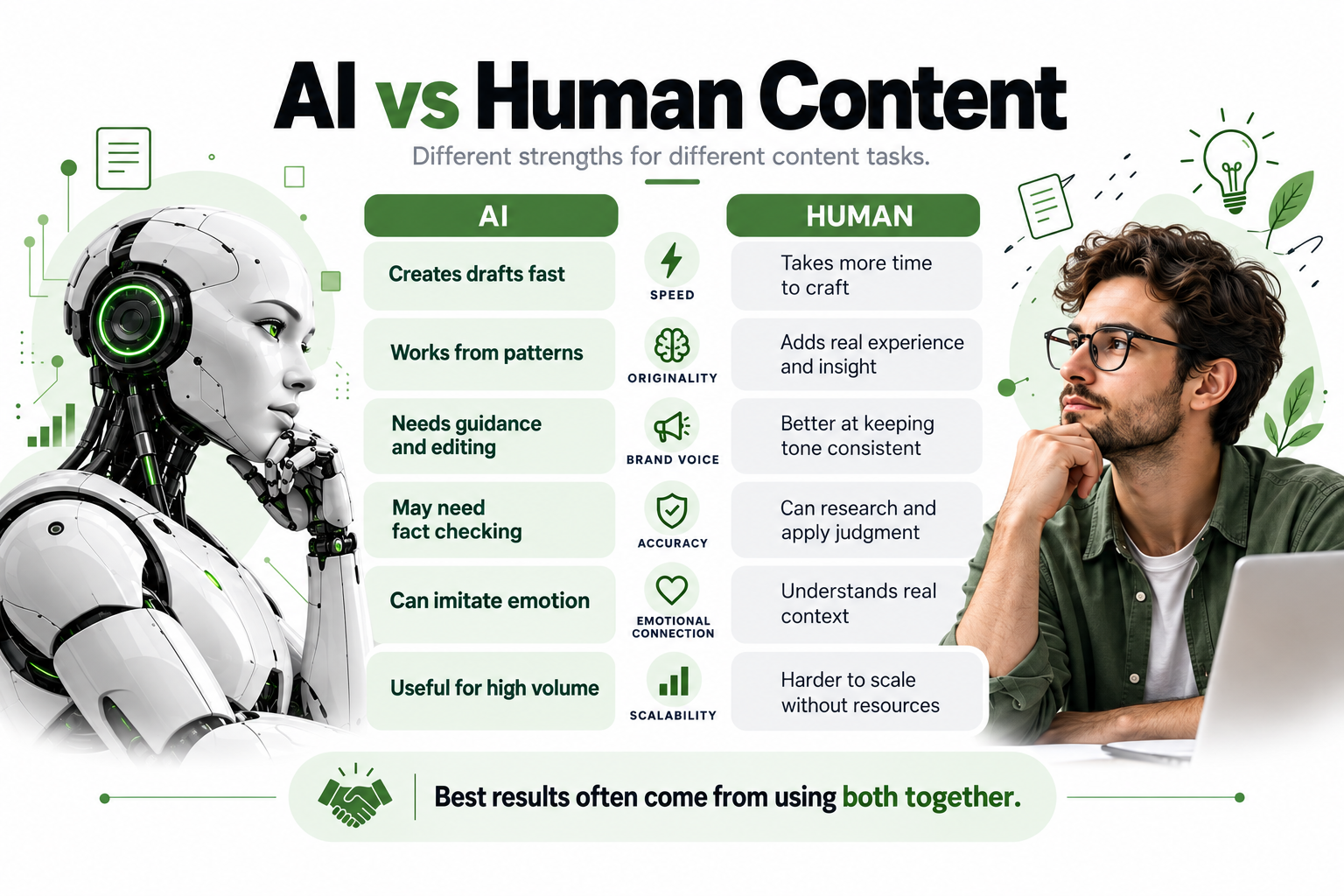
AI-Generated Content Human-Created Content Speed Can produce drafts and variations very quickly Usually takes more time for research and creation of originality Often works from familiar patterns Can draw from real experience and original observations
- Brand Voice: AI often needs guidance and editing to maintain a consistent brand voice. Human creators can maintain it more naturally when they understand the brand well.
- Accuracy: AI can sometimes produce incorrect or unsupported information. Human creators can research sources, verify details, and apply judgment before publishing.
- Emotional Connection: AI can imitate emotional language, but human creators can draw on real experiences and better understand emotional context.
- Scalability: AI is useful when large volumes of content or multiple variations are needed quickly. Human content is harder to scale without additional people, time, or resources.
The real difference is not simply machine versus person. AI is strong at speed, volume, and variation, while people bring context, responsibility, lived experience, and judgment. A good social media content strategy makes use of both.
The Biggest Risk Is Not Using AI but Using It without Control
Using AI is not automatically the problem. The bigger risk comes when brands publish generated content without checking what it says, how it sounds, or whether it fits the situation. A practical AI marketing strategy needs clear rules around what AI can help with and what still needs human approval.
- Unchecked AI Can Create Incorrect Claims: A generated post might include a product feature that does not exist, the wrong date, a questionable statistic, or a claim the business cannot support. Someone familiar with the subject should always verify those details before the content reaches the audience.
- Repetitive Content Can Weaken Brand Identity: When the same prompts and patterns are used again and again, captions can start to sound alike. Hooks, sentence structures, conclusions, and CTAs may become predictable. Over time, that can make the brand less distinctive. Editing should remove repeated patterns and bring back the language people associate with the company.
- Over-Automation Can Reduce Quality: Producing more posts does not automatically mean better marketing. A team might double its output with AI while publishing content that gets very little attention because it adds little value. Quality still has to guide the process. Ten useful posts can easily be more valuable than thirty forgettable ones.
A Better Approach: Use AI as a Content Assistant, Not the Final Decision-Maker
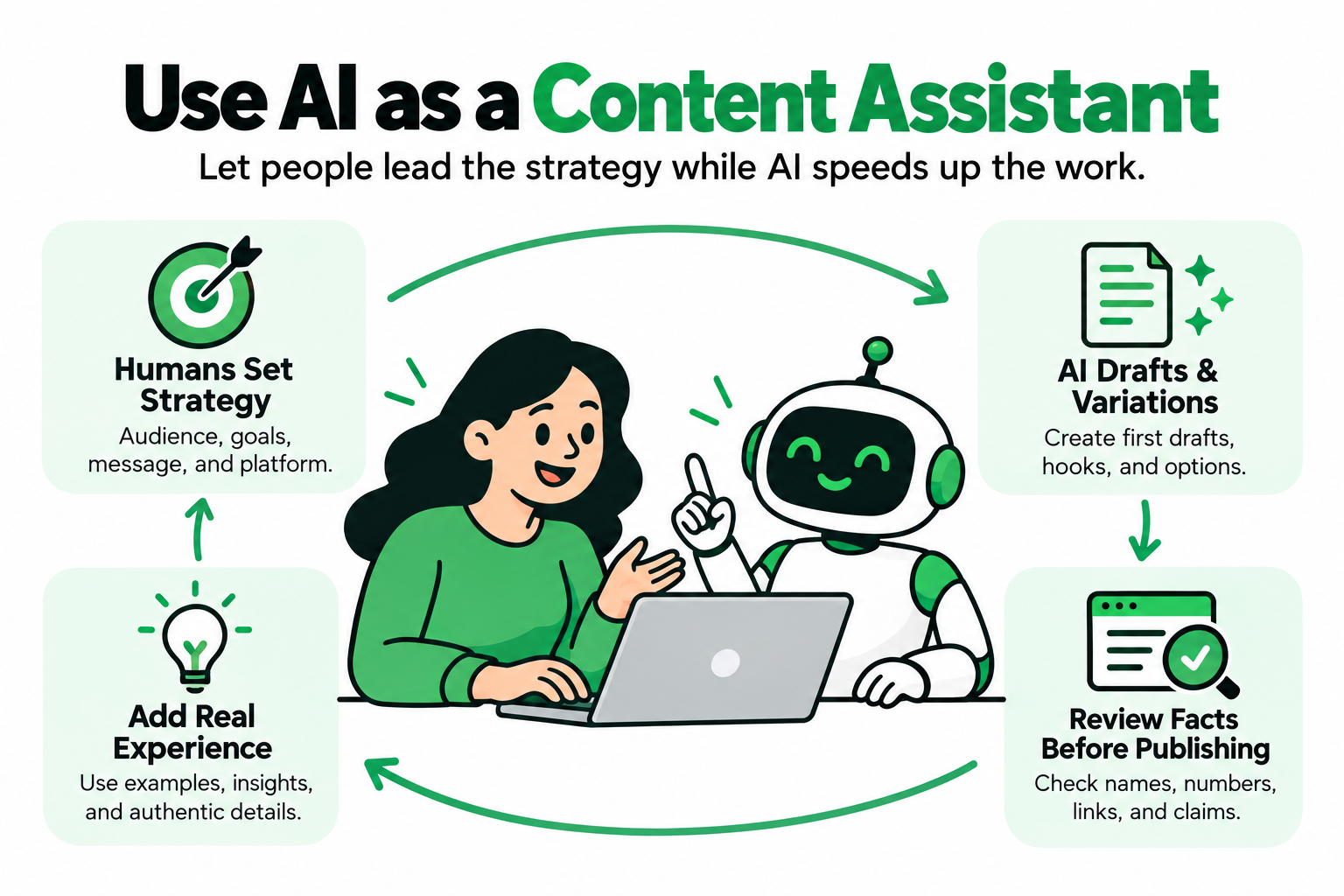
A balanced content creation workflow gives AI a useful role without handing it full control. People set the direction, AI speeds up suitable tasks, and humans remain responsible for what finally reaches the audience.
- Let Humans Set the Strategy: People should decide the audience, campaign objectives, key messages, platforms, offers, brand position, and measures of success. Without that direction, AI may produce a lot of content without solving a real marketing problem.
- Use AI for First Drafts and Variations: Once the direction is clear, AI can help create rough captions, headline options, hooks, summaries, and alternative versions. These drafts should be treated as raw material. The creator still decides what deserves to stay and what needs to be changed.
- Add Human Experience and Examples: Real examples immediately make generic content more useful. Add customer situations, project experiences, observations, lessons, original data, team insights, or specific product details whenever they genuinely support the post. These details also help create more authentic social media content.
- Review Facts before Publishing: Check any factual statement that could affect trust. Dates, figures, names, prices, specifications, statistics, claims, quotations, and links deserve particular attention. A sentence sounding confident does not make it correct.
Which Social Media Tasks Can Brands Safely Automate?
Automation is most useful when it removes repetitive work without taking important decisions away from the team. The best tasks usually have clear inputs and can be checked quickly before anything is published.
Brands can use automation to support:
- Initial content ideas: Generate possible angles around planned themes, campaigns, or customer questions.
- Caption drafts: Create rough versions that writers can improve before publishing.
- Headline variations: Produce alternative hooks for testing different approaches.
- Hashtag suggestions: Build a starting list that can be checked for relevance.
- Content repurposing: Turn existing long-form material into shorter social formats.
- Post summaries: Condense longer content into social-ready starting points.
- Basic product descriptions: Draft simple descriptions from verified product information.
- Calendar organization: Arrange approved themes and ideas across publishing dates.
- Reporting summaries: Turn performance data into an easier first-pass overview.
- A/B copy variations: Create alternative wording for controlled content tests.
The purpose of AI-assisted marketing should be to reduce repetitive work, not remove human responsibility. Creative direction, context, final judgment, and approval should stay with people who understand the brand.
Which Social Media Tasks Still Need Strong Human Involvement?
Some things depend too much on judgment, context, relationships, and accountability to be fully automated. These tasks can shape how people see the brand and often carry greater reputational risk.
Human involvement remains especially important for:
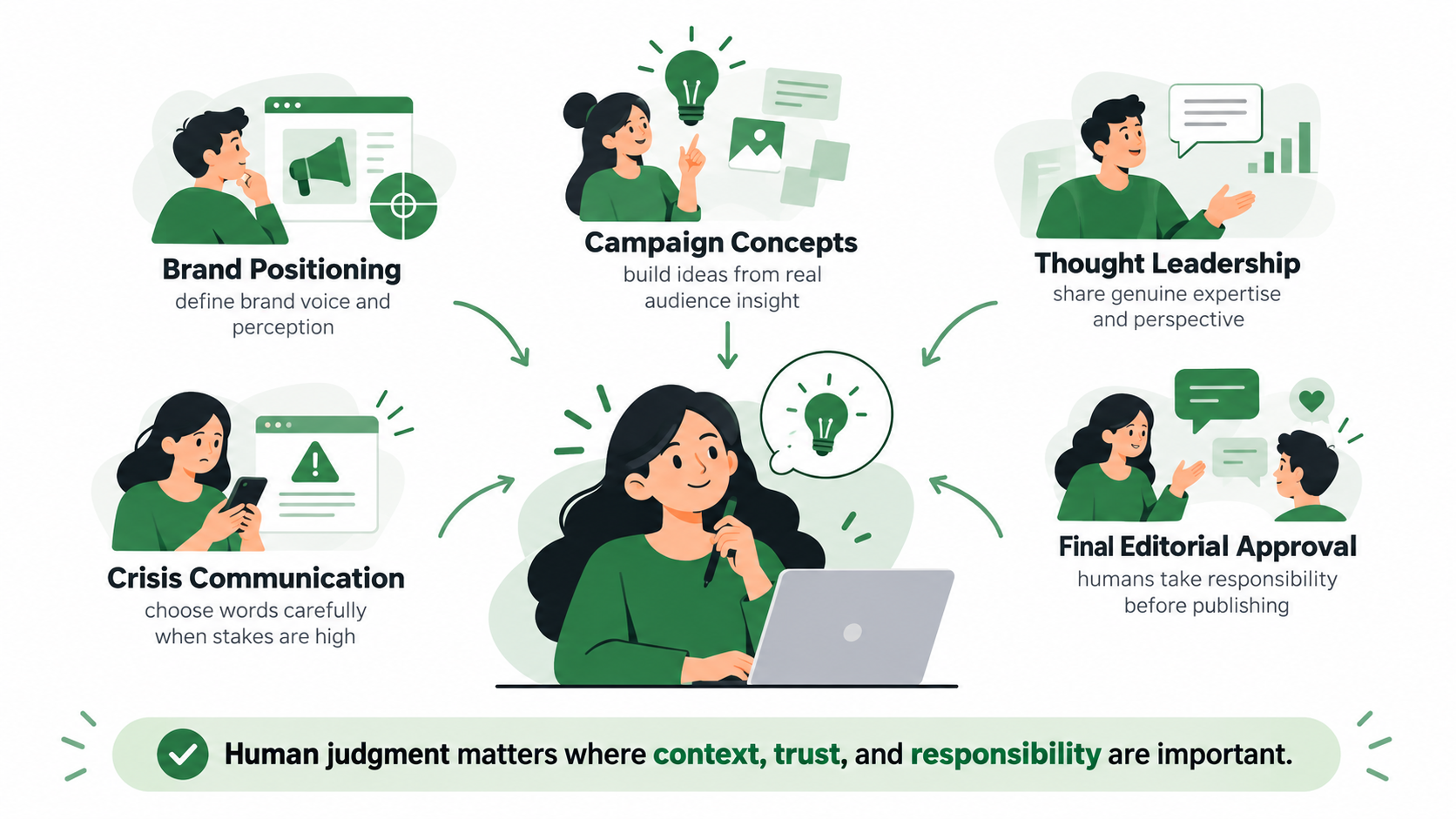
- Brand positioning: Decide what the company stands for and how it should be perceived.
- Campaign concepts: Build ideas around real audience and business insights.
- Thought leadership: Share genuine expertise, experience, and original professional views.
- Crisis communication: Respond carefully when accuracy, timing, and wording matter most.
- Customer responses: Understand individual questions rather than relying on generic replies.
- Community management: Build relationships through real conversation and participation.
- Humor and culturally sensitive content: Judge timing, context, interpretation, and possible misunderstandings.
- Original storytelling: Turn real experiences into stories people can connect with.
- Influencer collaboration: Manage relationships, expectations, fit, and campaign goals.
- Final editorial approval: Take responsibility for everything published under the brand’s name.
These areas need more than fluent writing. They need context, experience, judgment, and someone who is willing to take responsibility for the final decision.
How to Keep AI-Assisted Social Media Content Human
Using AI does not mean the finished content has to sound automated. Most generic output becomes much stronger when someone actively edits it instead of accepting the first version.
- Give AI Clear Brand Guidelines: Provide information about the audience, tone, preferred vocabulary, products, positioning, writing style, and language the brand avoids. Examples of successful past posts can also help. The more useful context the tool receives, the better the starting draft usually becomes.
- Replace Generic Examples with Real Ones: AI may create broad examples because it does not know what has actually happened inside the business. Replace them with real customer situations, project details, team experiences, product use cases, campaign results, or other information the company can genuinely support.
- Rewrite Openings and Hooks: Generated openings often fall back on familiar patterns. If several posts begin with the same question, dramatic statement, or predictable setup, the content can quickly start feeling repetitive. Rewrite hooks based on what would genuinely make the intended audience stop and pay attention.
- Add Opinions and Perspective: Useful content often has a point of view. A brand can explain what it recommends, what it has learned, what customers regularly misunderstand, or why it approaches a problem differently. That perspective gives the content something generic summaries often lack.
- Remove Repetitive AI Language: Look for repeated sentence structures, unnecessary summaries, vague transitions, excessive adjectives, and phrases that do not sound like normal conversation. A good edit should leave only the words needed to make the point clearly.
- Read Content as the Audience Would: Before publishing, stop looking at the post as its creator and read it as someone scrolling through a crowded feed. Would the opening make you stop? Is the point clear? Does the post offer something useful? Does it sound like the brand? These questions can reveal weaknesses that are easy to miss while writing.
How to Measure Whether AI-Assisted Content Is Actually Working
Saving time is useful, but it should not be the only way a brand judges social media content quality. Producing twice as many posts in half the time means very little if those posts attract less attention or lead to fewer business results.
Useful metrics can include:
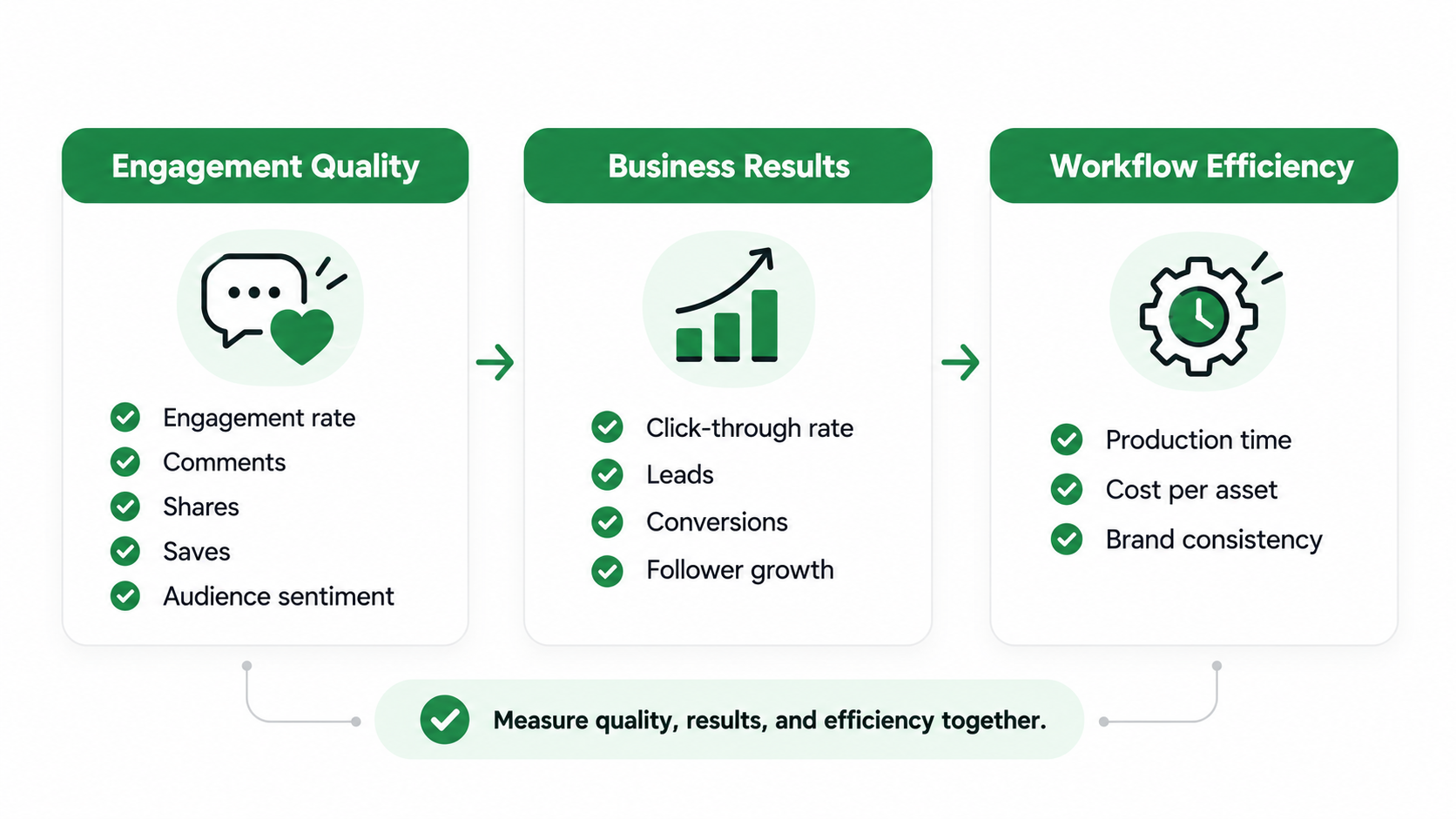
- Engagement rate: Are people interacting with the content relative to its reach?
- Comments: Is the content encouraging meaningful conversation?
- Shares: Do people find posts useful or interesting enough to pass along?
- Saves: Is the audience keeping the content for later?
- Click-through rate: Are posts encouraging people to take the next step?
- Leads: Is social activity contributing to genuine inquiries?
- Conversions: Are those interactions creating useful business outcomes?
- Content production time: Is AI actually making the workflow more efficient?
- Cost per content asset: Has production become more economical without lowering quality?
- Audience sentiment: How are people reacting to the tone and message?
- Follower growth: Is the account continuing to attract relevant people?
- Brand consistency: Does the content still sound and feel like the same company?
Brands need to compare real results and not just compare speed of production. If AI helps the team to work faster, and engagement, conversions, and audience response are healthy, or increasing, it is doing its job. If output increases while quality drops, the process needs adjusting.
A Practical AI + Human Social Media Workflow
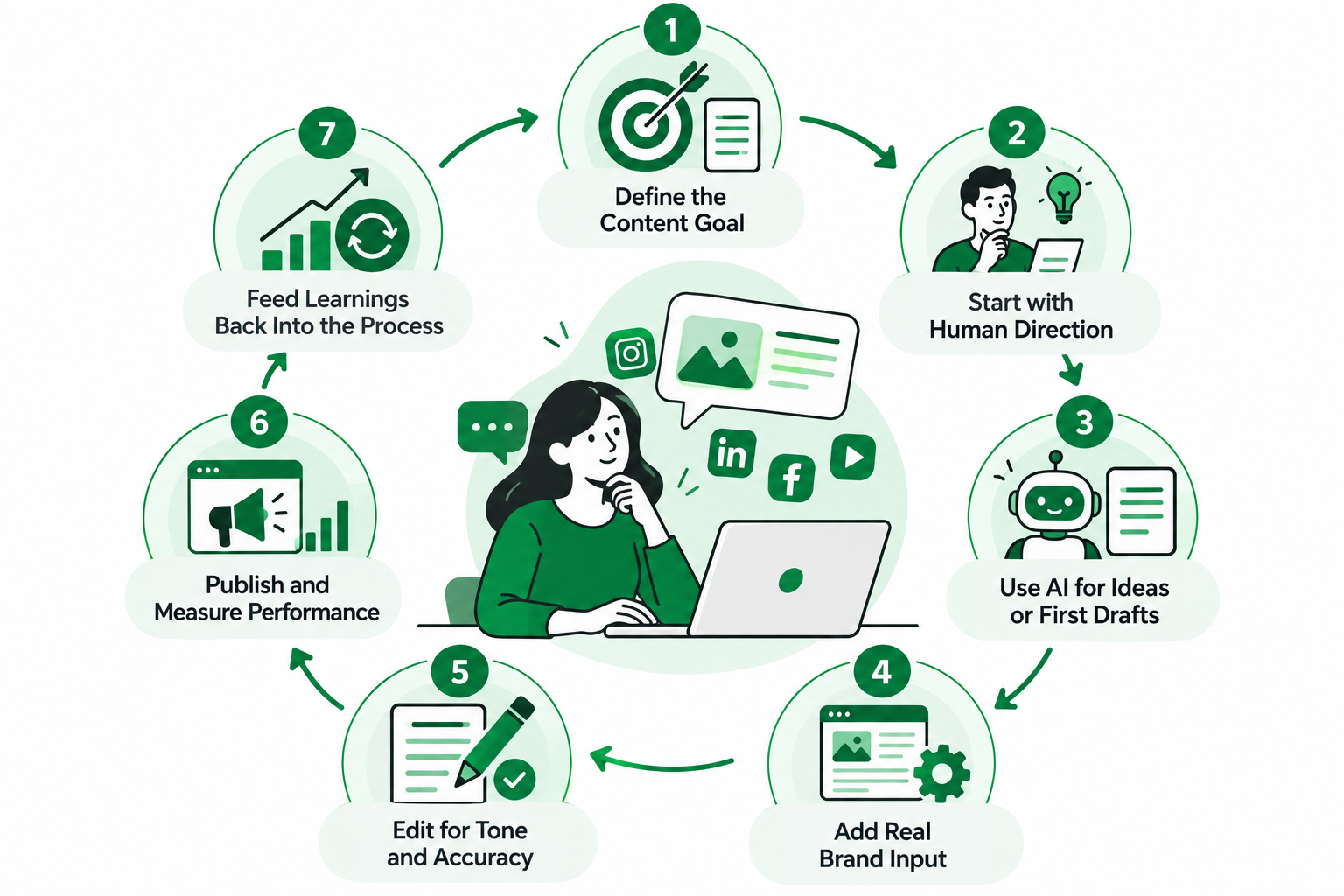
A good workflow makes it clear where technology helps and where people need to take over. It also stops AI-generated drafts from moving straight from creation to publication without enough review.
Step 1 – Define the Content Goal
Start with the reason the post is being created. Is it meant to educate, generate leads, promote an offer, build awareness, start a conversation, or support a wider campaign? A clear goal makes the next decisions much easier.
Step 2 – Start with Human Direction
Give the content a clear angle before using AI. Decide the audience, message, platform, tone, CTA, and any important information that must be included. This keeps the tool focused instead of asking it to invent the strategy.
Step 3 – Use AI for Ideas or First Drafts
AI can now help with brainstorming, rough captions, alternative hooks, summaries, or different versions. At this stage, speed is useful because the team is exploring possibilities rather than approving finished content.
Step 4 – Add Real Brand Input
Bring in information only the business can provide. Add customer experiences, product details, employee insights, campaign observations, original examples, opinions, or lessons from real work. This is where a generic draft starts to become genuine brand content.
Step 5 – Edit for Tone and Accuracy
Remove repetitive language, tighten weak sections, check the tone, and verify factual claims. The finished post should feel natural when read aloud and should match the way the brand normally communicate.
Step 6 – Publish and Measure Performance
Get it approved and post it and see how people respond. Look beyond likes and consider comments, saves, shares, clicks, enquiries, conversions, and other useful actions.
Step 7 – Feed Learnings Back Into the Process
Use performance data to improve future content. If certain hooks, formats, topics, or tones consistently work better, carry those lessons into future briefs and prompts. Over time, the workflow improves because decisions are based on real audience behavior rather than guesswork.
Practical Example: A brand could have a strategist choose the campaign theme, use AI to generate ten caption angles, let a writer develop the strongest two, have a subject expert check the details, and then compare performance. AI saves time without taking control of the message.
Final Thoughts
AI does not have to replace human social media creators to be valuable. Its biggest strength is helping teams move faster, explore more ideas, repurpose useful material, and spend less time on repetitive production work. That can make a real difference when brands are managing several platforms and constantly need fresh content. The problems usually begin when speed starts to matter more than relevance, accuracy, personality, or the way the audience actually responds.
Human involvement still matters because social media is ultimately communication between people. Strategy, original experience, humor, emotion, cultural awareness, difficult conversations, and creative judgment cannot simply be handed over to a tool. The stronger approach is usually a shared workflow: let AI handle the work it can do efficiently, then let people shape the message, challenge weak ideas, add real experience, verify important details, and decide what is good enough to carry the brand’s name.
Want to use AI without turning your social channels into a stream of generic posts?
A balanced approach can make content production faster while protecting personality and quality. With eSign Web Services, brands can build smarter social media strategies that combine useful automation, creative direction, consistent messaging, and meaningful audience engagement.
Frequently Asked Questions
Question: Is AI-generated social media content good for brands?
Answer: The use of AI-generated content will be quite useful for brands where the idea is required, caption writing, variations, summarization, and any kind of repurposing of content. The usefulness of the AI-generated content mainly relies on its use. If the content is published without any editing, it may result in generic and erroneous language.
Question: Can AI completely replace social media content creators?
Answer: AI is able to do some of the work of content creation, but to replace human creators with AI wholesale would be to lose judgment, experience, character, and the human context of the process. Human beings will always remain necessary for strategy, storytelling, careful communication, campaign creation, community conversations, and approval.
Question: What social media content can AI create?
Answer: The use of AI is useful in caption drafts, headlines, article ideas, scripts, summaries, product descriptions, post variations, calendar recommendations, and rewrites of existing material. These are mostly meant to serve as starting points. Companies will need to evaluate whether they make sense before posting them.
Question: Does AI-generated content hurt engagement?
Answer: However, AI-generated content does not mean low engagement. Instead, it hinges on how the final content is useful, relevant, and appropriate for the target market. Low engagement will occur if the brand keeps producing generic or repetitive content using the AI. The measure of engagement is in comparison with past content.
Question: How can brands make AI content sound more human?
Answer: A brand can make AI-generated content more natural by providing specific instructions about its voice, using real-life instances rather than hypothetical examples, restructuring obvious hooks, including some opinions, eliminating repetitive phrases, and reading each post from the perspective of the audience. It is human editing that makes the difference between a generated draft and authentic brand content.
Author Details

Ashwani Kumar Sharma
Ashwani has been actively involved in SEO services since 2005. His expertise and distinctive work approaches have made him one of the most experienced and trusted SEO experts in the industry. He is a certified SEO and Google Ads professional. He also has strong business development skills in advanced SEO, PPC, and digital marketing strategies.


