


How to Optimize Your Google Business Profile for AI-Driven Local Search

Key Takeaways
- AI-driven local search makes discovery more conversational and contextual, while established Google Business Profile and local SEO fundamentals remain important.
- Optimise for accuracy, relevance, completeness, reputation, and clear business identity rather than an isolated “AI optimisation” trick.
- Categories, services, products, attributes, hours, and descriptions should accurately represent the business.
- Genuine reviews provide useful customer context. Never manipulate ratings or ask customers to include specific keywords.
- Your profile, website, location pages, citations, and independent references should describe the same business consistently.
- Local content should answer genuine questions about services, locations, and buying decisions without keyword stuffing.
- Authentic photos help customers evaluate the actual business; adding more images alone does not guarantee rankings.
- Coordinate profile management, website SEO, reputation, and relevant AEO or GEO work around shared customer needs.
- Measure calls, website visits, directions, bookings, qualified enquiries, and customers rather than profile views alone.
- Make your business easy to identify, understand, evaluate, and select for needs you can genuinely meet.
Local discovery is changing as customers ask more detailed questions about nearby businesses. Instead of searching only for a dentist or plumber, someone may want a provider that serves their area, opens on Saturday, offers a particular treatment, and has reassuring customer feedback. These requirements make accurate business information essential. A profile that lists the wrong hours or leaves services unclear can create confusion before a customer even visits your website.
In this blog, we will explain how Google Business Profile optimization supports AI-driven local search through a practical ten-step process. You will learn how to improve business details, categories, services, reviews, photos, website alignment, and measurement. We will also explain how established local ranking factors apply, which tactics deserve caution, and why profile activity alone cannot guarantee recommendations. The aim is to help suitable customers understand your business, evaluate its relevance, and take the next step with greater confidence.
How AI Is Changing Local Search
AI-powered experiences give customers another way to discover and compare nearby businesses. The practical challenge is to provide information that answers their requirements clearly, wherever they encounter your business. A short query such as “emergency dentist” leaves several needs unstated. A conversational question might specify Saturday opening, treatment availability, location, and appointment preferences.
Effective AI local search preparation begins by identifying those real requirements. Customers may explain them during phone calls, enquiries, or appointments. Use that knowledge to improve your business information rather than inventing dozens of slightly different search prompts. A customer looking for heat pump installation may care about the service area, equipment experience, availability, and feedback from previous customers. An AI answer can help organise information about those factors, although its recommendations can still contain mistakes.
Customers often want to understand suitability before contacting anyone. Finding a nearby business is only the beginning; they also need to know whether it handles their particular problem. For businesses, AI search for local businesses should therefore be approached through customer decisions. Clearly explain what you provide, any meaningful limitations, and how someone can confirm availability. An impressive description is less helpful than a precise answer.
What Does Google Use to Understand Local Businesses?
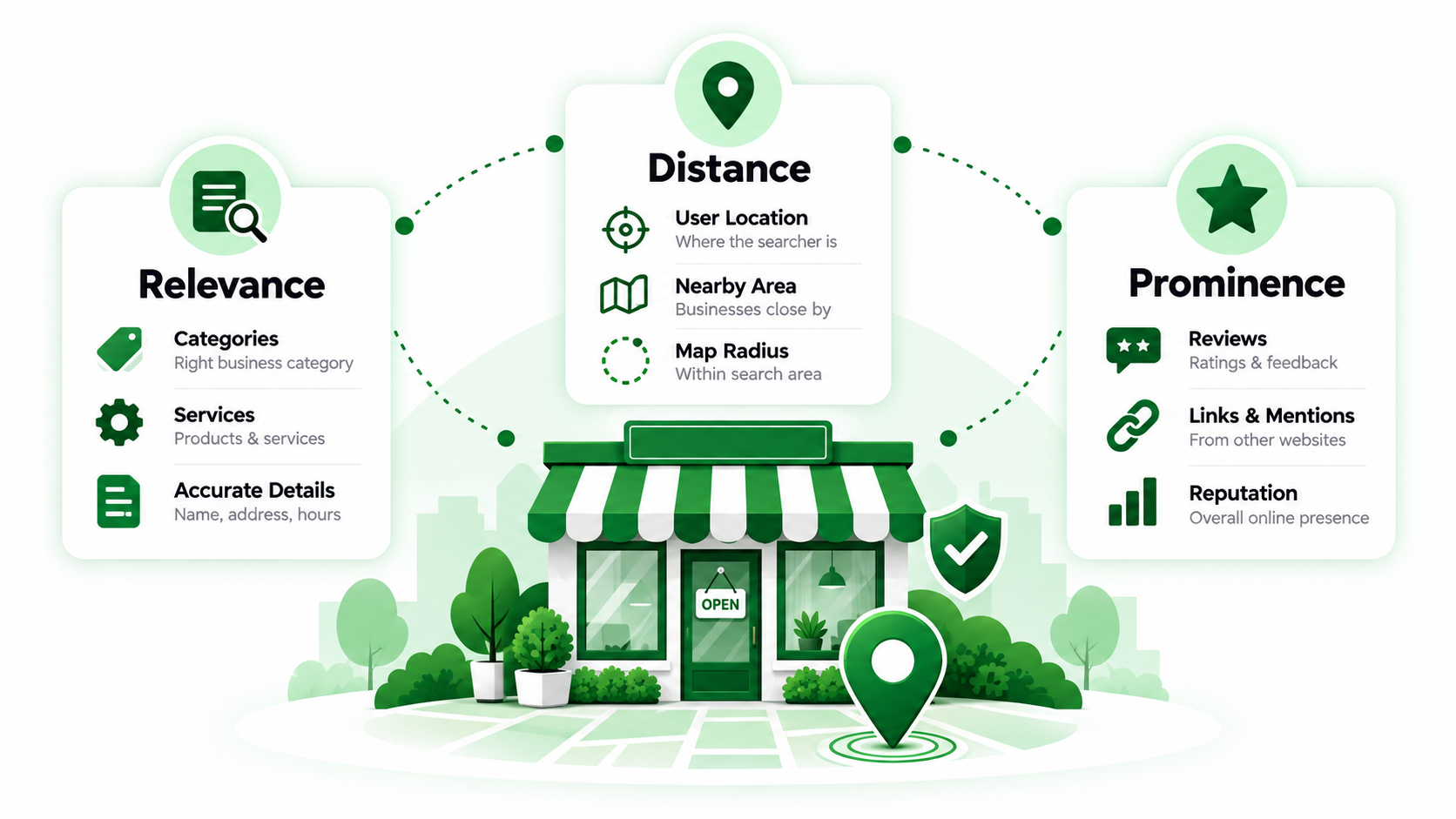
Before changing your profile, separate Google’s established local ranking principles from assumptions about AI recommendations. Google’s local ranking guidance describes relevance, distance, and prominence as central considerations.
Relevance
Relevance concerns how closely a business matches the customer’s request. Accurate categories and detailed information help explain what the business does. For example, someone seeking appliance repairs should not have to guess whether your company repairs washing machines, ovens, or commercial equipment. Specific, truthful information supports Google Business Profile SEO while reducing unsuitable enquiries.
Distance
Distance concerns the business’s location relative to the searcher. Results can therefore differ between people making similar searches from different neighbourhoods. You cannot remove that geographic consideration by adding more city names. Treat Google Maps ranking as something that varies across locations rather than one position applying to an entire metropolitan area.
Prominence
Prominence concerns how well known a business is. Google identifies links and reviews among the information that can contribute to this assessment. Build recognition through real work, useful contributions, and customer relationships. Prominence does not mean accumulating the largest possible collection of directory listings. Relevant, credible evidence matters more to customers than an impressive-looking quantity of references.
How to Optimize Your Google Business Profile for AI-Driven Local Search: A 10-Step Process
The following process connects accurate profile information with a useful website, genuine reputation, and measurement. Start with errors that could misdirect customers, then improve the details that help them evaluate your offer.
STEP 1: Complete and Verify Your Core Business Information
Reliable GBP optimization starts with confirming that your profile represents an eligible business and that you control its information. Complete any verification Google requires and resolve ownership problems before making wider changes.
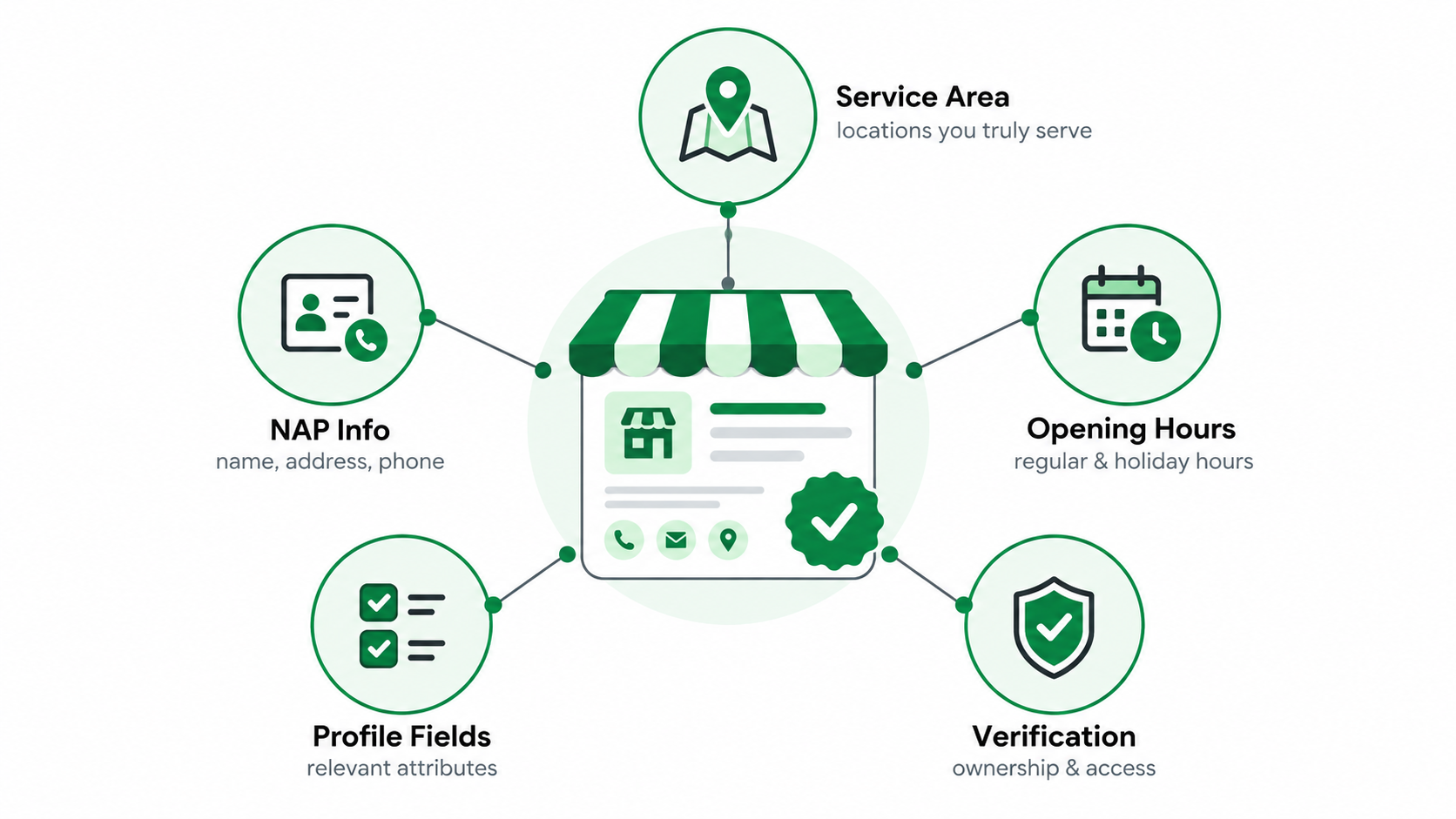
Keep NAP Information Accurate
NAP means business name, address, and phone number. Check these details alongside the website link and map location. Use your real-world business name. Google’s business representation guidelines prohibit adding unnecessary information to that name. A location or service phrase belongs there only when it genuinely forms part of the recognised business name.
Test the phone number and website link yourself. A correct-looking profile is still ineffective if calls reach an old employee or the linked page no longer exists.
Maintain Accurate Opening Hours
Check regular hours, holiday hours, and temporary changes. Where applicable, distinguish customer-facing opening hours from other service arrangements. A business that answers emergency calls overnight should not imply that its physical reception is open all night unless that is true. Explain appointment requirements and availability conditions on the relevant website page. Google provides separate options for regular, special, and certain additional service hours.
Define Service Areas Correctly
List places you genuinely serve. A cleaning company should base its service area on operational coverage, travel capacity, and the work it can deliver reliably. If customers do not visit your operating address, follow the applicable guidance for displaying or hiding that address. Adding service areas does not create branches or establish a physical presence in each town.
Complete Relevant Profile Fields
Review the fields available for your category and region. These may include accessibility information, appointment links, amenities, products, or other attributes. Only select attributes you can substantiate. An incorrect accessibility claim can create a serious inconvenience for a visitor. Completing relevant fields should make the profile more useful, not merely improve a completeness indicator.
STEP 2: Choose the Right Primary and Secondary Categories
Categories communicate the business’s main activities. They deserve careful attention because a vague or inaccurate selection can misrepresent the offer before customers read anything else.
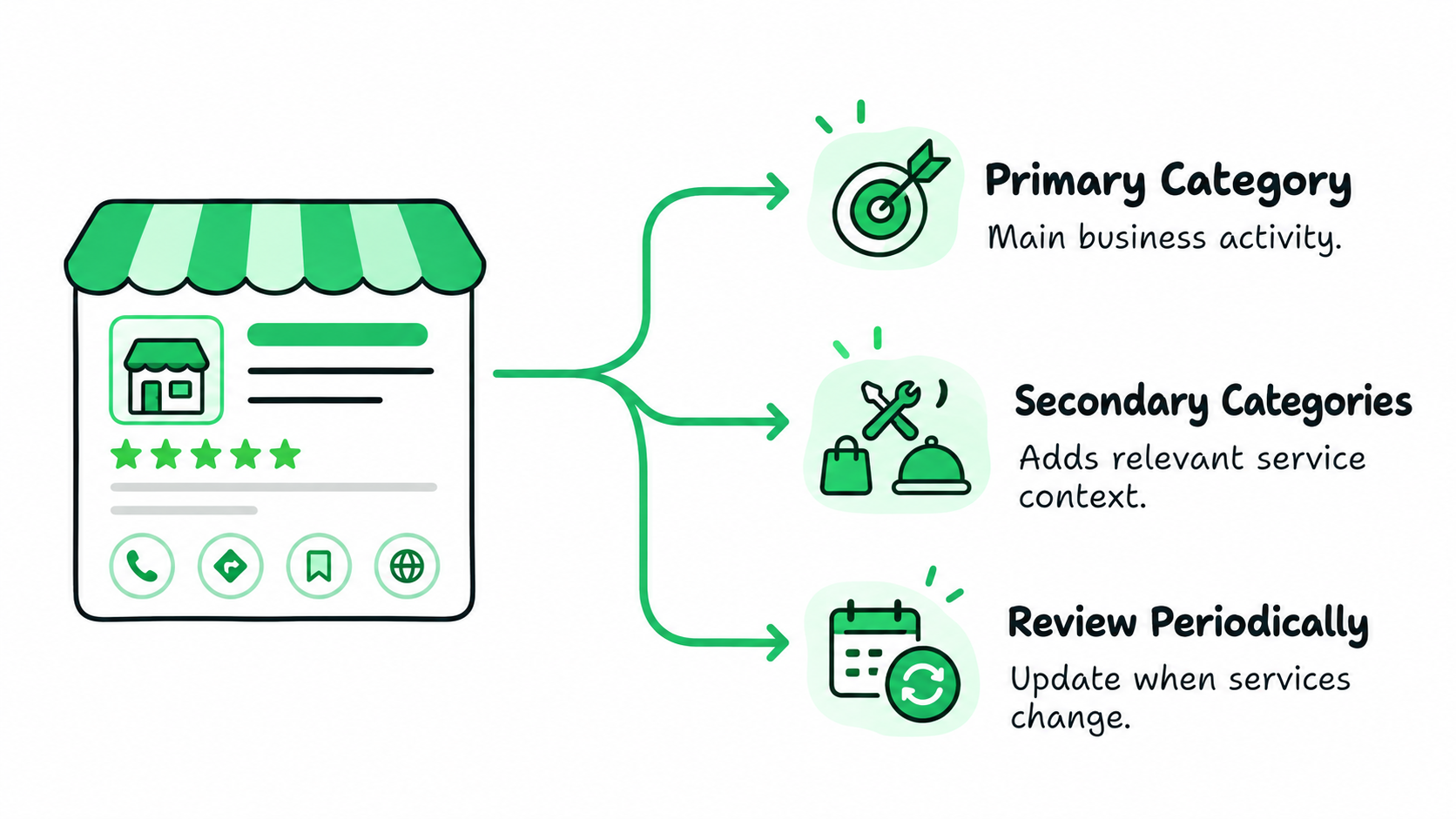
Select the Most Accurate Primary Category
Choose the available category that best describes your core business. Select according to what customers actually purchase from you, rather than which phrase appears popular in keyword research.
Google states that category selection affects local ranking. Its guidance recommends a specific primary category where available, with a broader accurate option when necessary.
Add Relevant Secondary Categories
Use additional categories for genuine activities that are not adequately represented by the primary category.
For example, a business with several related functions may need more than one category. However, a category should not be added simply because a neighbouring business uses it. Services, individual products, and business features do not each require their own category.
Review Categories Periodically
Revisit categories when your business changes its main offering or introduces a substantial new activity. Check the options available in the profile rather than relying indefinitely on an old category list.
Avoid changing categories repeatedly without a business reason. Keep a record of meaningful edits so you can understand what changed if visibility or enquiry quality shifts.
STEP 3: Add and Optimize Your Services and Products
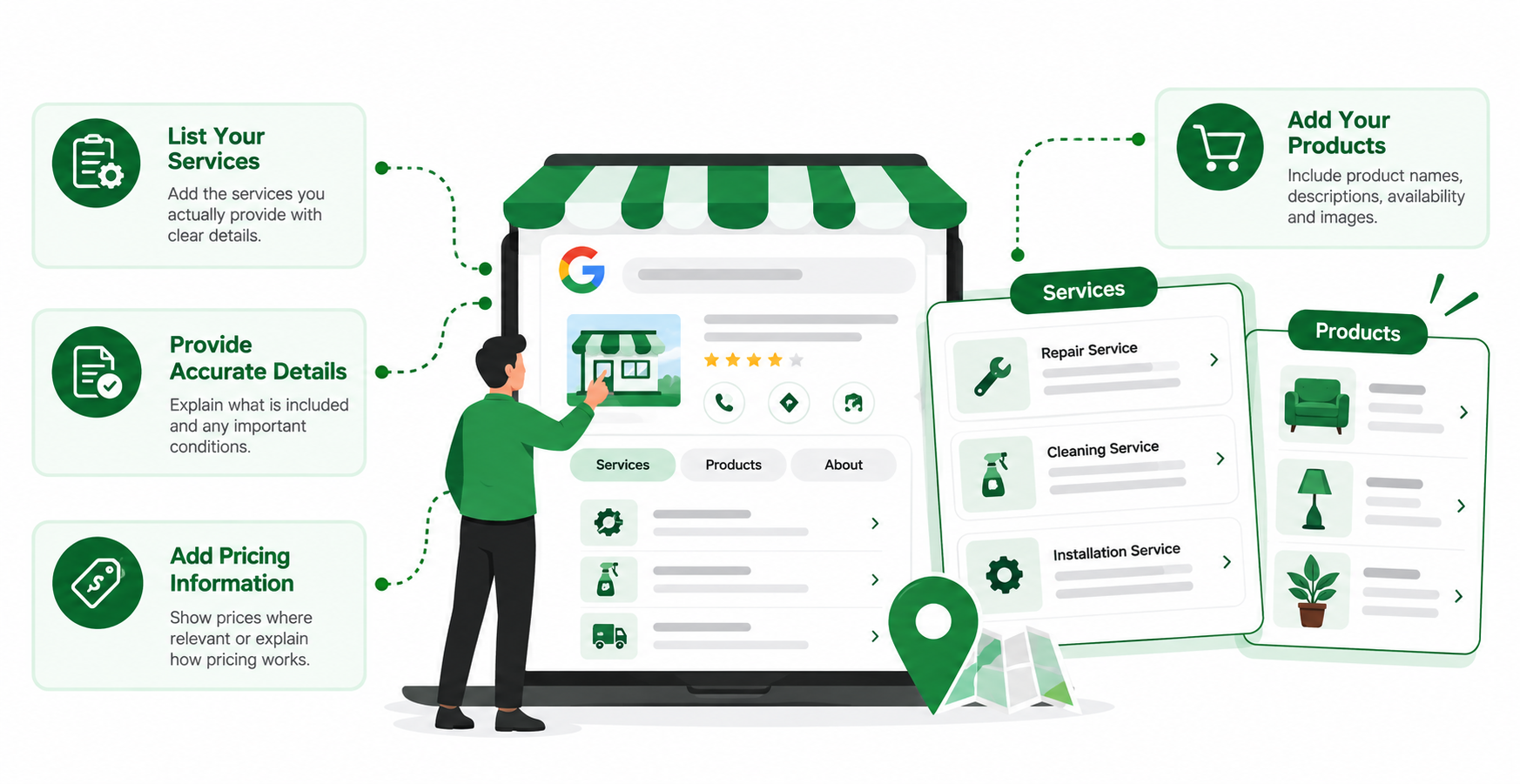
Categories describe the general business. Service and product details help customers assess the particular offer they need. This is an important part of local search optimization. Create a service inventory based on work you genuinely provide. Start with the services customers most often enquire about, then check that names are clear and distinct. Google’s service management guidance explains that eligible profiles can display services and that a matching service may be highlighted for a customer’s search. Availability depends on the business category.
Describe what the service includes and any important boundaries. “Office cleaning” becomes more useful when customers understand whether it covers shared kitchens, washrooms, scheduled visits, or specialist requirements. Avoid promising outcomes you cannot support. Where a price depends on an assessment, explain that rather than presenting a starting price as the full cost of every job.
Eligible retailers can use product information to help customers understand their offer. Keep names, descriptions, availability, and supporting images accurate. Do not describe an item as available locally merely because it can be ordered online. Product information should reflect the purchasing arrangement customers will encounter. Review the relevant tools and eligibility within your account before building a product-upload process.
STEP 4: Write a Clear, Entity-Rich Business Description
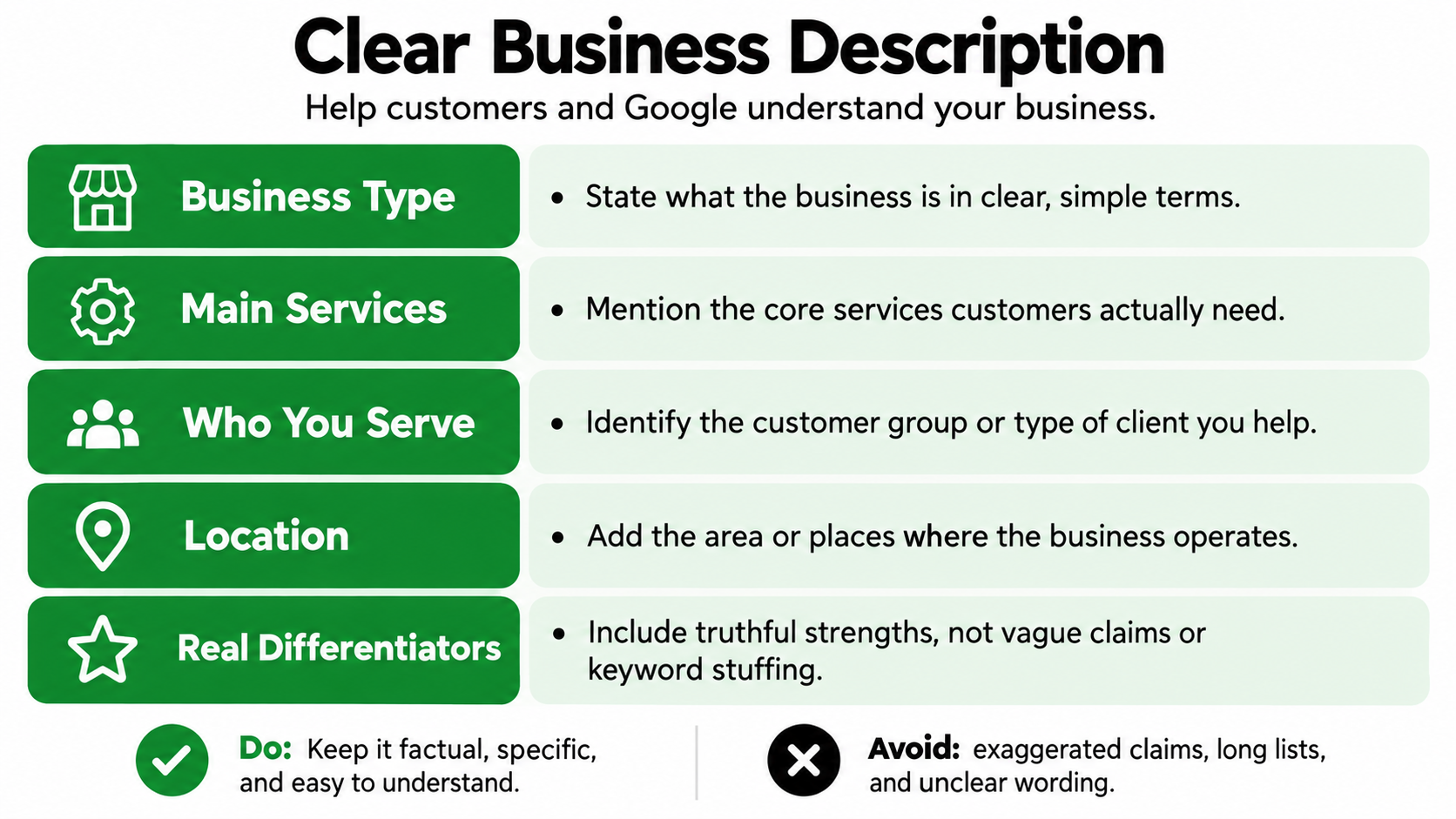
An entity-rich description simply makes the business’s identity and relationships clear. Readers should quickly understand what you do, whom you serve, and where the offer applies. Lead with the business type and main services. Add the customer groups, location, and meaningful differentiators that help establish suitability. A hypothetical description might read: “We provide residential plumbing repairs and bathroom installations for homeowners in Leeds and surrounding areas. Our team handles leak investigations, fixture replacements, and planned installation work.”
The principles behind entity-based SEO and clear business relationships can help you align this description with your website and public profiles. Use customer language naturally. A sentence describing an actual service is more useful than repeated variations of “best provider” and the city name. Treat the description as a concise introduction. Google limits its length and does not permit links in that field. Avoid turning it into a promotional price list or an attempt to include every possible local keyword.
Only include qualifications, experience, and capabilities that the business can support. Replace “the leading clinic” with information about actual services, relevant expertise, or appointment arrangements. An AI-assisted draft still requires factual review. Check that it has not invented years of experience, expanded service coverage, or implied recognition the business has never received.
STEP 5: Build a Strong and Authentic Review Profile
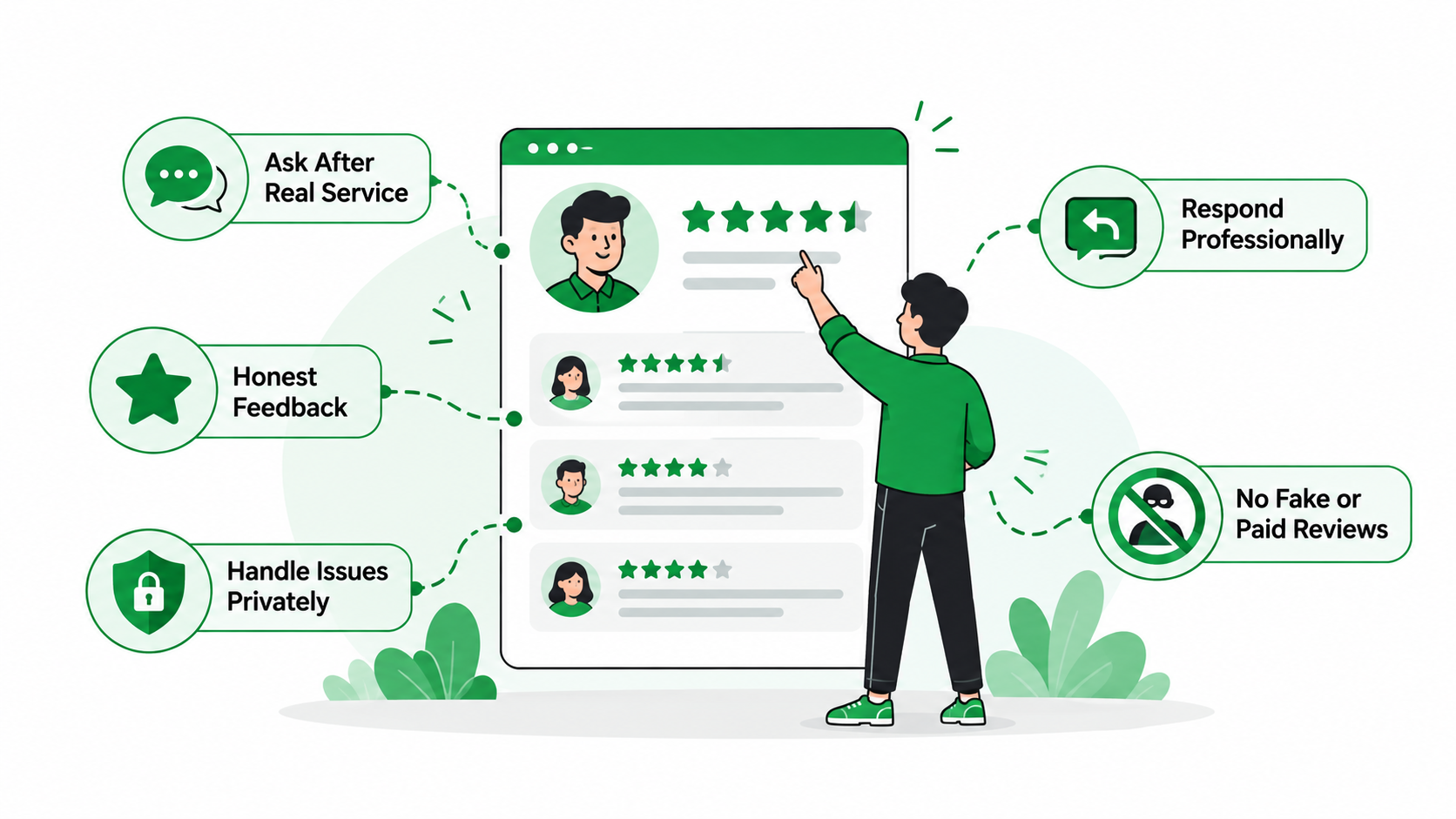
Reviews provide customer perspectives that the business cannot credibly write for itself. They can help prospective customers understand the experience of working with your team. Create a straightforward process for requesting honest feedback after genuine customer interactions. Use a review link where appropriate and make the request easy to understand. Google’s review and fake-engagement policies prohibit incentives, selective requests for positive reviews, and pressure to include specific content. Ask consistently rather than directing only satisfied customers to Google.
Do not give customers a list of service and location phrases to insert. Their review should reflect their own experience. Specific details can be useful when customers choose to share them. A comment about communication, punctuality, or a completed project gives another customer context. The goal is informative feedback, not a manufactured pattern of repeated wording. Write responses that acknowledge the actual feedback. A customer who praises clear explanations deserves a different reply from someone who mentions scheduling difficulties. Keep public responses respectful and avoid disclosing private information. For healthcare, legal, financial, and other sensitive services, take particular care not to reveal details about an individual’s relationship with the business.
Read the concern before responding. Acknowledge a legitimate issue, explain an appropriate next step, and offer a way to continue the discussion privately. Do not argue about personal details in public. Report reviews that appear to violate policy, but recognise that criticism alone is not a reason for removal. Repeated complaints about the same problem should prompt an operational review.
STEP 6: Use Photos and Visual Content to Strengthen Trust
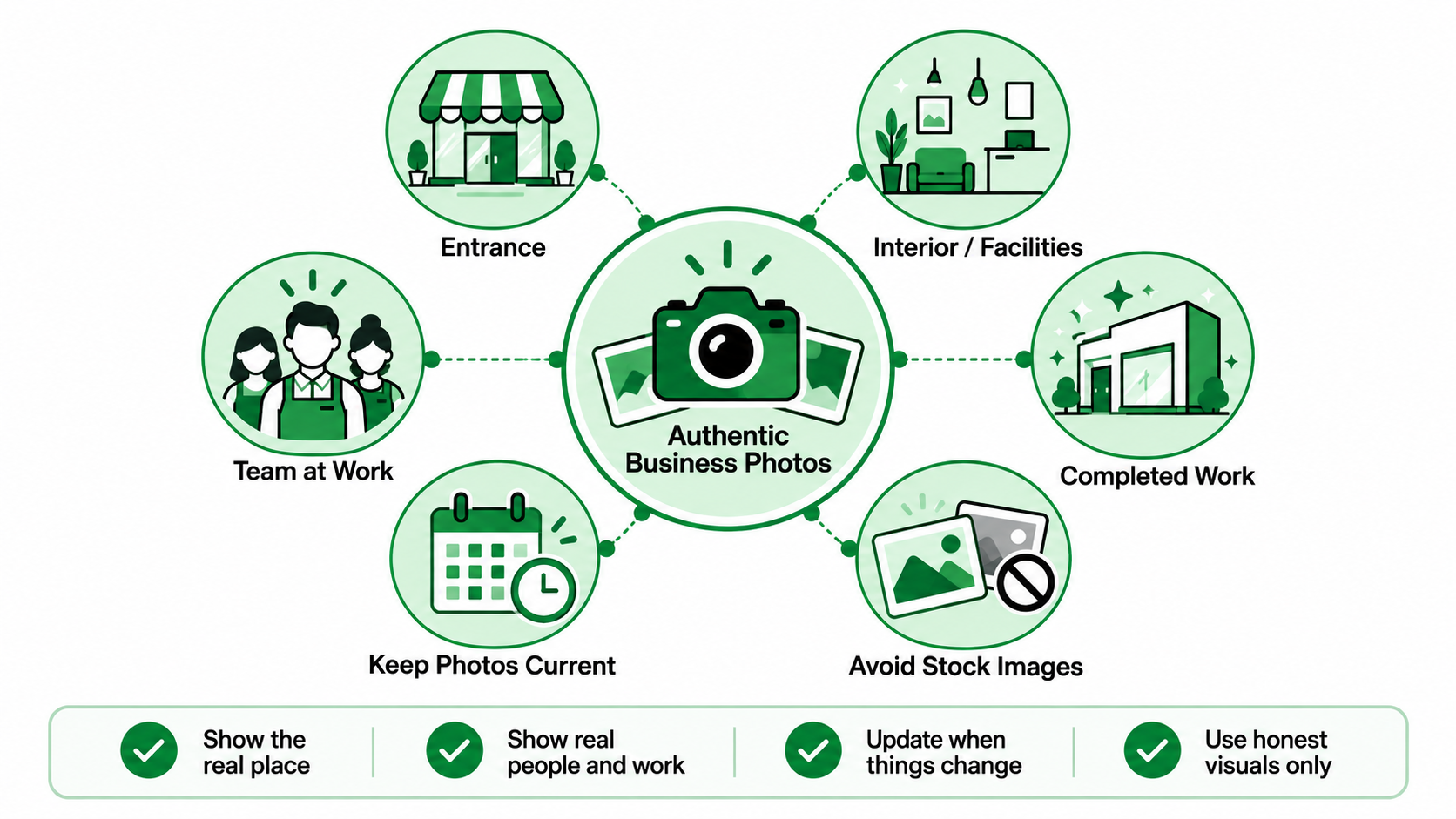
Photos help customers understand the place, people, products, and work behind a profile. Choose images according to what someone needs to evaluate or recognise.
Add Authentic Business Photos
For a customer-facing location, show the entrance and interior clearly. For a service business, show relevant equipment, team activity, or completed work where permission allows.
A useful selection might include:
- The entrance customers should use.
- Rooms, facilities, or products relevant to the visit.
- Team members in their genuine working environment.
- Completed projects that illustrate the services offered.
Together, these images should explain the business rather than create a decorative gallery.
Keep Visual Content Current
Replace images when the premises, branding, team, or offer changes materially. An outdated storefront photo can make a visitor think they have arrived at the wrong address. Review whether the collection still represents your current work. There is no need to upload repetitive pictures merely to meet an arbitrary schedule.
Prioritize Authenticity over Generic Stock Imagery
Stock imagery may support a broader marketing design, but it does not show your actual premises or completed work. Use clear, honest photographs without misleading alterations. Do not present an AI-generated office, team, or project as your own. Visual content should increase confidence in the real business, not substitute for evidence that is missing.
STEP 7: Keep Your Profile Active with Useful Updates
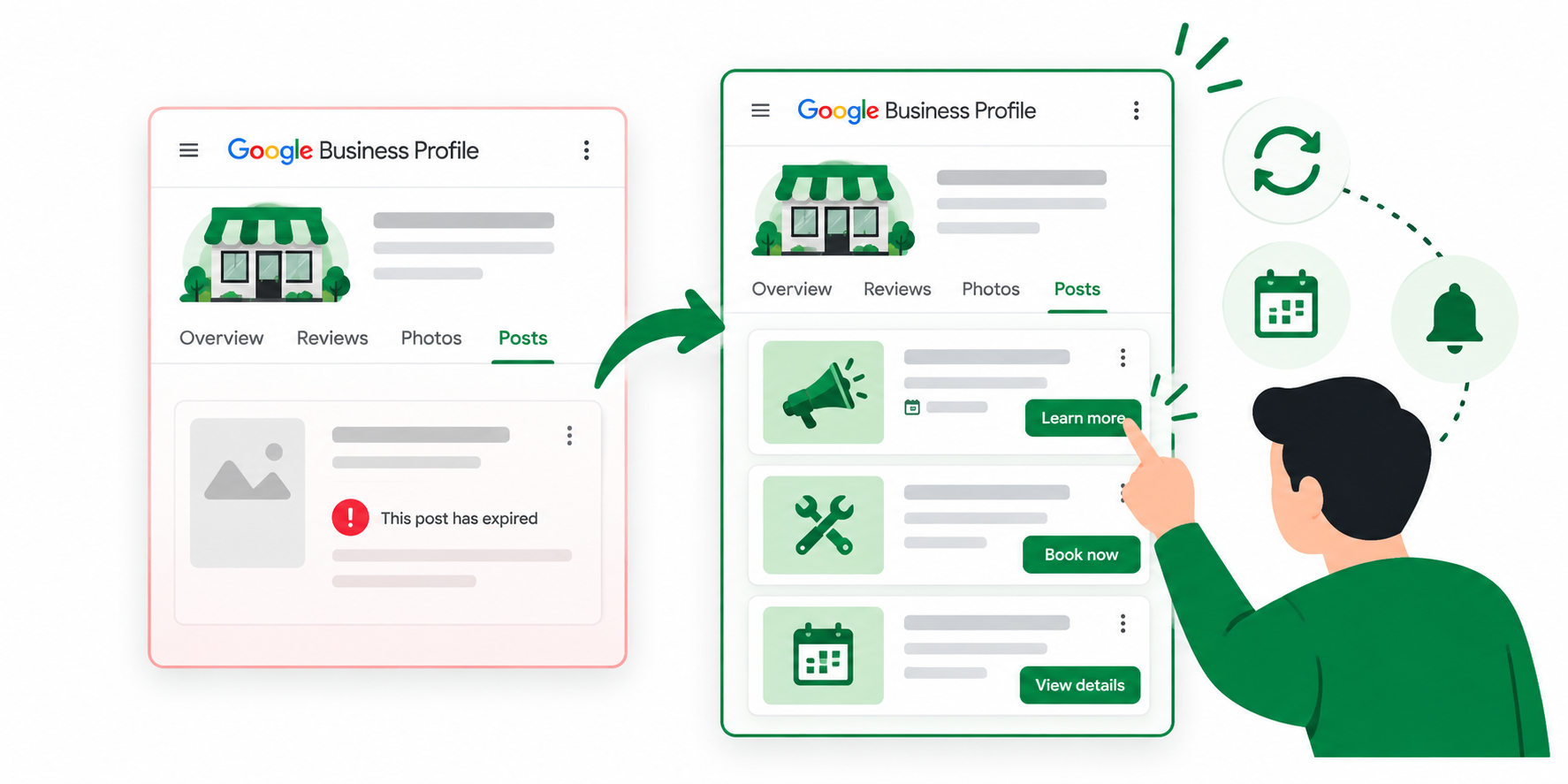
An active profile should reflect relevant developments. The value comes from keeping customers informed, rather than treating activity as a guaranteed ranking lever. Use Google Posts for timely information such as a new service, event, seasonal reminder, or offer. Match the post to a useful destination where customers can understand details or complete the next step. For example, an installation business could explain a newly available service and link to its requirements. Clearly state dates and conditions when the update concerns a limited offer. Ask what the update helps someone understand or do. “We are committed to excellence” adds little compared with an explanation of a changed booking process.
There is no need to claim that posting daily produces better Google Maps SEO results. A manageable schedule based on actual business developments is more useful than frequent, interchangeable promotional messages. Check whether published updates still apply. An expired promotion or old announcement can confuse someone who encounters it later. Coordinate changes across your profile and website. If an offer ends or a service becomes unavailable, ensure the linked page and booking process reflect the same position. Maintaining accurate information is more important than preserving an appearance of constant activity.
STEP 8: Align Your Google Business Profile With Your Website
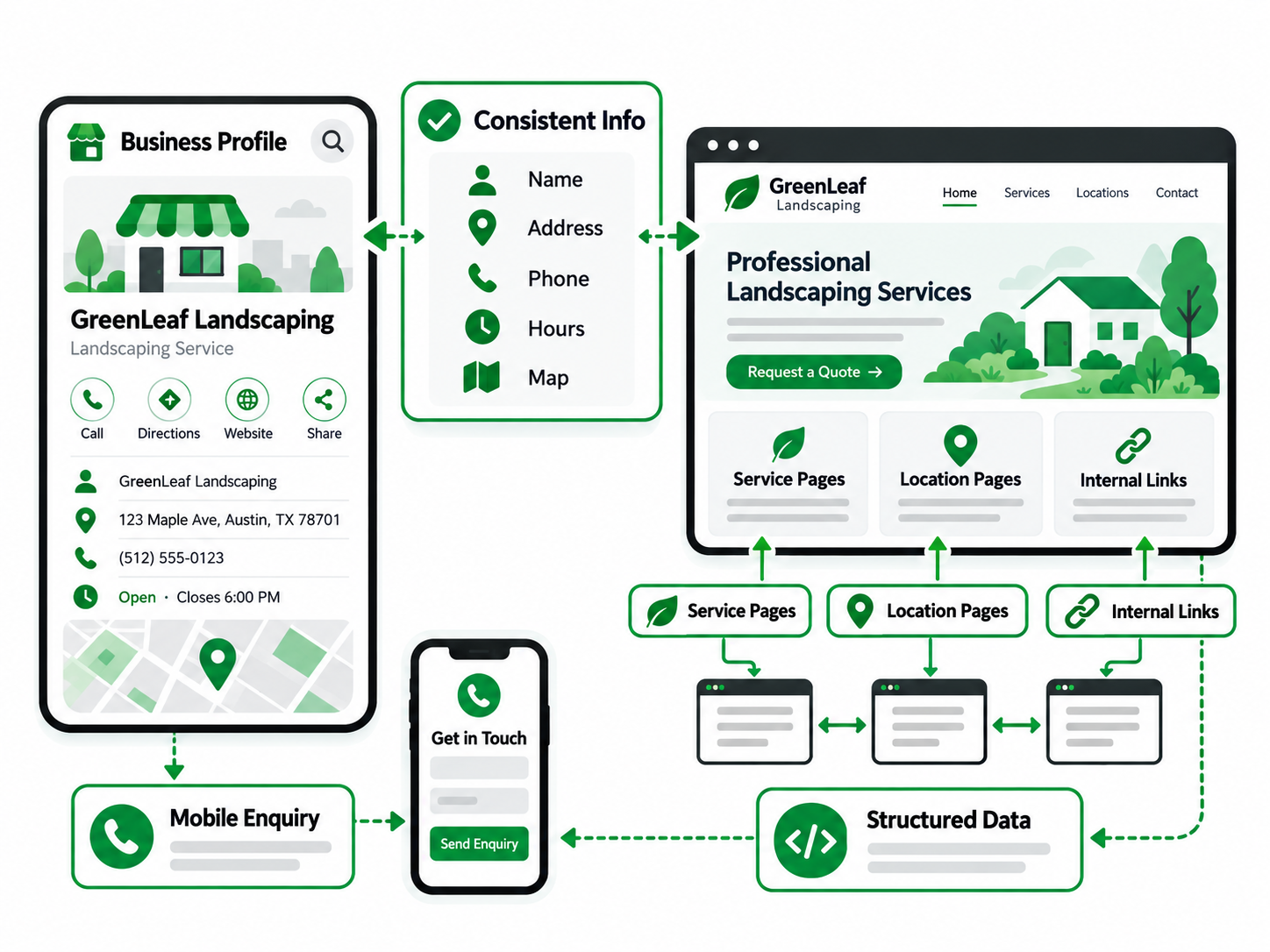
Your profile offers a concise view of the business. Your website should provide the depth needed to confirm suitability and make an inquiry. Create useful pages for genuine locations or service areas. Explain the services available, relevant experience, customer needs, and how someone can contact the right team. A location page should not be a generic article with a different town name. Include information that justifies the page: local projects, delivery arrangements, access details, or service conditions. Make the mobile enquiry path straightforward; website usability and SEO work together when visitors can find and act on the information they need.
Maintain Consistent Business Information
Compare profile details with contact pages, location pages, and booking destinations. Correct contradictions involving addresses, telephone numbers, opening hours, and services. Consistency concerns the underlying facts, not identical wording everywhere. A website may explain a service in more detail than the profile while still describing the same offer accurately.
Strengthen Internal Linking
Connect location pages with the relevant service explanations, project examples, and contact options. Links should help visitors resolve their next question. For example, a local repair page might connect to a guide explaining the inspection process. Avoid linking every location to every other location without a useful reason. Navigation should support decisions, not simply create a dense network of links.
Implement Relevant Structured Data
Use appropriate structured data to describe accurate website information. Depending on the page, relevant types may include LocalBusiness, Organization, Service, and BreadcrumbList. Check the requirements of any Google Search feature you want to support. Schema is not required for Google’s generative AI search features, and no special “AI schema” guarantees selection. Markup should agree with visible content and should never invent locations, reviews, or credentials.
STEP 9: Strengthen Local Entity Authority Beyond GBP
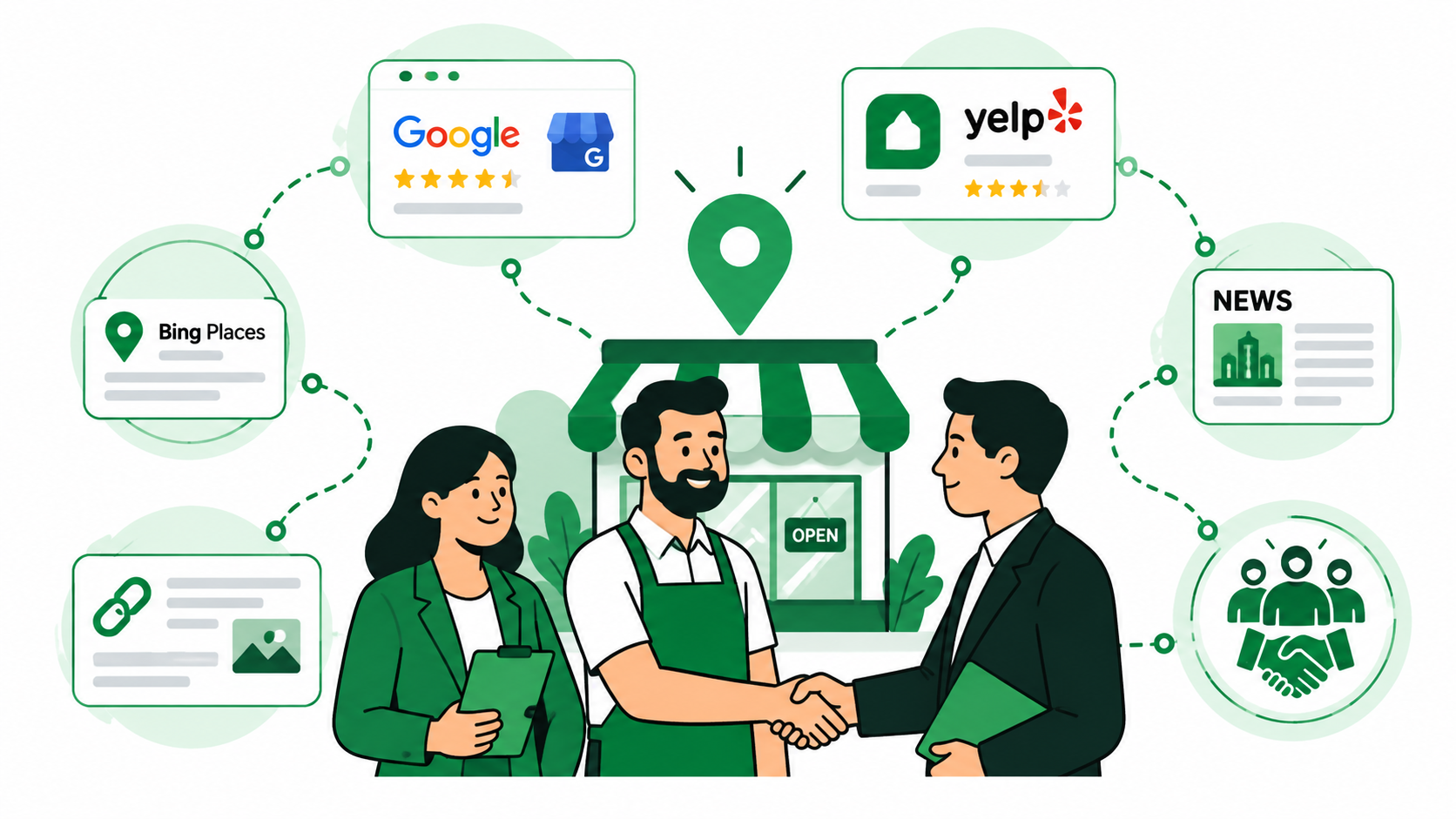
A credible local presence extends beyond one profile. Independent sources can help customers verify the business and understand its place within a community or industry.
Maintain Accurate Local Citations
Review important directories, professional listings, and local platforms where your customers may investigate the business. Correct outdated details and duplicate listings where appropriate. A citation is a reference to business information; it does not need to become another promotional article. Prioritise relevant, trustworthy platforms rather than submitting the business to every directory you can find.
Earn Relevant Local and Industry Links
Create reasons for others to reference your work. Useful resources, legitimate partnerships, professional contributions, and community projects can lead to relevant links. These opportunities belong within a wider local SEO strategy for small businesses. Evaluate the source’s relevance and audience rather than pursuing a link solely because an SEO tool assigns it a high score.
Build Independent Brand Mentions
A local publication might report on a community project, while an industry association might list the business’s membership. Such references help customers investigate genuine activity. Check the accuracy of the information. A mention is not automatically an endorsement, and paid publicity should not be presented as independent praise. Avoid describing every external reference as a confirmed AI ranking signal.
Strengthen Local Brand Recognition
Participate where your business has a useful contribution to make. This might involve sharing expertise, supporting a relevant organisation, or collaborating on a local initiative. Recognition should follow real involvement. It cannot be manufactured convincingly through repeated announcements that say little. Focus on becoming known for work customers value, with public information that accurately reflects that work.
STEP 10: Measure Local and AI Visibility, Then Keep Improving
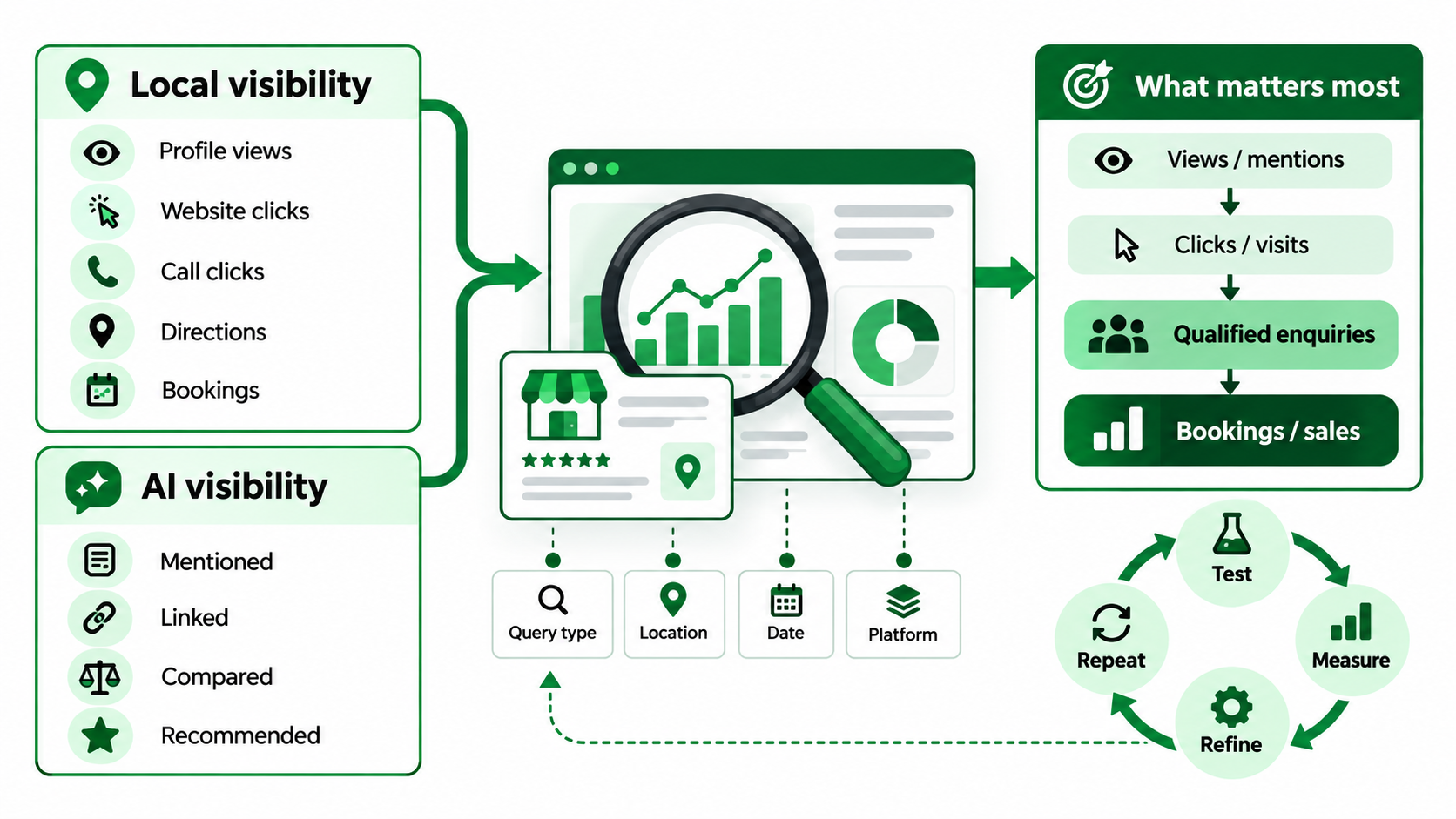
A useful measurement process separates visibility, customer interaction, and commercial outcomes. Improvements in one area do not automatically establish success in another.
Track Traditional Local Performance
Review profile performance alongside website and customer records. Google’s Business Profile performance documentation explains the metrics available and their meaning. For example, the calls metric counts call-button clicks, rather than confirmed conversations.
| Metric | What It Helps You Assess | Important Limitation |
| Profile views | Exposure to the profile | A view does not establish buying intent. |
| Website clicks | Visits initiated through the profile link | A click does not establish an inquiry. |
| Call-button clicks | Attempts to initiate contact | They do not confirm an answered call. |
| Direction requests | Interest in visiting | They do not prove a completed visit. |
| Supported bookings | Recorded booking activity | Availability depends on the relevant integration. |
| Qualified enquiries and sales | Business results | These require your own customer records. |
For Google Business Profile ranking checks, also record the search location. Results from one postcode should not be treated as representative of the entire service area.
Track Different Query Types
Include core service-and-location queries alongside questions about availability, particular requirements, comparisons, and customer concerns. A plumbing business could monitor general repair searches and questions about leak investigations or weekend appointments. Choose queries connected to actual services, not questions designed to make the business appear. Separate branded discovery from searches that do not name the company.
Test AI-Driven Local Discovery
Test relevant AI experiences regularly with representative questions. Record platform, question, site, date, context of conversation, answer, visible sources. Measure local AI visibility by type of appearance. A business can be mentioned, linked, compared or recommended – these are different results. Check for factual accuracy Repeat observations . You can see Search Console generative AI reporting and relevant inclusion settings for Google website visibility but don’t confuse that with Business Profile interactions. Link website visits to valuable actions like qualified leads, appointments and purchases. Use consistent campaign tagging where possible and compare analytics with customer records.
Google Business Profile Alone Is Not Enough for AI-Driven Local Search
A profile cannot answer every detailed customer question. Local SEO works more effectively when the profile, website, reputation, and relevant external information support one another. Your profile provides a practical starting point for business identity, location, hours, categories, and customer interaction. Its information should be dependable without requiring visitors to resolve contradictions elsewhere. However, profile fields have limits. A complex service, eligibility condition, or installation process may need a fuller explanation on the website.
The website can explain processes, specialisms, pricing conditions, experience, project outcomes, and service boundaries. It also gives customers a destination for questions that cannot be answered adequately in a profile. Build related resources around your genuine expertise. Reviews, professional listings, publications, and other independent sources can add context about the business. Their usefulness depends on what they actually establish. A directory may confirm contact details. A customer review describes an experience. An industry publication may document expertise. Keep these roles distinct rather than presenting all references as equally strong proof of quality.
Common GBP Mistakes That Can Hurt Local and AI Visibility
Some mistakes violate Google’s rules; others make information confusing or less useful. Both deserve attention, but they should not all be described as proven ranking penalties.
Avoid the following:
- Adding service keywords or promotional claims to a business name that does not use them in the real world.
- Selecting irrelevant categories or listing services the business does not provide.
- Creating fake locations or presenting service areas as staffed branches.
- Leaving contact details, opening hours, or website information contradictory.
- Writing repetitive descriptions that fail to explain the actual offer.
- Buying reviews, selectively requesting positive feedback, or prescribing review wording.
- Publishing identical replies that ignore the customer’s comments.
- Using imagery that misrepresents the premises, team, or completed work.
- Posting without a useful message or leaving expired information visible.
- Creating interchangeable location pages and expecting schema to compensate for weak content.
The underlying principle is straightforward: document genuine relevance clearly. When evaluating a proposed tactic, ask whether it improves factual accuracy, customer understanding, or the ability to take a useful next step.
How AI Changes Local Content Strategy
Supporting content should explain the decisions customers face. The most useful change is broader coverage of real requirements, rather than a new writing style aimed solely at AI.
Move Beyond “Service + City” Keywords
Continue using accurate service and location terminology, but answer the complete need behind it.
“Emergency dentist Chicago” may involve opening hours, urgent assessment arrangements, accessibility, or appointment availability. Understanding search intent and customer decision stages helps determine which information belongs on a service page and which deserves a separate guide.
Cover Real Decision Factors
Choose details according to the service and audience. Customers may need to understand:
- How appointments or emergency requests are handled.
- Which areas receive the service.
- What affects the price and what is included.
- Relevant experience or specialisms.
- Access, parking, delivery, or installation arrangements.
- Genuine guarantees, exclusions, or financing conditions.
Keep qualifications beside the claim they limit. “Same-day appointments” is misleading if it actually means availability must first be confirmed and only applies to certain services.
Create Content Based on Genuine Local Expertise
Use projects, customer questions, and operational knowledge to provide information a generic article would miss. A contractor might explain access considerations in particular building types. A retailer could describe delivery arrangements for local flats. If discussing regulations, verify the relevant authority and jurisdiction. Local expertise should come from the work itself, not from inserting neighbourhood names into otherwise identical paragraphs.
What the Future of Local SEO Looks Like
Future features are uncertain, but businesses can make sensible improvements now. Reliable information, useful explanations, and genuine customer evidence remain practical investments.
Local Search Will Become More Conversational
Conversational discovery is already available, and customers can describe detailed requirements. However, short searches and map browsing still serve useful purposes. Prepare for both. A customer should be able to understand the business from a concise listing and find deeper answers when a more complex decision requires them.
Business Data Quality Will Become More Important
When a request combines location, availability, accessibility, and service needs, conflicting information creates more opportunities for misunderstanding. Assign responsibility for important business data. Keep a record of changes and update the relevant public sources when operations change. Good data management is useful regardless of how quickly particular AI features develop.
Reputation Will Remain Central to Local Decisions
Customers still need reassurance that a business can deliver what it promises. Genuine feedback and documented work provide evidence beyond a promotional description. Treat reputation management as an operational activity. Better communication, dependable service, and appropriate complaint handling create experiences worth reviewing. Marketing cannot sustainably replace those foundations.
Local SEO, AEO and GEO Will Increasingly Overlap
These terms describe connected areas of work, but their names should not create separate, conflicting plans. Coordinate accurate data, website content, reputation, and measurement around the customer journey. There is no single Google Business Profile AI optimisation setting that replaces those tasks. Likewise, Google AI local search visibility cannot be guaranteed by a special file, description format, or repeated category phrase.
Conclusion
Optimising your Google Business Profile for AI-driven local search begins with reliable business information. Accurate categories, clear services, authentic reviews, helpful photos, and up-to-date hours allow customers to understand what you offer. More detailed explanations and evidence should be provided on your website and/or other independent references. These improvements make your public information better, without resorting to some AI ranking shortcut.
The ten-step process is a practical way to organize the work: correct facts, clarify the offer, build trust, link the website, and measure customer outcomes. Start with errors that risk losing inquiries, then improve the information people need to choose your business. Performance analysis by locations and questions of interest, isolate profile interaction data from completed bookings and sales. AI may change how local recommendations are displayed, but your job is still simple: make your business an accurate, trustworthy and good fit for customers you can actually serve well.
Ready to turn local discovery into more qualified leads?
Develop a unified profile, website and reputation strategy with eSign Web Services. We can audit your Google Business Profile, local content, technical SEO, and conversion paths to find actionable improvements. Contact us today for a custom local SEO proposal.
Frequently Asked Questions
Question: How do AI-powered search results affect Google Business Profile rankings?
Answer: AI experiences offer an additional opportunity for customers to discover and evaluate businesses, and there is no separate universal AI ranking position. Google’s local factors still apply. Maintain business information accuracy and supporting information utility and then assess appearances across relevant questions and locations rather than assume one recommendation creates lasting visibility.
Question: How do I optimize my Google Business Profile for AI search?
Answer: Optimize your Google Business Profile: Verify your business, fix critical details, pick the right categories, and write about real services. Save authentic reviews, helpful photos, and hours of operation. Make sure your website and public listings match those facts. These improvements help with discovery and evaluation, but no single change will guarantee an AI recommendation.
Question: Does Google AI Mode use data from Google Business Profile?
Answer: Google views Business Profiles as good sources of local business information, for both Search and AI answers. Make sure your profile is accurate and matches your website. But a full profile doesn’t mean you’ll get in every AI Mode answer, and don’t assume that profile info is the only possible source.
Question: Are Google reviews important for AI local search?
Answer: Reviews help customers evaluate experiences and are relevant to Google’s existing guidance on local prominence. They can also provide useful context about services and customer concerns. A fair and just process for reviewing, responding with thoughtfulness. Don’t say that a certain number of reviews will guarantee AI visibility or that all assistants treat reviews the same way.
Question: Do keywords in Google reviews help with local rankings?
Answer: Do not ask customers to add keywords about the service or location in reviews. Requests for specific review content are not allowed by Google. Let customers tell the truth about their real experience in their own words. Useful detail is a great way to help other customers understand your business, but should not be offered as a guaranteed ranking tactic.
Question: How important are Google Business Profile categories to Local SEO?
Answer: Categories help describe your business and influence Google’s local ranking. Choose a primary category that describes your primary activity and other allowable related categories. Do not assign categories to each product, service or keyword. Keep them current as operations change, but still provide an accurate and easy-to-understand overall picture.
Question: Are Google Posts effective for local search visibility?
Answer: Google Posts let businesses share useful updates, offers and events with customers. Use them to explain timely developments and to offer a relevant next step. Posting regularly doesn’t mean you will get higher ranks or AI recommendations. Focus on delivering value and useful information to your customers, rather than on a set schedule of repetitive promotional messages.
Author Details

Ashwani Kumar Sharma
Ashwani has been actively involved in SEO services since 2005. His expertise and distinctive work approaches have made him one of the most experienced and trusted SEO experts in the industry. He is a certified SEO and Google Ads professional. He also has strong business development skills in advanced SEO, PPC, and digital marketing strategies.


