


Google Has Deployed a New AI Spam Detector Called SAFE


Key Takeaways:
- Google has developed SAFE, short for Scaled Abuse Forensics Examiner, to investigate coordinated synthetic-content abuse at scale.
- SAFE uses several specialized AI agents rather than depending on a single content classifier.
- The system studies content, behaviour, and connections between related channels to uncover organized abuse.
- Google says early deployment has helped reduce the time needed to identify new synthetic threats.
- SAFE is built to recognize policy violations that simpler or more static detection systems may overlook.
- Google has not confirmed SAFE as part of Google Search ranking systems or a specific Search spam update.
Overview
Google has introduced a new artificial intelligence system aimed at dealing with a growing problem online: large networks creating synthetic content faster than traditional moderation teams can investigate it.
The Google AI spam detector, known as SAFE, stands for Scaled Abuse Forensics Examiner. Google Research explains that generative AI has made it much easier for bad actors to produce large amounts of synthetic media, often with enough variation to avoid older duplicate-content or static detection methods.
Rather than acting like a basic AI-content checker, SAFE looks at a much wider set of signals. It examines how content is created, how accounts behave, and whether several channels appear to be working together as part of a larger abuse network. For publishers and SEO professionals, that distinction is important. SAFE should not simply be viewed as a system designed to punish anything created with AI.
What Is Google’s SAFE System?
SAFE was introduced in a Google research paper titled The Synthetic Gap: Automating Forensic Investigation of “AI Slop” with the Scaled Abuse Forensics Examiner (SAFE). The research highlights what Google calls a “synthetic gap,” where AI-generated abuse can appear much faster than human investigators are able to identify and respond to it.
The Google AI spam detector is designed to reduce that gap by automating several parts of the investigation process.
Instead of asking only whether a particular piece of content appears to have been generated by AI, SAFE looks at the bigger picture. It can study how content is produced, how different accounts behave, and whether multiple channels appear to be connected through the same coordinated activity.
That makes SAFE less like a simple detection tool and more like an automated forensic system. The Google Research SAFE paper also explains that early deployment has helped speed up investigations into new synthetic threats. This could make it easier for Google to respond to emerging abuse patterns without relying entirely on slower manual investigation.
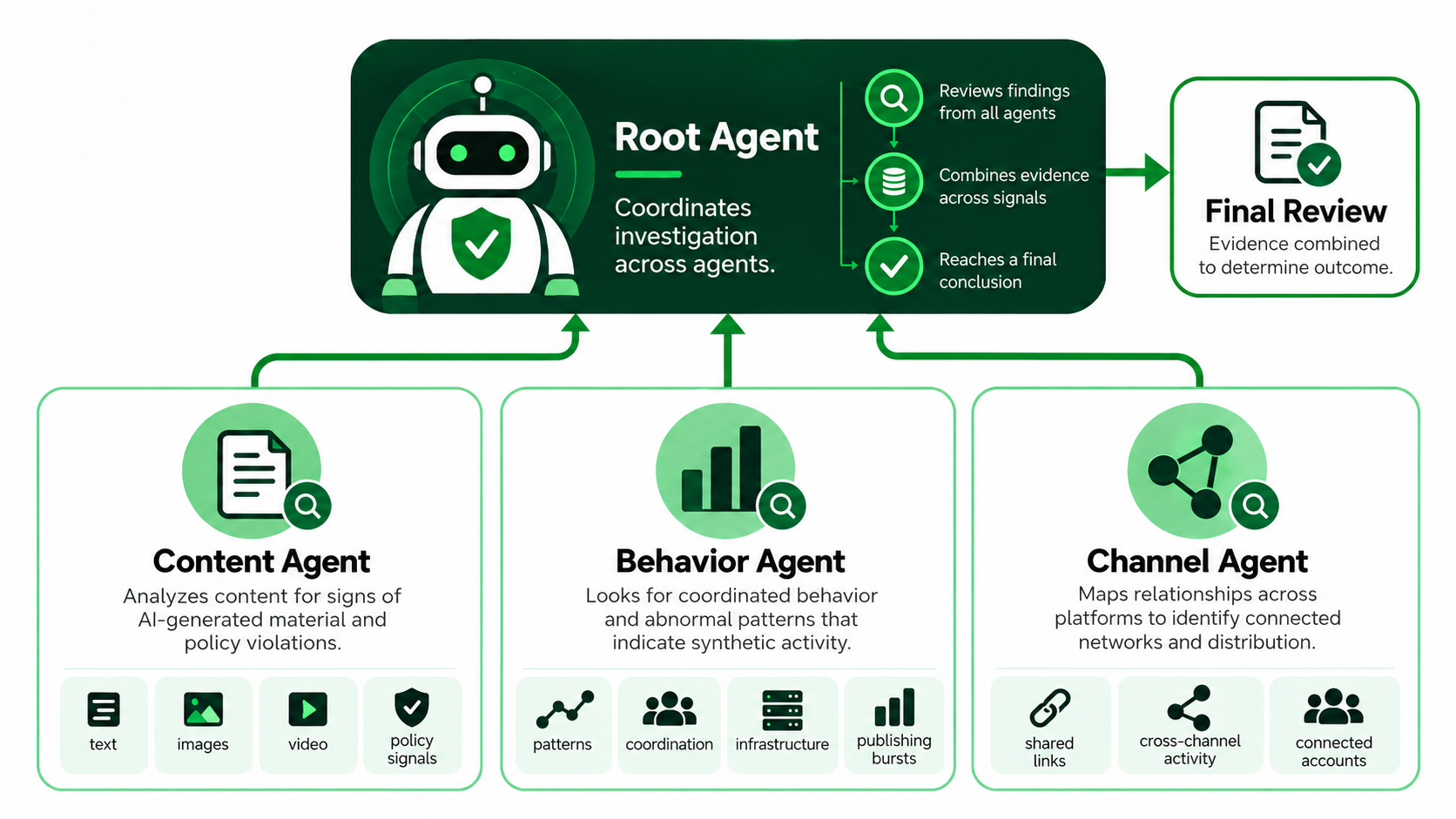
Google’s SAFE research framework uses specialized agents to examine content, behavioral patterns, and cross-channel relationships before combining evidence for review.
How Does the Google AI Spam Detector Work?
SAFE uses a multi-agent system. In practical terms, that means different AI agents are given different parts of the investigation, while another agent brings all of the findings together.
The system includes several key components:
- Content Understanding Agent: Reviews synthetic content and uses adapted large language models and few-shot learning to identify known policy violations and suspicious patterns.
- Behaviour Understanding Agent: Looks for unusual timing or behavioural activity that may suggest organized rather than natural behaviour.
- Cluster Understanding Agent: Studies relationships between channels to determine whether apparently separate publishers may belong to the same network.
- Root Agent: Brings the evidence together and coordinates the final investigation before deciding whether a cluster is likely to represent coordinated synthetic abuse.
This approach allows the Google AI spam detector to look at several signals at the same time instead of judging one piece of content in isolation.
That matters because modern spam networks do not always publish identical material. Generative AI allows them to change wording, style, prompts, images, and even language while keeping the same underlying purpose. A basic classifier may miss those differences, but a system that examines behaviour and relationships may be able to see the wider pattern.
Why SAFE Matters in the Age of AI-Generated Content
Generative AI has made content creation faster and more accessible. That has clear benefits for legitimate businesses and creators, but it also gives bad actors an easier way to produce large volumes of synthetic material.
This creates a much more difficult moderation problem. A spam network no longer needs to publish thousands of identical pages or videos. AI can generate different versions, localize the content, change presentation, and vary wording while still serving the same manipulative purpose.
SAFE appears to be Google’s response to that change. It is designed to look beyond individual pieces of content and understand whether several accounts, channels, or behaviour patterns are connected. That wider view could help Google identify abuse that might otherwise appear unrelated.
For marketers and publishers, the message behind Google’s approach to spam prevention is not simply that AI should be avoided. The bigger issue is how AI is being used and whether it is supporting genuine value or helping produce manipulative, low-quality content at scale.
Does SAFE Change SEO and AI Content Strategy?
This is where the announcement needs to be viewed carefully. SAFE has attracted attention within the SEO industry because of its connection with AI-generated abuse and spam. However, Google has not said that SAFE is a confirmed Search ranking system or that it directly powers a specific Google Search spam update.
The research focuses on synthetic media, channel clusters, behaviour, coordinated networks, and platform-integrity investigations. That means businesses should not suddenly abandon AI-assisted content because of the Google AI spam detector.
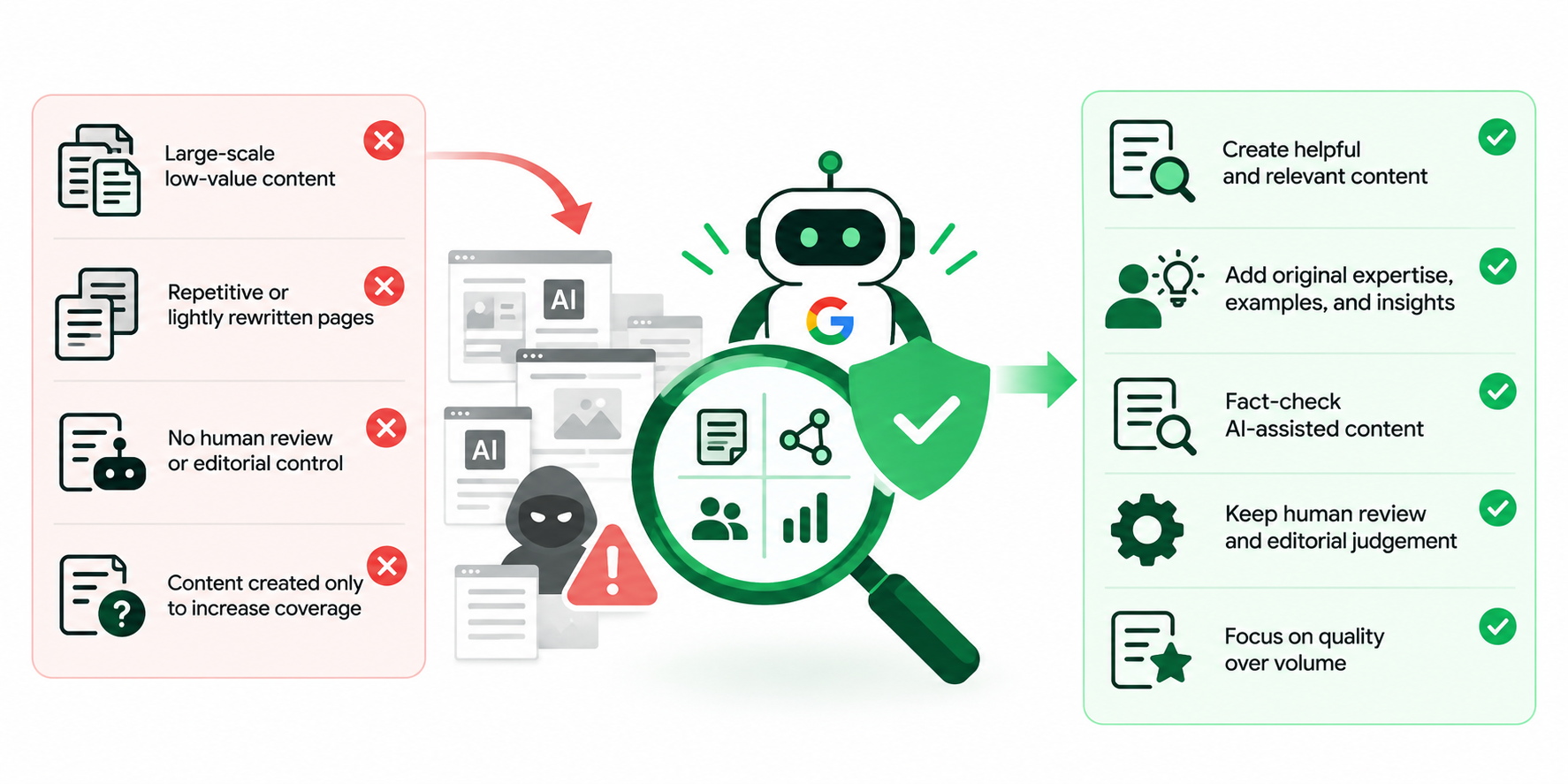
A better response is to look closely at how AI is being used within the content process. Businesses should focus on:
- Creating content that genuinely answers user questions rather than publishing pages simply to increase search coverage.
- Adding original expertise, examples, insights, research, and practical experience wherever possible.
- Fact-checking AI-assisted content before publishing it.
- Avoiding large-scale production of thin, repetitive, or lightly rewritten pages.
- Keeping human review and editorial judgement as part of the publishing process.
The main difference is between using AI as a useful working tool and using automation to produce large volumes of low-value material. AI can still help with research, planning, drafting, and productivity. The real risk comes when businesses remove quality control and allow scale to become more important than usefulness.
AI-assisted content should prioritize originality, accuracy, relevance, and human editorial review rather than large-scale, repetitive publishing.
Conclusion
Google’s SAFE system shows how online abuse detection is becoming more advanced as generative AI changes the way spam is created. Instead of relying on one signal, SAFE looks at content, behaviour, and relationships between connected channels to identify coordinated synthetic activity. For genuine businesses, the lesson is not to stop using AI, but to use it responsibly. Quality, originality, accuracy, and human review still matter. It is also worth remembering that Google has not confirmed SAFE as a dedicated Google Search ranking or spam-update system.
Want to build an SEO and AI Content strategy?
If you want to build an SEO and AI content strategy that focuses on useful content, long-term visibility, and smarter use of automation, connect with eSign Web Services for a more sustainable approach to digital growth.
Author Details

Ashwani Kumar Sharma
Ashwani has been actively involved in SEO services since 2005. His expertise and distinctive work approaches have made him one of the most experienced and trusted SEO experts in the industry. He is a certified SEO and Google Ads professional. He also has strong business development skills in advanced SEO, PPC, and digital marketing strategies.


