



Why Hire a Digital Marketing Agency Instead of In-House

Key Takeaways
- Modern marketing complexity often overwhelms small internal teams, creating execution gaps that slow business growth.
- In-house marketing costs extend beyond salaries, including tools, training, turnover risk, and management overhead.
- Agencies deliver specialized expertise, proven systems, and faster execution without long hiring cycles.
- Structural fragility emerges when marketing momentum depends heavily on a single internal role.
- Scalable agency support allows marketing capacity to adjust smoothly with changing business priorities.
- Hybrid models often balance internal ownership with agency-led execution for sustainable, measurable growth.
Every growing business reaches a point where marketing becomes heavier than it should. Leads slow down. Competition tightens. Platforms shift. And the strategies that once quietly worked don’t have the same effect. And that’s when leadership typically agonizes over whether to grow from within or to enlist outside assistance. When the decision is made to hire a digital marketing agency, it’s never about losing control. It’s more commonly a reaction to reality: modern marketing is not a job title but rather a stack of moving parts. SEO, Paid Media, analytics, content, automation, and conversion optimization are now separate departments. The expectation that one small internal team will be able to master all of them is a recipe for frustration, delay and shallow execution.
Lateral hiring feels neat on paper. It offers familiarity, instant connection, and a sense of ownership. But it also obscures structural constraints. One or two bodies cannot throw time at testing channels, while also taking responsibility for change reporting, learning, and adapting to that never-ending stream of information. And that has made digital marketing agency vs. in-house a function of pragmatism more than preference for many executives. If growth targets are taken seriously, the issue is less about pride than about output, stability and risk.
This article deconstructs the agency-vs.-in-house dilemma free of marketing hype, considering cost, expertise, speed, tools, accountability and risk. You’ll find out when in-house works, when agencies win the day, and why hybrid models often strike the best balance between control and execution. The goal is to save time and money while constructing a repeatable growth engine. Honest marketing agency vs. in-house team tradeoffs produces clear outcomes, not speculation.
Most companies start building an in-house digital marketing team with enthusiasm. A business brings in a new marketer with the hope of gaining better control, moving more quickly, and finding someone who truly understands their brand inside and out. In the early going, it can be efficient. Tasks move quickly. Decisions are made in that same room. There is less friction. But as marketing demands grow, the seams can be specialized. Marketing is not a single skill. It’s a special collection of functions that needs staring at. SEO, PPC, content strategy, optimization, email automation, and conversion optimization are some of the skill sets that require depth of knowledge. And when one internal hire is supposed to do everything, corners will get cut, and results will suffer.
Cost is where the challenge becomes impossible to ignore. Salary is only the first number. Recruitment fees, benefits, payroll taxes, ramp-up time, training, and management oversight add up fast. Then, come the tools. Modern marketing depends on advanced SEO platforms, analytics software, ad management systems, and reporting dashboards. Each tool looks “reasonable” on its own. Together, they raise the cost of in-house marketing long before meaningful momentum builds. Many teams end up paying for subscriptions they barely use because the learning curve is steep and time is limited.
There’s also a structural risk that most teams don’t consider. Single-point in-house rigs are brittle. If a person leaves, takes time off, or changes jobs, momentum slows. Campaigns pause. Reporting becomes inconsistent. Strategy gets fuzzy. From a marketing team structure standpoint, this reliance can also become a scalability roadblock. Leadership is largely about fixing problems and rebuilding processes rather than encouraging growth. None of this is to say that in-house marketing is “bad.” It just tells us why scaling is more difficult than you’d think when ambition exceeds internal capacity.
What Marketing Agencies Bring to the Table
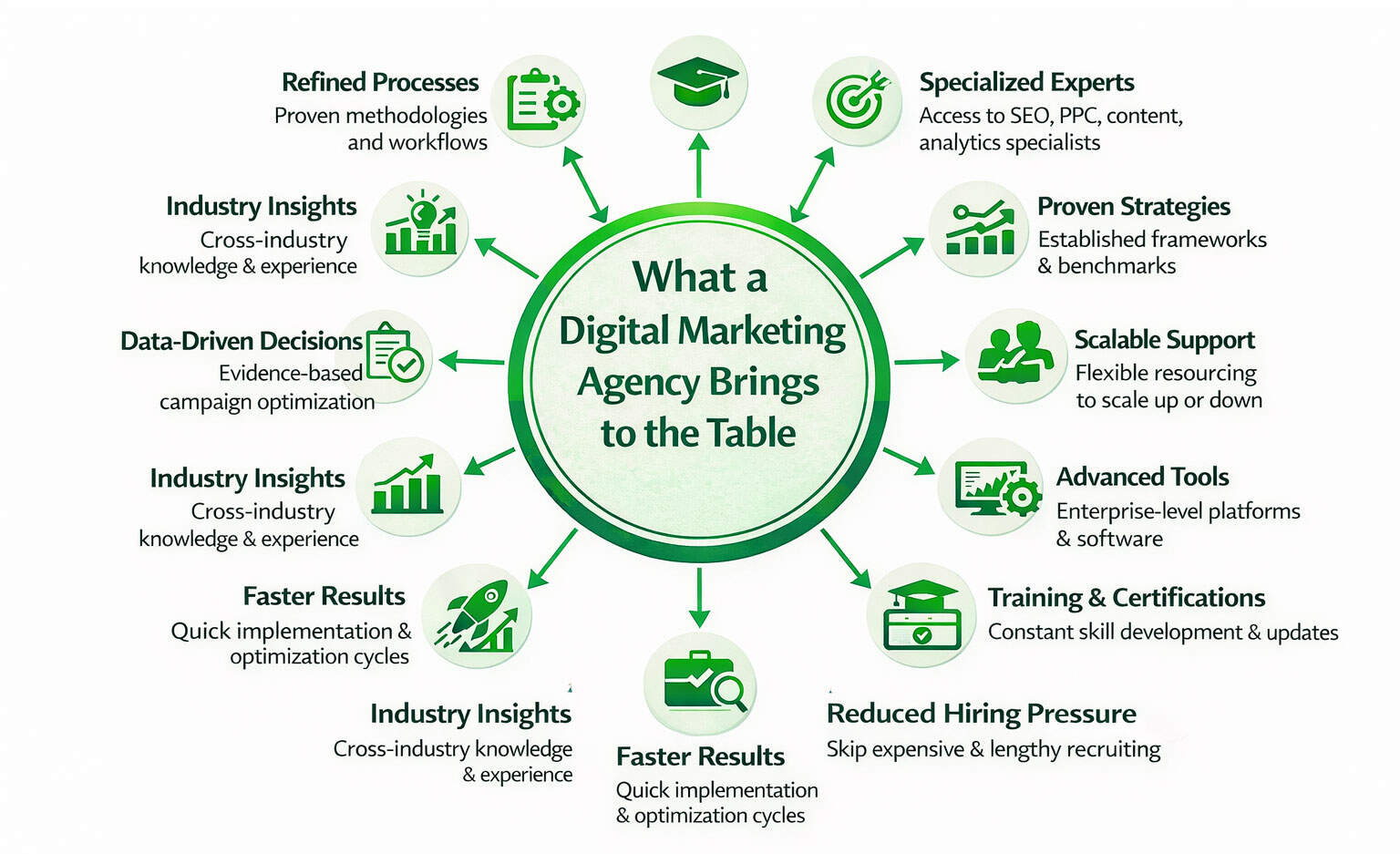
A digital marketing agency operates like a ready-built growth engine rather than an extension of a single role. Instead of relying on generalists, agencies are built around specialists who go deep into one or optimize one. SEO strategists track algorithm changes. Paid media managers optimize budgets daily. Analysts translate data into decisions. Content teams align messaging with search intent and buying funnel stages. This structure delivers capability immediately, without long hiring cycles. When businesses decide to hire digital marketing agency, they gain experience accumulated across industries, campaigns, and platforms that would otherwise take years to build internally. Stabilises and reduces learning curves, improves execution quality, and stabilises performance during growth phases.
Agencies also bring systems that remove optimization campaign frameworks, testing methods, reporting standards, and optimization workflows that are already proven in real markets. Instead of experimenting unquestioningly, agencies apply benchmarks learned from similar businesses and competitive environments. This improves marketing strategy execution because decisions are rooted in evidence rather than assumptions. Agencies invest heavily in training and certifications, too, staying current with platform changes that internal teams strive to optimization consistently. That exposure sharpens judgement, speeds up optimization cycles, and keeps campaigns resilient across channels.
Flexibility is the final advantage agencies deliver. Support can scale up during launches, competitive pushes, or seasonal demand, then scale down without layoffs or restructuring. Agencies often include enterprise tools within retainers and set clearer expectations for agency marketing services than most internal teams can document early. Combined with team redundancy and shared knowledge, this model lowers risk and protects continuity. For growing companies, this is where the digital marketing agency benefits become hard to ignore: speed, stability, and adaptability without hiring pressure. Leadership stays focused on core business decisions, while marketing runs consistently in the background.
1. Cost Comparison: Agency vs In-House
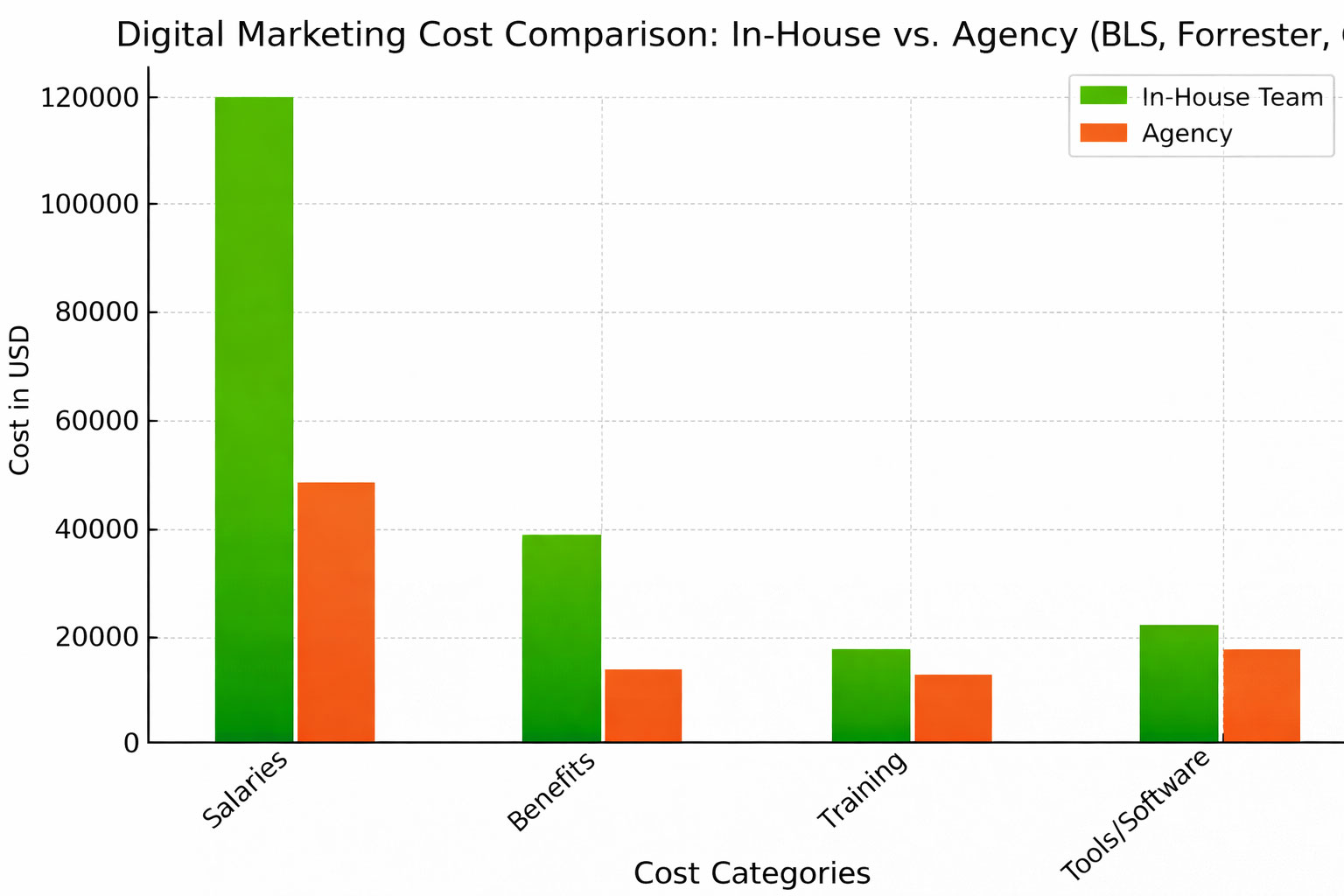
Cost is usually the first lens businesses apply when deciding how to build their marketing function. On the surface, an internal salary feels predictable, while an agency retainer can seem abstract. That perception is especially common in a small business, where budget visibility matters. The problem is that most cost comparisons stop too early. Once recruitment, benefits, payroll taxes, training, management time, and essential tools are added, the financial picture becomes far more complex. This is where the in-house marketing team vs agency debate shifts from intuition to math.
| Cost Factor | In-House Marketing Team | Digital Marketing Agency |
| Total compensation | Salary plus benefits, payroll taxes, bonuses, and raises add 20–35% beyond base pay | Fixed monthly retainer covering multiple roles |
| Hiring & ramp-up time | Recruitment, on boarding, and learning curves delay results by months | Immediate execution with no ramp-up |
| Tools & software | Separate costs for SEO tools, analytics, ads, CRO, and reporting platforms | Enterprise tools included in the service |
| Scalability & flexibility | Scaling requires new hires or restructuring | Capacity adjusts smoothly with business needs |
| ROI predictability | Harder to isolate impact across roles and tools | Clear performance tracking supports marketing ROI comparison |
Agencies package costs differently. Instead of fragmented spending across roles and tools, businesses pay one fee that covers strategy, execution, technology, and reporting. There is no ramp-up delay and no productivity loss when someone leaves. In practical agency vs. internal marketing comparisons, this consistency often matters more than headline cost. Agencies also distribute expenses across clients, lowering the burden for each individual business.
Over a full year, the difference becomes clearer. Matching an agency’s combined expertise internally usually requires multiple hires, increasing fixed costs and risk. Agencies rarely “win” because they are cheaper; they win because they convert spend into results faster. That efficiency makes the marketing ROI comparison far easier to justify at leadership level, especially when growth priorities shift.
2. Expertise & Specialization Advantage
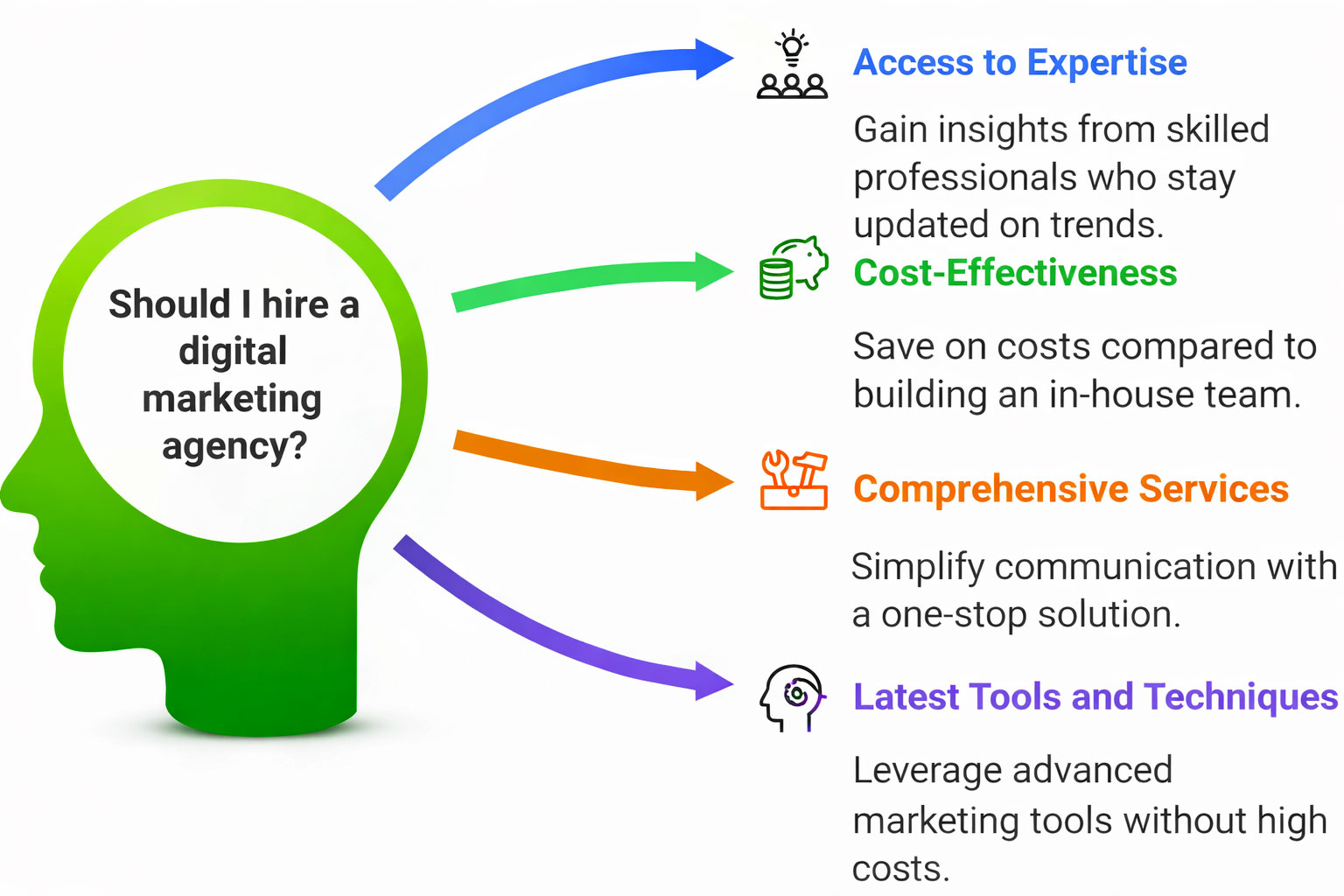
The biggest difference between internal teams and agencies is not effort, but how expertise is distributed. In most companies, internal marketers are hired to be versatile. One person may be responsible for SEO, paid ads, content coordination, reporting, and platform updates all at once. While this flexibility appears efficient, it often leads to shallow execution across channels. Modern marketing rewards focus, not multitasking. When attention is divided, optimization slows, learning curves stretch, and performance plateaus. This is typically where the in-house marketing vs agency conversation begins to surface in growing businesses.
- Expertise: Agencies are built differently. Their structure is intentionally specialized. Instead of relying on a single generalist, agencies deploy SEO strategists, paid media managers, analysts, and content specialists who work within clearly defined roles. Each function is practiced daily across multiple accounts and industries. That repetition builds deep digital marketing expertise that internal teams struggle to replicate without significant time and cost. Specialists don’t just execute tasks; they recognize patterns, test faster, and refine judgment through volume. This operational depth reduces mistakes and improves outcomes earlier in the campaign lifecycle.
- Specialization: Beyond execution, specialization improves strategic clarity. Internal teams can become too close to the brand, which sometimes limits perspective. Familiarity creates blind spots and can slow necessary change. Agencies operate with distance. Exposure to different markets, business models, and growth stages sharpens decision-making and challenges assumptions that may feel normal internally. Over time, when businesses compare results, the difference between in-house marketing vs. agency models becomes clear. It is not about working harder; it is about applying expertise with focus, context, and informed judgment.
Alignment with Cost & Speed
This specialization advantage directly influences both cost and speed. When expertise is focused rather than stretched thin, fewer resources are wasted on trial and error, and campaigns reach efficiency faster. That efficiency compounds over time, lowering the true cost of execution while accelerating momentum; a pattern that becomes even more evident when comparing agency-led models with internally built teams in later sections.
3. Faster Execution and Scalability
Speed is one of the most underestimated advantages of working with an agency. Internal teams often spend months setting up processes before meaningful campaigns go live. Hiring, onboarding, tool configuration, and internal approvals slow momentum. Even strong marketers lose time building systems instead of executing a strategy. Agencies arrive with workflows, already optimized campaign structures, testing frameworks, reporting formats, and optimization cycles ready from day one. That readiness shortens the gap between planning and action, which matters in competitive digital environments.
Execution speed also affects learning. The faster campaigns launch, the faster data arrives. Agencies run multiple tests in parallel because they have teams dedicated to execution rather than setup. This accelerates feedback loops and sharpens decision-making. Internal teams often move cautiously because mistakes feel costly when resources are limited. Agencies spread that risk across experience and volume. They know what typically works, what fails early, and where to adjust quickly. Progress feels steady rather than stop-start, even when strategies need refinement. (A simple timeline comparison below; week 1 to week 8, usually tells the story.)
Scalability completes the picture. Growth is rarely linear. Launches, seasonality, competitive pressure, or funding changes can suddenly increase marketing needs. Scaling an internal team usually means hiring or restructuring, both of which take time and add long-term cost. Agencies provide flexibility through scalable marketing solutions. Support can scale up to stabilize demand and scale down when priorities shift, without destabilizing the organization. That agility helps leadership pursue opportunities confidently because execution capacity can adjust without breaking the machine.
4. Better Tools Without Extra Overhead
Modern digital marketing runs on data, and data depends on tools. What often starts as a simple setup quickly grows into a fragmented stack. Internal teams usually begin with free or entry-level platforms, then add subscriptions as campaigns mature. SEO research tools, competitive analysis software, heat mapping, conversion tracking, attribution models, and dashboards slowly pile up. Individually, each tool feels reasonable. Collectively, they create high recurring costs, steep learning curves, and operational drag. This is where many teams underestimate the real cost of running marketing internally.
Where internal teams struggle with tools
- Tool adoption happens reactively, not strategically, leading to overlap and underused subscriptions
- Limited time prevents deep mastery, so insights remain surface-level
- Reporting becomes fragmented across platforms instead of unified
- Decision-making relies on high-level metrics rather than actionable signals
Agencies approach tools from a different starting point. They invest in enterprise-grade platforms because performance at scale requires them. These tools are already configured, integrated, and embedded into daily workflows. Access is typically included in the engagement rather than billed as separate line items. More importantly, agencies know how to interpret what the data is actually saying. Reports are not treated as outputs, but as inputs for decision-making. Metrics are translated into priorities, tests, and next actions that directly influence execution.
How agencies extract more value from the same data
- Centralized dashboards that connect traffic, spend, and conversions
- Established benchmarks to identify what “good” performance looks like
- Analysts dedicated to turning data into strategy, not just reports
- Faster optimization cycles because insights are acted on immediately
The difference is not the presence of tools, but how they are used. In-house teams often spend time collecting data. Agencies spend time applying it. That distinction reduces waste, sharpens decisions, and accelerates performance. When leaders decide to outsource marketing, it’s often because they want clarity instead of complexity. Clean reporting, focused tooling, and faster optimization turn data into leverage rather than overhead.
5. Strategic Focus Instead of Internal Distraction
One of the most overlooked costs of building an internal marketing team is the distraction it creates for leadership. Marketing does not manage itself. Founders and managers spend time setting priorities, reviewing work, resolving bottlenecks, and making tactical calls they were not hired to create. Instead of focusing on growth, operations, or product improvements, leadership gets pulled into campaign details. Over time, constant context switching slows decisions and dilutes strategic clarity. Marketing becomes a stream of tasks rather than a system designed to drive outcomes.
Agencies change that dynamic. They operate with clear goals, timelines, and accountability frameworks. Rather than asking leaders what to do next every week, agencies work against agreed objectives and report progress consistently. Conversations shift away from tasks and toward results. Instead of reviewing drafts and dashboards daily, leadership reviews performance, trends, and opportunities. When companies choose to hire a digital marketing agency for execution, leaders regain time and mental bandwidth without losing strategic control.
Agencies also bring perspective. Internal teams live inside the business and can become used to existing assumptions. Agencies bring distance. They ask hard questions, challenge familiar ideas, and spot inefficiencies internal teams may overlook. Removing day-to-day execution pressure from leadership while adding external accountability allows businesses to think more clearly. In practice, this is what strong outsourcing digital marketing looks like: internal teams keep ownership of direction, while external specialists handle execution with discipline and consistency.
6. Speed to Market & Competitive Advantage
Speed is no longer a luxury in fast moving digital markets; it is mandatory. Successes materialize in the blink of an eye and vanish with a breeze. Internal teams tend to be slow not because they lack the skill, but because of set-up, approvals and bottleneck capacity. Before the campaigns roll, tools need to be set up, processes outlined and priorities matched. By the time you can start optimizing; your competitors could be already testing and learning. That lag erodes advantage in silence, and growth becomes more difficult to maintain.
Agencies are built for momentum. And they move fast from strategy to execution because systems and playbooks are already in place. Campaigns start sooner, experiments launch younger, data happens quicker. That early data matters. It enables your team to fine-tune targeting, messaging and spend ahead of competitors. Also, agencies spot patterns faster by working across multiple clients and platforms. This pattern recognition is useful for anticipating what will work and where changes need to be made. One of the more subtle advantages of hiring a digital marketing agency; it is not quite as cut dry but can still manifest in data.
This pace adds up to a serious competitive advantage. But agency-supported teams are already working on maximizing the performance of capacity. They go into markets sooner, test more forcefully and adjust faster to the platform’s changes. In the long run, that leads to better position and efficiency. The faster it can be executed, less opportunity cost is wasted. Rather than waiting for perfect information and the absence of uncertainty, firms learn in real time and adapt based on evidence
7. Agencies Help You Avoid Costly Trial-and-Error
The most costly part of digital marketing isn’t the tools or ad spend; it’s tuition payment for your education (through painful mistakes). Though trial and error can’t be eliminated, agencies greatly reduce the frequency and cost of those errors.
- Experience reduces early mistakes: Internal teams often end up learning these things through the path of the wrong door, whether that’s picking the wrong channels or targeting poorly defined audiences, failing to correctly interpret data, or overinvesting in tactics that don’t align with their intent. Agencies come with past experience that beats off some of these common missteps right from the start.
- Decision-making is based on time-tested protocols: Agencies don’t start from zero. They depend on benchmarks, historical leverage data and frameworks developed from working with companies across industries, business models and stages. This is for the weak ones to cut their things early itself.
- Testing is structured, not random: There is still experimentation, but it is intentional. Hypotheses are developed based on experience rather than speculation, resulting in the sooner identification of what is working and less wasteful behaviors earlier in the campaign cycle.
- Faster learning, less wasted spend: Agencies are quick to see patterns, so campaigns reach efficiency faster without as many rookie mistakes that internal teams frequently make while learning in isolation.
- A healthier experimentation mindset: Internal teams might be playing it too safe, because mistakes seem so close to home and under a spotlight. Agencies will have no choice but to test and optimize, which ultimately leads to smarter experimentation ; even if budgets are at stake.
This is just one example where the advantages of outsourcing marketing are clear. Agencies help businesses “fail forward” more times without resetting as often and wasting so much spend with steadier progress; and the emotional and financial cost of learning lessons the hard way.
8. Performance, Accountability & ROI Focus
Possibly one of the clearest distinctions between internal marketing and agency partnerships is how performance is measured and leveraged. Many internal teams focus on activity rather than outcomes. It’s not that work isn’t getting done, or that campaigns aren’t running and reports aren’t being produced, but the connection to revenue is often unclear. This isn’t due to a lack of effort or intention. It’s a common challenge when individuals are tasked with execution, strategy, and reporting simultaneously, which leads to diluted accountability. As a result, performance discussions can become subjective, especially when priorities shift or budgets tighten.
Agencies, on the other hand, operate under a different model, they’re hired to deliver results. Objectives, key results (OKRs), and reporting cadences are established upfront. Success is defined by tangible outcomes such as qualified leads, conversions, revenue impact, and efficiency improvements. This structure naturally reinforces accountability. When performance falls short, it’s quickly identified and addressed. Agencies can’t hide behind being busy, their value is measured by the impact they drive. This becomes especially evident when leadership evaluates marketing ROI across channels and sees where real returns are coming from.
Return on investment also becomes easier to quantify. Agencies develop reporting systems that directly link marketing activity to business results. Spend is measured against return, and channels are prioritized based on performance, not preference. This clarity gives leadership the insights needed to scale, reallocate budgets, or pivot strategy confidently. With clean reporting and data-driven decision-making, confidence grows, and execution becomes more consistent.
When In-House Marketing Makes Sense
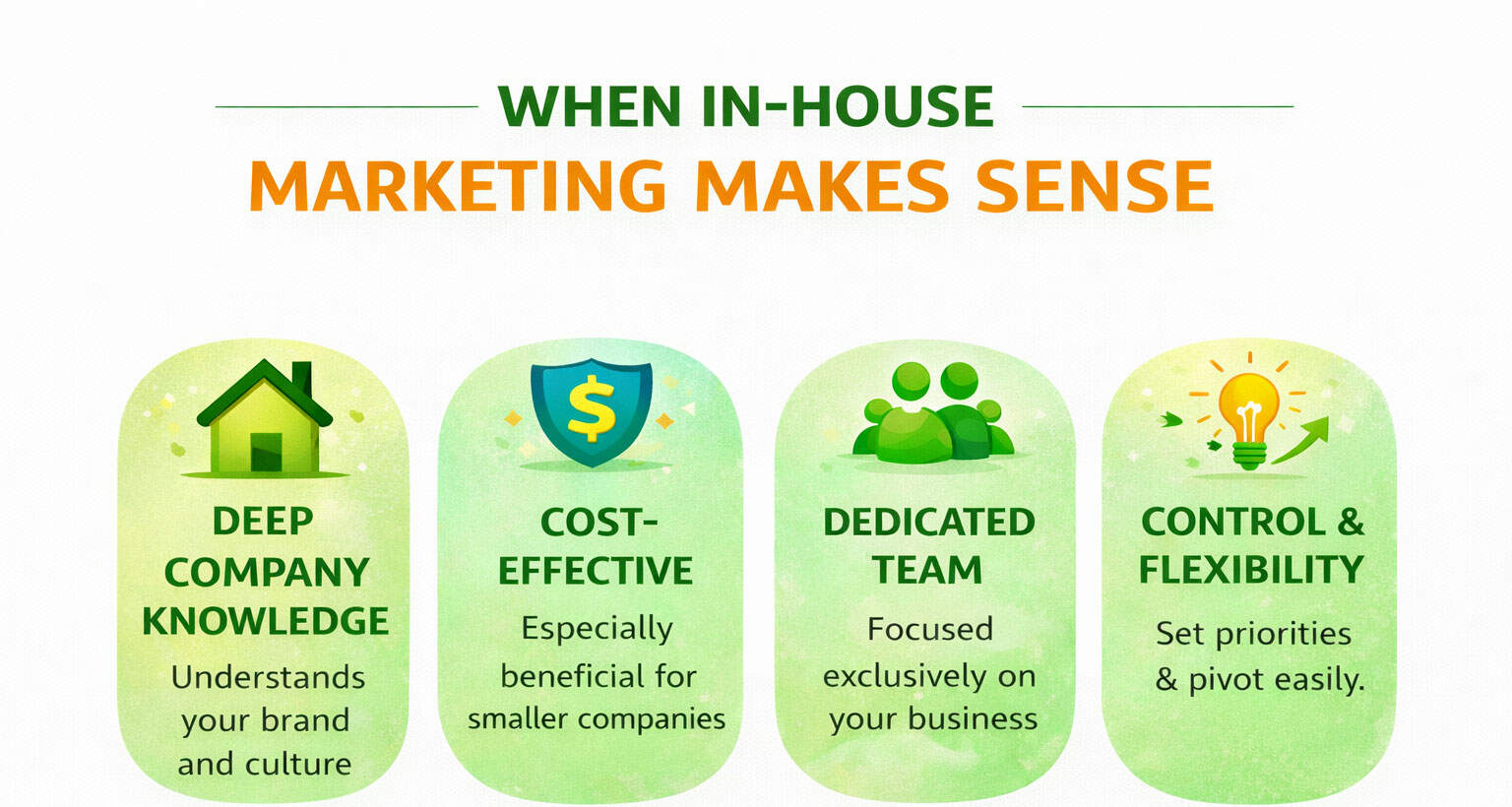
Agencies offer strong advantages for many growing businesses, but in-house marketing is not wrong in every case. There are scenarios in which building internally makes strategic sense as a company reaches a certain level of maturity. Large organizations with stable revenue, long-term budgets, and defined processes often benefit from dedicated internal specialists. At that stage, marketing is less about rapid experimentation and more about consistency, governance, and brand alignment across departments and regions.
In-house teams can also work well when marketing is tied to proprietary knowledge or complex internal workflows. Regulated industries like finance, healthcare, or enterprise software may require close collaboration with legal, product, and compliance teams. Embedded internal marketers can streamline communication, manage sensitive information, and maintain tight specialization messaging. Even then, success depends on resourcing true specialization rather than overloading a small team, because the real cost of in-house marketing often shows up later as burnout and stalled performance.
For many companies, the strongest answer is not choosing one model exclusively. Hybrid structures are increasingly common. An internal team may handle brand strategy, messaging, and stakeholder coordination, while agencies manage execution-heavy functions such as SEO, paid media, analytics, and larger campaign work. This preserves internal ownership while gaining outside expertise and scalable capacity. Understanding when in-house makes sense requires an honest assessment of budget, goals, and capacity. When resources are sufficient and roles are clear, internal teams can thrive. When those conditions are missing, agencies often provide a more reliable path to performance and growth, especially when comparing marketing agency vs. in-house team outcomes in real operating conditions.
Myths About Hiring a Marketing Agency
One of the familiar misconceptions is that agencies aren’t deep. The perception is often more to do with bad experiences in the vendor world, rather than problems inherent in how agencies work. Great agencies are willing to invest in discovery, on boarding and building context. They learn the product, the audience, competition and business goals long before they execute. Agencies often have a better outside-in view of positioning than in-house teams wholly engaged with the day-to-day. Closeness does not by itself create knowledge about a business; what determines the quality of learning is how well you ask questions and interpret the information
Another myth is that in-house marketing is always cheaper. A salary may look more affordable than a retainer, but hidden costs stack up: recruitment, on boarding, benefits, training, tools, and turnover. More importantly, cost should not be judged separately from output. A lower-cost structure that produces weaker outcomes is not truly efficient. Agencies can deliver stronger performance per dollar by combining expertise, systems, and tools. When businesses compare total investment against outcomes rather than line items, the cost argument often weakens; especially in small business digital marketing, where wasted months create real opportunity loss.
A third myth is that agencies focus only on vanity metrics. Some vendors do, and that is where skepticism comes from. Performance-driven agencies operate differently. They align reporting to business outcomes such as lead quality, conversion rates, customer acquisition cost, and return on spend. Metrics are chosen based on relevance, not convenience. Agencies succeed when clients succeed, which naturally pulls focus toward impact. When leaders see this structure in action, the in-house versus agency debate becomes less emotional and more operational.
Wrapping It Up
Deciding between building an internal team and working with an agency is not a philosophical choice. It is structural. The model you choose affects speed, cost, execution quality, and long-term sustainability. As marketing becomes more complex and competitive, the gap between effort and results often comes down to how well a business is built to execute consistently. This is why so many growing companies decide to hire a digital marketing agency once ambition outgrows internal bandwidth. It is not surrender. It is a capacity decision.
Hiring an agency is not about replacing specialized ownership. It is about expanding capability. Agencies bring specialized skills, proven systems, advanced tools, and experience earned across multiple markets. They reduce dependency on individuals, shorten learning curves, and protect budgets from avoidable mistakes. For leadership, that translates into clarity. Instead of managing tasks, leaders manage outcomes. Instead of reacting to problems, they plan growth. That shift becomes easier when teams commit to a clear in-house marketing team vs agency operating model and measure it through outcomes, not opinions.
There is no universal answer. In-house works well when budgets are strong, roles are clearly defined, and long-term stability is the priority. Hybrid models often deliver the best balance, combining internal brand ownership with agency-led execution. The key is alignment. When structure matches ambition, marketing becomes a growth engine instead of a recurring frustration. If your current setup feels fragile, slow, or stretched thin, it may be time to hire a digital marketing agency and treat marketing like the system it has become.
Ready to Strengthen Your Marketing Structure?
If your marketing performance depends too heavily on individual effort rather than a dependable system, it may be time to reassess how execution is structured. Many growing businesses reach a stage where internal capacity can no longer keep pace with ambition. In those moments, an external perspective helps identify whether the issue lies in strategy, execution, or structure itself.
eSign Web Services works with businesses facing this exact transition, helping leadership teams evaluate their current model and determine whether in-house, agency, or hybrid execution best supports long-term growth and stability.
Frequently Asked Questions
Question: How much does it typically cost to hire a digital marketing agency compared to building an in-house team?
Answer: Hiring a digital marketing agency typically costs between $3,000 and $15,000 per month, depending on scope and services. Building an in-house team often costs significantly more when salaries, benefits, recruitment, tools, training, and management overhead are included. A single well-rounded in-house team can easily exceed $200,000 annually. For small and mid-sized businesses, agencies usually deliver broader expertise and faster execution at a lower total cost.
Question: How long does it take to see results when working with a digital marketing agency?
Answer: Most agencies can begin implementation within one to two weeks after on boarding. Early indicators such as improved traffic quality or engagement often appear within 30 to 60 days. More meaningful results, including conversion growth and revenue impact, typically develop over three to six months. This timeline is generally faster than hiring, on boarding, and training internal staff, especially when multiple marketing channels are involved.
Question: What level of control do I maintain over marketing strategies when working with an agency?
Answer: Businesses retain strategic control when working with a reputable agency. Agencies usually operate through defined approval processes, regular reporting, and collaborative planning sessions. While agencies provide recommendations based on data and experience, final decisions remain with the client. This structure allows leadership to stay informed and involved without managing day-to-day execution, ensuring transparency while benefiting from external expertise.
Question: How do I ensure the agency understands my business and industry?
Answer: Strong agencies invest time in discovery and onboarding before execution begins. This includes understanding your products, audience, competitors, goals, and internal constraints. Reviewing relevant case studies, asking industry-specific questions, and establishing regular strategy meetings are key steps. Clear documentation, consistent communication, and performance reviews help ensure the agency stays aligned with your business context and evolving priorities.
Question: What happens if I’m not satisfied with the agency’s performance?
Answer: Most professional agencies define performance expectations upfront through KPIs, reporting schedules, and review checkpoints. If results fall short, agencies typically adjust strategy, execution, or resource allocation. Many agencies also offer flexible contract terms or notice periods. Clear communication and agreed benchmarks make it easier to evaluate performance objectively and decide whether to refine the approach or reconsider the partnership.
Question: Can agencies handle specialized or niche industry requirements?
Answer: Many agencies work across diverse industries and often develop deep expertise in specific sectors. Others build specialist teams that adapt to complex or regulated environments. When evaluating an agency, ask about prior experience, relevant case studies, and how they approach learning unfamiliar markets. Agencies with structured research processes and cross-industry exposure are often well equipped to handle niche requirements effectively.
Question: Is hiring a digital marketing agency more expensive than building an in-house team?
Answer: In most cases, hiring an agency is not more expensive. While agency fees may seem higher upfront, in-house costs accumulate through salaries, benefits, tools, training, turnover, and management time. Agencies bundle expertise, systems, and tools into a single engagement. When total cost and speed to results are considered together, agencies often provide better overall value.
Question: Do agencies work well with existing internal marketing teams?
Answer: Yes. Many agencies operate successfully alongside internal teams in hybrid models. Internal staff often manage brand direction, approvals, or stakeholder communication, while agencies handle execution-heavy tasks such as SEO, paid media, analytics, or large campaigns. This collaboration allows businesses to maintain internal ownership while gaining scalable execution capacity and specialist support without overloading internal resources.
Question: Are digital marketing agencies only suitable for large businesses?
Answer: Digital marketing agencies are especially valuable for small and mid-sized businesses. Agencies provide access to experienced specialists, advanced tools, and proven processes that smaller companies may not afford internally. This allows growing businesses to compete more effectively without building large internal teams. Agencies help reduce risk, accelerate learning, and deliver enterprise-level capability at a more manageable cost.
Question: What if I already have one in-house marketer?
Answer: An agency can complement an in-house marketer rather than replace them. The internal marketer often coordinates strategy, messaging, and approvals, while the agency handles specialised or time-intensive work such as SEO, paid advertising, analytics, or large-scale campaigns. This setup reduces burnout, improves execution quality, and allows the in-house role to focus on higher-level coordination and strategic oversight.
Author Details

Ashwani Kumar Sharma
Ashwani has been actively involved in SEO services since 2005. His expertise and distinctive work approaches have made him one of the most experienced and trusted SEO experts in the industry. He is a certified SEO and Google Ads professional. He also has strong business development skills in advanced SEO, PPC, and digital marketing strategies.


