



How Organic SEO Services Help Businesses Achieve Sustainable Growth and Visibility

Key Takeaways:
- Organic search improves visibility by combining useful content, relevant keywords, and a smooth website experience.
- Consistent optimization delivers stronger long-term results than making a few changes and stopping afterward.
- Technical improvements help websites load faster, work better on mobile, and avoid common performance problems.
- Small businesses can compete more effectively by targeting specific services, locations, and customer search needs.
- Strong content and helpful internal links make important pages easier to discover and understand.
- SEO success should be measured through qualified traffic, u0seful leads, conversions, and real business growth.
Businesses need more than a short burst of website traffic to grow steadily online. Paid ads can bring quick visits, but those visits often slow down as soon as the budget stops. Organic SEO services help build a stronger long-term presence by making a website easier to discover, easier to understand, and more trustworthy. A good SEO plan is not just about adding keywords or publishing more pages. It brings together helpful content, a clear understanding of what people are searching for, a smooth website experience, useful internal links, and a trusted online presence that helps people feel more confident about choosing a business. When useful content, a smooth website, clear navigation, and genuine expertise come together, it becomes easier to reach people who already need the products or services being offered.
SEO is not only about moving a page in search results. Its real value lies in creating helpful pages that continue bringing interested visitors long after they are published. This Article looks at how organic search works, what can help a website perform better, and how businesses can build lasting visibility and steady growth.
What are Organic SEO Services?
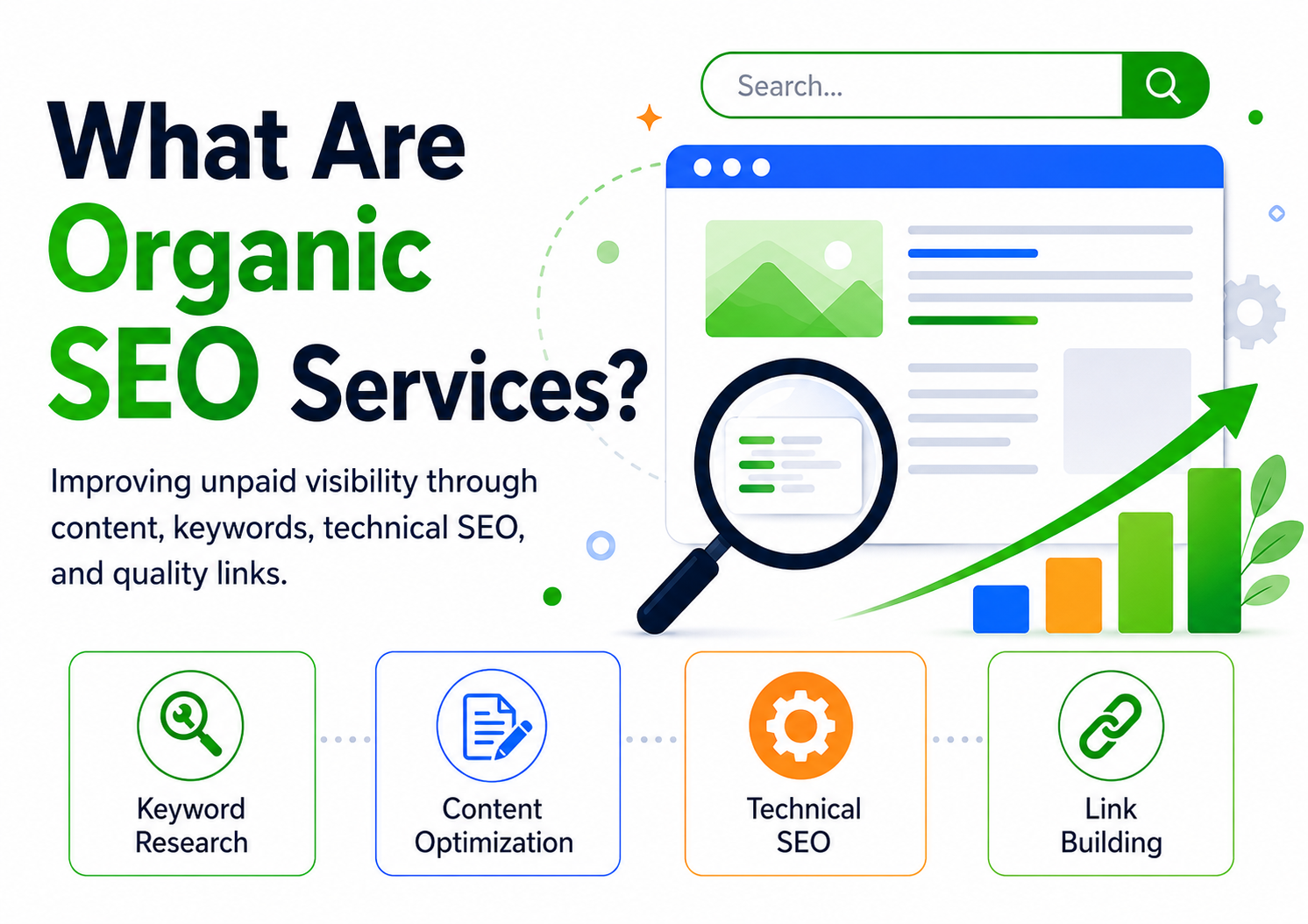
Organic SEO services are professional methods used to improve a website’s visibility in unpaid search results. They help search engines understand the website and help visitors find useful information.
The aim is not only to bring more traffic. It is to attract people who are interested in the business and may read, compare, enquire, or purchase.
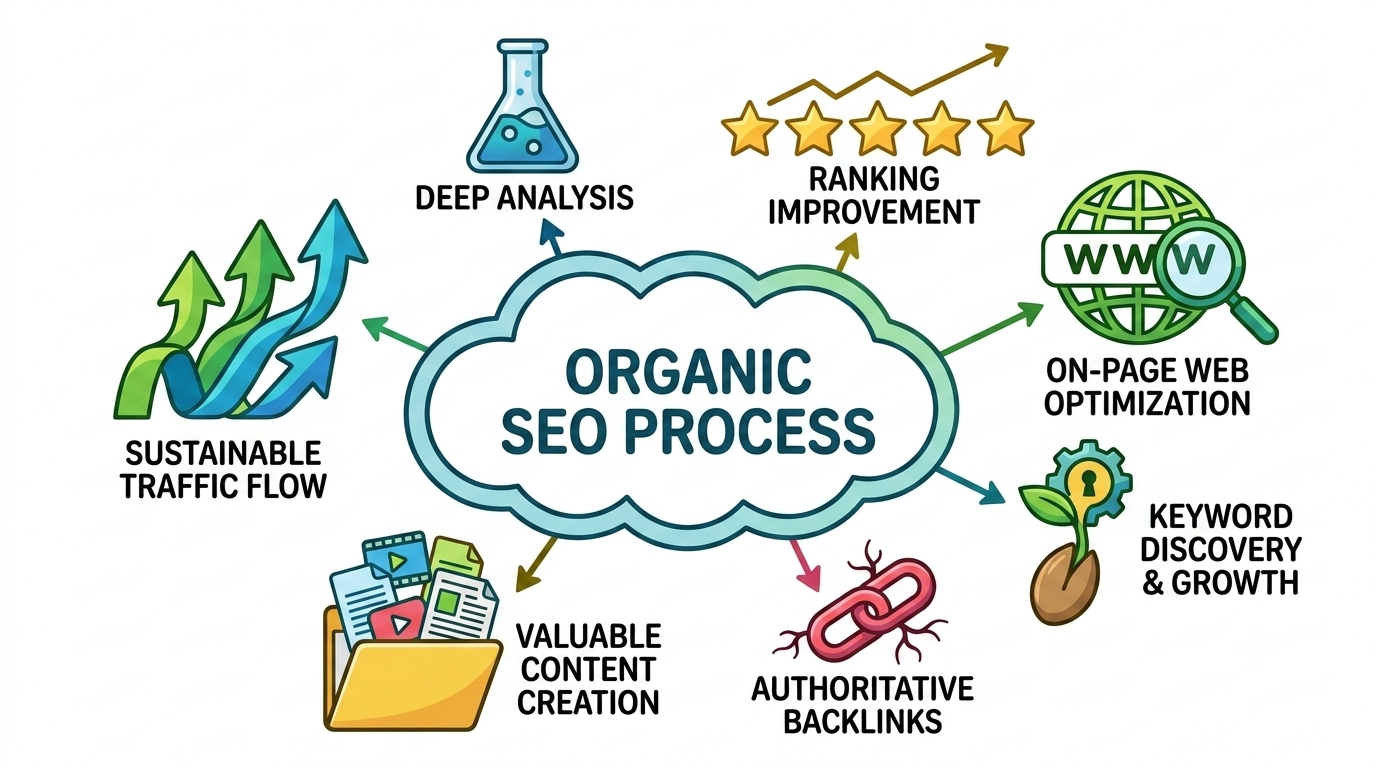
The main activities include:
- Keyword Research: Keyword research identifies the phrases people use when searching for services, products, or information. It helps businesses create content around real customer needs.
- On-Page SEO Optimization: On-page SEO optimization improves titles, headings, URLs, content, image text, and internal links so users and search engines can understand the page more easily.
- Technical SEO Improvements: Technical SEO improvements help a website load faster, work smoothly on mobile, fix broken links, remove duplicate pages, and make important content easier for search engines to find and understand.
- High-Quality Content Creation: High-quality content creation helps businesses answer customer questions, explain services, and guide users through the buying journey.
- Website Structure: A clear website structure helps visitors move from one page to another without confusion.
These activities work together under one clear search engine optimization strategy. Instead of improving only one page, SEO strengthens the whole website step by step. This approach supports organic traffic growth and helps businesses build long-term search engine visibility. It creates a stronger base for stable rankings and future growth.
What are the Benefits of Organic SEO?
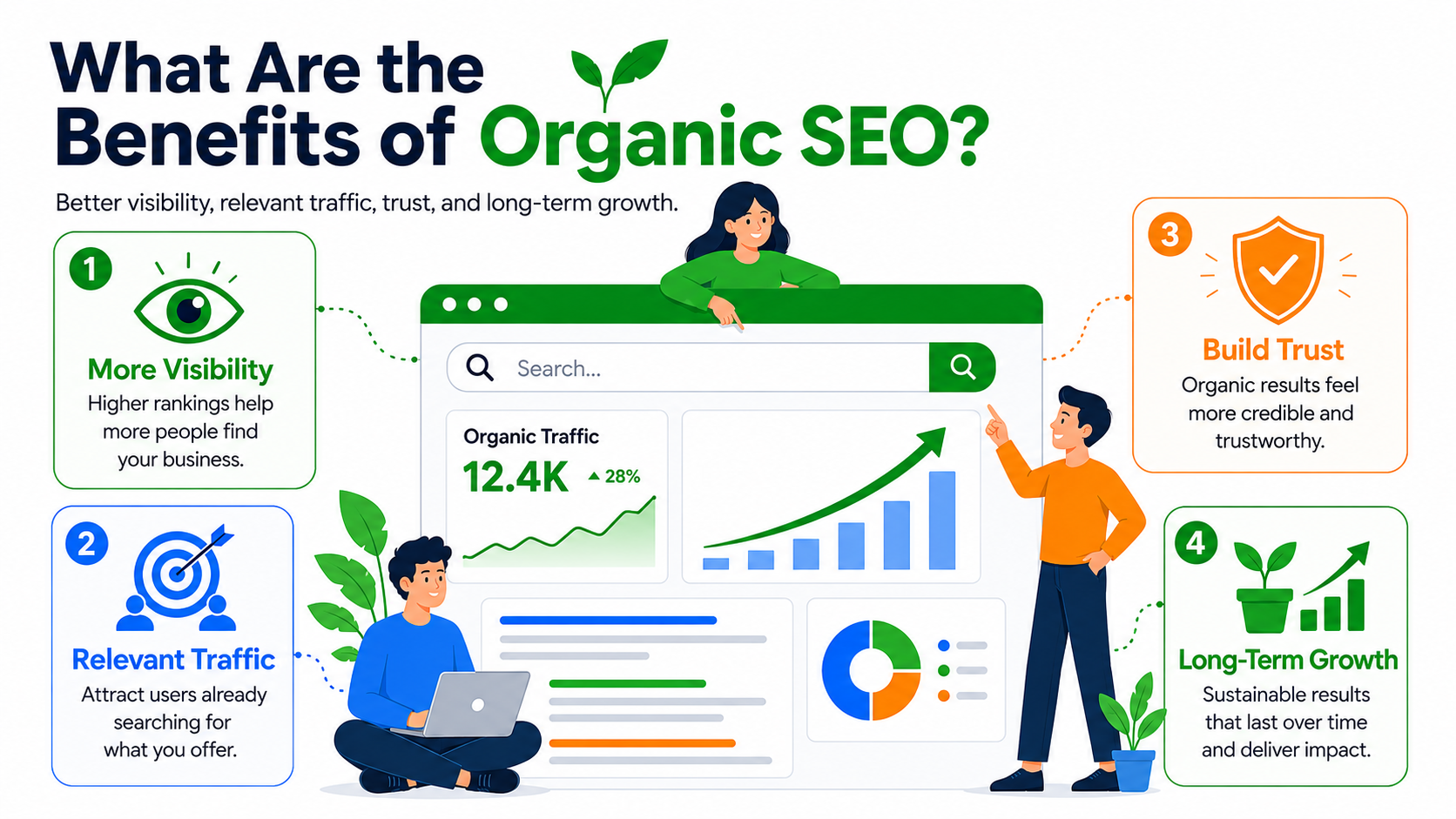
Organic SEO helps businesses attract people who are already interested in what they offer, without paying for every click. Helpful pages can keep bringing in visitors long after they are published. With the right sustainable SEO strategies, a business can become easier to find, build trust, attract better leads, and turn more visits into real inquiries or sales.
The main benefits include:
- Long-Term Visibility: Long-term search engine visibility helps businesses remain discoverable when users search for related services or information.
- Relevant Traffic: SEO attracts users based on their search needs. These visitors are more likely to have a real interest in the business.
- Stronger Brand Trust: Websites that appear regularly in search results often feel more familiar and reliable to users.
- Lower Long-Term Costs: Paid campaigns require ongoing spending. Organic SEO does not charge the business each time someone clicks a result.
- Better User Experience: Faster pages, clear menus, useful content, and mobile-friendly layouts make websites easier to use.
- Website Ranking Improvement: Improved rankings can lead to more impressions, clicks, calls, inquiries, bookings, and sales.
- Support for Small Businesses: SEO services for small businesses can target local areas, specific services, and detailed customer questions.
- Measurable Results: Businesses can track rankings, traffic, calls, form submissions, sales, and other important actions.
For example, a local business may create a service page, location page, customer guide, and FAQ page around one main topic. Together, these pages can increase organic website traffic and guide users towards an inquiry. The biggest benefit is not simply higher rankings. It is the creation of a steady visibility system that supports SEO for business growth.
Example: Suppose a local service business receives 1,000 website visits each month, but only 200 come from organic search. After improving service pages, fixing technical issues, publishing helpful content, and adding internal links, organic visits may gradually rise to 500 per month. Even if paid advertising remains unchanged, the business now has a stronger source of traffic that can continue growing over time.
This example shows how Organic SEO services can create steady progress instead of short-lived traffic spikes. The actual results will vary by industry, competition, website condition, and how consistently the strategy is followed.
Why Does Organic SEO Matters?
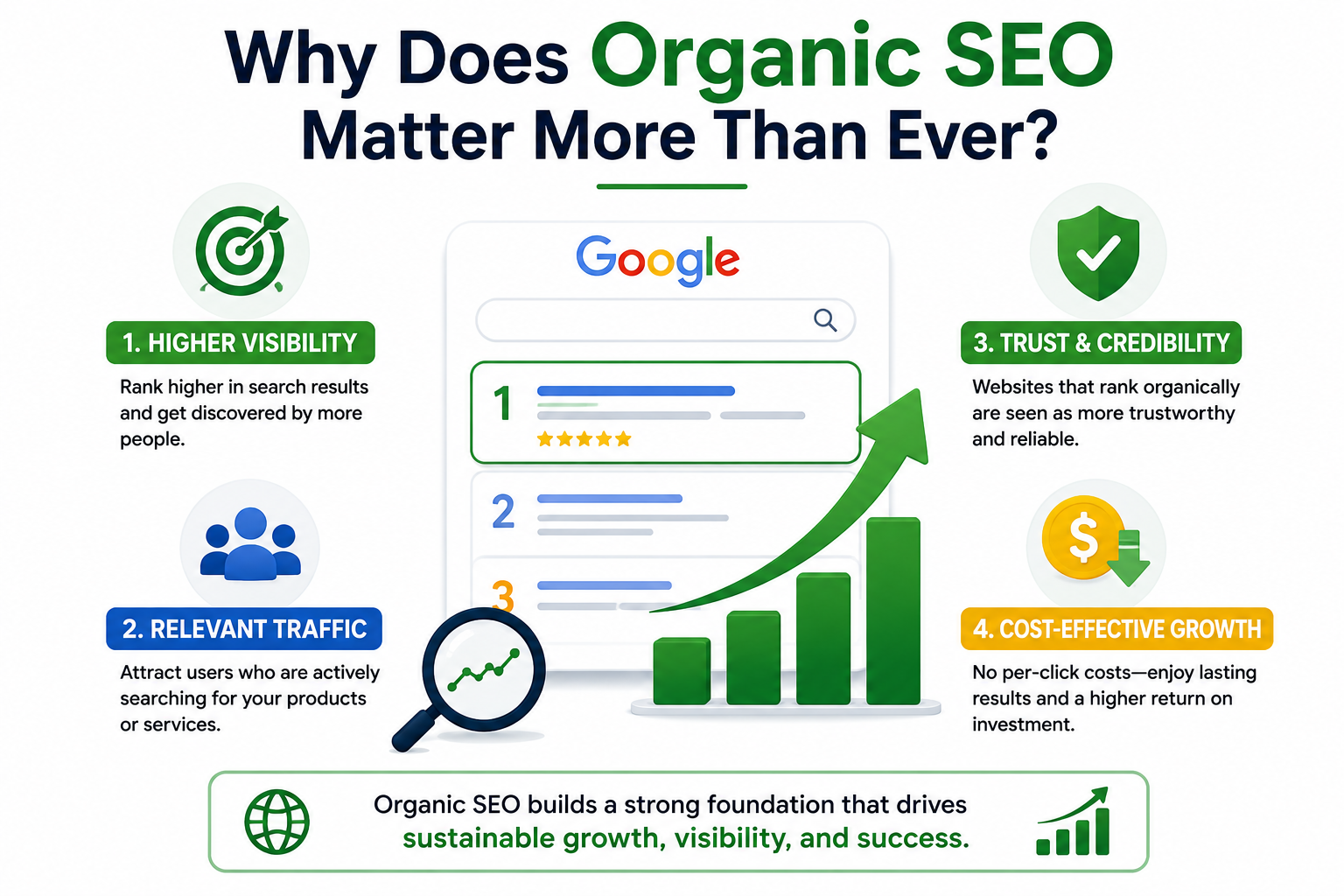
Organic SEO matters because online competition continues to grow. Customers now search for information, compare businesses, read reviews, and study websites before making contact. A business that does not appear during this research stage may lose potential customers to competitors.
The main reasons organic SEO matters include:
- Search Behavior Has Changed: People are asking more specific questions and want clear, useful answers. Businesses need content that speaks directly to what their audience is really searching for.
- Competition Is Growing: More companies are improving their websites and publishing content. Organic search optimization helps a business remain visible and relevant.
- Paid Advertising Is Temporary: Paid traffic normally stops when the budget stops. Organic pages may continue bringing visitors when they remain useful.
- Customers Research Before Buying: Users often visit several pages before taking action.
- Content Quality Matters: Thin or repeated content may not satisfy users. High-quality content creation helps businesses explain their services and answer important questions.
- Technical Performance Matters: Slow pages, broken links, and poor mobile design can damage rankings and conversions.
- Topic Coverage Builds Authority: Websites that cover a subject clearly across several pages can appear more trustworthy.
- SEO Supports Other Marketing: Useful SEO content can also support email, social media, sales, and remarketing campaigns.
Organic SEO helps businesses appear when customers are actively searching for help. Clear and useful pages can improve trust and bring users into the buying journey earlier. A planned approach can improve Google search rankings while supporting stronger brand awareness, traffic, and lead generation.
What Is Organic Search Engine Optimization?
Organic search engine optimization is the process of improving a website so it can appear more clearly in unpaid search results. It focuses on content, technical health, site structure, user experience, keyword relevance, and authority. The goal is to connect the right page with the right search.
The process usually includes:
- Search Intent Research: Search intent explains what the user wants. They may want information, a comparison, a nearby service, or a direct solution.
- Keyword Planning: Keywords are used to identify the central theme of the page. They should be used in the title, headings, introduction, and the entire page contents.
- Content Optimization: Existing pages may need clearer explanations, updated details, stronger headings, better examples, and useful internal links.
- Site Architecture: Website pages should follow a clear structure.
- On-Page Elements: The use of titles, meta description, headings, URL, internal links, and image texts helps search engines understand the page better.
A good search engine optimization strategy brings every SEO effort together with one simple goal: making the website more useful for people. It is not about gaming search engines. It is about helping visitors find the right information without confusion. When the website does that well, the business can reach the right audience, keep their attention, and build steady organic traffic growth over time.
How Do Organic SEO Services Work?
Organic SEO services work by turning business goals and customer needs into a clear improvement plan. A professional team reviews the website, competitors, target audience, and current performance. It then identifies the actions that can improve visibility, usability, and conversions.
The main working areas include:
- Strategy Guides Improvements: A clear search engine optimization strategy identifies valuable topics, priority pages, technical issues, and realistic ranking opportunities.
- Intent Shapes Content: Some users want information, while others are comparing services or preparing to buy. Each page should match the correct search intent.
- Technical Health Supports Results: Technical SEO improvements may include fixing broken links, improving speed, reducing duplicate content, and strengthening mobile usability.
- Content Builds Authoritative Content: High-quality content creation can include service pages, guides, comparisons, FAQs, and supporting blogs.
- Internal Links Connect Pages: Internal links guide users towards related content and show search engines how pages support one another.
- Authority Builds Trust: Trusted links, mentions, customer reviews, and expert references can strengthen credibility.
- Reporting Guides Decisions: Professional SEO services track rankings, traffic, engagement, and conversions to decide what should be improved next.
SEO works best when these activities support one another. Strong content may struggle on a technically weak website. A fast website may also struggle if its pages do not match user needs. A connected system creates clearer search signals, better user journeys, and stronger long-term results.
What Builds Stronger Rankings?
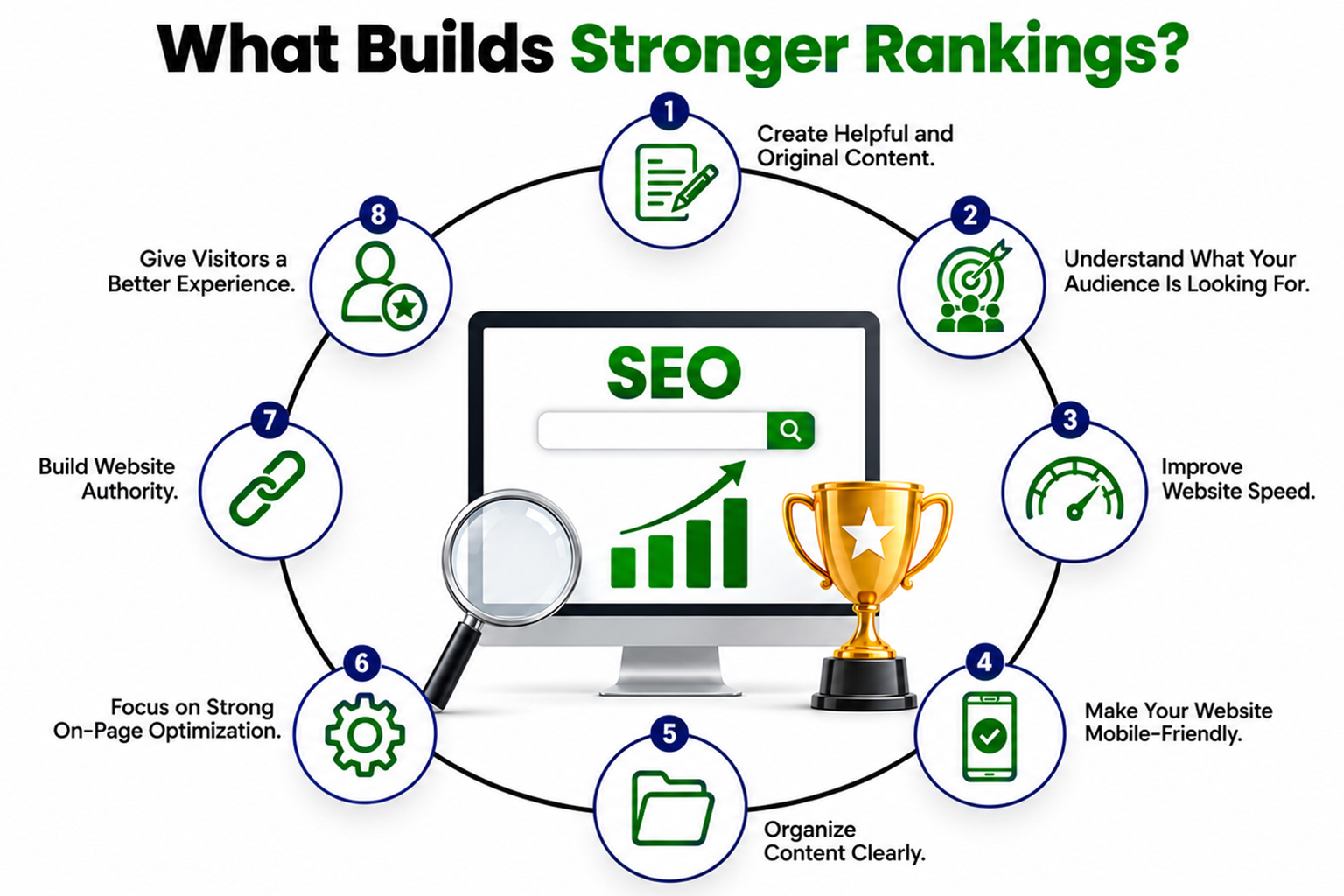
Strong rankings are not built by repeating the same keywords again and again. Search engines favor pages that are helpful, clear, trustworthy, and easy to use. Better results usually come when useful content, a well-structured page, strong website performance, and genuine authority all work together around the same topic.
The most important factors include:
- Content Must Solve Problems: High-quality content creation should answer the main question clearly, explain important details, and guide the user towards the next step.
- Pages Need Clear Structure: On-page SEO optimization makes a page easier to understand by improving its headings, title, URL, internal links, and keyword use. This helps readers find what they need quickly and gives search engines a clearer idea of what the page is about.
- Authority Must Grow Naturally: Ethical link-building strategies help websites earn relevant links and trusted mentions without using risky methods.
- Search Intent Must Match: Informational searches need helpful explanations. Commercial searches may need comparisons, benefits, Proof, or contact options.
- Technical Problems Must Be Fixed: Slow loading, duplicate pages, broken links, and indexing issues can hold strong content back.
- Content Must Stay Updated: Older pages may need fresh facts, links, examples, and service details.
- The User Journey Must Be Clear: Visitors should easily understand the page and find the next useful action.
When useful content, a clear page structure, a healthy website, and genuine authority come together, businesses have a much better chance of seeing steady website ranking improvement. These same strengths also help visitors trust the site and make search performance more consistent over time.
Why Does Technical SEO Matter?
Technical SEO matters because search engines must be able to find, crawl, and understand website pages. A website may have good content but still struggle if pages are slow, broken, duplicated, or blocked from search engines.
Important technical areas include:
- Page Speed: Large images, heavy scripts, and poor templates can slow down pages and increase user drop-off.
- Mobile Performance: Pages should be readable and easy to use on phones and tablets.
- Crawlability: Search engines need working links, clear menus, and correct sitemaps to discover pages.
- Indexing Control: Low-value, duplicate, or filtered pages may need to be removed from search results.
- Redirect Management: Broken redirects and long redirect chains can create problems for users and search engines.
- Website Security: Secure websites build trust and protect visitor information.
- Structured Data: Schema can help search engines understand page details more clearly.
- Canonical Tags: Canonical tags show search engines which version of a similar page should be preferred.
Technical SEO improvements create a strong base for all other SEO activities. They help search engines process the website correctly and help users browse without delays or confusion. Technical work may happen behind the scenes, but it strongly supports long-term search engine visibility and better website performance.
How Does Content Support Growth
Content helps businesses reach customers at different stages of the buying journey. Some users are learning about a problem. Others are comparing options, while some are ready to contact a provider. A strong content plan gives each group useful information.
Different types of content include:
- Service Pages: Explain what the business offers and how the service helps.
- Informational Blogs: Answer early questions and bring research-based traffic.
- Comparison Pages: Help users compare services, products, or approaches.
- Case Studies: Show experience, Proof, and practical outcomes.
- FAQ Pages: Answer common concerns and remove confusion.
- Location Pages: Connect services with customers in specific areas.
- Product Guides: Explain features, benefits, and selection factors.
- Resource Pages: Provide detailed information that may earn trusted links.
Internal links help users move through this journey. A supporting article may use Organic SEO services as anchor text and direct readers towards a related service page. Content should not be published only to fill a calendar. Every page should have a clear purpose and match a specific search need. When connected properly, content can increase organic website traffic, build authority, and bring more qualified inquiries.
Can Small Businesses Compete Through SEO?
Small businesses can compete through SEO by focusing on specific and realistic opportunities. They may not have the same budget as large brands, but they can often provide more detailed, local, and useful information.
Important areas include:
- Local Search Terms: Targeting cities, neighborhoods, and service areas can reach nearby customers.
- Detailed Service Pages: Separate pages for individual services can perform better than one broad page.
- Customer Questions: Answering practical questions can attract users that larger brands may ignore.
- Long-Tail Keywords: Detailed search phrases often have clearer intent and lower competition.
- Reviews and Local Signals: Accurate profiles and customer reviews support trust.
- Niche Expertise: Smaller businesses can focus on specialized services or industries.
- Focused Content Groups: Connected pages around one topic can build stronger authority.
SEO services for small businesses should begin with the pages that are most likely to bring inquiries, calls, or sales. Smaller businesses can often connect with customers more personally because they understand local needs and specific concerns. By creating clear, useful content for the right audience, they can compete with larger companies that rely on broad and less personal messaging.
How Should SEO Results Be Measured?
SEO success is about more than simply reaching a high position in search results. A website may rank well but still attract visitors who are unlikely to become customers, while a lower-ranking page may bring valuable inquiries. Businesses should therefore look at how search visibility contributes to traffic quality, leads, and real results.
Useful performance measures include:
- Search Impressions: Show how often pages appear in search results.
- Organic Clicks: Show how many users visit from unpaid search listings.
- Keyword Visibility: Tracks rankings across important topics.
- Qualified Traffic: Measures whether visitors match the target audience.
- Engagement: Includes scrolling, time on page, internal clicks, and return visits.
- Conversions: Tracks calls, forms, bookings, sales, downloads, or sign-ups.
- Lead Quality: Shows whether inquiries are useful and relevant.
- Revenue Contribution: Connects organic traffic with sales and conversions.
- Technical Health: Tracks crawl problems, speed, broken pages, and indexing changes.
- Content Performance: Shows which pages are improving or losing visibility.
Reporting should explain what changed, why it matters, and what action should happen next. Clear reporting helps businesses protect progress and improve sustainable SEO strategies. It turns data into useful decisions and supports stronger SEO for business growth.
Example: Imagine two websites each receive 2,000 monthly visitors. Website A attracts broad traffic and generates only 10 enquiries. Website B receives more focused traffic from service-related and local searches and generates 40 enquiries. Although both websites have the same number of visitors, Website B attracts people who are more likely to become customers.
This shows why SEO should focus on traffic quality, not just traffic volume. A clear search engine optimization strategy can help businesses reach the right audience, improve conversions, and support more meaningful growth.
Conclusion
Organic SEO services help businesses become easier to find by improving their content, website performance, search relevance, authority, and overall user experience. Unlike short-term marketing, organic search can keep bringing interested visitors to useful pages over time. The best results come from a clear plan that connects real customer needs with helpful information and a website that is easy to use.
Businesses that stay consistent can improve Google search rankings, depend less on paid traffic, and build more steady growth. Regular content updates, technical checks, and ethical link-building strategies help protect that progress as competitors and search trends change. Over time, stronger search visibility can become a valuable source of traffic, trust, and new business.
Connect with eSign Web Services for professional SEO services that improve visibility, attract qualified traffic, and strengthen website performance. A focused strategy can uncover hidden issues and turn valuable search opportunities into more inquiries and conversions.
Frequently Asked Questions
Question: What are organic SEO services?
Answer: Organic SEO service refers to any activity that helps a business in boosting its website’s search engine ranking. This includes activities like keyword research, technical audits, content planning, on-page optimization, internal linking, authority building, and performance reporting. Organic SEO works by improving the ability of search engines to recognize the relevant pages, as well as making the website useful to people who visit. It is different from other marketing strategies such as advertisements because there are no costs for clicks.
Question: How long does organic SEO take to show results?
Answer: It is unlikely for organic SEO to give instant results since the search engine has to index and analyze its changes, content, competition, and authority. Websites that see improvement sooner may see improvements in a couple of months, but some industries may take longer. This all depends on the age of the website, its technical state, its content, its competition, where the website is located, and what it has. Companies have to measure the impressions, rankings, traffic, and conversions collectively.
Question: Is organic SEO better than paid advertising?
Answer: However, since paid campaigns and organic SEO are used for different reasons, there is no point in saying that one is better than the other. Paid campaigns can provide immediate visibility and are great for launches, promotions, seasonal campaigns, and even tests. Organic SEO may take longer to implement; however, it will keep providing you with visitors even if you do not pay per click. Both techniques are widely used together by many businesses.
Question: Can small businesses afford professional SEO?
Answer: Small businesses can employ professional SEO effectively provided that the process suits their priorities and their budget. An effective SEO strategy can start with technical adjustments, relevant service pages, local presence, customer reviews, and question-related content. Small businesses should not necessarily try to optimize every possible nationwide keyword. By focusing on particular services, geographical areas, and keywords, small businesses can steadily advance. The key here is to select valuable tasks and stay away from those service providers who claim quick ranking without an explanation of how they will achieve it.
Question: What is included in organic search optimization?
Answer: Search engine optimization for organic traffic encompasses all the effort required to improve the visibility, usefulness, and understanding of the site. This could involve such actions as search intent analysis, keyword planning, content updating, title & header optimization, internal linking, mobile friendliness, page speed, crawling optimization, structured data, and building authority. Other aspects that might be involved are local search engine optimization and conversions. It all depends on the particular state of the site and what needs to be achieved.
Question: Why is high-quality content important for SEO?
Answer: It is essential to have high-quality content since it provides useful information and makes it easier for the search engine to understand the site. High-quality content does a good job of describing the topic and answering any questions about it. It also has useful headings and helps lead the reader into taking the next logical step. The content needs to be written for humans rather than repeating keywords. Useful websites will be rewarded with engagement, links, social shares, and repeat visits.
Question: How does technical SEO affect website rankings?
Answer: Technical SEO ensures that a website works smoothly for both users and search engines. Problems such as slow-loading pages, broken links, duplicate content, poor mobile design, or incorrect redirects can affect website performance, even when the content is valuable. A well-maintained website is easier to navigate and more likely to keep users engaged. Regular checks are important because newly installed plugins, design changes, or added content can sometimes create problems.
Question: Are backlinks still important for organic growth?
Answer: Backlinks are still valuable since links to the website from other sources indicate the recognition of that page as a credible and useful source. Nevertheless, not quantity but the quality and relevance of the backlink should be considered. Backlinks from reputable sources, such as industry-related sites, partners, or other valuable materials, may increase the authority of the website. Link manipulation, irrelevant directories, or purchased links may cause risks. Companies should strive to achieve quality backlinks through various methods.
Question: How can a business measure SEO success?
Answer: Rather than simply relying on rankings, businesses need to assess their SEO success using a variety of related metrics. Key metrics to consider include search impressions, organic click-through, quality traffic, engagement, inquiries, sales, assisted conversions, and sales attributed to organic visitors. It can be helpful to gauge your visibility around key topics as well as analyze the performance of key landing pages. By linking improvements in performance to particular actions, like content additions or technical optimizations, it will make it easier to see what’s working.
Question: Why does organic SEO require ongoing work?
Answer: Organic SEO is a process that demands constant effort since the search results, customer behavior, competition, and websites themselves keep changing. The competition keeps coming up with new materials, customer language evolves, there might be some technical issues with the site, and other pages can become irrelevant for the search. Ongoing efforts will help the company refresh its material, improve weaker spots on the site, link the internal pages of the website, solve any technical issues, and use new opportunities.
Author Details

Ashwani Kumar Sharma
Ashwani has been actively involved in SEO services since 2005. His expertise and distinctive work approaches have made him one of the most experienced and trusted SEO experts in the industry. He is a certified SEO and Google Ads professional. He also has strong business development skills in advanced SEO, PPC, and digital marketing strategies.


