



Why PPC Budgets Get Wasted Without Proper Funnel Strategy

Key Takeaways:
- PPC budgets often go to waste when campaigns chase clicks without guiding users through a clear funnel.
- Weak stage planning can send low-intent traffic to pages built only for immediate conversion.
- Poor targeting, vague offers, and weak landing pages increase friction and lower lead quality.
- Better tracking and attribution help teams understand where spend supports growth and where it leaks away.
- Remarketing can improve efficiency when audience segments and messages reflect real buying readiness.
- A stronger funnel improves budget control, campaign learning, and long-term paid search performance.
Introduction
Paid advertising can bring in impressions, clicks, and leads, but that does not always mean the budget is being spent wisely. Many businesses lose money because they treat paid ads as a way to drive traffic rather than as part of the customer journey. PPC funnel strategy helps make that journey clearer by matching the right message, landing page, and follow-up to each stage of the decision-making process. When those pieces do not connect properly, the spend is wasted, and the lead quality weakens. Businesses that manage PPC well usually understand one important thing: not every click should be treated the same. Someone visiting for the first time may need more information and trust before taking action. Someone with stronger intent may just need a clear offer and an easy next step. Once that difference is understood, PPC budget optimization becomes much easier because campaigns can be judged by where the user is in the funnel, not only by how many clicks they bring.
In this blog, we will explain what PPC Funnel means, why funnel planning matters, where things usually go wrong, and what changes can help reduce wasted spend more quickly. It will also cover how landing pages, targeting, tracking, and remarketing affect Google Ads budget management and overall paid search performance.
What Does PPC Funnel Mean?
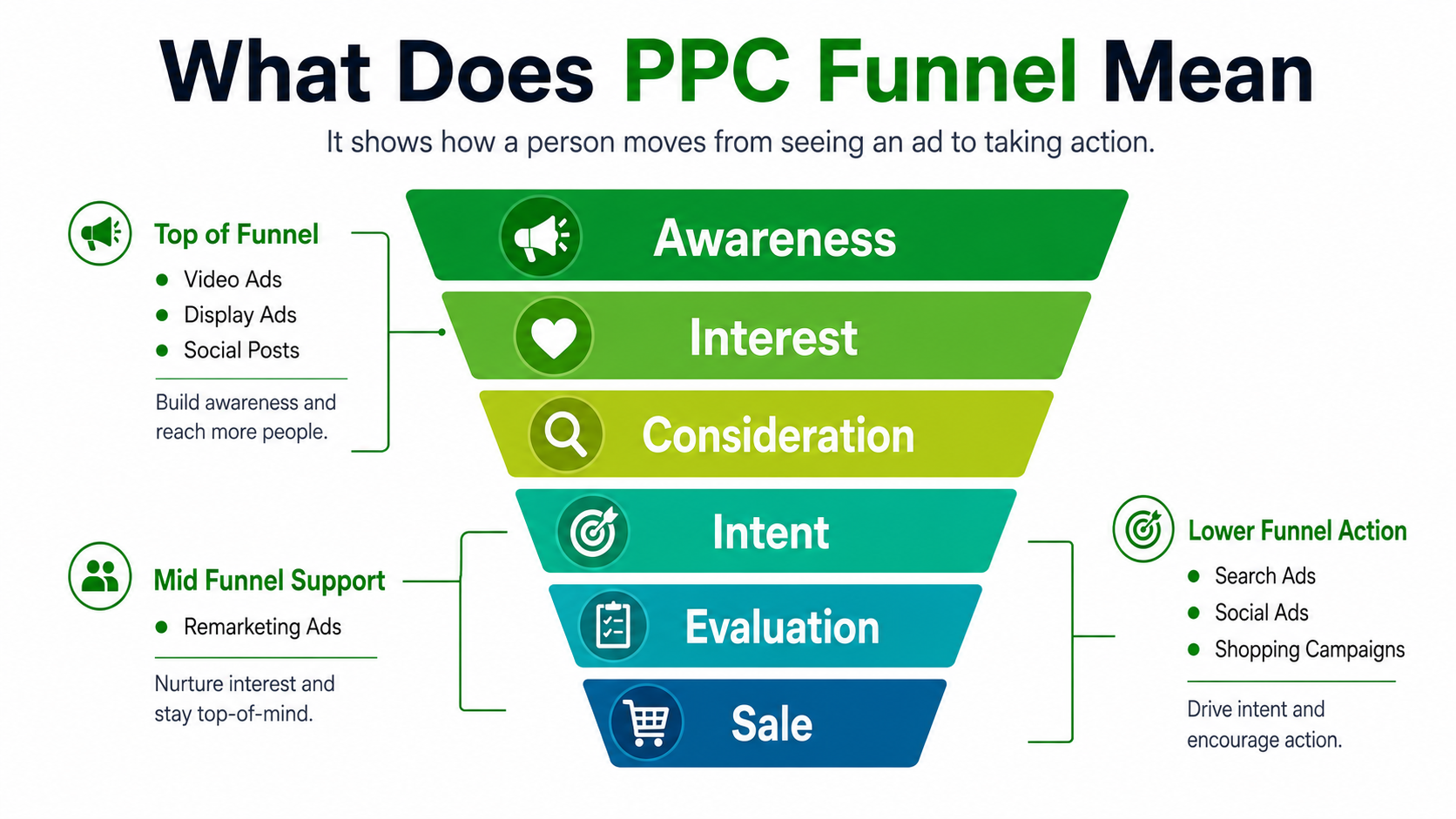
PPC Funnel refers to the route a user takes from noticing an ad to converting by taking an action. Such actions can include making a purchase, submitting a form, booking a service, or making an inquiry. It is called a funnel because many users may enter at the initial stage, while fewer reach the final stage. A PPC Funnel does not occur instantly because users require different levels of information, trust, and motivation at different stages.
To put it simply, a PPC Funnel shows advertisers that not every ad click means the user will convert right away. Some users require more awareness, others need nurturing, while some need a stronger prompt. When advertisements, landing pages, and follow-up communications are properly aligned at different stages of the funnel, the process becomes smoother.
- Awareness: This is the starting point where people first come across a business, offer, or product. At this stage, they may not know much about the brand and are simply becoming familiar with it. The main goal here is to attract attention and introduce the business in a clear, memorable way.
- Interest: Following the advertisement, there is a curiosity that arises in some people. Some of them may choose to learn more or visit the site. In this phase, the aim is to sustain consumer interest.
- Consideration: Now it is the stage when the consumer evaluates whether the offer is suitable for them. They may compare the available options, research them in more detail, and assess how well the offer meets their needs. This stage is important because the consumer is no longer simply curious.
- Intent: Now, the individual is indicating definite buying signals. He/she has now moved beyond just browsing and may be considering the price, services, options, etc. This indicates that the individual is coming close to taking some action.
- Evaluation: This is the stage where the consumer wants to feel sure before making the final move. They may go through the benefits, warranty, delivery details, reviews, or anything else that helps them feel more confident. They are almost ready, but sometimes they just need that last bit of trust and clarity before they go ahead.
- Sale: This is the final stage where the user completes the desired action. It could be a purchase, a registration, a lead form submission, a phone call, or a consultation request. This is the outcome the campaign is working toward, but only a portion of the original audience reaches this point.
Why Funnel Planning Matters
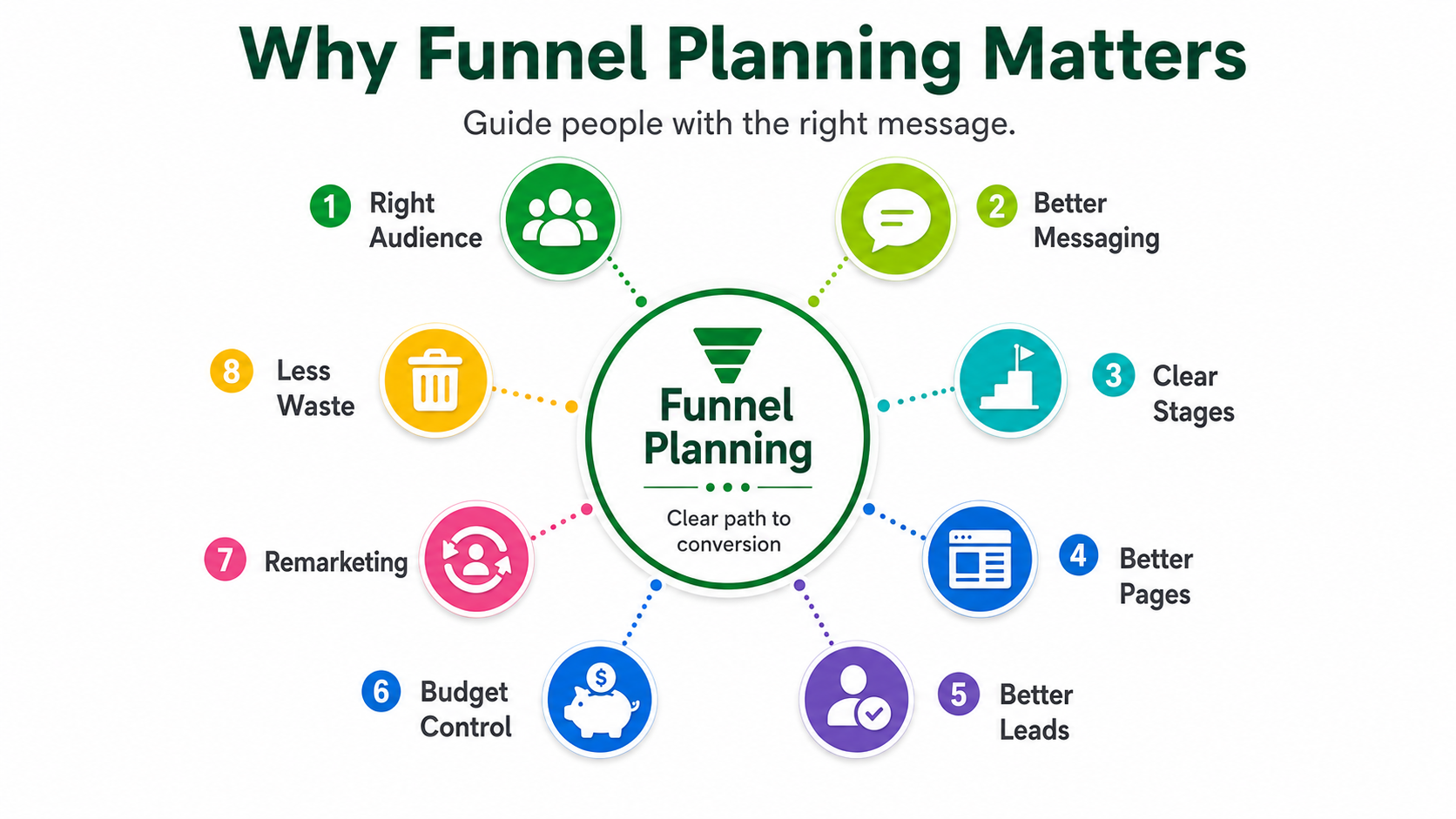
Funnel planning is necessary because advertising is much more effective when it aligns with how people actually think. Not everyone who sees an advertisement acts on it right away. Some people have only recently realized their problem, some are still weighing their options, and others are already ready to take action.
For businesses that want to improve return on ad spend, understanding each funnel stage can make a big difference. It helps campaigns reach the right people, send them to the right page, and generate more useful data for better decisions later. Without conversion funnel planning, even strong ad creative and a good number of impressions can still bring in low-quality leads.
- It Matches The User’s Mindset: People at different stages need different things. Someone who is hearing about your brand for the first time may need simple information and a clear explanation. Someone who is already comparing options will usually look for proof, details, and reasons to trust you. Funnel planning helps align the ad, page, and offer with what the person is ready for, rather than pushing them to act before they feel ready.
- It Reduces Budget Waste: Much of the waste in PPC stems from businesses directing cold traffic to landing pages intended for customers who are already ready to buy. For instance, a person visiting your website for the first time after clicking on a general search ad will probably not stay if they are forced to request a demo or quote right away.
- It Improves Conversion Quality: Good funnel planning is not only about getting more leads. It is also about getting better leads. When the journey is structured properly, users take actions that match their level of interest. This often means sales teams receive inquiries from people who understand the offer better and are more likely to move forward.
- It Makes Campaign Goals Clearer: Not every campaign should be judged by the same final result. A top-of-funnel campaign may be designed to attract attention and build interest, while a lower-funnel campaign may focus on conversions. Funnel planning gives each stage a realistic goal, which makes reporting more useful and optimization more accurate.
- It Helps With Better Budget Allocation: Paid campaigns often underperform when too much budget is allocated to a single stage, while the rest of the journey is ignored. For example, a business may spend heavily on lead generation ads but invest nothing in remarketing or middle-stage content. Funnel planning helps distribute the budget more evenly across the full path rather than overloading one part.
It is important to plan a funnel so that paid ads support the buyer’s journey rather than simply create another chain of clicks. It helps businesses use their marketing budget more efficiently, deliver the right message at the right time, and analyze results more clearly. When the funnel stages are applied properly, paid advertising becomes more effective. That is why successful PPC campaigns usually include a well-planned funnel.
Where PPC Funnels Break Down
Many marketing campaigns begin to fail when companies try to address all customers in the same way. People who have just discovered the brand are very different from those comparing options or about to make a purchase. Yet many campaigns still take a one-size-fits-all approach. When that happens, the journey feels disconnected, and ad spend allocation becomes harder to manage well.
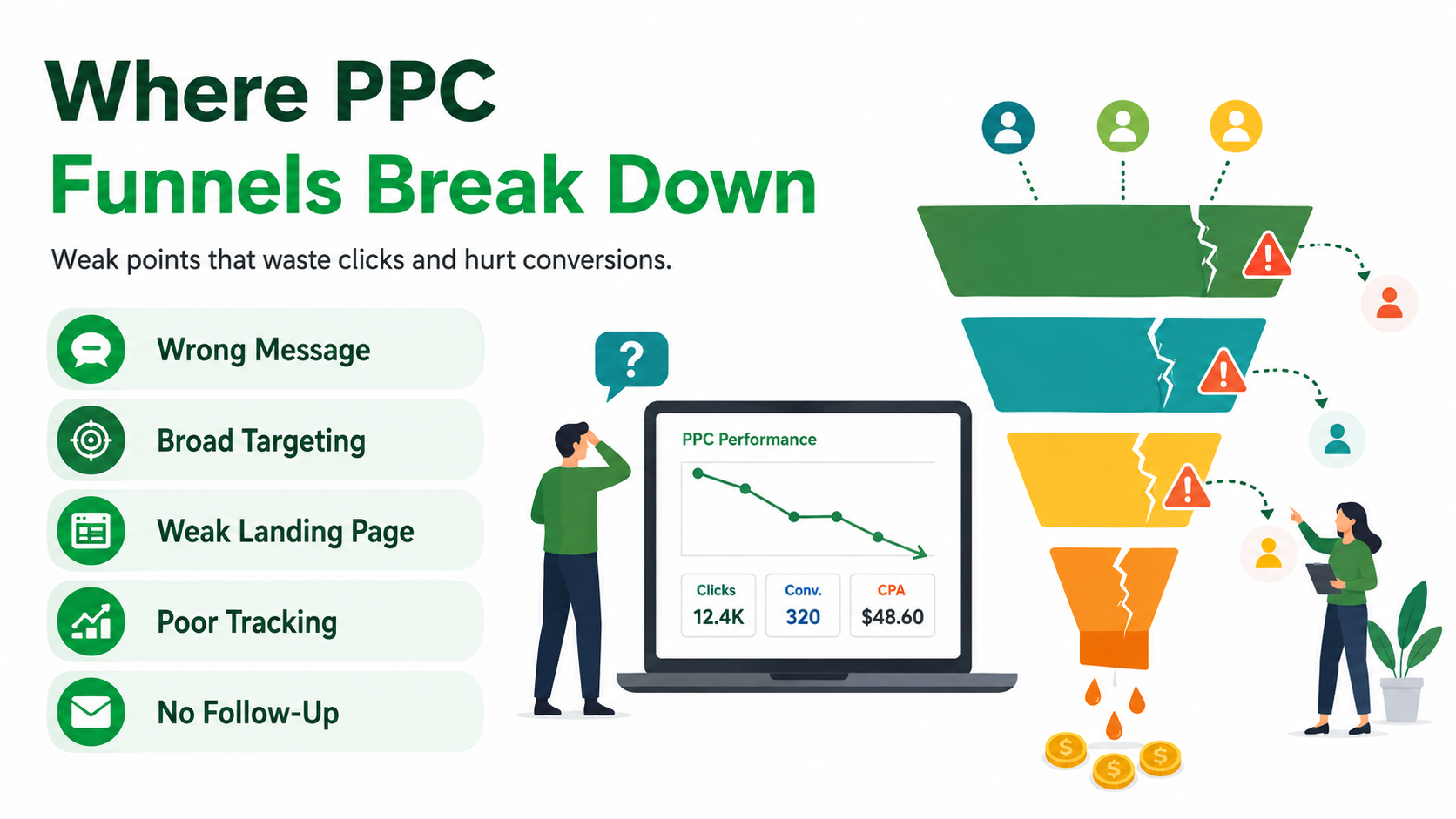
PPC funnel marketing typically fails because of poor planning in the click-to-conversion process. A campaign may attract visitors, but the process does not always follow the expected path. Clicks are lost due to unclear messaging, overly direct landing pages, a very broad audience, and a lack of alignment between the next required action and the visitor’s level of interest. In most cases, the problem is not that the ads fail to attract clicks, but that the clicks are being sent down the wrong path.
- The Message Does Not Fit The Stage
- Cold Traffic Is Pushed Too Far Too Soon
- Landing Pages Do Not Match What People Want
- Targeting Is Too Broad
- There Is No Clear Middle Step
- Every Campaign Is Measured The Same Way
- Tracking Does Not Show The Real Drop-Off Point
- Remarketing Is Missing Or Poorly Used
- Sales And Marketing Expectations Do Not Align
The problem with PPC funnels arises when the path users take is too short, too broad, or unrelated to their decisions. The disconnect may appear at any stage of the funnel, including targeting, messaging, landing pages, tracking, and follow-up. Still, its result will typically remain the same – clicks are coming in, but results are poor. A more effective funnel works by making each stage of the funnel work for it.
What Changes Reduce Waste Fast?
When the parts of the process that cause friction for the user are fixed, waste usually comes down faster. In most cases, the problem is not the platform itself but the fact that the different parts do not work well together. Quick wins often come from making the journey smoother, improving the targeting, and giving users a more suitable next step. Small changes can often improve efficiency much faster than building a completely new process from scratch.
- Refine Search Intent: One of the quickest ways to improve results is to examine your keywords and the intent behind them. Broad or loosely matched terms often attract people who are only browsing or not the right fit. When keyword targeting is tightened and stronger negative keywords are added, it becomes much easier to cut down poor-quality clicks and keep budget control stronger.
- Match Ads to the Right Stage: Not everyone clicks on an ad for the same reason. Some people are only trying to learn more about the issue, while others are already thinking about what action to take. That is why the message should match their level of interest. A visitor in the early stage needs simple and relevant information, while someone further along may need pricing, proof, or a clear next step.
- Improve Landing Page Relevance: Many campaigns end up losing money because the landing page does not feel like a natural follow-up to the ad that made the visitor click. The user clicked on something that caught their interest, but once they land on the page, it may feel unclear, confusing, or too aggressive. Small changes to the headline, page flow, call to action, and trust signals can make a big difference.
- Use Remarketing More Intelligently: Interested users often need a second or third touch before they act. Adding or improving remarketing can recover people who already showed intent. This is often more efficient than spending everything on first-time cold traffic.
- Check Form and Conversion Friction: A funnel may look fine until the final step becomes too difficult. Long forms, unclear calls to action, or slow-loading pages can block results. Simplifying conversion steps often improves performance without changing the ad spends itself.
Quick waste reduction usually comes from alignment, not complexity. More accurate intent targeting, stronger messaging, better landing pages, and improved audience management can all bring faster results. The quickest wins often happen when businesses stop chasing clicks and start focusing on what happens after the click.
How Remarketing Strengthens the Funnel?
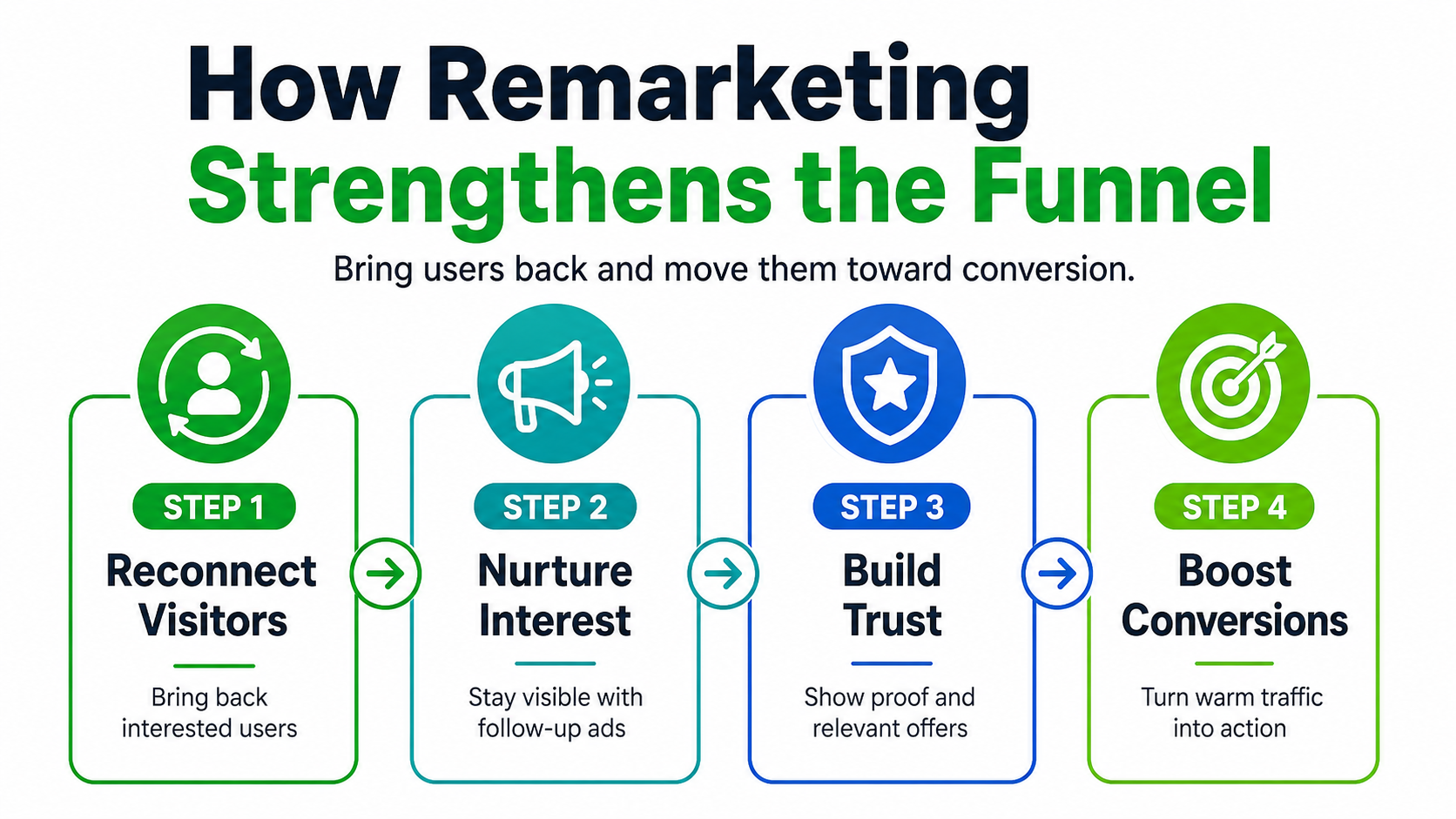
Remarketing strengthens the funnel by bringing back people who already showed interest but did not take action the first time. Most users do not convert on their first visit, especially when the product, service, or decision requires thought. Remarketing keeps the brand visible while the person continues comparing, thinking, or delaying. It helps move interested users forward instead of constantly restarting the journey with new cold traffic.
- It Brings Back People Who Already Showed Interest
- It Helps People Move Further Down The Funnel
- It Makes The Message Feel More Relevant
- It Gives Missed Opportunities Another Chance
- It Helps The Budget Work Harder
- It Builds More Familiarity And Trust
Example: A user visits a legal services page but leaves without making contact. A remarketing campaign strategy later shows confidential advice and common case concerns. That second touch may feel more reassuring because it speaks to the user’s earlier interest instead of acting like a first introduction.
Remarketing example in an ecommerce environment: A customer looks at running shoes, compares them with other options, and then leaves the website. Remarketing can then help show similar products, along with reviews, delivery details, and a limited-time offer. This helps keep the shopping process active and encourages the customer to come back.
Remarketing increases the effectiveness of the funnel since it offers the potential to follow up with those who have shown an interest and would not have otherwise proceeded through the funnel.
How Landing Pages Waste Budget?
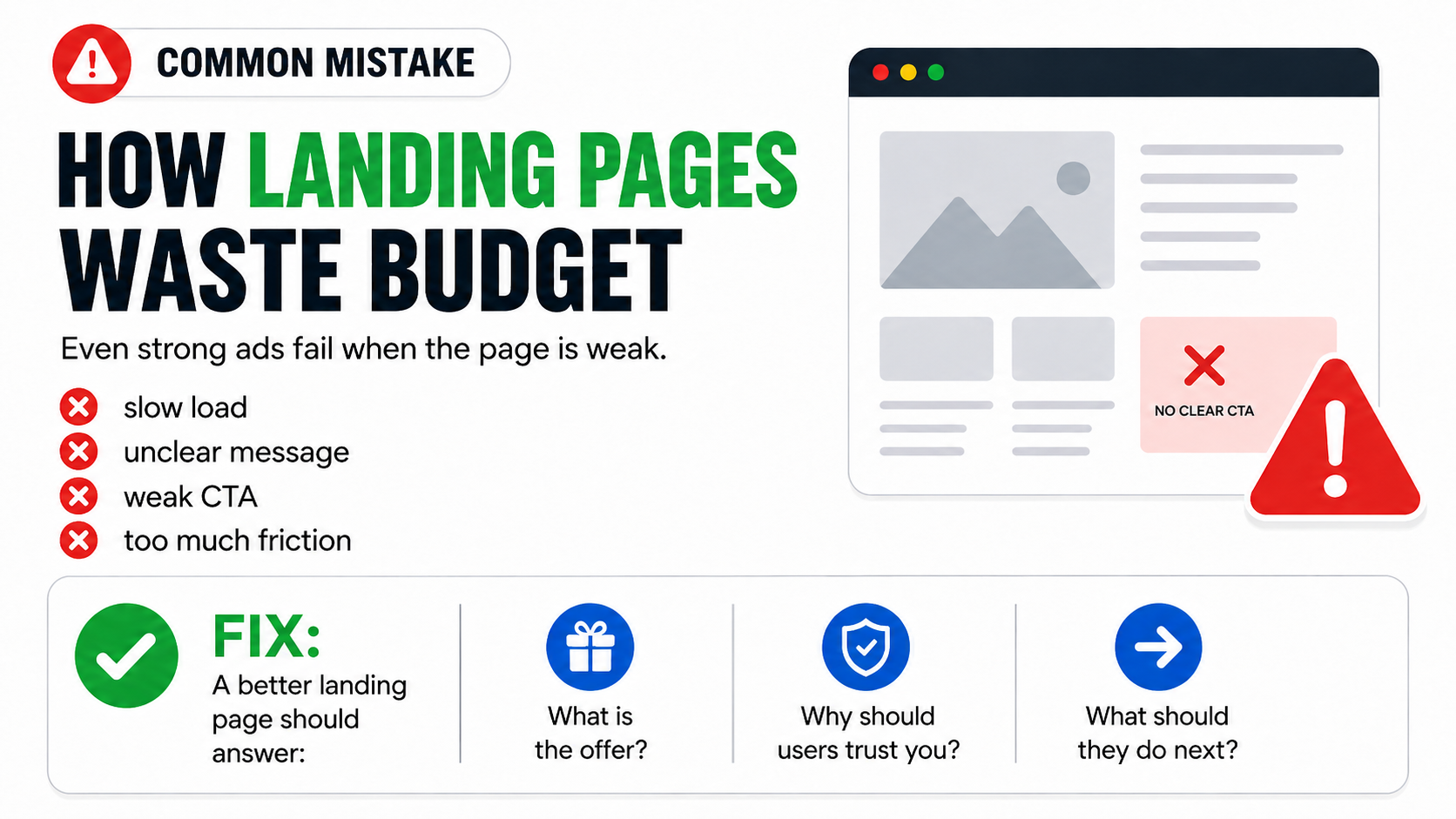
Money spent on landing pages is wasted when clicks do not turn into actions. A business may invest well in targeting and ad copy, but if the visitor lands on a page that feels unclear, too forceful, too weak, or irrelevant, those efforts may be lost. The landing page is where the message of the ad is tested. If the page fails to do its job, the whole funnel starts to break down.
- The Message Does Not Match The Ad: One of the major issues is that the landing page feels different from the ad that brings visitors to the site. The landing page should continue the same message promised in the advertisement, such as transparent pricing or a free consultation. When that does not happen, visitors often leave.
- The Page Asks For Too Much Too Soon: Some websites waste their budget by asking users to take a big step straight away. People who visit the site for the first time usually need clear information, trust, and context before they are ready to act. If that is missing, the click is often wasted.
- The Offer Is Unclear: A landing page should quickly explain what is being offered, who it is for, and why it matters. When this is vague or buried under design elements, the visitor may not understand the value. Paid traffic is expensive, so confusion becomes costly very quickly.
- The Design Creates Friction: Slow speed, weak mobile layout, cluttered sections, poor button placement, or long forms can all damage conversion chances. A user who was interested enough to click may still leave if the page feels difficult to use. Friction wastes budget because it blocks motivated people at the point of action.
- Trust Signals are Missing: Many visitors need reassurance before moving ahead. Reviews, credentials, guarantees, clear contact details, secure checkout signs, or proof elements can all support trust. When those are missing, hesitation increases, and the page becomes less effective.
Landing pages waste budget when they break the connection between the ad and the next step. A strong page should continue the message, match user intent, reduce friction, and make the path forward obvious. In paid advertising, even good traffic can underperform when the landing experience is weak.
Why Targeting and Intent Must Align?
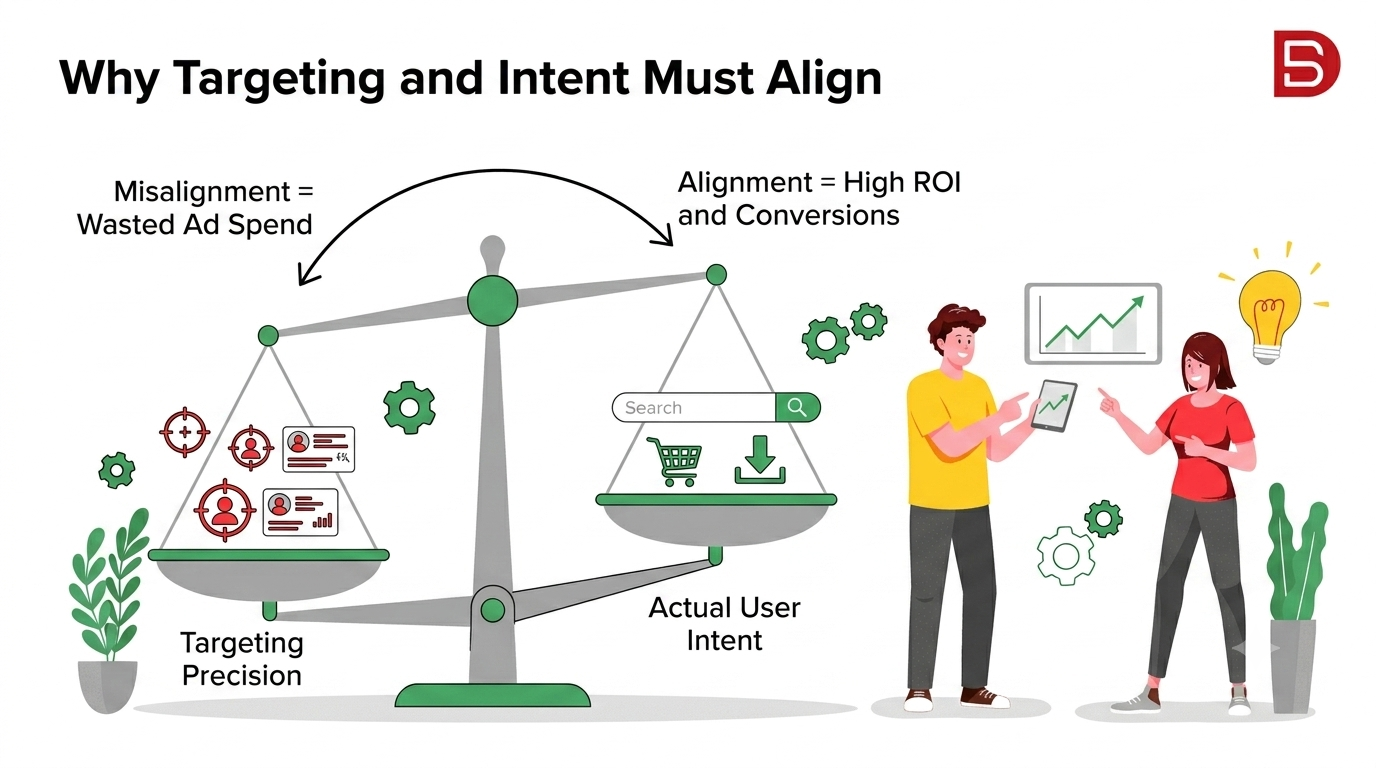
Targeting and intent must align because successful PPC is not only about reaching people, but reaching the right people at the right point in their decision-making journey. A campaign can generate many impressions and clicks, yet still perform poorly if the audience does not match the purpose of the offer. When targeting ignores intent, the funnel fills with users who are curious, distracted, or simply not ready. This makes the results weaker and makes the budget harder to control.
- Clicks Alone Do Not Mean Quality: A person may click because the ad caught their attention, but that does not always mean they are a good fit. Intent shows why the person is searching, browsing, or engaging. When targeting focuses only on volume, it often attracts traffic that has low commercial value.
- The Wrong Audience Creates the Wrong Journey: If low-intent users are pushed into high-intent offers, they usually leave. In the same way, highly ready users may be slowed down by messages meant for early-stage education. Alignment matters because each user needs a path that matches what they are ready for.
- Message Relevance Depends On Intent: Ad copy works best when it reflects the reason behind the click. Someone comparing options may respond to proof and benefits, while someone searching broadly may respond better to explanation or problem-solving. Good targeting helps deliver the right message to the right kind of visitor.
- Lead Quality Improves with Better Alignment: Many businesses complain about lead quality when the real issue is weak intent matching. Broad targeting may create leads, but those leads may be unqualified or unlikely to move forward. Better alignment usually improves both conversion quality and sales conversations.
- Budget Becomes Easier to Control: When targeting and intent match properly, performance data becomes more meaningful. Businesses can see which audiences respond to which offer and can allocate spend more confidently. Without this alignment, optimization decisions are based on mixed and often misleading signals.
Example: A clinic offering a specialist procedure may target a wide health audience and run ads that push appointment bookings immediately. Many users may click out of curiosity, but only a small number have the need or readiness to book. Better alignment would separate educational traffic from high-intent treatment searches.
Targeting and intent must align because the funnel works best when the people entering it actually fit the purpose of the campaign. Good alignment improves message relevance, lead quality, budget efficiency, and decision-making. In simple terms, it is not enough to attract attention. The attention must come from users whose intent matches what the campaign is asking them to do.
How Budget Gets Wasted?
Budget gets wasted when paid campaigns attract attention but fail to move users through a useful path. In many cases, the money is not lost because of one major mistake. It is lost through a series of smaller mismatches involving keywords, targeting, offers, and follow-up. A campaign may look active on the surface, but if the clicks are weak, the message is off, or the next step feels wrong, the spend starts leaking at every stage.
- Irrelevant Clicks Enter The Funnel: The budget often gets wasted when ads appear for searches or audiences that are too broad. These clicks may increase traffic numbers, but they do not always bring buyers or suitable leads. Without tighter control, spend goes toward users who were never likely to convert.
- The Wrong Offer Is Shown Too Early: Another common issue is pushing cold users toward a direct sale or lead action before they are ready. When they ask is too strong for the stage, visitors leave. The spend is real, but the journey ends too quickly to create value.
- Poor Landing Pages Break Momentum: Even when the click is relevant, the landing page may waste the opportunity. Weak structure, unclear information, poor mobile design, or lack of trust signals can stop users from taking the next step. Budget gets wasted when interested traffic lands on an underperforming page.
- Tracking is Incomplete or Misleading: Some businesses waste budget simply because they cannot see what is really happening. If conversion tracking is missing or inaccurate, teams may continue funding campaigns that looks good on paper but produce little commercial return. Bad data often leads to bad decisions.
- Remarketing Opportunities Are Ignored: Many users leave without converting on the first visit. If there is no remarketing support, the original spend may never get a second chance to perform. Budget is often wasted not only on bad traffic, but also on abandoned interests that are never followed up on properly.
For service-based businesses, this happens quite often. A consultancy may run ads to cold audiences and send everyone straight to a consultation booking page. But not every visitor is ready for that step. Some may want to read a case study, understand the service better, or build a little trust first. When that middle step is missing, the budget often gets spent on people who are not ready to move forward yet.
The budget gets wasted when attention is treated as a sign of success instead of being guided toward real business results. Budget leakage happens because of poor intent targeting, weak landing pages, limited tracking, and poor follow-up. Better performance usually comes from improving the conversion path, not simply increasing the traffic going through it.
Conclusion
PPC budget is rarely wasted for one obvious reason alone. For most businesses, money gets wasted because the different parts of the journey do not work well together. It is possible to get clicks and leads, but without clear stage logic, hidden inefficiencies usually remain underneath.
A better PPC Funnel Strategy ensures that paid marketing channels perform with purpose. This strategy enables better targeting, stronger landing page alignment, clearer measurement, more effective remarketing, and better decisions throughout the process. With the right PPC Funnel Strategy in place, businesses have better control over their budget, leads, and conversions.
Reach out to eSign Web Services for a focused marketing review and strategy built to solve hidden issues and improve real business performance.
Frequently Asked Questions
Question: What Does PPC Funnel Mean?
Answer: The PPC funnel is simply the sequence that the user goes through after noticing and clicking on a paid advertisement. This process is made up of three steps known as awareness, consideration, and decision. Each step calls for different messaging, offers, and a landing page. With a proper PPC funnel, marketers will be able to learn the point at which users become disinterested, what motivates the user to take the next step, and how paid advertising helps them achieve their business objectives.
Question: Why do PPC budgets get wasted so easily?
Answer: Budgets for PPC advertising are easily wasted if campaigns concentrate on clicks while neglecting to manage the customer journey post-click. Lack of relevance in keyword selection, poor quality of landing pages, generalization in targeting criteria, inadequate exclusion of users, and ambiguity of further actions all lead to budget wastage. In addition, the budget may be wasted if companies apply one metric of success to all campaigns despite the fact that different stages of funnels require their own approaches.
Question: How does PPC Funnel Strategy improve campaign results?
Answer: The PPC Funnel Strategy enhances the outcome by structuring the campaigns according to the buyer’s intention and readiness to buy. Rather than directing all the users to the same offer, this strategy matches the ads, pages, and call to actions to different stages of the funnel. In doing so, the process becomes smoother and allows the measurement of where spending is beneficial and where it isn’t. It also helps businesses improve lead quality and make better decisions with their budget.
Question: What is the difference between a funnel strategy and a campaign setup?
Answer: The setup phase concentrates on the technical aspects of the paid media campaigns, including keywords, bidding, audiences, budgets, and advertising itself. The funnel approach is more comprehensive and analyzes the entire journey from the initial click through to the end conversion. In this approach, decisions are made about what each individual campaign will do, what pages users will visit, what will happen next, and how performance will be measured. This helps campaigns support the full customer journey instead of focusing only on isolated actions.
Question: Can remarketing reduce wasted ad spend?
Answer: Certainly, it is possible to use remarketing to decrease the amount of wasted money on advertising, provided that the process is well thought out. Remarketing enables advertisers to interact with the audience who was interested, which is usually cheaper than always having to pay for fresh traffic. Still, remarketing is effective only when the segmentation of the audience and messages is correct. It can also improve conversion chances by keeping the brand visible during the decision-making stage.
Question: How does targeting affect funnel performance?
Answer: This is because targeting plays a key role in who enters the sales funnel process in the first place. Poor targeting will mean that your sales funnel contains individuals who lack the intention of buying. Effective targeting enhances the quality of messages conveyed, leads generation, and sales process efficiency. It also makes it possible for marketers to make better offers for each of the different steps in the journey. This means that data becomes more effective because it is collected from those who are most likely to take action. This means the data becomes more useful because it comes from people who are more likely to take action.
Question: Is Google Ads enough to fix PPC inefficiency?
Answer: There are many powerful tools in Google Ads, yet the platform itself does not resolve the issue of funnel inefficiency. A company may have perfectly set up campaigns, but it can fail in budget allocation due to poor offers, weak landing pages, bad tracking, and ineffective follow-ups on sales. All these aspects can be optimized using the platform, but the process goes much faster when the entire paid funnel is checked and arranged right from the start. This gives the business a clearer path from the first click to the final conversion.
Question: When should a business review its PPC funnel?
Answer: An organization should audit its PPC funnel when the budget has increased, there is poor quality of conversions, the sales team is getting low-quality leads or inconsistency in performance across different campaigns. Auditing helps in identifying any inefficiency in the funnel and ensures that the paid marketing campaign remains in line with consumer behavior changes and business objectives. It also becomes easy for marketers to understand where the slowdown in performance has occurred.
Author Details

Ashwani Kumar Sharma
Ashwani has been actively involved in SEO services since 2005. His expertise and distinctive work approaches have made him one of the most experienced and trusted SEO experts in the industry. He is a certified SEO and Google Ads professional. He also has strong business development skills in advanced SEO, PPC, and digital marketing strategies.


