


How to Build Topical Authority for Google Search and AI Search Together

Key Takeaways
- Topical authority requires depth, relevance, clear relationships, expertise, and credibility around a defined subject—not dozens of loosely related articles.
- Google Search and AI search differ, but both create opportunities for useful content that demonstrates relevant knowledge.
- Select topics according to commercial relevance, customer needs, and genuine expertise rather than search volume alone.
- A topical map should cover important concepts, customer questions, problems, comparisons, and decision-stage information.
- Connect supporting content with relevant pillar, service, product, or commercial pages.
- Content quality and distinct purpose matter more than publishing volume.
- Original research, expert observations, case studies, and first-hand experience give readers information beyond existing summaries.
- Internal links help readers and search systems discover pages and understand their relationships.
- E-E-A-T and accurate authorship information help readers assess credibility; E-E-A-T itself is not a specific Google ranking factor.
A business can publish regularly and still struggle to become a useful source on its main subject. The problem is often scattered coverage: introductory articles repeat familiar advice, important customer questions remain unanswered, and related pages barely connect. A stronger approach develops knowledge around the services, products, and decisions the business genuinely understands. That work helps visitors find explanations, compare options, and judge whether the company has relevant expertise.
In this blog, we will explain how to build topical authority for Google Search and AI search through a practical ten-step process. You will learn how to choose topics, create a topical map, organise content clusters, add original evidence, strengthen internal links, and measure results. We will also explain the differences between organic rankings and AI citations, why publishing volume alone proves little, and how to improve existing content without creating another library of overlapping pages that customers struggle to navigate.
What Is Topical Authority?
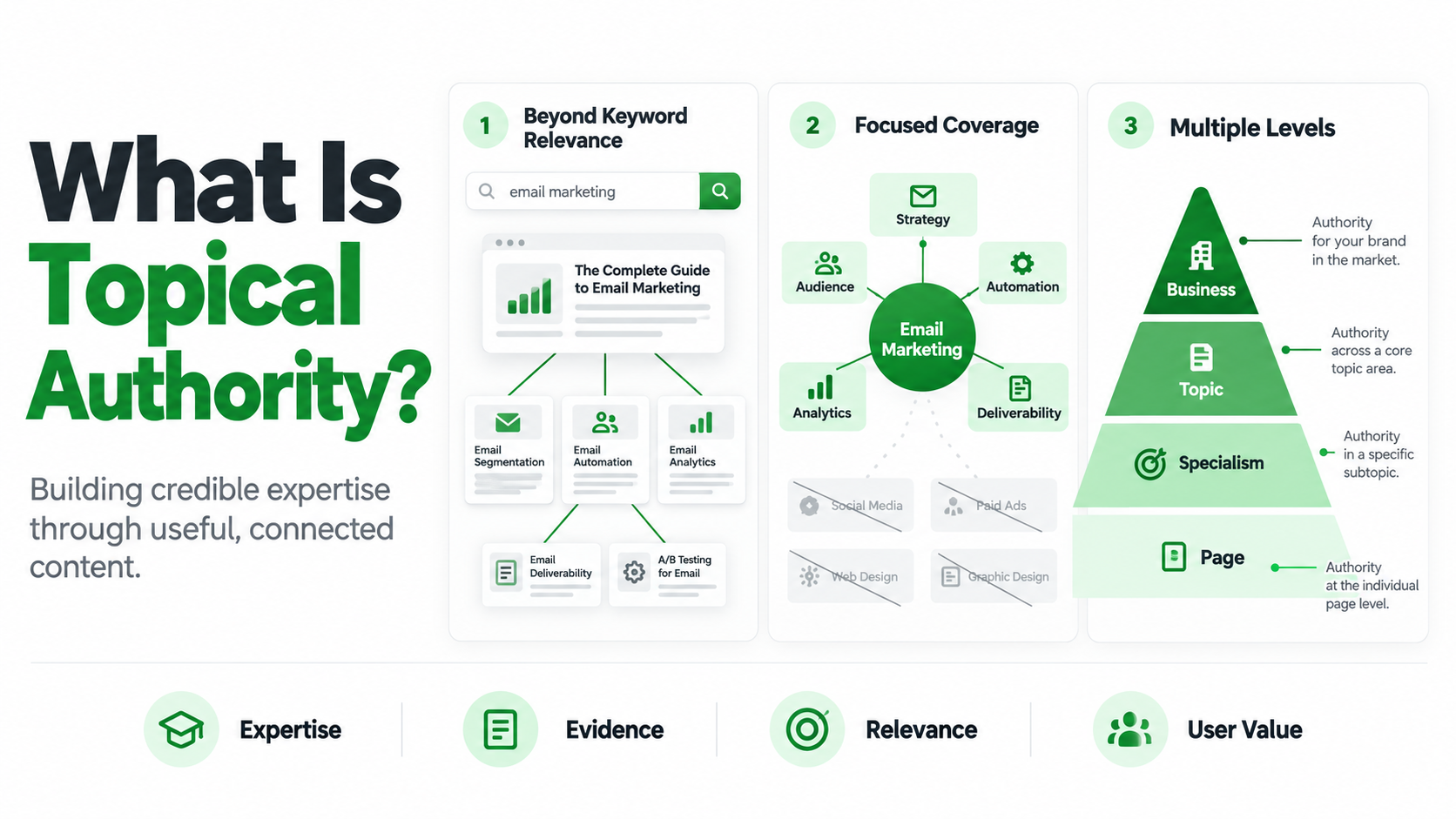
Topical authority describes credible, useful expertise around a particular subject. A business demonstrates it through accurate information, practical understanding, relevant evidence, and a body of content that answers meaningful customer questions. In this article, topical authority SEO refers to that strategic approach, not a publicly available Google score. Google has described a topic authority system for news-related queries, but that system should not be treated as a universal authority formula for every business website.
Topical Authority Is Broader Than Keyword Relevance
A page can mention the right terminology without explaining the subject well. An article about technical SEO might list crawling, indexing, and canonical tags but leave readers unable to diagnose a problem. Broader expertise becomes clearer when related pages explain the concepts, their relationships, practical applications, and limitations. Each page should still satisfy its own purpose. A well-organised website cannot compensate for an individual article that fails to answer its main question.
Topical Authority Is Not About Covering Everything
Comprehensive coverage means addressing important needs within a sensible scope. It does not require writing about every subject remotely connected to your industry. An accounting practice serving small businesses may need strong resources on bookkeeping, reporting, payroll, and choosing support. It does not automatically need articles about international investment banking. Select subjects that connect your expertise with the customers you serve.
Topical Authority Exists at Multiple Levels
Review authority at several levels: the business’s reputation, its knowledge of a broad topic, its depth within a specialism, and the usefulness of an individual page. For example, an agency may offer several marketing services while demonstrating particularly detailed expertise in local SEO. Its reputation across marketing does not prove equal expertise in every specialism. These levels are a planning model, rather than separate scores Google publishes.
Why Topical Authority Matters for Both Google and AI Search
Google results and AI-generated answers present information differently. The overlap lies in providing relevant, accessible, useful material that people can understand and evaluate.
Google Needs to Understand Relevance and Expertise
Clear pages, logical navigation, and accurate explanations help establish what information your website provides. Google’s ranking systems guidance explains that ranking operates at page level while also using site-wide signals. Stronger site-wide signals do not guarantee that every page will rank highly.
Treat topical authority for Google as a content and credibility strategy. Improve both the individual answer and the surrounding resources that help readers explore the subject.
AI Search Needs Useful Information to Retrieve and Synthesize
When an AI experience searches the web, it may retrieve several sources to develop an answer. Your content can be useful when it explains a relevant issue clearly and supports important claims.
Google’s generative AI search guidance describes retrieval and related-query exploration within its Search experiences. Other platforms have their own processes. Developing topical authority for AI search creates useful source material without guaranteeing retrieval, citation, or recommendation.
Authority Extends Beyond Individual URLs
A business should consider both page performance and how people investigate its expertise. Customers may consult articles, service descriptions, author profiles, case studies, and independent references before deciding whether to trust the company.
Aim to become a useful source on the subject rather than relying on one successful article. However, a citation supporting an explanation is different from an endorsement of your services. Measure those appearances separately.
How to Build Topical Authority for Google and AI Search: A 10-Step Process
The following framework connects topic planning with content quality, website structure, credibility, and measurement. Begin with one important subject, audit what already exists, and expand where customer needs justify the work.
STEP 1: Choose Topics Your Business Has a Right to Own
Choose topics your team can explain responsibly and support with real knowledge. You cannot claim ownership of a subject, but you can earn recognition by making a useful contribution.
Start With Core Products and Services
Identify the subjects connected to your actual offer. For eSign Web Services, relevant areas include SEO, Google Ads, web design, social media marketing, and content marketing. Within each area, prioritise questions the team encounters through real work. An agency offering SEO audits can explain audit scope, common findings, implementation priorities, and measurement. Those subjects connect directly with expertise and commercial services.
Consider Customer Relevance
Look at enquiries, sales discussions, support requests, and objections. These reveal needs that a list of popular topics may miss.
Useful planning questions include:
- What problem brings customers to the business?
- What must they understand before comparing solutions?
- Which concerns delay a purchase?
- What information helps establish suitability?
- What questions arise during implementation?
- What support do customers need afterwards?
Use these answers to prioritise work. A frequently misunderstood requirement may deserve attention before a broader topic with greater traffic potential.
Define Clear Topical Boundaries
Set boundaries around the audience, service, circumstances, and expertise your content will address. A practical SEO topical authority strategy needs these limits to prevent the publication from becoming unfocused. For example, “SEO for local service businesses” is more manageable than “everything about digital marketing.” Broaden the scope when the business has relevant expertise and a clear customer reason—not simply because another subject attracts attention.
STEP 2: Build a Topical Map before Creating More Content
A topical map organises the subject into meaningful concepts, questions, and page purposes. It helps identify missing coverage and existing material before another article is commissioned.
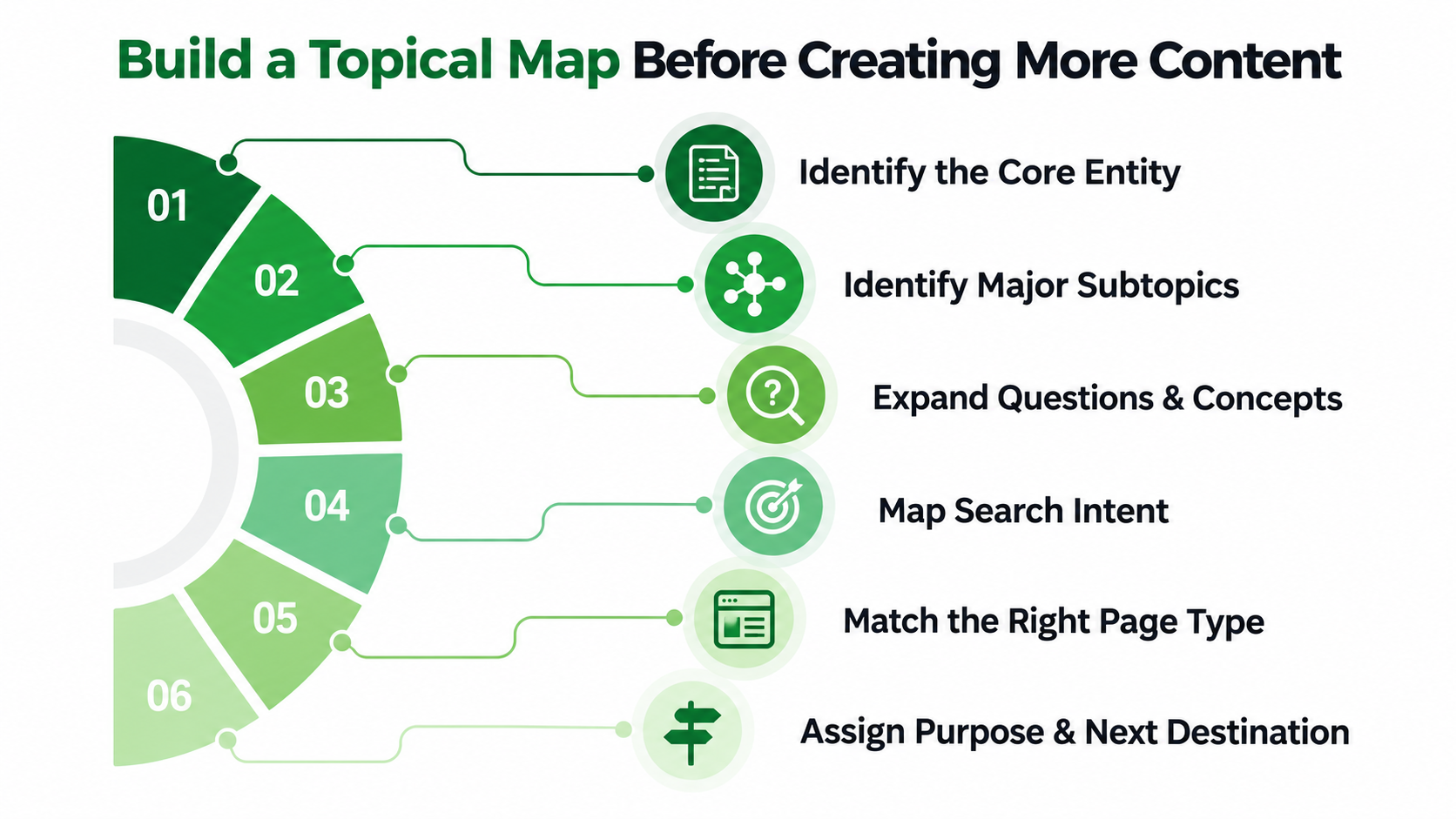
Identify the Core Entity
Start with the main subject: SEO, commercial heat pump installation, outsourced bookkeeping, or another area linked to your offer. Define the audience and scope alongside it. “SEO” alone is broad. “SEO audits for small ecommerce businesses” identifies a more specific set of technical, commercial, and customer requirements. Clear scope makes later content decisions easier.
Identify Major Subtopics
Divide the subject into areas that customers need to understand. For SEO, these might include technical access, on-page content, local visibility, links, measurement, and AI discovery. These divisions do not all require separate hub pages immediately. First determine whether each area has sufficient distinct content and customer demand. A topical map is a working plan, not a requirement to publish every planned URL.
Expand Into Relevant Questions and Concepts
Under technical SEO, explore crawling, indexing, rendering, canonicalization, sitemaps, robots directives, and structured data. Then identify practical questions about each concept. For example, customers may need to understand why a page is excluded from indexing, how to investigate it, and when exclusion is intentional. A useful topical map SEO workflow connects the concept with the problem and decision it helps resolve.
Map Search Intent
Match each need with the appropriate page type. Someone learning what an audit includes needs a different explanation from someone requesting an audit proposal.
| Customer Need | Suitable Content | Purpose |
| Understand an SEO audit | Overview or guide | Explain scope and terminology. |
| Investigate an indexing problem | Troubleshooting resource | Support diagnosis and next steps. |
| Compare audit options | Comparison page | Explain trade-offs and suitability. |
| Choose a provider | Service page | Establish the offer and process. |
| Implement recommendations | Checklist or support guide | Help customers act on findings. |
Assign each planned page an audience, purpose, evidence requirement, and useful next destination. Related wording alone does not justify another page.
STEP 3: Organize Topics into Pillars and Content Clusters
Turn the map into a website structure that visitors can navigate. Effective topic clusters SEO depends on distinct page purposes and useful connections, rather than a rigid hub-and-spoke template.
Create Strong Pillar or Hub Pages
A pillar page introduces a major topic and helps readers find deeper explanations. It should provide enough context to be useful on its own. A technical SEO hub might explain the main areas of an audit and link to detailed resources. It does not need to reproduce every troubleshooting guide. A service page can sometimes serve as the hub when its purpose and audience make that appropriate.
Build Supporting Content
Supporting pages explore questions that require their own depth. They might address a process, problem, comparison, use case, or research finding. Give each page a clear responsibility. One article could explain canonical tags, while another investigates conflicting canonical signals. These content clusters work when the pages contribute different information. They become repetitive when every article simply restates the same introductory advice.
Connect Content to Commercial Pages
Link educational material with relevant offers when doing so helps the reader. Someone who understands an audit problem may then want to know what professional support includes. The journey does not have to follow one fixed sequence. A troubleshooting article may link directly to a service page, while a comparison may point to a detailed guide. Make the next step relevant and explain why it is useful.
STEP 4: Cover the Topic across the Complete Customer Journey
Genuine depth includes the questions people ask before, during, and after choosing a solution. Publishing many introductory articles leaves important decisions unsupported.
Awareness Questions
Explain the basics without assuming prior knowledge. Define the subject, why it matters, and where it applies. For an SEO audit, an awareness page could distinguish an audit from ongoing optimisation. Keep the explanation useful without forcing a sales pitch into every paragraph. The reader may still be deciding whether the service addresses their problem.
Problem and Solution Questions
Help readers investigate difficulties rather than promising one universal fix. Explain likely causes, the evidence needed, and appropriate next steps. An article about falling organic traffic should distinguish changes in demand, visibility, click behaviour, and tracking. This demonstrates more understanding than presenting every decline as a ranking problem.
Evaluation Questions
Explain alternatives, costs, advantages, limitations, and suitability. Comparisons should evaluate the same relevant criteria across options. For example, compare a one-off audit with ongoing support through scope, implementation responsibility, maintenance, and reporting. Disclose your commercial involvement and avoid selecting criteria solely to make your offer appear superior.
Decision Questions
Address the practical information someone needs before committing. This may include deliverables, responsibilities, pricing conditions, communication, and what happens after engagement. A decision-stage service page should make the offer clear. Visitors should not have to piece together several blog posts to determine whether implementation is included or whether the service suits their website.
Implementation and Post-Purchase Questions
Explain how to use the solution and judge whether it is working. Provide handover guidance, maintenance advice, and answers to recurring support questions. For an audit service, customers may need help prioritising findings or coordinating developers and content teams. Supporting those tasks demonstrates knowledge beyond acquisition and makes the information useful throughout the relationship.
STEP 5: Create Content with Information Gain
Information gain is a practical editorial question: what does your page add beyond existing explanations? It should not be presented as a universal, publicly measurable ranking factor.
Don’t Simply Rewrite Existing SERPs
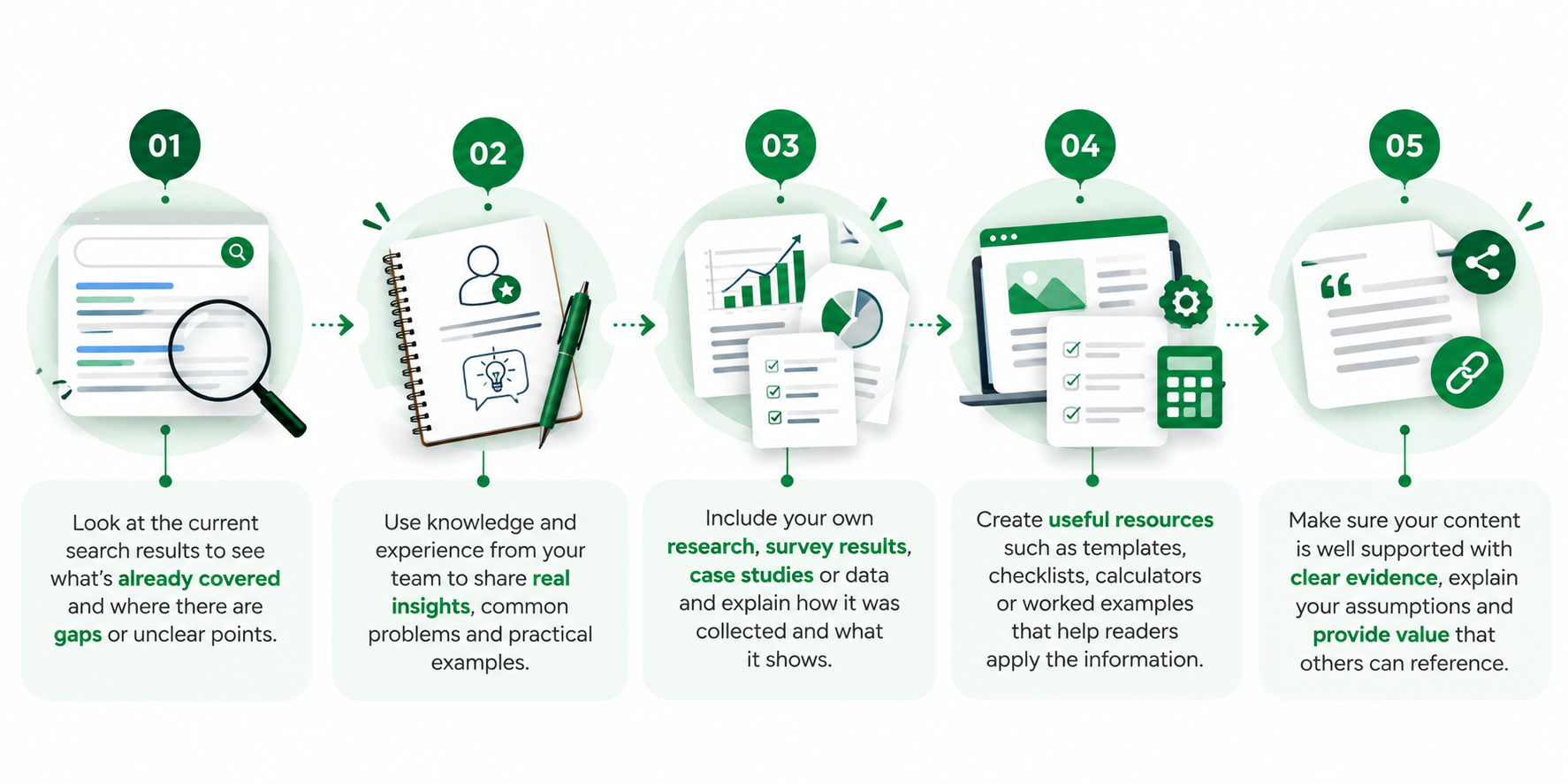
Review existing results to understand the audience’s needs, then identify what remains unclear. Another article with the same headings and examples may add little. Look for missing conditions, weak explanations, conflicting advice, or decisions that existing resources do not address. Original value can come from a clearer method or a better example; it does not always require a major research project.
Add First-Hand Expertise
Ask the people doing the work to explain recurring problems, useful observations, and important exceptions. Turn that knowledge into material readers can apply. An SEO specialist might describe how they distinguish a tracking issue from a genuine traffic decline. Present this as a documented approach, with its limitations. Do not invent client experience or imply that one observation represents an entire industry.
Produce Original Information
Choose a form of evidence your business can collect and explain responsibly. Suitable options include:
- Research with a clearly defined sample and method.
- Customer surveys that disclose who participated.
- Anonymised operational data with appropriate permissions.
- Case studies describing the starting point and work completed.
- Experiments that state their conditions and limitations.
- Expert interviews or tools based on documented assumptions.
Publish the collection period, definitions, exclusions, and relevant limitations. A small, transparent study is more credible than a sweeping conclusion supported by an unexplained dataset.
Build Citation-Worthy Assets
Create something another person has a reason to reference: a useful template, original finding, worked example, checklist, or calculator. A calculator should explain its assumptions and avoid false precision. A benchmark needs scope and definitions. A case study should distinguish observed improvement from proof that a particular change caused it. Citation potential follows usefulness and evidence; it cannot be guaranteed by formatting alone.
STEP 6: Strengthen Entity and Semantic Relationships
Semantic SEO focuses on meaning and context. Entity clarity helps establish which people, organisations, products, systems, or concepts the page discusses.
Identify Important Entities within Each Topic
Include concepts because they are necessary to explain the subject, not to complete a terminology checklist. An indexing guide may need to discuss Googlebot, robots directives, canonical URLs, and Google Search Console. Define unfamiliar terms where they appear. Listing them without explanation does little to improve understanding or topical relevance.
Explain Relationships between Concepts
Explain what one concept means for another. Crawling, rendering, indexing, and serving results are related activities, but they are not interchangeable or guaranteed steps for every page. A useful troubleshooting guide might show why allowing crawling does not guarantee indexing. Relationships make the explanation actionable because readers can understand which evidence to check and where a problem may occur.
Maintain Brand-Topic Relationships
Clearly connect the business with its services, experts, industries, and relevant work. Your About page, author profiles, service descriptions, and case studies should agree about those relationships. A consultant’s experience should be connected accurately with their current role. A partner’s project should not be presented as your own. Entity-based SEO and brand relationships offer a useful way to review this consistency.
Use Structured Data Where Appropriate
Use relevant schema to describe information already visible on the page. Article, Person, Organization, Product, or other types may be appropriate according to the content and intended Search feature. Do not invent credentials, affiliations, or reviews in markup. Structured data does not guarantee rankings, AI citations, or Knowledge Graph inclusion. Clear content and accurate relationships remain necessary whether markup is present or not.
STEP 7: Build a Strong Internal Linking Architecture
Internal links help visitors discover related information and understand where to go next. They also provide pathways through which Google can discover pages.
Link Supporting Content to Pillar Pages
Link a detailed resource to its broader hub when the hub provides useful context. The hub should also lead visitors to relevant supporting resources. An article about sitemap problems could link to a technical SEO overview for readers unfamiliar with the wider subject. The link should explain the relationship rather than merely repeat a commercial anchor in every article.
Link Laterally Between Related Content
Connect supporting pages when one resolves a likely follow-up question. A canonicalisation article may link to a redirect explanation where the distinction matters. Avoid connecting every page with every other page in the cluster. Readers benefit from selected relationships, not an overwhelming collection of links with little explanation.
Use Descriptive Anchor Text
Anchor text should tell readers what they will find. Google’s link best practices recommend meaningful link context and accessible internal connections. Use natural descriptions such as “investigating indexing exclusions” rather than generic instructions. Do not force a repeated exact-match anchor into every sentence. The wording should fit the surrounding explanation.
Prevent Orphan Content
An orphan page has no discoverable internal connection from the rest of the site. Review whether important resources can be reached through relevant hubs, navigation, or contextual links. A sitemap does not replace a useful visitor pathway. Check links after redesigns, content consolidation, or navigation changes. Important pages should remain part of the website’s structure rather than existing only as isolated URLs.
STEP 8: Demonstrate EEAT and Real Expertise
Experience, expertise, authoritativeness, and trustworthiness provide a framework for reviewing credibility. Google’s helpful content guidance clarifies that E-E-A-T itself is not a specific ranking factor.
Show Who Created the Content
Identify authors where readers would reasonably expect that information. Explain relevant experience and qualifications instead of adding a generic biography. A technical guide might identify the person who developed or reviewed the process. Authorship information should be accurate and useful. A name and portrait do not establish expertise without supporting context.
Use Expert Review for Sensitive Topics
Obtain appropriate specialist input for consequential subjects such as healthcare, finance, legal matters, and insurance. Review should cover substantive claims, applicable circumstances, and limitations—not simply attach a reviewer’s name. Where information depends on a jurisdiction or individual situation, make that boundary clear and maintain it as circumstances change.
Support Important Claims
Use primary documentation, authoritative research, or well-explained original evidence where a claim requires support. A source should establish the claim it accompanies. A provider document describing a feature does not prove that using it guarantees improved rankings. Separate factual statements, professional recommendations, and hypotheses so readers can judge each appropriately.
Demonstrate Experience
Use relevant project examples, methods, observations, and results. Explain the starting situation, work completed, and what was learned. Screenshots can document a point in time, but should include enough context to be meaningful. A ranking screenshot without the query, location, and date provides limited evidence. Protect customer information and avoid presenting isolated success as a typical outcome.
STEP 9: Build Topical Authority beyond Your Website
Your publication should not be the only source describing your expertise. Relevant external references can help customers discover and investigate the business.
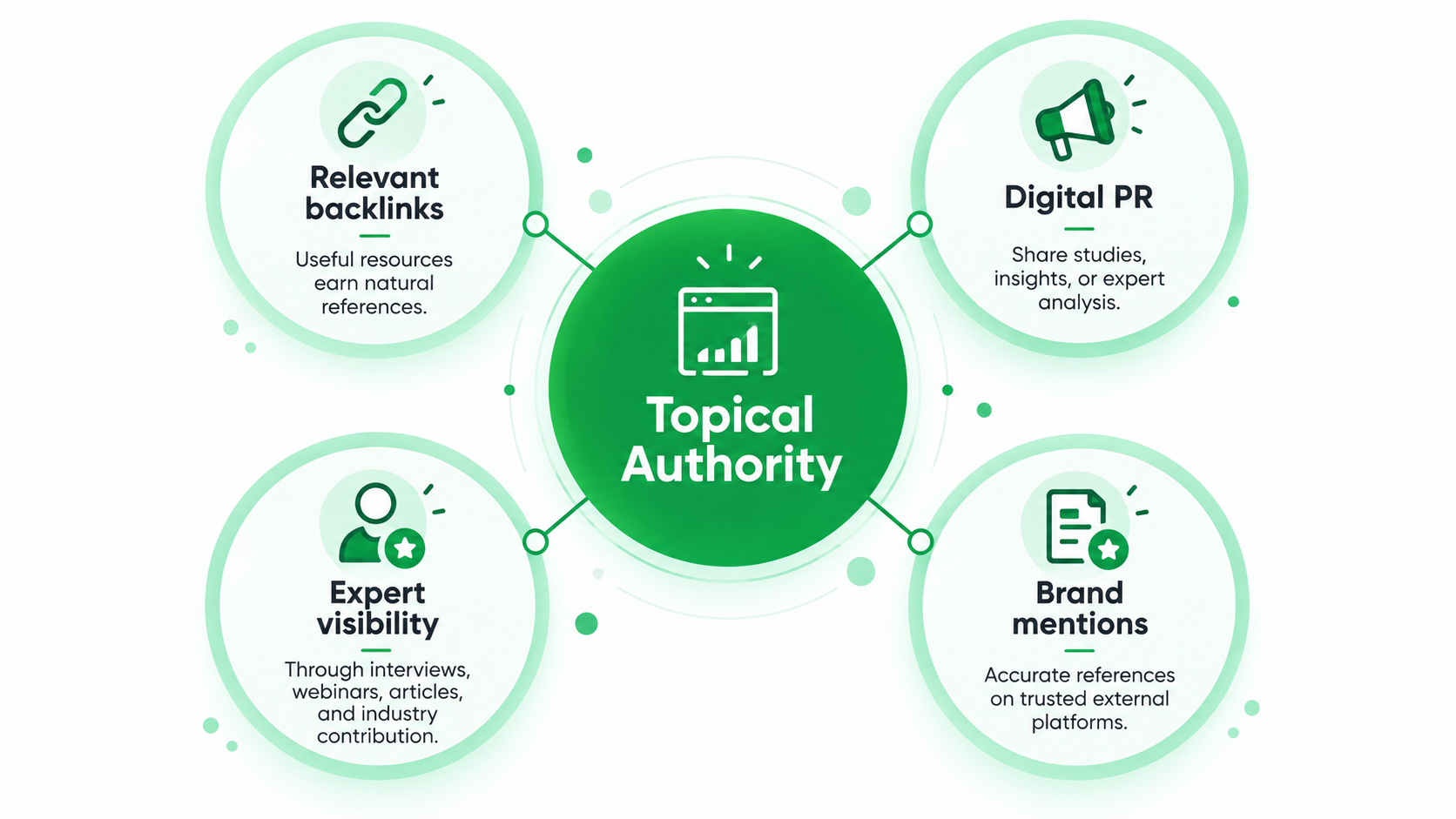
Earn Topically Relevant Backlinks
Create resources others have a legitimate reason to reference. A useful industry explanation, research finding, or practical tool may attract relevant editorial links. Evaluate context and audience rather than a metric alone. An industry link can support discovery without guaranteeing a ranking improvement. Unrelated links obtained purely to inflate a score provide little evidence of subject expertise.
Build Digital PR Around Expertise
Offer publishers something substantive: a transparent study, timely expert analysis, or a useful explanation of an industry problem. Prepare supporting information so findings can be checked. Disclose methods, commercial interests, and limitations. A routine promotional announcement should not be presented as independent recognition of expertise.
Strengthen Expert and Founder Authority
Choose interviews, articles, webinars, or professional events where the expert can make a useful contribution. Their public profile should reflect actual knowledge and responsibilities. Connect relevant contributions with company information where appropriate, but do not assume that founder publicity establishes expertise for every service the business offers.
Build Independent Brand Mentions
Look for accurate, relevant references that connect the business with its core work. These might include professional listings, industry reporting, or discussion of a genuine project. A mention is not necessarily an endorsement. Its value depends on the source and what it establishes. For AI search visibility, independent references provide information that may be available to systems; they are not universally confirmed ranking signals.
STEP 10: Measure, Consolidate and Improve Your Topical Authority
Measurement should show whether the content helps the intended audience and contributes to the business. There is no universal authority score that replaces this assessment.
Measure Topic-Level Performance
Group relevant pages into clusters for reporting. Review Google impressions, clicks, useful customer actions, and commercial contributions alongside individual page performance. Separate branded from non-branded discovery where possible. A cluster’s increased traffic may come from an unrelated query and provide little value. Interpreting GA4 acquisition and engagement reports can help connect visits with meaningful actions.
Monitor AI Search Visibility
Use representative questions related to the subject. Record the platform, mode, question, date, context, cited pages, appearance type, and accuracy. Keep fresh conversations separate from tests containing prior information. For Google, its Generative AI performance report reports link impressions from supported Search features, including AI Overviews and AI Mode. It does not measure every brand mentioned across assistants.
Identify Content Gaps
Look for missing explanations that affect customer decisions. A gap may concern suitability, cost conditions, implementation, or an important exception—not simply an unused query variation. Compare your topical map with enquiries and existing content. Prioritise gaps that your team can answer credibly and that matter commercially. A gap in your publication does not automatically justify entering an unfamiliar subject.
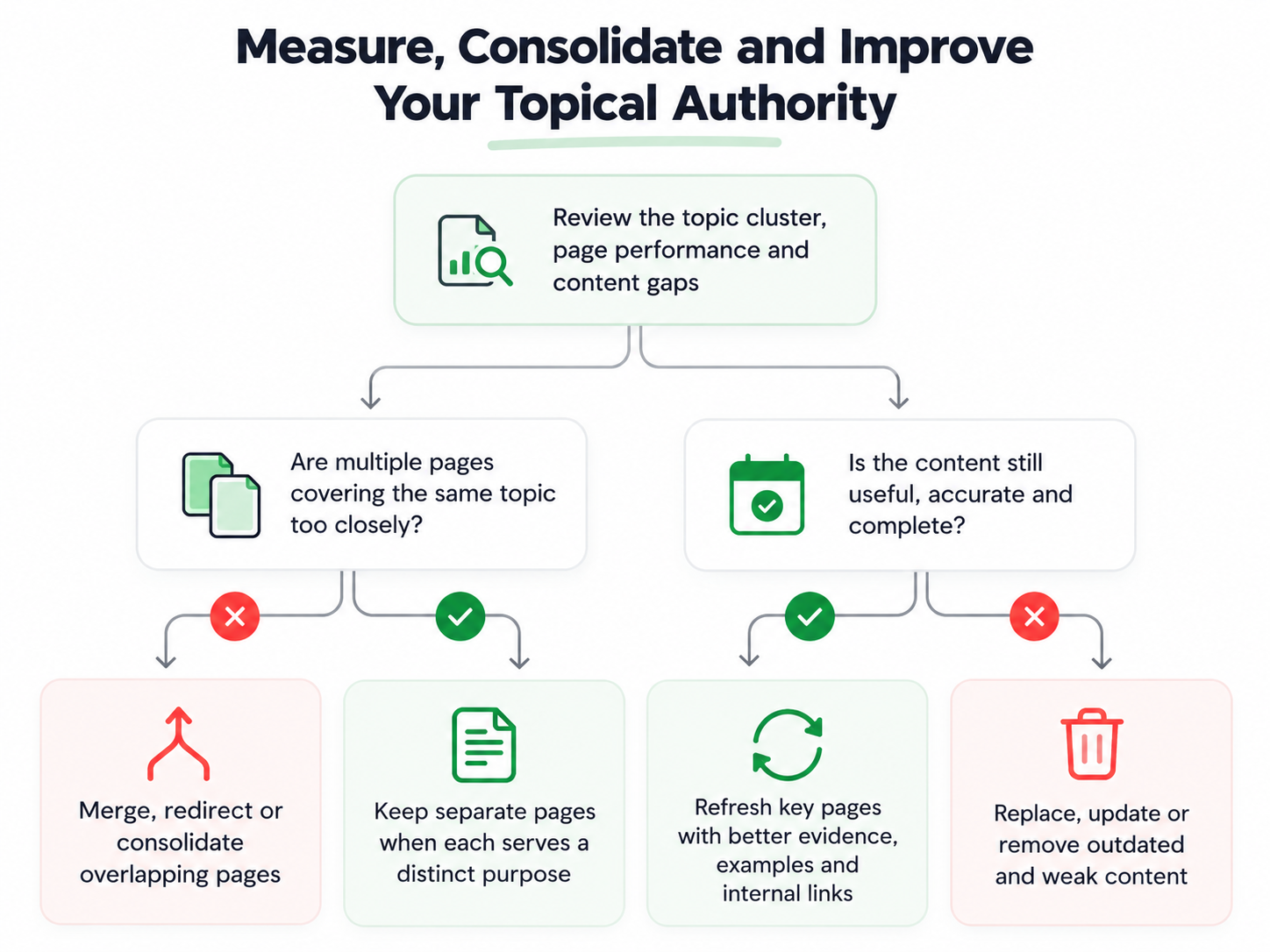
Consolidate Overlapping Content
Review pages that address nearly identical purposes. Preserve distinct resources when they serve different audiences or decisions, even if some terminology overlaps. Where consolidation is appropriate, retain useful material in the stronger page, implement a relevant redirect from a retired URL, and update internal links. Do not redirect unrelated pages to a broad hub simply to keep every URL active.
Update High-Value Existing Content
Review changing information, weak explanations, missing examples, and outdated references. Improve the substance rather than changing a publication date to imply freshness. Use a simple decision framework:
| Existing Page Condition | Appropriate Action |
| Useful and accurate | Maintain and monitor. |
| Valuable but outdated | Update the affected information. |
| Missing an important answer | Expand within its existing purpose. |
| Substantially overlapping another page | Assess consolidation. |
| Serving a distinct customer need | Preserve its separate role. |
| Obsolete with no useful replacement | Assess removal and handle the URL appropriately. |
Repeat the cycle of creating, connecting, measuring, consolidating, updating, and expanding. New publishing should follow identified needs rather than continue automatically.
How Much Content Do You Need to Build Topical Authority?
There is no universal article count. The required coverage depends on subject breadth, audience complexity, existing resources, and the distinct decisions customers need to make.
Narrow Topics May Need Fewer Pages
A specialist service may need a focused collection covering suitability, process, costs, examples, maintenance, and common concerns. Several related questions can often be answered well on one page. Do not split a coherent explanation simply to increase the number of supporting articles. The structure should reflect the reader’s task.
Broad Topics Require Greater Depth
Subjects such as digital marketing or software development contain many specialisms, audiences, and practical requirements. Start with a defined area rather than attempting comprehensive coverage immediately. Build depth where the business has the strongest knowledge and evidence. Broader coverage can develop as the team’s capabilities and customer requirements justify it.
Coverage Quality Matters More Than URL Count
Ask whether the important questions are answered accurately and whether readers can locate the right explanation. Measure gaps through user needs and evidence, not a predetermined publishing target. Some topics benefit from a detailed guide; others require tools, service information, comparisons, or documentation. A blog-only strategy can leave important needs unresolved.
Topical Authority for Google Search vs AI Search: What Changes?
Google’s conventional results usually lead users towards individual pages. AI experiences may synthesise information and provide supporting sources. However, Google itself includes AI features, so these are overlapping discovery experiences rather than completely separate systems.
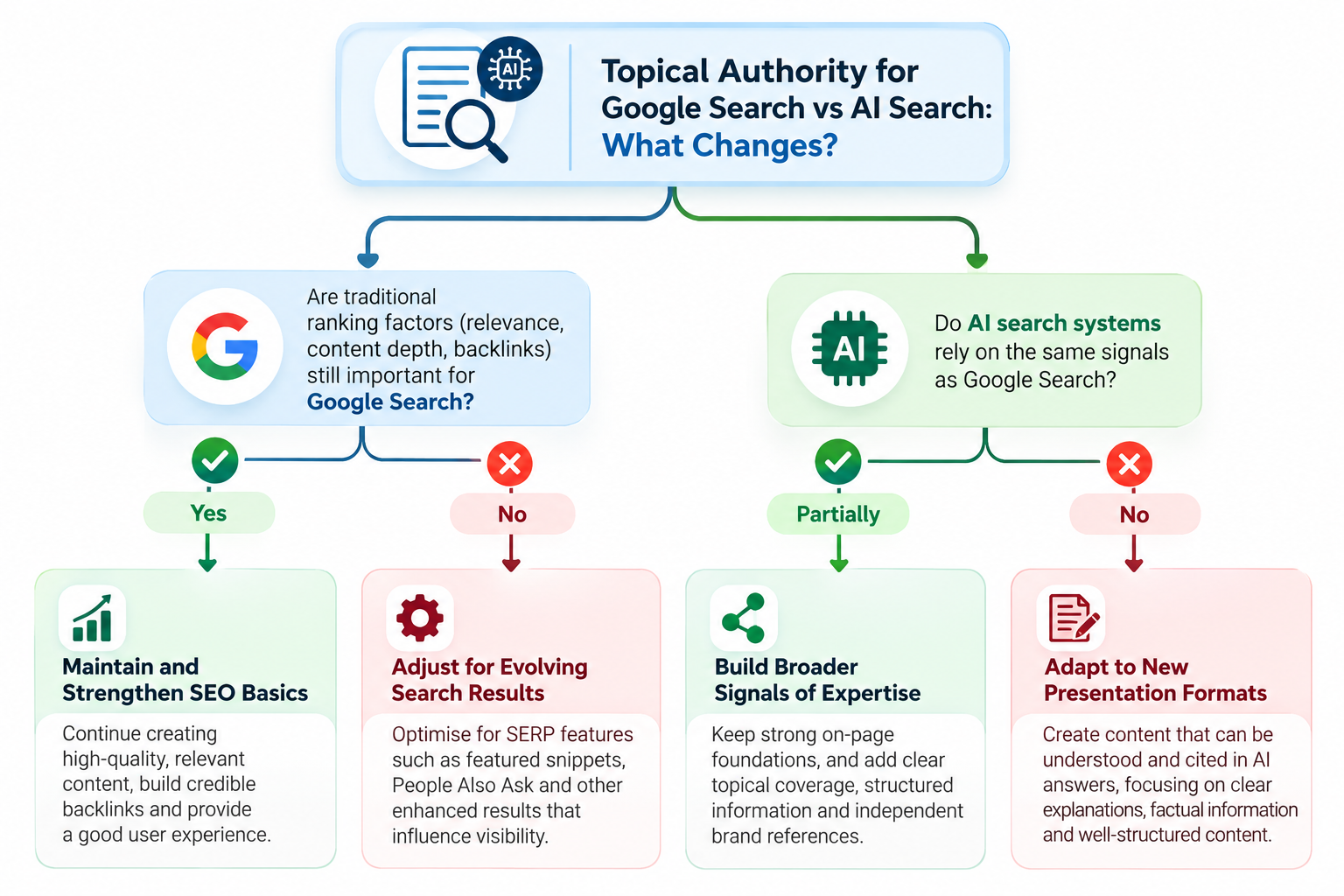
| Comparison | Conventional Google Search | AI-Powered Discovery |
| Main Opportunity | Relevant page visibility and visits | Mentions, citations, links, comparisons, and recommendations. |
| Content Presentation | Search result leading to a page | An answer that may combine several sources. |
| Shared Foundation | Accessible pages, relevance, evidence, and usability | Accessible information, relevance, evidence, and clarity. |
| Useful Content Advantage | Satisfying the visitor’s task | Providing information useful to the particular answer. |
| External Context | Links and reputation among broader considerations | Sources and public information available to the product. |
| Measurement | Impressions, clicks, customer actions, and conversions | Appearance type, cited URLs, referrals, accuracy, and consistency. |
| Main Limitation | Rankings vary and clicks do not guarantee customers | Answers vary and citations do not establish provider endorsement. |
Don’t Build Separate Google and AI Content Libraries
Improve one coherent resource rather than producing an “AI version” of every SEO article. Use headings, definitions, examples, and tables where they help readers. Do not remove necessary context to produce short answer fragments. Account for platform-specific access and reporting separately from the core content plan. A shared library can serve several discovery experiences without assuming they evaluate it identically.
Common Topical Authority Mistakes
Most failures arise when publishing activity replaces a clear purpose. Avoid practices that create more material without improving the underlying resource.
Common mistakes include:
- Publishing without checking existing coverage.
- Choosing subjects solely for traffic potential.
- Creating separate pages for minor wording variations.
- Repeating generic explanations without original value.
- Covering topics outside the business’s expertise.
- Neglecting service and product information.
- Building clusters without useful internal links.
- Treating entity names or schema as substitutes for explanation.
- Using unsupported claims, fabricated experience, or generic author profiles.
- Measuring output while ignoring customer usefulness and commercial contribution.
Google’s guidance on AI-generated content warns that generating many pages without adding user value may violate its scaled-content-abuse policy. The concern is the purpose and quality of the output, rather than AI assistance alone.
Do not assume overlapping pages automatically trigger a penalty or that publishing frequency creates authority. Investigate the actual problem and improve the information customers encounter.
How Long Does It Take to Build Topical Authority?
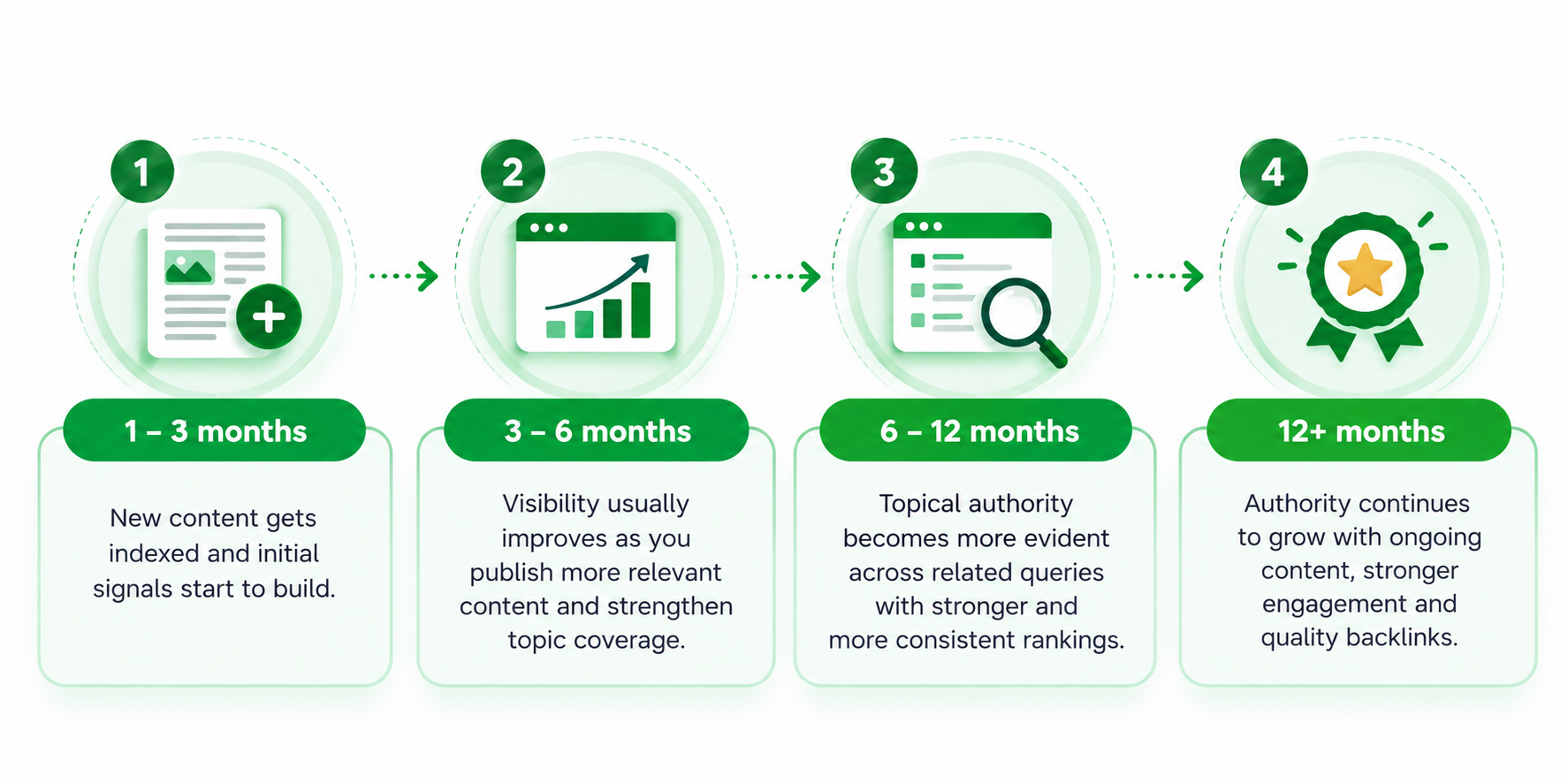
There is no dependable universal timeframe. An established specialist improving an existing resource faces a different task from a new business entering a highly competitive subject. Progress depends on current content, technical access, competition, expertise, differentiation, internal structure, external recognition, and maintenance. Publishing resources affect how quickly work is completed, but they do not control when a platform retrieves or displays the result.
Set milestones around work you can verify: auditing the cluster, improving priority pages, collecting useful evidence, and resolving access problems. Evaluate outcomes separately through relevant visibility and customer actions. A stronger resource can become a compounding asset because later pages draw on earlier knowledge and evidence. That does not guarantee uninterrupted growth or protection from changes in platforms, demand, or competitors.
The Future of Topical Authority in Search
The future of individual features is uncertain. A practical investment is to make the business’s knowledge more useful, distinctive, and verifiable across the experiences customers already use.
Generic Information Becomes Easier to Produce
AI tools can generate basic explanations quickly. That makes interchangeable summaries less distinctive, although introductory information remains useful when it is accurate and serves a real audience. Keep foundational resources, but connect them with specific examples, meaningful decisions, and deeper explanations. Being different is not enough; the difference must help the reader.
Demonstrable Expertise Becomes More Valuable
First-hand knowledge, reliable data, and expert interpretation provide information that cannot be reproduced responsibly without access to the underlying work. Invest in documenting that knowledge. A clear project method or modest original finding may be more useful than a large report with weak evidence. This is a strategy for differentiation, not a prediction that every AI system will reward it identically.
Brand Authority and Content Authority Will Work Together
Readers evaluate both the answer and the organisation behind it. A strong article benefits from clear authorship, accurate business information, and credible supporting examples. Equally, a recognised brand still needs useful individual pages. Reputation should support the content rather than become an excuse for broad claims or incomplete explanations. Maintain both the public identity and the quality of the resource.
SEO, AEO and GEO Will Increasingly Converge
Technical access, useful content, evidence, and measurement already overlap across SEO, Answer Engine Optimization, and Generative Engine Optimization. The relationship between traditional SEO and AI discovery is best managed through connected priorities. SEO supports discovery; AEO emphasises useful answers; GEO addresses visibility within generated responses. These are overlapping areas of work, not exclusive functions or guaranteed outcomes.
Conclusion
Building topical authority starts with choosing subjects your business can explain credibly and customers genuinely need to understand. A useful topical map connects those subjects with distinct pages, relevant examples, and clear commercial information. Original evidence, accurate explanations, expert input, and meaningful internal links then turn separate articles into a resource people can navigate and trust.
Ready to turn scattered content into a focused growth strategy? Build a connected plan with eSign Web Services for topical mapping, technical SEO, expert content, internal linking, and AI visibility measurement. Contact our team for a tailored proposal that identifies priority topics, content gaps, and practical opportunities for qualified enquiries.
Frequently Asked Questions
Question: What is topical authority in SEO?
Answer: Topical authority describes credible, useful expertise around a defined subject. Businesses develop it through accurate explanations, relevant services, original evidence, connected pages, and independent recognition. It is a strategic concept rather than a universal Google score. Strong coverage helps customers understand the topic and evaluate the business behind the information.
Question: How does topical authority help with AI search visibility?
Answer: Focused topic coverage can make your pages useful for more relevant questions when AI systems retrieve web information. Clear explanations, supporting evidence, and original insights improve source usefulness. However, retrieval, citation, and recommendation are different outcomes. No cluster size, content format, or authority claim guarantees inclusion across every AI platform.
Question: How many articles do you need to build topical authority?
Answer: There is no required article count. A narrow specialist service may need a small collection of detailed pages, while a broad subject requires more varied coverage. Decide according to customer needs, distinct intents, and existing content. Measure whether important questions are answered adequately rather than treating publishing volume as authority.
Question: What is the difference between topical authority and domain authority?
Answer: Topical authority concerns demonstrated expertise within a subject. Domain Authority is Moz’s third-party predictive metric for comparing websites; it is not a Google ranking factor. A strong score does not establish expertise on every topic. Evaluate content relevance, evidence, customer usefulness, and business performance alongside any tool-based metric you use.
Question: What is a topical map, and how do you create one?
Answer: A topical map organises a subject into relevant subtopics, concepts, customer questions, and page purposes. Start with your core offer, identify audience needs, group related questions, and match them with existing or planned pages. Record the intended audience, useful evidence, internal links, and business objective before deciding what to publish.
Author Details

Ashwani Kumar Sharma
Ashwani has been actively involved in SEO services since 2005. His expertise and distinctive work approaches have made him one of the most experienced and trusted SEO experts in the industry. He is a certified SEO and Google Ads professional. He also has strong business development skills in advanced SEO, PPC, and digital marketing strategies.


