



Does Traditional SEO Still Work in the Age of AI Search?

Key Takeaway:
- Traditional SEO still works, but people now discover information through Google, AI-generated answers, conversational platforms, and several other digital channels.
- Core SEO fundamentals such as crawlability, indexability, technical quality, search intent, relevant content, internal linking, authority, and trust still have a clear role.
- Older practices such as keyword stuffing, thin pages, mass-produced low-quality content, and manipulative link building are becoming less useful and can create more problems than value.
- AI search has not replaced SEO. It has added new considerations around answer visibility, entities, citations, brand mentions, and information gain.
- Businesses need to look beyond rankings and think more broadly about visibility, credibility, qualified traffic, and conversions.
- GEO and AEO work best when they build on a strong SEO foundation. Instead of when SEO, AEO, and GEO support one another instead of competing, they become more meaningful. As complete replacements.
- First-hand knowledge, original research, useful examples, and strong brand authority matter more because generic content has become much easier to produce.
SEO has been called dead more times than anyone can count, yet it has continued to adapt whenever search behavior changes. AI is simply the latest shift. Tools such as Google AI Overviews, ChatGPT Search, Gemini, and Perplexity can answer questions, compare information, and bring together ideas from several sources, sometimes without sending users directly to a website. Naturally, businesses are beginning to wonder whether traditional SEO still has a place. It does, although the way people discover brands and information is becoming much broader.
In this blog, we will look at what traditional SEO actually means, how it differs from modern SEO, and which familiar practices are still worth keeping. We’ll also talk about how AI is changing the search journey and where older tactics are starting to fail, as well as how businesses can adapt without abandoning methods that already work. The goal is simple: more visibility, more trust, more useful traffic, and sustainable development.
What Do We Mean by Traditional SEO?
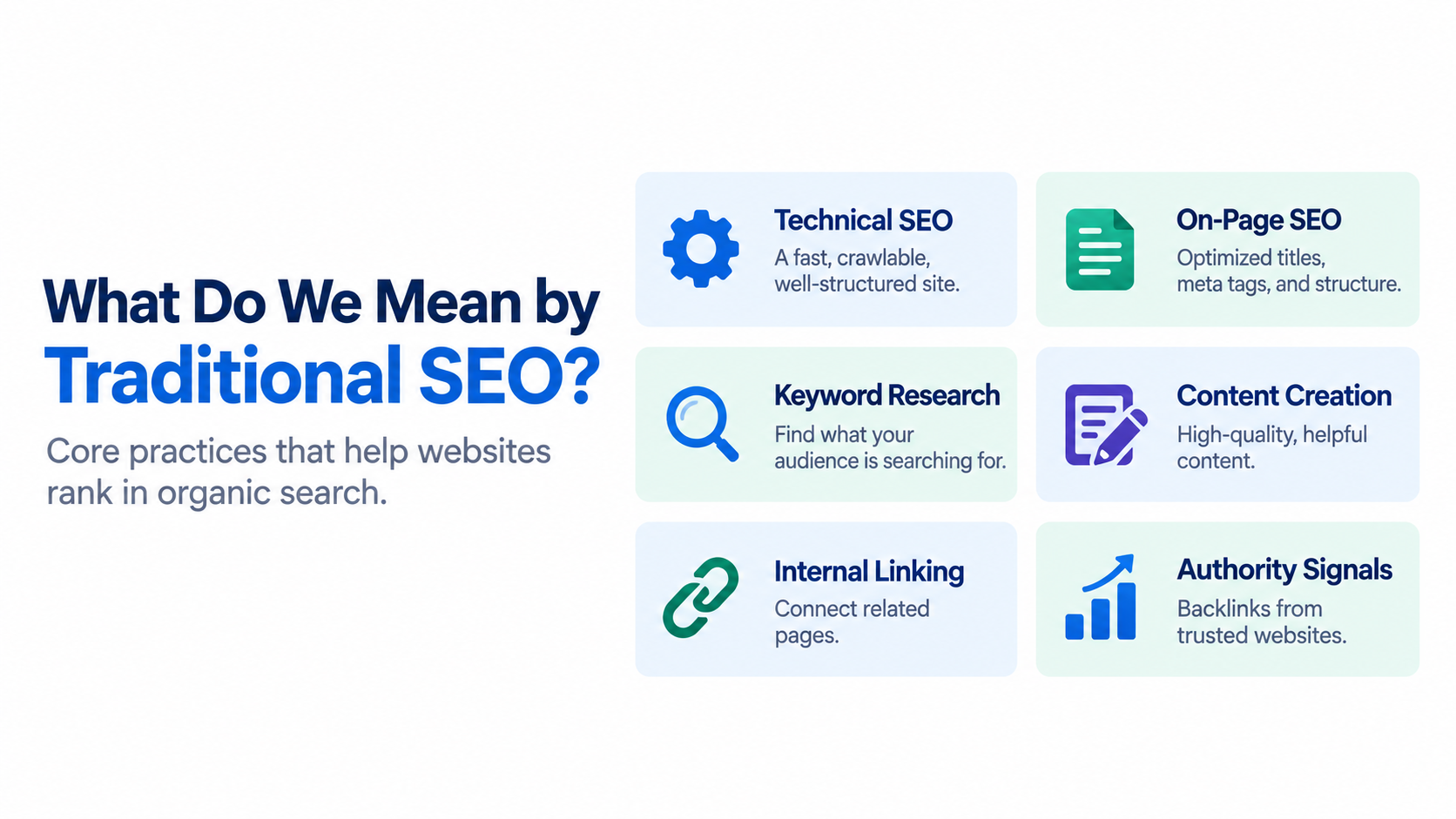
Traditional SEO refers to the established work used to improve a website’s visibility in organic search results. At its core, search engine optimization has always had two important jobs. Search engines need to be able to access and understand a website, while the people who arrive there need to obtain information that genuinely helps them.
Technical SEO: A website needs to work properly behind the scenes before anything else can perform well. Search engines should be able to reach important pages, follow links, understand which URLs matter, and process the content without unnecessary obstacles. Site architecture, XML sitemaps, redirects, canonical tags, mobile usability, crawlability, and indexability are all part of that foundation.
- On-page optimization: Good on-page SEO makes the purpose of a page clear to both readers and search engines. Titles, headings, body copy, internal links, images, URLs, and supporting sections should make sense together. The idea is not to squeeze the same term into every paragraph. The page should simply communicate its subject clearly.
- Keyword and intent research: Keywords remain useful because they show how people describe their needs and the questions they are trying to answer. Good research, however, goes further than search volume. It also considers search intent. Someone asking how technical SEO works has a different need from someone looking for an SEO company to hire.
- Content creation: Traditional SEO has always depended on useful content. Service pages, guides, category pages, comparisons, case studies, and blogs can all support organic visibility when each page has a genuine reason to exist.
- Internal linking: A useful website should feel connected rather than like a collection of isolated pages. Thoughtful internal linking helps visitors move to relevant information while giving search engines more context about how different pages relate to one another.
- Authority building: Relevant backlinks, recommendations, media coverage, trusted references, and industry mentions can strengthen a site’s credibility. One meaningful link from a respected source can say far more about a business than dozens of links placed simply to increase a number in an SEO report.
The word “traditional” can sometimes make SEO sound outdated. That is not really the case. Many traditional practices still form the basic structure of a healthy search strategy. The difference is that some of the shortcuts once associated with SEO are no longer as effective.
How Is AI Search Changing the Search Journey?
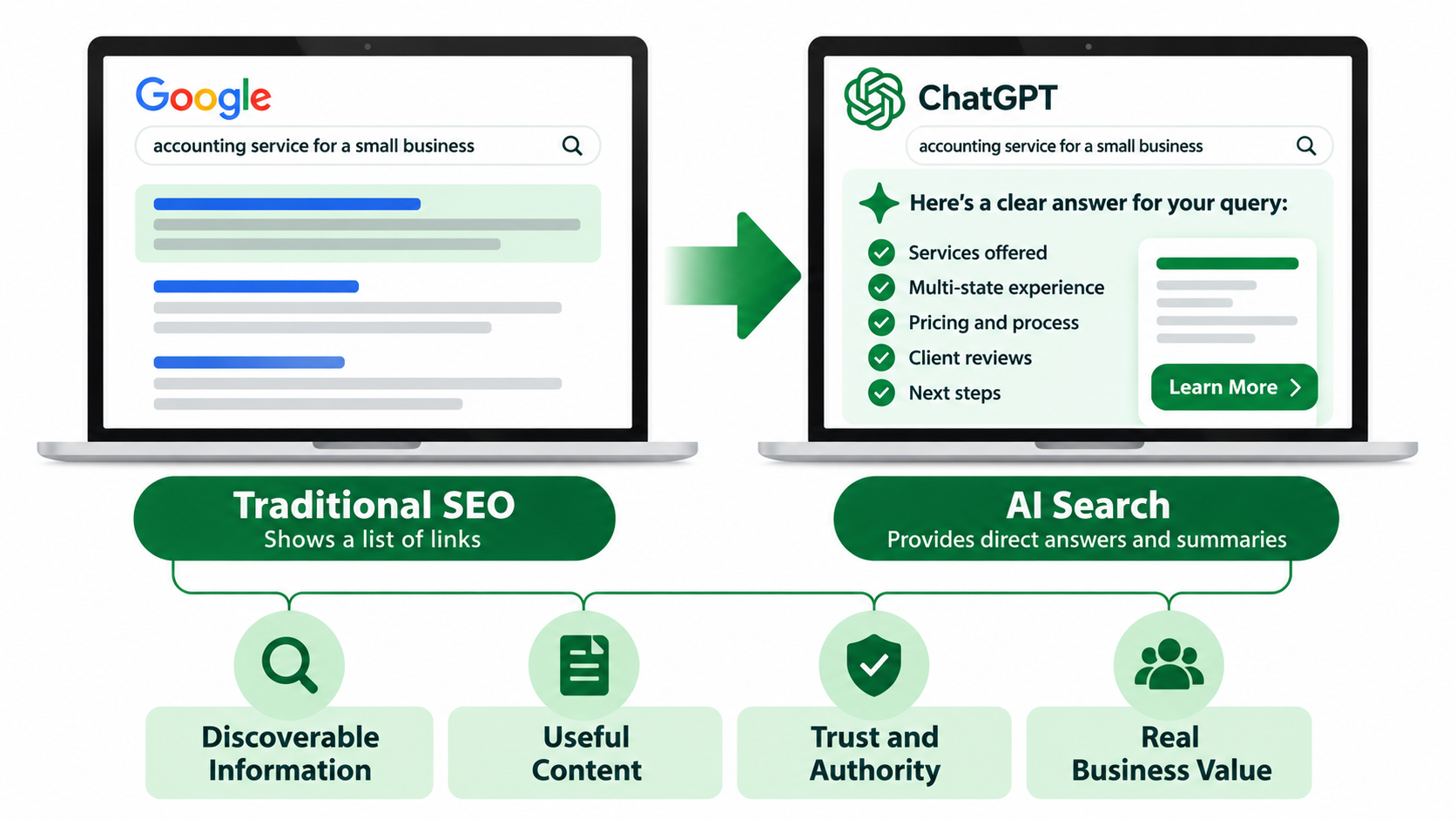
Traditional search usually presents a list of results and leaves the user to decide which ones are worth opening. AI search can now do some of that early work for them. Someone planning a family holiday, for example, may once have opened several websites to compare destinations, costs, weather, and activities. An AI-powered search experience can now bring much of that information together in a single response. Websites are still important because the information has to come from somewhere, but the route between a question and the source is changing.
That is why SEO and AI search are better understood as overlapping parts of the same discovery journey rather than two competing channels.
What Parts of Traditional SEO Still Work Extremely Well?
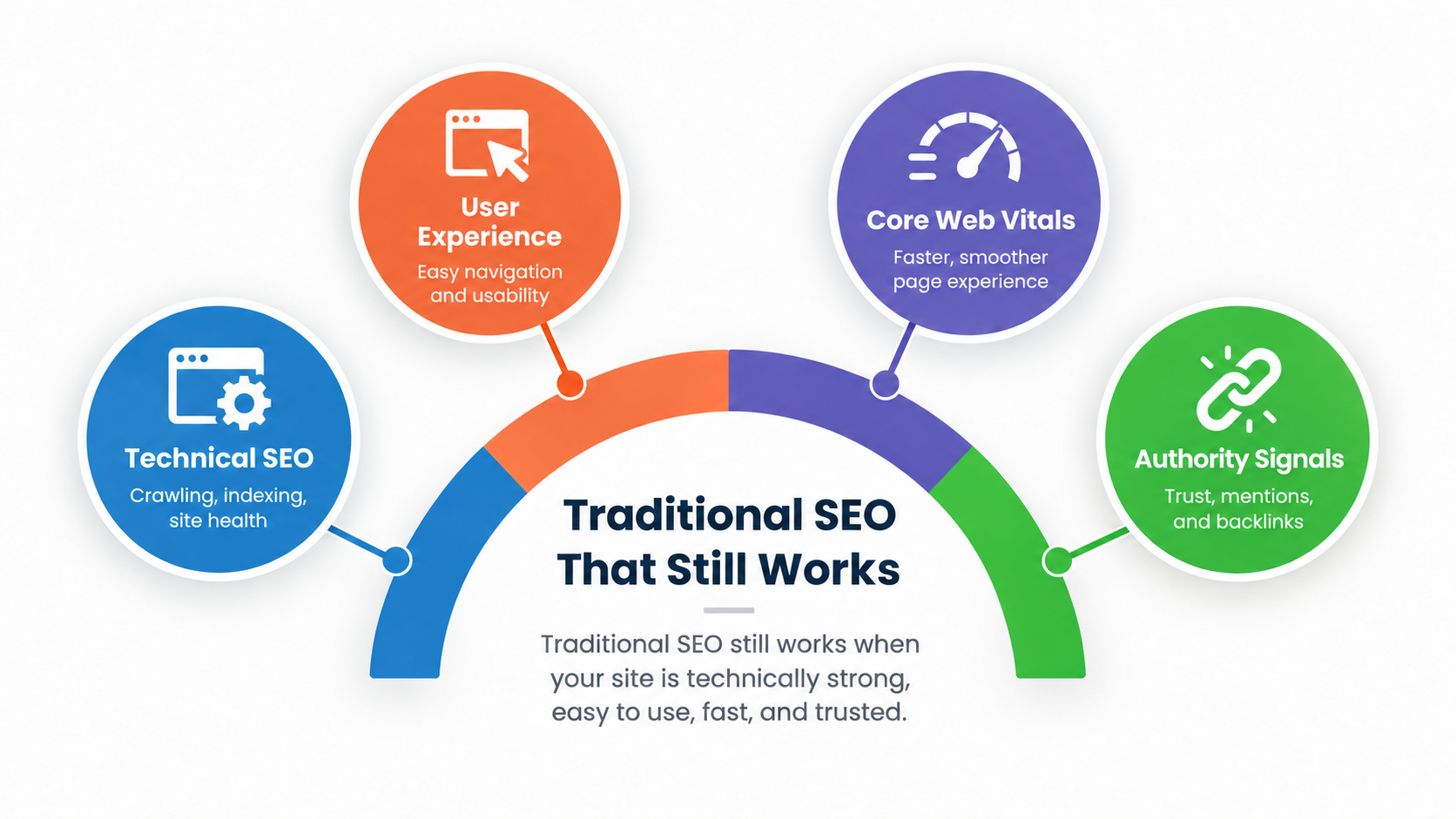
Strong technical SEO still matters because search systems need a reliable way to find and process content. Clear crawl paths, working pages, sensible canonical signals, appropriate redirects, usable templates, and a website that performs properly on desktop and mobile all continue to play a part.
User experience matters just as much. Improving Core Web Vitals, cutting unnecessary loading delays, simplifying confusing navigation, and making information easier to find can improve what happens once a visitor reaches the site. More traffic means very little when visitors struggle to use the website.
Authority has not disappeared either. People generally feel more confident about a company when respected publications, industry organizations, specialists, customers, and other credible sources recognize it positively. Over time, that wider reputation can strengthen a well-rounded SEO approach.
Which SEO Fundamentals Does AI Search Still Depend On?
AI-powered search experiences may look very different from a familiar results page, but the fundamentals behind strong visibility have not suddenly become unrecognizable. Search systems still need access, context, credible information, and enough structure to understand what a page is offering.
- Make Content Easy to Access: AI-powered search systems still need to discover and process pages. Clear internal links, sensible navigation, reliable crawl paths, and proper indexability make important information easier to reach. A strong page can offer excellent information, but it has limited value if search systems cannot easily find or process it.
- Build Trust and Expertise: EEAT remains a helpful way to think about experience, expertise, authoritativeness, and trust. Real examples, expert review, first-hand knowledge, clear authorship, and accurate information give a page more substance than a generic article that simply repeats familiar advice.
- Keep Information Structured and Current: Structured data and accurate schema markup can help search engines interpret certain information more clearly when used appropriately. Content itself also needs attention over time. Prices, statistics, services, laws, policies, and product details can change, so regular reviews help maintain accuracy and brand authority.
Important Note: A schema can make well-organized information easier to interpret, but it cannot turn weak content into an authoritative resource. Thin pages, confusing site structure, unclear entities, and limited credibility need to be improved at their source rather than covered up with additional markup.
Which Traditional SEO Tactics Are Losing Effectiveness?
Traditional SEO itself is not the problem. The bigger issue is that several tactics once widely associated with SEO were designed more around manipulating signals than giving people something genuinely worthwhile. Those approaches are becoming increasingly difficult to justify.
- Avoid Keyword Stuffing: Repeating the same keyword again and again rarely improves a page for the reader. It usually does the opposite. Modern search systems are far better at understanding context, related language, synonyms, and meaning, so natural writing and useful coverage matter much more than forced repetition.
- Focus on Link Quality, Not Link Volume: A long spreadsheet filled with irrelevant or weak links may look impressive in a report, but it does not automatically build a trustworthy website. Fewer backlinks from relevant publications, respected industry sources, or credible organizations can carry far more meaning.
- Create Content Around Real Audience Needs: Search volume should not be the only reason a business publishes something. A useful topic should connect to the company’s expertise, services, audience, customer questions, or buying journey. Traffic from unrelated content may increase visitor numbers without doing much for engagement, trust, or conversions.
Keywords Still Matter, but Their Role Has Changed
Keywords are still an important part of SEO, but they are no longer mainly about exact-match repetition. They now help businesses understand demand, intent, related topics, and the natural language people use when searching across traditional and AI-powered platforms.
- Keywords Reveal Demand: Keywords show what people are actively looking for, the language they use, and the problems they want solved. This makes keyword research useful for understanding demand, shaping content priorities, and identifying valuable audience interests.
- Search Intent Matters More Than Repetition: Using a keyword repeatedly does not make a page more useful. Search engines now focus more on why someone searched, so content should match whether the user wants information, comparison, guidance, or a solution.
- Long-Tail Queries Are Becoming More Conversational: People increasingly search using complete questions and natural language, especially through voice assistants and AI tools. Longer conversational queries reveal specific needs, helping businesses create content that answers detailed questions more accurately and naturally.
Do Keywords and Backlinks Still Matter?
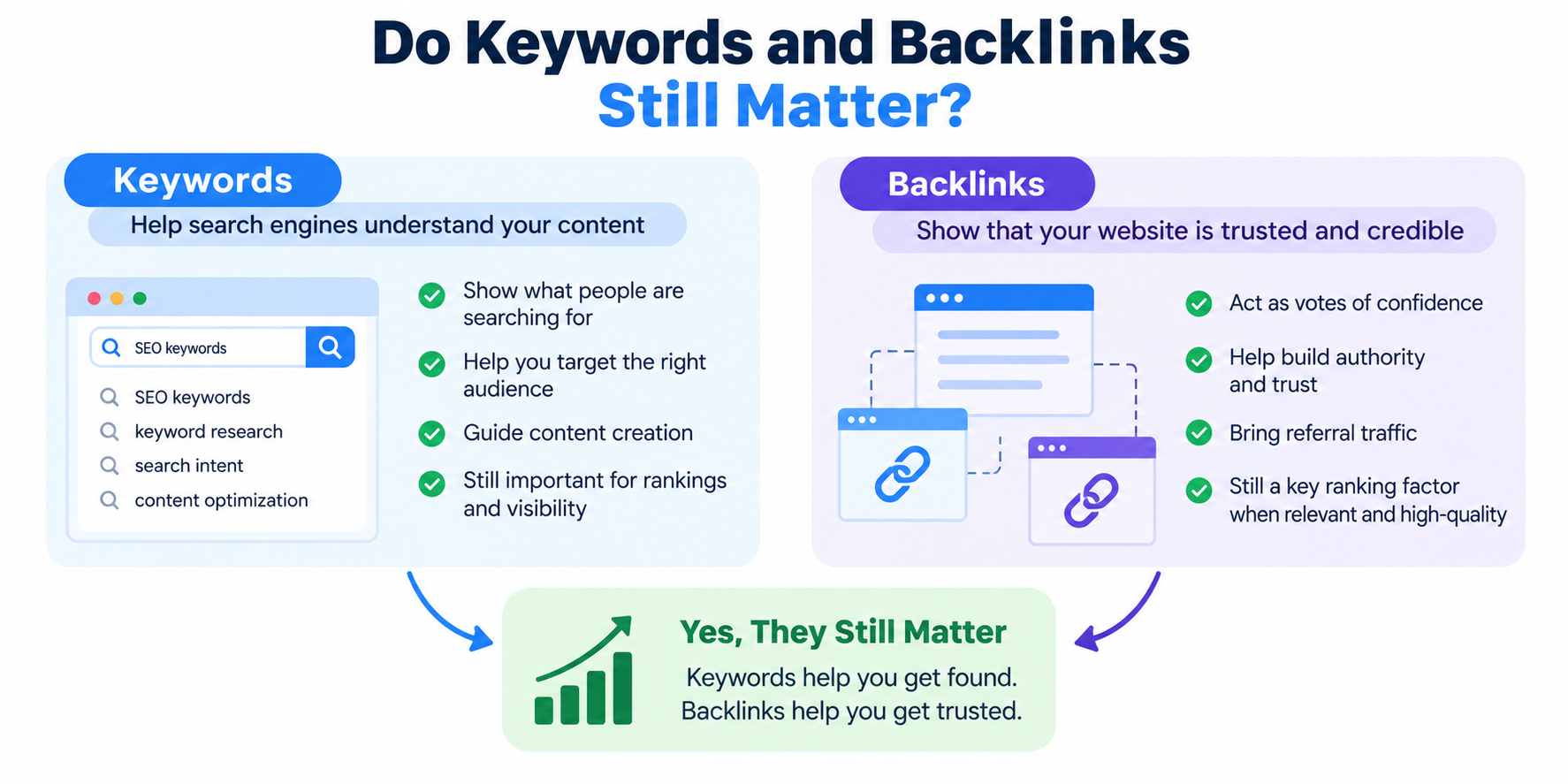
Yes, but both are better used with a little more judgement than they sometimes were in the past. Keywords still reveal what people care about, while links can still help demonstrate authority. Neither works particularly well when treated as a numbers game.
- Use Keywords to Understand What People Need: Keywords give businesses useful clues about customer language, common problems, questions, and demand. That insight can guide content planning, but it should not turn into a requirement to repeat the same phrase throughout a page. The reader’s need should stay at the center of the content.
- Prepare for More Conversational Searches: People are increasingly comfortable asking longer, more detailed questions, particularly when using conversational tools. Effective SEO for AI search therefore means understanding what sits behind the question and answering it properly rather than optimizing only for a short target term.
- Build Authority through Digital PR and Brand Mentions: Digital PR can earn attention through useful research, expert commentary, original data, case studies, industry observations, and other material people genuinely want to reference. Even when a third-party mention does not include a clickable link, it can still increase brand recognition and strengthen the wider reputation of the business.
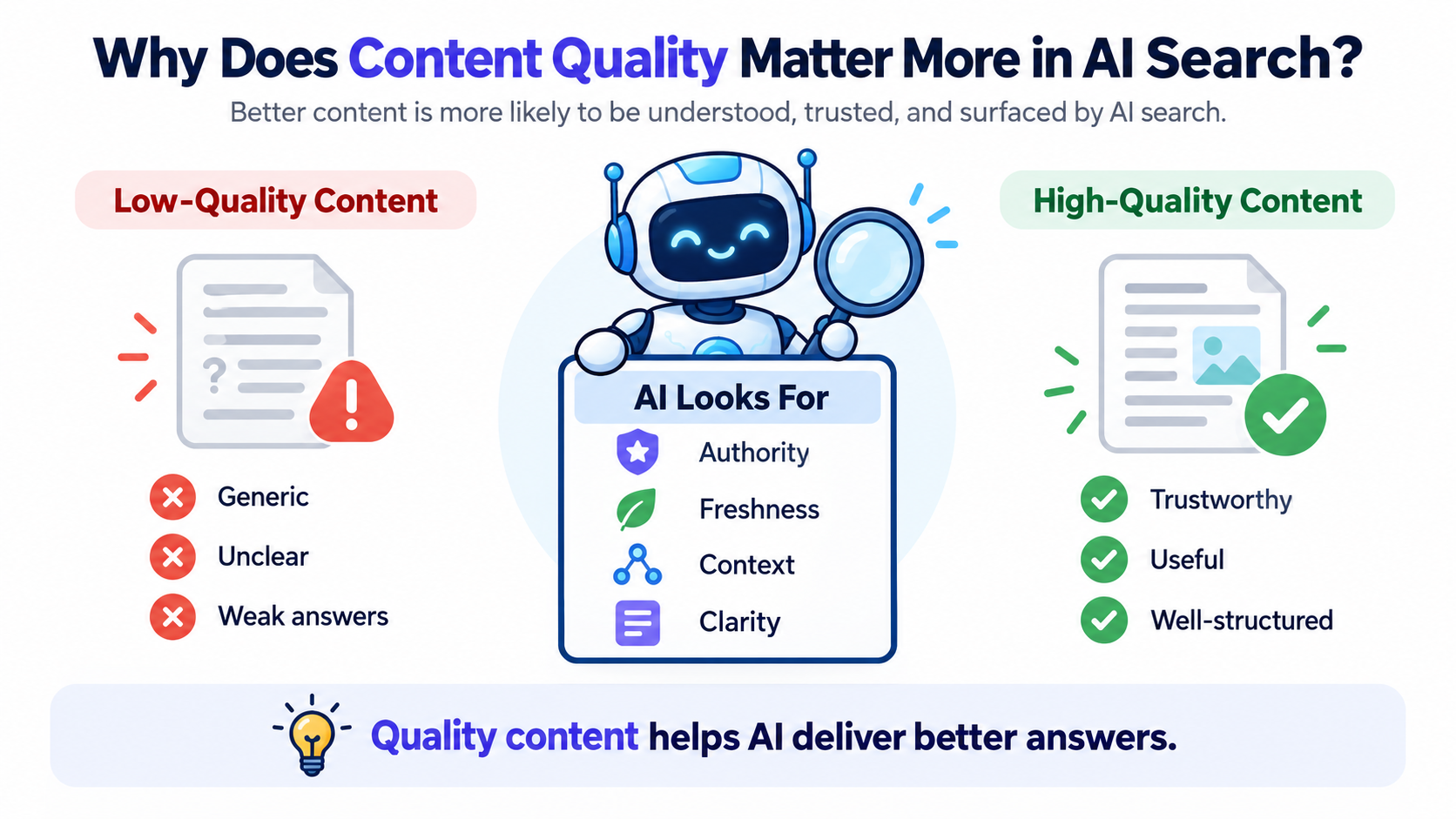
Why Does Content Quality Matter More in AI Search?
AI has made basic content much faster to produce. As a result, the web is filling up with articles that cover the same subjects in very similar ways. To stand out in AI search, businesses need more than polished wording. Content has to bring genuine value, useful experience, clear answers, and enough substance to give people or search systems a reason to pay attention.
- Add Something Original: Rewriting information that already appears across hundreds of other pages adds very little. Businesses can strengthen a topic with internal data, original research, expert observations, useful examples, or insights collected through real work. These elements increase information gain because the page gives the reader something beyond what is already easy to find elsewhere.
- Use First-Hand Experience: Real experience can make an otherwise familiar subject much more useful. Businesses can talk about lessons from projects, customer questions they regularly hear, results they have seen, common mistakes, unexpected challenges, or processes they use in practice. Those details make a page feel grounded rather than assembled from general information.
- Create Content Worth Referencing: Businesses hoping to earn AI citations should concentrate on becoming genuinely useful sources. There is no reliable shortcut that forces an AI system to cite a page. Original findings, detailed comparisons, case studies, expert insight, and specific examples simply give other systems and publishers more reason to reference it.
Strong content in the AI era does not need to be longer for the sake of length or polished until it sounds unnatural. It needs to offer something worth reading. Originality, experience, evidence, accuracy, and regular updates can make familiar subjects far more useful and help them hold their value across both traditional and AI-powered search.
Where Traditional SEO Stops and AI Search Optimization Begins
Traditional SEO still provides the foundation for visibility, but AI search introduces new ways for content to be discovered, interpreted, cited, and presented. A modern strategy needs to support both traditional search results and AI-driven experiences.
- Traditional SEO Optimizes for Discovery and Rankings: Traditional SEO focuses on helping search engines crawl, understand, and rank pages in organic results. Technical health, keywords, content quality, internal links, backlinks, and user experience remain central to improving search visibility.
- AEO Optimizes for Direct Answers: Answer Engine Optimization focuses on making information easy to extract and present as a direct response. Clear definitions, concise explanations, FAQs, lists, and well-structured sections help search systems identify useful answers quickly.
- GEO Optimizes for Generative Visibility: Generative Engine Optimization looks at how content can appear within AI-generated responses. Strong authority, clear entities, original information, reliable sources, and well-organized content can improve the chances of being referenced by generative platforms.
- Conversational Search Changes Content Structure: People often use longer and more natural questions when searching through AI tools. Content should therefore include clear answers, logical sections, related questions, examples, and natural language that reflects how users actually communicate.
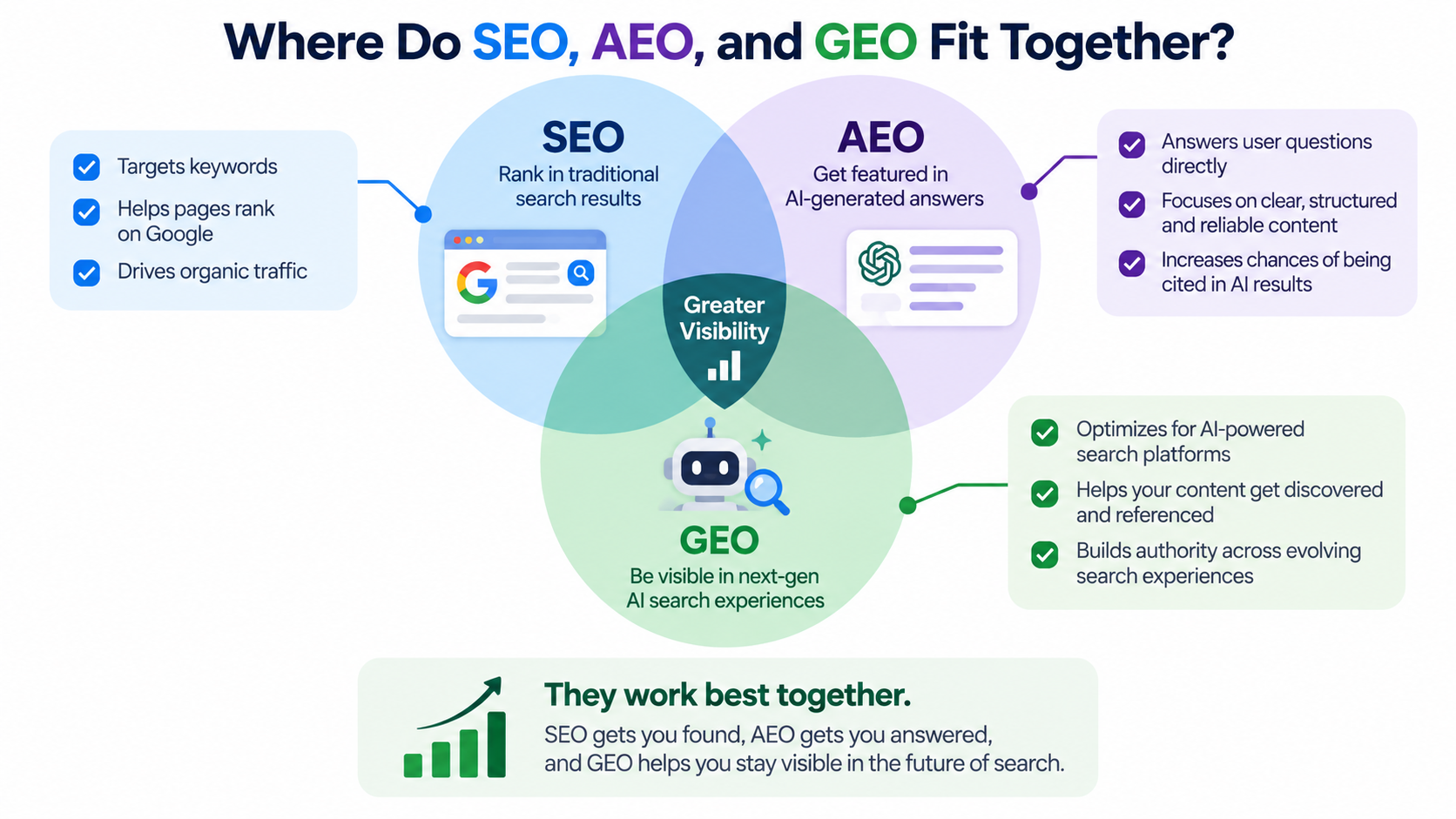
Where Do SEO, AEO, and GEO Fit Together?
SEO, AEO, and GEO look at different parts of online discovery, but there is considerable overlap between them. A business does not need three disconnected content strategies. It needs useful information that can be found, understood, trusted, and presented effectively across both established and newer search experiences.
- SEO Builds the Foundation: SEO covers technical accessibility, crawlability, relevant content, internal links, authority, user experience, and organic visibility. These are basic requirements that help search engines find and understand a website. They continue to matter even when the final search experience is presented in a different format.
- AEO Helps Provide Clear Answers: Answer Engine Optimization (AEO) puts more emphasis on making information easy to understand when someone asks a direct question. Clear definitions, useful FAQs, comparisons, practical steps, and logically organized sections can help people reach the information they need without working through unnecessary filler.
- GEO Supports Generative Visibility: Generative Engine Optimization (GEO) looks more closely at visibility in generative AI experiences. Clear entity information, reliable sources, expert knowledge, original evidence, external mentions, and wider authority can all contribute to a business becoming easier to recognize and reference.
- Brand Authority Connects the Strategies: A recognized and credible brand gives each approach a stronger base. Expert profiles, consistent company information, useful content, relevant third-party mentions, trusted references, and digital PR help establish who the business is and why its information may deserve attention.
SEO, AEO, and GEO make more sense when they support one another instead of being treated as competitors. SEO creates the groundwork, AEO helps information answer questions more clearly, and GEO extends the conversation into generative search. Together, they give a clearer picture of the future of SEO, where visibility is no longer limited to traditional rankings.
How Should Businesses Evolve Their SEO Strategy for AI Search?
Most businesses do not need to start their SEO strategy again from scratch simply because AI search has arrived. A more practical approach is to protect what already performs well, improve weaker areas, and gradually broaden the strategy where user behavior has changed.
- Strengthen entity signals: Keep information about the business, its people, expertise, services, locations, and products consistent. Author pages, about pages, service information, business profiles, external references, and appropriate markup should reinforce rather than contradict one another.
- Build reputation beyond your own site: Search visibility is not built entirely through publishing more articles. Industry relationships, third-party coverage, expert contributions, relevant mentions, useful research, and trusted references can help a business develop a reputation that exists beyond its own domain.
- Make answers easy to follow: People should not have to work through dense or overcomplicated writing to find the point. Helpful headings, clear explanations, practical examples, concise definitions, comparisons, and well-organized paragraphs make information easier to understand without turning every sentence into an artificial “AI-friendly” snippet.
- Measure traditional and AI visibility together: Continue monitoring rankings, impressions, traffic, leads, and conversions while gradually paying attention to newer forms of discovery where dependable data is available. Traditional performance should not be ignored simply because another visibility metric has appeared.
Taken together, these steps create a more practical modern SEO strategy. The aim is not to chase every change in AI search as soon as it happens. It is to build a website and brand that remain useful, understandable, credible, and easy to discover as search behavior continues to evolve.
Measurement Tip: An AI mention can be encouraging, but it should not distract from pages that already bring qualified visitors and leads. New visibility signals should provide extra context, not replace the business results that ultimately matter.
How to Create Content That Works for Traditional and AI Search
Content now needs to perform across standard search results and AI-driven platforms. The strongest approach combines clear structure, useful depth, trustworthy information, and natural writing that serves real users first.
- Answer the Main Question Clearly: Give readers the main answer early instead of making them search for it. A clear opening improves usability and helps search systems understand the page’s core purpose.
- Cover the Topic Comprehensively: Go beyond a basic explanation by addressing related questions, concerns, comparisons, examples, and practical details. Strong topic coverage gives readers fewer reasons to look elsewhere.
- Include Relevant Entities: Mention important people, brands, products, locations, technologies, or concepts connected to the subject. Relevant entities provide additional context and help search systems understand relationships more accurately.
- Support Claims With Evidence: Back important statements with reliable data, research, expert sources, case studies, or documented examples. Evidence improves credibility and gives readers more confidence in the information provided.
- Add Unique Examples: Use original examples, experiences, observations, or scenarios that make familiar topics more useful. Unique details can differentiate the content from generic pages covering the same subject.
- Keep Important Facts Updated: Review statistics, prices, policies, tools, processes, and other time-sensitive information regularly. Updated facts reduce misinformation and help maintain the reliability of your content over time.
- Write for Humans First: Keep language clear, natural, and useful instead of forcing keywords or artificial AI-focused phrasing. Content should primarily help people understand the topic and take the next step.
When these elements work together, content becomes easier to discover, understand, trust, and reuse across both traditional search engines and newer AI-powered search experiences.
Common Mistakes When Adapting to AI Search
AI search is moving quickly, which can make businesses feel as if they need to change everything at once. In practice, some of the biggest mistakes happen when companies react too quickly and stop paying attention to the fundamentals that were already producing useful results.
- Treating Every SEO Practice as GEO: Some tactics now presented as new GEO techniques have been part of good SEO for years. Clear content, stronger authority, understandable entities, useful information, and credible sources were valuable before generative search became widely discussed. Changing the label does not automatically improve the strategy.
- Creating Content Only for AI Systems: Separate “AI content” written mainly for machines can quickly become awkward and unnatural. Real people still need to read the page, understand the information, trust what they see, and decide what to do next. If the content does not work for them, calling it AI-optimized does not make it more useful.
- Ignoring Conversion After Gaining Visibility: Being visible is only the first part of the journey. If someone reaches the website and finds vague information, confusing navigation, weak evidence, or no obvious next step, greater visibility may still fail to generate inquiries, sales, or other meaningful outcomes.
Do Small Businesses Need to Change Their Entire SEO Strategy?
Small businesses do not need to rebuild their SEO strategy completely. A better approach is to protect what already works, improve weak areas, and gradually adapt to AI-driven search.
- Keep What Already Works: Continue using tactics that already generate relevant traffic, enquiries, or sales. Strong content, technical health, local SEO, and useful service pages should remain part of the strategy.
- Audit Weak and Outdated Tactics: Review thin pages, poor-quality links, outdated content, and keyword-heavy copy. Removing ineffective practices can strengthen performance without forcing a complete change in direction.
- Improve Content Quality Before Increasing Volume: Publishing more pages is not always better. Improve existing content first with clearer explanations, stronger examples, reliable evidence, and information that genuinely helps users.
- Add GEO and AEO Gradually: Introduce GEO and AEO as extensions of existing SEO. Start with clearer answers, stronger entities, structured information, and content that search systems can easily understand.
- Prioritize Commercially Important Topics First: Focus on topics connected to services, products, customer needs, and buying decisions. These areas are more likely to generate meaningful traffic, enquiries, and revenue.
- Avoid Chasing Every New AI Trend: Not every AI tactic deserves immediate attention. Strong SEO fundamentals, useful content, authority, and measurable business results should remain the priority.
For most small businesses, gradual improvement is more practical than a complete reset. The aim is to modernize SEO without losing the strategies already delivering results.
What the Future of SEO Actually Looks Like
SEO is not disappearing. It is becoming broader, with businesses needing to think beyond rankings and consider visibility across search engines, AI platforms, maps, and other discovery channels.
- SEO Will Become Broader, Not Disappear: Technical SEO, content quality, authority, and search intent will remain important, but they will increasingly support a wider range of search and discovery experiences.
- Search Visibility Will Extend beyond Google Rankings: Visibility will include organic results, AI answers, citations, maps, video, and other digital platforms where users discover brands, services, products, and information.
- Entities and Brands Will Matter More: Search systems need to understand who a business is, what it offers, and why it is credible. Consistent brand signals can strengthen that understanding.
- Original Information Will Become More Valuable: Generic content is easier to produce, making first-hand experience, original research, expert observations, useful data, and unique examples more valuable.
- Search and AI Discovery Will Coexist: Traditional search and AI-driven discovery are likely to work alongside each other. Businesses should create content that performs well across both environments.
- SEO Professionals Will Become Search Visibility Strategists: SEO roles will increasingly include AI visibility, entities, brand authority, content strategy, user experience, and performance measurement across several discovery platforms.
The future of SEO is about expanding proven practices rather than replacing them. Businesses that combine strong fundamentals with AI-era visibility will be better prepared for changing search behaviour.
Does Traditional SEO Still Work in the Age of AI Search?
Yes. The fundamentals still work. Search systems still have to discover information, websites still need to be accessible, and people still expect useful and accurate answers. Businesses still need to establish trust, while strong content still benefits from clear structure, context, relevance, and authority.
Keyword stuffing, thin pages, low-value mass publishing, manufactured links, and rankings that have little connection to business performance do not represent a sustainable way forward. Keeping them simply because they once worked would miss how much search has changed. The stronger approach is to develop traditional SEO into a broader search visibility strategy. That involves understanding how technical quality, useful content, brand reputation, entities, authority, AI-generated answers, citations, and real customer journeys fit together.
This is the practical relationship between SEO and AI search. AI is changing the environment in which SEO operates, but it has not removed the basic need for businesses to create information that can be discovered, trusted, and used.
Conclusion
Traditional SEO is not disappearing. It is becoming part of a wider approach to online discovery. Technical accessibility, useful content, clear site structure, search intent, internal links, authority, relevant backlinks, accurate information, trust, and a good user experience still matter. People need reliable information, and search systems still need ways to find, understand, and assess that information. The bigger change is where discovery now takes place.
A strong strategy now brings proven SEO practices together with clearer entities, more distinctive content, genuine expertise, AEO and GEO considerations, wider authority, and broader performance measurement across traditional and AI-driven search. That is a more realistic search engine optimization strategy for a search landscape that will continue to change.
Want to Build an SEO Strategy for the Way People Search Today?
If your SEO strategy is still focused almost entirely on rankings, it may be worth looking at the wider journey. Connect with eSign Web Services for an SEO proposal built around meaningful visibility, qualified traffic, stronger authority, leads, and sustainable organic growth.
Frequently Asked Questions
Question: Does traditional SEO still work in 2026?
Answer: Yes. The basics of SEO technical accessibility, helpful content, search intent, internal linking, authority, and website experience are still relevant. It’s the broader search journey that has changed. Now businesses have to take into account AI responses, citations, conversational discovery, and brand visibility in addition to their existing organic search performance.
Question: Is AI search replacing Google SEO?
Answer: AI search is changing the way we find and consume information, but it hasn’t rendered SEO obsolete. Useful, accessible, and trustworthy information still has to be provided by search engines. In fact, it’s better for companies to build on a strong SEO strategy rather than drop it for an entirely different, AI-focused one.
Question: What traditional SEO tactics still work today?
Answer: Technical optimization, search intent research, useful content, logical internal linking, relevant backlinks, clear site architecture, page experience, accurate information, and meaningful performance tracking still matter. These practices both help search systems understand a website and help visitors to find useful information and to navigate through the site in a natural way.
Question: What is the difference between SEO, AEO, and GEO?
Answer: SEO is about organic discovery, technical quality, relevance, authority, and visibility of a website. AEO is more about making information easy to read when someone asks a direct question and gets an answer. GEO is more about how easy it is to see information in a generative AI experience. They have a lot of overlap and generally work best when built on the same solid SEO foundation.
Question: How should businesses measure SEO success in the age of AI search?
Answer: Businesses should still monitor rankings, impressions, organic traffic, leads, conversions, and revenue. Broader signals can then be added where they are useful, including branded searches, quality mentions, backlinks, AI referral traffic, citations, and AI brand visibility. Commercial impact should remain more important than collecting impressive-looking vanity metrics.
Author Details

Ashwani Kumar Sharma
Ashwani has been actively involved in SEO services since 2005. His expertise and distinctive work approaches have made him one of the most experienced and trusted SEO experts in the industry. He is a certified SEO and Google Ads professional. He also has strong business development skills in advanced SEO, PPC, and digital marketing strategies.


