



How Answer Engines Evaluate Online Content (Google SGE, Perplexity & AI Search)

Key Takeaways
- Answer engines prioritize clarity, credibility, and extractable information over keyword repetition, filler, or vague positioning.
- Content must answer the main question early, then support it with evidence, structure, and context.
- Google and Perplexity both evaluate relevance, but they differ in citation behavior and presentation styles.
- Strong authorship, clear dates, and reliable sourcing help content feel trustworthy to users and AI.
- Pages structured with headings, short paragraphs, and examples are easier for answer engines to interpret.
- Query intent matters more when content reflects comparisons, processes, decisions, and likely follow-up questions clearly.
- Selection-focused SEO means creating content that can be reused accurately, not merely discovered in results.
- Better reporting now tracks citations, influence, brand recall, and assisted conversions alongside traffic performance metrics.
Answer engines do not simply rank pages. They decide which passages are clear enough to quote, credible enough to trust, and useful enough to reuse inside an AI-generated response. That shift is what makes answer engines SEO different from old-school visibility work. Google says AI Overviews now reach over 1.5 billion users every month and are driving a more than 10% increase in usage for the query types where they appear, in markets like the U.S. and India. Perplexity, meanwhile, describes itself as a research-focused answer engine built to deliver conversational, verifiable responses with citations.
That changes the job entirely. A small business blog post is no longer competing only for a blue link and a possible click. It is competing to become the sentence an engine reuses when someone asks, “What should I trust?” or “What should I do next?” Google has also said that AI Mode queries are, on average, twice as long as traditional Search queries, which shows how much more layered these interactions have become. This is why AI search optimization is part SEO, part editorial discipline, and part evidence management.
So this blog focuses on the practical question that matters most: how do these systems decide what to select? We will look at what answer engines are, how they interpret queries, what signals shape selection, where Google and Perplexity differ, and which mistakes quietly make solid content invisible. The goal is not to chase hype. It is to write pages that deserve to be chosen.
What Are Answer Engines
Answer engines are search systems built to deliver a direct response, not just a list of pages. Traditional search engines mostly help users find information. Answer engines go further. They retrieve content, interpret meaning, compare sources, and generate a usable answer in real time. That is the big shift. Instead of saying, “Here are ten links, go figure it out,” they try to say, “Here is the most likely answer, and here is where it came from.” That is why answer engine optimization is not just about ranking on a page. It is about creating content that an AI system can confidently understand, extract, and cite.
The difference becomes clearer in real use. A person searching “best CRM for a five-person sales team” on a traditional search engine may see product pages, review articles, and listicles, then do the comparison work on their own. An answer engine behaves more like a fast research assistant. It scans multiple sources, identifies consistent patterns, extracts the most relevant points, and provides the user with a condensed recommendation or summary. That means the winning content is not always the loudest or longest. It is usually the clearest, most specific, and easiest to verify. In this environment, answer engines SEO starts rewarding pages that remove confusion instead of adding noise.
That also makes visibility more selective. A page does not earn attention just by existing in the index or repeating the right keyword. It needs to be structured so the engine can identify the main point, trust the source, and reuse the information without distorting it. If the content is vague, bloated, anonymous, or slow to get to the point, it becomes harder for the system to treat it as reliable input. In simple terms, answer engines are not only asking, “Does this page match the query?” They are also asking, “Can I safely build an answer from this?” That is the real change businesses need to understand.
Here’s what this looks like in practice:
- Traditional search helps users find answers.
- Answer engines try to form the answer first.
- Traditional SEO rewards visibility.
- Answer-focused content rewards usability, clarity, and trust.
Mini-example:
Here is a simple example: if two articles cover the same topic, the one with a direct definition, a visible author, a concrete example, and a clean structure is far more likely to be reused than the one that opens with filler and vague commentary.
How AI Understands Queries
AI systems do not read queries as isolated keywords. They interpret them as tasks, expectations, and likely next steps. A search like “best CRM for a five-person agency” is not just about software. It signals budget limits, team size, sales complexity, and comparison intent. A query like “why did leads drop after a redesign” points to diagnosis, not definitions. That is why answer engines’ SEO works best when content mirrors the real problem behind the phrasing rather than mechanically repeating search terms.
What AI often tries to understand inside the query:
- the real intent behind the exact words the user chooses
- the decision stage the user is currently in
- the context shaping what kind of answer makes sense
- the follow-up questions likely to come next
- whether the topic needs fresh or evergreen information
This is where Google SGE optimization becomes practical instead of theoretical. If the query implies a comparison, the page should clearly show the comparison. If it signals confusion, the content should simplify early. If it points to a process, the page should break that process into steps. Strong semantic SEO helps because it connects related meanings, entities, and subtopics, which makes the page easier to retrieve for long, layered prompts. AI is not only asking, “Does this page mention the topic?” It is asking, “Does this page solve the need behind the search?” That difference is what makes useful content easier to select and summarize.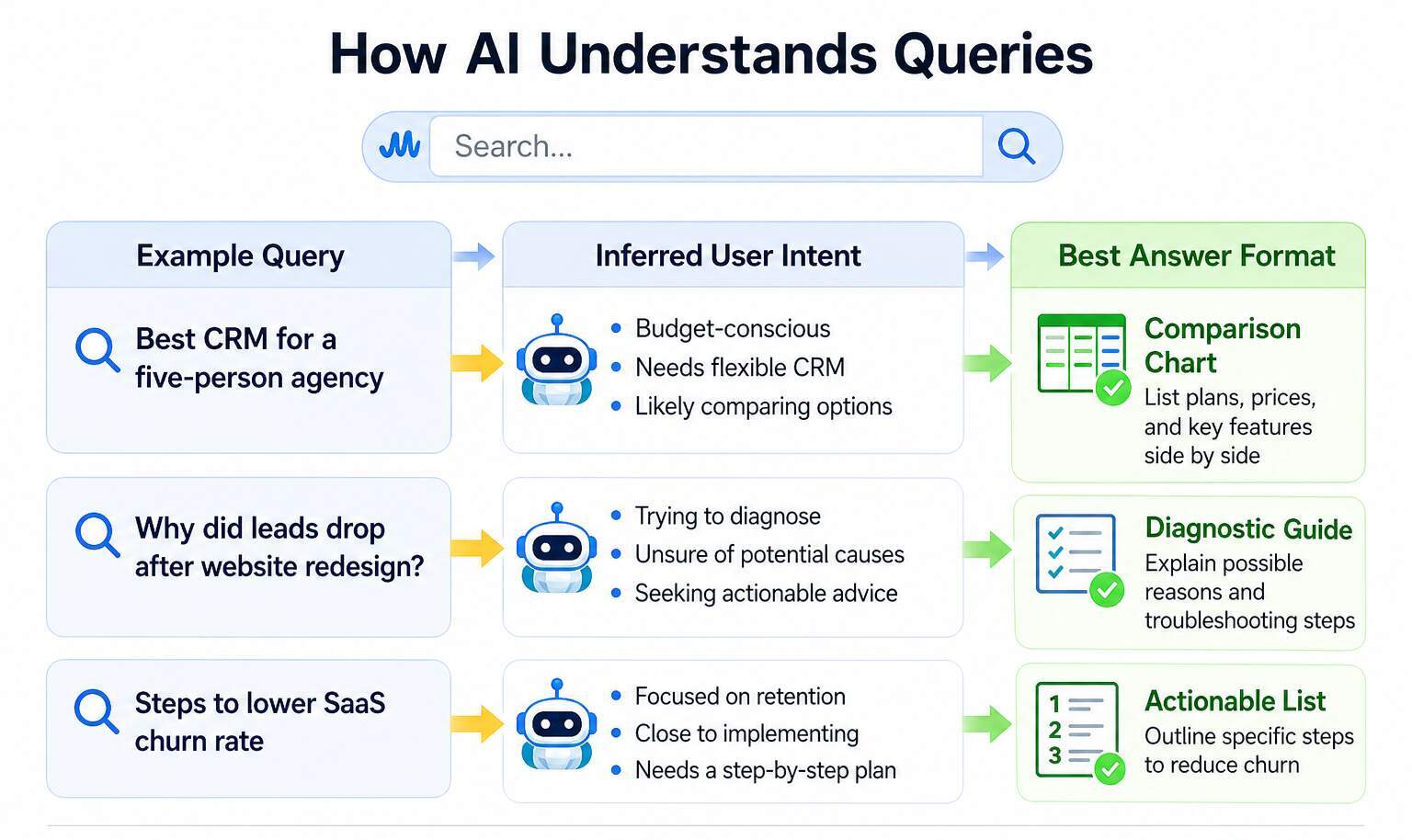
Core Content Evaluation Signals
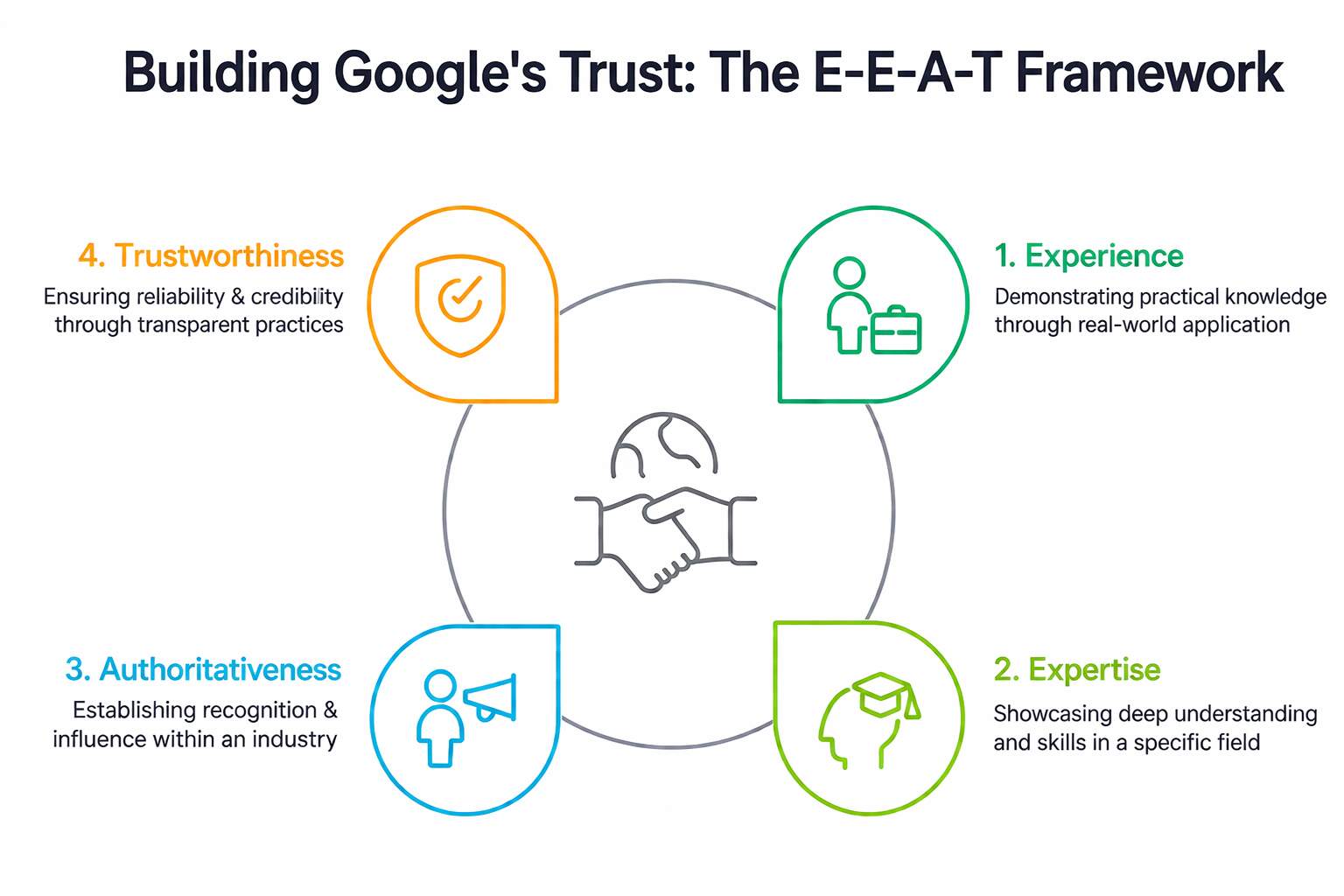
The strongest content signals are not mysterious. Google says its automated systems use many factors to prioritize helpful content, and it explicitly states that trust is the most important aspect of E-E-A-T. It also recommends evaluating content using the “Who, How, and Why” framework, a practical framework for content teams. If your page makes it hard for the author to be identified, hides how claims were formed, or looks created to attract search traffic, you are making selection harder for the engine.
Originality matters too. Google’s ranking systems guide says its original content systems help surface original material prominently, including original reporting. In contrast, the helpful content system was folded into the core ranking systems in March 2024. That means generative search ranking factors are not asking only, “Is this page relevant?” They are also asking, “Did this page add anything?” Pages that merely remix consensus without adding examples or first-hand knowledge are easier to replace. Add entity-based content to that mix, and the page becomes easier to interpret because the people, tools, brands, and concepts are more clearly defined.
One more signal deserves far more attention than it usually gets: evidence density. A claim with a source, a date, and a concrete example travels better than a polished sentence that says almost nothing. For a marketing manager reading AI output, “removing two fields reduced checkout abandonment” is reusable. “We improved UX significantly” is wallpaper. That is why answer engines SEO favors pages that prove the point before they decorate it.
Content Structure for AI Extraction
Even excellent ideas underperform when the page structure buries them. Answer engines need passages they can extract cleanly, and that usually starts with clearer organization, not more words. Google’s Article guidance recommends elements such as the headline, author, publication dates, and images because explicit context reduces ambiguity. That is why content for AI search should feel less like a wall of information and more like a well-built brief: answer first, evidence next, and detail after that.
What strong extraction-friendly formatting usually includes:
- Clear headings tell readers and AI what each section is really about.
- Short paragraphs make important ideas easier to scan, follow, and reuse.
- Direct definitions reduce confusion and help core concepts stand on their own.
- Tables simplify comparisons when the topic involves options, differences, or tradeoffs.
- Mini examples turn abstract advice into practical, concrete, and memorable guidance.
- Consistent formatting makes information feel clearer, more credible, and easier to cite.
This is where format becomes strategy. A strong section does not just explain the topic well; it presents the idea in a way that can be lifted without losing meaning. If you define a concept in a single sentence and support it with a brief scenario, you create multiple clean extraction points. That is smarter conversational search optimization than forcing stiff Q&A patterns into every section. A good structure helps both people and AI understand the point more quickly.
Trust and Authority Factors
Trust and authority are no longer decorative signals. They help determine whether a page feels safe to reuse in an AI-generated response. Google’s guidance around helpful content, authorship, and structured article data all point in the same direction: the clearer the source, the easier it is for both readers and systems to evaluate credibility. That matters even more when the content touches decisions involving money, health, legal matters, or operations, where weak sourcing can quietly damage confidence.
What builds trust first:
- Clear bylines show readers exactly who is speaking and why it matters.
- Recent publication and update dates make the advice feel timely and dependable.
- Real citations support important claims and reduce the risk of vague assertions.
What strengthens authority next:
- Strong author bios clearly demonstrate experience, specialization, and practical subject knowledge.
- Consistent brand expertise across related topics reinforces topical depth and reliability.
- Specific examples make guidance feel earned, not copied, inflated, or generic.
This is where many brands get it wrong. They treat trust as something that lives in a footer, a badge strip, or an about page; few people actually check. Answer engines do not work that way. They evaluate the page in front of them. That is why authority works best when it is visible within the article itself through clear sourcing, relevant expertise, and useful specificity that answers the reader’s doubts before they even ask.

Platform Differences in Evaluation
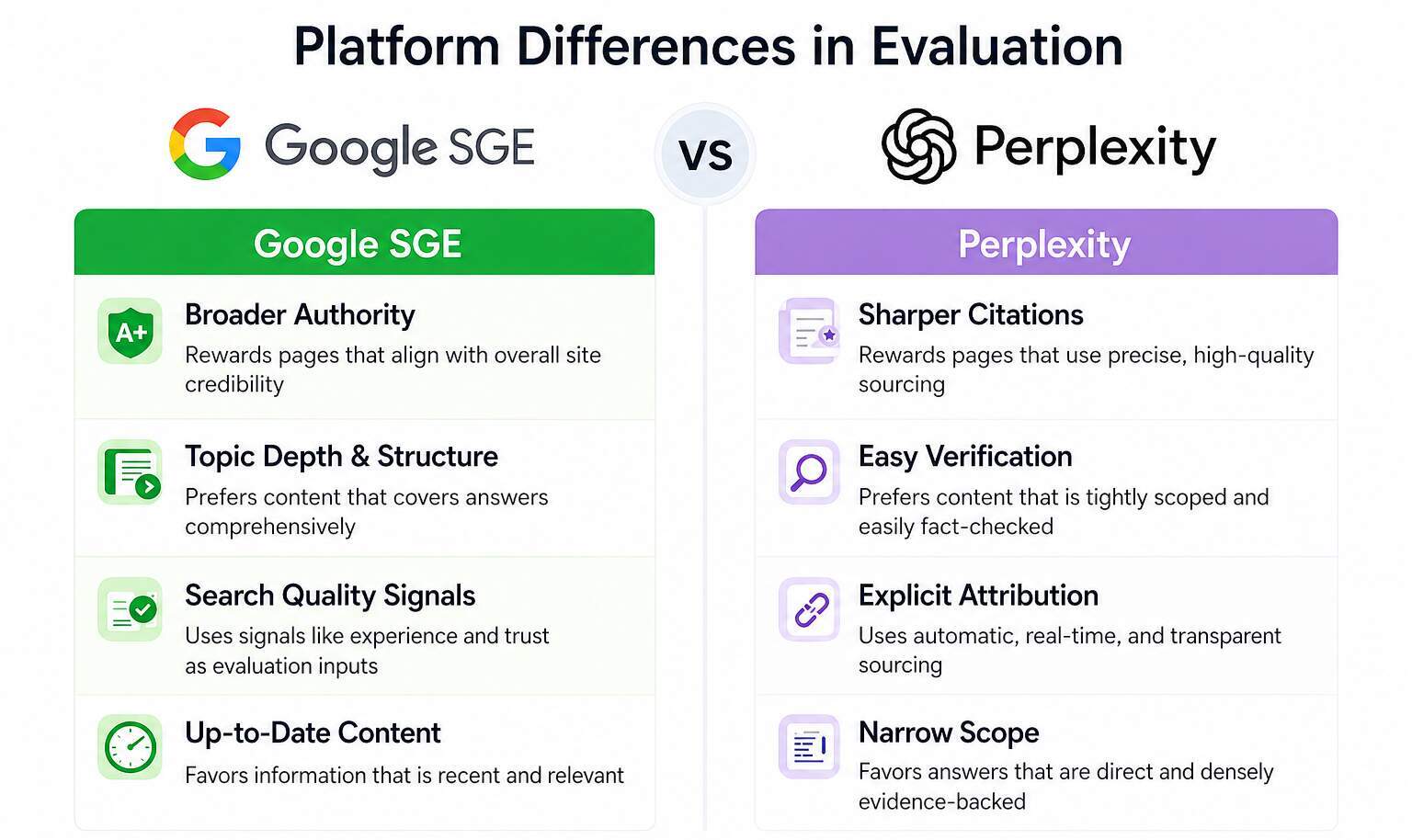
Google and Perplexity both retrieve information from the web, but they evaluate and present that information differently because their products serve different user experiences. Google’s AI search features are rooted in its existing quality and ranking systems, and the company says AI Mode is grounded in those systems while using newer approaches to improve factuality. Perplexity, by contrast, emphasizes real-time search, ranked results, automatic source attribution, and answer transparency across its platform and developer products. That difference matters because the output format shapes the type of evidence each platform prefers.
For content teams, the practical translation is simple. Google SGE optimization tends to reward pages that align with broader search quality signals while still being answer-friendly. Perplexity SEO tends to reward pages that are highly citable, sharply scoped, and easy to verify line by line. One platform behaves like a search giant, adding AI layers; the other behaves more like a citation-first research assistant. Neither wants sloppy pages, but their tolerance for ambiguity differs.
That is why the same page can perform differently across platforms. A well-known brand page with strong site authority but weak sourcing may fare better in Google than in Perplexity. A niche expert page with excellent citations and tight framing may punch above its weight in Perplexity. For teams planning AI-generated answers SEO, the smart move is not picking one engine to please. It is publishing pages that can survive both styles of scrutiny. Strong Perplexity SEO usually starts with cleaner evidence, not louder copy.
The comparison below distills Google’s AI search guidance and Perplexity’s public documentation into a clearer evaluation snapshot for content teams.
| Evaluation lens | Google tends to value | Perplexity tends to value | What that means for writers |
| Query fit | Broad search quality alignment plus answer usefulness | Tight match between query and citable evidence | Open with the clearest answer, then support it |
| Trust cues | Strong authorship, recency, page quality, site context | Visible sourcing, explicit proof, narrow claims | Make evidence obvious, not implied |
| Extraction style | Works within a large search ecosystem | Feels more citation-first and research-led | Write sections that stand alone cleanly |
| Content sweet spot | Helpful pages that can scale across many intents | Specific pages that can survive close scrutiny | Prefer precision over ornamental copy |
Common Mistakes to Avoid
- The most common mistakes are surprisingly ordinary. The first is writing around the answer instead of giving it. Pages open with throat-clearing, vague trend talk, and broad promises, then hide the useful part mid-page. That is a problem because answer engines are built to select the clearest usable passage, not reward suspense. If your article needs three paragraphs before it says anything concrete, it is handing the opportunity to a sharper competitor. That is exactly where a disciplined GEO strategy starts winning.
- The second mistake is publishing generic content that sounds competent but proves nothing. Google’s guidance on generative AI content says creators should focus on accuracy, quality, and relevance, including metadata, titles, structured data, and alt text. Perplexity’s documentation similarly highlights filtering, source control, and extraction. So the issue is not whether an article sounds polished. The issue is whether the claims hold up under inspection. Better AI content evaluation starts by asking one uncomfortable question: if I removed the brand name, would this page still feel authoritative?
- The third mistake is confusing keyword presence with usefulness. Teams still assume that if the phrase appears often enough, the page will sort itself out. It will not. Thin intros, copycat angles, weak examples, and missing dates quietly make content more expensive to publish and easier to ignore. A page must resolve intent, reduce ambiguity, and show real understanding. That is why clean formatting, concrete examples, and direct language are no longer mere style flourishes. They are selection signals, and they are where answer engines SEO outrun lazy content production.
Conclusion: From Ranking to Selection
For years, SEO was largely about one thing: position. Rank higher, get seen, and win the click. That is still part of the picture, but it is no longer the whole game. In AI-driven search, the bigger question is whether your content gets selected to shape the answer itself. That is a very different kind of visibility. It is not just about appearing on the page. It is about being useful enough, clear enough, and credible enough to be pulled into the response.
That shift also changes how content should be measured. When AI summaries reduce clicks and compress the space in which brands can earn attention, performance can no longer be judged by traffic alone. The better question is whether your content influenced the answer, reinforced trust, and moved the user one step closer to action. In this environment, clarity, structure, and credibility carry more weight because they help your content do more than rank. They help it get chosen.
The encouraging part is that the way forward is not complicated. Answer the question early. Support your point with evidence. Make authorship clear. Keep the structure clean. Refresh the page when the topic evolves. None of that is gimmicky. It is simply strong publishing discipline. And as answer engines become more selective, that discipline is what turns a page from just another result into a reliable source.
Ready To Compete Beyond Rankings?
If you want content that goes beyond impressions and earns stronger visibility in AI-driven search, eSign Web Services can help you create content built to be selected, trusted, and remembered. Contact us today and speak with our team about the right strategy for your goals.
Frequently Asked Questions (FAQs)
Question: How do answer engines decide which sources to trust?
Answer: Answer engines evaluate trust based on multiple signals including content accuracy, source credibility, author expertise, and consistency across content. They analyze whether the information aligns with known facts and whether the source has demonstrated authority over time. External validation such as backlinks, mentions, and citations also influence trust. AI systems compare multiple sources to identify consensus and reliability. Content from well-established, authoritative websites is more likely to be selected. Maintaining transparency, providing accurate data, and building a consistent content presence helps improve trustworthiness and increases the chances of being included in AI-generated responses across different platforms.
Question: What makes content “extractable” for AI systems?
Answer: Extractable content is information that AI systems can easily identify, interpret, and reuse within generated responses. It typically includes clear answers, structured formatting, and concise explanations. Content that provides direct responses early, uses bullet points, and maintains logical flow is easier to extract. Avoiding long, complex paragraphs improves extraction efficiency. AI systems prefer content where key information is clearly separated and well-organized. Extractability is critical because answer engines do not display full pages; they extract segments. Optimizing content for extractability increases the likelihood of being selected and included in AI-generated answers across search platforms.
Question: Why do some high-ranking pages not appear in AI answers?
Answer: High-ranking pages may not appear in AI answers because ranking and selection are different processes. While rankings depend on traditional SEO factors, AI inclusion depends on clarity, extractability, and trust. Content that ranks well but lacks direct answers or structured formatting may be ignored. AI systems prioritize content that clearly addresses user intent and provides concise, usable information. Pages optimized only for keywords may fail to meet these criteria. Additionally, weak authority or inconsistent information can reduce selection probability. To appear in AI answers, content must go beyond ranking and meet answer engine evaluation standards.
Question: How important is content freshness for AI search systems?
Answer: Content freshness is important, but it is not always the primary factor in AI evaluation. Answer engines prioritize accuracy, relevance, and authority over recency for most topics. However, for time-sensitive queries such as news or trends, freshness becomes critical. Regularly updating content ensures information remains accurate and competitive. Updated content also signals reliability and ongoing expertise. Businesses should balance freshness with quality by maintaining evergreen content while updating key sections as needed. This approach improves both traditional rankings and AI inclusion by ensuring content remains relevant and trustworthy over time.
Question: Do answer engines use backlinks as a ranking factor?
Answer: Answer engines do not use backlinks in the same way as traditional search engines, but backlinks still play an important role. They act as credibility signals, helping AI systems evaluate trust and authority. Content supported by strong backlinks from reputable sources is more likely to be considered reliable. Backlinks also indicate that content is referenced and valued externally. While they are not directly used for ranking, they influence selection decisions indirectly. Building high-quality backlinks strengthens overall authority, which improves the chances of being included in AI-generated answers and enhances long-term visibility across search platforms.
Question: How does user intent affect AI content evaluation?
Answer: User intent plays a central role in how AI systems evaluate content. Answer engines aim to deliver responses that match what users are actually looking for, not just what they type. They analyze query context, phrasing, and expected outcomes. Content that aligns closely with intent is more likely to be selected. Understanding whether a query is informational, navigational, or transactional helps shape content structure. Addressing intent clearly improves relevance and usability. Content that fails to match intent may be ignored, even if it is well-written. Optimizing for intent ensures better alignment with AI evaluation processes.
Question: What role does content consistency play in AI visibility?
Answer: Content consistency helps build trust and authority over time. Answer engines evaluate whether a website provides reliable and uniform information across multiple pages. Inconsistent messaging can confuse AI systems and weaken credibility. Maintaining consistent terminology, tone, and factual accuracy strengthens entity signals. Regular publishing also reinforces authority within a topic. Consistency improves the likelihood of repeated inclusion in AI-generated responses. It signals that the source is dependable and knowledgeable. Businesses that maintain consistent content strategies achieve better long-term visibility and stronger performance across both traditional and AI-driven search environments.
Question: Can small websites compete in AI-generated search results?
Answer: Yes, small websites can compete if they focus on quality, clarity, and authority within a specific niche. Answer engines prioritize relevance and usefulness over size. A smaller website that provides highly focused, well-structured content can outperform larger competitors in specific topics. Building topical authority within a niche increases selection probability. Clear entity definition and strong content structure improve visibility. Consistency and expertise are key factors. Small websites should avoid competing broadly and instead focus on specialized areas where they can demonstrate authority and deliver high-value answers aligned with user intent.
Question: How do answer engines handle conflicting information across sources?
Answer: Answer engines compare multiple sources to identify the most accurate and reliable information. When conflicting data exists, they prioritize content from trusted and authoritative sources. Consistency across credible sources increases selection probability. AI systems may also present balanced answers if multiple perspectives are relevant. Content that provides clear evidence, references, and accurate data is more likely to be selected. Reducing ambiguity and ensuring factual correctness improves trust. Businesses should focus on accuracy and credibility to ensure their content is chosen when multiple sources provide different or conflicting information.
Question: How should businesses measure success in AI-driven search environments?
Answer: Success in AI-driven search should be measured beyond traditional rankings. Metrics such as visibility in AI-generated answers, brand mentions, and inclusion frequency become important. Tracking impressions, engagement, and user interactions helps evaluate performance. Monitoring how often content is referenced or cited in AI responses provides insights. Conversion rates and user behavior also indicate effectiveness. Businesses should focus on authority growth, topical coverage, and consistency. Combining traditional SEO metrics with AI-specific indicators provides a complete view. This approach ensures strategies align with evolving search behavior and deliver long-term results.
Author Details

Ashwani Kumar Sharma
Ashwani has been actively involved in SEO services since 2005. His expertise and distinctive work approaches have made him one of the most experienced and trusted SEO experts in the industry. He is a certified SEO and Google Ads professional. He also has strong business development skills in advanced SEO, PPC, and digital marketing strategies.


