



How Google Judges Content Quality Today: Signals That Influence Rankings

Key takeaways
- Google rewards content that genuinely helps people; not just keyword-stuffed pages.
- Matching your content format to search intent is half the ranking battle won.
- Real depth means answering follow-up questions, not just padding your word count.
- E-E-A-T isn’t a checklist; it’s the trust readers decide in seconds.
- Behavioral signals don’t lie; if readers leave fast, rankings will follow.
- A slow, broken page wastes great content before anyone even reads it.
- Structure isn’t decoration; clear headings and flow are ranking signals too.
Every second, millions of searches land on Google; and Google has one job: surface the page that actually deserves to be there. Not the most keyword-heavy page. Not the one with the flashiest design. The one that answers what the person was looking for, in a way that feels trustworthy, clear, and genuinely worth their time. That bar has never been higher than it is right now, and understanding Google content quality signals is the first step to rising above it.
Most businesses know content matters. What they struggle to understand is why their content isn’t ranking; even when it looks polished. The answer is rarely one big failure. It’s a set of small, compounding gaps: intent slightly off, authority not visible enough, structure a little loose, page speed just slow enough to lose someone. Understanding how Google ranks content means seeing how these signals connect; and knowing where your real leverage is.
This guide covers the six Google content quality signals shaping rankings in 2026. Not abstract theory; each one is practical, specific, and tied to how Google actually evaluates pages in a world where AI summaries, behavioral signals, and search intent all factor into what rises and what stays buried.
How Content Quality Evaluation Has Changed
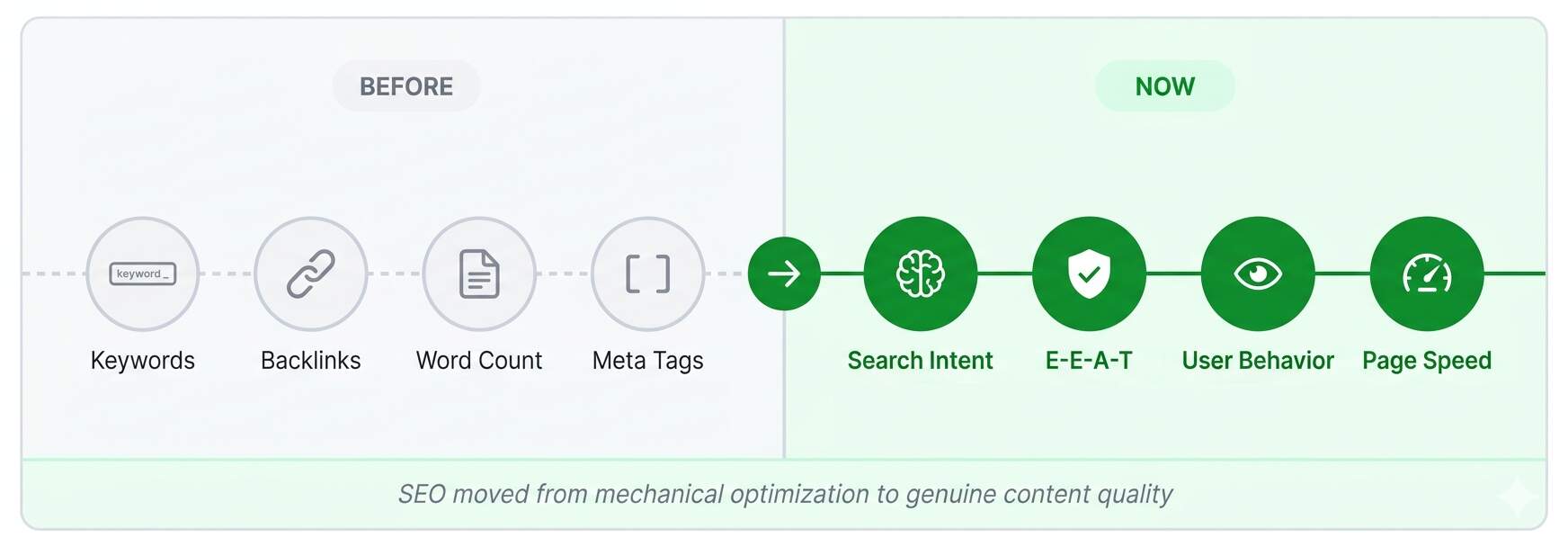
Not long ago, SEO was a fairly mechanical exercise. Use the right keywords, build some links, and rankings would follow. That worked; until Google got significantly better at understanding what a page actually says, and whether it genuinely helps the person reading it. Today, a keyword-heavy page with little real substance routinely gets outranked by a well-written piece that earns the reader’s time. The shift from optimization to editorial quality is not a trend. It is the new baseline, and it’s driven entirely by Google algorithm signals that reward real value over mechanical optimization.
What has fundamentally shifted inside the ranking game:
- Google content quality signals now reward clarity, usefulness, structure, and real-world relevance consistently.
- Keywords still matter, but context now decides whether they deserve attention.
- Thin rewrites lose ground fast when competitors add examples, proof, and original insight.
- Search visibility is driven by meaning and intent, not mechanical keyword repetition.
- Helpful content feels built for readers first, and optimized for rankings second.
The SEO ranking factors 2026 that hold their value are the ones built around this shift: content quality SEO that serves genuine intent, demonstrates real expertise, loads without friction, and treats the reader’s time as something worth respecting. These are not tactics you bolt on before publishing. They are the foundation you build on before writing begins. Teams that internalize this distinction are the ones producing content that survives algorithm updates instead of scrambling after them.
Core Signal 1: Search Intent Alignment
Every search query has a job behind it. Someone typing “best CRM for startups” is in evaluation mode; comparing features, weighing cost, trying to make a decision. Someone typing “what is CRM” just wants a clear explanation. The topic is the same. The intent is completely different. When content answers the wrong job, it fails the searcher, and these are precisely the kinds of Google content quality signals Google measures fastest.
Intent patterns every content team should build around:
- “What is” searches need simple definitions and grounded examples readers can trust.
- “Best” searches need honest comparisons, real pricing context, and clear decision guidance.
- “How to” searches need steps, common mistakes flagged, and outcomes readers can act on.
- “Near me” searches need location trust signals, clearly listed services, and fast contact options.
- “Cost” searches need realistic price ranges, key variables explained, and a clear next step.
Strong search intent optimization is what separates content that holds a ranking from content that briefly visits one. Backlinko analysis of around four million Google results found the top organic result captures 27.6% of clicks, while fewer than 1% of users ever reach page two. That is not a rounding error — it’s real pipeline walking away. Matching format to intent is the single clearest way to improve content quality and close that gap.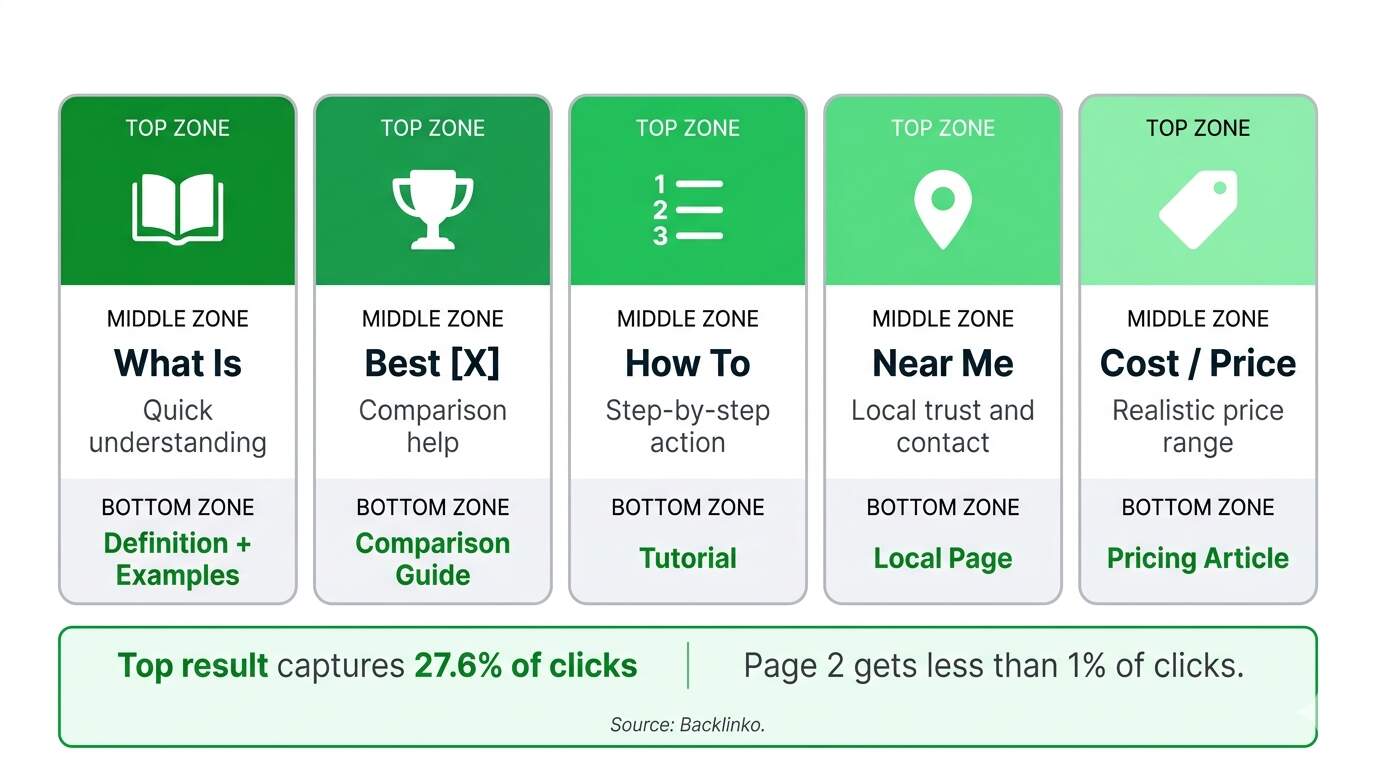
Core Signal 2: Content Depth and Real Value
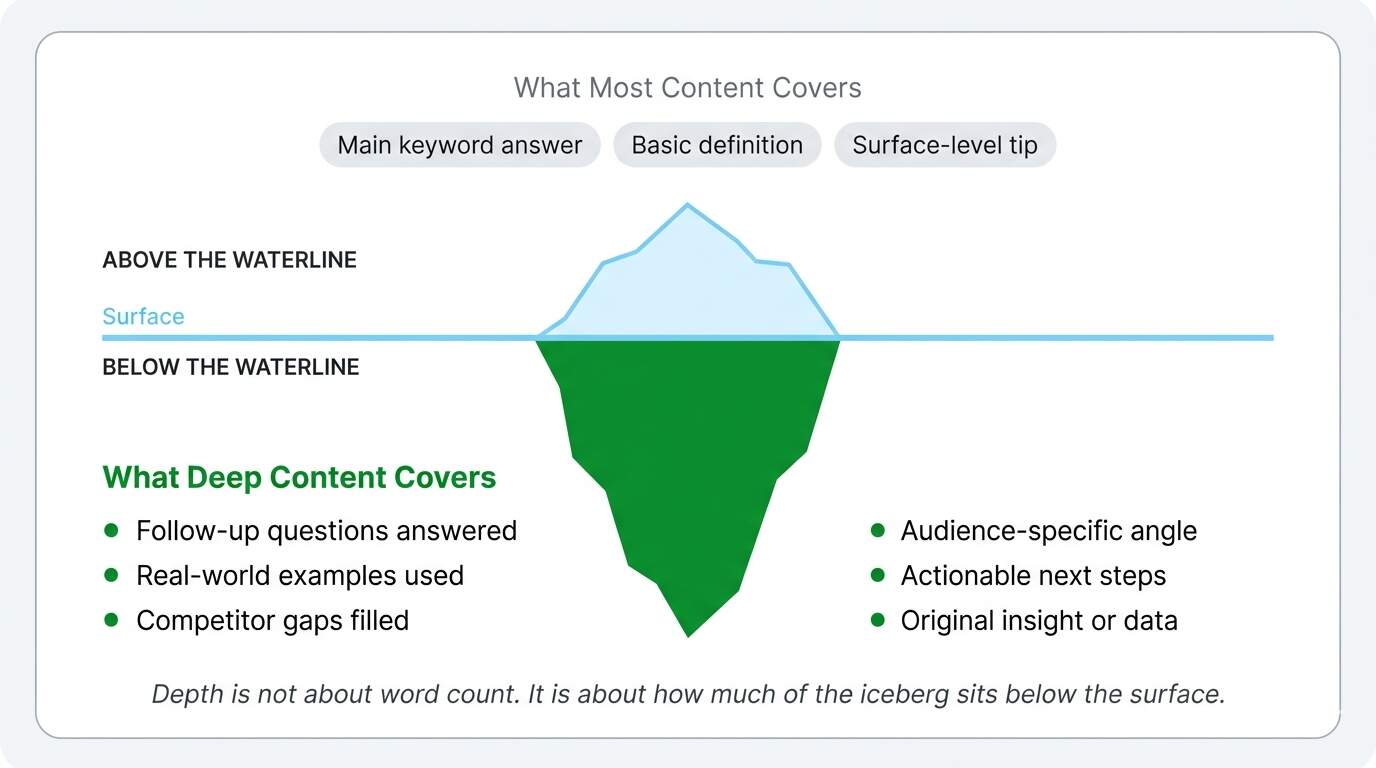
Depth is not about length. A 3,000-word article that circles the same three points is not deep; it is padded. Real depth means covering what the searchher actually needs to know, handling the follow-up questions they will naturally have, and delivering something they couldn’t get from skimming the first five results. That kind of content drives strong content performance factors; dwell time, engagement, and return visits, because it makes people stay.
What genuine depth looks like when executed well:
- Answers the main query directly, without making readers wade through unnecessary background.
- Covers follow-up doubts that users typically search immediately after the main answer.
- Uses real examples that make advice feel grounded and immediately applicable.
- Brings a fresh angle instead of summarizing what ten other articles already said.
- Removes bloated sections that add word count but nothing the reader will remember.
A focused content optimization strategy starts before the writing does: map the full topic, find the gaps competitors missed, and cut anything that serves the word count rather than the reader. Different audiences need different kinds of depth too. A startup founder wants a concise, actionable framework. A marketing director wants benchmarks and diagnostics. A small business owner wants plain-English explanations they can act on today. Depth is not one size — it is knowing your reader and refusing to waste their time.
Core Signal 3: E-E-A-T and Content Authority
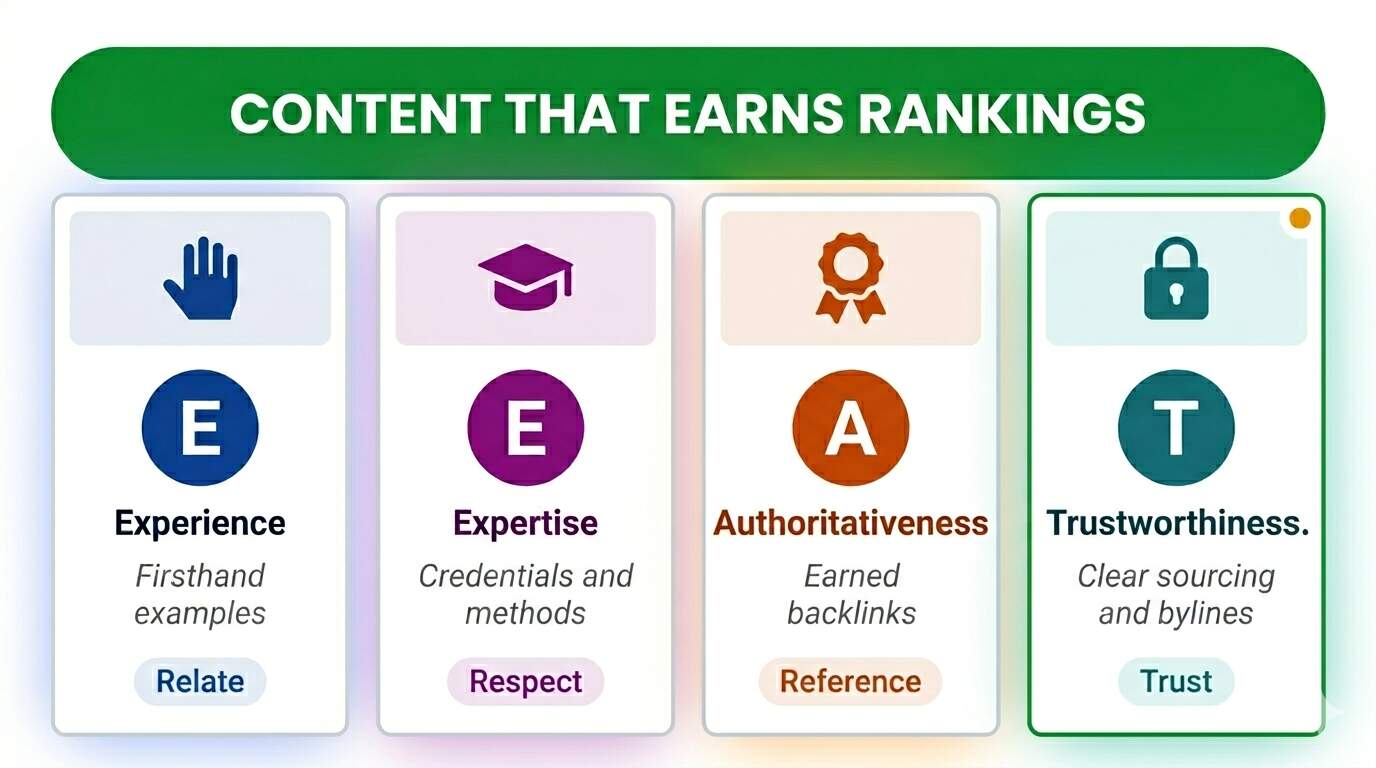
Credibility is not something you declare, it is something readers decide, usually within the first few seconds of landing on a page. E-E-A-T SEO; Experience, Expertise, Authoritativeness, and Trustworthiness; is Google’s framework for evaluating exactly that. It matters most for content that touches health, money, safety, or life decisions, but its influence has expanded well beyond those categories. If a reader has no reason to trust the page, they leave, and that behavior feeds directly back into Google content quality signals.
Trust signals readers notice and act on within seconds:
- Clear bylines show a real, accountable person stands behind what is being said.
- Updated publish dates signal the content has not been left to quietly go stale.
- Source links let curious readers verify claims rather than just take your word for it.
- Consistent brand voice communicates genuine specialization, not generalist content farming.
- Specific, firsthand examples prove the author has actually worked through the problem.
Building strong content authority SEO is less about credentials and more about evidence. A generic post says “improve your website speed.” A credible one explains which metric to fix first, why it affects conversion specifically, and what the fix looks like in practice. That specificity is what separates content people trust from content people skim and close. Add a named author, a clear last-updated date, and at least a few citations. These are small additions that do a lot of quiet work toward stronger ranking factors Google actually rewards.32
E-E-A-T at a Glance
| E-E-A-T Element | What It Signals to Google and Readers |
| Experience | Real-world exposure and hands-on knowledge of the topic being covered |
| Expertise | Deep knowledge shown through credentials, case studies, and tested methods |
| Authoritativeness | Citations, earned backlinks, and mentions from trusted, established sources |
| Trustworthiness | Transparency, factual accuracy, clear sourcing, and an honest editorial tone |
Core Signal 4: User Engagement Signals
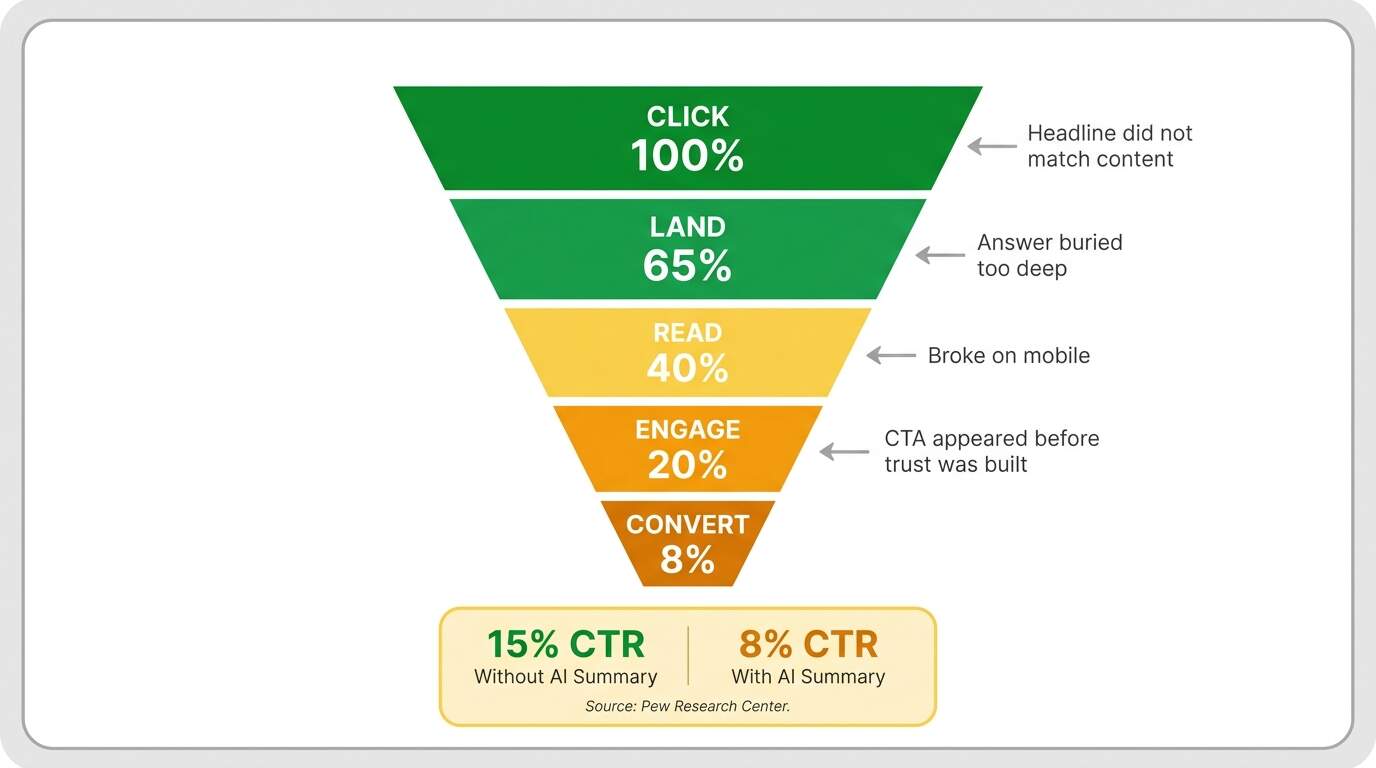
A strong title gets the click. After that, the page is on its own. User engagement signals; scroll depth, time on page, return visits, interaction patterns, tell Google whether the page delivered on the promise it made in the search results. When it does, the page holds its position. When it doesn’t, Google content quality signals register the failure and rankings slip regardless of how thoroughly optimized everything else looks on paper.
Engagement problems that quietly erode rankings over time:
- Headline promised a thorough guide but the page only delivered a shallow overview.
- The real answer was buried after three paragraphs of unnecessary setup and context.
- The layout was uncomfortable on mobile, so the reader bounced before finding value.
- Content explained the topic in theory but never addressed the reader’s actual problem.
- A call-to-action appeared before the page had earned anywhere near enough trust.
Pew Research Center found that when an AI summary appeared in search results, clicks to traditional results dropped from 15% to just 8%. That shift changes the math considerably, every click earned now carries more weight, and every page that fails to hold that visitor wastes a harder-won opportunity. Metrics like scroll depth, internal link movement, and assisted conversions tell the real story of whether content is performing. These are among the most reliable AI search signals for long-term ranking health.
How AI Summaries Change Click Behavior
| Scenario | Click Rate |
| Traditional result — with AI summary present | 8% |
| Traditional result — without AI summary | 15% |
| Direct click on AI summary source link | 1% |
Core Signal 5: Technical SEO Foundations
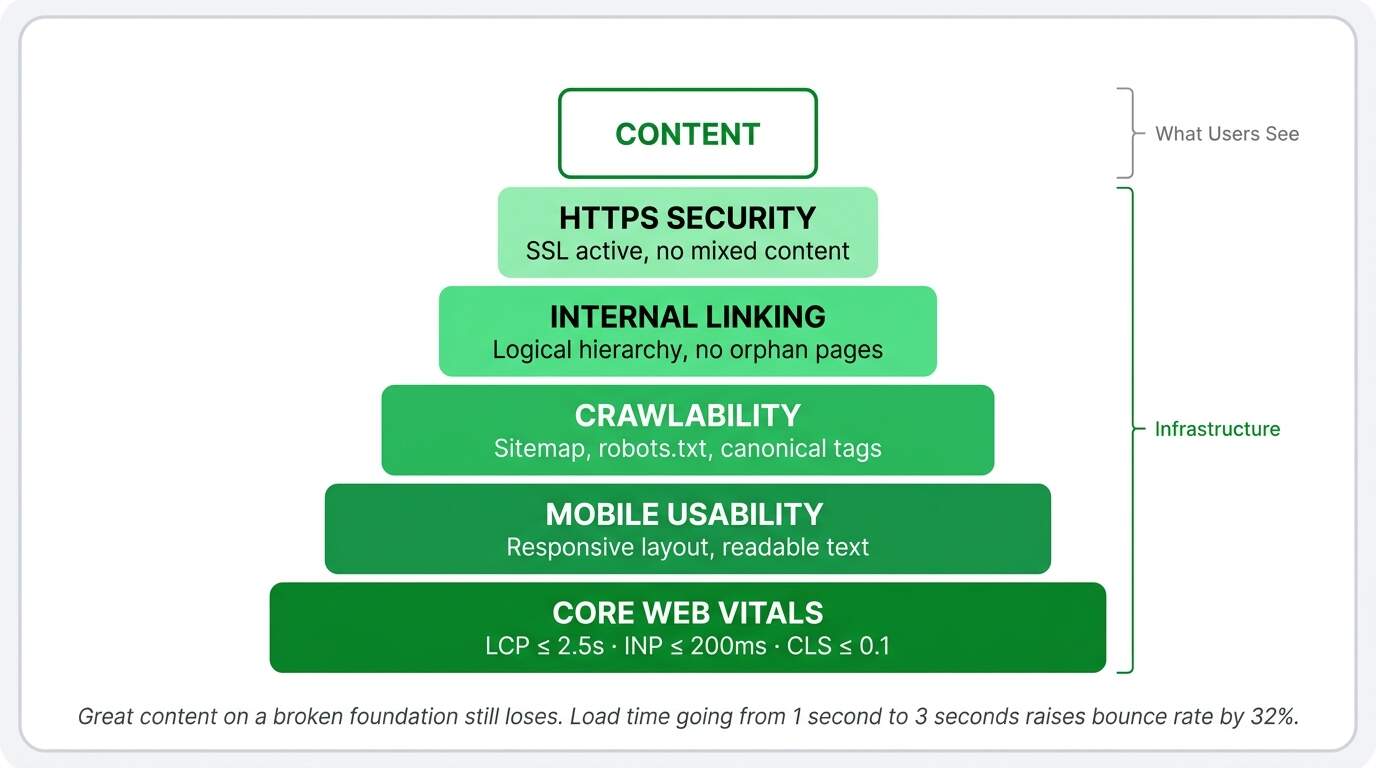
Great content buried behind poor technical performance is still poor-performing content. A slow load time, a broken mobile layout, or a crawl error does not just frustrate users; it prevents Google from properly evaluating what the page says. Technical SEO signals are the infrastructure everything else depends on, and they are some of the most direct Google algorithm signals in the entire ranking system. When they work, they are invisible. When they don’t, they quietly undermine every other investment in content quality.
Technical friction users feel the moment they land on a page:
- Slow load times make even genuinely helpful content feel untrustworthy and unpolished.
- Broken layouts turn good information into a frustrating experience that ends with back-click.
- Poor mobile design means pinching, zooming, frustration, and users who never come back.
- Indexing issues prevent well-written pages from being discovered or evaluated at all.
- Weak internal linking leaves important content invisible to both crawlers and readers.
Core Web Vitals give every content team a concrete target: LCP at 2.5 seconds or under, INP at 200 milliseconds or under, and CLS at 0.1 or below. These are not aspirational benchmarks; they are the thresholds where real user patience runs out. Google’s own data shows a 32% increase in bounce probability when load time goes from one second to three. Fixing these technical SEO signals is one of the fastest ways to improve content quality without changing a single word of copy.
Core Web Vitals — Performance Benchmarks
| Vital | What It Measures | Good Threshold |
| LCP | Load performance of the main visible content | ≤ 2.5 seconds |
| INP | Page interactivity and responsiveness to user input | ≤ 200 milliseconds |
| CLS | Visual stability and layout consistency during load | ≤ 0.1 |
Core Signal 6: Content Structure and Clarity
Readers do not read; they scan first, then decide whether to commit. If a page doesn’t make it immediately clear what each section covers and why it matters, most people move on before they’ve reached anything useful. Semantic SEO depends on structure the same way: clear headings, logical flow, and a predictable path from question to answer help Google understand what a page is actually about, and these structural choices are measurable Google content quality signals in their own right.
How strong structure actively supports both rankings and readability:
- Headings tell readers what each section solves before they decide whether to read it.
- Short paragraphs make the page scannable without sacrificing depth or substance.
- Lists simplify complex information without breaking the logical flow of the piece.
- Examples ground abstract strategy in decisions that feel real and immediately relevant.
- FAQs handle the lingering questions readers carry into the final sections of a page.
Structure is one of the most underrated SEO ranking factors 2026 because its impact is felt before the algorithm even gets involved. It is also one of the simplest ways to improve content quality across an existing content library. A simple test: read only the H2 and H3 headings of any article before publishing. If they tell a clear, logical story from top to bottom, the structure is working. If they feel generic or disconnected, the content needs another pass. It takes five minutes and catches more issues than most full rewrites do.
The Verdict: Quality Is a System, Not a Tactic
Ranking in 2026 is not about chasing the newest SEO trick. It is about creating content that earns attention through clear intent, useful depth, visible trust, strong engagement, solid technical health, and reader-friendly structure. These signals work together. When one is weak, the whole page feels less convincing.
The best place to start is your existing content. Review pages that already get impressions but are not earning enough clicks, leads, or conversions. Sharpen the intent. Make expertise easier to see. Improve the flow. Fix technical issues. Updating these pages often works faster than publishing something new because the visibility is already there; the page just needs a stronger reason to win.
The brands that grow through search will not be the ones publishing the most. They will be the ones improving consistently, with clear standards behind every piece of content. Quality built into the process compounds. Quality added later rarely does.
Stop Guessing. Start Ranking.
Your competitors are already optimizing for every Google content quality signal in this guide. Every day without a content quality SEO strategy is ground lost. Let eSign Web Services audit your top pages, identify what’s holding them back, and build a system that earns rankings built to last. Get Your Free Content Audit Today
Frequently Asked Questions (FAQS)
Question: How does Google determine whether content is high quality?
Answer: Google determines content quality by evaluating multiple signals that reflect relevance, usefulness, and trustworthiness. It analyzes how well content satisfies user intent, the depth of information provided, and the credibility of the source. Engagement metrics such as time on page and interaction also influence quality perception. Technical factors ensure accessibility and usability. Google’s systems aim to deliver the most helpful results. Content that provides clear, accurate, and valuable information performs better. Businesses should focus on user experience, originality, and authority to meet these standards and achieve better rankings.
Question: What is the role of E-E-A-T in content ranking?
Answer: E-E-A-T stands for Experience, Expertise, Authoritativeness, and Trustworthiness. It plays a significant role in how Google evaluates content quality. Content created by knowledgeable sources is more likely to rank well. Demonstrating expertise through accurate information improves credibility. Authority is built through recognition and references from other trusted sources. Trustworthiness is essential for user confidence. While E-E-A-T is not a direct ranking factor, it influences how algorithms interpret content quality. Businesses should focus on building strong expertise and credibility signals. This improves rankings and ensures long-term visibility in search results.
Question: Why is search intent important for SEO performance?
Answer: Search intent is important because it defines what users expect when they perform a query. Google prioritizes content that best matches this expectation. If content does not align with intent, it struggles to rank regardless of optimization. Understanding intent helps create relevant and useful content. Informational, navigational, and transactional intents require different approaches. Aligning content with user needs improves engagement and satisfaction. This leads to better rankings and visibility. Businesses should analyze search behavior and tailor content accordingly. Focusing on intent ensures content delivers value and meets user expectations effectively.
Question: How does user engagement affect content rankings?
Answer: User engagement provides signals that indicate how valuable content is to visitors. Metrics such as dwell time, bounce rate, and interaction levels help Google understand user satisfaction. High engagement suggests that content meets expectations, while low engagement indicates issues. Improving readability, structure, and relevance enhances engagement. Content that keeps users interested performs better in search results. Engagement signals help refine ranking decisions. Businesses should focus on creating content that encourages interaction and delivers value. Strong engagement improves visibility and supports long-term SEO success.
Question: Can technical SEO issues impact content quality perception?
Answer: Yes, technical SEO issues can impact how Google perceives content quality. Problems such as slow loading speed, poor mobile usability, and indexing errors reduce accessibility. Even high-quality content may fail if users cannot access it easily. Technical issues also affect user experience, which influences engagement. Ensuring proper site performance improves visibility and usability. Regular audits help identify and fix technical problems. Businesses should maintain strong technical foundations to support content performance. Addressing these issues ensures content can be effectively evaluated and ranked by search engines.
Question: What makes content more trustworthy in Google’s eyes?
Answer: Trustworthy content is accurate, transparent, and created by credible sources. Including author information and citing reliable references improves trust. Consistent branding and positive reputation also contribute. Secure websites and clear policies enhance credibility. User reviews and testimonials strengthen trust signals. Google evaluates these factors to determine reliability. Content that demonstrates honesty and expertise performs better. Businesses should focus on building credibility through consistent quality and transparency. Trust is essential for both rankings and user confidence.
Question: How often should content be updated for better rankings?
Answer: Content should be updated regularly to maintain relevance and accuracy. Search engines prefer fresh and up-to-date information. Updating content improves performance and ensures it reflects current trends. Frequency depends on the topic and industry. Highly dynamic topics require frequent updates, while evergreen content needs periodic revisions. Monitoring performance helps identify when updates are needed. Adding new information, improving structure, and optimizing keywords enhance effectiveness. Regular updates signal to Google that content remains valuable. Businesses should adopt a consistent update strategy. This ensures sustained visibility and better rankings over time.
Question: Does content length affect Google rankings?
Answer: Content length alone does not determine rankings, but it can influence performance. Longer content often provides more comprehensive information, which improves value. However, quality is more important than length. Content should be as long as necessary to answer user queries effectively. Short content can rank if it meets user needs. Overly long content without value may reduce engagement. Balancing depth and clarity is essential. Businesses should focus on delivering useful information rather than increasing word count. Well-structured content improves readability and performance.
Question: What are common content quality mistakes businesses make?
Answer: Common mistakes include focusing only on keywords, ignoring user intent, and creating thin content. Poor structure reduces readability. Lack of originality makes content less competitive. Many businesses overlook technical issues and fail to optimize for mobile users. Inconsistent updates weaken performance. Ignoring engagement signals limits improvement. Content that does not provide value struggles to rank. Avoiding these mistakes requires a strategic approach. Businesses should focus on quality, relevance, and consistency. Identifying and fixing these issues improves content performance and ranking potential.
Question: How can businesses improve content quality for better rankings?
Answer: Improving content quality requires a comprehensive approach. Businesses should focus on understanding user intent and providing valuable information. Clear structure and readability enhance user experience. Adding depth and unique insights improves authority. Regular updates ensure relevance. Optimizing technical performance supports accessibility. Monitoring engagement metrics helps refine content. Using data-driven strategies improves effectiveness. Consistency in publishing strengthens authority. Businesses should prioritize quality over quantity. A strategic approach ensures better rankings and long-term success in search results.
Author Details

Ashwani Kumar Sharma
Ashwani has been actively involved in SEO services since 2005. His expertise and distinctive work approaches have made him one of the most experienced and trusted SEO experts in the industry. He is a certified SEO and Google Ads professional. He also has strong business development skills in advanced SEO, PPC, and digital marketing strategies.


