



Google Draws the Line: Hijacking the Back Button Is Now a Spam Violation

Key Takeaways
- The Google spam policy back button hijacking update officially designates the practice as a malicious spam violation.
- Google announced the policy on April 13, 2026, with enforcement beginning June 15, 2026.
- Sites in violation may face manual spam actions or automated demotions in Google Search.
- Third-party libraries and advertising platforms can cause the issue, not just code written directly by site owners.
- Website owners should review scripts, integrations, and browser-history behavior to avoid potential violations.
Google has officially added back button hijacking to its spam policies, putting websites that interfere with normal browser navigation on notice. Announced through the Google Search Central Blog, the Google spam policy back button hijacking update makes the practice an explicit violation under Google’s malicious practices policy. Enforcement begins on June 15, 2026.
That leaves website owners with a limited window to identify and remove scripts or configurations that interfere with how visitors use their browser’s back button. Google says pages using this practice may face manual spam actions or automated demotions that can affect their performance in Search.
What Back Button Hijacking Actually Means
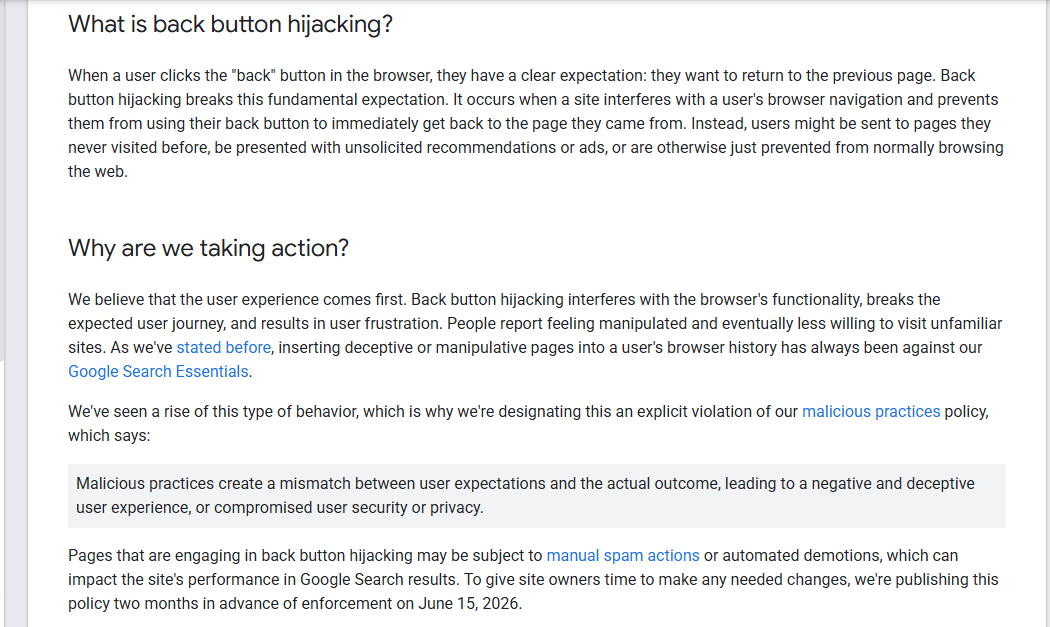
When someone clicks the back button in their browser, they expect to return to the page they previously visited. Back button hijacking breaks that expected behavior by interfering with browser navigation or manipulating browsing history.
Instead of returning normally, users may be redirected to pages they never visited, shown unsolicited advertisements or recommendations, or prevented from navigating back altogether. Google considers this deceptive because it creates a mismatch between what users expect and what actually happens.
This concern is not entirely new. Google discussed manipulative or deceptive browser behavior as far back as 2013. What’s different now is that back button hijacking is specifically named in Google’s current spam policies, removing uncertainty about whether the practice can trigger spam enforcement.
Third-Party Code Is Not an Excuse
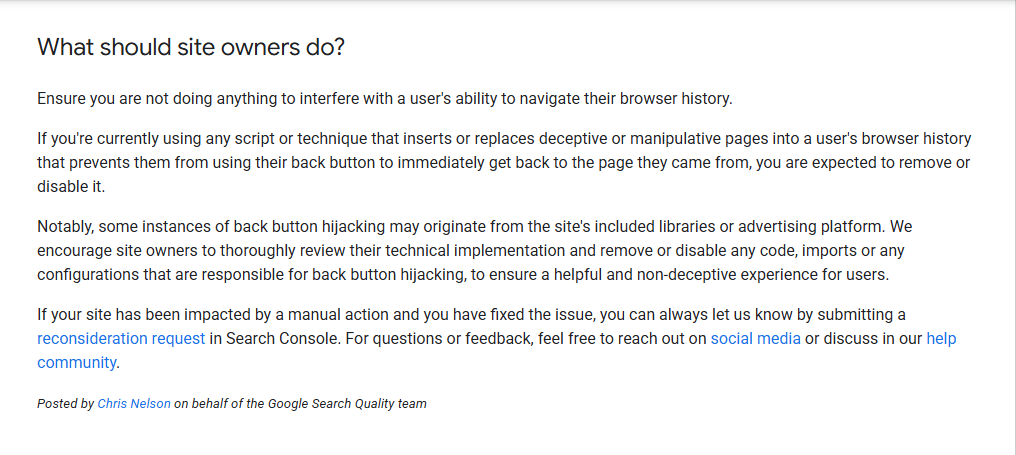
One of the most important parts of Google’s announcement involves third-party code. Back button hijacking may not always come from scripts written directly by the website owner. Google specifically notes that included libraries and advertising platforms can also cause the behavior.
That means website owners need to look beyond their own development work. Advertising scripts, external libraries, content widgets, monetization tools, and other integrations should be reviewed to make sure they are not modifying browser history or interfering with normal navigation. If problematic code is running through your website, Google recommends removing or disabling the responsible code, import, or configuration.
What to Do Before June 15
Website owners using advertising scripts, engagement widgets, third-party libraries, or content tools should review their technical implementation before enforcement begins.
Start by checking whether any script or integration inserts, replaces, or manipulates pages in a visitor’s browser history. Test the back button across important pages and pay particular attention to areas where third-party scripts, advertising platforms, pop-ups, recommendation widgets, or monetization tools are active.
If suspicious behavior appears, identify the responsible integration and remove, disable, or reconfigure it before June 15. Google also confirms that websites affected by a manual action can fix the problem and submit a reconsideration request through Google Search Console.
Wrapping Up
The Google spam policy back button hijacking update sends a clear message: websites should not manipulate basic browser behavior in ways that confuse or trap users.
For businesses working with digital marketing partners like eSign Web Services, this policy update is a useful reason to review third-party scripts, advertising integrations, and website functionality before they become a search visibility problem.
Google’s June 15 enforcement date makes proactive auditing especially important. When third-party code runs on your website, understanding exactly what it does is now more important than ever.
Author Details

Ashwani Kumar Sharma
Ashwani has been actively involved in SEO services since 2005. His expertise and distinctive work approaches have made him one of the most experienced and trusted SEO experts in the industry. He is a certified SEO and Google Ads professional. He also has strong business development skills in advanced SEO, PPC, and digital marketing strategies.


