


AEO vs. GEO vs. SEO: What’s the Difference, and Which One Does Your Business Need?

Key Takeaways
- SEO, AEO, and GEO are closely related rather than three completely separate marketing disciplines.
- SEO focuses broadly on making content discoverable, crawlable, useful, and competitive in traditional and evolving search experiences.
- AEO generally describes the practice of structuring and improving content so search systems can clearly understand and surface direct answers.
- GEO is commonly used to describe efforts to improve visibility within generative AI search experiences and AI-generated answers.
- Google itself does not treat AEO or GEO as separate ranking systems and has warned against supposed AEO/GEO “hacks” that do not match how Google Search actually works.
- Google says standard SEO best practices remain relevant for AI Overviews, AI Mode, and other generative search features.
- Structured data can help Google understand page content and qualify pages for supported search features, but no special schema is required specifically for generative AI search.
- Most businesses do not need three separate strategies. They need one strong search visibility strategy built around useful content, technical accessibility, clear answers, authority, and measurable business outcomes.
A few years ago, SEO was the first thing businesses thought about when trying to improve their visibility on Google. Today, terms like AEO and GEO are becoming more common, especially as AI-generated answers change how people find information online. Naturally, this has left many business owners with questions. Is their current SEO strategy still effective? Do they need to follow three different approaches? Should they update existing pages or start creating new content? With new marketing trends appearing so often, it can be difficult to know what actually matters. The good news is that SEO, AEO, and GEO share many of the same principles, despite their different names.
In this blog, we’ll break down AEO vs GEO vs SEO in practical terms, explain where they differ, and show how they work together. We’ll also look at Google’s guidance, the role of structured data, and the changes worth making to your content. By the end, you’ll have a clearer idea of where your business should focus its efforts.
What Does SEO Actually Mean Today?
Search Engine Optimization has come a long way from simply placing keywords in website content and hoping to rank on Google. It now covers almost everything that helps search engines discover a website, understand its pages, and decide whether the information deserves to appear for a particular search. There’s also the visitor to consider. Getting someone onto a page means little if they can’t find what they need or understand what to do next.
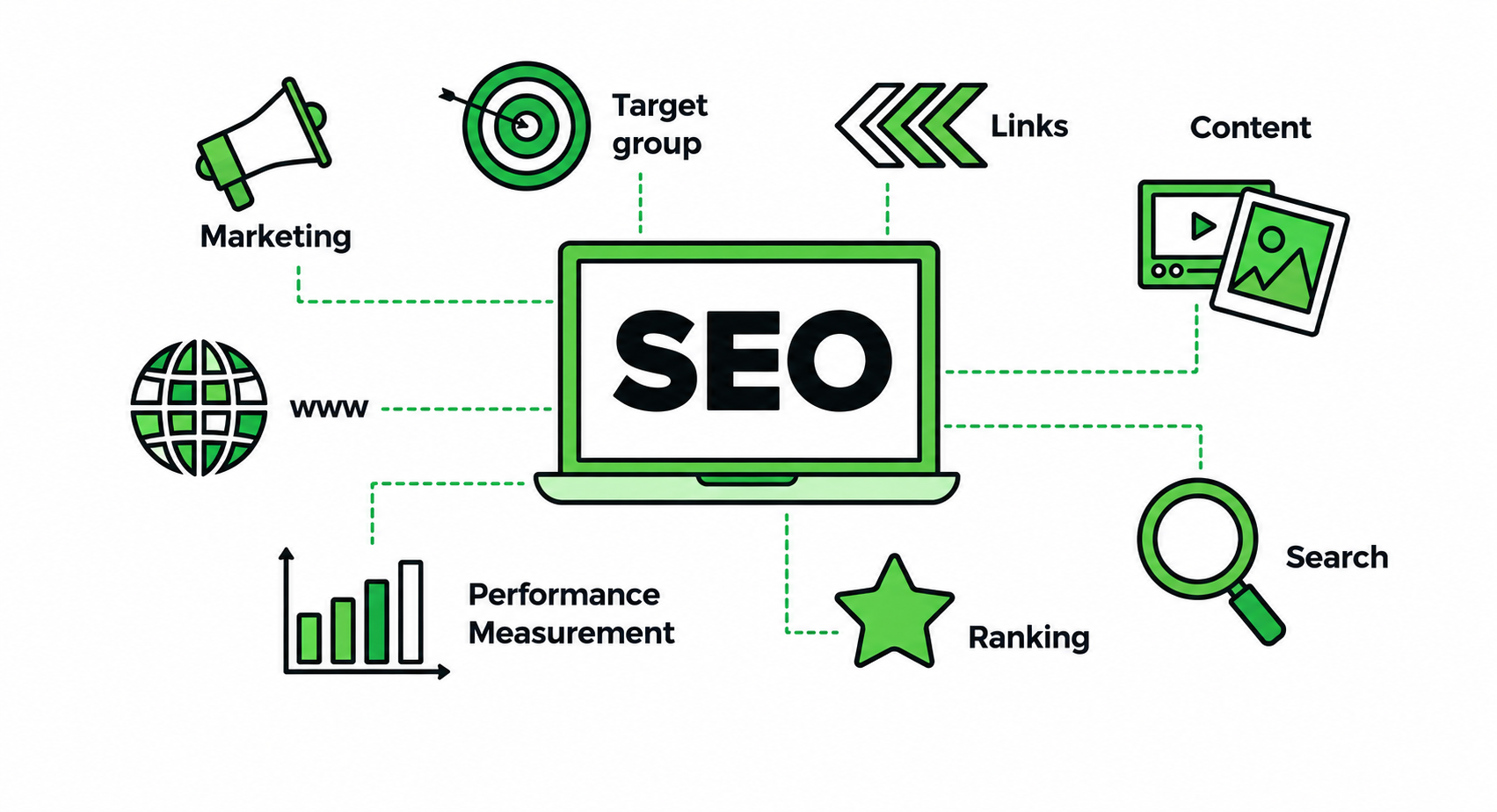
A modern organic search strategy usually involves several areas:
- Crawlability and indexing: Making sure search engines can discover and process important pages.
- Search intent: Understanding what someone hopes to find when entering a query.
- Content quality: Providing useful, accurate information that answers real questions.
- Site architecture: Organizing pages so visitors can move through the website without confusion.
- Internal links: Connecting related content and making important pages easier to discover.
- Authority: Demonstrating knowledge, credibility, and a trustworthy business presence.
- Page experience: Making the website accessible, responsive, and easy to use.
- Structured data: Providing additional context through appropriate machine-readable markup.
- Multimedia visibility: Helping images and videos contribute to the page’s usefulness.
- Local search: Making relevant business information available to nearby customers.
- Conversion paths: Helping visitors move from finding information to making an enquiry or purchase.
These elements support one another. Great content won’t reach its potential if search engines struggle to access it. Equally, a technically perfect website won’t achieve much if its pages offer little value.
SEO Helps Search Engines Discover and Understand Content
Websites have to be found by search engines, and their contents have to be known by search engines before they can attract organic traffic. Technical SEO helps by fixing broken links, blocked pages, confusing redirects, and bad website structure. You can imagine a business with a great service page, but they never link it to the main navigation or any other relevant pages. Visitors may have a harder time finding it, and search engines will have less opportunity to find it. Clear headings, descriptive titles, and sensible internal links make that information easier to find.
SEO Helps Pages Compete for Relevant Searches
Being indexed is only the beginning. A page also needs to match what someone is looking for. Consider two searches: “why is my air conditioner leaking?” and “emergency air conditioner repair near me.” The first person probably wants an explanation. The second may be ready to contact a technician.
Good search intent optimization recognizes those differences. Instead of treating every search as an opportunity to sell immediately, it helps businesses create the right kind of page for the situation.
SEO Is No Longer Limited to Traditional Rankings
Google results aren’t limited to a list of website links anymore. Depending on the search, people may see maps, images, videos, featured snippets, product information, or AI-powered responses such as Google AI Overviews.
It means businesses need to think beyond keyword ranking. A helpful page can boost visibility across a variety of search experiences, even if those appearances don’t look like classic organic listings.
What Is Answer Engine Optimization?
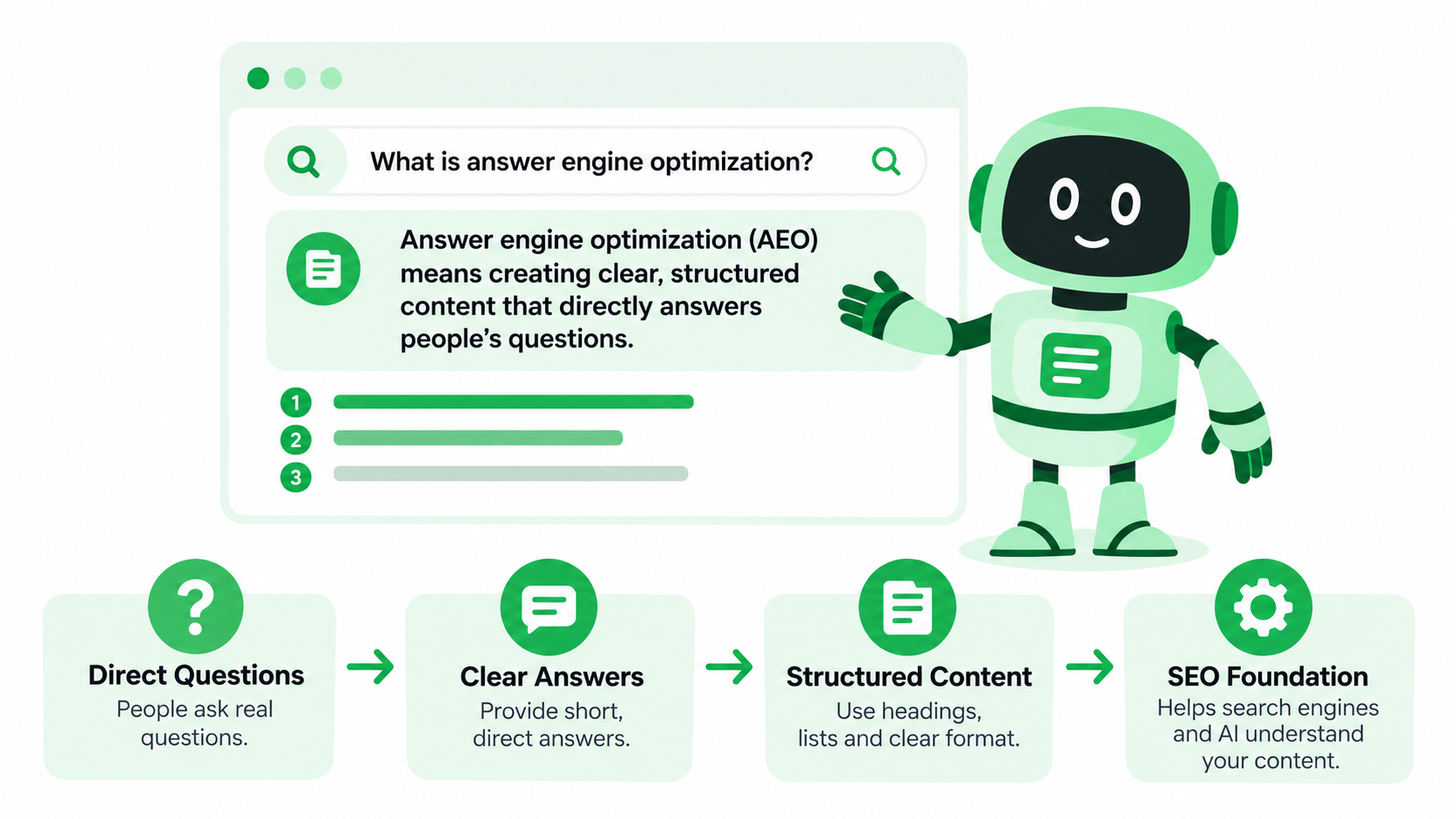
Answer engine optimization, usually shortened to AEO, describes the practice of making content easier for search engines and answer-based systems to understand and present. It’s an industry term rather than a separate Google ranking system. The thinking behind it is simple. If someone asks a question, the answer should be easy to find and not buried in extraneous information.
1. AEO Focuses on Direct Questions
People increasingly search using natural questions, particularly when they need help understanding a product, service, or problem. A homeowner might ask, “How long does a roof replacement take?” A useful answer would explain the usual timeframe, and then discuss the factors that could change it, such as roof size, weather, materials, and project complexity. AEO encourages businesses to answer these questions directly instead of surrounding them with lengthy introductions.
2. Clear Structure Helps
Even a good explanation would be hard to follow if you wrote it all in one long paragraph. Clear headings, definitions, short paragraphs, and relevant lists help readers to find the information they need.
This is where structured content becomes useful. For instance, a page comparing business insurance options might separate coverage, exclusions, eligibility, and costs into individual sections. That arrangement makes the information easier to understand and compare.
3. AEO Is Not Just FAQ Optimization
It’s tempting to think AEO means adding a long FAQ section to every page. But helpful answers belong throughout the website. A product page can explain how an item works. A service page can answer questions about the process. A buying guide can compare available options. An FAQ section is useful when it addresses genuine questions, but it shouldn’t become the only place where important information appears.
4. Strong AEO Still Relies on SEO
A clear answer won’t help much if the page is difficult to access or contains unreliable information. Good website structure, accurate content, internal linking, and technical accessibility are still necessary for AEO. For businesses weighing SEO vs. AEO, the difference is largely one of emphasis.
SEO means search performance and general discoverability. AEO urges content creators to make answers more specific and easier to find and understand.
What Is Generative Engine Optimization?
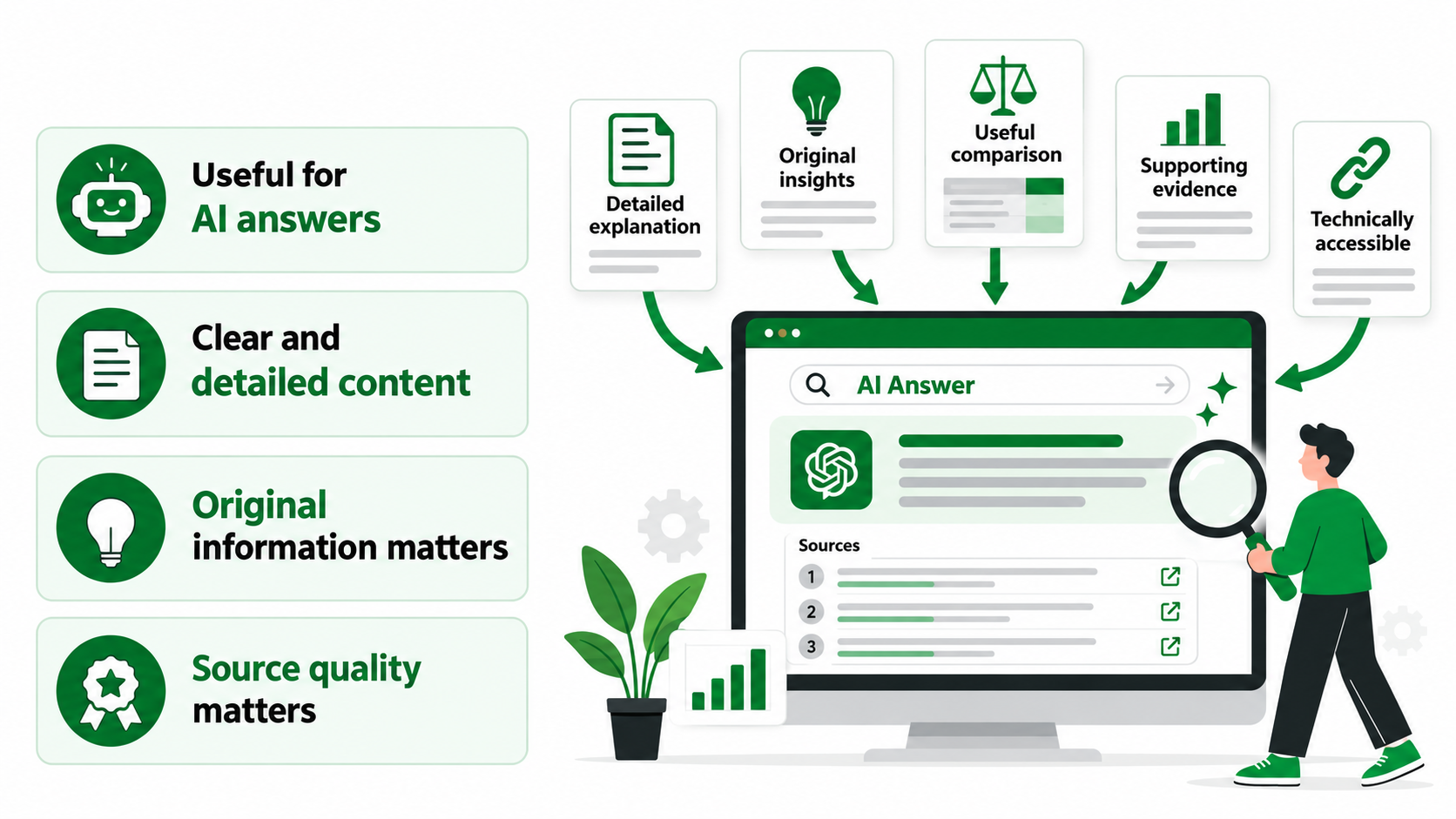
Generative engine optimization, commonly known as GEO, is another term developed within the marketing industry. This is about making content more useful and visible in generative AI search experiences. In those experiences, a system might pull from a number of sources to generate an answer. GEO doesn’t just look to see if a page ranks, but if the information on the page is useful enough to cite, summarize, or mention.
1. GEO Focuses on AI-Generated Answers
Generative AI search tools can answer detailed questions, compare products, and describe complicated topics in conversational language. For example, a user might ask an AI-powered search tool to compare different project management platforms for a small construction firm. Possible points of discussion include features, cost factors, and practical limitations.
GEO optimization encourages businesses to publish information that may be relevant to these discussions. However, appearing in an AI-generated answer is never guaranteed.
2. GEO Places More Emphasis on Source Usefulness
A page that just repeats the same basic explanation you can find on dozens of other sites probably doesn’t offer much unique value. Good references tend to be those that provide detailed explanations, useful comparisons, original examples, or reliable supporting evidence.
Think of a logistics company that can share lessons learned from handling difficult deliveries in several locations. Those observations might be more useful to readers than yet another general article explaining what logistics means.
3. Original Information Becomes More Valuable
Businesses have useful knowledge not found in generic online articles. They may have project experience, customer research, product testing, or industry-specific observations. For example, a manufacturer might report what happened when a certain material was tested under different conditions. That firsthand information makes the content more distinctive and gives readers something they may not find elsewhere.
4. GEO Does Not Require Special AI Markup
There isn’t a universal piece of code that guarantees a website will appear in generative AI answers. Google has explained that its AI Search features don’t require a special schema created specifically for AI visibility.
Businesses should continue using appropriate structured data and established SEO practices. Effective AI search optimization is better approached through useful information and technical accessibility than through supposed shortcuts.
AEO vs GEO vs SEO: What Is the Real Difference?
The three approaches become easier to understand when you look at what each one is trying to improve. They share many of the same foundations, but each highlights a slightly different part of the search experience.
| Approach | Primary Focus | Typical Priorities |
| SEO | Helping content become discoverable, relevant, useful, and competitive in search results. | Keywords, intent, technical SEO, content quality, links, site structure, page experience, and visibility. |
| AEO | Making information easier for answer systems to understand and use when responding to questions. | Direct answers, question-based headings, definitions, clear explanations, readability, and semantic clarity. |
| GEO | Improving the usefulness and visibility of content within generative AI search experiences. | Original insights, clear entities, expert information, topic depth, source credibility, and accessibility. |
Think about a company selling commercial air conditioning systems. SEO helps its website appear for relevant product and service searches. AEO encourages the company to answer questions such as “How often commercial air conditioning systems should be serviced?” GEO encourages it to publish useful technical explanations, maintenance insights, and firsthand information that may contribute to AI-generated comparisons.
All three activities can happen on the same website. The difference lies in what each approach emphasizes, not in the need to create three completely separate sets of content.
Where Do SEO, AEO, and GEO Overlap?
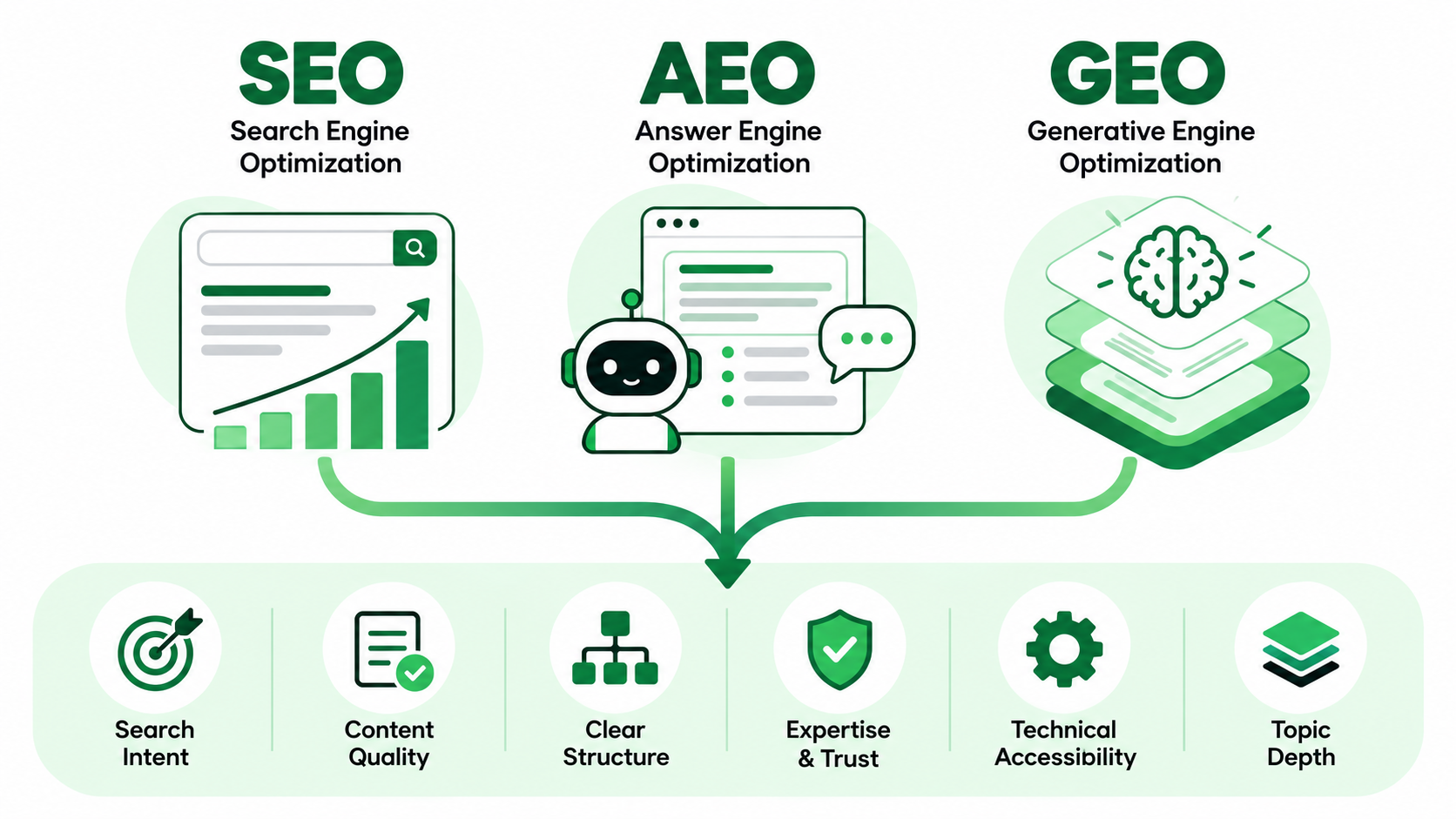
Despite the different terminology, much of the work behind SEO, AEO, and GEO is remarkably similar. All three benefit from websites that are technically accessible, easy to understand, and filled with information that serves a genuine purpose.
- Search Intent: Everything begins with understanding what someone wants. A person researching accounting software has different needs from someone ready to request a demonstration. The content should reflect those differences. Whether an individual finds your content via a traditional search result or an AI-powered answer, relevant information remains key.
- Content Quality: Good content explains a topic correctly and covers the details readers need. It’s not based on repetition, vague claims, or unnecessary length. A useful article should leave someone better informed than they were before reading it. That standard applies across all three approaches.
- Clear Structure: The reader should not have to work hard to understand the organization of information. Headings, lists, tables, and logical paragraphs help to separate ideas and make comparisons easier. For example, a product comparison should delineate features, limitations, and appropriate use cases, not combine them all together.
- Expertise and Trust: Readers want trustworthy information. A business can show credibility by providing accurate explanations, relevant experience, qualified contributors, and trustworthy references. This is especially important when dealing with content influencing technical, financial, or health decisions.
- Technical Accessibility: Search systems need to get access to content before they can use it. Broken navigation, blocked pages, and indexing issues can cause important information to get lost. Even a detailed article may struggle to reach its audience if the technical foundation is weak.
- Topic Depth: Some subjects require more than one article. A business may need a main guide supported by resources covering specific questions and related issues. This kind of connected content can support topical authority while giving readers a more complete understanding of the subject.
Does Google Treat AEO and GEO as Separate Ranking Systems?
There is so much talk about AEO and GEO; it is understandable that businesses might think that Google has implemented completely new ranking systems for them. That’s not how Google describes these concepts. AEO and GEO are industry terms, but guidance from Google continues to highlight the long-standing principles of search optimization.
1. Google Still Recommends SEO Best Practices
Google’s guidance on AI-powered Search features still sends businesses back to familiar SEO practices. Pages should be accessible, useful, well organized, and backed up by accurate information. Businesses don’t need to discard their existing SEO work simply because AI-generated responses are becoming more common.
2. There Is No Special GEO Ranking Switch
There’s no hidden setting that makes Google automatically include a website in an AI-generated response. Nor is there a reliable method that guarantees a citation. GEO optimization is better understood as improving the quality and usefulness of information rather than activating a separate ranking feature.
3. There Is No Special AEO Schema
Adding FAQ markup doesn’t automatically make a page appear in direct answers. Some types of content can be described with structured data, but it doesn’t guarantee that your content will be a featured result or an AI-powered answer. Businesses should apply the correct markup for the purpose and not as a shortcut.
4. Focus on What Search Systems Actually Need
Search systems need information that they can access, understand, and measure for relevance. So it’s worth focusing on accurate explanations, clear headings, logical website structure, and trustworthy content. These improvements help, regardless of what marketers call the strategy.
Why SEO Should Still Be the Foundation
AI-powered search hasn’t removed the need for basic website optimization. Before thinking about whether an AI system might reference a page, businesses should make sure that page works properly and provides information worth finding.
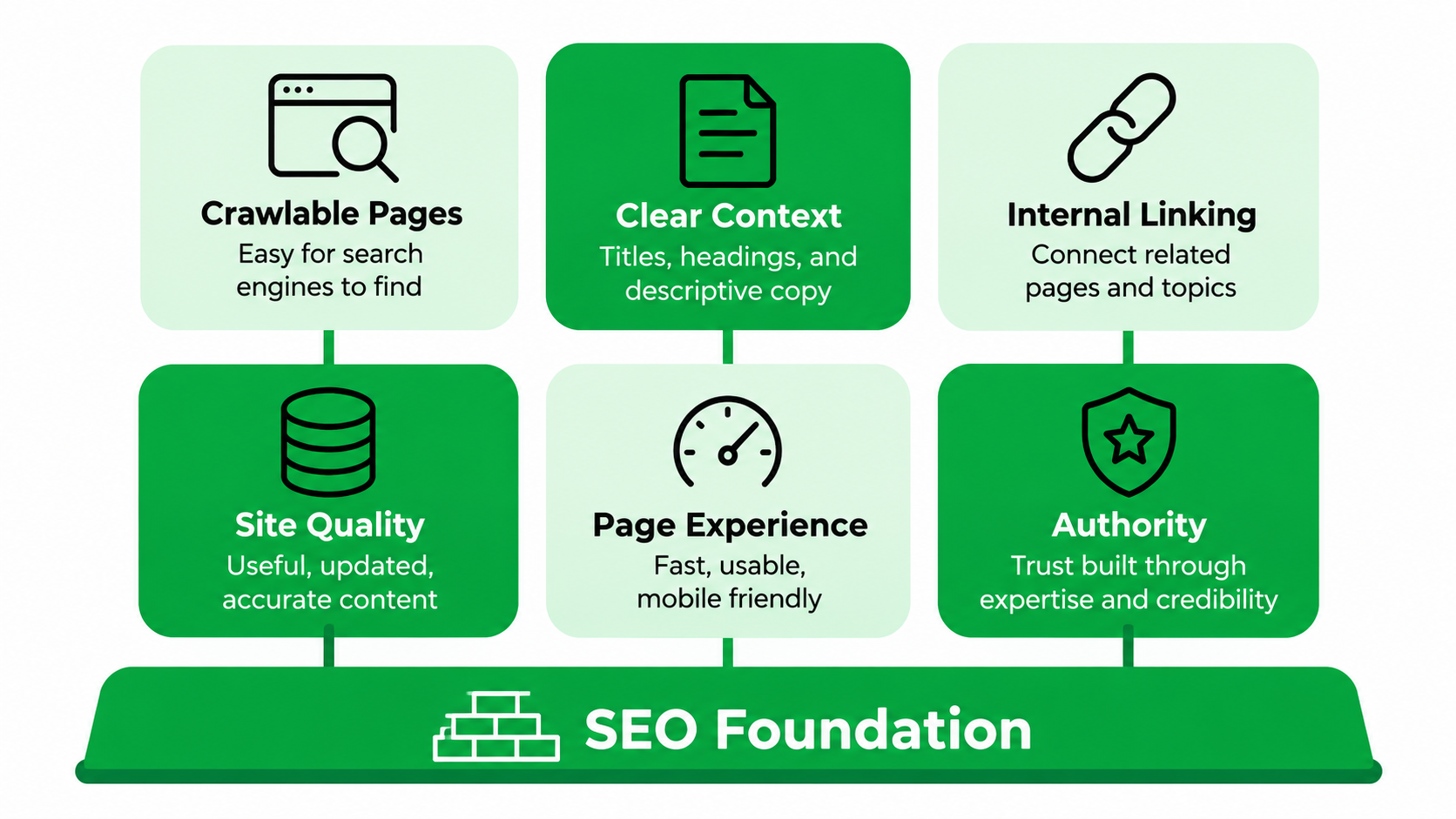
1. Pages Still Need to Be Crawlable
Search engines need to find important pages. That process can be interfered with by a poor website structure, wrong robots settings, and broken links. Problems that a technical review can help identify prevent access or indexing of valuable content.
2. Search Engines Still Need Context
Clear titles, headings, descriptive text, and internal links help explain what a page is about. For instance, a service page called “Our Solutions” provides less context than one that explicitly names the service. Specific wording helps readers know what the page is about before they begin reading.
3. Internal Linking Still Matters
Internal links connect related information and help people navigate a topic. A website accessibility guide could link out to separate articles on navigation, mobile usability, and page performance. These links improve user satisfaction and help build relationships between topics.
4. Site Quality Still Matters
An outdated website with duplicate pages and non-working features can be a source of irritation for visitors. Frequent revisions help a company to fix any inaccuracies and delete unnecessary material. More pages are not necessarily the answer. Sometimes the best way to add value is to do better than what’s there.
5. Page Experience Still Matters
Visitors expect a website to work and load properly on their devices. Slow pages, confusing navigation, intrusive pop-ups, and difficult forms can cause people to abandon the site. Improving usability does not guarantee rankings, but it can make the traffic a business receives more valuable.
Where AEO Adds Value beyond Traditional SEO Thinking
AEO is particularly useful as a way of improving how information is written and presented. It encourages businesses to consider the questions that their customers ask and if their pages answer those questions without too much effort.
1. Answer Important Questions Earlier
Readers should not have to read through multiple paragraphs to get the answer. When someone asks you how long it takes to develop a website, say that the time depends on the size of the project, features, and approval. The rest of the section can then elaborate on these factors in more detail.
2. Make Definitions Easy to Identify
When introducing a technical term, explain it in language the intended audience can understand. For example, define conversion tracking before discussing more complicated attribution methods. A useful definition should make the next part of the explanation easier to follow.
3. Use Clear Question-Based Headings
Question-based headings can help visitors locate the information they need. “What Does the Service Include?” is usually more informative than a vague heading such as “Our Approach.” Not every heading needs to be a question, but readers should be able to understand what each section covers.
4. Break Complex Answers into Logical Steps
Some questions have a process, not a short answer. A website migration guide might also include auditing pages, setting up redirects, testing functionality, and monitoring results. If arranged in a logical sequence, these activities can be more readily applied.
5, Use Tables When Comparison Is the Real Intent
If readers want to compare several options, a table may be more helpful than long paragraphs. A hosting comparison, for instance, could show storage, support, security, and pricing considerations side by side. The format should make the decision easier rather than simply make the page look more detailed.
6. Avoid Writing around the Answer
Some articles spend too much time introducing a subject without explaining anything useful. AEO encourages more direct writing. Give the answer, explain why it matters, and provide supporting details where needed. This benefits readers even if the content never appears in a featured answer.
Where GEO Adds Value beyond Traditional SEO Thinking
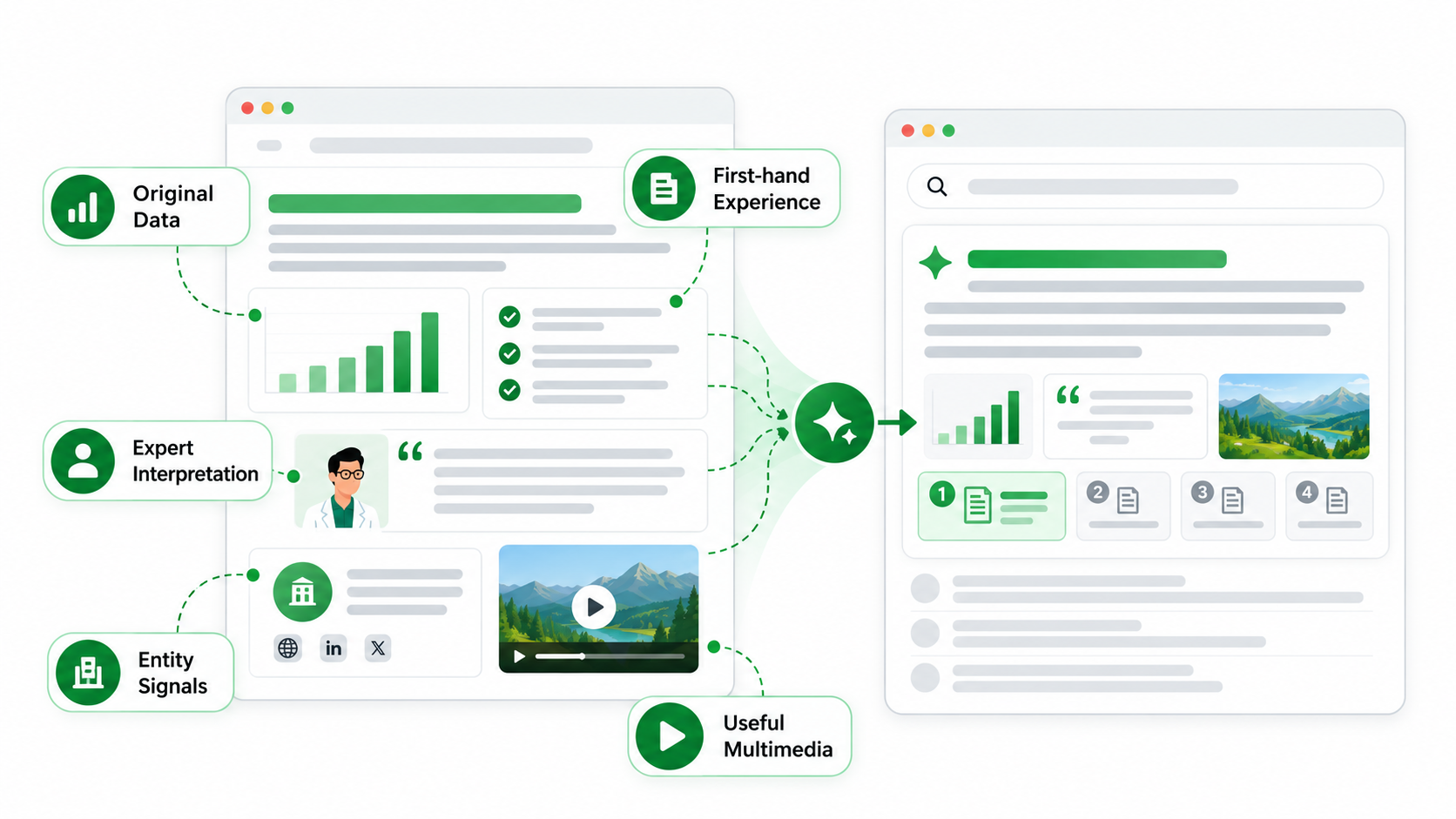
GEO encourages businesses to create valuable content that AI platforms can understand and cite. Sharing original data, customer insights, real project experiences, and expert opinions helps content stand out. For example, businesses can use case studies, survey results, or practical examples to offer useful information that competitors may not provide.
Strong brand signals also play an important role in GEO. Clear business details, consistent service information, and credible author profiles help AI systems understand a company’s expertise. Adding relevant images, videos, and diagrams can make complex topics easier to understand. Together, these practices improve content quality and increase its chances of appearing in AI-generated answer.
How Content Should Change for SEO, AEO, and GEO Together
Businesses don’t need to publish three separate articles covering the same subject. One well-written resource can support traditional search, answer-focused experiences, and generative AI discovery. The key is to combine clear explanations with useful detail and genuine expertise.
1. Start with Search Intent
Before creating content, understand what visitors are looking for and what they hope to achieve. Some may need an explanation, while others want to compare services or contact a professional. For example, someone learning about website security has different concerns from a business owner looking to hire a cybersecurity company. Your content should address those specific needs and provide the information visitors expect to find.
2. Answer the Core Question Early
Give readers the main information near the beginning. If the article is about two services, mention the difference in brief before going to individual features. And that gives visitors a clear starting point. Then they can read on for the details that matter to their decision.
3. Add Depth after the Direct Answer
An answer in brief may suffice to an immediate question, but complex subjects frequently require further elucidation. Include appropriate pros and cons, examples, costs, and practical considerations. For example, a comparison of cloud hosting vs. dedicated hosting should include performance, scalability, management requirements, and use cases.
4. Include Original Expertise
Share something that comes from real experience. It could be a project example, a professional observation, a testing result, or an explanation of a common problem. Don’t treat assumptions as facts. The knowledge originally should make the subject clear to the readers.
5. Use Clear Headings
Headings should make it obvious what each section contains. Avoid vague labels that force readers to examine every paragraph before understanding the topic. A logical structure is especially useful in longer guides where visitors may only need one particular section.
6. Cite Reliable Sources Where Necessary
Important claims should be backed up with credible information. Useful evidence may be official documentation, relevant research, and credible industry sources. When clearly explained, firsthand experience can also add value. References should be relevant to the content and not seem like random links.
How Topic Clusters Support All Three Approaches
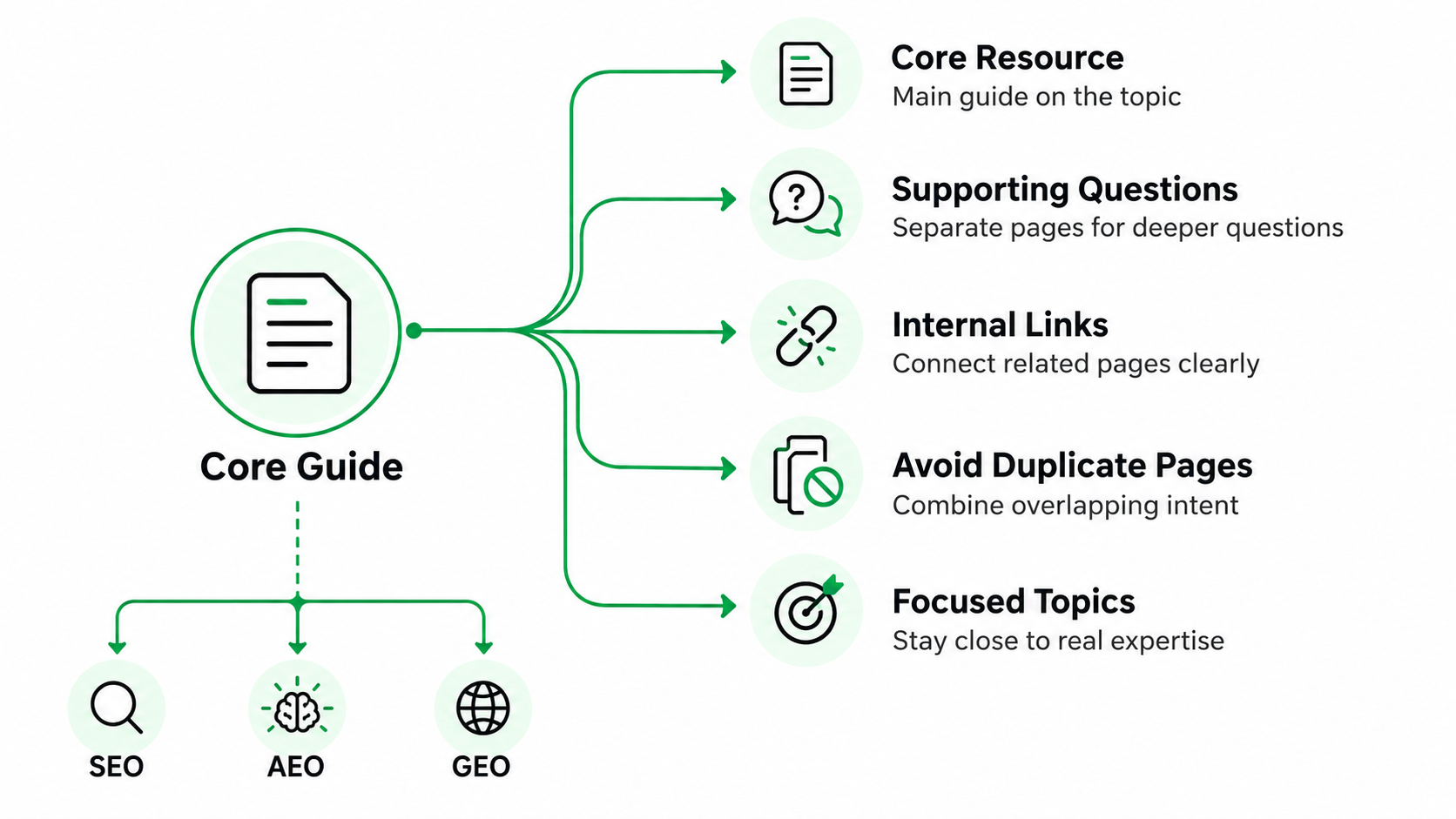
Sometimes, one article is not enough to cover all the aspects of a complicated subject. Topic clusters give businesses a method to structure related information into linked resources. It makes it easier for visitors to explore important questions instead of cramming everything into one giant page.
- Build a Core Resource: Then a long introduction to the main subject. For example, a cybersecurity company could create a resource that talks about common security threats companies face, how they can protect themselves, and what to think about. That page becomes the starting point for readers exploring the topic.
- Add Supporting Questions: Make different articles for questions that require more explanation. The cybersecurity company might come out with guides on phishing prevention, employee security training, and incident response. Each resource should address a different issue, not duplicate the main guide. This gives readers useful depth without unnecessary repetition.
- Connect Pages through Internal Links: Link related pages where the connection benefits the reader. Email Threats: The cybersecurity guide may contain a link to an in-depth article on how to prevent phishing. The supporting article may refer to the main guide for context. These links make it easy to find and move around in information.
- Avoid Duplicate Keyword Pages: Creating separate pages for every small wording variation can produce repetitive content. For example, “What is cloud backup?” and “How does cloud backup work?” may belong in one comprehensive guide if the reader’s needs overlap. Focus on meaningful differences in intent rather than minor differences in wording.
- Keep the Site Focused: Businesses should focus on topics related to their products, services, and know-how. An accounting software provider doesn’t need to be posting about every technology trend. A tight collection of pertinent resources is worth more than a site full of random articles created for the sole purpose of driving traffic.
Does Every Business Need AEO?
Most businesses benefit from AEO principles because customers often have questions before they buy. This is especially true in professional services, healthcare, SaaS, financial services, education, home services, and e-commerce. But that doesn’t mean every company needs to have its own AEO team or campaign.
AEO Is Valuable When Questions Drive the Buying Journey
Some purchases involve considerable research. A business owner choosing accounting software may want to understand pricing, features, integrations, and implementation requirements. A company that can answer these questions clearly can help prospective customers make informed decisions. AEO is particularly useful when the explanations affect the person’s willingness to ask or to buy.
It Should Not Replace Commercial Pages
Educational articles are useful, but businesses still need pages that explain what they sell. A guide about choosing an accountant doesn’t replace a clear accounting services page. Both serve different purposes. A strong website connects educational content with relevant commercial pages so visitors can move naturally from learning to taking action.
Does Every Business Need GEO?
Businesses that depend on online visibility should understand how AI-powered search is changing the way customers find information. However, GEO does not mean replacing existing SEO strategies. Companies with well-structured websites, useful content, and trustworthy information already have a strong foundation. They can improve their chances of appearing in AI-generated answers by providing clear information, sharing original data, and including real experiences. These efforts are especially valuable in competitive industries where many websites offer similar content.
As AI-powered search continues to grow, businesses should monitor how their brands appear in AI-generated responses. Tracking brand mentions, referral traffic, and customer discovery patterns can help identify new opportunities. Although the importance of GEO varies by industry and audience, combining it with traditional SEO can strengthen online visibility and help businesses adapt to changing search habits.
Which Strategy Should Small Businesses Prioritize First?
For small businesses, the decision shouldn’t begin with choosing an acronym. It should begin with understanding what currently prevents potential customers from finding the business, trusting its information, or taking the next step.
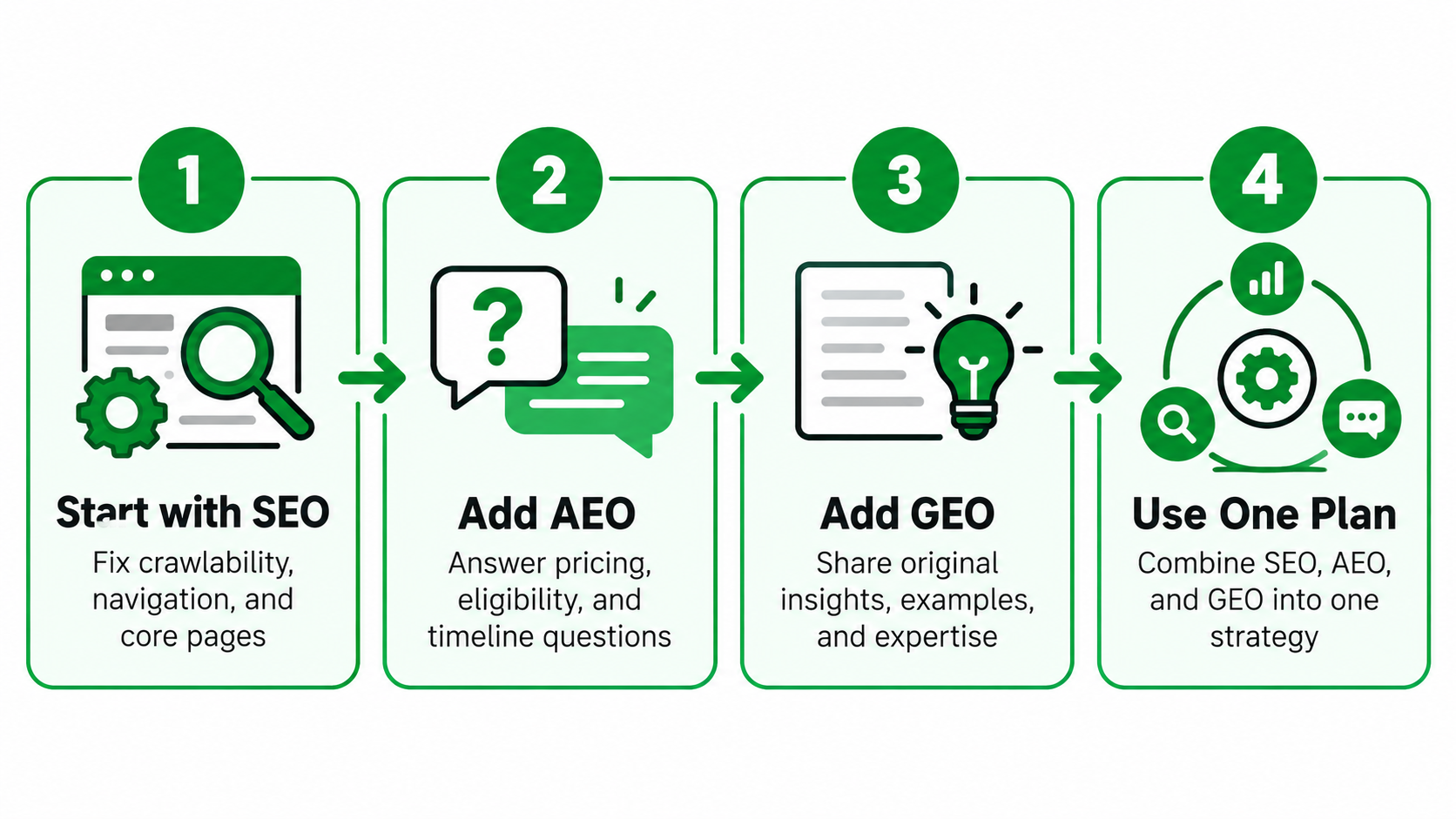
1. Start with SEO if the Foundation Is Weak
If important pages aren’t indexed, the website is difficult to navigate, or service information is incomplete, address those problems first. Technical accessibility, relevant content, clear navigation, and useful commercial pages provide the foundation. These improvements can support both traditional and AI-powered search experiences.
2. Add AEO When Customers Ask Repetitive Questions
If customers frequently ask about price, eligibility, timelines, or product differences, these are questions that deserve clear answers on the website. Improve current pages and develop in-depth resources where necessary. This makes content more useful, without requiring a whole separate strategy.
3. Add GEO by Improving Originality and Authority
Find ways to communicate information that your competitors are not already communicating. That might be project examples, expert explanations, original research, or good comparisons. Create reliable business data and pertinent references. Such improvements can help make content more unique across search experiences.”
4. Do Not Build Three Separate Strategies
Most small businesses don’t need separate SEO, AEO, and GEO teams producing similar content. One coordinated plan can cover technical accessibility, search intent, answer clarity, original expertise, and performance measurement. That approach is easier to manage and reduces unnecessary duplication.
A Practical SEO + AEO + GEO Framework
Bringing the three approaches together doesn’t require a complicated new system. Businesses can make steady improvements through a practical process that addresses both website quality and customer needs.
Step 1 – Fix Technical SEO
Start with verifying that important pages are crawlable and indexable. Check for broken links, redirects, mobile usability, page speed, and site structure. Fix problems that make valuable information unavailable to search systems or visitors. The technical improvements should be serving the content and not being a task in itself.
Step 2 – Map Search and Customer Intent
Understand what potential buyers need to know at each stage of their journey. Split informational searches from comparison and purchase searches. For example, a person researching the benefits of solar panels may need an educational guide, while a person asking about installation costs may be closer to asking for a quote. Develop content that corresponds to each need.
Step 3 – Build Strong Core Pages
Ensure there are comprehensive, useful pages for key products and services. Describe what’s available, who it’s for, how it works, and what customers need to know. Provide relevant evidence and specific next steps. These pages are the commercial base that supporting articles can link to.
Step 4 – Answer Important Questions Clearly
See the questions customers ask most often. Make sure the website responds directly and appropriately in the relevant sections. Use lists, tables, or examples where appropriate to make the explanation clearer. Don’t just throw in questions to make the page longer.
Step 5 – Add Original Value
Enhance content with personal knowledge, project examples, professional observations, or trusted data. Discuss the rationale for the conclusions and discuss key limitations. For example, a services company might talk about common project challenges and how different solutions did. That’s more valuable than just repeating sage advice.
Step 6 – Strengthen Internal Linking
Connect pages when they naturally support one another. A service page might link to a detailed guide answering an important customer question. A supporting article could link back to the relevant service when readers may want further help. Keep links useful and avoid adding them unnecessarily.
Step 7 – Build External Authority
Build credibility with real business activity. This could be industry input and partnerships, expert quotes, customer reviews, and reliable sources. Keep company information accurate and up to date on key platforms. Authority should come from real experience and credibility, not manufactured attempts to generate mentions.
Step 8 – Measure Search and AI Visibility
Monitor organic performance, relevant keyword groups, conversions, and available AI search observations. See where the business is found by visitors and what they do after. Don’t just count impressions but focus on the pages that generate meaningful inquiries or sales. Use findings to improve content and strategy over time.
Common SEO, AEO, and GEO Mistakes to Avoid
New search terminology can make businesses feel they need to change everything at once. In reality, many problems arise when companies chase new tactics while overlooking the quality of their websites and content.
Common mistakes include:
- Treating GEO as a replacement for SEO: AI search still benefits from accessible, relevant, and trustworthy content.
- Creating separate pages for every question variation: Similar pages can become repetitive and offer little additional value.
- Adding FAQ schema solely for AI visibility: Markup doesn’t guarantee an AI-generated mention.
- Publishing generic AI summaries: Repeating widely available information gives readers little reason to choose the page.
- Ignoring crawlability and indexing: Valuable content still needs to be accessible.
- Writing answers without enough detail: Short responses may leave important questions unanswered.
- Creating content only for search engines: Visitors need useful explanations, not keyword-heavy paragraphs.
- Chasing AI citations without business relevance: A mention has limited value if it doesn’t support meaningful goals.
- Ignoring brand and expertise signals: Credibility should be supported by genuine experience and information.
- Measuring visibility without conversions: More impressions don’t automatically mean more customers.
- Assuming structured data guarantees inclusion: Markup supports understanding but doesn’t control results.
- Following unverified AEO hacks: Unsupported shortcuts can distract from improvements that matter.
Companies don’t need to chase every new trend. A better approach is to have a technically sound website, publish useful content, answer customer questions, and measure if the work supports business growth.
How Should Businesses Measure Success Across All Three?
Measuring search performance now involves more than watching a handful of keyword rankings. Businesses need to understand where they’re gaining visibility and whether that attention leads to useful outcomes.
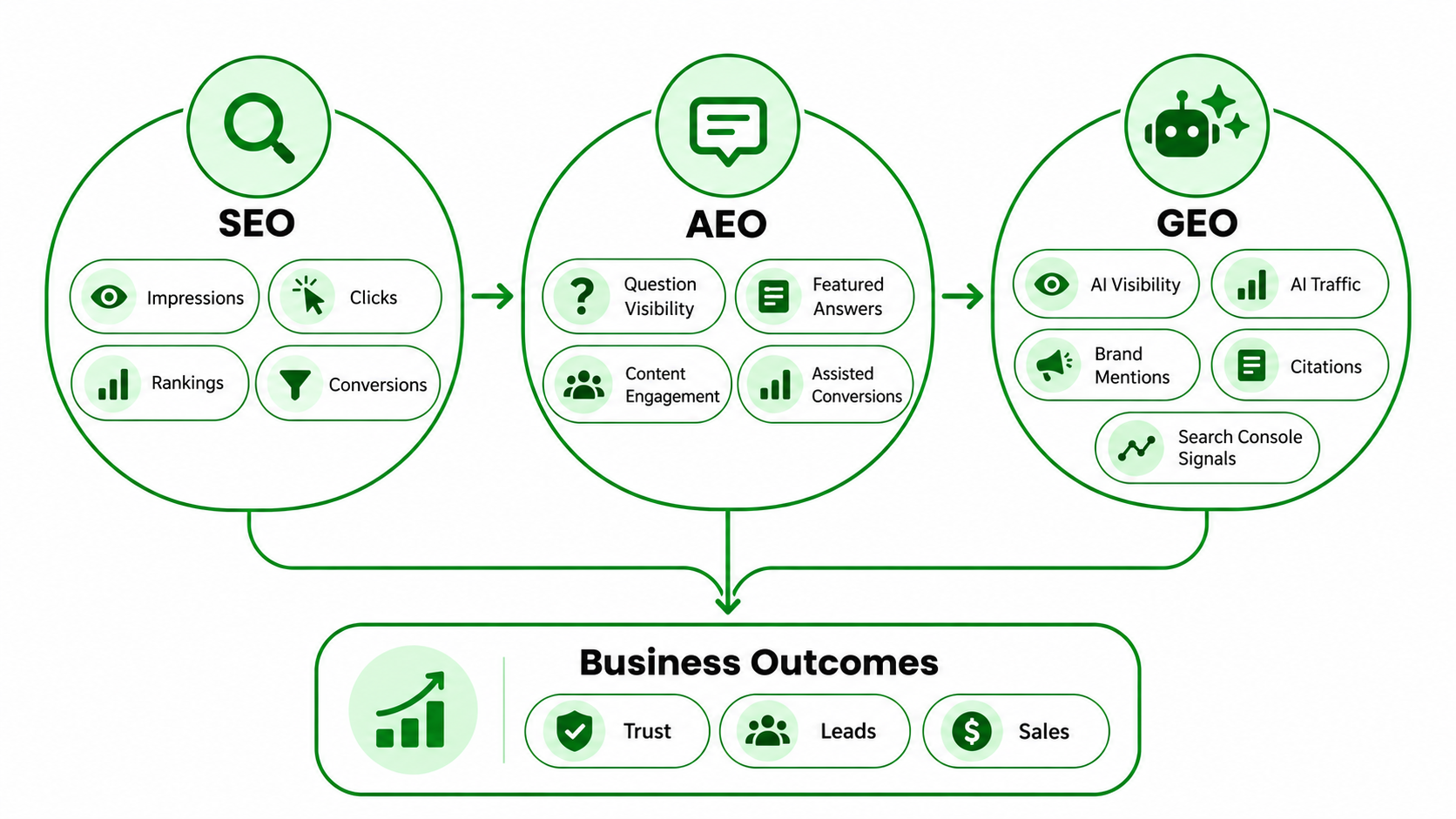
1. Traditional SEO Metrics
Important measures include:
- Organic impressions
- Organic clicks
- Relevant keyword rankings
- Non-branded search visibility
- Enquiries, purchases, and other conversions
These figures help show whether the website is attracting relevant search traffic and turning that attention into business activity.
2. AEO-Oriented Metrics
For answer-focused content, businesses may examine:
- Visibility for important question-based searches
- Featured-answer appearances where applicable
- Engagement with educational resources
- Assisted conversions from informational content
These indicators can help explain whether useful answers are reaching potential customers and contributing to their decisions.
3. GEO-Oriented Metrics
For generative search, possible measures include:
- Visibility in AI-powered search experiences
- AI-referred website traffic that is measurable
- Relevant brand mentions
- Source and citation visibility
- Search Console performance associated with AI search experiences where available
Measurement still has limitations. AI responses can vary, and not every appearance can be tracked reliably. Google’s AI Search performance could be included in general Search Console reporting instead of its own separate category. The question is not simply whether visibility has grown. It’s whether more people are finding out about the business, trusting its information, and ultimately choosing its products or services. Traffic and mentions are good indicators but should be viewed in conjunction with meaningful business outcomes.
Final Thoughts
The discussion around AEO vs GEO vs SEO can make search marketing seem more complicated than it needs to be. Each approach has a different emphasis, but they share much of the same foundation. SEO helps search engines find and understand useful pages. AEO encourages businesses to answer customer questions more clearly. GEO places greater attention on original information, credible sources, and how content may be used in AI-generated responses. None of these makes the others unnecessary.
For most businesses, building one connected strategy is more practical than managing three separate plans. Start with a website that works properly, create content people genuinely need, answer questions directly, and share knowledge that reflects real experience. As AI-powered search develops, keep reviewing how customers discover your business and where improvements are needed. The goal isn’t to follow every new marketing term. It’s to remain useful, visible, and trustworthy wherever potential customers look for information.
Wondering whether your business should focus on SEO, AEO, or GEO?
You don’t need three disconnected strategies. With eSign Web Services, you can improve technical SEO, create more useful content, and strengthen visibility across traditional and AI-powered search. Contact our team to discuss an approach built around your business goals.
Frequently Asked Questions
Question: What is the difference between SEO, AEO, and GEO?
Answer: SEO is how a website gets found and competes in search results. AEO is about making it easier to find and understand answers to specific questions. GEO focuses on useful, credible information for generative AI search experiences. They share many of the same fundamentals, so businesses are often able to tackle all three with a single, coordinated content and SEO strategy.
Question: Is GEO replacing traditional SEO?
Answer: No, GEO is not replacing the traditional SEO. Websites still require accessible pages, relevant information, clear structure, and trustworthy content. GEO adds another dimension by considering how information could be used in generative AI answers. Businesses should do what they are doing in SEO better and add new strategies instead of throwing out everything that has been done.
Question: What is the difference between AEO and GEO?
Answer: AEO is concerned with delivering unambiguous answers that can be processed by search and answer systems. GEO takes a closer look at whether the content offers useful and unique information for generative AI experiences. All benefit from accurate writing, relevant expertise, and technical accessibility. The difference is mostly in the emphasis and not in separate optimization strategies.
Question: Does my business need AEO if we already invest in SEO?
Answer: Perhaps you’re already using some AEO principles in your SEO content. Making it easy for customers to understand answers to questions they ask prior to purchase can help improve their experience. You don’t necessarily need a separate campaign. • Review existing service pages and articles for key questions and ensure they are answered directly and accurately with enough detail.
Question: Does my business need GEO to appear in ChatGPT and other AI platforms?
Answer: There’s no surefire way to get a business to appear in ChatGPT or other AI platforms. Useful content, original expertise, accurate brand information, and credible sources, however, can support wider discoverability. No guarantees of citations or special GEO shortcuts; businesses need to understand generative search and improve their content.
Author Details

Ashwani Kumar Sharma
Ashwani has been actively involved in SEO services since 2005. His expertise and distinctive work approaches have made him one of the most experienced and trusted SEO experts in the industry. He is a certified SEO and Google Ads professional. He also has strong business development skills in advanced SEO, PPC, and digital marketing strategies.


