



Building Topical Authority: Why It Matters More Than Ever in AI Search

Key Takeaways:
- The topical authority increases if the website focuses on one topic effectively.
- Nowadays, search engines do not concentrate on single words but focus on whole topics.
- AI search engines prefer the content which provides reliable and relevant answers.
- Pillar pages, support articles, and topic clusters can be used for organizing information.
- Effective internal linking helps users find the relevant pages and understand their connection.
- Use of expert knowledge and actual examples makes the content more valuable and credible.
- Updating of the content helps preserve authority in changing conditions.
Publishing a few keyword-focused blogs is no longer enough to build strong search visibility. Search engines have become much better at understanding subjects, relationships, user questions, and the wider meaning behind a search.
AI-powered platforms have pushed this change even further. Users can now ask detailed questions and receive complete answers without searching through several pages. These platforms do not only look for a page that mentions the right phrase. They look for reliable sources that clearly understand the subject.
This makes topical authority more important than ever. A website needs to show that it can answer basic questions, explain difficult ideas, solve common problems, and guide readers towards informed decisions. The goal is not to publish the most content. The goal is to create a useful and connected group of pages that people can trust.
In this blog, we saw that topical authority is not built with just one good article. It is built through the coordinated efforts of the entire website. Each page should be based on a genuine question and should contribute to the general subject while directing the reader towards another useful bit of information.
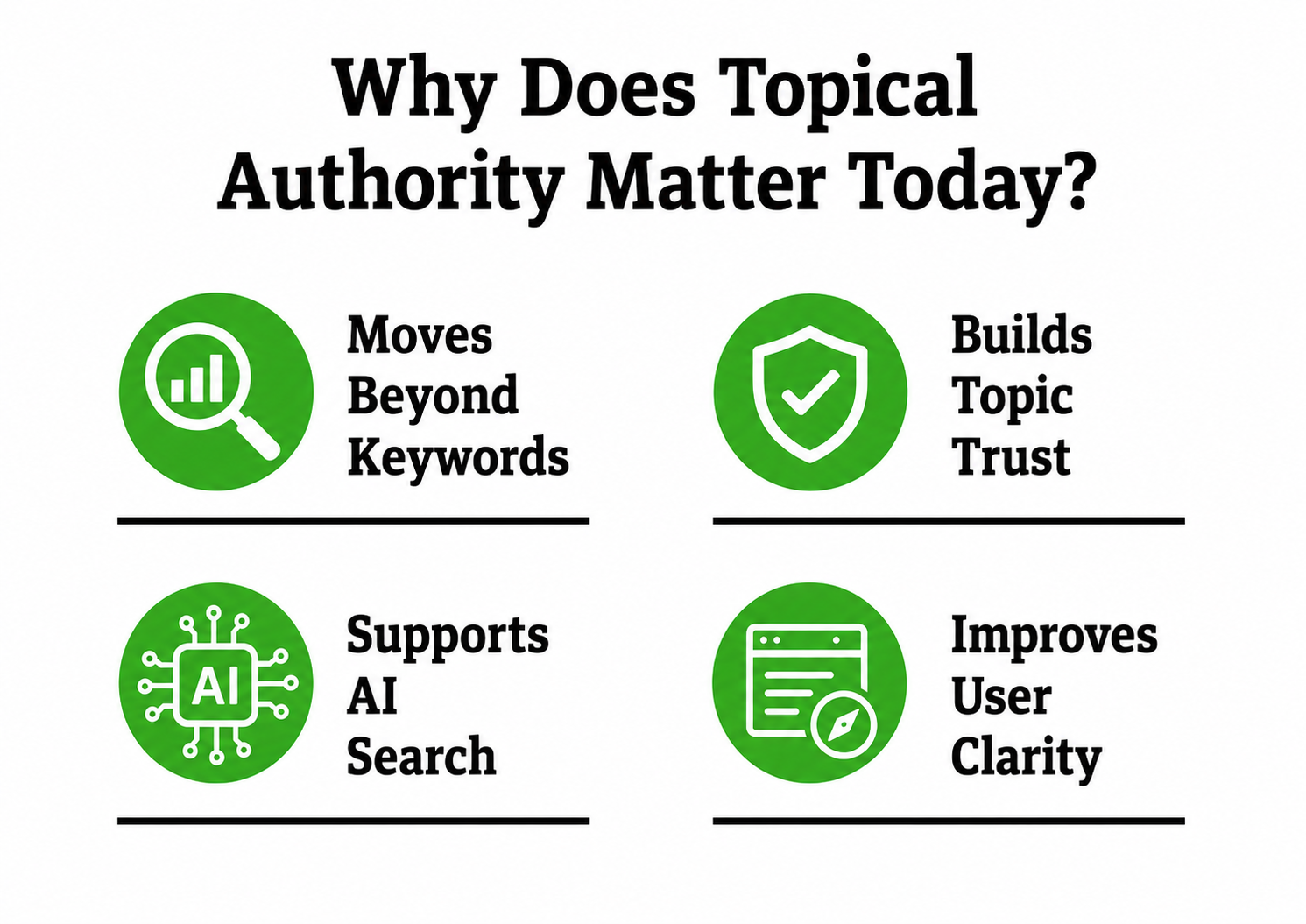
Why Does Topical Authority Matter Today?
Search engines once relied heavily on exact keywords. A page could often perform well simply because it used the right phrase in the title, headings, and body content. That approach is now far less effective. Modern search systems look at the full meaning of a page and how it connects with the rest of the website. They also consider whether the site covers the subject properly or only touches on one small part of it.
Search Has Moved Beyond Keywords:
Keyword searches remain important in demonstrating how users articulate their needs. Nevertheless, search engines also strive to identify the underlying subject matter of the keyword searches. For instance, in the case of a site that provides information on home loans, the publication of one page that addresses issues such as interest rates is not enough. There is need for provision of information on eligibility requirements, deposits, credit scores, repayment time frames, and much more.
Authority Comes From Full Coverage:
A website begins to look more reliable when it answers different questions within the same subject. This is the main idea behind topical authority SEO.
Strong coverage usually includes:
- Clear explanations for beginners
- Detailed guides for experienced readers
- Answers to common questions
- Practical examples
- Comparisons between available options
- Advice for solving common problems
- Content for users who are ready to take action
Every page contributes to the process of adding another layer of information. As such, all pages together will prove that the website knows about the topic, rather than just using the keyword.
Users Also Benefit From Clarity:
Topical authority is not only about pleasing search engines. It also creates a better experience for readers. A visitor should be able to find an answer, understand it, and move easily to the next useful page. When the content feels connected, readers do not need to leave the website and continue searching elsewhere.
What Does Topical Authority Really Mean?
Topical authority describes how well a website demonstrates knowledge and trust around a particular subject. It develops when the site publishes accurate, useful, and connected content over time. This is not about repeating the same word many times. This is not about trying to write the longest article possible. This is about knowing what your audience requires and fulfilling their requirements.
Topical Authority versus Domain Authority:
Domain authority and topical authority are often confused. The table below explains how they differ and why a smaller specialist website can still become a trusted source within one focused subject, even if it does not have the strongest overall domain profile.
| Comparison Point | Domain Authority | Topical Authority |
| Main focus | The estimated overall strength of an entire website. | The depth of knowledge a website shows in one specific subject. |
| Common influences | Backlinks, website history, overall reputation, and general visibility. | Content depth, accuracy, expert input, topic coverage, and connections between related pages. |
| Scope | Broad and website-wide. | Narrower and focused on a particular topic or area of expertise. |
| How it grows | Usually develops through backlinks, brand mentions, age, and wider online authority. | Develops by publishing detailed, useful, connected, and regularly reviewed content around one topic. |
| Practical example | A national publication may have strong overall authority because it has many backlinks and a long publishing history. | A small healthcare website may become trusted for one treatment by publishing medically reviewed, detailed, and patient-friendly information. |
Practical example
A national publication may have strong overall authority because it has many backlinks and a long publishing history. A small healthcare website may become trusted for one treatment by publishing medically reviewed, detailed, and patient-friendly information.
Topics Must Connect Naturally:
Search engines try to understand how people, products, places, services, and ideas relate to one another. This is an important part of semantic SEO. For example, a website discussing commercial cleaning may also need to cover the following:
- office cleaning
- floor care
- hygiene standards
- cleaning schedules
- equipment
- workplace safety
- cleaning products
- Service costs
The reason why these topics appear here is that they fit perfectly well into the larger theme and will provide some insights into it. In addition, the website will be able to answer more questions for its visitors, giving them a complete picture on the matter. Moreover, the connection between these pages will be clear for search engines.
Every Page Needs a Purpose:
Good topic coverage does not mean forcing every possible idea onto one page. Each page should answer a clear question or serve a specific stage of search intent.
A reader may want to:
- understand a subject
- compare choices
- solve a problem
- check costs
- find a provider
- make a final decision
By developing the appropriate content plan, a website will have the correct pages for all the needs. This ensures that visitors do not get confused while searching for information in one big page. It also makes sure that there is a particular aim of each page such as informing, comparing, solving a problem, and deciding.
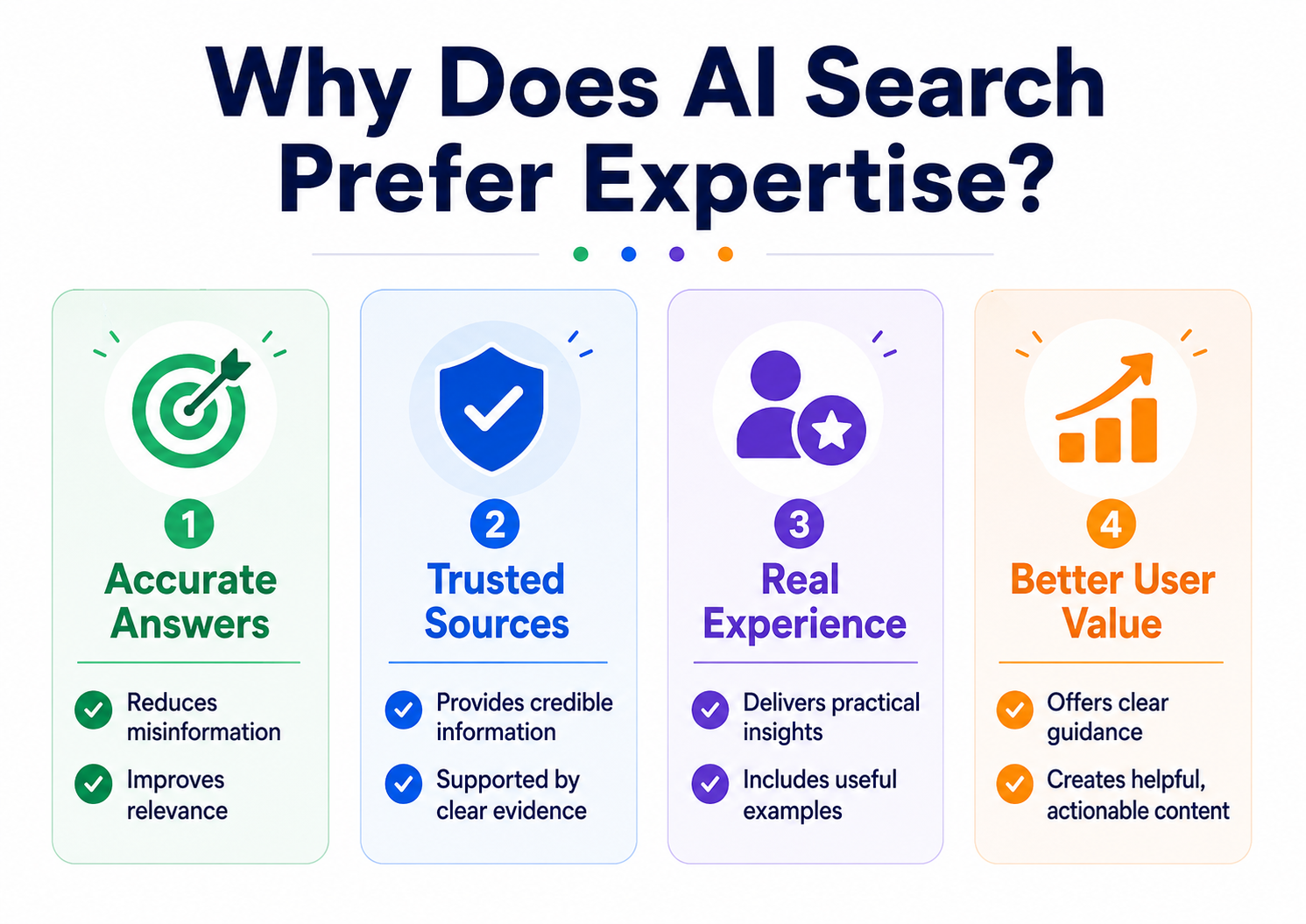
Why Does AI Search Prefer Expertise?
AI search modifies the method of information retrieval and presentation. Unlike the usual presentation where just the list of links is provided, AI search would explain the topic, compare the choices, or even make conclusions about several relevant facts within one answer. To accomplish all this, it requires understandable and reliable content.
AI Needs Clear Context
A page with vague statements and weak structure may be difficult to interpret. Content becomes easier to process when it includes:
- direct answers
- clear headings
- simple explanations
- relevant examples
- connected supporting pages
- accurate source information
- consistent terminology
A complete content ecosystem gives AI systems more contexts about what the website knows and how its pages relate.
Trusted Information Has More Value
AI platforms require information that can help formulate appropriate responses. Dependability of the website can be judged by the degree to which it reveals the author of the information, the sources of important information, and the time at which the information was verified. This is where E-E-A-T becomes important. Experience, expertise, authority, and trust can be shown through:
- expert author profiles
- first-hand knowledge
- original examples
- credible references
- transparent business information
- updated content
- Clear contact details
Original Knowledge Creates Difference
Generic information is easy to reproduce. Real value comes from adding something useful that other pages do not offer.
That could include:
- findings from internal data
- lessons from real projects
- expert observations
- original research
- industry-specific advice
- mistakes commonly seen in practice
- Examples based on customer questions
For example, a cybersecurity company may publish a basic article about phishing. A stronger article could explain the warning signs its team regularly sees in real attacks and how businesses can respond during the first hour.
AI Content Still Needs Human Review
AI applications can help with outlines, research, summary writing, and draft generation. But writing that is published without being reviewed could lead to mistakes, repetitions, irrelevant examples, and artificial style. Human knowledge will be required for the content to be reliable, meaningful, and relevant.
How Can You Build Topical Authority?
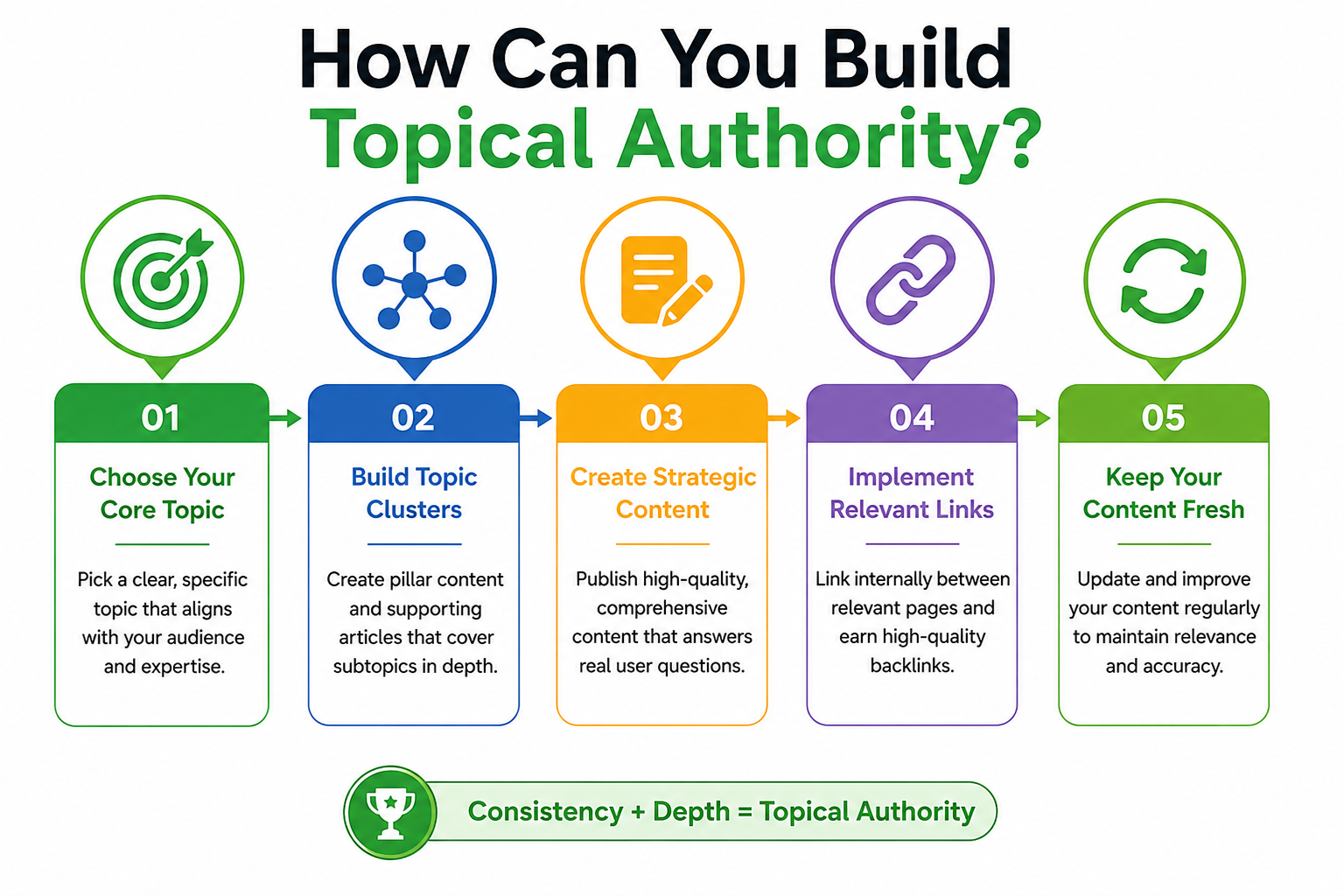
A practical topical authority strategy begins with focus. Choose a subject that connects closely with the brand’s services, experience, and audience. Trying to cover every possible topic usually leads to scattered content. It is better to become highly useful in one area before expanding into another.
Create a Clear Topic Map: A topical map shows what the website should cover. It contains the key theme, key sub-themes, key questions, common issues, objectives of users, and relevant entities. For instance, a moving company can create a topic map on office moving. It can include topics such as planning, packing equipment, communication among employees, schedule of moving, IT equipment, insurance, storage, and after move setup. Every future article will have its justification because of that map.
Build Useful Pillar Pages: Pillar pages give readers a broad introduction to the main subject. They highlight the important points and direct to more extensive pages. The pillar page should contain all the important information to assist the reader, but it should not contain all the details. This is because the function of the pillar page is only to highlight the topic.
Publish Focused Supporting Content: Supporting content covers smaller questions in greater detail. These pages help expand the website’s knowledge around the main topic.
Useful content formats include:
- how-to guides
- checklists
- comparisons
- cost explanations
- troubleshooting articles
- case studies
- beginner guides
- common question pages
Pages should be different. Having several articles with similar intentions can create confusion among the pages.
Strengthen Internal Page Connections: Strategic internal linking helps readers discover related information. It also shows search engines how different pages belong together.
Useful links may connect:
- A supporting article to its pillar page
- One related guide to another
- An educational page to a relevant service
- A comparison article to a buying guide
- An older page to a newly published resource
Links should feel natural. They should help the reader, not interrupt the flow.
Add Real Knowledge and Experience: To build topical authority, content should reflect what the business genuinely knows. The plumber would be able to discuss the warning signs that generally occur before a pipe bursts. The marketing agency would provide information on observations made during campaign audits. The healthcare practice would answer questions that patients usually ask during consultation sessions. This makes the information much more practical than textbook information.
The plumber would be able to discuss the warning signs that generally occur before a pipe bursts. The marketing agency would provide information on observations made during campaign audits. The healthcare practice would answer questions that patients usually ask during consultation sessions. This makes the information much more practical than textbook information.
Review and Improve Old Pages: Old content may become less relevant if some information becomes outdated, broken links occur, the examples used become out-of-date, or more recent web pages offer better coverage of the topic. Regular reviews can help identify:
- Missing information
- Repeated sections
- Outdated claims
- Broken links
- Weak page structure
- Pages targeting the same intent
- Opportunities for stronger internal links
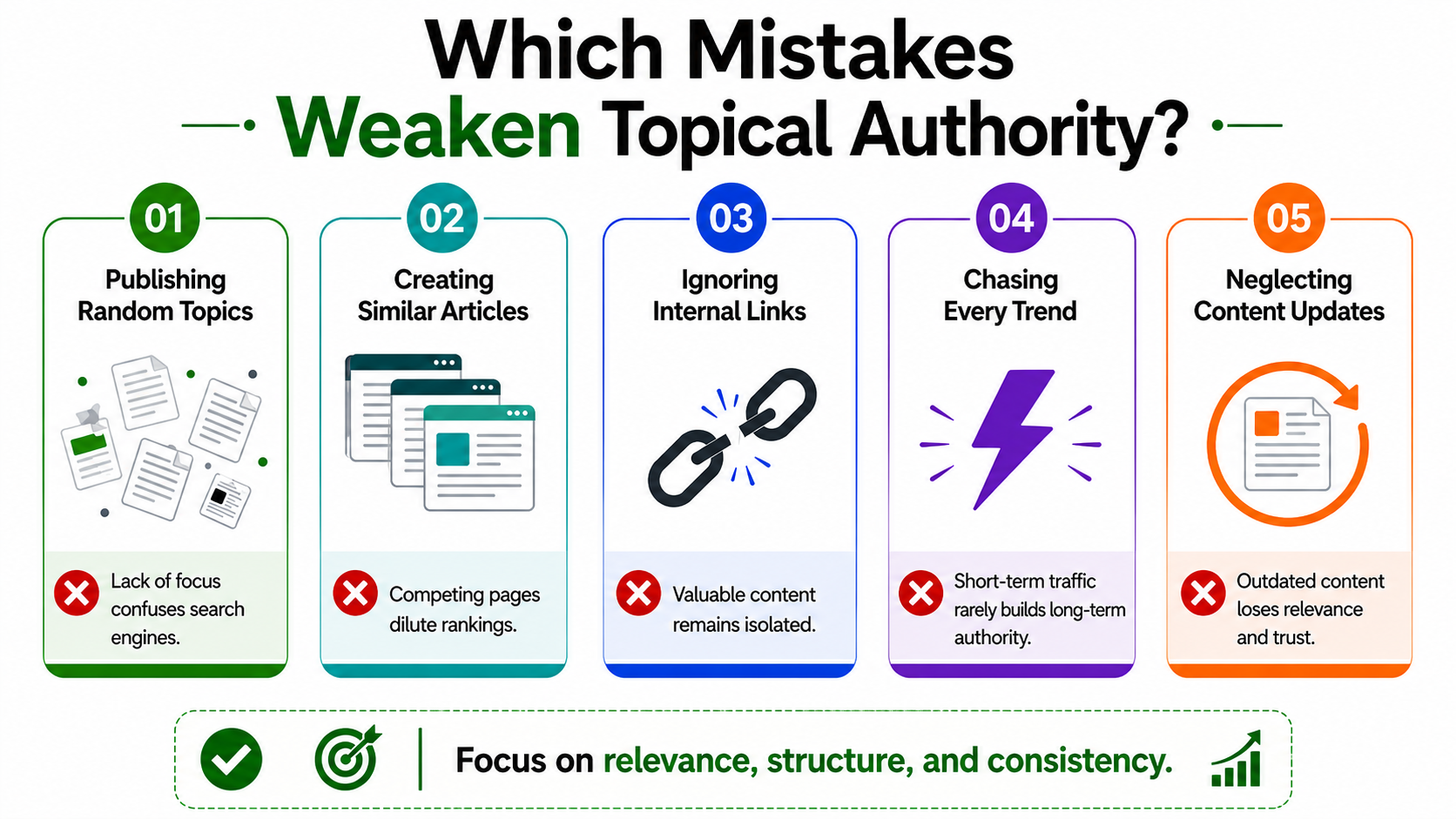
Which Mistakes Weaken Topical Authority Most
Many websites publish regularly but still fail to create meaningful authority. The problem is often a lack of structure rather than a lack of effort.
- Publishing Random Topics: A blog does not mean just listing some random ideas. Each post should be related to something specific like topic, need of customers, a service or a goal of the business. Such an approach will complicate search engine’s job to define the focus of the site.
- Targeting Too Many Niches: A small organization may seek to touch upon all topics, hoping to draw more people to their site. However, this could result in loss of coherence. For instance, an agency that specializes in providing digital marketing solutions may write about such topics as social media, recruitment, accounting, leadership, ecommerce, branding, and software.
- Creating Thin Content: Short pages give only superficial details without addressing the user’s actual queries. They could give definitions for terms but not the application of the same, significance of the same, problems solved by the same, etc. Good content requires more than just superficial details.
- Repeating the Same Intent: A number of pages may have differing keywords but address the same issue. This can cause repetition and competition within the site. When two pages are serving the same function, it is best to merge them into one page.
- Ignoring Internal Links: A helpful page may go unseen if no other page points to it. Important articles should be linked from related pages, menus, hubs, or service pages. This will help the reader and search engine alike locate the page and its significance in the larger context of the website.
- Depending on Keywords Alone: Keywords can guide the subject, but they should not control every sentence. Forced repetition makes content less natural and can weaken readability. Good writing should answer the question first and include keywords only where they fit comfortably.
How Can You Measure Authority Growth?
It is not one specific score that would show that a site is topically authoritative. It is important to track progress in terms of various factors across the entire topic: keyword performance, organic traffic, engagement on pages, internal linking power, content coverage, and user movement across relevant pages.
Review Topic – Wide Visibility: Do not only track one main keyword. Look at whether the website is becoming visible for related questions, comparisons, problems, and long-tail searches.
Useful signs include:
- more ranking queries
- higher search impressions
- stronger visibility across supporting pages
- improvement in commercial page rankings
- growth in relevant organic traffic
Check Content Coverage: Comparison of the live site with the original topic map will help identify the questions left unanswered, poor quality articles, repetitive themes, and gaps that require elaboration. The objective here is not to replicate every single competitor, but rather to meet the needs of the target audience.
Measure Reader Engagement: Authority should help people explore the website more easily. Useful engagement signals may include:
- Time spent reading
- Movement between related pages
- Scroll depth
- Return visits
- Downloads;
- Newsletter sign-ups
- Form submissions
- Booking requests
Track Business Results: A larger volume of traffic does not necessarily guarantee success. It might be that fewer relevant users will add more value than an influx of non-relevant traffic. Analyze if the topic clusters generate more meaningful questions, good leads, conversations, or assisted conversions.
Watch AI Search Visibility: Organizations can also check if there is any mention of their brand or content through AI-powered responses. Referral traffic, sources cited, citations, and consistent visibility can be good indicators. However, this measurement will only supplement existing SEO analytics and not replace them.
What Does Future Search Require?
Search is not going to stop changing, but the demand for credible information will remain constant. Organizations that manage their information effectively will have an easier time coping with search engines, AI answers, voice search, and discovery channels.
- Connected Content Will Matter More: One strong article can still perform well, but a connected group of useful pages gives search systems and readers a clearer understanding of the website’s expertise. This is why topic clusters and structured content hubs are likely to remain valuable.
- Experience Will Create More Trust: Summary writing is becoming easier to do. Experience is what will make content more unique. Websites need to contain useful information based on actual experiences, conversations with clients, tested techniques, and professional information.
- Helpful Writing Will Stay Important: Successful AI search SEO does not require strange wording or complicated optimization tricks. Readers still want clear answers, honest explanations, and practical guidance. Content should be easy to scan, but it should also feel natural and complete.
- Regular Updates Will Protect Authority: Industries change, tools improve, customer expectations shift, and old information becomes less useful. A strong website should continue reviewing and improving its important pages. This also supports answer engine optimization, as up-to-date and well-structured information is easier to use in direct answers.
Conclusion
Building topical authority is not about producing the highest number of articles. It is about becoming genuinely helpful within a subject that matters to the business and its audience. A strong approach combines focused pillar pages, detailed supporting articles, natural internal linking, expert input, clear structure, and regular content updates. These elements create a website that is easier to explore and easier to understand.
With the increasing use of AI search technologies, pages based on individual keywords might not be able to provide sufficient context. Companies require an interconnected knowledge base which can answer queries all through the customer journey.
Contact eSign Web Services for a detailed topical authority audit and a practical content plan designed to strengthen topic coverage, improve page connections, and support long-term visibility across traditional and AI-powered search.
Frequently Asked Questions
Question: What is topical authority in SEO?
Answer: The topical authority is the extent to which a particular site demonstrates expertise on a particular subject. This improves through the creation of relevant content in the form of pages that have reliable answers to questions, solutions to issues, comparisons, and decisions related to the topic. The search engine will then be able to tell that the site has not just one single answer but several answers. Authority typically results from good content, expert advice, good organization, proper internal linking, accurate information, and frequent updating.
Question: Why is topical authority important for AI search?
Answer: The information that is collected through such AI search engines usually consists of a set of contexts about a specific topic. When a website has well-organized and consistent content on a particular subject matter, then this allows search engines to create more contexts about their areas of specialization. Full topic coverage may also help in increasing the relevance of a particular webpage to different questions. Nonetheless, having full coverage does not automatically qualify for being mentioned by search engines.
Question: How does topical authority differ from domain authority?
Answer: Topic Authority is concerned with the knowledge and credibility of the website on a certain topic. On the other hand, domain authority is more or less an independent measure of the website’s strength, which is based on the backlinks and reputation of the website. A big website might have good metrics at the domain level but not be very competent in a specialized area. Even a small website can develop good topical authority through focusing on one specific area and doing other things.
Question: How many articles are needed?
Answer: It depends on the topic. There is no particular number because each topic varies from the other. The narrow topic will have one page and few supporting articles, while an elaborate industry will have many pages. Coverage and quality are more important than quantity. Begin by outlining the central questions, issues, comparisons, and decisions that matter to the audience. Develop a new page only if it has a definite aim. Expand continuously until the website has sufficient coverage of the topic without duplicating the content.
Question: What role do topic clusters play?
Answer: In topic clusters, a collection of related information is grouped according to the topic it focuses on. There is a general pillar page on the subject, while there are specific pages which answer the questions in detail. This is also beneficial for search engines to understand the inter-relation between the pages. The best way of working with topic clusters is to ensure that each page has a unique objective and links to other pages only if it is helpful to the users.
Question: Does internal linking improve authority?
Answer: Internal linking aids both users and search engines in locating content that is pertinent to them. More specifically, internal linking will reveal which pages provide general information on the topic and which provide more specific information. Internal linking will ensure that your valuable content does not remain standalone. Links must be inserted into logical sentences and are not only required for optimization purposes. It is important that the anchor text is self-explanatory for the user.
Question: Can small businesses build authority?
Answer: It will be much easier for small businesses to create a lot of authority by choosing one particular niche rather than trying to cover all the topics out there. Local experience, questions of visitors, examples, and expertise will allow for creating content that will be more helpful than general information that could be found on a bigger website. Even if the small business updates its blog once in a while, every single page is able to address the real need.
Question: How long does authority take?
Answer: It will depend on the level of competition, the age of the site, its technical condition, the quality of the content, how often it is posted, and its current reputation. Some changes, like improved indexation or visibility of particular questions, may become visible after just a few weeks. Improvements to overall rankings within the topic will require a few months or even more time. The authority of the pages builds gradually through posting, discovery, linking, updating, and use by the visitors.
Question: Can AI content build authority?
Answer: AI technology may help one with researching, planning, outlining, and editing, but it is not supposed to be considered a replacement for the human intellect and edits. The unverified AI content may have mistakes, repetitions, generalizations, or inappropriate examples for the target audience. Credibility comes from offering valuable information in the form of expertise, experience, data, or recommendations. AI may speed up some parts of the process, but an intelligent person has to check all the output before publishing it.
Question: Should businesses hire an SEO agency?
Answer: The presence of an SEO agency might be appropriate when the firm does not have sufficient time, expertise, or capability to create a content strategy and manage its implementation. A good agency will start with audience research, content audits, topic planning, and performance goals. The agency should not make any guarantees of authority nor depend on a huge number of irrelevant articles. Firms with qualified staff can handle everything in-house, while outside specialists can serve as a framework.
Author Details

Ashwani Kumar Sharma
Ashwani has been actively involved in SEO services since 2005. His expertise and distinctive work approaches have made him one of the most experienced and trusted SEO experts in the industry. He is a certified SEO and Google Ads professional. He also has strong business development skills in advanced SEO, PPC, and digital marketing strategies.


