



Why Most Content Fails to Rank and How to Fix It

Key Takeaways:
- Good writing isn’t the only reason why content ranks. The content needs to be relevant to the user’s search intent, provide proper coverage of the subject matter, and have SEO signals.
- Search engines are analyzing things like page structure, authority, engagement, technical SEO, freshness, and usefulness before ranking a piece of content.
- Thinner content or a generic one usually fails since it lacks the depth, examples, credibility, and practical solutions that the readers require.
- Content strategy needs to incorporate keyword research, competitor gap analysis, topics covered, internal links, and updates.
- Existing content can be enhanced quicker than creating new content because the existing content already has some impressions, traffic, and ranking capacity.
- Good rankings require great content, good organization, great trust indicators, and an easy experience for users and search engines.
Many businesses publish blogs regularly but still struggle to get rankings, traffic, or leads. The problem is not always the writing quality. In many cases, content fails to rank because it does not match what users want, does not cover the topic deeply, or lacks the SEO signals search engines need to trust it. Good content goes beyond the mere filling of pages with words; rather, good content answers genuine questions, leads the reader well, and shows that the website knows what it is talking about. Currently, search engines assess the content using several indicators like intent, structure, authority, technicality, freshness, and user experience.
In this blog, we will discuss why good-looking content does not rank, the most common pitfalls that affect the performance of content, the current way of assessing content by Google, and possible solutions to strengthen weak content. You will also get practical examples, a content publication checklist, AI-powered SEO, and FAQ sections here.
Why Does Good Content Still Fail?
Good writing alone is not enough to rank. A blog may sound polished, but if it does not satisfy search intent, support strong SEO signals, or fit the topic properly, it can still remain invisible in search results.
Google Evaluates More Than Content Quality
Google does not just analyze the grammatical correctness and readability of the content. The company verifies if the content is useful, complete, credible, functional, and linked to the rest of the website. A page might contain very informative content on any specific issue, but if its headings, internal linking, trust factor, and relevance of information are poor, then its ranking ability gets reduced.
Rankings Depend on Multiple SEO Signals
Rankings depend on many content ranking factors, such as:
- Search intent match
- Topic depth
- Internal linking
- Backlinks and authority
- Page speed
- Mobile experience
- Freshness
- User engagement
For instance, one firm can offer a comprehensive guide to SEO services; however, the guide may fail in terms of speed, linking within the website, and lack of expertise.
AI Search Has Changed Content Evaluation
With AI search, content must be easier to understand, summarize, and trust. AI-driven results prefer pages that answer questions clearly, explain entities well, and show topical depth. Content that is vague, generic, or keyword-only might not fare very well in AI overviews, ChatGPT searches, Perplexity, or Gemini-style search experiences.
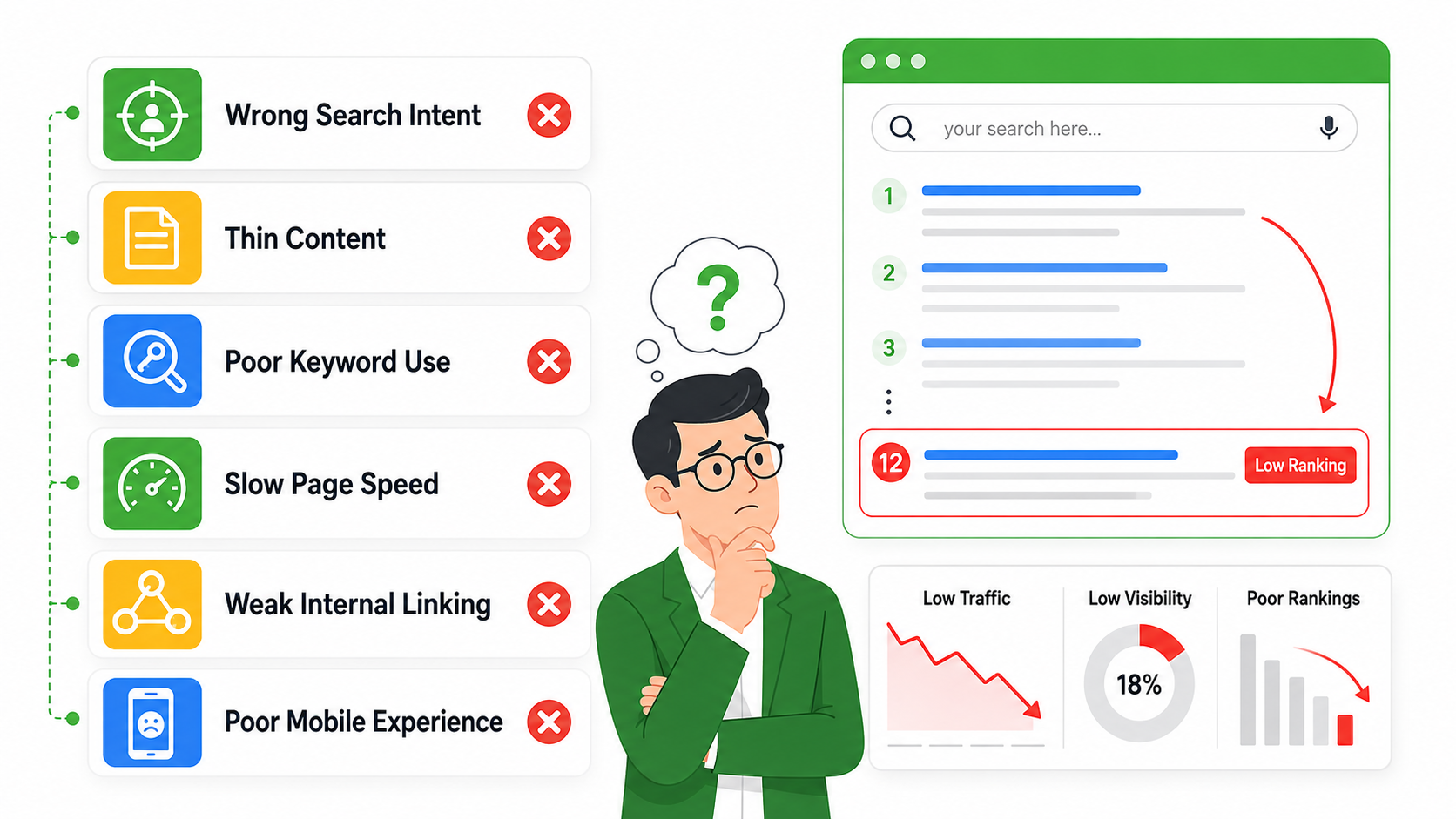
Why Do Most Pages Fail?
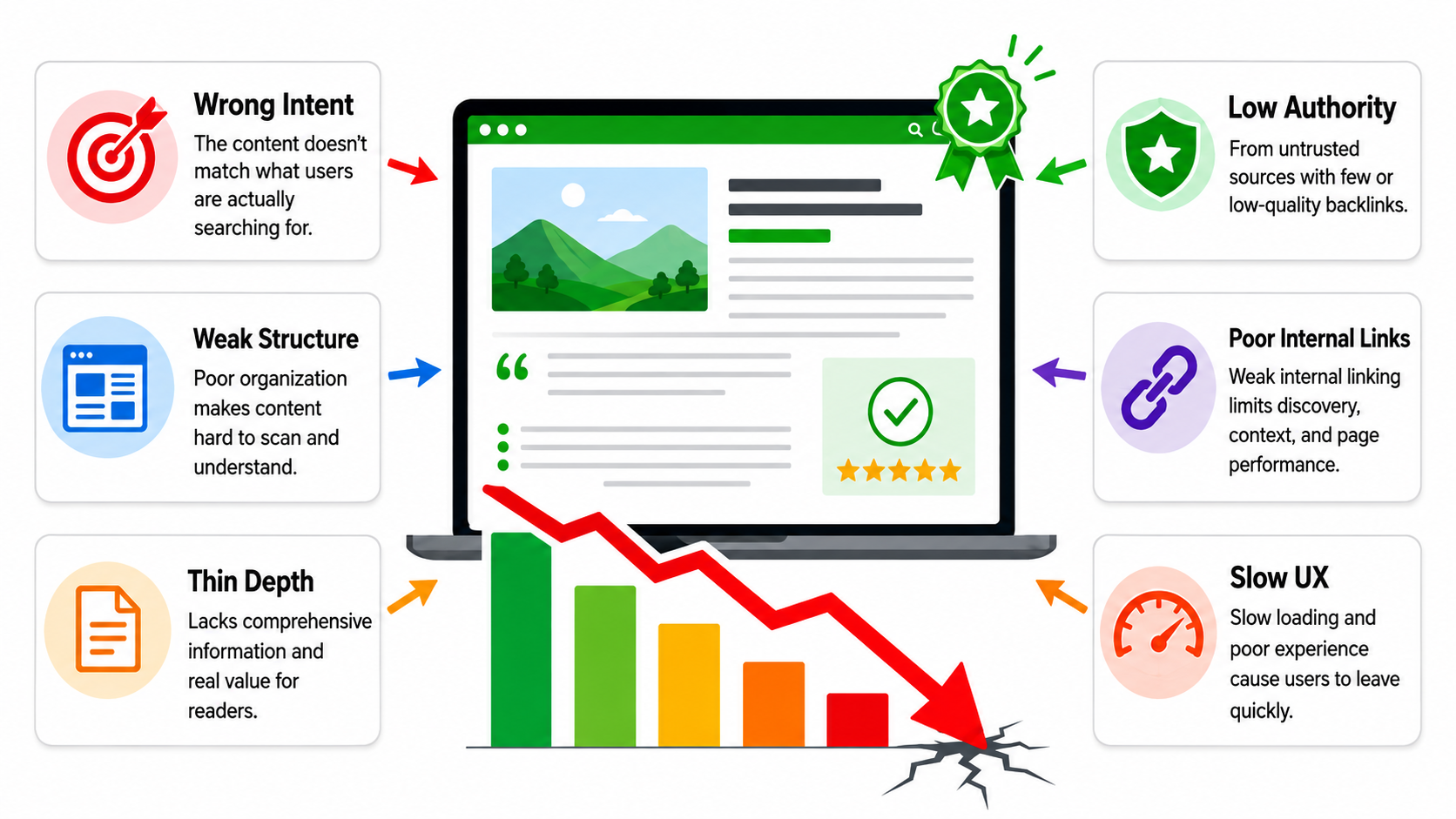
Most pages fail because they are created without a complete SEO content strategy. They may target a keyword, but they do not always support the full search journey.
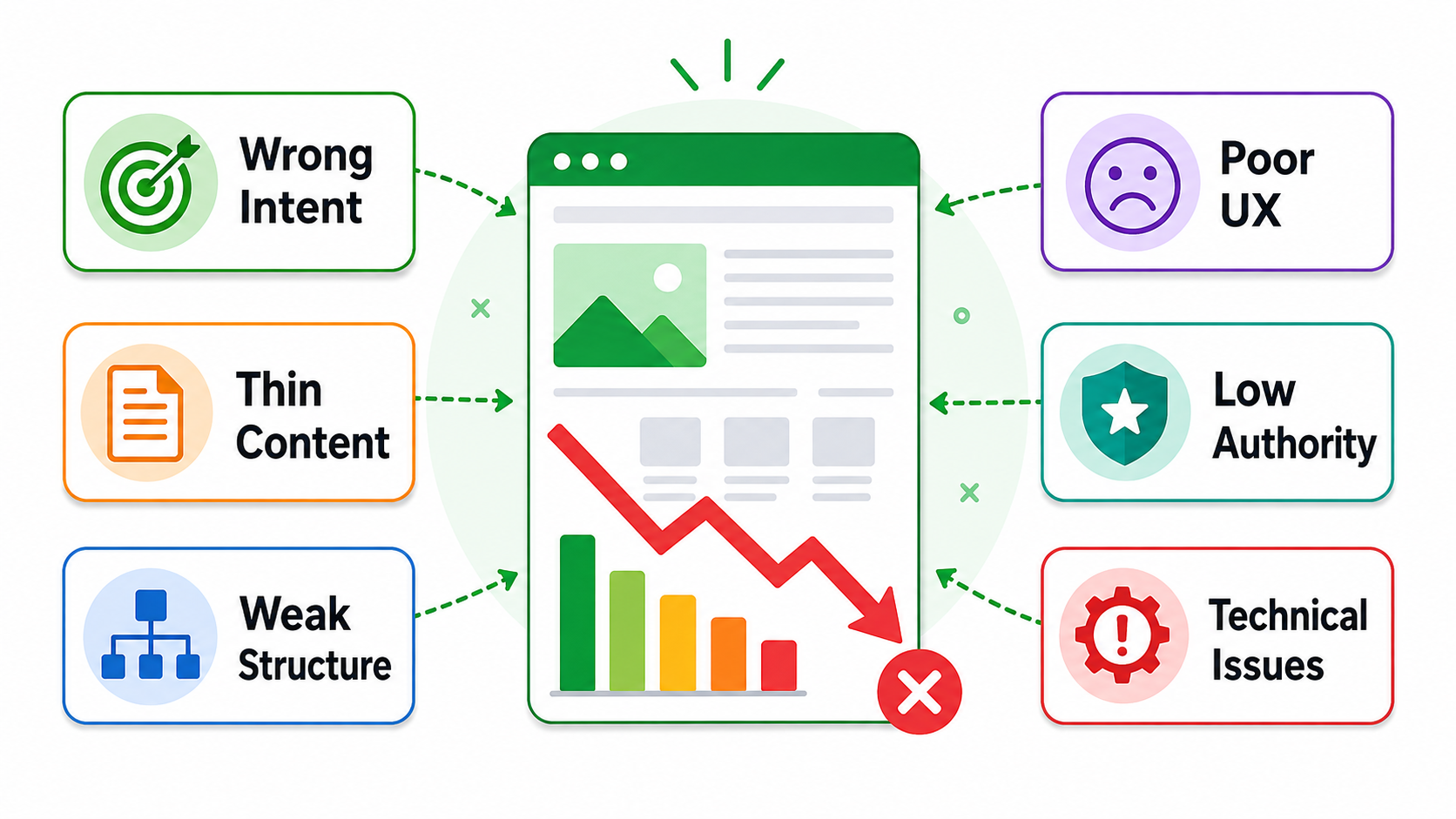
- Wrong Search Intent: In case the user is looking for comparative analysis but receives the definition only, then the content will seem lacking. In case the user needs a service page but finds himself or herself on a blog instead, the page will also be intent-deficient.
- Weak Topic Coverage: A page might discuss the subject matter but be unable to answer relevant questions on the subtopics. In this way, the content will come across as weak as compared to other pages.
- No Topical Authority: Topical authority is built when a website covers a subject properly across multiple connected pages. One isolated article is often not enough.
- Thin or Generic Content: Thin content gives basic answers without real value. It may repeat common points, avoid examples, or fail to explain how something works.
- Poor EEAT Signals: Weak EEAT signals can hurt trust. Content should show experience, expertise, authority, and trust through clear information, author credibility, sources, case examples, and accurate explanations.
- Weak Internal Linking: Poor internal linking stops users and search engines from understanding how pages connect. Related blogs, service pages, and guides should support each other naturally.
- Technical SEO Problems: Even useful content can struggle if technical SEO issues block crawling, indexing, or page performance. Broken links, duplicate pages, poor indexing, and bad site structure can all weaken rankings.
- Slow Website Performance: Slow pages frustrate users and reduce engagement. Core Web Vitals are important because they measure loading speed, responsiveness, and layout stability.
- Keyword Cannibalization: Keyword cannibalization occurs when different pages fight for the same keyword. It creates confusion among search engines and affects ranking capability.
- Poor User Experience: A page having a messy design, too many pop-ups, bad mobile design, or difficult-to-read areas will drive away visitors fast.
- No Backlinks or Authority: Where the competitors have more credible backlinks and higher authority than your web page, it might need to be better promoted, more supported, and more credible.
How Does Google Judge Content?
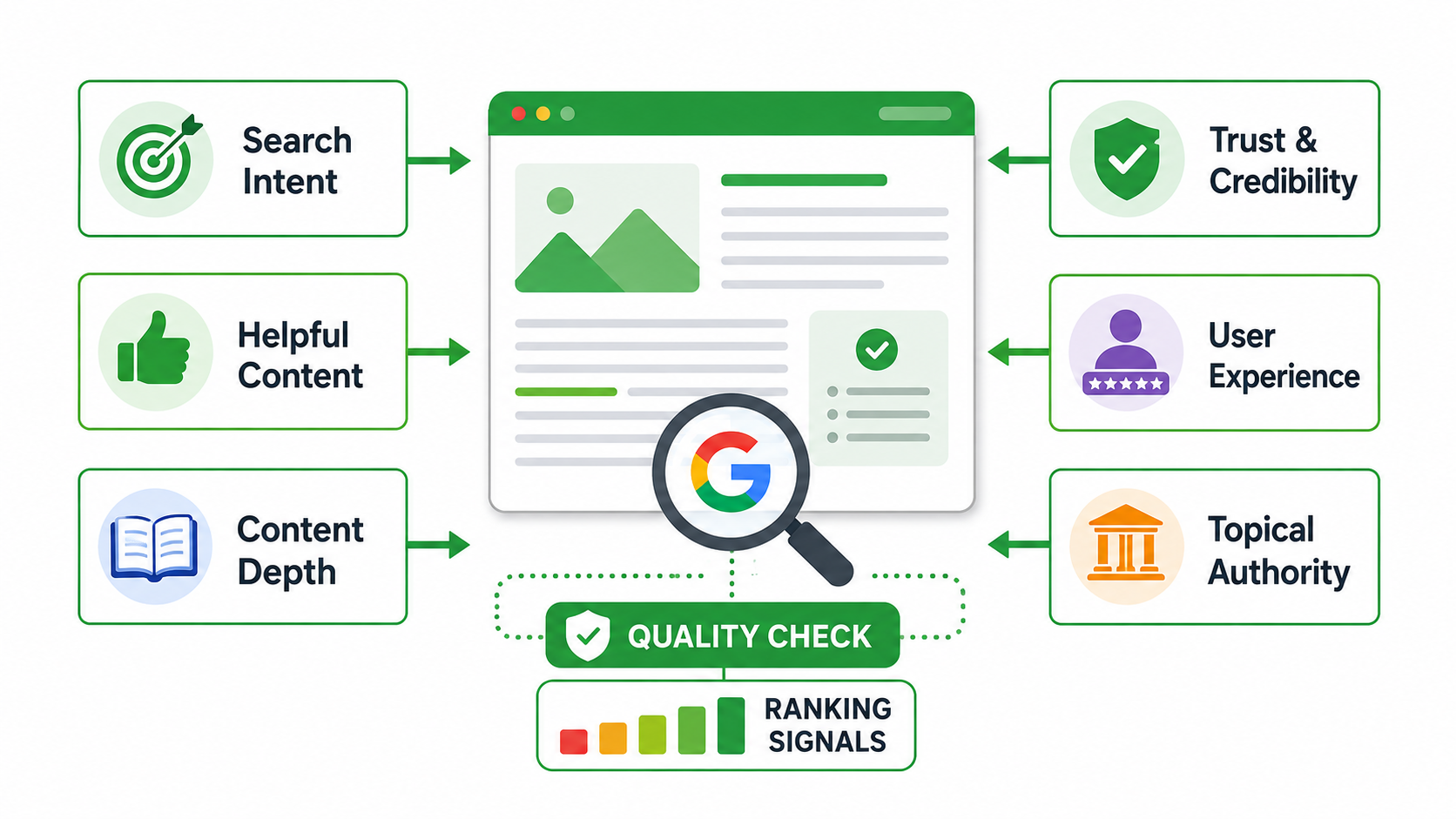
Content analysis by Google is more layered. The search engine tries to understand if the page is really useful, credible, and relevant to the search query.
- Helpful Content Signals: Helpful content signals show whether the page is written for people first. A helpful page answers the main query, supports it with useful details, and avoids unnecessary filler.
- User Engagement Signals: User engagement signals can include how users interact with a page. If people leave quickly, avoid clicking, or return to search results, the page may not be meeting expectations.
- Entity Relationships: Entities represent topics for search engines. As an illustration, when writing on content ranking, one will have to include search intent, backlinks, EEAT, technical SEO, and topical authority.
- Semantic Understanding: Semantic understanding helps Google read meaning, not just exact keywords. This is why related terms, natural language, and complete topic coverage matter.
- Topical Authority: Many pages about the same topic on a website may make the site look more reliable than just a random blog on the topic from a single website.
- Trust & Credibility: Trust develops through use of accurate information, explanations, updated information, expertise, and references. For instance, a healthcare site that provides information on treatment requires more trust signals compared to a leisure blog site. This is because there is a need for more accurate, credible, and thoughtful information.
How Can Ranking Issues Be Fixed?
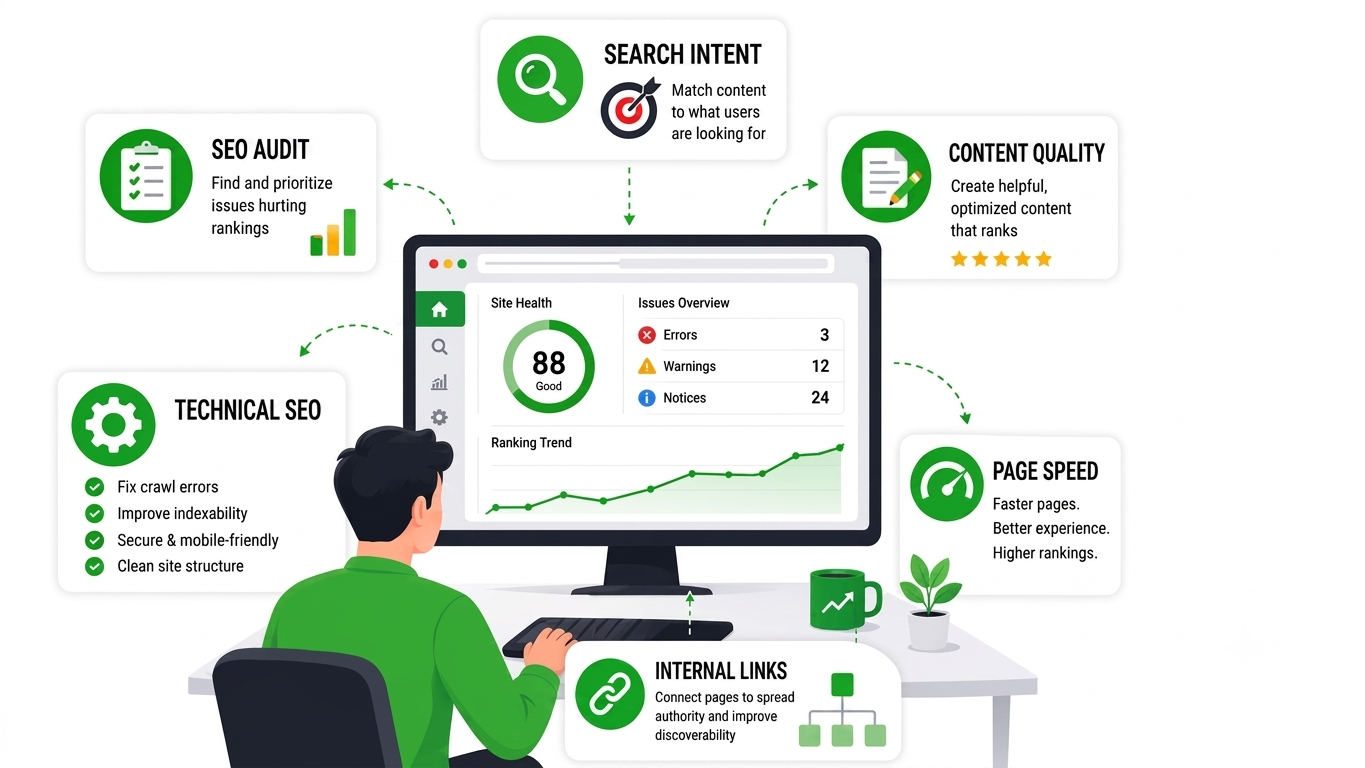
Fixing underperforming content begins with understanding why it is performing poorly. Do not simply rewrite everything without reason. Begin by analyzing intention, gaps, structure, authority, links, technical performance, and freshness.
Step 1—Identify Search Intent
Find out whether existing ranking pages belong to guides, services, lists, products, or comparisons. This way you will be able to provide your own material on the same need of the users.
Step 2 – Perform Competitor Gap Analysis
Analyze the high-ranking pages and look for the gaps in relation to your material. Check whether there are unanswered questions, examples, or other issues.
Step 3: Expand Topic Coverage
Improve weak content by adding:
- Related Questions
- Answer common user questions naturally within the content.
- Supporting Entities
- Include related topics and terms that help search engines understand the page better.
- Real Examples
Make use of practical examples to illustrate the topic. For instance, you could have an agency’s website describing how one of the services is beneficial to small businesses, factors that determine price, and expected outcomes.
Step 4 – Improve Content Structure
Good structure helps users scan and understand the page:
- Heading Hierarchy
- Use clear H1, H2, and H3 headings in the right order.
- Scannability
- Use short paragraphs, bullets, bold points, and simple formatting.
- Visual Elements
- Images, charts, screenshots, and tables can make content easier to understand.
Step 5—Strengthen EEAT.
Add author details, expert input, updated information, real examples, testimonials, case studies, or trusted references where relevant.
Step 6 – Improve Internal Linking
Connect your blog with related service pages and supporting articles. This helps users move deeper into your site and supports topical authority.
Step 7 – Optimize Technical SEO
Check crawlability, indexing, page speed, mobile layout, broken links, schema, and duplicate pages.
Step 8 – Refresh Existing Content
Update old content with current examples, better headings, new FAQs, improved CTAs, and stronger keyword alignment.
Which SEO Mistakes Kill Rankings
Some SEO mistakes look small, but they can slowly damage performance. These mistakes often happen when content is published quickly without enough planning.
- Publishing Without Keyword Research: Without the keyword research, there is a risk that writing will end up creating either content that no one is looking for or content targeting the wrong audience.
- Chasing High-Volume Keywords Only: High-volume keywords are very attractive, but they may be quite generic or competitive. At times, low-volume keywords perform better because they indicate higher intent.
- Writing for Search Engines Instead of People: Over-optimized content can feel unnatural. Readers want clear answers, not repeated keywords or forced SEO phrases.
- Ignoring Conversion Optimization: Ranking is useful, but the page should also guide users toward the next step. A weak CTA can reduce business value even if traffic improves.
- Not Updating Old Content: Content that was useful two years ago may no longer be enough. Search results change, competitors improve, and user expectations grow. For example, a blog about AI SEO written before AI Overviews became common may need updates to stay relevant today.
What Should You Check Before Publishing?
A simple checklist will eliminate many ranking issues before the page even goes live. It will also assist in ensuring that everyone is on the same page.
- Search Intent Check: Make sure the page matches what users expect from the keyword.
- Keyword Optimization: Use keyword optimization naturally in the title, meta details, introduction, headings, and body without stuffing.
- Internal Links: Add relevant internal links to related blogs, services, or pillar pages.
- External References: Use credible external sources where they add trust or support important claims.
- Schema Markup: Add schema when relevant, such as FAQ, article, product, review, or local business schema.
- Image SEO: Use clear file names, alt text, compressed images, and relevant visuals.
- Mobile Experience: Check whether the page looks good and works properly on mobile devices.
- Core Web Vitals: Review speed, layout stability, and responsiveness.
- CTA Optimization: Add a clear CTA that tells the reader what to do next.
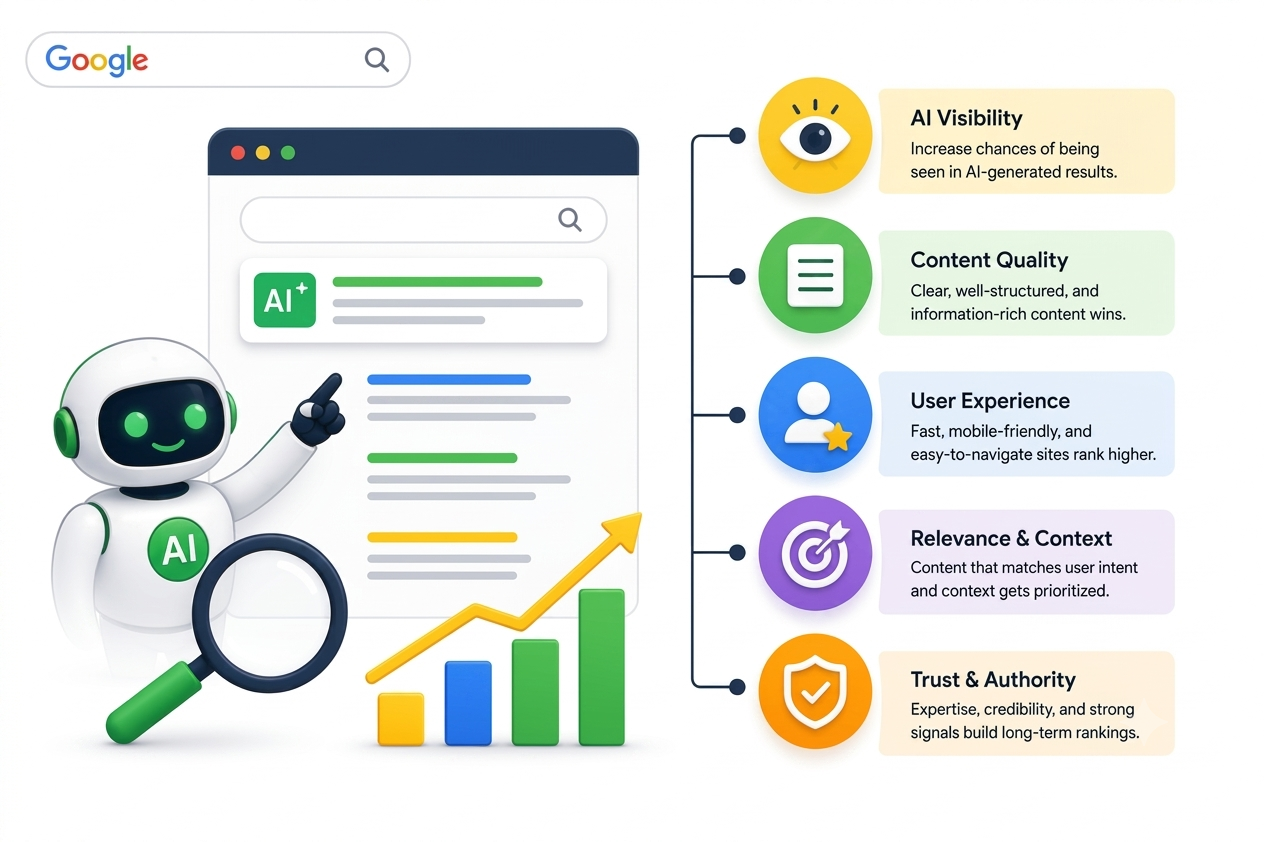
How Does AI Search Change Rankings?
AI search has brought about new approaches to finding and summarizing content. Content that is direct, clear, well-organized, and credible will be rewarded.
- Google AI Overviews: Google AI Overviews may pull information from pages that answer questions clearly and provide strong context.
- ChatGPT Search: ChatGPT-style search experiences often favor content that explains topics naturally and provides useful, easy-to-summarize information.
- Perplexity AI: Perplexity focuses on cited, answer-style information. Clear explanations and source-backed content can help visibility.
- Gemini: Gemini can understand topic relationships and user intent, so content needs strong semantic clarity.
- GEO, AEO & SEO Together: GEO, AEO, and SEO now complement each other. The content must rank in the search engine results, answer questions, and look helpful to AI-based responses.
In case impressions increase while clicks are not increasing, work on improving titles and descriptions. In case clicks increase while conversions are not increasing, improve page experience and CTAs.
Conclusion
Most content fails to rank because it is created without enough planning, depth, structure, or authority. A page may look complete, but if it misses intent, lacks trust, loads slowly, or does not connect with related content, it can still struggle in search results.
The solution is not always to publish more. Businesses should improve content optimization, strengthen SEO content strategy, update old pages, fix technical problems, and build stronger topic coverage. When content becomes more useful for readers, it also becomes easier for search engines to understand and trust.
Connect with eSign Web Services for a detailed content analysis and SEO strategy that helps improve visibility, strengthen organic performance, and turn underperforming content into a stronger business asset. Get expert insights to identify content gaps, improve search relevance, and build a more sustainable path toward long-term organic growth.
Frequently Asked Questions
Question: Why does content fail to rank even after writing well?
Answer: A post may lack ranking skills despite its excellent writing skills due to the fact that not only the writing skill but other factors as well are considered by search engines in ranking a website. The website also has to meet the user’s intention, be relevant and informative enough, load successfully, show credibility, and link to related pages. If your competitors give better solutions and examples, have more credibility, and have an easier-to-use page, then they are likely to rank higher than you.
Question: How do I know if search intent is wrong?
Answer: Inappropriate search intent will be seen when there are many impressions but fewer clicks, many visitors to the page but low engagement, and when users leave the website after landing on it. Checking the high-ranking sites using the target keyword is also another good way to do that. It would mean there’s a problem with the search intent if there are how-to guides listed by Google and your page is a service page or vice versa.
Question: What is thin content in SEO?
Answer: Content that offers limited value to the user is called thin content. The content need not necessarily be short but can also be long as long as it fails to offer substantial information. This happens when a page offers no examples, fails to address essential questions, and lacks sufficient depth. Generally, thin content faces difficulties since it fails to meet the needs of the reader. This can be corrected by providing useful information to enhance the page.
Question: How often should old content be updated?
Answer: Older content must be updated every few months, especially if it was written for competitive keyword purposes, to generate traffic or any service. Some industries need updates more often than others because of changing trends, technology, pricing, or search results. Updating entails checking the page ranking, the traffic that is generated, click rates, outdated information, broken links, missing FAQs, and increased competition. An update on existing content often delivers quicker results than creating fresh content due to its previous search history.
Question: Can internal linking improve rankings?
Answer: The use of internal links will contribute to improved rankings through signaling search engines how your pages are linked internally. This will also be good for navigation by users to get from one page to another that might be useful. For instance, in the case of a blog post about content ranking, you could have internal links to pages such as keyword research, SEO audits, technical SEO, and content strategy.
Question: Why does topical authority matter?
Answer: Topical authority is important for search engines to ensure that they rank web pages that demonstrate a good grasp of a particular topic. In case a web page has just one post about a wide topic, then that web page will appear as less credible compared to a web page with many posts that are relevant to the topic. Developing topical authority involves writing about the main topic, related questions, sub-topics, and supporting pages.
Question: How does AI search affect content rankings?
Answer: The impact of AI search on rankings comes from the increased value of content that is clear, structured, and trustworthy. Content that would be considered relevant for tools such as AI Overviews, ChatGPT Search, Perplexity, and Gemini would be content that provides direct answers and explains the topics with correct context. Keyword-stuffed and vague content may not rank well. In order to be prepared for AI search, the following should be included in content.
Question: What is the fastest way to fix weak content?
Answer: Improvements will be made faster on the pages with some visibility already. Find the pages with high impressions but with low clicks or pages close to being on the first page of search engine results. Such pages could be improved in terms of title, introduction, headings, depth, internal links, examples, and calls-to-action. It would be great if you checked whether the page is aligned with the intent of the searcher.
Question: Do backlinks still matter for content ranking?
Answer: Backlinks are important since they help in establishing trust and authority. Backlinks alone will not be able to rescue poor-quality content. There should be strong relevance, useful content, proper structure, and technical soundness of the page. If two pages are identical in quality, the page having higher authority will be superior. The best way is to produce linkable content and boost authority using relevant and credible references.
Question: How do I measure content fixes?
Answer: These are the performance metrics that will enable you to evaluate your level of success in making content changes—rank, organic traffic, impressions, clicks, engagement, conversion, and information in Google Search Console. An increase in impressions could mean that your page is more visible. Better clicks will tell you that your title and meta description have become more appealing for users. Better engagement and conversion will show that your content meets user requirements.
Author Details

Ashwani Kumar Sharma
Ashwani has been actively involved in SEO services since 2005. His expertise and distinctive work approaches have made him one of the most experienced and trusted SEO experts in the industry. He is a certified SEO and Google Ads professional. He also has strong business development skills in advanced SEO, PPC, and digital marketing strategies.


