



How to Build an SEO Content Cluster Strategy That Dominates Rankings

Key Takeaways
- Content clusters organize related pages around core topics instead of targeting keywords through disconnected articles.
- Strong pillar pages establish the foundation while supporting content develops depth around specific subtopics and intents.
- Strategic internal linking helps search engines understand relationships between pages and distributes authority throughout clusters.
- Keyword clustering should consider search intent, entities, semantic relationships, and SERP overlap rather than keyword similarity alone.
- Content clusters help businesses build topical authority and compete across broader groups of relevant searches.
- Existing website content can often be reorganized into clusters instead of creating every page from scratch.
- Cluster performance should be measured at topic level rather than judging individual keyword rankings alone.
Introduction
Publishing more content does not automatically lead to stronger organic visibility. A website can have hundreds of articles and still struggle to rank if those pages feel disconnected, cover the same ideas, or fail to show real depth around important topics. Search visibility increasingly depends on how clearly a site organizes knowledge, answers related questions, and guides users from one useful resource to another. A structured SEO Content Cluster Strategy brings all of that together by organizing content around broader topics instead of treating every keyword as a separate publishing opportunity.
In this blog, we will explore how content clusters work, why they can improve search performance, and how to build them step by step. We will cover keyword research, search intent, pillar pages, supporting content, internal linking, cannibalization, performance measurement, and AI search. You will also learn how to reorganize existing content into stronger topic ecosystems instead of constantly creating new pages.
What Is an SEO Content Cluster Strategy?
A Content cluster strategy organizes related website pages around one central subject. Instead of publishing articles that sit separately and happen to target different keywords, the website builds a connected group of resources that explains a topic from several useful angles.
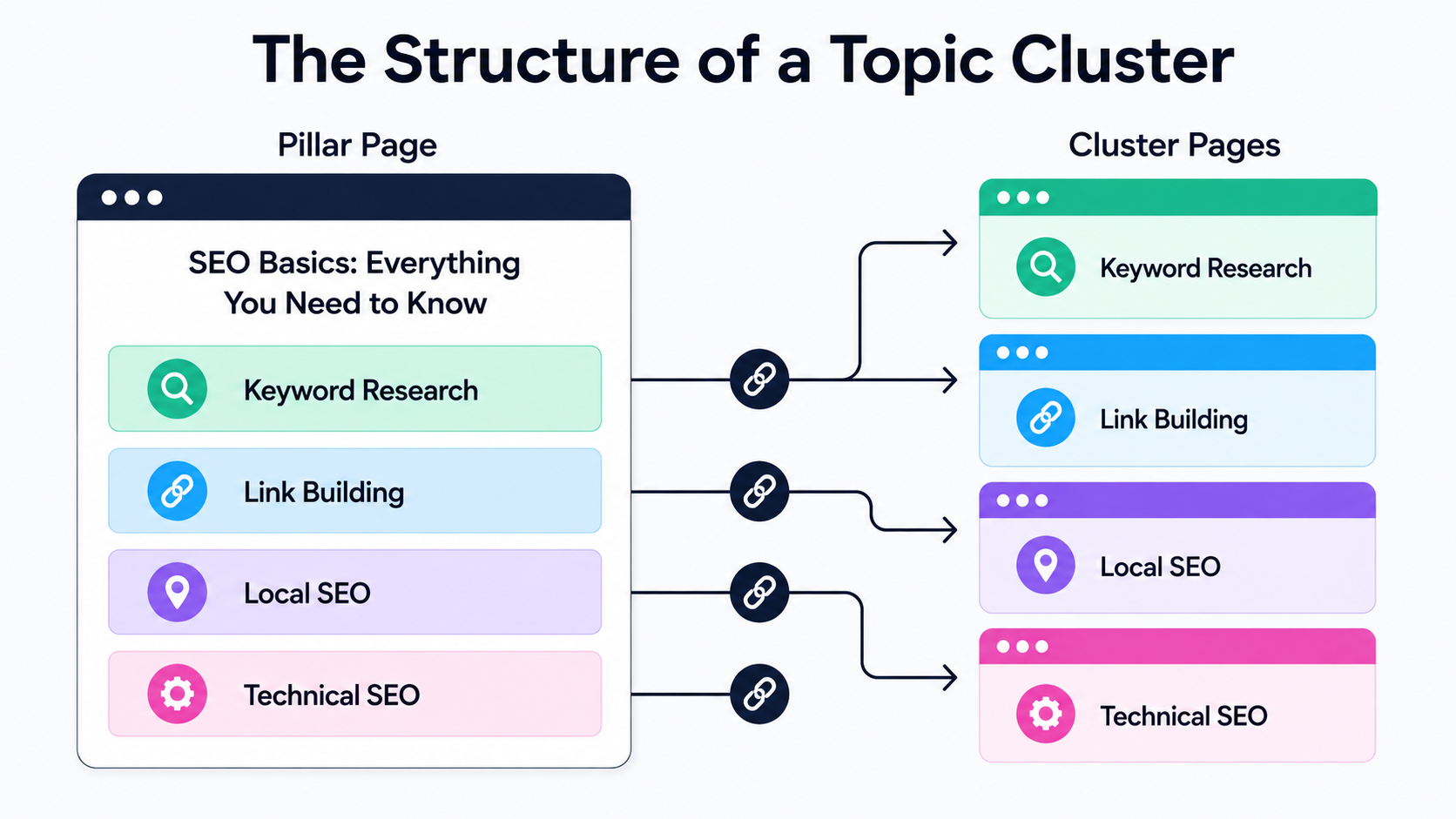
For Example: A digital marketing website may create a broad pillar page about search engine optimization. Supporting pages could then cover technical SEO, local SEO, keyword research, content optimization, link building, and reporting. Each page serves a different purpose, but they all contribute to the same larger topic.
This approach makes it easier for visitors to move through related information while also giving search engines a clearer picture of the subjects a website understands well.
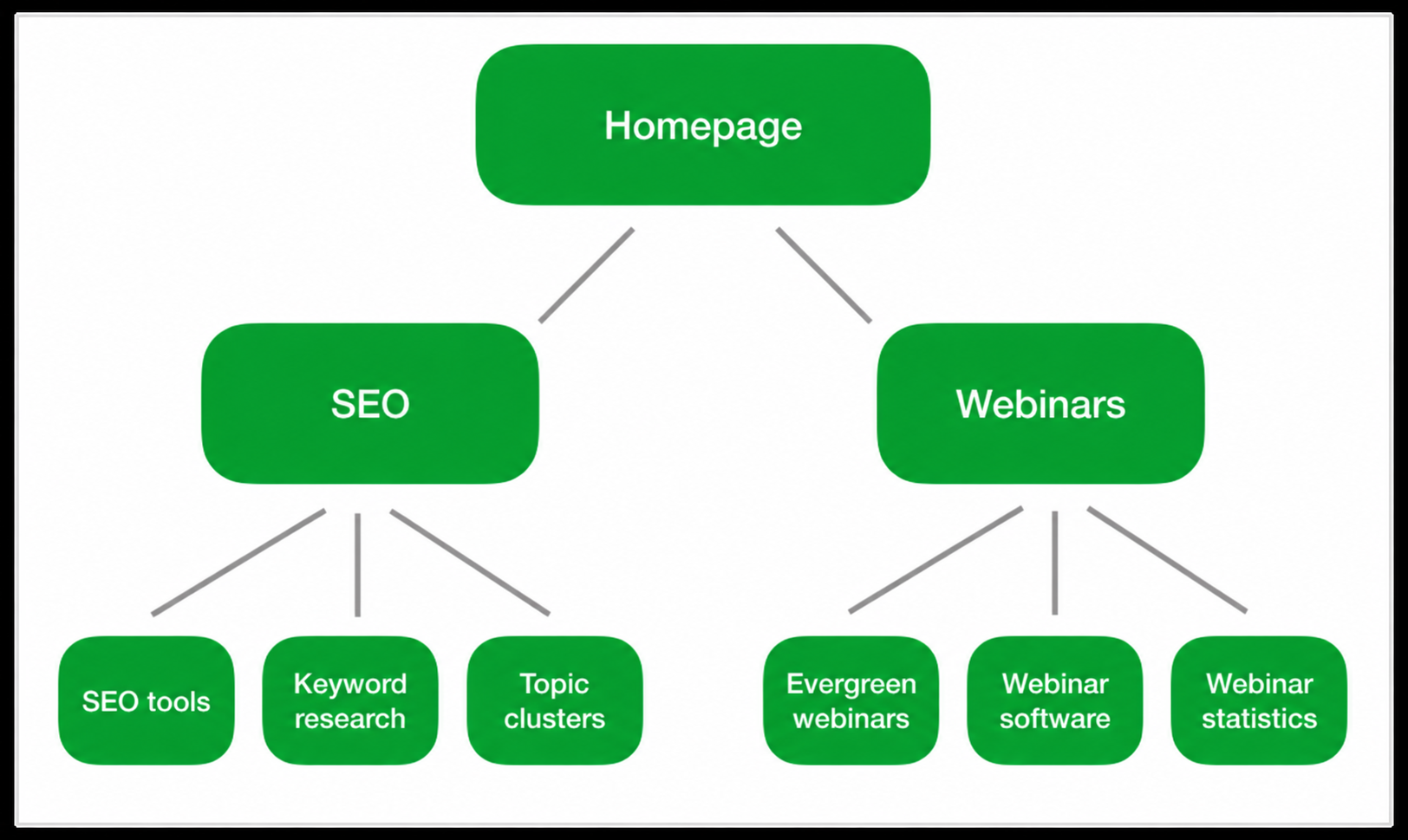
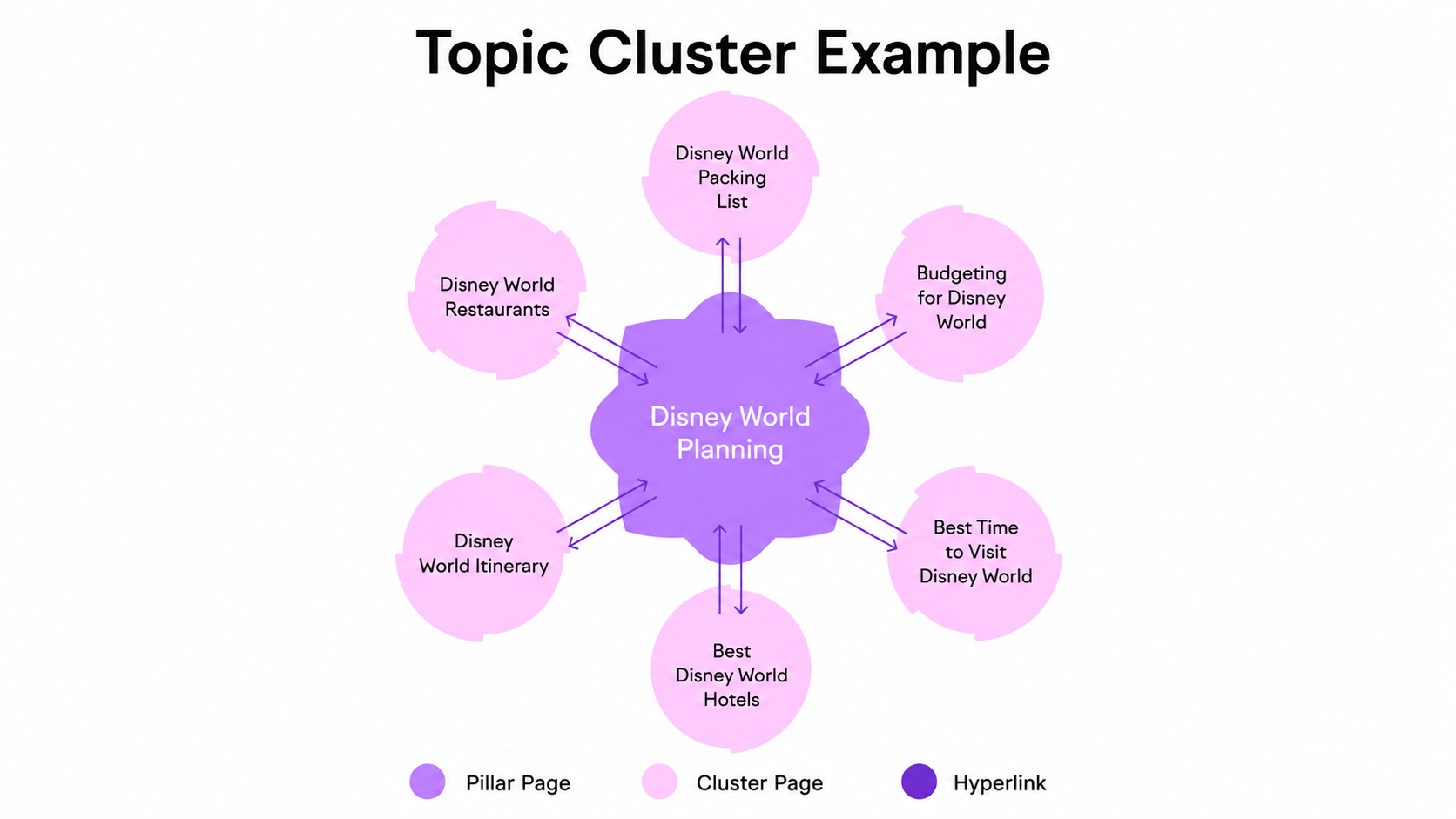
- Understanding the Topic Cluster Model: A topic cluster starts with one main pillar page and several supporting articles. Each supporting page explores a specific question or subtopic, helping readers understand the subject better while building stronger topical depth.
- Pillar Pages vs Cluster Content: Pillar pages give readers a broad overview, while cluster content goes deeper into specific questions or areas. Together, they create a clear structure where the pillar guides readers and supporting pages provide the extra detail.
- How Content Hubs fit In: Content hubs bring related resources together in one easy-to-navigate place. They may include pillar pages, guides, videos, tools, and case studies, helping visitors explore the topic without searching around the website repeatedly.
- Keywords vs Topics vs Entities: Keywords are the phrases people search for, topics are the broader subjects behind them, and entities are related people, products, technologies, or concepts. Understanding all three helps create richer and more relevant content.
- Why Internal Relationships Matter: Internal links connect pillar pages with supporting content and help readers move naturally between related topics. They also give search engines clearer signals about page relationships, making the website structure easier to understand.
Why Content Clusters Improve SEO Performance
The purpose of content clusters for SEO is not simply to increase the number of pages on a website. Their real value comes from building organized depth around topics that matter to the audience and the business. When related resources support one another, the website becomes easier to understand as a connected source of information rather than a collection of unrelated URLs.
1. Build Stronger Topical Authority
Topical authority develops when a website consistently publishes useful, accurate content around a subject and its important subtopics. Imagine an accounting website that wants to rank for small-business tax searches. A single article about tax deductions probably will not be enough. A stronger cluster could cover quarterly payments, deductions, tax planning, recordkeeping, deadlines, common mistakes, and business structures.
That broader coverage helps demonstrate real depth. This is where topical authority SEO becomes valuable because the site can start building visibility across many related searches instead of depending on one article.
2. Improve Search Engine Understanding
Search engines need to understand what a page is about, what purpose it serves, and how it connects with other pages. A well-organized cluster makes those relationships easier to interpret. When a pillar links to detailed supporting content and those pages link back naturally, the overall topic structure becomes clearer.
Descriptive headings, meaningful anchor text, relevant entities, and strong semantic relationships all help reinforce that understanding.
3. Expand Keyword Coverage
A content cluster can help a site appear for a much wider range of search queries. The pillar page may target broader topics, while supporting pages can focus on long-tail phrases, specific questions, comparison searches, and problem-based queries.
Instead of trying to squeeze every keyword variation into one page, a thoughtful SEO content strategy gives each search intent the right place within the larger topic.
4. Strengthen Internal Authority Flow
A page that earns backlinks or builds authority can pass some of that value to other pages through internal links. For example, if an original industry report attracts external links, it can connect naturally to an important pillar page and several related resources. That creates a stronger internal flow of authority across the cluster.
The key is relevance. Internal links should help readers first. Adding dozens of links purely for SEO can quickly make a page feel cluttered and forced.
5. Improve Website Crawlability
Search engines discover many pages by following links. If important content is buried deep within the site or has very few internal links, crawlers may have a harder time finding or revisiting it.
A connected cluster creates clear pathways between the main pillar and supporting content. Strong information architecture helps both users and search engines move through the site more easily.
6. Create Better User Journeys
People rarely stop after reading one answer. Someone researching CRM software may first want to know what a CRM is, then compare features, look at pricing, explore implementation issues, and eventually search for a provider.
Content clusters support this journey because each page can lead naturally to the next useful step. The visitor stays within the site instead of repeatedly going back to search results.
How Search and AI Systems Understand Content Clusters
Search is increasingly focused on meaning rather than exact keyword matching. Search engines and AI tools look at concepts, relationships, entities, context, and search intent when interpreting content. Well-planned clusters work well in this environment because they create clearer connections between related ideas.
1. Semantic Relationships between Pages
Two pages can be closely connected even when they do not share the same keywords. For example, a guide on choosing running shoes and another on how foot pronation affects running may target different phrases, but both belong within the broader topic of running footwear.
Planning these relationships intentionally helps create real subject depth instead of relying only on keyword similarity.
2. Entity and Topic Connections
Entity SEO focuses on recognizable concepts and the relationships between them. Content about electric vehicles, for example, may naturally involve batteries, charging networks, range, Tesla, lithium-ion technology, incentives, and charging stations.
Including relevant entities helps search and AI systems understand context. However, these terms should appear because they genuinely help explain the topic, not because they were copied from a checklist.
3. Search Intent Coverage
Search intent is simply the reason behind a search. A strong cluster can support several types of intent without forcing everything onto one page:
- Informational content helps users understand a subject.
- Comparison content helps them evaluate options.
- Product or service pages support purchasing decisions.
- Tutorials show people how to complete a task.
- FAQs answer specific concerns.
Covering these different needs gives the cluster more depth and makes it useful throughout the customer journey.
4. Google AI Overviews
Google AI Overviews can combine information from different sources to answer complex questions directly within search. There is no guaranteed method for being featured. However, clear explanations, useful context, strong structure, relevant entities, and genuinely helpful information can make content easier for search systems to understand and use.
Trying to write specifically for AI at the expense of human readers is usually the wrong direction. Helpful content still comes first.
5. AI Search and Answer Engines
Search experiences such as ChatGPT Search and other answer engines are changing how people look for information. Users can now ask longer, more conversational questions and receive direct, summarized answers. That makes AI search optimization increasingly relevant.
Websites need content that explains subjects clearly, answers specific questions, shows expertise, and connects related information in a way that can be understood without relying on repetitive keyword use.
6. Why Comprehensive Coverage Matters
Comprehensive coverage does not mean making every page extremely long. It means making sure the website, as a whole, covers the important questions surrounding a topic.
A 2,000-word article that repeats the same points may offer less value than a smaller group of well-connected pages where every resource solves a different problem.
How to Build an SEO Content Cluster Strategy Step by Step
Building a strong topic cluster SEO strategy takes planning. It is much easier to create a useful content ecosystem when the structure is clear before writing begins. The steps below bring together business priorities, search behavior, site architecture, and content production.
Step 1 – Define Your Core Business Topics
Start with the subjects that are directly connected to what your business offers. A strong core topic should relate to your products, services, customer problems, expertise, or business goals. Avoid choosing topics only because they have high search volume. Large traffic numbers are not useful if the visitors are unlikely to become customers.
- Products and Services: Look at the main products and services your business provides. Each important service can become a separate pillar topic or content cluster. For example, a digital marketing agency offering SEO, PPC, web design, and social media marketing can create a separate cluster for each service. This is usually clearer than placing everything under one broad “digital marketing” topic.
- Customer Problems: Think about the problems your customers face before they look for a solution. For example, a payroll software company may create content around late payroll, tax errors, employee classification, payroll compliance, and automated payroll processing. These problem-based topics are useful because they often reflect what people are genuinely searching for.
- Industry Expertise: Focus on subjects where your business has real knowledge and experience. First-hand examples, case studies, expert opinions, internal data, practical lessons, and original insights can strengthen EEAT and make your content more useful than generic competitor articles.
- Commercial Opportunities: Not every popular topic is worth targeting. A topic may attract a lot of traffic but still have little connection to your services or customer journey. A good content cluster should balance search demand with real business value.
Step 2 – Perform Topic and Keyword Research
Once you have chosen your main business topics, research the full search landscape around each one. Good SEO content planning looks beyond a basic keyword list. It should include search terms, common questions, user intent, competitors, related concepts, and missing content opportunities.
- Primary Keywords: Primary keywords represent the main topic or search opportunity of a page. They help guide the content, but they should not be repeated unnaturally. The main goal is still to answer the reader’s question clearly and completely.
- Secondary Keywords: Secondary keywords are closely related terms, variations, and subtopics. They help broaden the page’s relevance and reflect the different ways people may search for the same subject. Use them naturally so the content does not sound repetitive.
- Long-Tail Queries: Long-tail keywords are more specific search phrases. For example, “CRM software” is broad, while “best CRM software for small construction companies” shows a much clearer need. These detailed searches are often useful for supporting cluster content because they focus on specific problems, industries, or situations.
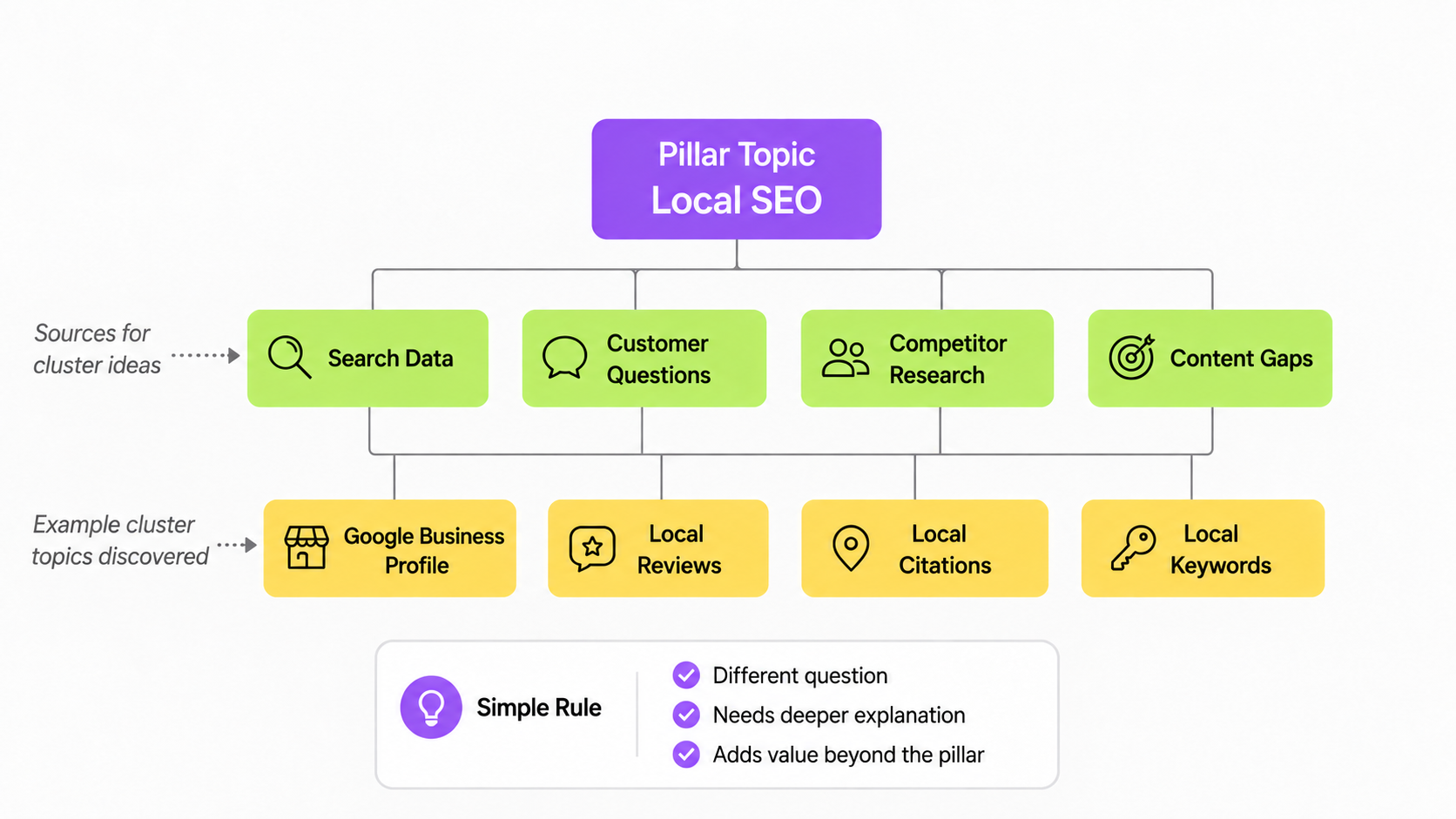
- Related Questions: Look for the questions people regularly ask about the topic. Useful sources include customer emails, sales calls, support tickets, forums, online communities, search results, and keyword tools. Repeated questions can often become strong ideas for supporting articles.
- Relevant Entities: Identify the important people, tools, products, technologies, organizations, standards, and concepts connected to the topic. Including these naturally can make the content more complete and prevent important context from being missed.
Step 3 – Group Keywords by Search Intent
Keyword clustering should be based on what users actually want, not only on whether two keywords look similar. Different phrases may have the same intent, while similar phrases may require completely different pages.
- Informational Intent: Informational searches happen when users want to learn or understand something. These searches may include definitions, tutorials, guides, explanations, or troubleshooting questions. Blog posts, educational guides, and knowledge-base pages usually work well for this type of intent.
- Commercial Investigation: Commercial investigation happens when users are comparing their options. Searches containing words such as “best,” “top,” “reviews,” “versus,” and “alternatives” often fall into this category. These users may benefit from comparison pages or detailed evaluation content.
- Transactional Intent: Transactional searches come from users who are closer to taking action. They may look for pricing, services, products, quotes, consultations, free trials, or providers. These searches usually fit better on service pages, product pages, or conversion-focused landing pages.
- Navigational Intent: Navigational searches happen when users already know the brand, product, tool, or page they want to visit. Understanding this intent helps you avoid creating unnecessary content that competes with important branded pages.
Step 4 – Analyze SERP Overlap
SERP overlap helps you decide whether similar keywords need one page or separate pages. Search both keywords and compare the results. If many of the same pages rank for both searches, Google may see those keywords as having similar intent. In that case, one strong page may be better than creating several competing pages.
If the search results are very different, separate pages may make more sense.
Step 5 – Create a Topical Map
A topical map helps you organize everything that should be covered around one main subject. You can create it in a spreadsheet, mind map, database, or project management tool. The format is not the main concern. What matters is seeing how the topics connect.
- Core Topic: Start with the main topic at the center. It should be broad enough to support several subtopics, but still closely connected to the business.
- Major Subtopics: Break the main topic into smaller sections. For example, an email marketing cluster may include automation, segmentation, list building, deliverability, analytics, campaigns, templates, and software.
- Supporting Questions: Add the main questions people ask under each subtopic. Some questions may need their own article, while others may fit better as sections within a larger page.
- Entity Relationships: Map the important tools, technologies, products, concepts, and organizations connected to the topic. This helps writers understand what supporting context should be included.
- Content Gaps: Compare the topical map with your existing website content. Anything important that is missing becomes a possible new content opportunity and can support a more focused content gap analysis.
Step 6 – Select the Pillar Page
Choose a pillar topic that is broad enough to support several related articles but still focused enough to remain useful. For example, “digital marketing” may be too broad for an SEO-focused agency. “Local SEO” or “enterprise SEO” may work better because each topic is specific while still supporting many useful subtopics.
Good pillar page SEO starts with choosing the right topic, not simply creating the longest article on the website.
Step 7 – Plan Supporting Cluster Content
Supporting content should cover the narrower questions and subtopics connected to the pillar page. Useful content types include:
- Tutorials
- Comparisons
- Common problems
- Definitions
- Checklists
- Use cases
- Industry-specific guides
- Pricing topics
- Decision-stage resources
- Emerging trends
Each page should have a clear purpose. If two articles would answer almost the same question, creating both may only cause overlap.
Step 8 – Map Internal Links
Plan internal links before publishing the content. Decide which cluster pages should link back to the pillar, where the pillar should link to supporting articles, and which supporting pages should connect with each other. Planning this early creates a cleaner and more useful structure than adding random links after publication.
Step 9 – Prioritize Content Production
You do not need to publish the entire cluster at once.
Prioritize pages based on:
- Business value
- Search opportunity
- Competition
- Existing authority
- Customer demand
- Funnel stage
- Content dependencies
- Conversion potential
This helps you focus on the most useful pages first while keeping content quality consistent.
Step 10 – Continuously Expand the Cluster
A content cluster should continue to grow as search behaviour, customer needs, and the industry change. New products, customer questions, competitor activity, industry updates, and technology can all reveal new content opportunities. Review the cluster regularly and add new pages only when they provide useful information that is not already covered.
How to Design a Strong Pillar Page
A pillar page acts as the main reference point for a cluster. It should answer the core intent clearly while helping users discover more detailed resources when they want to go deeper.
1. Choose the Right Topic Breadth
A very narrow topic may not support enough useful subtopics. A topic that is too broad, on the other hand, can become unfocused and difficult to cover properly. The best pillar topics sit somewhere in the middle. They have a clear search intent, strong business relevance, and enough depth to support several related pages.
2. Cover the Complete Primary Intent
A pillar page should fully answer the main question behind the search. If the topic is “content marketing strategy,” readers should understand what it is, why it matters, how it works, and what major elements are involved. They should not be forced to open several additional articles just to understand the basic subject.
3. Create Logical Content Sections
Structure the page around natural subtopics. Clear headings make content easier to scan and create a smoother reading experience. They also provide obvious places to link to supporting articles. The structure should feel useful, not like a list of keywords turned into headings.
4. Connect Supporting Cluster Pages
A pillar page should help readers move deeper into the topic. If one section introduces keyword research, link to a more detailed keyword research guide. If another covers measurement, point readers to a stronger analytics resource. These links should appear where they genuinely help the reader continue learning.
5. Demonstrate Experience and Expertise
Generic information is easy to copy. First-hand examples, real observations, unique frameworks, case studies, original data, and expert commentary can make a pillar page more useful and more trustworthy. These details also make the content feel less like a rewritten summary of what already exists online.
6. Include Original Value
Original value does not always require expensive research.
It can include:
- A useful checklist
- Custom examples
- Original diagrams
- Industry observations
- Survey data
- Unique workflows
- Expert commentary
- Templates or calculators
These additions give readers a reason to choose your page instead of another generic article.
How to Create Supporting Cluster Content
Supporting cluster pages add depth to the ideas introduced by the pillar. They should not simply repeat the main page using slightly different keywords. Every supporting resource should answer a narrower need or provide more detailed help.
1. Answer Specific User Questions
Specific questions often make excellent cluster topics. If the pillar is about website speed, supporting content might explore image compression, Core Web Vitals, caching, JavaScript performance, or hosting. These pages allow the website to answer detailed questions without overcrowding the pillar.
2. Target Narrower Search Intent
Supporting pages can focus on situations that are too specific for the pillar. Instead of another broad CRM guide, a site could publish articles about CRM migration, CRM implementation for construction companies, or CRM integration with email platforms. That level of detail gives users more relevant answers.
3. Cover Problems and Solutions
Problem-based searches often come from users who need help quickly. Topics such as falling traffic, slow websites, duplicate content, cart abandonment, or email deliverability can make strong supporting resources. These articles work best when they explain the cause clearly and provide practical solutions.
4. Create How-To Resources
Step-by-step guides can be extremely useful cluster content. Users often want to complete a specific task, not just understand the theory behind it. Screenshots, examples, workflows, and troubleshooting tips can make these guides much more practical.
5. Publish Comparison Content
Comparison pages help users evaluate different options. They can compare tools, services, products, strategies, or approaches and explain the advantages, limitations, and ideal use cases of each.
The goal should be to help the reader make a better decision, not simply to target a “versus” keyword.
6. Avoid Repeating the Pillar Page
Every supporting page should add something that the pillar cannot cover in enough depth. If the article simply repeats one paragraph from the pillar in slightly more words, it may not deserve a separate URL.
Internal Linking Strategy for Content Clusters
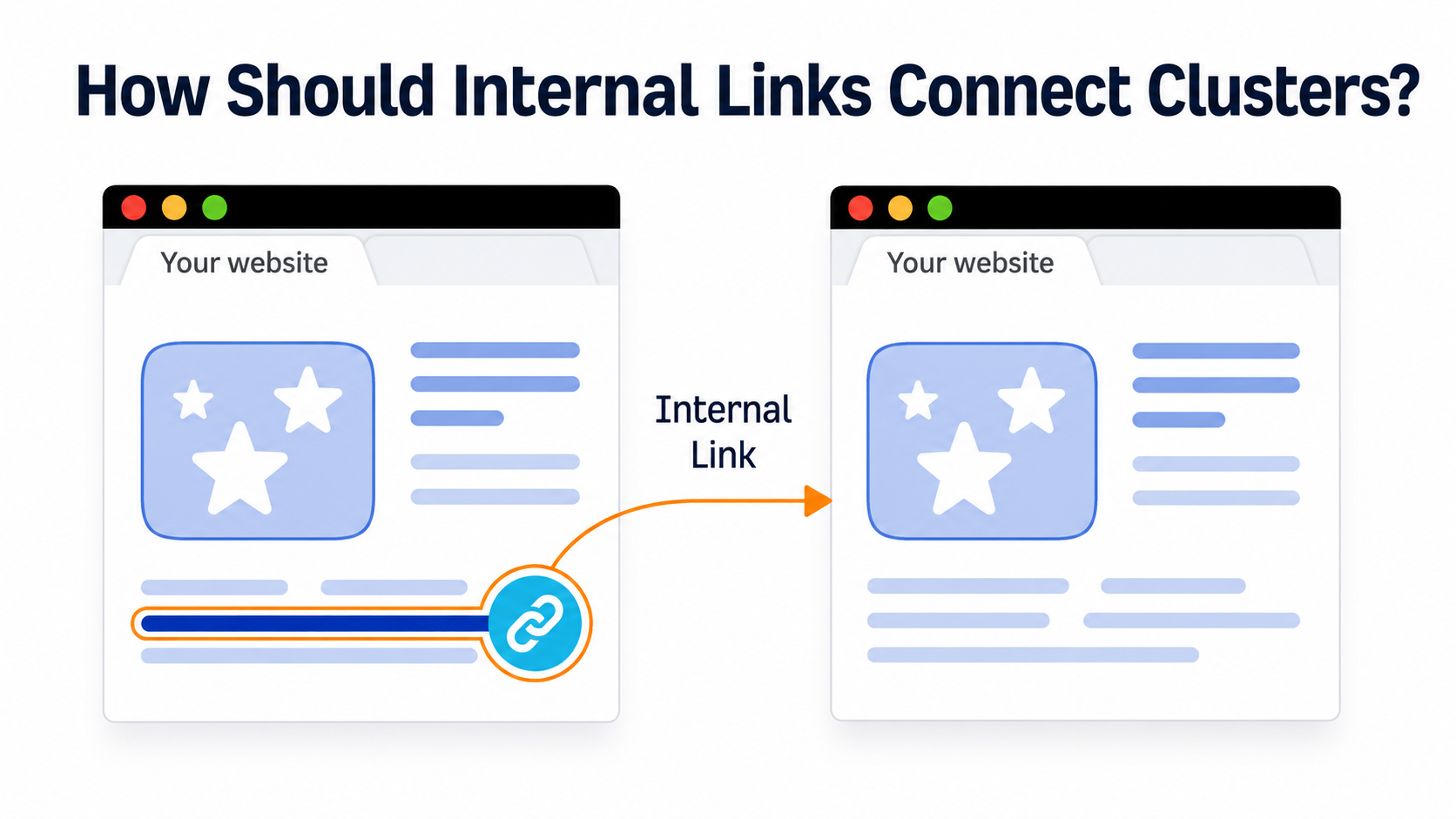
Internal links are what turn separate pages into a connected cluster. They should make sense for readers while also showing search engines how topics relate across the website.
- Link Cluster Pages to Pillars: Supporting pages should usually link back to the relevant pillar when that broader context is useful. This makes the relationship between the detailed article and the main topic easier to understand.
- Link Pillars to Supporting Content: The pillar should also link outward to deeper resources. These links let readers explore specific areas without forcing the main page to become unnecessarily long.
- Optimize Anchor Text Naturally: Anchor text should tell readers what they are likely to find after clicking. Descriptive anchors such as “technical SEO audit process” are more useful than vague wording like “click here.” At the same time, avoid using the exact same keyword-rich anchor dozens of times across the site.
- Fix Orphan Pages: Look for pages with few or no internal links pointing toward them. Some may need to be added to an existing cluster. Others may be outdated, duplicated, or no longer useful. Fixing orphan pages often improves the structure of older websites significantly.
- Avoid Excessive Internal Linking: Adding more links does not always improve a page. Too many links can distract the reader and make the content feel messy. Use internal links where they genuinely provide context or help the user take a useful next step.
How to Prevent Keyword Cannibalization within Clusters
Keyword cannibalization happens when several pages compete for similar searches without a clear difference in purpose. A well-planned cluster can reduce this problem, but a poorly planned one can actually make it worse.
- Map One Primary Intent per Page
Every important page should have one clear primary purpose. A page can rank for many keywords, but those keywords should generally support the same main intent. This keeps the role of each page easy to understand. - Identify Overlapping Content
Review articles that cover similar subjects. Compare their titles, headings, target queries, ranking keywords, and purpose. If two pages answer almost the same question, they may be competing unnecessarily. - Consolidate Competing Pages
When several weak pages cover the same intent, combining them can create a much stronger resource. Choose the best URL, merge the useful information, improve the final page, and redirect outdated versions where appropriate. - Differentiate Search Intent
Sometimes similar keywords genuinely need separate pages. For example, “what is marketing automation” and “marketing automation software” may sound related, but they serve different needs. One is primarily educational, while the other may involve product comparison or purchase research. - Review Internal Anchor Text
Internal links can sometimes create confusion. If the same anchor text points toward different URLs, search engines and users may struggle to understand which page is the main resource for that topic. Review anchor text whenever page roles begin to overlap. - Monitor Ranking URL Changes
Use search data to see which URLs appear for important queries. If Google regularly switches between two similar pages for the same term, their search intent may not be clearly separated. That is usually a good reason to review the structure.
Common Content Cluster Mistakes
A cluster can look perfectly organized in a spreadsheet and still perform poorly once published. Most problems happen when teams focus too much on keywords and content volume while overlooking quality, intent, business relevance, or site structure.
- Building Clusters around Search Volume Alone: Large search volumes can be tempting, but traffic that has little connection to the business may not deliver much value. Choose topics that combine genuine search demand with customer relevance and business expertise.
- Creating Too Many Similar Articles: Publishing one article for every small keyword variation often leads to duplication. SERP analysis and search intent mapping can help determine whether related phrases should be combined into one stronger page.
- Publishing Thin Supporting Content: A large number of weak pages does not create authority. If the supporting content offers little beyond what the pillar already says, the cluster becomes bigger without becoming better.
- Choosing Overly Broad Pillar Topics: Very broad themes such as “business,” “marketing,” “technology,” or “health” can be difficult to use as effective pillars. Choose topics with clearer boundaries and stronger connections to the business.
- Weak Internal Linking: A collection of related articles is not automatically a cluster. Without clear internal links, users and search engines may struggle to understand how the pages connect.
- Ignoring Commercial Search Intent: Some websites publish large amounts of educational content but ignore users who are ready to compare services, check prices, or choose a provider. A balanced cluster should support both learning and decision-making where appropriate.
- Creating Clusters Unrelated to Business Expertise: Trending topics can generate traffic, but that traffic may not support the areas where the business actually wants visibility. Stay close to subjects where the company has genuine knowledge, experience, or commercial relevance.
- Publishing Everything at Once: Trying to launch an entire cluster in one batch can lead to rushed content and inconsistent quality. A phased approach gives the team more time to learn, improve, and maintain standards.
- Never Updating Existing Clusters: Content becomes outdated. Old statistics, broken links, outdated screenshots, expired recommendations, and obsolete advice can slowly reduce the value of an otherwise strong cluster.
How to Optimize Existing Content into Topic Clusters
Many established websites already have enough content to build strong clusters. The real issue is often that the content was published over time without a clear structure. Reorganizing those existing pages can sometimes produce better results than constantly creating more.
1. Audit Existing Content
Start with a complete content inventory.
Review:
- Topic
- Search intent
- Organic traffic
- Ranking queries
- Backlinks
- Internal links
- Conversions
- Content quality
- Last update date
This gives you a clearer view of what is working and where improvements are needed.
2. Group Pages by Topic
Organize existing pages into broad topic groups. Do not worry about creating perfect clusters immediately. The first goal is simply to see which areas already have enough content to support a meaningful structure.
3. Identify Content Gaps
Compare the existing pages with your planned topical map. Missing questions, search intents, entities, or subtopics can reveal where new content is actually needed.
4. Find Duplicate Search Intent
Look for articles that serve nearly the same purpose. Similar titles, overlapping ranking queries, and identical search results often suggest that two pages may be competing with one another.
5. Consolidate Weak Pages
Several short or outdated pages can sometimes be combined into one stronger resource. Consolidation can improve depth, reduce cannibalization, simplify maintenance, and concentrate authority on fewer URLs.
6. Select Existing Pillar Candidates
A strong existing guide may already have the traffic, backlinks, depth, or authority needed to become a pillar. Instead of creating a new page, it may be better to expand and reorganize the strongest existing candidate.
7. Rebuild Internal Linking
Once the page roles are clear, update the internal links. Connect cluster pages to the pillar, link the pillar to deeper resources, and create relevant connections between related supporting articles. This step is often one of the most important parts of reorganizing an old blog.
8. Refresh Outdated Content
Update old statistics, examples, recommendations, screenshots, broken links, tools, and outdated advice. A cluster built from old content should still feel current once it is reorganized.
Measuring Content Cluster Performance
Content clusters should be measured as a connected group rather than judged only by the ranking of one keyword or one page. Looking at several signals together gives a much clearer picture of whether the topic is gaining visibility and producing value.
- Topic-Level Organic Visibility: Track search visibility across the full set of queries connected to the cluster. One ranking may drop while overall visibility across the topic continues to improve. Looking at the bigger picture prevents teams from overreacting to small fluctuations.
- Number of Ranking Queries: Monitor how many relevant search queries generate impressions or rankings across the cluster. An increase may show that search engines are beginning to associate the site more strongly with the wider topic.
- Organic Traffic Growth: Measure organic traffic across all pages within the cluster. Where useful, separate branded and non-branded traffic to understand whether new users are discovering the content through search.
- Pillar Page Performance: Review impressions, clicks, rankings, engagement, internal link activity, conversions, and assisted conversions for the pillar page. Its performance can offer useful insight into how well the broader topic is being understood.
- Cluster Page Performance: Supporting pages also deserve individual attention. Some may attract large traffic volumes, while others may generate fewer visits but play an important role in conversions, internal linking, or customer education.
- Internal Link Distribution: Review how internal links are distributed throughout the cluster. Important pages should not remain weakly connected while less valuable articles receive most of the internal links.
Google Search Console Impressions: Google Search Console can show whether impressions are increasing across a wider range of related searches. Review queries, landing pages, clicks, CTR, average position, and trends over time. Growing impressions can sometimes appear before significant increases in organic traffic.
Content Clusters in the AI Search Era
Search is moving beyond the old model of one keyword leading to one ranked page. AI systems can connect information across different sources, understand entities, summarize content, and respond to more detailed conversational questions. Content clusters fit naturally into this environment because they organize expertise into connected, understandable groups.
- Content Clusters and Entity SEO: Entities help search systems understand what a piece of content refers to. A well-developed cluster naturally includes the concepts, products, technologies, organizations, and processes connected to its main subject. These relationships provide more context than exact keyword matching alone.
- Supporting Answer Engine Optimization: Answer Engine Optimization (AEO) focuses on making information useful for platforms that provide direct answers to user questions. Clusters support AEO because focused supporting pages can answer specific questions while pillar pages provide broader context. Clear definitions, useful examples, and straightforward explanations can make content easier to use in answer-based search environments.
- Strengthening Generative Engine Optimization: Generative Engine Optimization (GEO) focuses on improving visibility within generative and AI-powered search experiences. A strong cluster can support GEO by building clear topical context, demonstrating expertise, covering related entities, and presenting information in a well-organized way. GEO should work alongside strong SEO fundamentals rather than replace them.
- Preparing for Conversational Search: Conversational queries are often much longer and more specific than traditional search terms. A user might ask, “How should a small B2B company organize its content if it already has 100 unrelated blog posts?” A site with a detailed content cluster is better prepared to answer that kind of question because it already contains connected resources at different levels of depth.
Conclusion
A strong content cluster is much more than a pillar page surrounded by a few supporting articles. It is a connected knowledge system built around search intent, customer needs, semantic relationships, business expertise, and useful internal links. The strongest clusters begin with relevant business topics, use careful keyword and intent research, organize pages through a clear topical map, avoid unnecessary overlap, and continue improving as search behavior changes over time.
A successful cluster should also be measured beyond individual keyword rankings. Track topic-level visibility, impressions, organic traffic, ranking breadth, internal link distribution, conversions, and emerging AI visibility. Most importantly, make sure every page has a clear reason to exist. When each resource serves a distinct purpose and supports the wider topic, the website becomes easier for users, search engines, and AI systems to understand.
Ready to turn scattered content into a stronger, more connected SEO strategy?
Build a stronger content ecosystem with eSign Web Services. Organize existing pages, uncover content gaps, strengthen internal connections, and create topic-focused resources that support lasting organic visibility and audience relevance.
Frequently Asked Questions (FAQs)
Question: What is an SEO content cluster strategy?
Answer: An SEO content cluster strategy organizes related website pages around one main topic. A pillar page covers the broader subject, while supporting pages answer more specific questions, problems, comparisons, or search intents. Internal links connect these resources, helping users explore the topic while making the website’s structure clearer to search engines.
Question: What is the difference between a pillar page and cluster content?
Answer: A pillar page gives readers a broad overview of an important topic, while cluster content focuses on specific parts of that subject. The pillar introduces the main areas and links to deeper resources. Supporting pages provide the examples, comparisons, tutorials, and detail that would make the pillar unnecessarily long if everything were included there.
Question: How many pages should an SEO content cluster contain?
Answer: There is no ideal number of pages for every cluster. The right size depends on the topic, user questions, search intent, competition, and business relevance. A focused cluster with eight useful pages can perform better than one with 40 thin articles. Quality, purpose, and clear relationships matter much more than simply publishing more.
Question: How do I choose topics for a content cluster?
Answer: Start with topics directly connected to your services, products, expertise, customer problems, and commercial goals. Then research related keywords, questions, entities, search results, and user intent. Choose subjects that are broad enough to support several useful subtopics but focused enough to stay closely connected to what your business actually does.
Question: Do content clusters improve Google rankings?
Answer: Content clusters can support stronger organic performance by improving topical depth, internal linking, crawlability, search intent coverage, and website organization. However, simply creating a cluster does not guarantee rankings. Content quality, competition, technical performance, backlinks, authority, relevance, and user value still play an important role in how pages perform.
Author Details

Ashwani Kumar Sharma
Ashwani has been actively involved in SEO services since 2005. His expertise and distinctive work approaches have made him one of the most experienced and trusted SEO experts in the industry. He is a certified SEO and Google Ads professional. He also has strong business development skills in advanced SEO, PPC, and digital marketing strategies.


