



Instagram Growth Strategy for Brands in 2026

Key Takeaways:
- Sustainable Instagram growth requires a defined audience, positioning, content system, and measurable business objectives.
- Reels remain important for discovery, but brands should not build their entire strategy around one format.
- Shares, saves, watch behavior, meaningful interactions, and content relevance provide stronger signals than follower count alone.
- Instagram increasingly functions as a discovery and search platform, making content discoverability important for brands.
- Content pillars help brands maintain consistency without publishing repetitive content.
- Community engagement and creator collaborations can expand reach while strengthening credibility and brand trust.
Introduction
Instagram growth is not as simple as posting a few times a week and watching the follower count go up. For brands in 2026, the platform is much more competitive, and people are far more selective about what they watch, follow, save, and share. That is why a strong Instagram growth strategy needs to focus on more than numbers. It should help the brand reach the right people, create content they genuinely care about, build trust over time, and give interested users a natural reason to take the next step.
In this blog, we will look at what an Instagram growth strategy for 2026 should actually include. We will cover how Instagram discovery works, how to choose the right content, how to improve Reels and engagement, how Instagram search fits into growth, which mistakes hold brands back, and how to measure whether the work is leading to useful business results.
What Instagram Growth Really Means in 2026
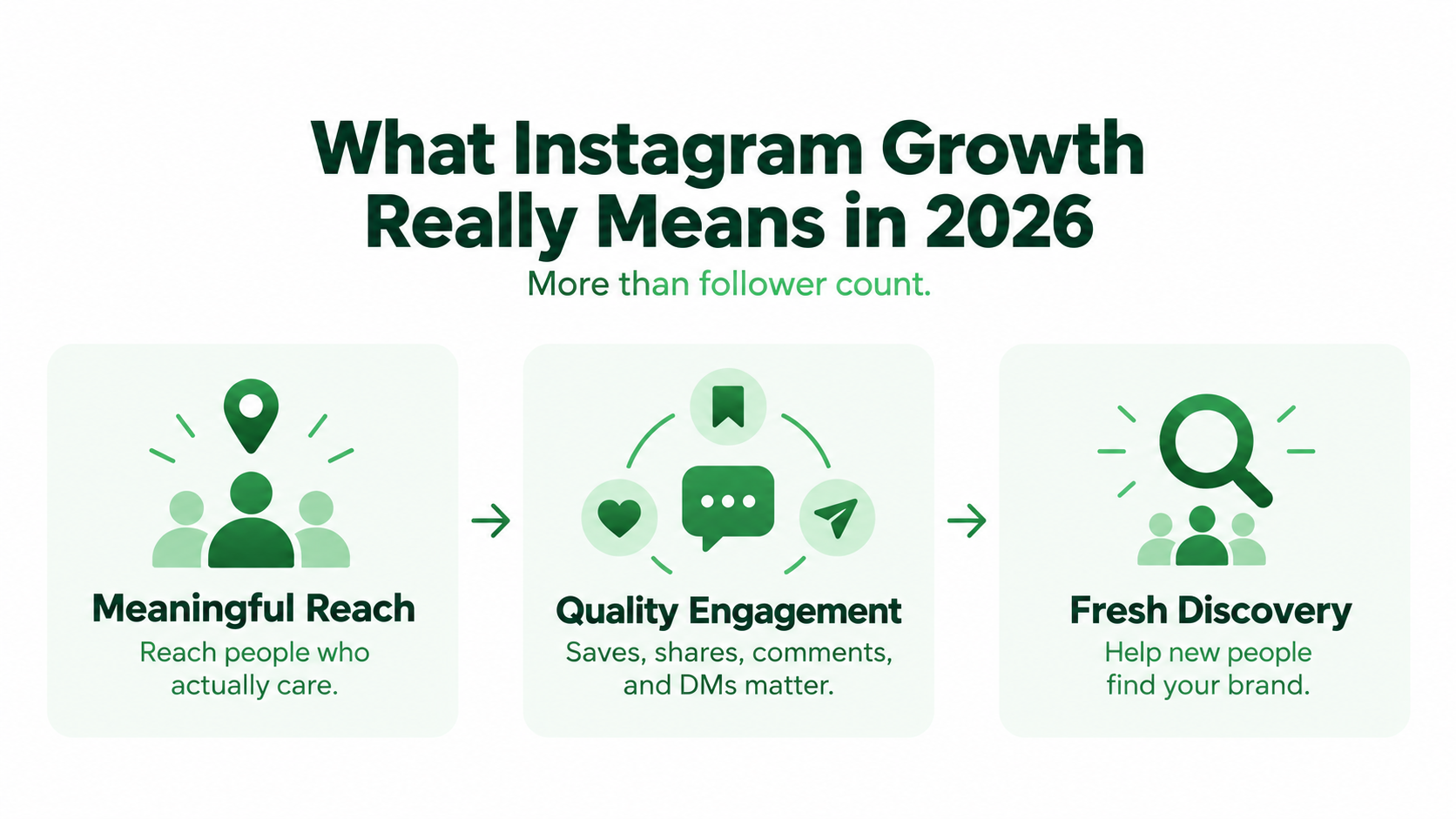
Instagram growth should be useful to the business, not just impressive on the surface. A growing follower count can be encouraging, but it tells only part of the story.
- Reach should mean reaching people who could actually care: a big reach number can look great, but it does not help much if those people are never likely to use your product or service. A local business, for example, would usually get more value from reaching 5,000 nearby people than 50,000 users in places it does not serve. That is what meaningful Instagram brand growth looks like: getting in front of people who actually make sense for the business.
- Engagement should show more than a quick like: likes are useful, but they do not always tell you how interested someone really is. Saves, shares, comments, replies, profile visits, and DMs often give a clearer picture. If someone saves your post for later, sends it to a friend, or takes the time to message you, your content has probably connected with them in a much more meaningful way.
- Discovery should help fresh people find your brand: Your current followers matter, but real growth becomes difficult if your posts keep going to the same audience again and again. Reels, Explore, collaborations, recommendations, and search can help your content reach people who have never come across your brand before. That is often where new followers, new conversations, and new opportunities start.
How Instagram Discovery Works
Brands often talk about “beating the algorithm,” but that way of thinking can create the wrong priorities. Instagram is trying to show people content they are likely to care about. The better question is, why would someone stop and pay attention to this post?
- Reels can introduce the brand to new users: Instagram Reels are especially useful for discovery because they can appear in front of people who do not follow the account. A helpful Reel can travel well beyond the brand’s existing audience if viewers continue watching, sharing, or responding to it.
- Stories help people feel like they know your brand better: Instagram Stories are one of the easiest ways to stay in front of people without making everything feel polished or promotional. You can share a quick update, a behind-the-scenes moment, ask a simple question, run a poll, or remind followers about something useful. These small updates make the brand feel more active, natural, and easier to connect with.
- More people are using Instagram to search for things they need: Users do not just open Instagram to scroll anymore. They also search for local businesses, products, services, ideas, recommendations, and answers to everyday questions. That is where social search becomes useful. If your profile and content clearly show what your brand is about, you have a better chance of being found by people who are already interested in that topic.
- Instagram pays attention to what people genuinely enjoy: The platform looks at things like how long someone watches, whether they save or share a post, leave a comment, or keep interacting with similar content. So instead of worrying too much about how to “beat” the Instagram algorithm, focus on making content people actually want to spend time with. If they find it useful, interesting, or worth sharing, that naturally sends a stronger signal.
Build Your Instagram Strategy before Creating Content
One of the most common mistakes brands make is jumping straight into content production. A team may decide it needs four Reels and three Stories every week without first deciding what those posts are supposed to accomplish. That often leads to a busy account with very little direction.
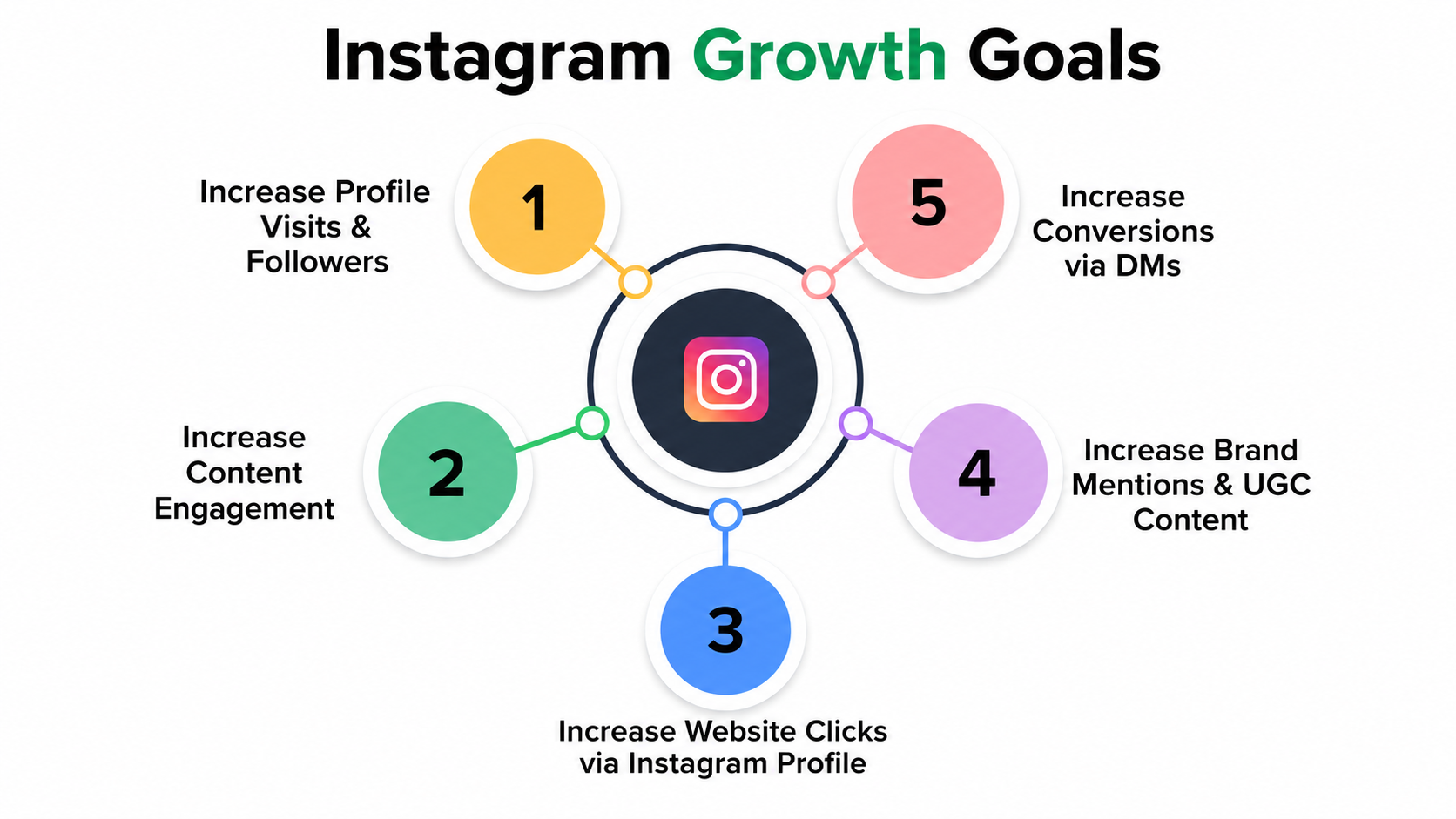
- Start with one clear business goal: Decide what Instagram should help with. Is the priority awareness, leads, sales, website traffic, community growth, recruitment, or customer education? A business can have more than one goal, but knowing the main priority makes planning much easier.
- Know who you are really trying to reach: A strong Instagram strategy for brands gets much easier once you stop thinking about “followers” as one big group. Think about the actual people you want to attract. What are they trying to solve? What questions keep coming up? What makes them interested, unsure, or ready to buy? When you understand that, your content starts sounding more useful and much less like something posted just to fill the feed.
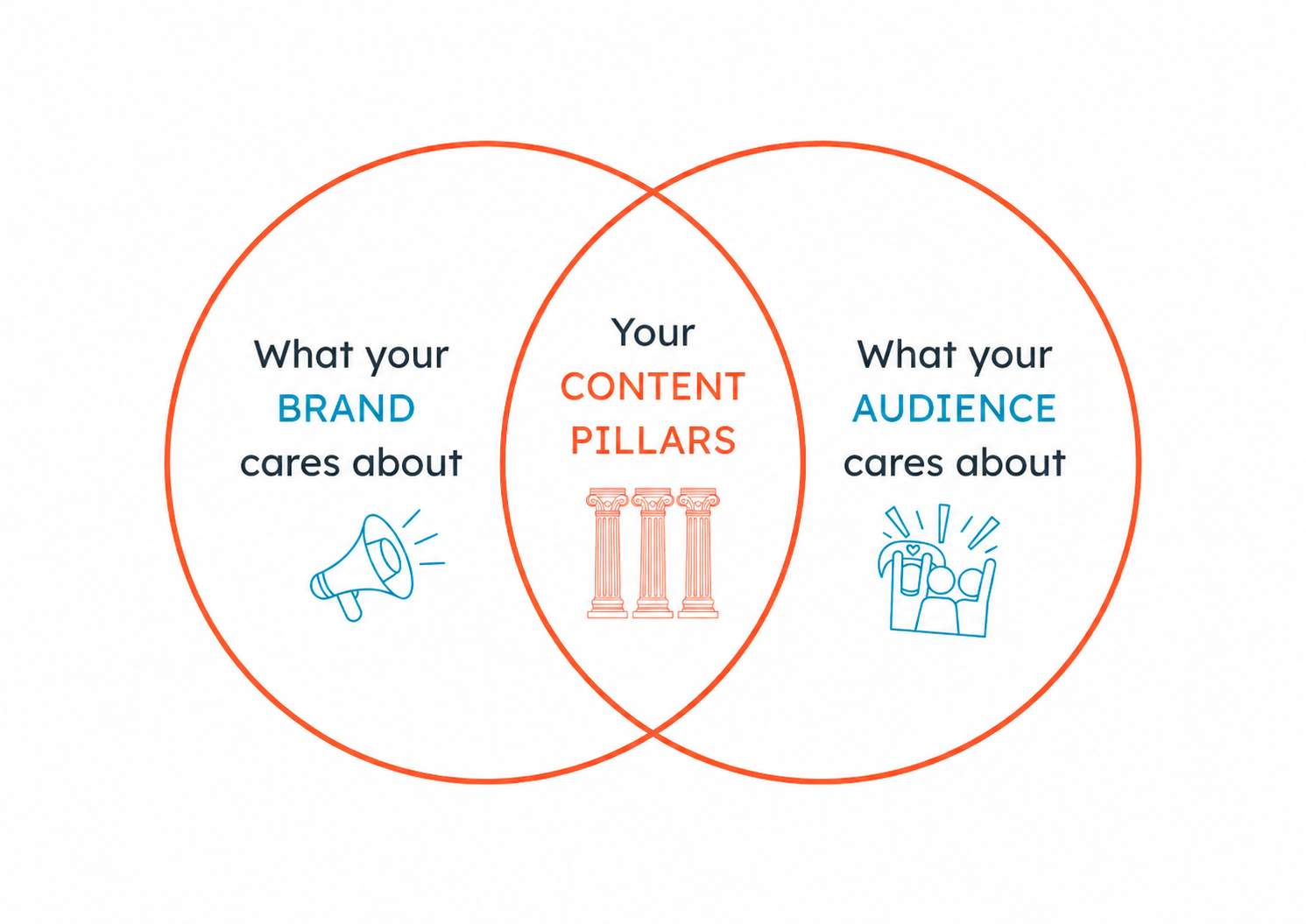
- Build your content around a few themes you can keep coming back to: Good content pillars give you direction without making the account feel repetitive. A digital agency, for example, could share simple marketing tips, common client problems, real results, service explanations, and a few behind-the-scenes moments. You can keep changing the angle and format, while the account still feels clear, useful, and connected to the brand.
- Build a schedule you can actually maintain: A content calendar should help the team stay organized, not create unnecessary pressure. It is better to publish three strong posts consistently than to force seven weak posts simply because the schedule says so.
Build Content Pillars That Support Growth
A brand account should feel consistent without becoming predictable. The easiest way to achieve that is to work with a few strong themes and explore them from different angles.
- Educational content gives people a reason to follow: Helpful posts can build authority over time. Tips, tutorials, simple explanations, common mistakes, and industry insights work especially well when they answer questions customers already have. The aim is not to teach everything but to be genuinely useful.
- Problem-focused content makes the brand relatable: People pay attention when they recognize their own problem in the content. A financial service company could talk about budgeting mistakes. A furniture brand could explain why certain materials do not work well in humid conditions. Showing that you understand the problem creates trust before you present a solution.
- Product or service content should help people decide. Promotional content is not automatically bad. The problem comes when it says very little beyond “buy now.” Strong product content explains where the product fits, who it is for, how it works, what problem it solves, and what customers should expect.
- Use real customer experiences to make your brand feel more believable: People often trust another customer’s experience more than a polished brand message. Reviews, customer stories, demonstrations, before-and-after results, and user-generated content can show what your product or service is really like in everyday use. That kind of content feels more genuine.
Example: A skincare brand does not need to talk about products in every post. It could share simple skincare tips, explain ingredients in an easy way, answer common questions, show real customer experiences, and talk about everyday skin concerns. Then, when a product is mentioned, it feels like a natural part of the conversation instead of another attempt to sell something.
Create a Content Mix That Does Not Feel Repetitive
Using the same format again and again can make even good ideas feel tired. Different Instagram formats work better for different types of messages, so brands should choose based on what they are trying to communicate.
- Use Reels when showing the idea makes more sense: Reels are great when people can understand something faster by watching it. Think quick demonstrations, short tutorials, before-and-after moments, common mistakes, or simple visual tips. They can also help your content reach people who do not already follow you. Just keep the idea focused and get to the point before people lose interest.
- Use carousels when the topic needs a bit more room: Some ideas are too detailed for one image and too slow for a short Reel. That is where carousels work well. You can break a topic into simple steps, comparisons, checklists, myths, or useful tips and let people move through it at their own pace without feeling overloaded.
- Use static posts when a simple post does the job: Not everything needs to be turned into a video. A strong testimonial, useful statistic, announcement, opinion, campaign message, or clear visual can work perfectly as a single-image post. If the message is already easy to understand, keeping it simple can often make it stronger.
- Use collaborations when both audiences benefit: Instagram Collabs can help a post appear to two connected communities. The partnership should make sense. A fitness studio collaborating with a nutrition expert feels natural. A random collaboration done only for extra reach may not.
Build a Reels Strategy for Brand Discovery
Reels can be powerful, but simply publishing more videos will not guarantee better results. A good Instagram Reels strategy starts with a strong idea and clear delivery.
- Make the opening immediately useful: People decide quickly whether to keep watching. Avoid long logo screens, slow introductions, or vague openings. If the Reel is about three mistakes businesses make when running ads, say that early. Give viewers a reason to stay.
- Keep one main idea per Reel: Trying to squeeze five different topics into one short video usually weakens all of them. A focused Reel is easier to understand, easier to remember, and more likely to hold attention.
- Respect the viewer’s time: Good watch time is not about making every video extremely short. It is about keeping the content worth watching. A 15-second tip should not take 45 seconds. A detailed demonstration may need longer. The length should fit the idea.
- Create Reels people want to send: Shares can help content travel beyond the original viewer. Relatable problems, useful reminders, practical advice, surprising facts, and strong examples are often easy to share with friends or colleagues.
Example: A renovation company could create three Reels around the same topic, “kitchen renovation mistakes,” but change the opening each time. It can then compare which version holds attention longer and generates more profile visits or shares.
Instagram SEO and Social Search
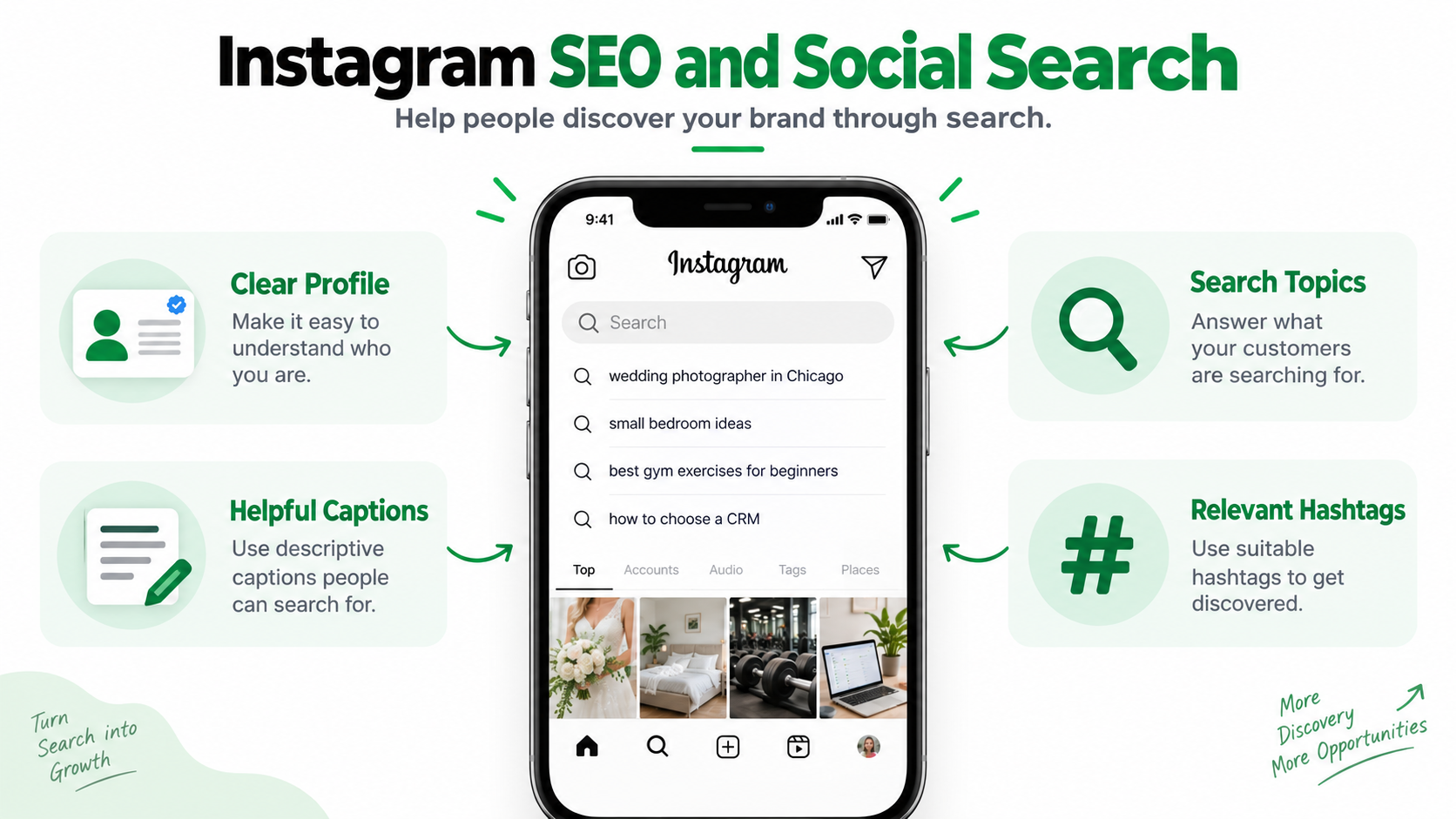
Instagram is also becoming a place where people search for ideas and businesses. Someone may search for “wedding photographer in Chicago,” “small bedroom ideas,” “best gym exercises for beginners,” or “how to choose a CRM.” That creates another opportunity for brands to be discovered.
- Make your profile easy to understand at a glance: When someone visits your account, they should not have to guess what your business does. Your name, category, bio, and description should make that clear straight away. If the profile feels confusing or too vague, people may leave before they even get to your posts.
- Write captions that tell people what the post is actually about: Good Instagram SEO should feel natural. You do not need to force the same keyword into every sentence. Just make sure the caption gives enough context so both people and Instagram can understand the topic without having to work it out.
- Talk about the things your customers are already searching for: Think about the questions people ask before they buy, book, compare, or choose a service. Those real questions can become useful posts. If people are already looking for that information, you are starting with a topic that already has a reason to matter.
- Use hashtags that actually belong with the post: You do not need a huge list of popular tags. A few relevant hashtags that genuinely match the topic are enough. The point is to help keep the post connected to the right subject, not to add random tags just because they are widely used.
Turn Engagement into a Growth Engine
Many brands want to increase Instagram engagement, but the solution is not adding “comment YES below” to every post. Useful engagement begins with useful content.
- Give people a real reason to join the conversation: People are much more likely to respond when the post touches on something they actually care about. A useful comparison, a common frustration, a practical question, or a clear opinion can open the door naturally. The goal is not to force comments, but to make the topic interesting enough that people want to say something.
- Reply like there is a real person behind the account: When someone takes the time to leave a genuine comment, try to give them more than a quick “Thanks!” when possible. A thoughtful reply can make the interaction feel much more personal. It shows that the brand is paying attention, which can make people more comfortable coming back and engaging again.
- Use Stories to make interaction feel easy: Polls, questions, quizzes, sliders, and casual updates are simple ways to encourage audience engagement without making it feel like work. People can react in seconds, and brands get a useful look at what followers are interested in, what they prefer, and what they may want to see next.
Use Creator Collaborations to Expand Reach
Creator collaborations can help brands reach new people without relying only on their own followers. The key is choosing creators whose audience already matches the people the brand wants to attract. A good collaboration should feel natural, useful, and relevant rather than looking like a forced promotion.
- Choose Creators Based on Audience Fit: Do not choose creators only because they have a large following. Look at who follows them, what their audience is interested in, where they are located, and how closely that audience matches your ideal customer. A smaller creator with the right audience can often be more useful than a much bigger account with little relevance.
- Micro vs Macro Influencers: Micro-influencers usually have smaller, more focused communities, which can work well for local businesses, niche products, or highly specific audiences. Macro influencers offer much wider reach, but they may be more suitable when the goal is broad awareness. The right choice depends on budget, audience fit, and what the campaign is trying to achieve.
- Instagram Collab Posts: Instagram Collab posts allow the same post or Reel to appear on both accounts, helping both audiences see and engage with the content. This works especially well when the two brands or creators have a natural connection. For example, a fitness studio could collaborate with a nutrition coach on a practical health tip.
- Creator-Led Product Demonstrations: Let creators show how a product or service works in a way that feels natural to their usual content. A real demonstration can help people understand the product much faster than a polished promotional image. It also gives the audience a chance to see the product being used in a more realistic situation.
- Employee and Founder Advocacy: Creators do not always have to come from outside the business. Founders, employees, specialists, or team members can also create valuable content because they already understand the brand and its expertise. Behind-the-scenes explanations, personal insights, and real experiences can make the business feel more human and credible.
- Customer Collaborations: Happy customers can also become strong content partners. Reviews, customer stories, before-and-after examples, testimonials, and customer-created posts can provide social proof while giving the brand fresh content. These collaborations often feel more believable because the message comes from someone who has actually used the product or service.
Combine Organic Growth with Paid Advertising
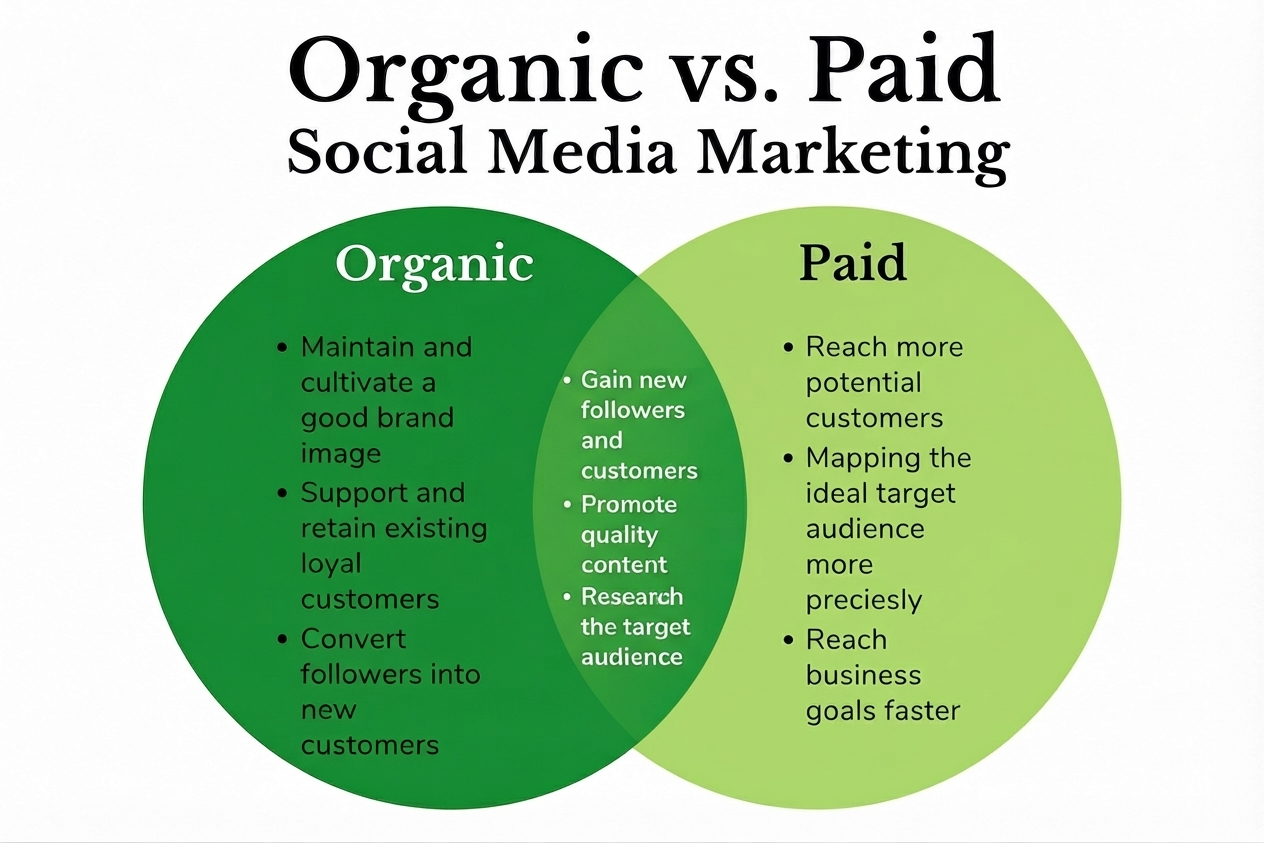
Organic and paid Instagram activity should not feel like two separate strategies. The strongest approach is often to learn organically, then use paid promotion to extend ideas that already show promise.
- Look at what is already working: Before spending heavily on Instagram advertising, review which posts are earning useful watch time, saves, shares, profile visits, or conversations. These results can reveal what people actually care about.
- Match the campaign to a real goal: Awareness, website traffic, leads, purchases, and retargeting require different messages. Paid campaigns should be designed around what the business actually wants users to do.
- Build a connected journey: A person may first discover a brand through a Reel, later see a Story, visit the profile, and finally respond to an ad. The experience works better when those pieces support the same message.
- Do not expect paid Reach to fix weak content: Advertising can put a poor message in front of more people, but it cannot make that message useful. Strong creative and clear positioning should come first.
Common Instagram Growth Mistakes Brands Should Avoid
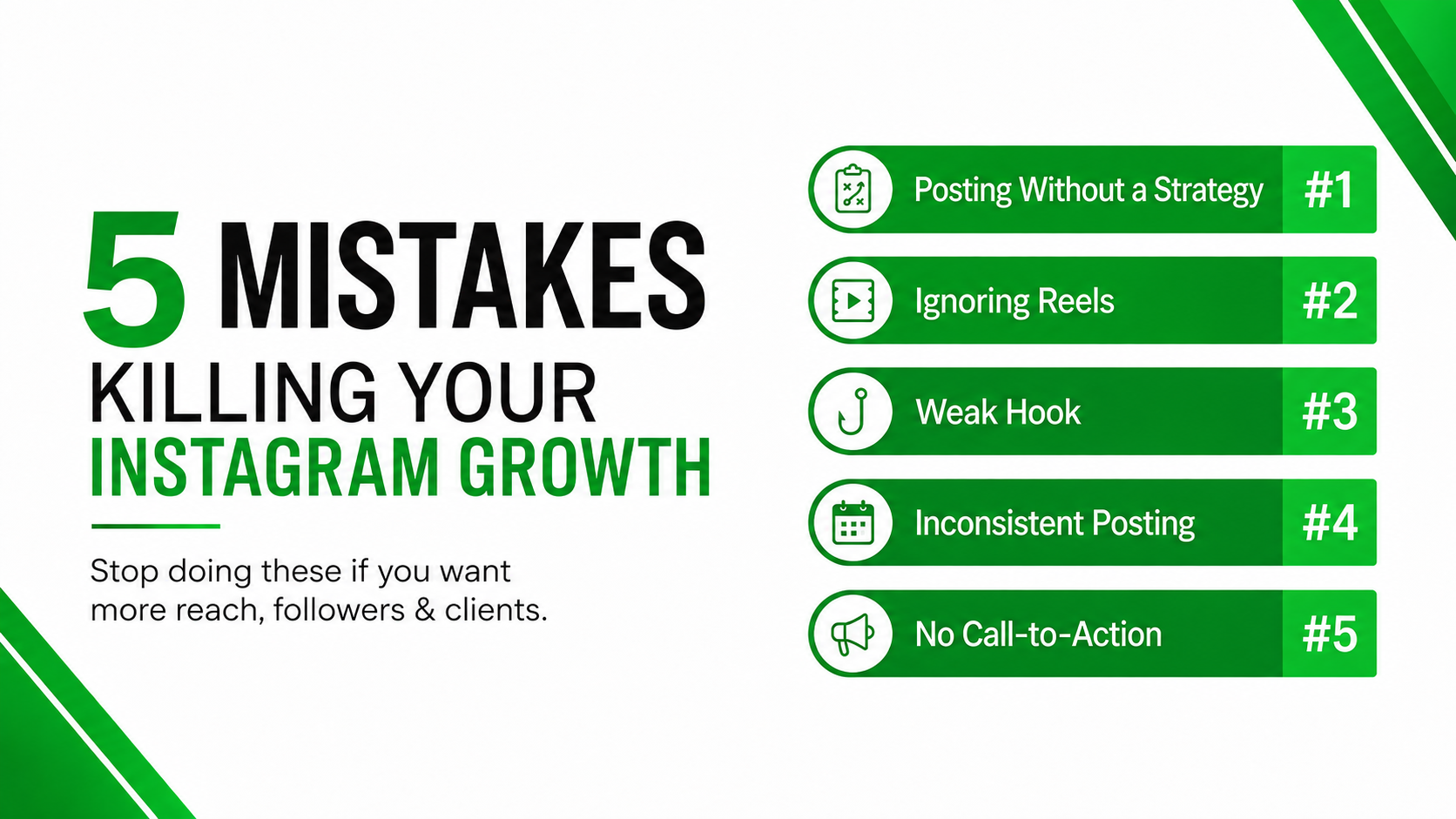
Many businesses searching for how to grow on Instagram assume they need to post more. In reality, poor direction is often a bigger problem than low posting frequency.
- Buying followers: A big follower count might make the account look popular, but that does not mean the audience is actually useful. If those followers never watch, save, share, comment, or ask about what you offer, the number is not doing much for the brand. It can also make it harder to understand whether your content is really reaching people who care.
- Promoting all the time: If every post feels like another sales message, people can get tired of it fast. Most users want more than offers. They want useful tips, simple ideas, answers, stories, and content that gives them a reason to stop scrolling. When you mix helpful content with promotion, the account feels much more natural, and people have a better reason to stay interested.
- Using too much generic AI content: AI can save time with ideas, research, editing, and repurposing, but it should not make the brand sound like everyone else. If every caption feels flat and every visual could belong to any business, the account becomes easy to forget. Real experience, opinions, examples, and a clear brand voice still make a big difference.
How to Measure Instagram Growth Properly?
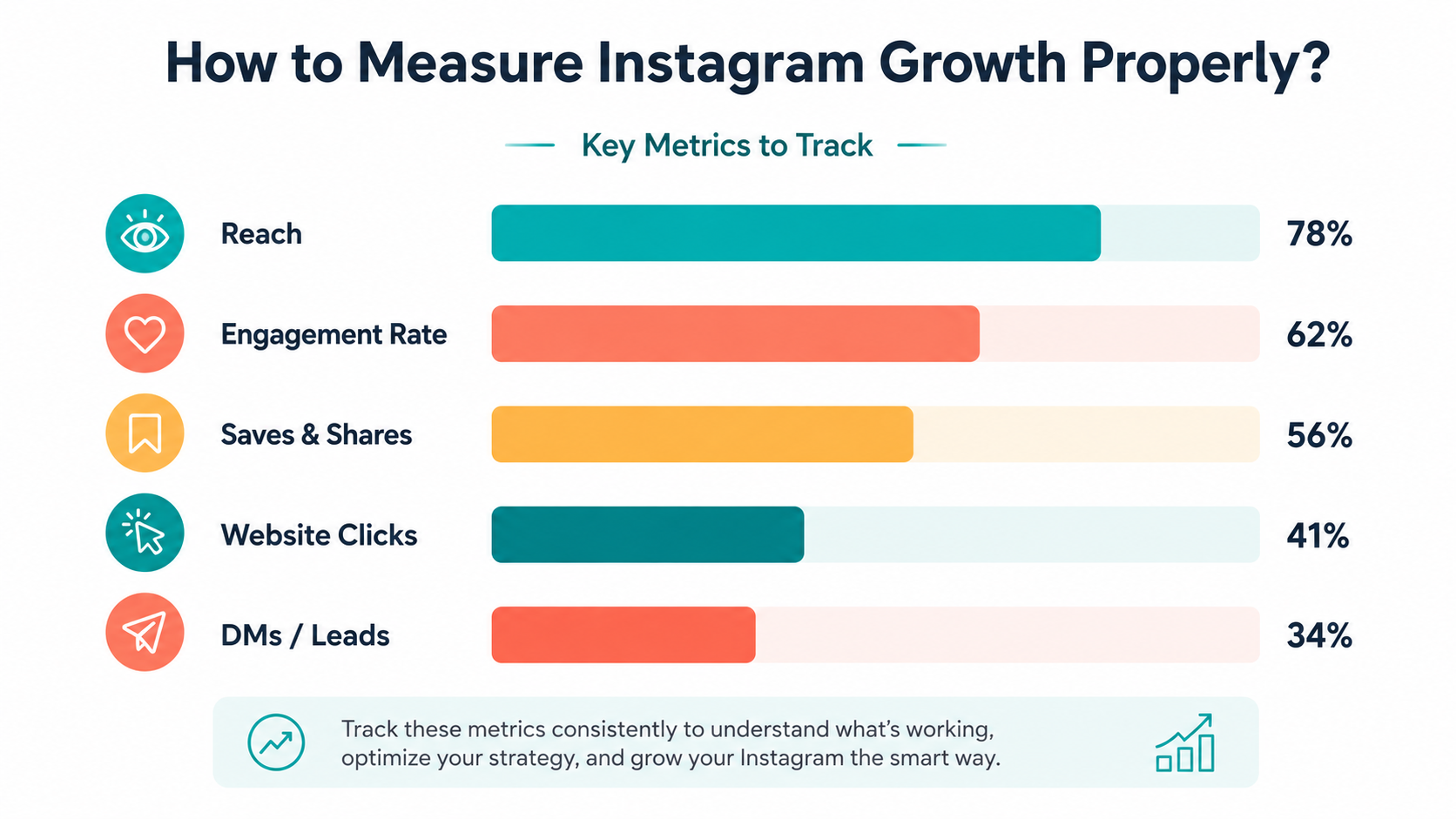
Measurement should begin with a simple question: what was Instagram supposed to achieve? Without that answer, teams often report whichever number looks nicest.
- Look at who is actually seeing your content: Reach is not just a number to report. It helps you understand whether your posts are mainly being seen by current followers or whether new people are finding you too. That difference matters because an account can look active without really growing beyond the audience it already has.
- Notice how long people actually stay with your videos: Watch time can give you a much clearer idea of whether the content is holding attention. If people leave after a few seconds, the opening may be too slow, confusing, or simply not interesting enough. If they keep watching, that usually means the video is doing a better job of pulling them in.
- Do not overlook saves and shares: A like is easy to give, but saving or sharing a post usually takes a little more interest. If someone saves a guide for later or sends a useful post to a friend, it shows that the content gave them something worth keeping or passing on.
A Practical Instagram Growth Framework for 2026
A good social media marketing system should be simple enough to repeat. Brands do not need a completely new strategy every month. They need a process for learning and improving.
- Research before creating: Study the audience, competitors, customer questions, pain points, buying concerns, and content habits. Good ideas usually come from understanding real people rather than guessing.
- Set a clear goal: Decide what the account should help achieve. This keeps the team from chasing every metric at the same time.
- Plan around useful themes: Build content pillars and formats around what the audience actually needs. A clear plan also makes production much easier.
- Create original content: Use real examples, business experience, demonstrations, opinions, and customer questions. “Original” does not always mean completely new. It means the brand adds its own useful point of view.
- Publish at a sustainable pace: Consistency matters, but quality should not collapse because the team is trying to meet an unrealistic schedule.
- Engage after publishing: Good content can start conversations, but someone still needs to participate in them. Reply, listen, and use audience feedback to improve future posts.
The Future of Instagram Brand Growth
Instagram growth is likely to become less about posting more and more about creating content that feels relevant, useful, and genuinely worth paying attention to. Brands will have better tools, smarter targeting, and more ways to sell directly through the platform, but that will also make strong ideas and real audience connection even more important.
- AI-Assisted Content Creation: AI will make it easier for brands to brainstorm ideas, write first drafts, edit videos, repurpose content, translate posts, and study performance. The advantage will be speed, not originality. Brands that rely too heavily on generic AI content may start to sound similar, so human judgement, real experience, and a clear brand voice will still matter.
- Social Search Growth: More people are using Instagram to look for products, services, places, ideas, and answers instead of only scrolling through their feed. That means brands need to think about how their profile, captions, topics, and content are understood in search. Clear, useful content around real customer questions can help a brand become easier to find.
- Creator-Led Brand Marketing: Creators will continue playing a bigger role in how brands introduce products and build trust. Instead of only using creators for one-off sponsored posts, more businesses may build longer partnerships with people who genuinely fit their audience. The strongest collaborations will feel natural and useful rather than overly scripted.
- Personalized Content Discovery: Instagram is becoming better at showing each person content based on their interests and behaviour. That means two users may have completely different experiences on the same platform. For brands, the lesson is simple: broad, generic content may struggle, while content built around specific audience interests and problems can have a better chance of reaching the right people.
- Social Commerce: Instagram can support more of the buying journey, from discovering a product to learning about it and deciding whether to purchase. Brands will need content that does more than attract attention. Product demonstrations, customer proof, FAQs, comparisons, and clear buying information can help people feel more confident before taking the next step.
- Community-Led Growth: A strong community can become one of the biggest growth advantages for a brand. Comments, DMs, customer stories, shared experiences, and user participation can help content travel naturally. When followers feel involved rather than simply marketed to, they are more likely to return, recommend the brand, and take part in future conversations.
- Authenticity as Differentiation: As AI-generated content and polished brand posts become easier to produce, authenticity will become even more valuable. Real customer stories, honest opinions, behind-the-scenes content, useful expertise, and a recognisable tone can help a brand stand out. The goal is not to make content look less professional. It is to make it feel more real and less interchangeable with everyone else.
Conclusion
Instagram growth in 2026 is not about posting more than everyone else, chasing every trend, or trying to find a secret algorithm trick. The brands with the greatest potential for long-term success are those that know their audience and give those people a real reason to pay attention. That means creating useful content, picking formats that suit the message, making Reels easy to consume, using Stories to stay connected, improving how well you show up in search, partnering with creators who matter to you, and measuring what happens after someone engages.
When reach connects you with the right people, engagement turns into conversations, and those conversations turn into website visits, inquiries, bookings, or sales. Instagram becomes more than a place to post content. It’s a practical part of the brand’s broader marketing and growth plan.
Ready to Build a Stronger Instagram Strategy?
Connect with eSign Web Services to build an Instagram approach focused on relevant reach, stronger engagement, and measurable business growth. Our team focuses on building a strategy around what your business actually wants to achieve.
Frequently Asked Questions
Question: What is the best Instagram growth strategy for brands in 2026?
Answer: The first step towards a good strategy starts with having full knowledge of exactly who the brand wishes to reach out to and what it wants Instagram to accomplish. Brands can then mix in good Reels, good informative posts, Stories, community building, searchability, collaboration with creators, and paid assistance. Growth should be measured by relevant reach, engagement, inquiries, website activity, and conversions.
Question: How often should a brand post on Instagram in 2026?
Answer: There cannot be any perfect number of posts that will apply to all accounts. An ideal thing for any brand would be to select an optimal frequency of postings without compromising the quality of content posted. It could very well be that three ideal postings have a lot more value than seven bad ones.
Question: Are Instagram Reels still important for organic growth?
Answer: Yes. But Reels are still pertinent in connecting with people who are not even following the page. Yet, they should always form part of the overall content strategy too. After all, carousels can tackle difficult issues, and stories can help sustain engagement, while posts are ideal for sending simple messages.
Question: What type of Instagram content gets the most engagement?
Answer: One certain format may not be suitable for all brands. Tutorial videos, practical challenges, checklists, demos, customer success stories, comparisons, and entertainment posts are some of the formats that may suit. The important thing is for the brands to discover what suits them rather than finding out what will work best for them.
Question: How long does it take to grow a business Instagram account?
Answer: It does not have a fixed schedule. The pace of growth depends on many factors such as the industry it belongs to, the target audience, quality of content, degree of competition, consistency, branding, creativity, and advertising efforts. It is necessary for businesses to focus on achieving growth within realistic timelines and not instant success.
Author Details

Ashwani Kumar Sharma
Ashwani has been actively involved in SEO services since 2005. His expertise and distinctive work approaches have made him one of the most experienced and trusted SEO experts in the industry. He is a certified SEO and Google Ads professional. He also has strong business development skills in advanced SEO, PPC, and digital marketing strategies.


