



Importance of On-page and Off-page SEO

Search Engine Optimization (SEO) is the process of increasing the chances that a website will appear higher in the search engine results for relevant keywords. Search Engine Optimization also means making a website easier for search engines to understand, crawl, index, and assess.
In general, SEO falls into two categories: On-Page SEO and Off-Page SEO.
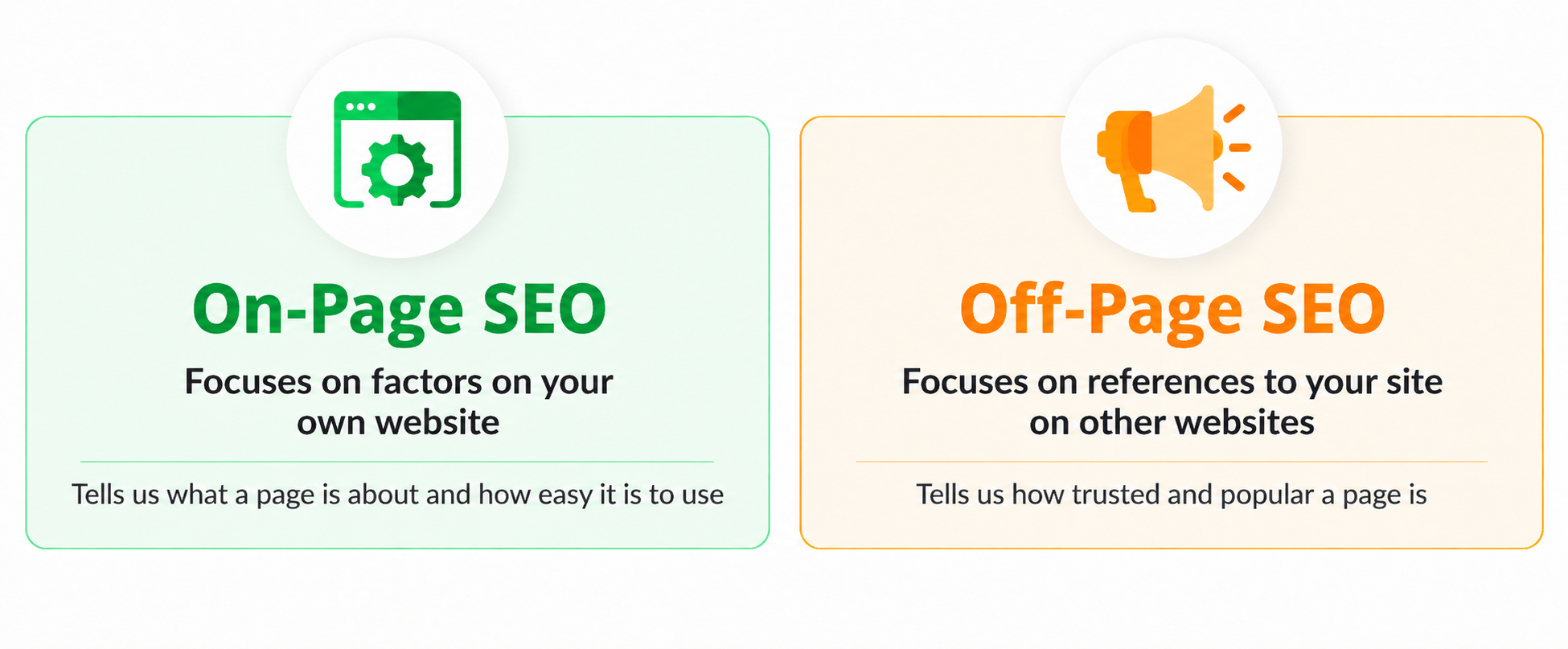
They have different functions, but they work together. On-page SEO is all the things you are able to optimize on your actual site. Off-page optimization refers to things and signals that are outside of a website. Understanding the difference matters because focusing on only one side of SEO can limit a website’s ranking potential.
What Is On-Page SEO?
On-page SEO is a process of improving the content of web pages and websites to get a better ranking in search engines. Page SEO is the process of modifying the text, images, page titles, tags, headings, URL structure, internal links, and other aspects of a website. The aim of SEO is to make search engines understand what a page is about and what the best search terms are to find it.
For example, if you attach an image to a specific product or service, you can add an appropriate ALT tag that provides search engines with more information about the image. Relevant keywords that are naturally incorporated into page titles, headings, and content can also give a clearer idea of what a page is about.
Important Elements of On-Page Optimization
A properly optimized webpage should make its subject clear to both visitors and search engines. Search engines look at different parts of a page to understand what the content is about and how relevant it may be to a certain search. That’s why on-page SEO isn’t just about stuffing keywords into the text.
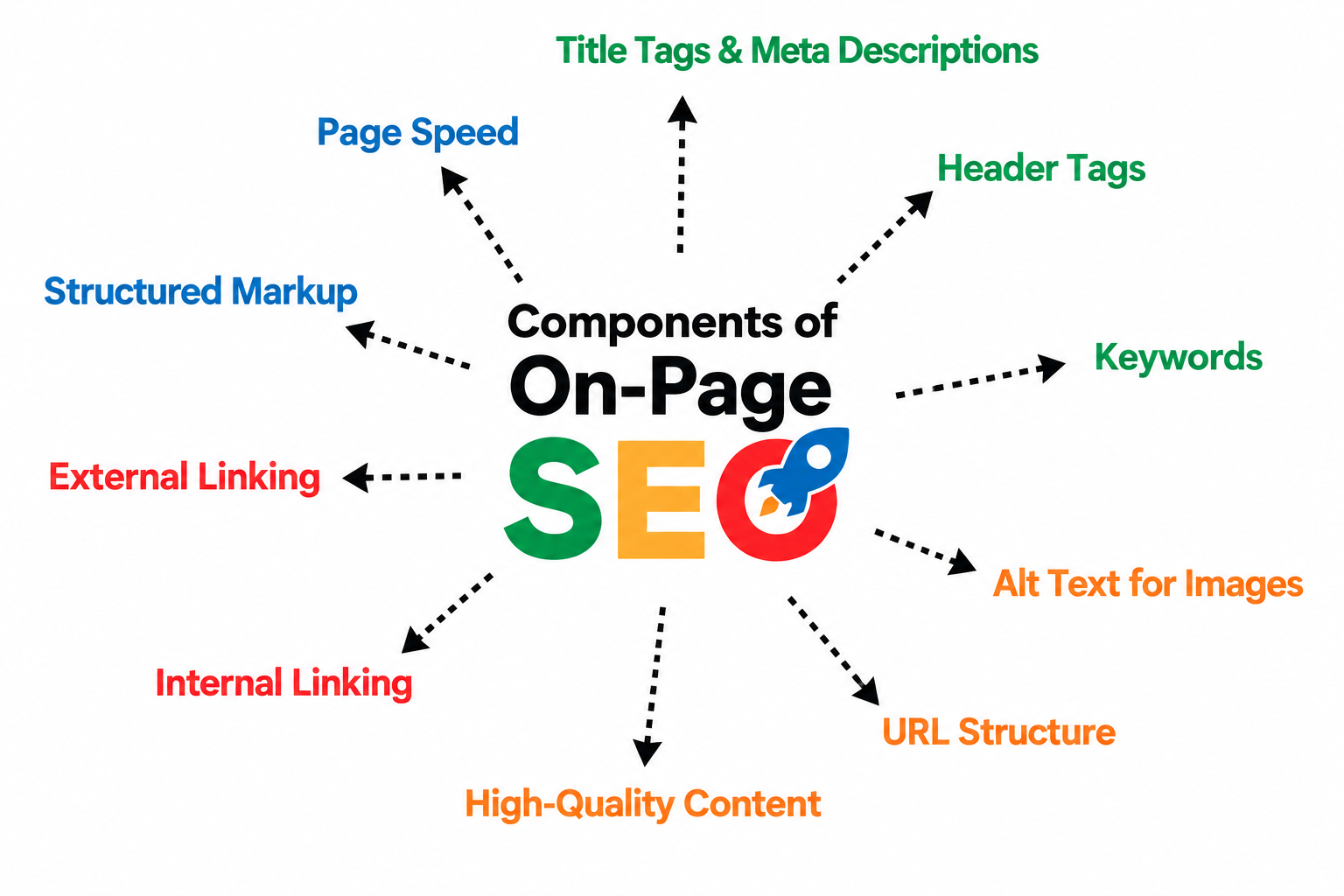
- Page Titles: One of the first things search engines look at to determine what a page is about is the page title. Unique descriptive title tags on each important page should naturally include relevant search terms. A good title also helps users understand what they will find on the page.
- Page Content: The content of the page should be relevant and useful to the subject that the page is targeting. Keywords can be included in the content, but they should fit naturally within sentences. If you repeat the same keyword too many times, it will be hard to read the content, and the page will look over-optimized.
- Heading Tags: Heading tags like H1, H2, H3, etc. break up content into sections. The main heading usually tells you the main topic of the page, and smaller sub-headings break up supporting information. This helps search engines understand how sections relate and gives readers a better structure.
- Images and Search Engines: Search engines cannot ‘see’ images the way people can, so you need to provide a text description of an image using an ALT tag. Proper ALT tag optimization involves writing useful image descriptions that provide meaningful context without stuffing them with unnecessary keywords.
- URL Structure: A simple descriptive URL can give you a clue as to what the webpage is about. Generally, human-readable (and subject-relevant) URLs are easier to understand for visitors and search engines than long URLs with lots of random numbers or characters.
- Internal Links: Internal links are links that connect a page of a site to another relevant page of the same site. These links help visitors find related information and can also aid search engines in finding more pages. Good anchor text tells more information about the page it links to.
- Page Tags and Descriptions:Meta descriptions and other aspects of information on a page can give more information about a webpage. A good description succinctly describes what the page contains and invites searchers to learn its relevance before clicking through to the website.
All these elements should be in support of one main subject. For example, if a page discusses a particular service, then the page title, subheadings, main content, images, URLs, and internal links should all tell the same story about that service.
So, it’s not just about repeating keywords throughout a page. On-page optimization works well if you have a clear organized page where all the various elements work together naturally. This makes the content more user-friendly for visitors and provides search engines with stronger clues about what the page is about and how relevant it is.
What is Off-Page SEO?
Off-Page SEO (also known as Off-Site SEO) is a collection of optimization activities performed outside of a website’s pages. Unlike on-page optimization, these factors are not mainly about changing the content of the website itself. Link building is one of the most critical components of off-page SEO. Links to that page from other websites can help the search engines realize that the website is being talked about in other places on the Internet.
But it’s not just about counting links. The quality and relevance of sites that link to them is also important. A website that receives links from useful and relevant sources can build a stronger online reputation than one that relies on large numbers of poor-quality links. Off-page SEO is closely related to building the website’s reputation and authority outside of its own pages in this way.
Why Backlink Quality Matters
Backlinks have long played an important role in search engine optimization, but link building should not simply be treated as a race to collect as many links as possible. If you get a link back to your site from a site that is relevant to your industry or subject, this may have more value than many links from unrelated or poor-quality sites. Search engines evaluate websites based on the link patterns, making the position and method of placing backlinks crucial.
Therefore, a sensible off-page strategy is to build links that look natural and come from useful sources, rather than build links simply to increase numbers. This is also why website owners should be wary of choosing SEO services that promise super large numbers of backlinks in a short period.
Why On-Page SEO and Off-Page SEO Should Work Together
On-page optimization and off-page optimization are different aspects. One does not replace the other. What if a site has great content, headings, URLs, images, and internal links but few other sites link to it? Even if the search engines understand the site well, it may still have a hard time competing with established sites with more powerful external links and online reputation.
The reverse case can also be problematic. A website can have a lot of backlinks, but if that website’s individual pages are poorly structured, lack good content, or are not optimized well for the right terms, then those links alone may not be enough to achieve good rankings. For competitive keywords especially, a combination of strong on-page optimization and appropriate off-page work provides a much stronger foundation. Businesses may therefore benefit from choosing professional SEO services that consider both areas as part of the overall strategy
Look Beyond Link-Building Packages
Website owners should also pay attention to what an SEO company actually includes in its service. Some SEO vendors promote packages that concentrate almost entirely on link building. They may provide a large number of external links while giving little attention to problems on the website itself. In some cases, on-page SEO may be offered separately as an additional service. Before selecting an SEO package, it is therefore useful to ask whether the service covers both on-page and off-page optimization.
A proper review should consider questions such as whether the website’s titles, content, headings, images, URLs, and internal links will be checked and whether the off-page work will focus on relevant and worthwhile backlinks. Otherwise, a business may purchase a link-building package only to discover later that additional work and expense are required to correct problems on its own website.
Final Takeaway on Both SEO Approaches
Good search engine optimization is not only about making changes to a website, and it is not only about building links. Both areas contribute to a site’s overall performance and visibility. On-page SEO provides a strong foundation for search by creating relevant content, well-structured pages, the right tags, optimized images, URLs, and internal links. Off-page SEO refers to the visibility of your site outside your own pages. This is mainly done through relevant backlinks and online reputation.
When these two areas are planned together, a website has a stronger opportunity to compete for its desired search terms. For that reason, businesses considering SEO services should make sure that their strategy does not focus on only one side of optimization.
Author Details

Ashwani Kumar Sharma
Ashwani has been actively involved in SEO services since 2005. His expertise and distinctive work approaches have made him one of the most experienced and trusted SEO experts in the industry. He is a certified SEO and Google Ads professional. He also has strong business development skills in advanced SEO, PPC, and digital marketing strategies.


