



SEO vs. GEO: Are They Really Different, or Is GEO the Next Evolution of SEO?

Key Takeaways
- SEO and GEO are closely connected rather than completely separate strategies.
- SEO still provides the technical, content, and authority foundation needed for online visibility.
- GEO adds more focus on AI-generated answers, citations, source selection, and brand mentions.
- Strong content should work for people first while remaining easy for search and AI systems to understand.
- Businesses should strengthen existing SEO rather than build a completely separate GEO program.
- The long-term goal is broader visibility across traditional search and AI-powered discovery.
Introduction
Search does not work quite the way it used to. People still type questions into Google and browse search results, but they are also asking longer questions through ChatGPT Search, Gemini, Perplexity, and other AI-powered platforms. Google itself is also bringing generated responses into the search journey through Google AI Overviews and other AI-driven experiences.
That change has pushed generative engine optimization into the marketing conversation. GEO is often presented as something completely new, which naturally leads to the SEO vs. GEO debate. Is GEO a separate strategy that businesses now need to build from scratch, or is it simply another stage in the development of SEO?
The answer sits somewhere in the middle. GEO introduces new considerations around AI visibility, AI citations, information retrieval, conversational questions, and how brands appear inside generated answers. At the same time, much of what supports GEO already exists within strong SEO: useful content, technical accessibility, authority, topic depth, clear structure, and reliable information.
What Does SEO Actually Mean in 2026?
Search engine optimization has changed considerably over the years. SEO once relied much more heavily on keywords, links, and fairly basic ranking signals. Modern search is more capable of understanding context, topics, intent, entities, and relationships between ideas. SEO still helps webpages become discoverable, but rankings are only part of the job. A strong website also needs good crawlability, proper indexability, sensible site architecture, useful internal links, accurate information, and content that matches what people actually want.
Search intent plays a major role here. Someone searching “what is technical SEO?” needs something very different from a person searching “technical SEO agency.” One wants information, while the other may already be looking for a service provider. Good SEO recognizes that difference and creates the right experience for each visitor.
Modern content optimization also looks beyond placing an exact phrase in a title and repeating it several times. Pages need enough depth and context to explain a subject properly. This is where semantic SEO, related entities, expert knowledge, and useful supporting information become more valuable.
What Is GEO and Why Has It Become Important?
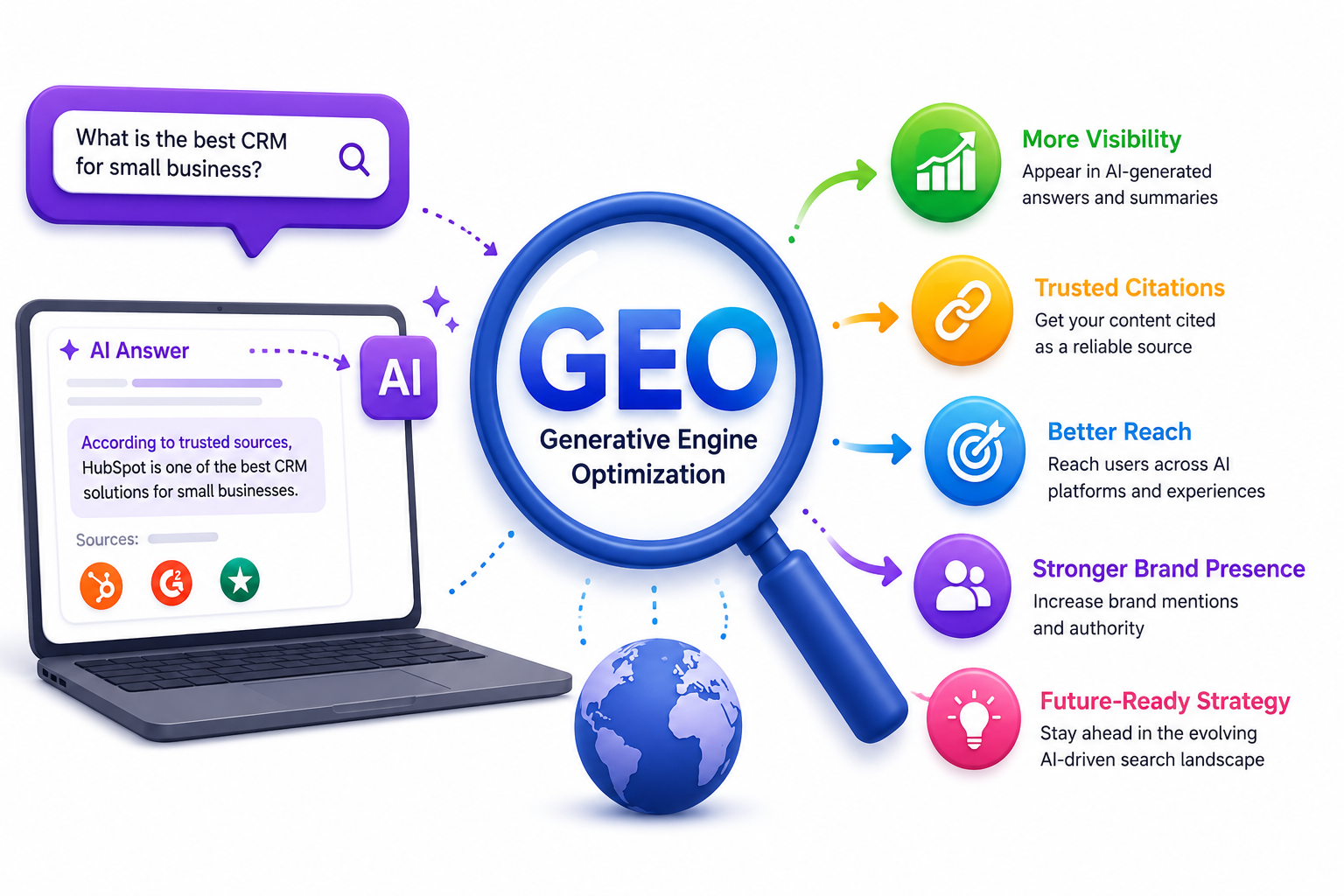
GEO focuses on improving how information and brands appear inside generative search experiences. Where traditional SEO often aims to get a webpage into search results, a generative engine optimization strategy also considers whether information can be understood, retrieved, referenced, or recommended by an AI system.
The difference becomes easier to understand when we look at the search journey.
- Traditional search: A user enters a query, looks through a list of results, clicks a page, and finds the answer.
- Generative search: A user asks a question, receives a combined answer, checks supporting sources if needed, and may continue asking follow-up questions.
This does not mean websites suddenly stop mattering. Generative systems still need information from somewhere. Businesses therefore have a reason to make their content clear, accurate, useful, and distinctive enough to contribute to those experiences.
GEO also widens the idea of visibility. Success may involve brand mentions, recommendations, citations, or source references rather than an immediate website click. This is why GEO marketing is better understood as an extension of digital visibility rather than a replacement for search marketing.
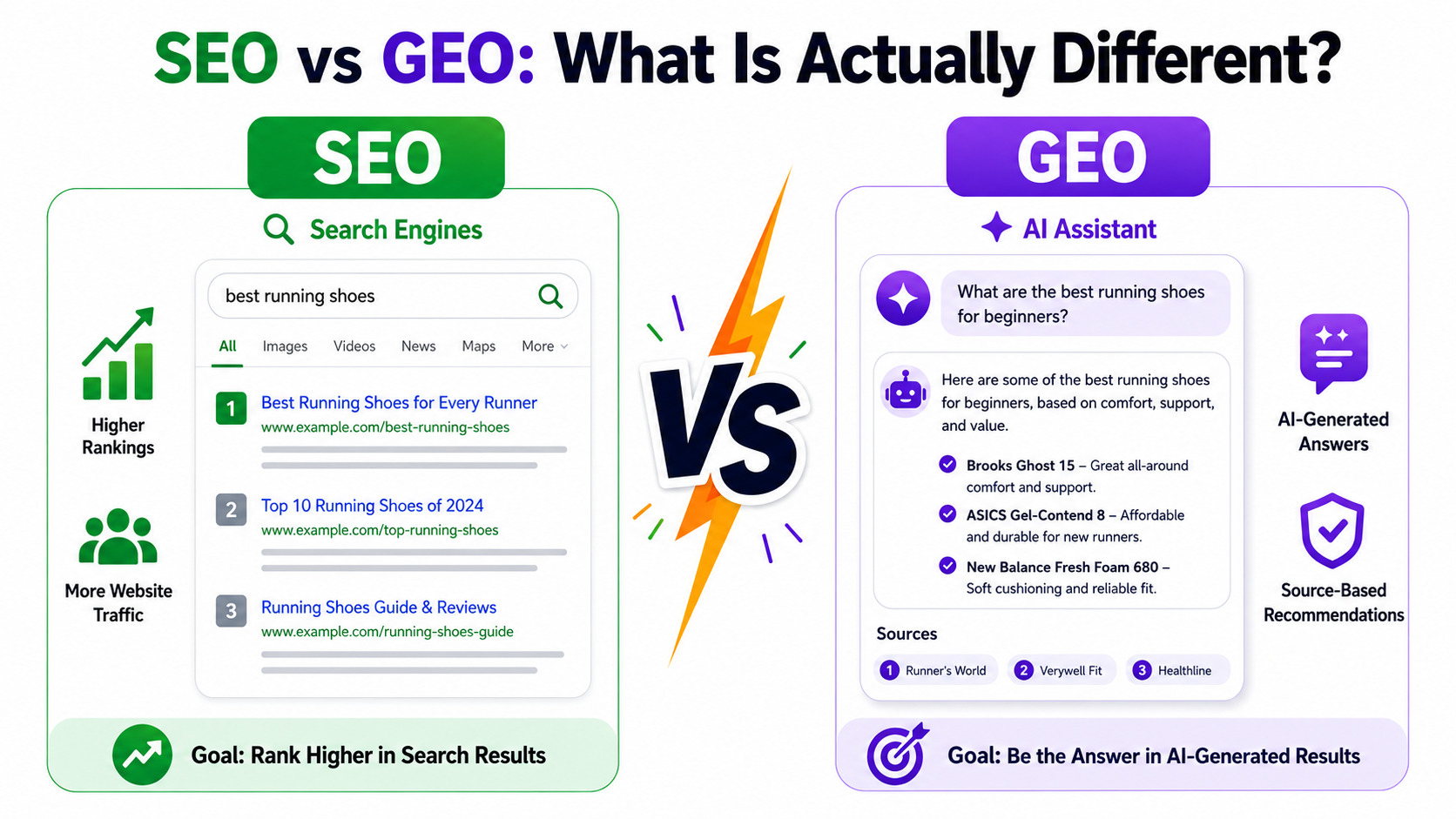
SEO vs GEO: What Is Actually Different?
| Comparison Point | SEO | GEO |
| Main Goal | SEO aims to improve rankings, organic visibility, clicks, and traffic from traditional search engines. | GEO aims to improve how a brand or its content appears in AI-generated answers, citations, mentions, and recommendations. |
| Search Experience | SEO usually helps a webpage compete within search results, where users choose which result to visit. | GEO focuses on generated responses that may combine information from several sources before a user visits any website. |
| Queries | SEO often starts with keyword research, search intent, and the phrases people type into search engines. | GEO also considers longer conversational prompts and follow-up questions that may include several needs in one request. |
| Useful Tools | Google Search Console, Google Analytics, Ahrefs, Semrush, and Screaming Frog are commonly used for SEO analysis. | Bing Webmaster Tools AI Performance, Ahrefs Brand Radar, Semrush AI Visibility tools, and AI referral tracking can support GEO measurement. |
A practical example makes the difference clearer. Someone could search Google for “best accounting software for consultants” and compare several ranking pages. In an AI platform, that person might instead ask, “Which accounting software would suit a five-person consultancy that invoices international clients and does not need complex inventory features?” The second question asks for a more specific combination of information. That does not make keyword research useless. It simply means content may need to answer more natural and detailed questions.
Where Are SEO and GEO Already the Same?
The more closely we compare SEO and GEO, the more overlap becomes obvious. Many principles now being associated with GEO have been part of good SEO for years.
- Useful content still matters: Thin pages that repeat what every competitor already says are unlikely to offer much value. Content should answer the question properly and give the reader something worth remembering.
- Technical accessibility still matters: Search and AI systems cannot do much with pages they cannot properly access or understand. Technical SEO, therefore, remains an important foundation for SEO for AI search.
- Topical depth still matters: Strong topical authority comes from covering an area with genuine depth rather than publishing disconnected articles simply because individual keywords have search volume.
- Trust still matters: Clear authorship, expertise, reliable information, transparent business details, and signals connected with EEAT can help establish credibility.
- Entities still matter: Entity SEO helps make relationships between a company, its services, people, locations, and areas of expertise clearer. Similar relationships may also contribute to how information appears within a knowledge graph.
- External authority still matters: Relevant backlinks, industry references, coverage, reviews, and third-party validation can strengthen the wider reputation of a website and brand.
- Structured information still helps: Proper structured data and relevant schema markup can make certain information easier for search engines to interpret, although markup cannot make weak content authoritative.
The common foundation is simple, useful information needs to be accessible, understandable, relevant, and credible.
If SEO Covers So Much, What Does GEO Actually Add?
The strongest argument for GEO is not that everything is new. It is that AI-generated search puts more emphasis on a few areas that SEO teams now need to think about more carefully.
GEO also raises the value of information gain. If twenty websites explain a topic in almost the same way, another rewritten version adds little. Businesses can make content more useful by including the following:
- first-hand experience and observations
- original research or internal data
- practical examples from real situations
- expert commentary
- useful comparisons
- original frameworks or processes
- current statistics supported by reliable sources
This is where digital PR and stronger brand authority can support both SEO and GEO. The goal is not to manufacture mentions. It is to build genuine recognition around the topics and services the business is actually known for.
Practical Example: If a cybersecurity company publishes an article about ransomware, it can go beyond a basic definition by adding examples of common attack patterns, expert observations, prevention steps, recovery considerations, and links to reliable supporting sources. That gives the page more substance than simply rewriting general advice.
How Do AI Search Systems Find and Use Information?
It is easy to oversimplify AI search and talk as though every platform works in exactly the same way. They do not. Different systems may use different search indexes, retrieval methods, models, ranking processes, and approaches to citing sources.
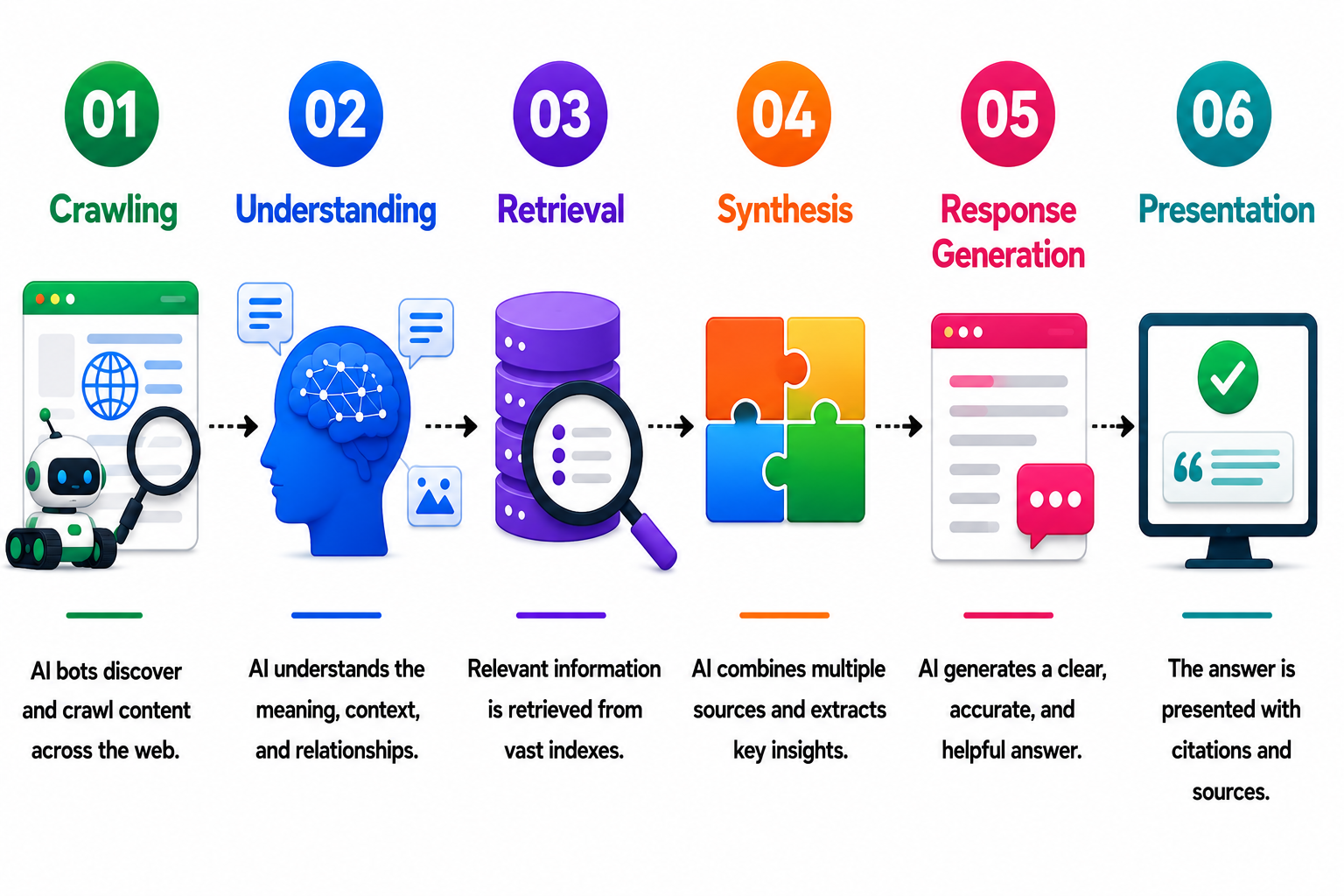
Still, the basic journey can be understood through a few stages.
- Discovery: The system first needs access to useful information. This keeps good technical SEO, clear site structure, and accessible pages relevant.
- Retrieval: When someone asks a question, the system may look for information that matches the meaning and context of that request rather than relying only on an exact keyword.
- Understanding: Clear headings, entities, supporting context, logical relationships, and direct explanations can make information easier to interpret.
- Evaluation: The usefulness of a source can depend on relevance, accuracy, freshness, authority, and whether the information actually helps answer the question.
- Selection: Some systems may cite or reference supporting sources, while others may present information differently. This is why businesses should avoid assuming that one optimization tactic will work identically across every platform.
A page therefore needs to do more than contain the right words. It needs to make sense as a reliable source of information.
How Do SEO, AEO, and GEO Fit Together?
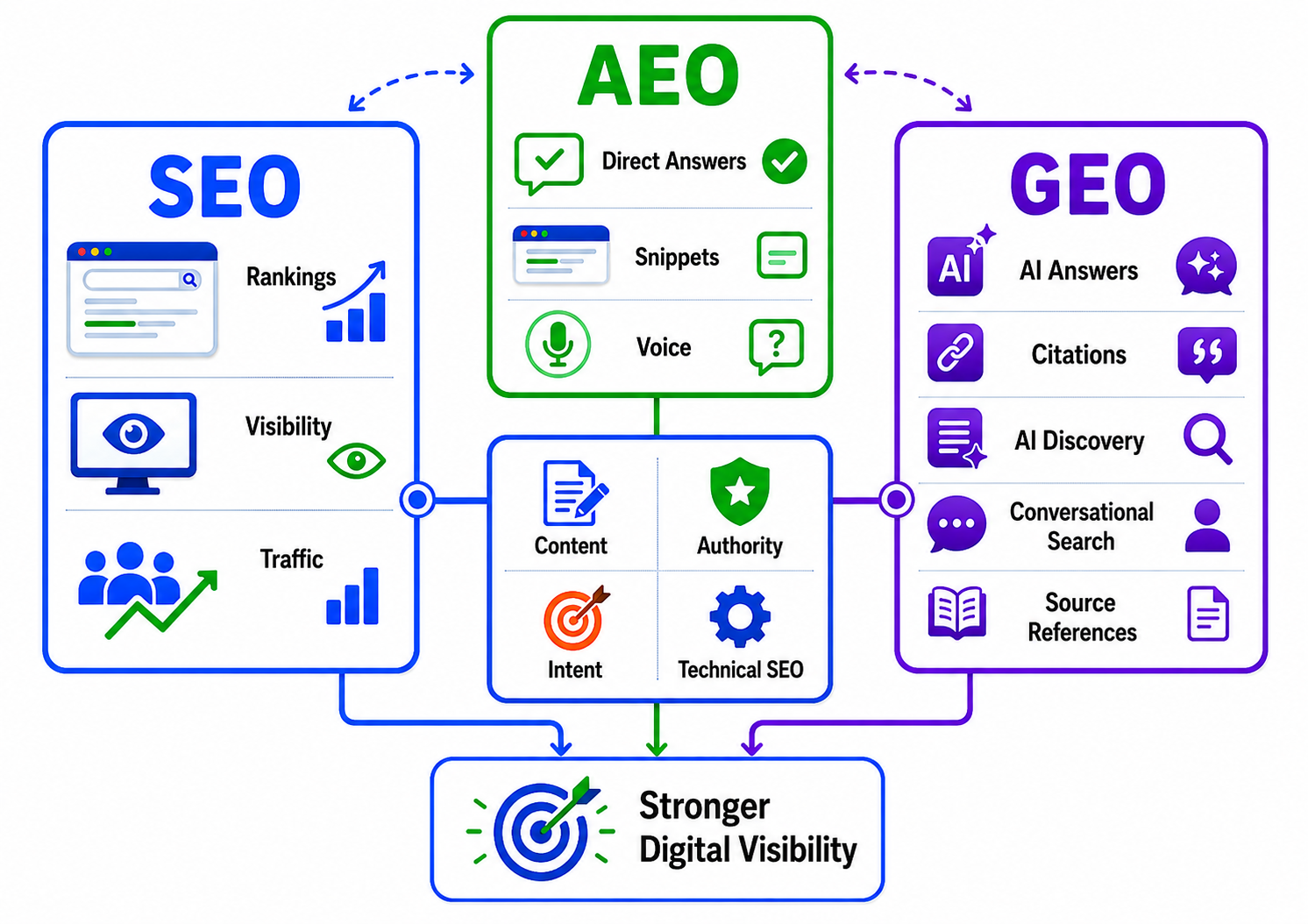
The growing number of marketing acronyms can make search sound more complicated than it needs to be. In practice, SEO, answer engine optimization, and GEO can support different parts of the same visibility strategy.
- SEO: Helps a website become technically accessible, relevant, authoritative, and visible across traditional search experiences.
- AEO: AEO focuses more closely on giving clear answers that can work well in direct-answer environments, featured results, assistants, and question-based searches.
- GEO: Looks at whether information or a brand can become useful within generative responses, recommendations, source citations, and AI-assisted discovery.
Some marketers also use the phrase “GEO SEO“ when discussing this overlap. The exact label matters less than how the work is handled. This is why the practical goal should be one connected search visibility strategy rather than several disconnected optimization programs.
How Can Businesses Evolve SEO for GEO?
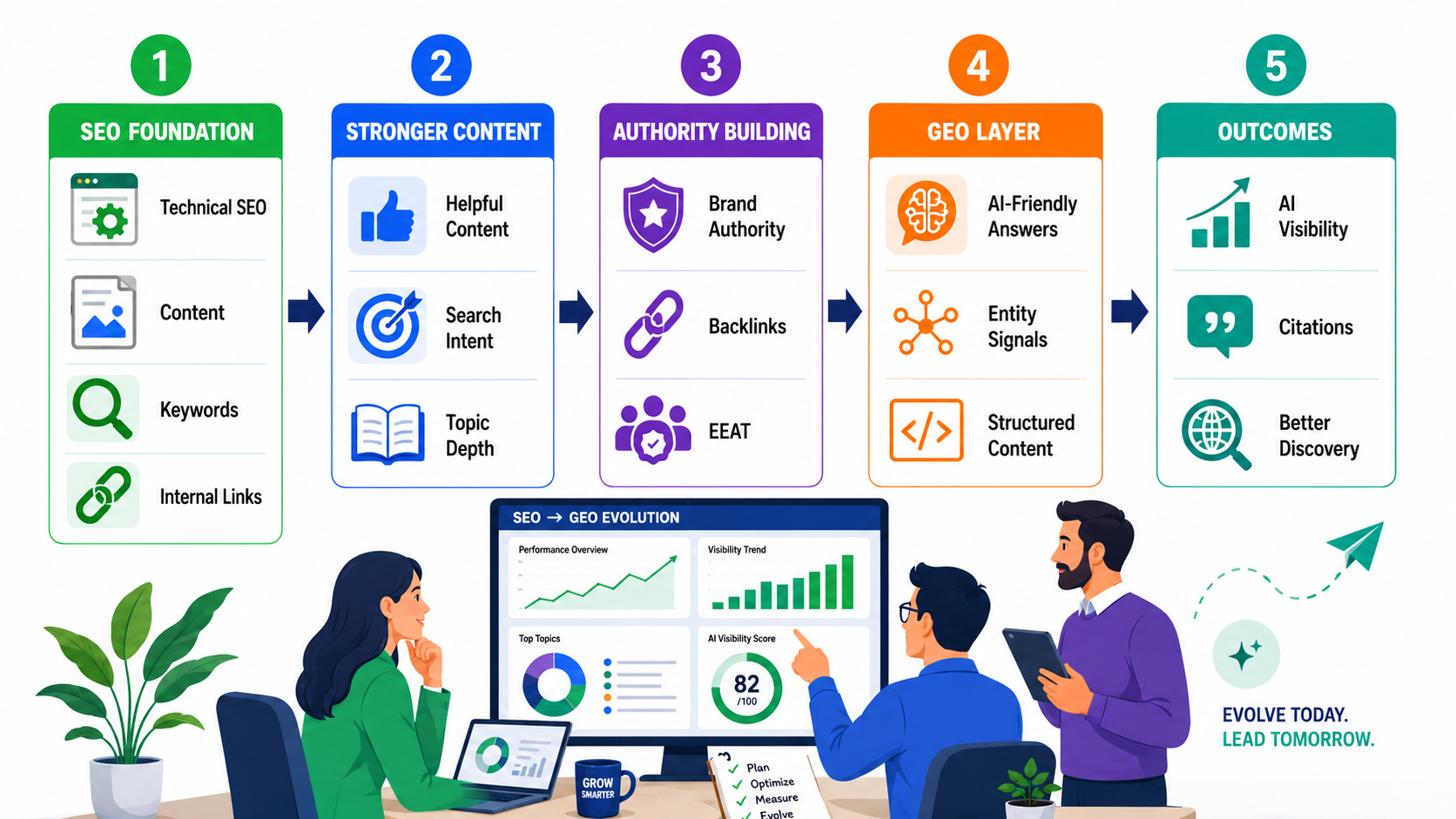
Businesses that already have a strong SEO foundation usually do not need to start over. They need to extend what they are already doing and pay more attention to how information may be understood outside traditional search results.
- Keep technical SEO healthy: Review crawling, indexing, internal links, duplicate content, mobile usability, rendering, canonicals, and important page templates. Advanced AI search optimization has little value if the site itself is difficult to access.
- Build topic depth: Create useful resources around the subjects that genuinely matter to your audience. One excellent cluster around a core service is usually more valuable than dozens of unrelated articles.
- Strengthen entities: Keep company names, services, locations, authors, credentials, and topic relationships consistent across the website and other trusted sources.
- Answer important questions early: Do not make readers work through several paragraphs before reaching the point. Give them a clear answer and then add explanations, examples, and evidence.
- Add original value: Look for places where experience, research, expert commentary, customer insights, or real examples can make the page different from generic content.
- Build a wider authority footprint: Relevant links remain useful, but businesses should also look at interviews, industry coverage, expert contributions, reputable directories, reviews, partnerships, and independent references.
- Keep important information current: Pages covering prices, statistics, technology, products, regulations, or fast-moving industries need meaningful updates when the facts change.
- Track search and AI together: Traditional rankings and traffic still matter, but businesses should also watch for AI referrals, citations, mentions, and changes in branded demand.
This approach makes SEO and GEO work together rather than creating more content and more work for the sake of using a new label.
Do Keywords and Backlinks Still Matter?
Yes. GEO does not suddenly make keywords or links irrelevant. Keywords still help businesses understand what people care about and how they describe a problem. Exact-match repetition matters less than building useful context around the topic. Related questions, entities, examples, and natural language can make a page more complete without forcing the same phrase into every paragraph.
Links remain valuable too, but businesses should think beyond raw link numbers. A relevant mention from an established industry publication can be more meaningful than dozens of weak links from unrelated sites.
The debate around GEO vs. traditional SEO, therefore, should not become “keywords and backlinks are dead.” A better question is how familiar SEO signals fit into a search environment that now includes generated answers, conversational prompts, and wider brand discovery.
What Common GEO Mistakes Should Businesses Avoid?
The speed of AI development has created plenty of excitement, but it has also created unrealistic promises. Businesses should avoid making large strategic changes based on every new GEO theory.
- Abandoning traditional SEO: Good GEO does not begin with neglecting technical SEO, search intent, content quality, or authority.
- Creating separate AI pages: Publishing one version for Google and another for every AI platform usually creates unnecessary duplication.
- Stuffing articles with questions: Question-based content can be useful, but dozens of forced headings make a page harder to read.
- Publishing generic AI content at scale: More pages do not automatically create more expertise. Generic content that adds nothing new can weaken the overall quality of a site.
- Treating schema as a shortcut: Markup helps machines interpret information, but it cannot replace experience, evidence, or useful content.
- Writing for machines first: Readers should never feel as though a page was assembled purely to satisfy an algorithm.
The safest approach is surprisingly simple make the content genuinely useful, technically accessible, easy to understand, and credible enough to stand on its own.
How Should GEO Performance Be Measured?
Measurement is one area where GEO genuinely changes the conversation. SEO already has established metrics such as impressions, positions, clicks, organic traffic, leads, and revenue. Generative visibility can add a few more signals.
- AI citations: How often are your pages used or referenced as supporting sources?
- Brand mentions: Does the business appear in relevant generated answers?
- AI referral traffic: Are people visiting the website from AI-powered platforms?
- Prompt visibility: Does the brand appear for important questions related to its services or expertise?
- Branded search: Is wider visibility leading more people to search directly for the company?
- Business results: Are leads, inquiries, sales, and assisted conversions improving?
No single metric should become the goal on its own. A hundred AI mentions mean very little if none of them reach the right audience.
Measurement Note: Treat AI visibility as another part of the customer journey. Connect citations and mentions with branded searches, qualified traffic, leads, and revenue before deciding whether a GEO effort is actually working.
GEO vs. SEO: What Should Brands Do in 2026?
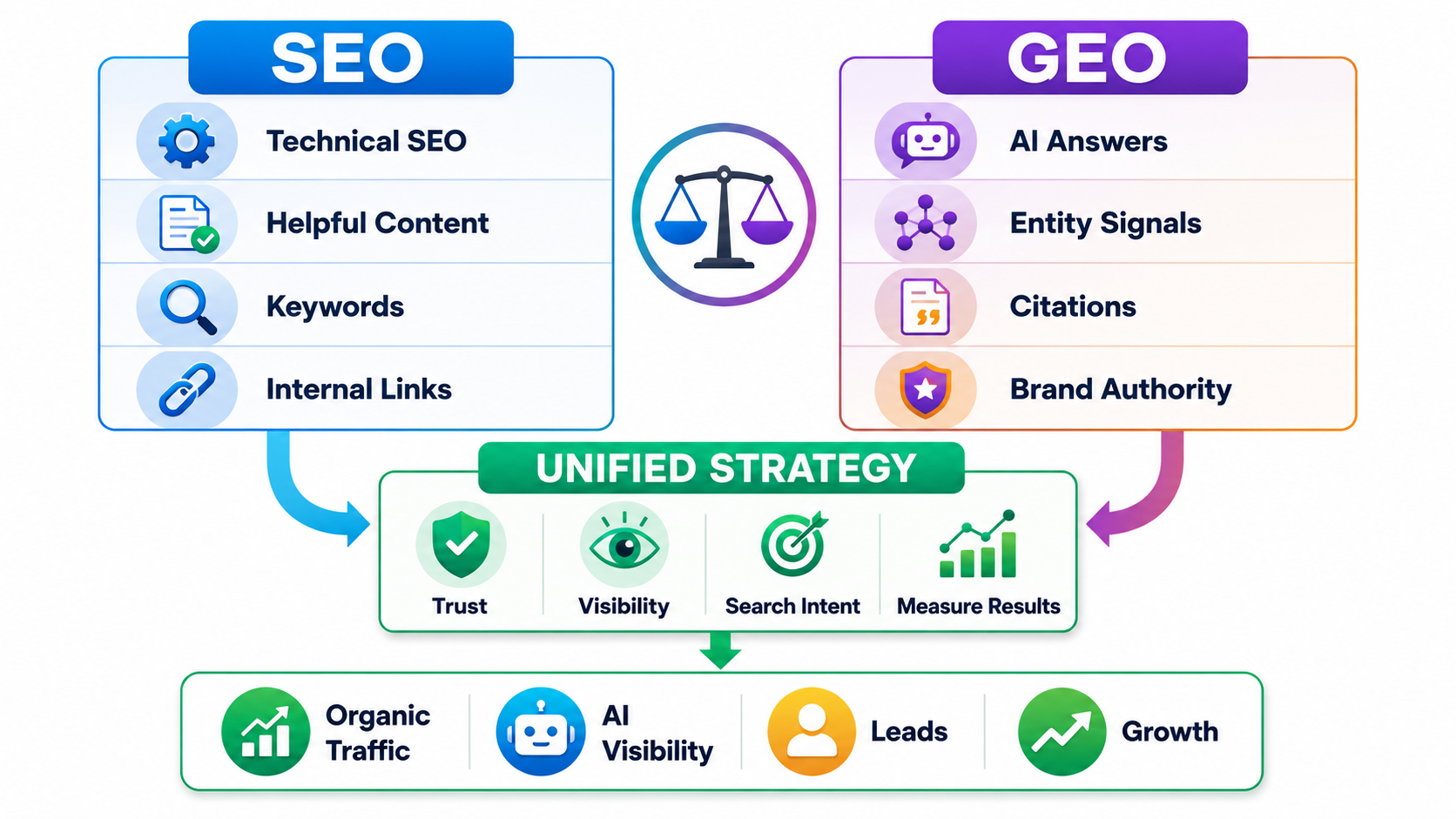
For most businesses, the smartest answer is to avoid choosing one over the other. SEO vs GEO should not become an argument about replacing an old strategy with a new one. Brands should keep their SEO foundations strong while gradually improving the areas that matter more in generative search.
- Keep Strong SEO Foundations in Place: Technical quality, useful content, internal linking, topic relevance, authority, and user experience are still important. Businesses should protect these strengths rather than reducing SEO investment to chase a new trend.
- Create Content AI Systems Can Understand: Clear writing, useful headings, supported claims, accurate facts, connected topics, and direct explanations can help both people and machines understand a page.
- Build Stronger Brand and Entity Authority: A trusted brand is harder to replace than a page targeting one keyword. Expert content, industry relationships, original insights, reviews, PR, and independent recognition create a stronger authority footprint.
- Optimize for Both Rankings and AI Citations: Businesses should create pages that deserve to rank and also contain information worth referencing. Those goals support one another when the content is genuinely useful.
- Measure Visibility beyond Organic Search Traffic: Rankings and traffic should remain part of reporting, but they may no longer tell the complete story. AI referrals, citations, mentions, branded demand, and assisted journeys can provide a wider picture.
This broader approach is likely to shape the future of SEO. Search is not disappearing. It is becoming more varied.
Is GEO Really the Next Evolution of SEO?
SEO has already gone through several major changes. It moved from basic keyword matching towards semantic understanding; adapted to mobile browsing; expanded into local search, images, video, shopping, voice, and rich search experiences; and became far more focused on intent and usefulness.
- Generative search is another important shift: GEO deserves attention because generated answers change where information can appear and how people may discover a brand. However, the strongest GEO practices still rely on things SEO professionals already understand: good technical foundations, useful information, strong entities, clear writing, trusted sources, topic depth, and external authority.
- The real difference is where visibility happens: Traditional SEO asks whether people can find a useful page through search. GEO adds another question: can an AI system understand that information, retrieve it when relevant, trust it enough to use it, and potentially reference the source?
Businesses prepared for both environments are likely to be in a much stronger position as search continues to evolve.
Conclusion
The SEO vs. GEO debate becomes much easier to understand when both are viewed as parts of the same search journey. SEO still provides the foundation by helping search engines discover, understand, and rank useful content. GEO builds on that foundation by extending visibility into AI-generated answers, citations, mentions, and recommendations. Businesses do not need to replace their existing SEO strategy or chase every new GEO trend. They need to strengthen what already works by creating useful content, adding original insight, building authority, improving brand signals, and keeping important information clear and accurate. The goal should be simple: remain visible wherever people look for information, whether that happens through traditional search results or AI-powered discovery.
Ready to Strengthen Your Search and AI Visibility?
Connect with eSign Web Services to bring SEO, AI-powered search, content strategy, entity optimization, AEO, technical SEO, digital authority, and GEO together into one practical visibility strategy built around stronger rankings, better discovery, qualified traffic, and long-term business growth.
Frequently Asked Questions
Question: What Is the Main Difference Between SEO and GEO?
Answer: SEO is mainly about helping websites show up where people are already searching, while GEO focuses on how a brand or its content may be used in AI-generated answers, citations, mentions, and recommendations. They work in different environments, but both still depend on useful content, technical accessibility, relevance, authority, and understanding what users actually need.
Question: Is GEO Replacing Traditional SEO?
Answer: No. GEO is better understood as an extension of SEO rather than a replacement. Websites still need technical SEO, useful content, authority, internal links, and good topic coverage. Generative search creates additional ways to become visible, but businesses should build on existing SEO strengths instead of throwing them away.
Question: Can Good SEO Improve GEO Visibility?
Answer: Yes. Strong SEO gives GEO a much better foundation because it improves accessibility, relevance, authority, structure, and content quality. GEO adds more attention to clear answers, original information, external brand associations, conversational questions, and content that may be useful enough for generative systems to retrieve or reference.
Question: Do Keywords Still Matter for GEO?
Answer: Keywords still help businesses understand demand, language, topics, and user intent. What matters less is repeating the same exact phrase throughout a page. Natural topic coverage, related entities, useful examples, connected questions, and clear explanations create richer context while giving readers a much better experience.
Question: Should Businesses Run SEO and GEO Separately?
Answer: For most businesses, one connected strategy makes more sense. SEO, content, digital PR, authority building, entity optimization, and technical improvements can support both traditional and generative visibility. GEO performance may need additional measurement, but separating execution completely can create duplicated work, unnecessary content, and conflicting priorities.
Author Details

Ashwani Kumar Sharma
Ashwani has been actively involved in SEO services since 2005. His expertise and distinctive work approaches have made him one of the most experienced and trusted SEO experts in the industry. He is a certified SEO and Google Ads professional. He also has strong business development skills in advanced SEO, PPC, and digital marketing strategies.


