



How to Optimize Your Website for Google AI Mode without Abandoning Traditional SEO

Key Takeaways:
- Google AI Mode does not mean businesses should leave traditional SEO behind. Google has made it clear that the same core SEO practices still matter because its generative AI search features are closely connected to existing Search systems.
- Pages usually need to be indexed and eligible to appear in Google Search with a snippet before they can show up as supporting links in AI Mode. There is no separate technical eligibility process created only for AI Mode.
- AI Mode can use query fan-out, which means one detailed question may lead Google to explore several related searches. This gives websites with strong topic coverage, useful supporting pages, clear entities, and good internal connections a better foundation.
- Businesses should focus on genuinely useful, original, experience-led content instead of creating large numbers of thin pages for every possible AI query variation.
- There is no special Google AI Mode schema that websites need to install. Existing structured data should simply be accurate and match what visitors can actually see on the page.
- Technical SEO, crawlability, internal linking, page experience, useful content, structured data, images, video, and authority still have an important place in search strategy.
Google Search is no longer limited to typing a few words, scanning blue links, and choosing the result that looks most relevant. The experience is becoming more conversational, detailed, and flexible. People can now ask longer questions, compare several options, add specific requirements, explore related topics, and continue with follow-up questions without starting a new search each time. Google AI Mode reflects this shift by helping users work through more complex queries and discover information from different parts of the web in a more connected way. It can support comparisons, refinements, and broader exploration, giving searchers a richer way to find answers.
For businesses that have invested in Search Engine Optimization, this change naturally raises questions about what should happen next. Does traditional SEO still matter? Should companies replace it with Generative Engine Optimization or GEO? In most cases, the answer is no. A practical Google AI Mode SEO strategy should build on the same foundations that help Google discover, understand, and trust a website. The difference is that content now needs to answer more complex questions, cover relevant supporting topics, demonstrate genuine expertise, and make useful information easier to understand. The goal is to make SEO and AI search work together.
What Is Google AI Mode?
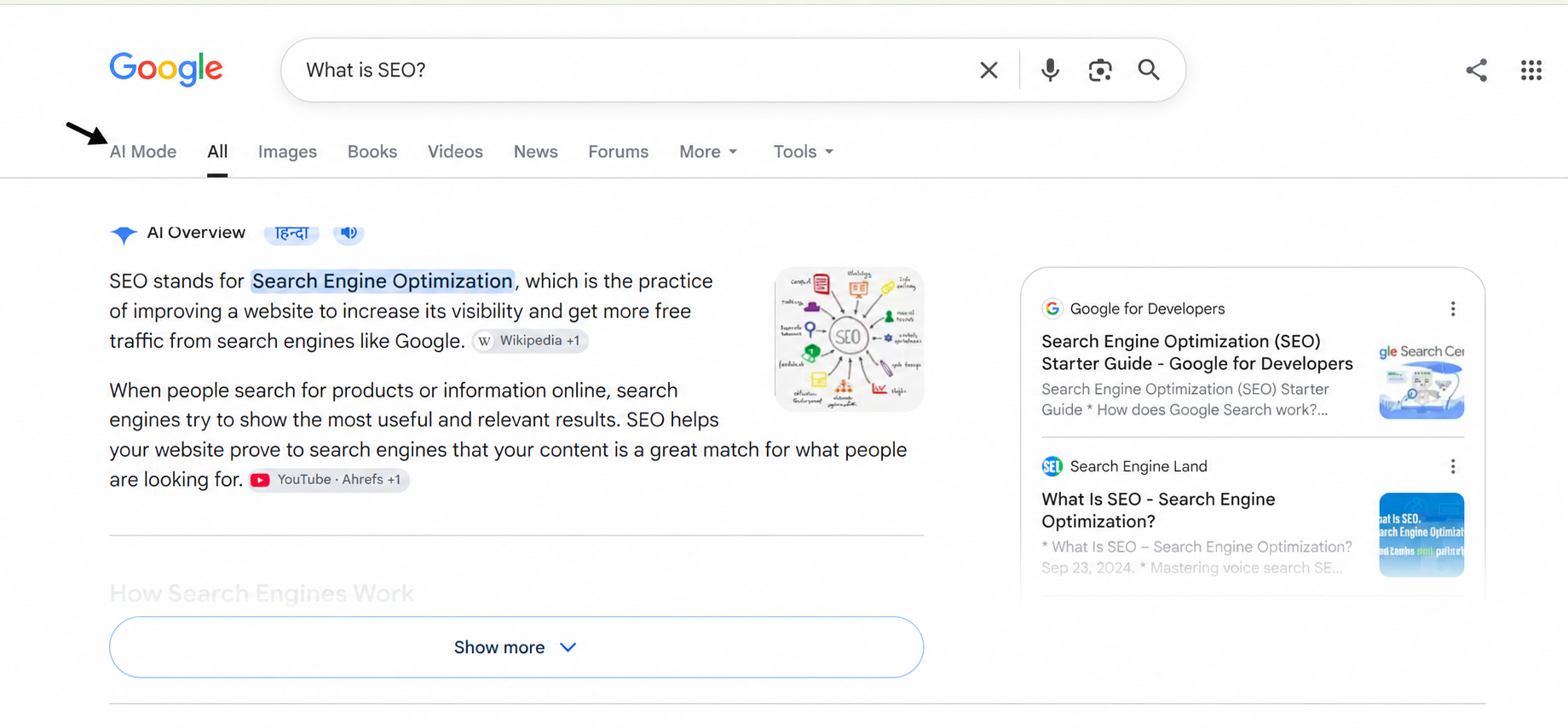
Google AI Mode is an AI-powered search experience that helps users explore detailed questions more conversationally. It can understand complex queries, search across related topics, combine useful information, and provide clear answers with relevant web links. Users can also ask follow-up questions, compare options, and refine their search without starting over.
Before changing anything on a website, it helps to understand what is actually different. AI Mode still sits within Google’s wider search ecosystem, but the way people ask questions and move through information can feel very different from a familiar search results page.
- Traditional Google Search still matters: In a normal search, someone enters a query and Google returns ranked results along with other features such as maps, images, videos, products, or featured results. Strong search intent alignment is still important because Google is trying to work out what the person really wants and which page can satisfy that need best.
- AI Mode allows a more conversational search journey: Google AI Mode is designed for people asking detailed or layered questions. Instead of searching “best project software,” someone might ask, “Which project management software works well for a 25-person construction company that needs mobile access and cost tracking?” That gives Search much more context to work with.
- Follow-up questions keep the conversation moving: With conversational search, users can keep refining the same topic. They might ask for cheaper options, compare two products, add a location, or change a requirement. Good website content should therefore answer the main question while also helping people understand what they may need to know next.
- Query fan-out can widen the search: Google explains that query fan-out can break a complicated request into several related searches. A single question might lead to searches around cost, suitability, comparisons, limitations, features, reviews, location, or common problems.
The important thing to understand is that AI Mode is not simply looking for a page that repeats the exact words used by the searcher. It can explore the wider subject. That makes useful topic coverage and clear relationships between pages more valuable than producing dozens of pages built around tiny keyword variations.
Why AI Mode Is Not a New SEO System?
Whenever search changes, new terms, tools, and supposed shortcuts appear quickly. Some can be useful, but the rush to rebuild everything around AI can easily distract businesses from the SEO work that still matters.
- Google still needs to reach your pages: Strong crawlability allows Google to access important content, while proper indexability gives those pages a chance to enter the Search index. Even excellent content will struggle if Google cannot reliably crawl or index it.
- Existing quality systems still play a role: Google’s generative search experiences are connected to its broader Search systems. That means SEO for Google AI Mode should build on familiar foundations such as relevance, quality, technical accessibility, trust, and usefulness rather than treating AI Mode as an entirely separate platform.
- AI search should strengthen existing SEO work: A practical traditional SEO and AI Mode approach keeps technical SEO, content quality, internal links, useful pages, backlinks, and conversion work in place while adding stronger answers, better topic relationships, original insight, and clearer entities.
The main idea is simple. Google AI Mode optimization should improve a solid SEO strategy, not replace one.
What Should You Keep From Traditional SEO?
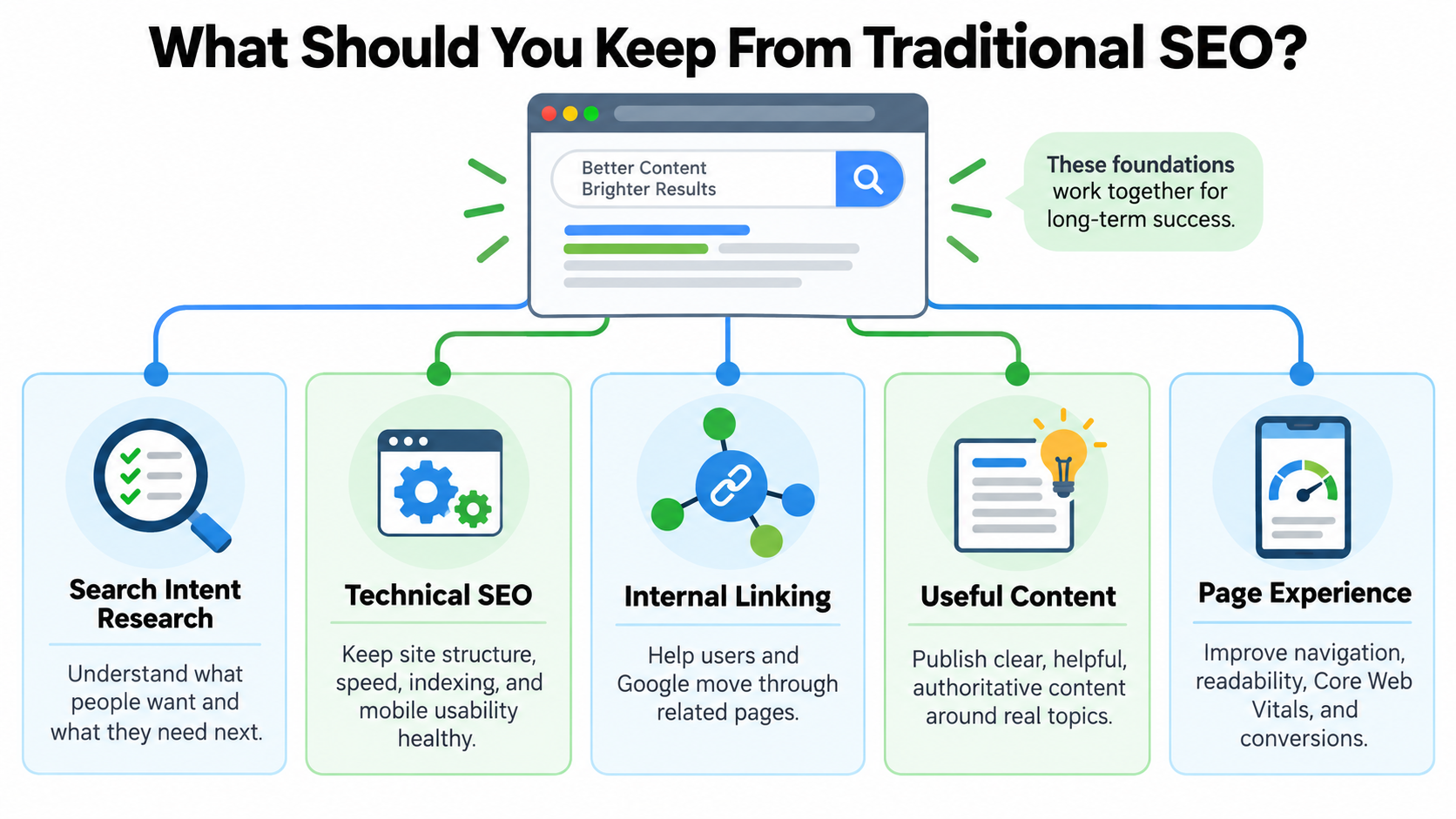
There is plenty from traditional SEO that businesses should keep doing. In fact, many of these fundamentals become even more useful when search journeys get longer and more detailed.
- Keep technical SEO healthy: Site architecture, canonical tags, XML sitemaps, robots directives, JavaScript accessibility, mobile usability, page speed, and clean URL handling still matter. Technical problems can stop strong content from being discovered no matter how well it is written.
- Keep publishing useful, authoritative content: Semantic SEO matters because real topics are larger than a single phrase. Content should explain related ideas, important entities, common questions, and practical considerations without trying to force every possible term into the copy.
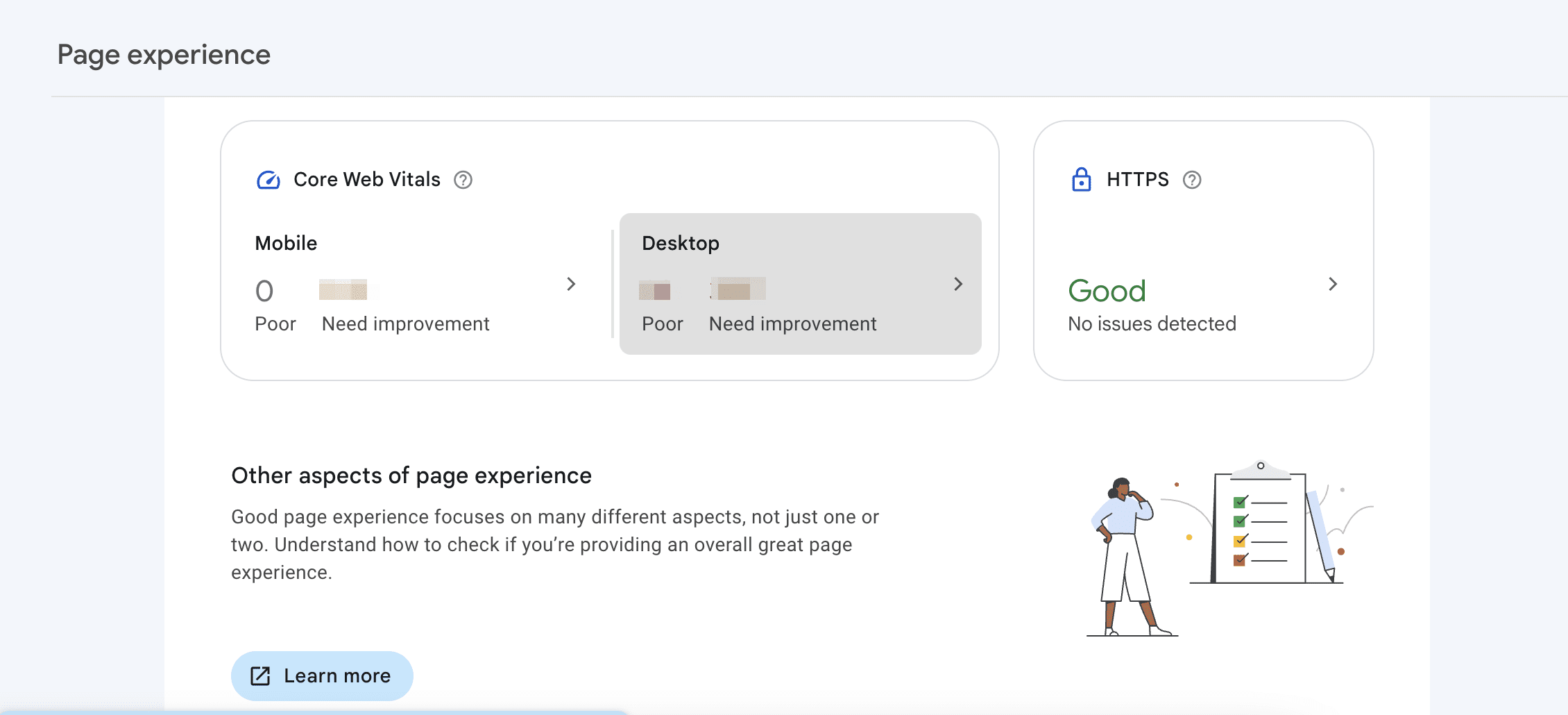
- Keep improving page experience and conversion: Search visibility has limited value if people arrive and leave. Clear navigation, readable content, mobile usability, useful calls to action, and healthy Core Web Vitals all contribute to a better user experience.
Traditional SEO has not suddenly become outdated. The environment around it has changed, which means these foundations now need to support more complex search behaviour.
What Actually Changes With AI Search and Human Intent?
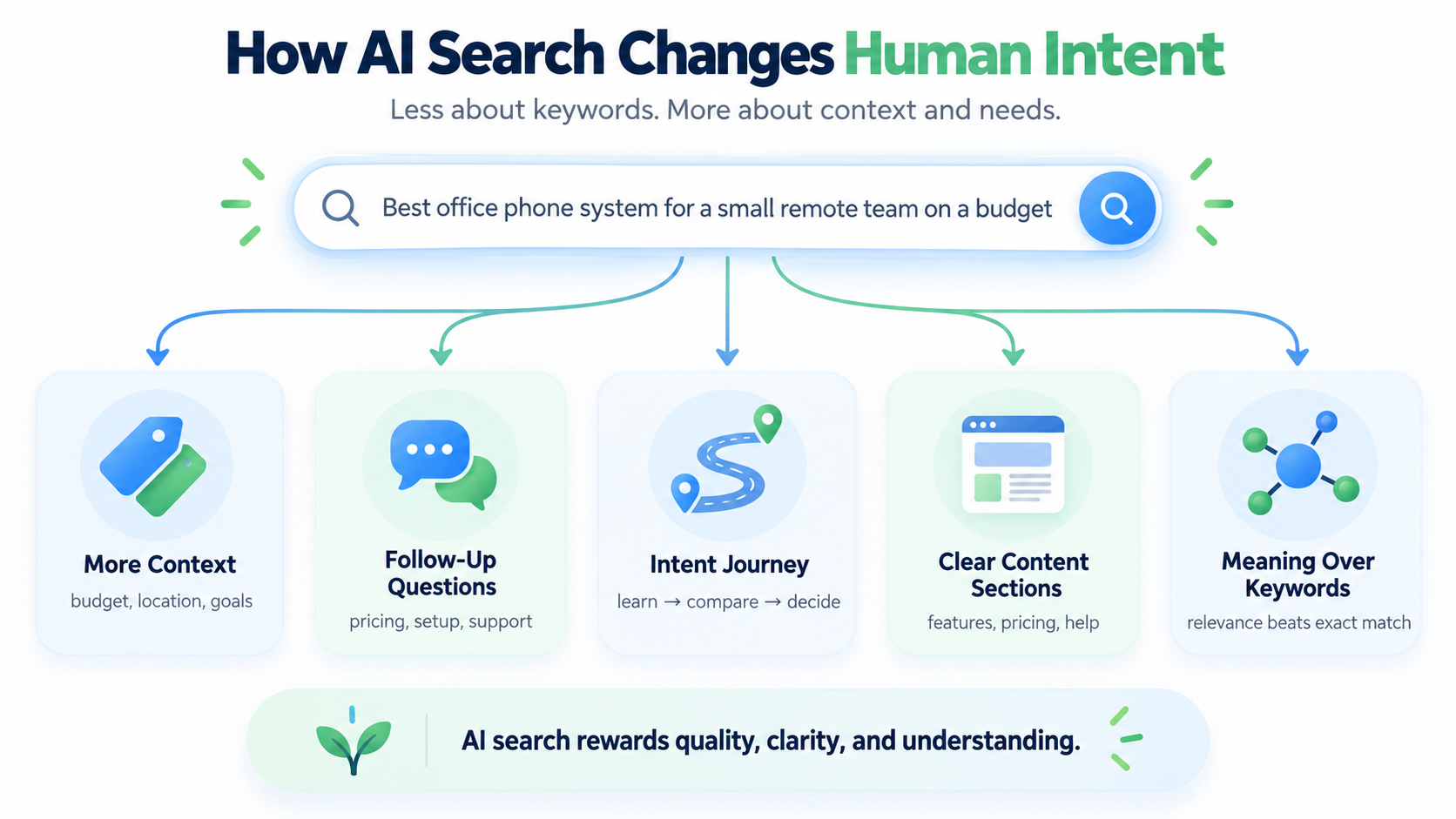
The biggest shift is not a technical one. It is the amount of detail people can include in a search. When users are free to describe their exact situation, good optimization starts with understanding people more deeply rather than chasing isolated phrases.
- Searches can include far more context: Someone can now mention budget, location, business size, preferences, concerns, past problems, and desired outcomes in the same query. That makes AI search SEO much more dependent on understanding real situations instead of simply matching a few popular terms.
- A single conversation can move through several intent stages: Users can move from learning to comparing and then to buying very quickly. Informational and commercial pages should therefore connect naturally instead of being treated like unrelated parts of the website.
- Different sections of a page can solve different problems: Clear headings, examples, definitions, evidence, and well-written paragraphs make sections easier for readers to scan and understand. They also make the purpose of each section clearer without turning the page into artificial “AI chunks.”
This is where Google AI search optimization starts to feel less like a volume game and more like a quality and understanding game.
Strategy #1 – Protect Crawlability and Indexability First
Before thinking about AI visibility, make sure Google can properly access, understand, and index your important pages. If search engines cannot reach the content reliably, stronger content or AI-focused optimization will have limited impact.
- Fix Canonical Problems: Make sure canonical tags point to the correct preferred version of each page. Incorrect canonicals can send confusing signals about which URL Google should index.
- Resolve Duplicate URLs: Identify pages with identical or very similar content and consolidate them where appropriate. Duplicate URLs can divide ranking signals and make indexing less efficient.
- Improve JavaScript Accessibility: Ensure important text, links, navigation, and page elements remain accessible when JavaScript is rendered. Search engines should not struggle to discover essential content.
Strong crawlability and indexability give the rest of your SEO strategy a reliable base. Once Google can consistently find and process important pages, content, authority, and AI search improvements have a better chance to perform.
Strategy #2 – Build Content Around Topics
AI search understands broader subjects rather than isolated phrases alone. Building content around meaningful business topics helps users explore related questions while giving search systems clearer context about your expertise and overall subject coverage.
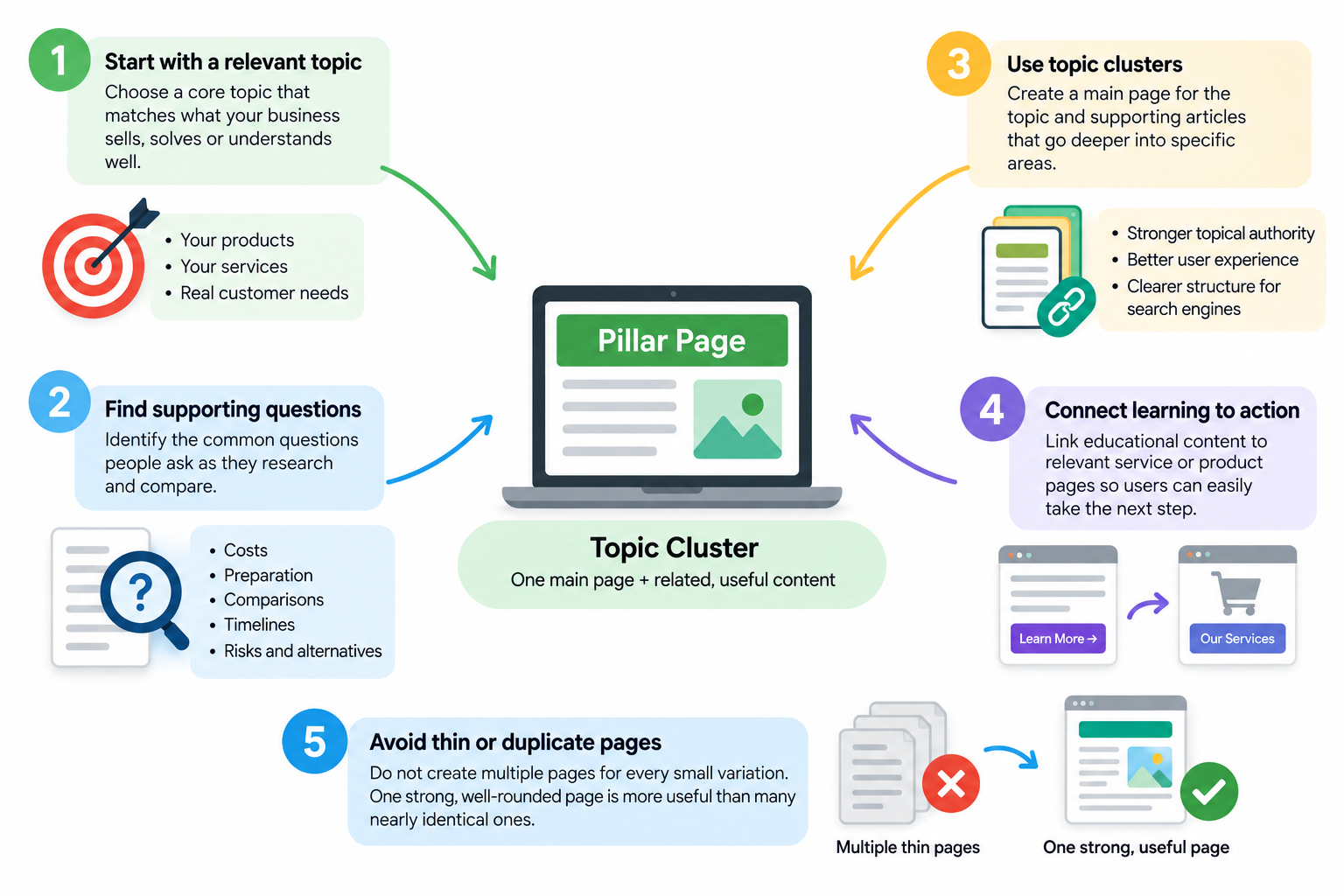
- Start with a Core Business Topic: Choose a subject closely connected to your products, services, expertise, or customer problems. A strong core topic gives the surrounding content a clear purpose.
- Map Commercial and Informational Intent: Separate questions people ask while researching from those asked closer to making a decision. Both types of content should connect naturally within the same topic.
- Avoid Creating Pages for Every Minor Query Variation: Do not publish multiple pages that answer almost identical questions. Combine closely related variations where possible and focus on creating genuinely useful resources instead.
Strong topic coverage is about relevance and depth, not publishing the largest number of pages. A connected content structure can serve different user needs while keeping the website organized and useful.
Strategy #3 – Prepare Content for Query Fan-Out
Query fan-out can take one detailed search and explore several connected areas around it. Content should therefore address the wider problem behind a query while giving related questions enough useful coverage.
- Cover Advantages and Limitations: Give readers a balanced understanding by explaining both strengths and restrictions. Useful content should help people evaluate suitability rather than presenting every option positively.
- Answer Follow-Up Questions: Think about what someone is likely to ask after receiving the first answer. Addressing natural next questions makes the page more useful within a conversational journey.
- Create Supporting Content Rather Than One Overloaded Page: If a subtopic requires detailed explanation, give it a dedicated supporting page instead of making the main page unnecessarily long or difficult to navigate.
Preparing for query fan-out does not mean predicting every possible search. It means understanding the wider decision journey and creating connected information that can support people as their questions become more specific.
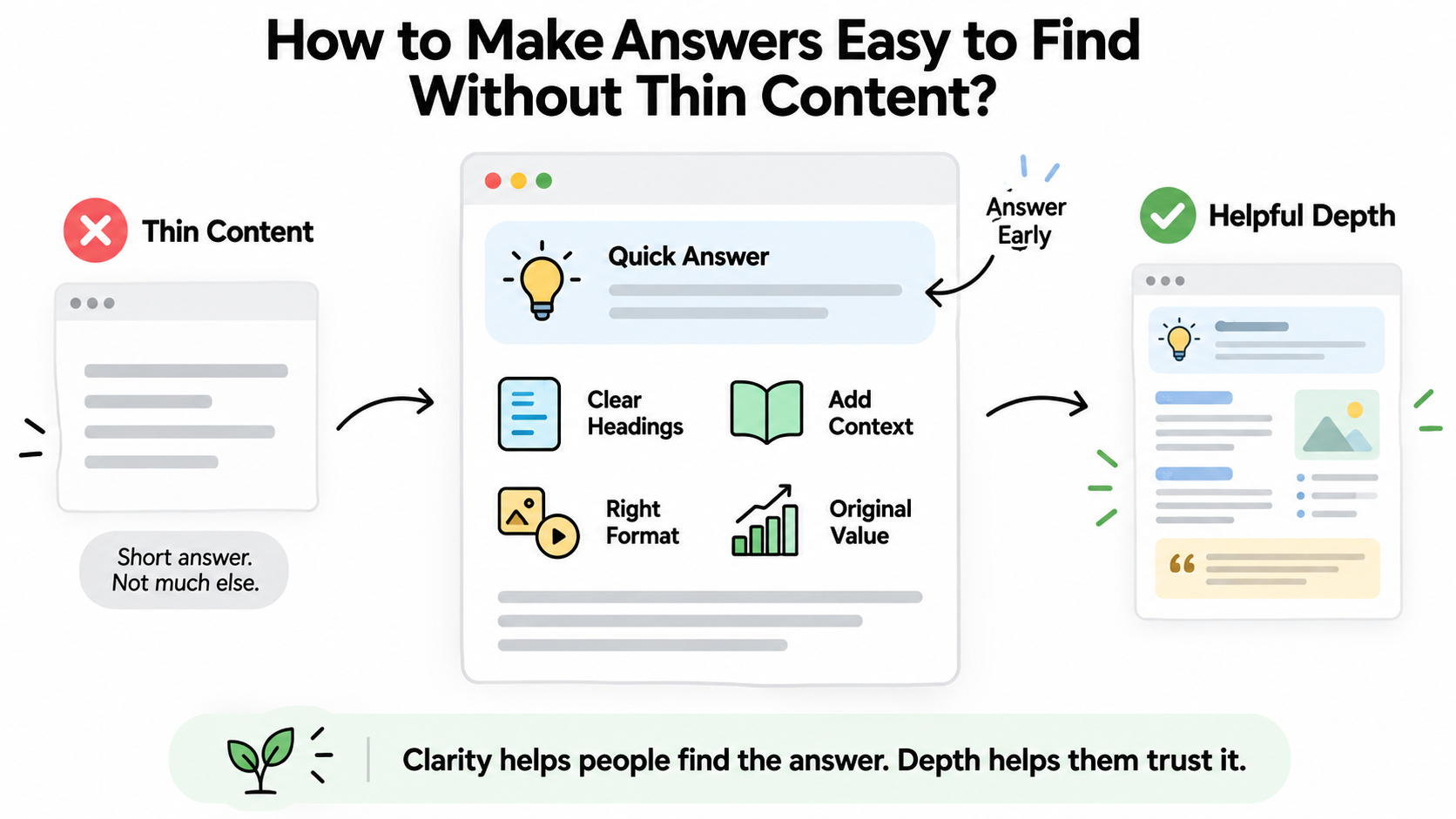
Strategy #4 – Make Important Answers Easy to Find
Useful information should not be buried beneath long introductions or unnecessary explanation. Clear structure helps readers reach important answers quickly while still giving them enough detail to understand the subject properly.
- Use Lists Where They Improve Understanding: Lists are useful for steps, requirements, benefits, mistakes, or checks. Use them when they make information easier to scan rather than automatically.
- Use Comparison Tables Where Appropriate: Tables can make differences between options easier to understand when readers need to compare features, costs, requirements, or suitability across several choices.
- Include Clear Definitions: Define technical terms when they first become important. A simple explanation can prevent confusion and make the rest of the content easier for wider audiences.
- Avoid Unnecessary Introductory Filler: Remove generic opening statements that delay the useful information. Start sections with context that directly helps the reader understand the topic or problem being discussed.
Clear answers and useful depth should work together. Readers should be able to find the main point quickly while still having enough supporting information to make an informed decision.
Strategy #5 – Create Non-Commodity Content
Generic summaries are easy to reproduce and rarely give readers a strong reason to choose one source over another. Valuable content should include information, experience, or insight that adds something genuinely useful.
- Add First-Hand Experience: Share observations, challenges, decisions, and lessons from real work where appropriate. First-hand experience can make explanations more practical and show how ideas perform outside theory.
- Develop Original Frameworks: Organize knowledge into a useful process, model, checklist, or decision framework that helps readers understand the subject and apply the information more confidently.
- Add Unique Industry Examples: Use realistic examples from the relevant industry rather than generic scenarios. Specific situations often make complex concepts easier for the target audience to understand.
- Share Lessons from Actual Projects: Explain what worked, what did not, and what changed during real projects. Practical lessons can make content more useful than polished theoretical advice.
Strong content does not need to be completely revolutionary. It simply needs to add useful information, experience, evidence, or perspective instead of repeating the same generic explanation available everywhere else.
Strategy #6 – Strengthen Entity and Brand Clarity
Search systems need clear information about who a business is, what it offers, where it operates, and who provides expertise. Consistency across the website and wider web helps strengthen those relationships.
- Strengthen About Pages: Use the about page to explain the organization’s background, expertise, people, values, and areas of work rather than filling it with generic promotional language.
- Build Author Profiles: Give regular contributors useful author pages or biographies that explain their experience, professional role, specialist subjects, and relevant credentials where those details matter.
- Connect Locations Where Relevant: Clearly show how specific services, offices, or teams relate to different locations when geography matters to the business and the customers it serves.
- Maintain Consistent Third-Party Profiles: Review important business profiles and directories regularly. Outdated descriptions, contact details, or service information can create confusion around the organization’s identity.
Strong entity clarity comes from consistency rather than repetition. When the organization, people, services, expertise, and locations are accurately connected, both users and search systems receive a clearer picture of the brand.
Strategy #7 – Use Structured Data Correctly, Not Aggressively
Structured data can help search engines interpret certain information on a page, but adding more markup does not automatically improve visibility. Use supported types accurately and keep them aligned with visible content.
- Person Schema: Person markup can provide structured information about relevant authors, experts, or professionals when their identity and role are genuinely important to the page or organization.
- Service and Other Applicable Types: Use supported schema types that genuinely match the content. Do not force a markup type onto a page simply because it appears closely related.
- Validate Structured Data: Test markup after implementation to identify syntax errors, missing required properties, unsupported combinations, or other problems that could prevent search engines from processing it correctly.
Structured data works best as clarification, not decoration. Accurate markup can support understanding, but it cannot compensate for weak content, unclear information, or poor technical foundations.
Strategy #8 – Improve Internal Linking and Site Structure
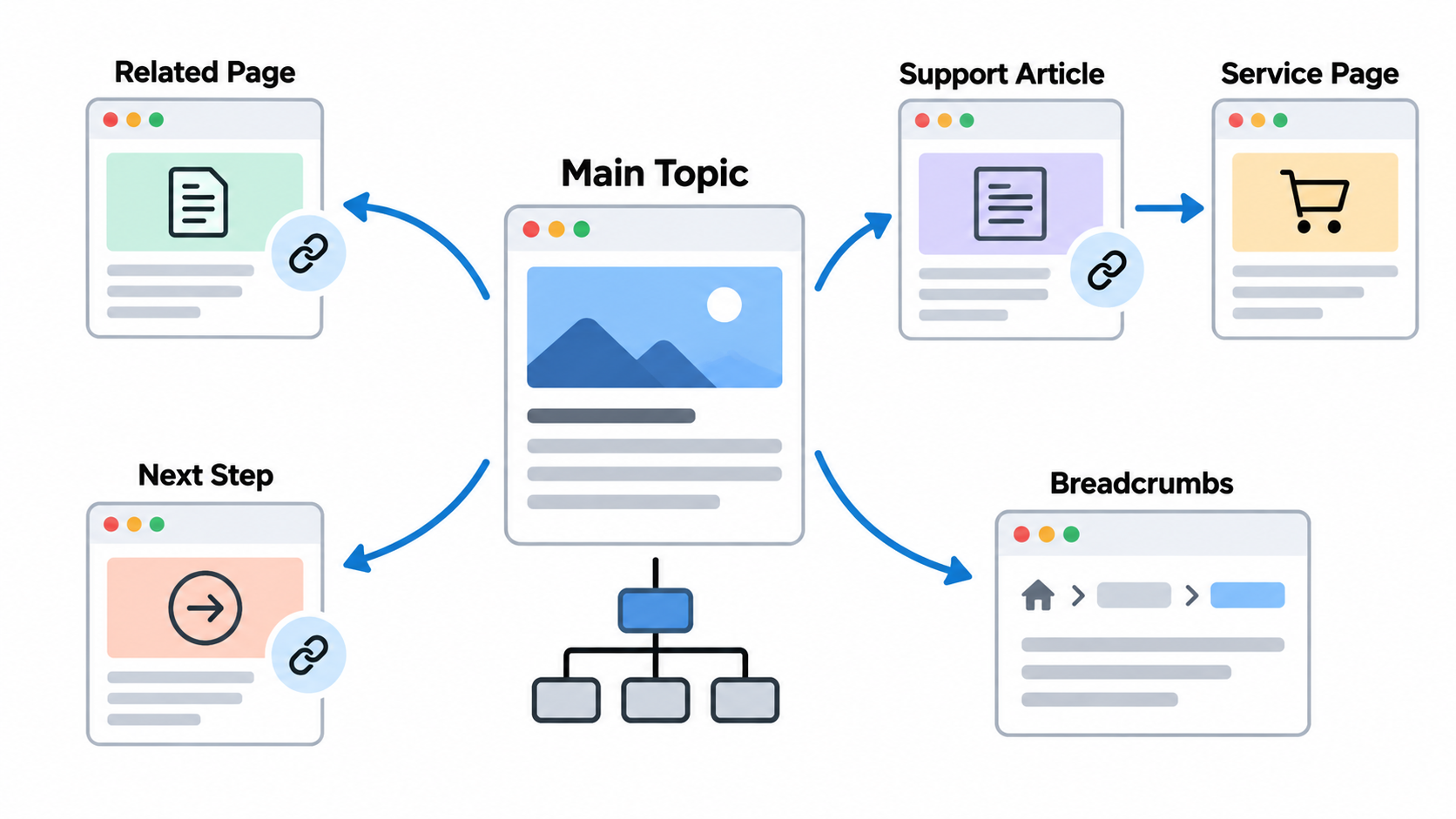
Internal links shape how users and search engines move through a website. A clear information structure can connect related ideas, show topic relationships, and make important pages easier to discover and understand.
- Connect Related Concepts: Link pages when one naturally expands on another
- Link Supporting Articles to Commercial Pages: When relevant, guide readers from educational content toward related services or products. The transition should feel useful rather than forced or overly promotional.
- Prevent Dead-End Content: Avoid pages that provide no clear next step. Add relevant links to supporting resources, related topics, commercial pages, or helpful navigation where appropriate.
- Create Logical Breadcrumb Paths: Use breadcrumbs that reflect the real site hierarchy and help visitors understand where the current page sits within the broader structure of the website.
Good internal linking should feel helpful rather than engineered. Each connection should make the website easier to explore while strengthening the relationship between important topics and pages.
Practical Note: Internal links should guide users toward the next useful step, not simply pass SEO value. Connect supporting articles, commercial pages, related concepts, and breadcrumbs so each page sits within a clear information journey.
Strategy #9 – Build Trust, Expertise, and Evidence
Users are more likely to trust information when they can see where it came from, who created it, and what supports important claims. Strong evidence also separates useful content from unsupported opinion.
- Cite Reliable Sources: Link to authoritative, relevant, and preferably primary sources when referring to research, standards, official guidance, statistics, or other information that readers may want to verify.
- Provide Transparent Business Information: Make contact information, company details, policies, service information, and relevant credentials easy to find so visitors can understand who stands behind the website.
- Demonstrate Real Results: Where appropriate, use case studies, outcomes, testimonials, or documented improvements to show how expertise has been applied rather than relying entirely on promotional claims.
- Maintain Editorial Standards: Establish processes for fact-checking, updates, sourcing, author review, and corrections. Consistent editorial quality helps keep content accurate as information and industry practices change.
Trust develops through visible evidence and consistency. Clear authorship, current sources, transparent business details, and genuine experience give readers stronger reasons to rely on the information provided.
Strategy #10 – Strengthen Authority beyond Your Website
Search visibility is influenced by more than what appears on your own pages. Relevant mentions, links, profiles, reviews, and expert recognition can strengthen how the brand is understood across the wider web.
- Build Relevant Third-Party Profiles: Maintain accurate profiles on respected industry platforms, directories, associations, and business networks that customers or professionals actually use when researching your type of organization.
- Increase Unlinked Brand Mentions: Useful coverage does not always include a backlink. Relevant brand mentions can still expand awareness and strengthen the brand’s association with important topics.
- Prioritize Relevance Over Link Quantity: Avoid measuring authority by link volume alone. A relevant mention from a respected industry source can provide stronger context than many unrelated placements.
Off-page authority should reflect genuine reputation, not artificial popularity. Aim to become known and referenced in the places your customers, industry professionals, and trusted publishers already use.
Strategy #11 – Optimize Images and Video alongside Text
Text is only one way people understand information. Relevant images and videos can make complicated ideas easier to explain, improve page usefulness, and support richer search experiences when they genuinely add value.
- Optimize Image Context: Place visuals near the information they explain and use surrounding text, captions, filenames, and page structure to make their purpose and relevance easier to understand.
- Write Useful Alt Text: Describe meaningful images clearly for accessibility while reflecting what the image actually shows. Avoid stuffing keywords or writing alt text for purely decorative elements unnecessarily.
- Provide Descriptive Video Information: Give videos accurate titles, supporting copy, captions, transcripts, or descriptions where useful so viewers and search systems can understand the subject more easily.
- Connect Multimedia to the Main Topic: Every important visual should support the purpose of the page. Avoid adding images or videos simply to make long content look more visually varied.
Multimedia should support understanding, not compete for attention. Strong image optimization, useful videos, and well-written text should work together around the same topic, making the page clearer, more engaging, and easier to use for different audiences.
Strategy #12 – Protect Page Experience and Conversion Performance
AI visibility only matters when visitors can comfortably use the website and take meaningful action. Strong page experience helps turn discovery into enquiries, sales, bookings, subscriptions, or other valuable business outcomes.
- Strengthen Navigation: Keep menus simple, descriptive, and logical. Users should be able to move between important categories, resources, services, and conversion pages without guessing where information is located.
- Improve Calls-to-Action: Make the next step clear and relevant to the page. Calls-to-action should explain what users can expect instead of relying only on generic wording.
- Reduce Form Friction: Ask only for information genuinely needed at that stage. Long or confusing forms can discourage qualified visitors from completing enquiries, sign-ups, or purchases.
- Optimize for Leads and Revenue, Not Visibility Alone: Measure whether search traffic produces valuable outcomes. High impressions or visits have limited business value when users rarely convert or engage meaningfully.
Search visibility should support business performance rather than exist as an isolated metric. A fast, clear, trustworthy website gives new visitors a better chance to become customers.
How SEO and AI Mode Work Together
Traditional SEO and AI search optimization solve different parts of the same discovery journey. Combining technical access, topic depth, answer clarity, authority, entities, and user experience creates a more complete search strategy.
- Topical SEO Builds Context: Connected coverage around meaningful subjects helps explain what the website knows and how individual pages relate to a wider area of expertise.
- AEO Improves Answerability: Clear definitions, direct responses, logical headings, supporting evidence, and well-structured explanations make important information easier for users and answer-driven systems to understand.
- GEO Extends Generative Visibility: Generative Engine Optimization considers how useful information, entities, authority, and original evidence may contribute to visibility across AI-powered search and discovery experiences.
The goal is not to run separate SEO, AEO, GEO, and entity campaigns without coordination. Each layer should reinforce the others and support one consistent search visibility strategy.
A 12-Step Google AI Mode SEO Framework
A practical framework helps businesses improve AI search readiness without abandoning work that already performs. The process should begin with technical access, protect existing value, and gradually strengthen content, authority, entities, and measurement.
- Step 1 – Audit Crawlability and Indexability: Check whether important pages can be accessed and indexed correctly. Review robots directives, sitemaps, canonicals, duplicate URLs, rendering, and current indexing problems.
- Step 2 – Protect Existing Organic Rankings: Identify pages already performing well before making major changes. Avoid unnecessary rewrites that could disrupt rankings, traffic, conversions, or important search intent alignment.
- Step 3 – Identify High-Value Topics: Prioritize subjects closely connected to business goals, customer needs, services, products, or expertise instead of creating content around topics with little practical relevance.
- Step 4 – Map Search Intent and Likely Follow-Up Questions: Understand what people want at each stage and identify the questions, comparisons, concerns, requirements, or objections likely to appear next.
- Step 5 – Build or Improve Topic Clusters: Organize related resources around central topics and strengthen gaps where useful supporting content can improve understanding without creating unnecessary duplication.
- Step 6 – Strengthen Important Pages: Improve high-value pages with clearer answers, better structure, stronger evidence, updated information, internal links, multimedia, and more useful coverage of genuine user needs.
- Step 7 – Add Original Information Gain: Include first-hand experience, original research, case studies, proprietary data, expert interpretation, or practical examples that provide information readers cannot easily find elsewhere.
- Step 8 – Improve Entity Signals: Clarify the relationships between the organization, services, experts, locations, products, and specialist topics through consistent website information and relevant third-party profiles.
- Step 9 – Validate Structured Data: Check supported markup for accuracy, errors, and consistency with visible content. Remove unsupported or unnecessary schema that does not genuinely represent the page.
- Step 10 – Strengthen Internal and External Authority: Improve internal linking while earning relevant backlinks, industry mentions, reviews, partnerships, citations, and professional recognition from credible external sources.
- Step 11 – Improve UX and Conversion Paths: Make important pages easy to navigate, read, trust, and act on through clear layouts, mobile usability, useful calls-to-action, and simpler forms.
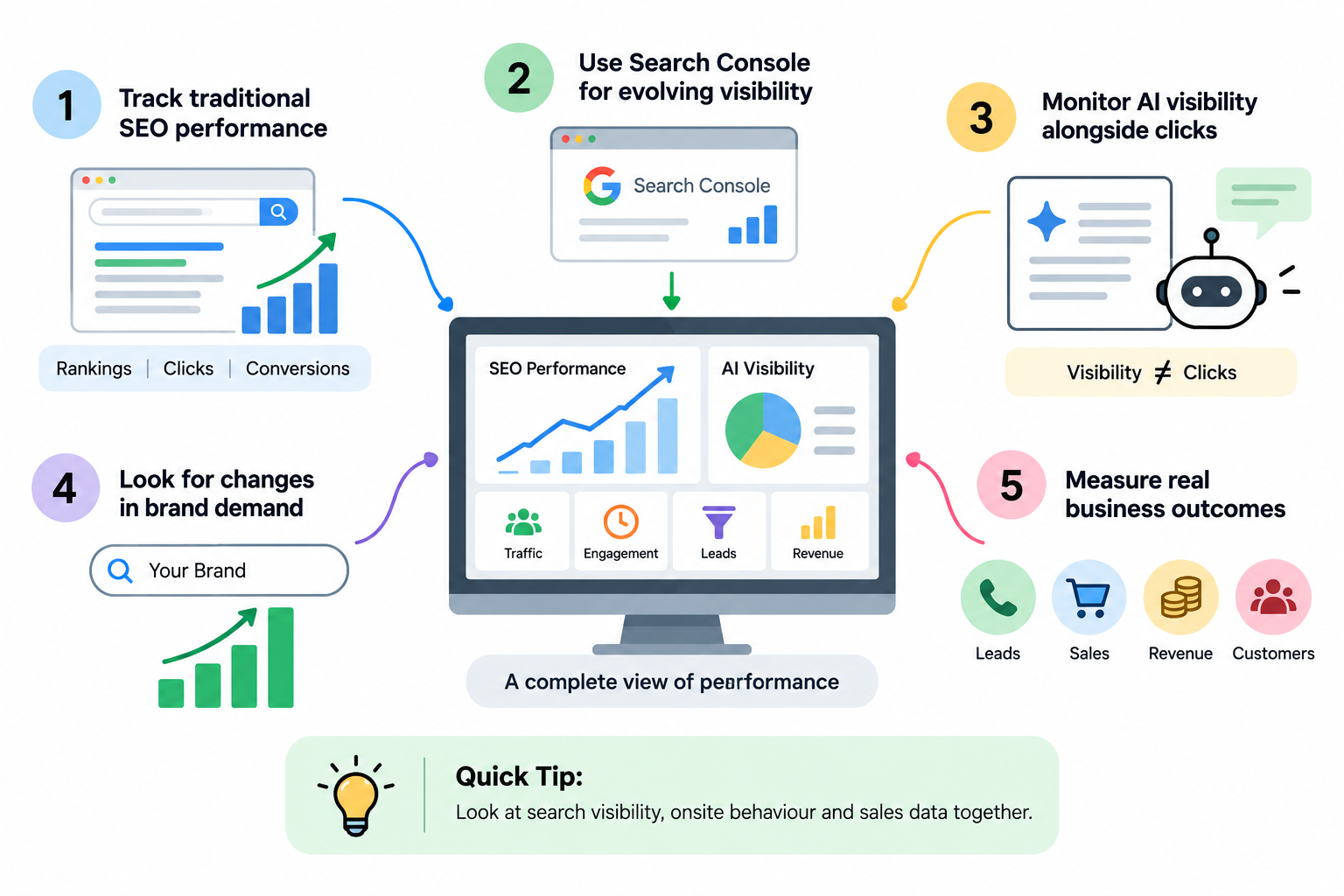
- Step 12 – Measure Traditional and AI Search Performance Together: Track organic rankings, clicks, impressions, AI visibility, brand demand, leads, assisted conversions, and revenue to understand the full impact.
The framework works best as a cycle rather than a one-time project. Review performance regularly, improve weak areas, protect what already works, and adapt as search behaviour continues to develop.
Common Google AI Mode Optimization Mistakes
AI search has created plenty of new advice, but not every tactic deserves attention. The biggest mistakes often happen when businesses chase visibility shortcuts instead of improving content quality, technical health, authority, and customer usefulness.
- Chasing Every GEO Hack: Avoid constantly rebuilding pages around unproven tactics. Test ideas carefully and prioritize improvements that genuinely make information clearer, more useful, or easier to discover.
- Overusing FAQs: FAQs are useful when they answer genuine customer questions. Adding dozens of repetitive questions solely for search coverage can make pages longer without making them better.
- Adding Unsupported Schema: Do not use structured data types simply because they appear related to AI. Unsupported or inaccurate markup can create unnecessary technical problems.
- Treating AI Citations as Guaranteed: No individual optimization tactic can guarantee that a particular page will be cited. Focus on improving the factors within your control instead.
- Ignoring Brand Authority: Strong content works better when it is connected to a recognizable and credible organization. Build reputation both on the website and across relevant external sources.
Successful AI optimization is usually less dramatic than it sounds. Improve useful content, website access, topic depth, authority, and user experience instead of constantly chasing new shortcuts.
How to Measure Google AI Mode SEO Performance
AI search adds new visibility signals, but businesses still need traditional metrics to understand whether search activity creates value. Measurement should combine discovery, traffic, brand growth, conversion behaviour, and real commercial results.
- AI Mentions and Citations: Monitor where the brand, website, or content appears within relevant AI-driven experiences, while remembering that appearances alone do not guarantee traffic or business value.
- Brand Search Growth: Watch whether more people begin searching directly for the company, products, experts, or services after broader search visibility and brand exposure increase.
- Branded vs Non-Branded Visibility: Compare searches involving the brand with broader discovery queries. This helps show whether SEO is supporting both brand demand and new audience reach.
- Referral Traffic: Review visits coming from relevant external websites or platforms to understand whether wider mentions, citations, partnerships, or coverage are introducing new users.
- Qualified Leads: Measure whether search visitors become meaningful prospects rather than focusing only on traffic volume. Lead quality provides stronger insight into commercial performance.
A useful dashboard should combine visibility with business performance. Rankings, citations, and impressions matter, but they become much more meaningful when connected to customer behaviour and revenue.
Conclusion
Google AI Mode changes the way people ask questions, compare options, explore topics, and discover websites, but it does not wipe out the foundations of SEO. Businesses should keep technical accessibility, useful content, search intent research, internal linking, authority, structured data, page experience, and conversion performance firmly in place. What changes is how those foundations are developed. Content needs clearer answers, stronger topic depth, better evidence, more original insight, and clearer entities. The goal is not SEO versus AI search. It is one connected strategy built around real people and the way Search is evolving.
Ready to Strengthen Your Search Visibility for AI Mode?
Improving visibility across traditional and AI-driven search starts with strong SEO foundations, useful content, clear authority, and a focus on real business results. eSign Web Services brings technical SEO, content strategy, AEO, GEO, entity optimization, and conversion improvements together to help businesses grow their search presence in a practical and measurable way.
Frequently Asked Questions
Question: What is Google AI Mode?
Answer: Google AI Mode is a more conversational Search experience designed to help users explore detailed questions, compare options, and continue with follow-up searches. It can bring together information from different sources while also giving users supporting links when they want to explore a topic in more detail.
Question: Does traditional SEO still work for Google AI Mode?
Answer: Yes. Core SEO factors like technical accessibility, valuable content, crawlability, indexing, internal links, page experience, authority and correct structured data remain important. The AI search should be seen as an additional layer on top of those foundations, not as a reason to replace them.
Question: How can I optimize my website for Google AI Mode?
Answer: Good technical SEO, and continue to optimize what’s working well. Then expand your topic coverage, clearly answer important questions, link to relevant pages, add original experience or evidence, strengthen brand and entity signals, and create content around real customer needs instead of trying to predict every AI-generated query.
Question: What is query fan-out in Google AI Mode?
Answer: Query fan-out is a method that allows a complex question to be explored by conducting several related searches. This allows Google to gather information around different parts of the topic. This makes strong topic coverage, useful supporting pages, clear entities and sensible internal linking even more valuable for website owners.
Question: Do I need special schema or an llms.txt file for Google AI Mode?
Answer: There’s no special AI Mode schema that websites need to install. The existing markup should reflect what is visible on the page. New AI-related files should not take precedence over technical SEO, crawlability, useful content, indexing, authority, and user experience.
Author Details

Ashwani Kumar Sharma
Ashwani has been actively involved in SEO services since 2005. His expertise and distinctive work approaches have made him one of the most experienced and trusted SEO experts in the industry. He is a certified SEO and Google Ads professional. He also has strong business development skills in advanced SEO, PPC, and digital marketing strategies.


