



Google Finishes Rolling Out the August 2026 Spam Update

Key Takeaways:
- Google has completed the August 2026 spam update after a rollout of about 2 days and 16 hours.
- The update started on August 18, 2026, and was completed on August 21.
- It was released worldwide and applied to searches in all languages.
- Google did not announce any new spam rule with this update.
- Website owners can now review ranking and traffic changes more clearly.
- Sites that were affected may need time to recover, even after fixing possible issues.
Google has now completed its August 2026 spam update. The Google Spam Update 2026 started on August 18 and wrapped up on August 21, giving website owners a better chance to look back at their rankings and traffic and see whether anything changed during the rollout. Spam updates are part of Google’s ongoing effort to keep low-quality and manipulative pages out of search results. In simple terms, Google wants to make it harder for websites to gain rankings through shortcuts rather than useful content.
Google has not said that this update was aimed at one specific type of spam. It also did not introduce a new spam policy. For businesses and SEO teams, the sensible next step is to review any noticeable changes and check whether important pages still meet Google’s existing quality and spam guidelines.
Google’s official spam policies explain the practices that can affect a website’s visibility in Search, including attempts to manipulate rankings or generative AI results.
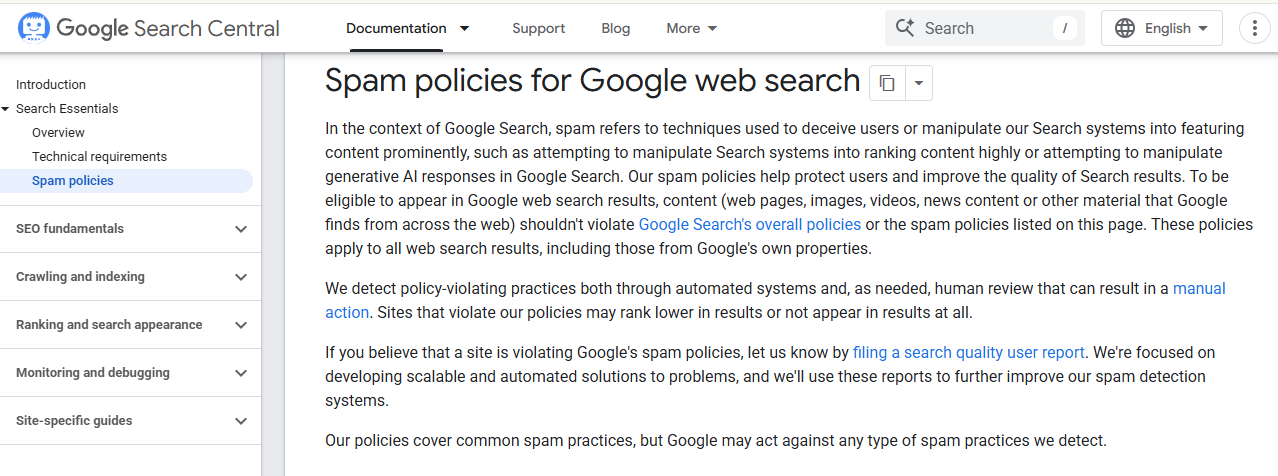
Image Source: Google Search Central
What Should Websites Review Afterward?
Google confirmed that the August update took around 2 days and 16 hours to finish. It came after earlier spam updates in March and June, making it another major spam-related change during 2026.
The Google Spam Update 2026 was rolled out globally and across all languages. So, its effects were not limited to one country, industry, or type of website.
The fact that the rollout is now complete is useful because rankings can move around quite a bit while an update is still running. A page might drop for a day, recover slightly, and move again before things settle. Website owners can check the Google Search Status Dashboard to see when official search updates start and finish. Once Google marks an update as complete, it becomes easier to look at the data without reacting to every small daily movement. Google also did not point to one particular spam tactic during this rollout. So, it would be a mistake to assume that every traffic drop is linked to the same issue.
Why Does This Rollout Matter Now?
Now that the update is over, businesses can take a closer look at whether the Google Spam Update 2026 had any noticeable impact on their search visibility. The best way to do this is by looking at patterns rather than one or two keyword changes. A single ranking drop does not always mean something is wrong with the website.
Website owners should check:
- Organic clicks and impressions in Search Console
- Pages that saw a clear rise or fall in traffic
- Important keywords that moved significantly
- Website sections that lost more visibility than others
- Changes that appeared after August 21
- Any practices that may go against Google’s guidelines
It is also worth remembering that traffic can fall for plenty of other reasons. Competitors may have improved their pages, demand may have changed, technical issues may be affecting the site, or some topics may simply be getting fewer searches.
If several important pages dropped at the same time, though, it is worth taking a proper look at them before making large changes across the whole website.
What Does This Mean for Search?
If a website lost rankings or traffic, the first thing to do is review Google’s existing spam guidance. The Google Spam Update 2026 did not come with a new recovery process, so there is no special checklist that applies only to this update.
The Google Search spam policies cover practices such as link spam, cloaking, scaled content abuse, scraped content, doorway pages, hacked content, and site reputation abuse.
A website review should look at areas like the following:
- Repetitive pages that offer very little new information
- Content written mainly to rank for keywords
- Unnatural or poor-quality backlinks
- Third-party pages that do not fit the main website
- Copied or heavily rewritten content
- Pages that do not really help the reader
The main question is simple: does the page actually help someone, or was it mainly created to get traffic from Google? That does not mean every page needs to be long or detailed. Sometimes a short page can be useful if it answers the question properly. What matters more is whether the content feels relevant, clear, original, and genuinely helpful.
Even after fixing problems, a site may not recover straight away. Google’s systems can take time to notice changes and reassess how a website should perform in search.
Google Search Central announces the August 2026 spam update, confirming that the rollout applies across all languages and locations.
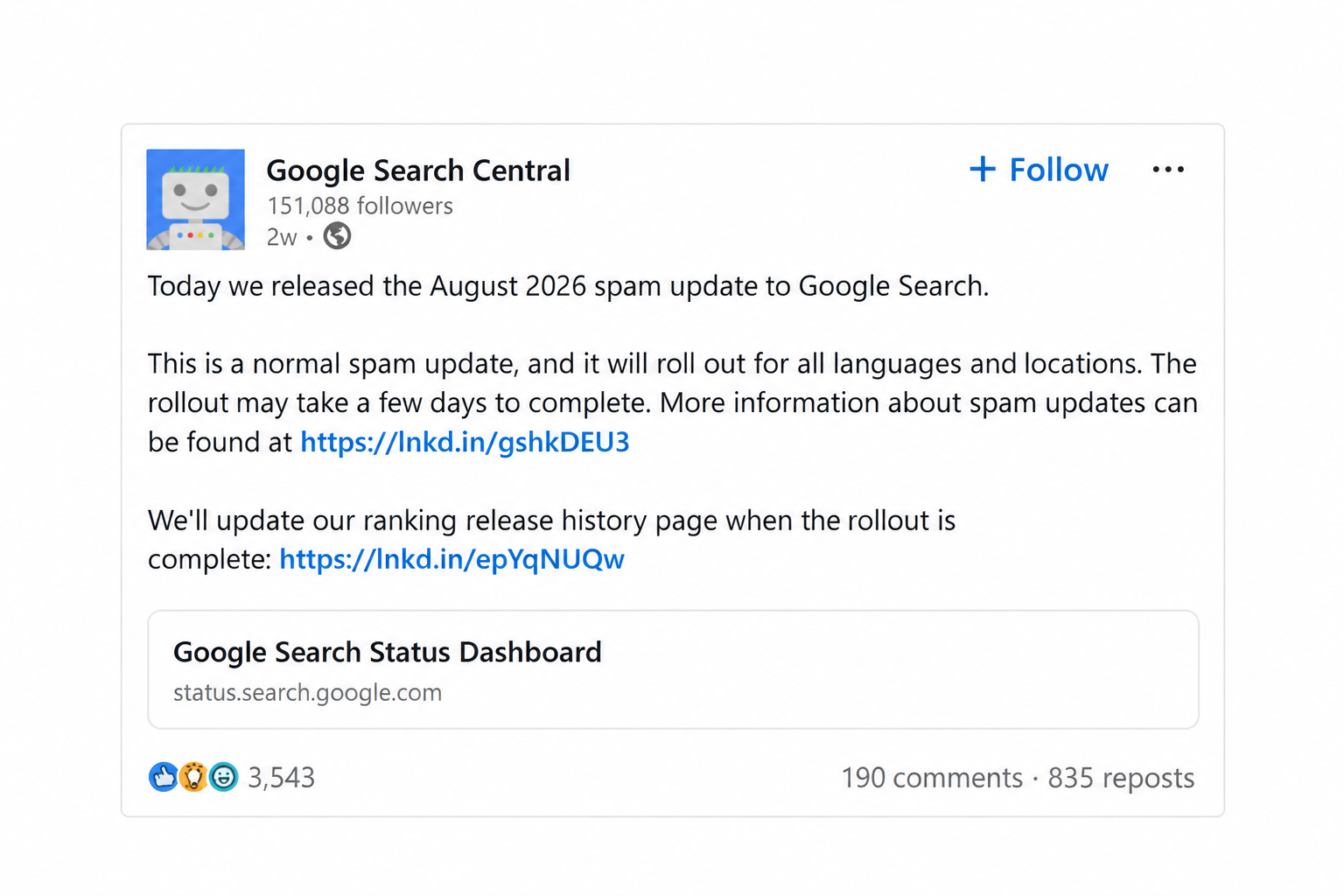
Image Source: Google Search Central via LinkedIn
What Does This Mean for Google Search?
This update makes one thing pretty clear: Google wants to show people pages that are actually useful. For businesses, that means SEO cannot be treated as a checklist of keywords, backlinks, and new pages. Those things still have a place, but they will not help much if the content feels thin, repetitive, or written only to rank. A page needs to answer the reader’s question properly, feel trustworthy, and give people a reason to stay on the site.
As Google adds more AI features to search, the quality of the content becomes even more important. Businesses should make sure their pages are still useful, accurate, and easy to follow. It also helps to revisit older content from time to time and see whether it still gives readers what they need. Some pages may only need a few small changes, while others may need better information or a clearer purpose. And when Google rolls out an update, there is usually no need to make sudden changes straight away. Keeping the website useful and improving it bit by bit is usually a much better approach.
Conclusion
The Google Spam Update 2026 has now finished rolling out, so website owners can take a clearer look at how their rankings and traffic changed during August. Since Google has not pointed to one specific spam tactic, there is no need to make quick changes based on guesswork. It makes more sense to check Search Console, review the pages that saw the biggest changes, and make sure the site still follows Google’s guidelines. Keeping the content useful, the SEO approach clean, and the website updated regularly is still the best way to move forward.
Overall, the best response is to focus on long-term website quality rather than short-term fixes. Regular monitoring, helpful content, accurate information, and responsible SEO practices can help maintain stronger and more stable search visibility. Website owners should also keep reviewing technical issues, outdated pages, and overall user experience as search systems continue to evolve. A steady, quality-focused approach is more useful than reacting to every ranking fluctuation.
Need Help Reviewing Your SEO Performance?
If your rankings or traffic changed after Google’s latest update, eSign Web Services can help you take a closer look at what may have happened. From reviewing weaker pages to spotting possible SEO issues, the team can help you make practical improvements and build a stronger search strategy for steady growth over time.
Author Details

Ashwani Kumar Sharma
Ashwani has been actively involved in SEO services since 2005. His expertise and distinctive work approaches have made him one of the most experienced and trusted SEO experts in the industry. He is a certified SEO and Google Ads professional. He also has strong business development skills in advanced SEO, PPC, and digital marketing strategies.


