



Wikipedia Bans AI Content: Human Editors Take the Lead in Protecting Trust

Wikipedia has long been regarded as one of the internet’s most trusted sources of information, thanks to its global network of volunteer editors rather than automated systems. As generative AI becomes more common, the English-language Wikipedia has introduced a policy banning editors from using AI tools like ChatGPT, Gemini, Claude, and other large language models to write or substantially rewrite encyclopedia articles. Approved by an overwhelming 40-to-2 community vote, the decision aims to safeguard the platform’s standards for neutrality, accuracy, and reliable sourcing. While AI can generate fluent text quickly, it can also produce factual errors, fabricated citations, and misleading information. Wikipedia believes that protecting public trust requires human judgment, careful fact-checking, and editorial oversight, qualities that AI cannot consistently provide..
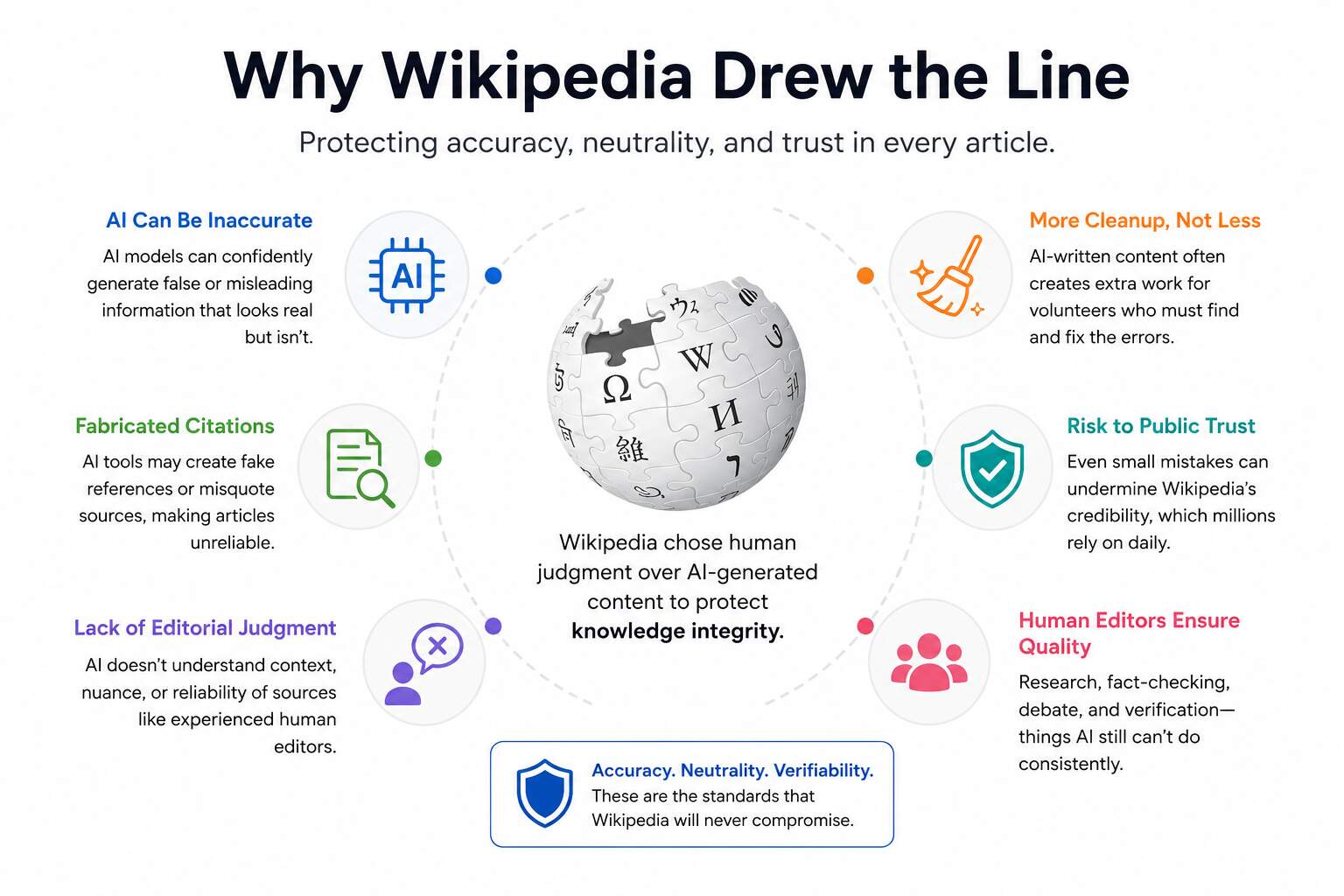
Why Wikipedia Drew the Line
Wikipedia has always operated under a simple principle: every claim should be supported by reliable, independent sources. Unlike many websites that publish content under a single editorial team, Wikipedia relies on thousands of volunteers who research, verify, debate, and continuously improve articles. This collaborative model has helped the encyclopedia maintain credibility for more than two decades.
According to the newly adopted policy, text generated by large language models frequently violates several of Wikipedia’s core content policies. AI systems are designed to predict language, not verify facts, which means they can confidently present incorrect information as if it were true. They may also generate references that do not exist or summarize sources inaccurately. Because of these risks, editors concluded that AI-generated article writing creates more work for volunteers, who must spend additional time identifying and correcting mistakes before information reaches readers.
AI Isn’t Completely Banned
While Wikipedia has prohibited AI from writing or rewriting encyclopedia articles, the platform has not eliminated AI from its workflow altogether. The updated policy includes two important exceptions. Editors are still allowed to use AI tools for basic copyediting tasks, such as correcting grammar or improving sentence structure, provided the software does not introduce new facts or change the intended meaning. Every suggested edit must still be carefully reviewed by a human before publication.
The second exception applies to translations. AI can assist editors in translating articles from one language edition of Wikipedia to another, but the translated content must undergo thorough human verification to ensure that it accurately reflects the original article. In both cases, editors remain fully responsible for everything they publish. AI may provide assistance, but it cannot replace editorial accountability.
Message for Publishers & Content Creators
Wikipedia’s decision comes at a time when businesses, publishers, and marketers are embracing AI to produce content faster than ever before. While artificial intelligence has become an excellent tool for brainstorming ideas, improving productivity, and streamlining workflows, the encyclopedia’s latest policy serves as an important reminder that speed should never come at the expense of accuracy.
Google has expressed a similar position regarding AI-generated content. The company has repeatedly stated that it does not rank content based on whether it was written by humans or AI. Instead, Google’s systems evaluate whether the content is original, helpful, accurate, and created for users rather than solely to manipulate search rankings. Low-quality or spammy AI-generated pages that lack value may still violate Google’s Search Spam Policies.
Businesses and marketers can review Google’s official guidance here:
The message from both Google and Wikipedia is remarkably consistent: AI can support content creation, but it cannot replace expertise, fact-checking, and responsible publishing.
Looking Ahead
Wikipedia’s updated policy is less about resisting technological progress and more about defining the appropriate role of artificial intelligence in knowledge creation. Rather than allowing AI to become the author of encyclopedia articles, the platform sees it as a productivity tool that can assist editors while leaving critical thinking, research, and verification to humans. That distinction could shape how many other educational platforms, publishers, and media organizations approach AI in the years ahead.
As generative AI continues to evolve, debates around accuracy, transparency, and trust are likely to become even more important. Wikipedia’s decision demonstrates that despite rapid advances in technology, human judgment remains essential for building reliable information. In an online world where anyone can generate thousands of words in seconds, credibility will increasingly depend not on how quickly content is produced, but on how carefully it is verified before it reaches readers.
Build Content People, and Search Engines—Can Trust
AI can accelerate your content workflow, but lasting rankings and credibility come from expert strategy, accurate information, and human editorial review. Contact eSign Web Services today to create SEO-focused, high-quality content that drives traffic, builds authority, and delivers measurable business growth.
Author Details

Ashwani Kumar Sharma
Ashwani has been actively involved in SEO services since 2005. His expertise and distinctive work approaches have made him one of the most experienced and trusted SEO experts in the industry. He is a certified SEO and Google Ads professional. He also has strong business development skills in advanced SEO, PPC, and digital marketing strategies.


