



Traffic without Leads: What’s Going Wrong in Your Marketing Funnel

Key Takeaways
- Traffic means little unless visitor intent, messaging, and conversion paths work together clearly.
- High sessions with weak lead flow usually signal funnel friction, not visibility failure.
- Wrong traffic sources can inflate reports while bringing visitors unlikely to become customers.
- Landing pages must prove value quickly before asking users to take action.
- Trust signals should be specific, recent, visible, and tied to measurable outcomes.
- Broken tracking creates misleading dashboards and pushes teams toward the wrong fixes.
- Nurturing systems recover warm visitors who are interested but not ready today.
Rising traffic numbers have a way of making everyone feel good. The monthly report trends upward, the dashboard looks healthy, and the team breathes a little easier; until someone checks the pipeline. When visitors aren’t turning into calls, bookings, quote requests, or real sales conversations, the problem isn’t visibility. It’s the funnel. This traffic but no leads pattern shows up far more often than most marketing teams want to admit. A digital marketing funnel that attracts attention but fails to convert it isn’t an asset; it’s an expensive illusion.
Think of a website like a busy showroom. People walk in, look around, nod politely, touch nothing, ask no questions, and quietly walk out. That’s not a footfall problem; that’s a persuasion problem. The funnel must align with visitor intent, explain value clearly, build trust quickly, remove friction at every step, and make the next action feel like the obvious move.
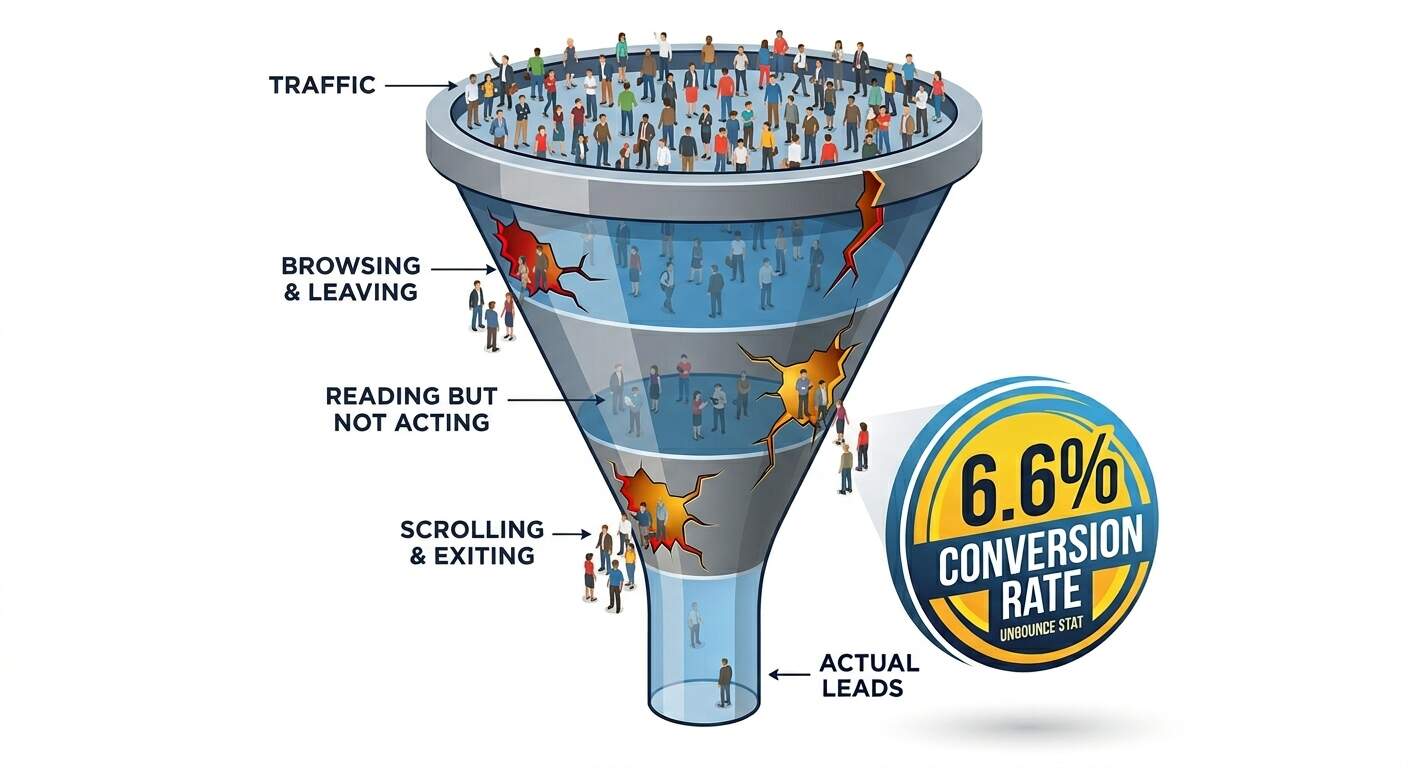
Unbounce’s Q4 2024 benchmark found the average landing page conversion rate sat at just 6.6% across industries; drawn from 41,000 landing pages, 464 million visitors, and 57 million conversions. That single number makes one thing clear: traffic only becomes valuable when the page knows how to turn attention into real action.
Traffic vs. Leads: Understanding the Gap
Traffic is applause. Leads are interest with intent, and that difference is exactly where money gets quietly wasted. A visitor can read the blog, admire the design, scroll through the service page top to bottom, and still have zero intention of making contact. Most marketing funnel issues start the moment teams treat every visit as equal. A student researching a topic, a competitor benchmarking pricing, and a ready buyer comparing vendors are three completely different people, and measuring them with the same level of excitement is where the trouble begins.
Here’s where traffic not converting starts to cost real money:
- Traffic numbers look strong, but decision-stage pages remain completely silent.
- Users consume content and read information but never move toward an actual inquiry.
- Campaigns attract clicks without drawing in any meaningful buyer intent.
- Content answers questions well but consistently fails to prompt real action.
- Sales teams see volume in the reports but rarely see genuine conversations in the pipeline.
This is why traffic but no leads can’t be solved by staring at page view reports. The right question is what the visitor needed at that exact moment, and whether the page delivered it fast enough. Informational users need education. Comparison users need proof. Transactional users need confidence, clarity, and a low-risk next step. When every page speaks to every visitor the same way, the funnel becomes flat, forgettable, and painfully easy to exit.
Stop asking, “How do we get more visitors?” Start asking, “What did these visitors need, and did this page give it to them fast enough?” That’s where real diagnosis begins.
Hidden Problem: Wrong Traffic Sources
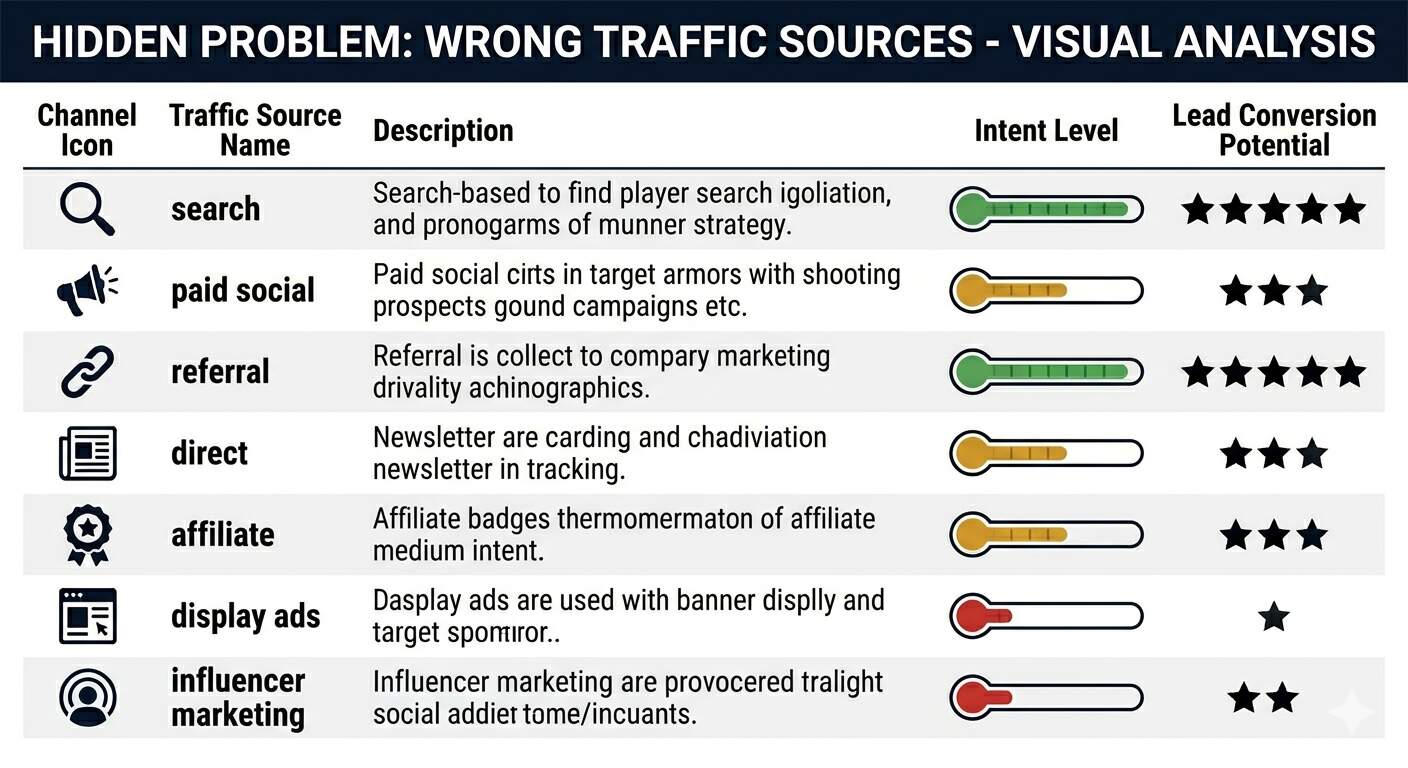
Wrong traffic is like hosting a product launch for people who only came for the free appetizers. The room looks packed, but the pipeline stays empty. This is where lead quality vs. traffic becomes a brutally important distinction. A paid campaign can pull in impressive clicks, sessions, and impressions while consistently attracting audiences who would never convert and the reports will still look healthy on the surface.
Funnel analysis must start at the traffic source before anyone rewrites a headline or redesigns a page. Watch for these red flags in the channel mix:
- Paid campaigns optimizing for cheap clicks instead of qualified, high-intent inquiries.
- Broad keywords pull in researchers instead of active, ready buyers.
- Social traffic that engages lightly but almost never follows through with serious action.
- Referral traffic arriving from irrelevant placements with no buying context or intent.
- Channels selected purely for reach rather than buyer readiness and actual intent level.
When traffic but no leads becomes a recurring pattern, inspect the source before blaming the funnel. Great landing pages can persuade genuinely interested visitors. They cannot manufacture buying intent from traffic that never had any.
Landing Page Conversion Issues
A landing page has exactly one job: make the next step feel worth taking. Not looking polished. Don’t say everything. Not list every service since the company launched. Real landing page conversion issues begin the moment a page asks visitors to act before giving them a compelling reason to care. The page is where attention either becomes action or quietly disappears, and most businesses don’t realize how much is being lost there every single day.
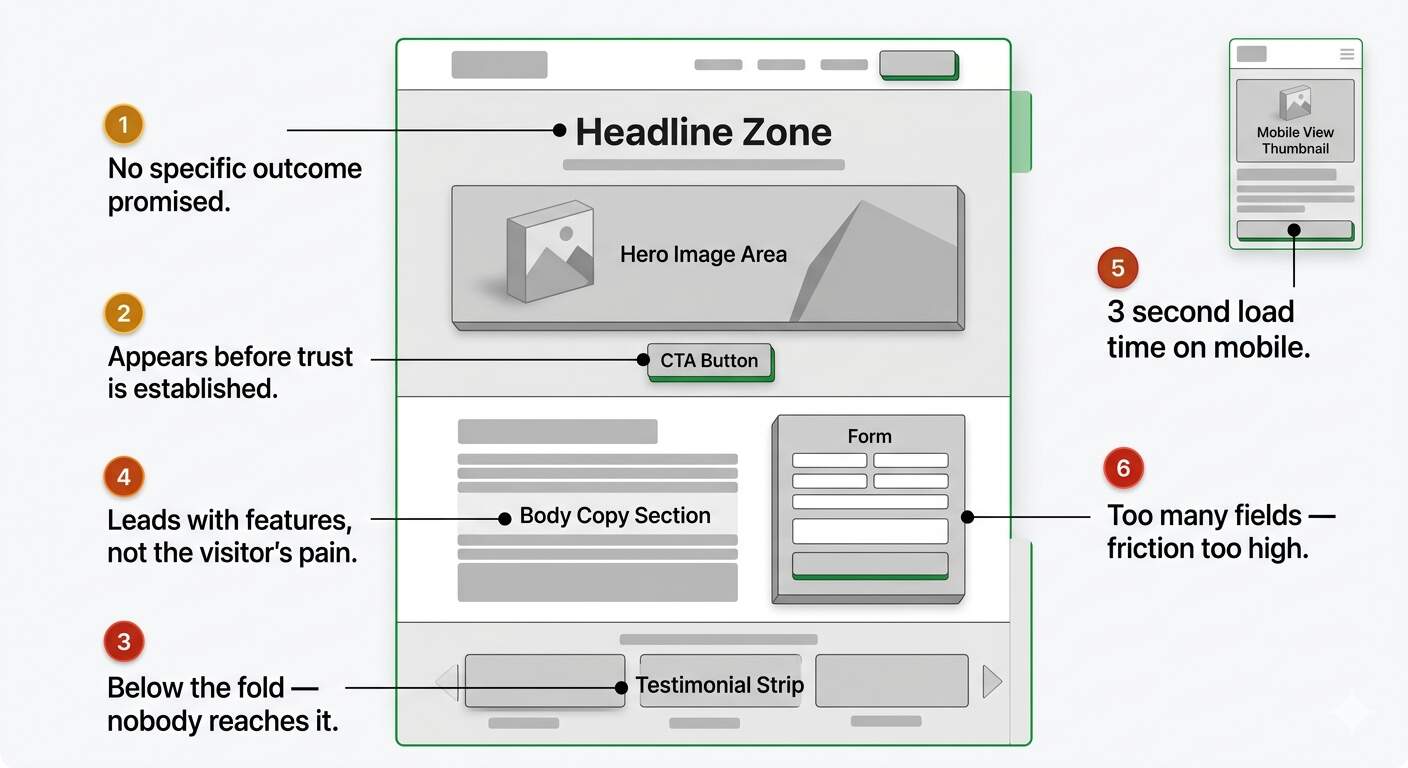
Here’s where pages typically lose people before the conversion ever happens:
- The headline sounds polished but fails to promise a specific, tangible outcome.
- The offer centers on the service rather than addressing the visitor’s actual, felt pain.
- The CTA appears too early, before any meaningful trust has been established.
- The layout forces visitors to actively hunt for the most important information.
- Mobile visitors face tiny text, frustrating forms, and pages that load at a crawl.
Page speed alone directly impacts how long visitors will wait. Google reports that 53% of mobile visits are abandoned when a page takes longer than three seconds to load. For any business trying to capture leads that mean potential customers could be leaving before the pitch even starts.
A strong conversion optimization strategy blends sharp messaging, fast performance, clean design, visible social proof, and UX optimization that remove every unnecessary friction point. When traffic but no leads keeps surfacing on high-intent pages, the answer isn’t to increase the ad budget; it’s to fix the experience that’s supposed to convert the click.
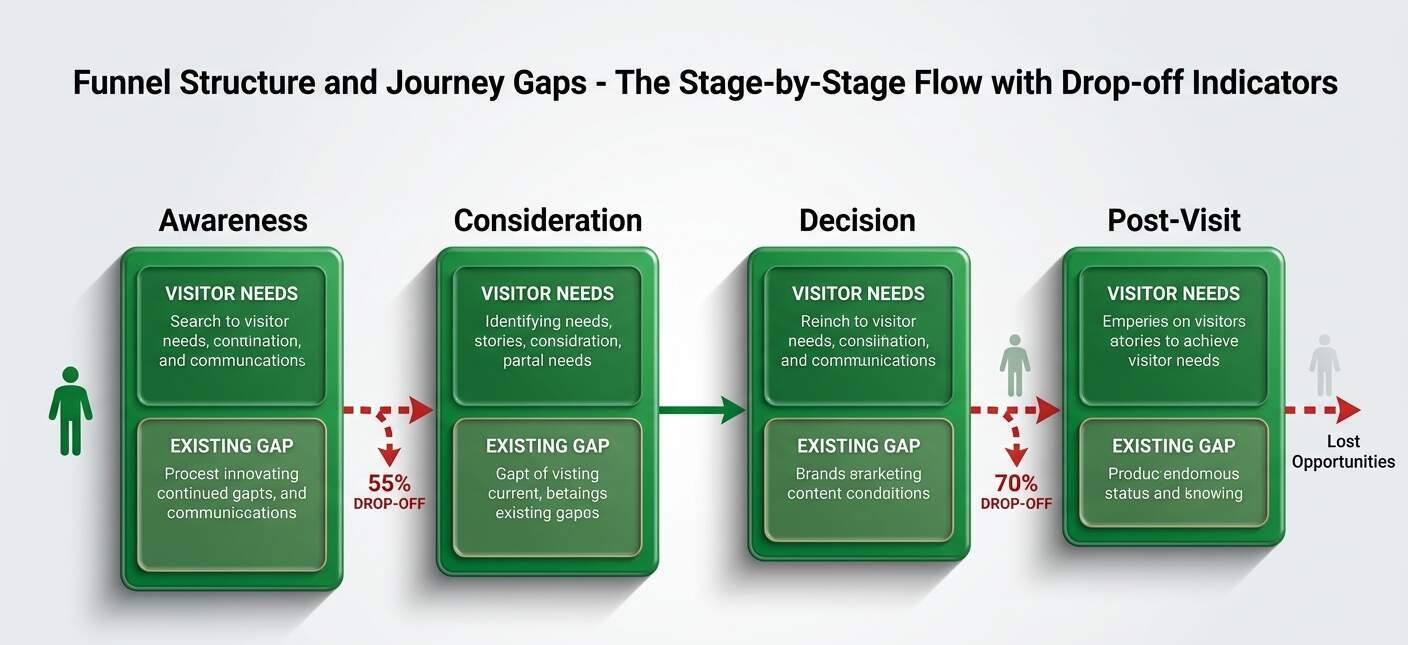
Funnel Structure and Journey Gaps
A strong funnel should feel like a guided path, not a maze with better branding. Many websites have decent individual pages but genuinely broken journeys. The blog educates but doesn’t guide. The service page explains but doesn’t reassure. The contact page asks, but doesn’t reduce hesitation. These user journey gaps quietly turn interested visitors into silent exits. Nobody files a complaint. They simply leave and never come back.
The journey usually breaks in predictable, fixable places:
- Awareness-stage content creates no clear path toward consideration-stage pages or resources.
- Service pages fail to connect the visitor’s problem, the proof of capability, and a clear next step.
- Follow-up after first contact is missing, significantly delayed, or frustratingly generic.
- Content promises one kind of experience while the actual offer delivers something different.
- Returning visitors see the same message instead of deeper, more specific evidence and proof.
The absence of a lead nurturing sequence is another silent drain that proper funnel analysis almost always surfaces. Not every visitor is ready to convert on the first visit, that’s completely normal. What isn’t normal is letting warm, interested visitors disappear with no remarketing, no email follow-up, no comparison content, and no softer next step on offer.
Baymard Institute’s research shows an average cart abandonment rate of 70.22%, meaning even high-intent users regularly stop before completing an action. Funnel drop-off points exist well beyond ecommerce; they appear anywhere users lose clarity, trust, or the motivation to continue forward.
| Funnel Stage | What Visitors Need | Common Gap Found | The Fix |
| Awareness | Education and helpful context | No pathway to the next stage | Add contextual CTAs linking to related content |
| Consideration | Proof, comparisons, and clarity | No case studies or testimonials | Add results-focused social proof and comparisons |
| Decision | Confidence and a clear next step | Vague CTAs and unclear expectations | Use low-risk CTA with a specific, clear outcome |
| Post-Visit | Follow-up and ongoing reassurance | No nurture sequence or retargeting | Build email sequences and remarketing audiences |
Trust and Credibility Issues
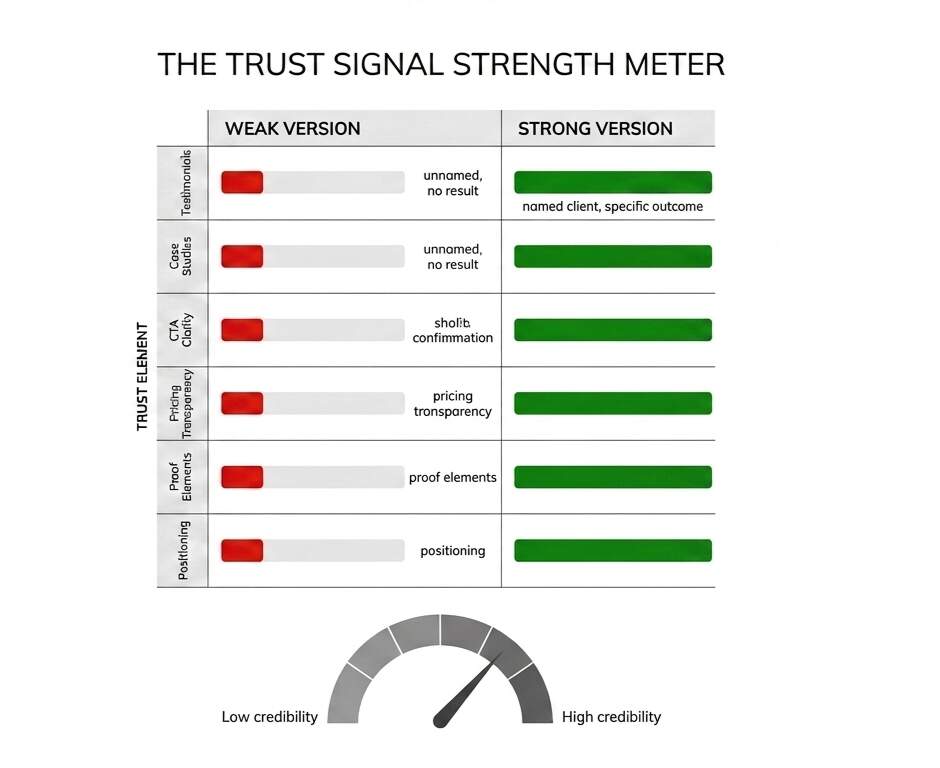
Visitors don’t become leads because a button says “Submit.” They become leads because the page gave them enough reason to believe the business is capable, safe, and genuinely worth contacting. Trust is the invisible bridge between interest and action. When that bridge feels unstable, visitors hesitate, and that hesitation is one of the most overlooked lead generation problems hiding inside underperforming funnels.
Trust usually breaks in small but consistently costly ways:
- Testimonials are missing, vague, outdated, or buried so far down the page that nobody sees them.
- Case studies describe the work completed but never mention the actual results achieved.
- Brand messaging sounds interchangeable with every competitor in the space.
- The process, pricing, or next steps feel unclear or hidden behind unnecessary friction.
- The site looks professionally built but doesn’t feel especially convincing or trustworthy.
Weak credibility quietly drags down the website conversion rate even when the traffic is genuinely relevant and well-targeted. Strong positioning answers three questions fast: who gets helped, what problem gets solved, and why this approach is genuinely different from every available alternative.
| Trust Element | What Strong Looks Like | What Weak Looks Like |
| Testimonials | Specific, named, result-focused and recent | Generic quotes with no names or outcomes |
| Case Studies | Before-and-after with measurable results | Feature descriptions, no measurable outcome |
| Call-to-Action | Low-risk, explains clearly what happens next | ‘Submit’ or ‘Contact Us’ with no context |
| Pricing | Clear or explained in transparent tiers | Hidden behind a form or ‘Call for pricing’ |
| Proof Elements | Logos, awards, certifications above the fold | No visible credibility markers on the page |
| Positioning | Clearly answers who, what, and why different | Sounds identical to every competitor online |
Tracking and Data Blind Spots
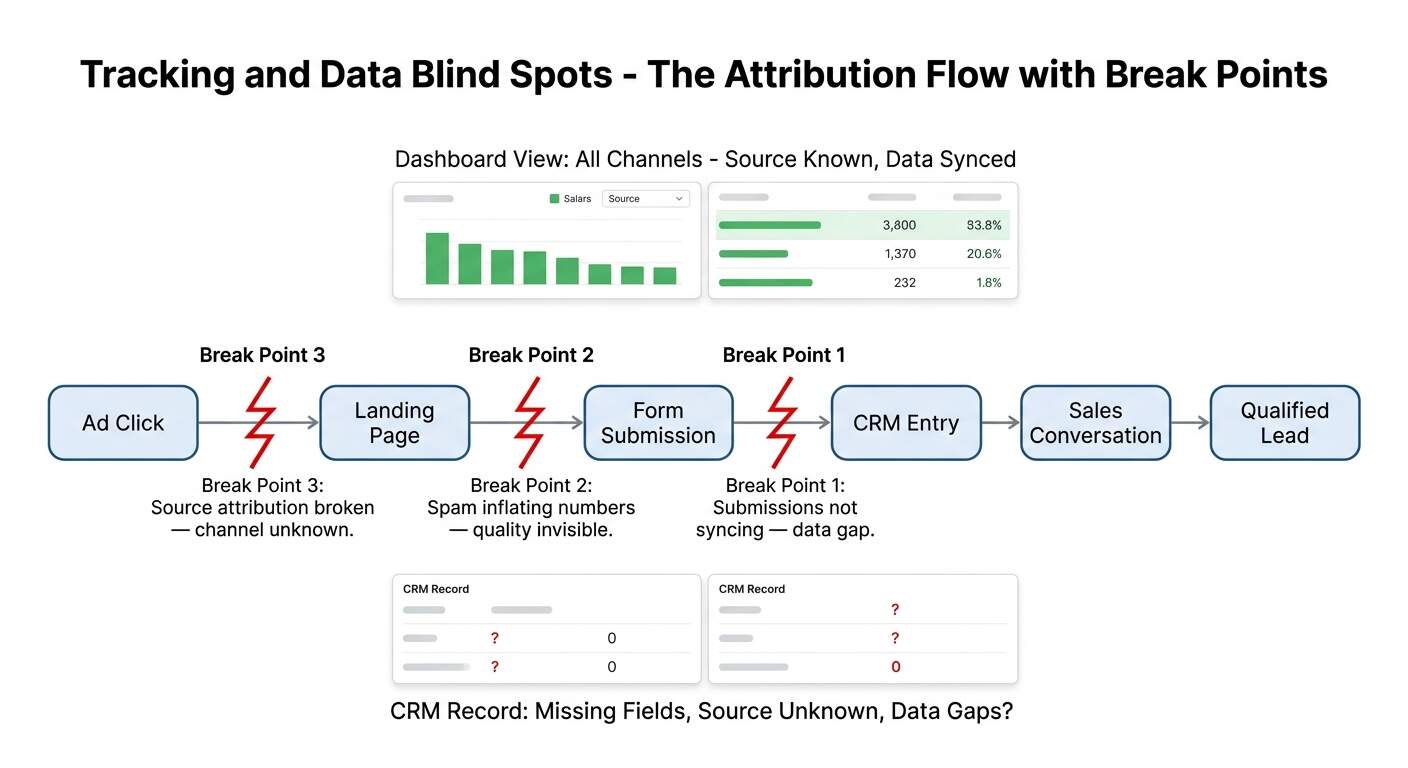
Bad data doesn’t look dangerous; it looks official. A beautifully organized dashboard can be completely and confidently wrong. These conversion tracking issues lead teams to fix the wrong problems with impressive confidence.
Data blind spots tend to follow predictable patterns:
- Form submission events fire in analytics, but the CRM records tell a completely different story.
- Phone click-throughs are counted as conversions, but call quality is never actually evaluated.
- Spam and low-quality submissions inflate campaign performance numbers significantly.
- Source attribution breaks somewhere between the analytics platform and the sales CRM.
- Teams measure form fills without ever measuring whether those submissions were qualified leads.
This is where CRO optimization goes well beyond testing button colors or swapping headline copy. It requires clean tracking infrastructure, accurate source attribution, real CRM alignment, and an honest lead-quality review process conducted on a regular schedule. Without that foundation, every decision is made on dashboards that look compelling but aren’t actually telling the truth.
Conclusion: Fix the Funnel, Not Just Traffic
Traffic but no leads is a warning light, and it is not a traffic problem. It signals that something in the journey is consistently failing to convert attention into action. The answer is rarely more visitors, more ad spend, more content, or a bigger monthly budget.
The strongest funnels align intent, message, offer, experience, proof, tracking, and follow-up at every stage of the journey. That is the actual work of sales funnel optimization, and it’s where the biggest gains are almost always hiding.
If marketing funnel issues keep appearing in the reports, treat them as conversion problems; not visibility problems. Sharpen the offer. Reduce friction at every step. Strengthen the proof. Track the actions that actually matter.
Your Funnel Has the Traffic. Now Let’s Make It Work.
If marketing is generating traffic but not leads, the gap isn’t reached; it’s the experience waiting on the other side of every click. Connect with eSign Web Services to pinpoint exactly where your funnel is leaking and build a conversion strategy that turns real visitors into qualified business opportunities.
Frequently Asked Questions (FAQs)
Question: Why do websites get traffic but fail to generate leads?
Answer: Websites often get traffic but fail to generate leads because visitors are not aligned with the intended audience or intent. Traffic may come from informational queries rather than transactional ones. Poor messaging, weak value propositions, or unclear calls-to-action also reduce conversions. Users may not find what they expected. Additionally, trust signals such as testimonials or credibility indicators may be missing. Technical issues like slow loading can also impact results. Businesses should analyze traffic quality, user behavior, and funnel performance. Identifying these gaps helps improve conversion rates and ensures traffic leads to meaningful business outcomes.
Question: How can businesses identify where users drop off in the funnel?
Answer: Businesses can identify drop-off points by analyzing user behavior using analytics tools. Funnel visualization reports show where users exit the journey. Heatmaps and session recordings provide insights into user interactions. High bounce rates or low engagement indicate issues. Monitoring conversion paths helps understand behavior patterns. Comparing performance across pages highlights weak areas. Regular audits help identify problems early. Businesses should focus on data-driven analysis rather than assumptions. Understanding user behavior improves decision-making. Addressing drop-off points enhances conversion rates and overall funnel effectiveness.
Question: What role does user intent play in lead generation?
Answer: User intent plays a crucial role in determining whether traffic converts into leads. Visitors with informational intent may not be ready to take action, while transactional users are more likely to convert. Misalignment between intent and content reduces effectiveness. Understanding intent helps tailor messaging and offers. Businesses should create content for different stages of the funnel. Aligning campaigns with intent improves relevance and engagement. This leads to higher conversion rates. Focusing on intent ensures that traffic is more valuable and contributes to business growth.
Question: How important is landing page design for conversions?
Answer: Landing page design is critical for conversions because it directly influences user experience and decision-making. A clean, intuitive layout helps users understand the offer quickly. Clear messaging and strong visuals improve engagement. Poor design creates confusion and reduces trust. Elements such as headlines, images, and calls-to-action should be optimized. Mobile responsiveness is also essential. Fast loading speeds improve usability. A well-designed landing page guides users toward action. Businesses should focus on clarity, simplicity, and relevance. Effective design improves conversion rates and ensures better results from marketing efforts.
Question: Can poor targeting lead to low conversion rates?
Answer: Yes, poor targeting is one of the main reasons for low conversion rates. When ads or content reach the wrong audience, engagement remains low. Users may not be interested in the offer. This results in high traffic but low conversions. Accurate targeting ensures that campaigns reach users who are more likely to take action. Understanding demographics, behavior, and intent improves targeting. Businesses should refine audience segments continuously. Better targeting improves engagement and conversion rates. It also ensures efficient use of marketing budget and resources.
Question: What are the most common funnel mistakes businesses make?
Answer: Common funnel mistakes include unclear messaging, weak calls-to-action, and poor user experience. Many businesses focus on traffic rather than conversions. Lack of alignment between content and offers creates confusion. Ignoring user intent reduces effectiveness. Inconsistent follow-up and lack of nurturing also impact results. Poor tracking prevents proper analysis. Businesses may fail to test and optimize regularly. These mistakes reduce conversion rates. Addressing them requires a structured approach and continuous improvement. Fixing these issues helps improve funnel performance and lead generation.
Question: How can businesses improve lead generation from existing traffic?
Answer: Improving lead generation involves optimizing the conversion process. Enhancing landing page design improves user experience. Clear messaging and strong value propositions increase engagement. Adding trust signals builds credibility. Testing different calls-to-action helps identify effective strategies. Personalization improves relevance. Retargeting helps capture missed opportunities. Monitoring user behavior provides insights. Continuous optimization improves performance. Businesses should focus on improving conversion rates rather than increasing traffic. This ensures better results and higher return on investment from existing visitors.
Question: What role does trust play in converting visitors into leads?
Answer: Trust is essential for converting visitors into leads. Users need confidence before sharing information or making decisions. Trust signals such as testimonials, reviews, and certifications improve credibility. Professional design and clear messaging also influence perception. Lack of trust reduces conversions. Transparency and consistency build confidence. Businesses should focus on creating a trustworthy environment. Strong brand reputation supports lead generation. Building trust improves engagement and encourages users to take action. It is a key factor in successful marketing funnels.
Question: How does page speed affect conversion rates?
Answer: Page speed has a direct impact on conversion rates. Slow-loading pages frustrate users and increase bounce rates. Visitors expect fast and seamless experiences. Delays reduce engagement and trust. Search engines also consider speed as a ranking factor. Optimizing performance improves user experience. Faster pages encourage users to stay longer and interact. Businesses should focus on improving load times. This enhances conversions and overall performance. Speed optimization is essential for effective digital marketing strategies.
Question: Why is continuous optimization important for funnel performance?
Answer: Continuous optimization ensures that marketing funnels remain effective over time. User behavior and market conditions change regularly. Without updates, performance may decline. Testing different strategies helps identify improvements. Data analysis provides insights into what works. Regular updates improve conversion rates and efficiency. Businesses should focus on ongoing optimization rather than one-time fixes. This approach ensures consistent growth. Continuous improvement helps maintain competitiveness. It also ensures better return on investment from marketing efforts.
Author Details

Ashwani Kumar Sharma
Ashwani has been actively involved in SEO services since 2005. His expertise and distinctive work approaches have made him one of the most experienced and trusted SEO experts in the industry. He is a certified SEO and Google Ads professional. He also has strong business development skills in advanced SEO, PPC, and digital marketing strategies.


