



What Ad Algorithms Learn From Engagement Signals

Key Takeaways
- Ad engagement signals determine which ads scale and which lose visibility over time
- Platforms rely on user interactions to refine targeting and improve ad delivery efficiency
- Clicks generate visibility, but deeper engagement signals drive meaningful campaign performance outcomes
- Conversion-focused signals help algorithms identify high-intent users and scale campaigns effectively
- Strong engagement improves ad relevance score, lowering costs and increasing placement competitiveness
- Poor engagement reduces reach, increases costs, and limits overall campaign growth potential
- Creative quality, targeting accuracy, and testing directly influence engagement consistency and results
- Algorithms continuously learn from behavior patterns, improving targeting precision with every interaction
- Sustainable performance comes from optimizing engagement signals, not just increasing advertising budget
Modern advertising has shifted. It’s no longer about who spends the most; it’s about who understands their audience better. Every click, scroll, and conversion feeds into a system that determines which ads get seen and which don’t. That system runs on ad engagement signals.
Brands that know how to improve ad performance don’t just increase their budgets. They feed the algorithm better data. Today’s platforms use machine learning ads to make real-time predictions about what to show, who to show it to, and when. These decisions occur continuously, driven almost entirely by user responses.
What’s changed is how fast and deep this feedback loop runs. Every interaction now shapes future paid media performance. The brands gaining ground aren’t simply running campaigns and hoping for results. They’re actively training the algorithm to favor them over time. Understanding how this works isn’t just useful for marketers; it’s essential. When you know what signals matter and why, you stop guessing and start making decisions that the algorithm actually rewards.
What Are Engagement Signals
Ad engagement signals tell platforms how your audience is responding in real time. A click, a pause, a scroll past; each one sends a clear message about whether your ad is relevant. Platforms read these signals continuously and use them to decide which ads deserve more reach.
But engagement goes much deeper than clicks. Platforms also analyze user behavior signals, like time on page, navigation patterns, and what users do after clicking. This layered data shapes both targeting accuracy and Google Ads performance signals, directly determining how well your campaigns compete for placement.
What Engagement Signals Reveal
- Clicks show curiosity, but don’t always confirm strong purchase intent
- Scroll depth tells you whether the content holds attention past the first moment
- Time spent reflects genuine interest and content relevance
- Conversions are the clearest indicator of meaningful campaign success
- Bounce behavior reveals gaps between your ad message and the landing experience
Together, these signals create a continuous feedback loop. The more consistently you generate quality engagement, the better algorithms get at identifying what works and scaling it efficiently.
Types of Engagement Signals That Matter
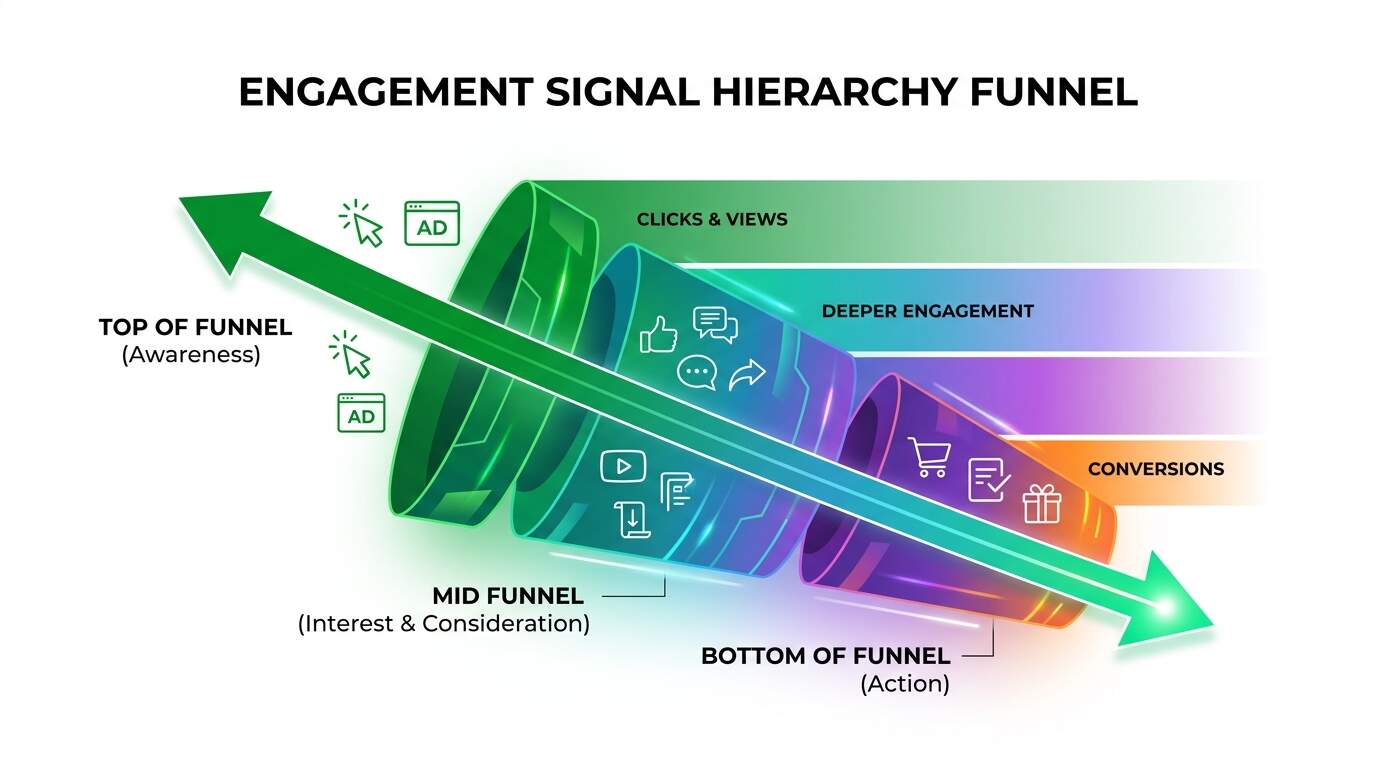
Not all engagement carries the same weight, and that’s exactly where smarter strategy begins. Strong PPC engagement metrics, such as clicks, build initial visibility. But it’s deeper actions, form submissions, purchases, and return visits that actually move performance forward.
Ad algorithm optimization depends on these richer signals to understand who’s genuinely interested and who isn’t. To consistently improve ad performance, you need both types working together. Google has confirmed that conversion-focused campaigns can improve ROI by up to 30%, which makes conversion signals ads central to any long-term growth strategy.
| Signal Type | What It Measures | Algorithm Impact | Cost Effect |
| Click | Initial interest | Medium — confirms ad relevance | Moderate CPC improvement |
| Scroll depth | Content attention | Medium — refines audience fit | Minor efficiency gain |
| Time on page | Content relevance | High — signals strong alignment | Reduces bounce-related penalty |
| Conversion | Purchase intent | Very high — enables campaign scaling | Significantly lowers CPA |
| Bounce | Poor ad-to-page fit | Negative — reduces delivery | Increases bid costs over time |
| Video view | Passive interest | Medium — effective for awareness | Improves CPV efficiency |
| Share / comment | Social engagement | High on Meta — extends organic reach | Reduces CPM over time |
Signals That Actually Drive Results
- Surface-level clicks improve visibility but don’t guarantee meaningful outcomes
- Deeper engagement sharpens audience targeting and improves quality scores
- Conversions give algorithms the clearest signal for efficient scaling
- Negative signals like high bounce rates quietly erode your reach and delivery
When campaigns consistently generate high-quality ad engagement signals, algorithms gain the confidence to expand delivery to similar audiences. That compounding effect is where real performance growth starts.
How Algorithms Use Engagement Data
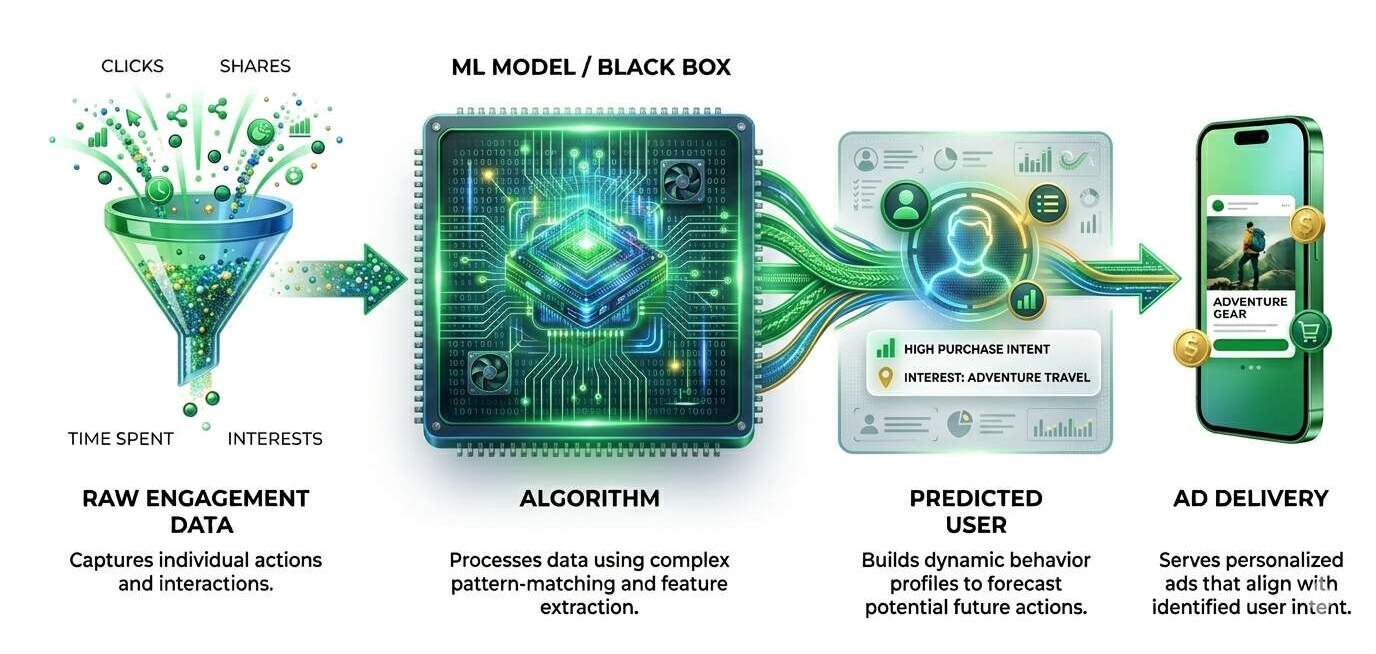
Here’s what’s happening under the hood: platforms collect campaign-optimization data from every interaction and build predictive models based on it. These models learn which users are most likely to click, convert, or return, and then prioritize showing your ads to more people like them.
Ad targeting signals are central to this process. The richer your engagement data, the more precisely the algorithm can match your ads to the right person at the right moment. Google has confirmed that expected CTR and ad relevance directly influence ad rank, meaning performance is shaped by audience response, not just budget.
How Algorithms Turn Data Into Results
- Engagement data surfaces the audience segments that consistently perform best
- Algorithms expand reach by identifying users with similar behavioral patterns
- Strong engagement improves ad rank and visibility without requiring higher bids
- Budget flows naturally toward ads that deliver consistent results
- The system keeps learning, compounding improvements across every campaign cycle
Google Ads performance signals are critical at every stage here. They shape where your ad appears, how often it’s shown, and what you pay for it. This is an ad algorithm optimization at work, a live feedback loop between what users do and how delivery decisions get made.
Why Engagement Signals Impact Costs
When ad costs fluctuate, engagement is usually the underlying cause. Ad engagement signals feed directly into your ad relevance score, which platforms use to calculate both your ad rank and your cost per click. Higher quality scores mean lower CPC and better placements. Google confirms this relationship directly. In practice, ads that earn strong engagement cost less to run and appear more competitively.
This dynamic is especially clear with Meta ads engagement signals, where comments, shares, and reactions shape delivery in real time. Ads with strong social interaction earn more reach at a lower cost. Ads that underperform require progressively higher bids just to maintain visibility.
How Engagement Controls Costs
- High engagement lowers CPC through stronger relevance and quality scoring
- Consistent interaction improves reach without requiring budget increases
- Low engagement forces higher bids to maintain baseline visibility
- Weak signals reduce delivery efficiency and create unnecessary wasted spend
- Better engagement compounds into a stronger ROI over time
The takeaway is straightforward: improving engagement quality is a more sustainable cost control strategy than simply spending more.
Factors That Influence Engagement Signals
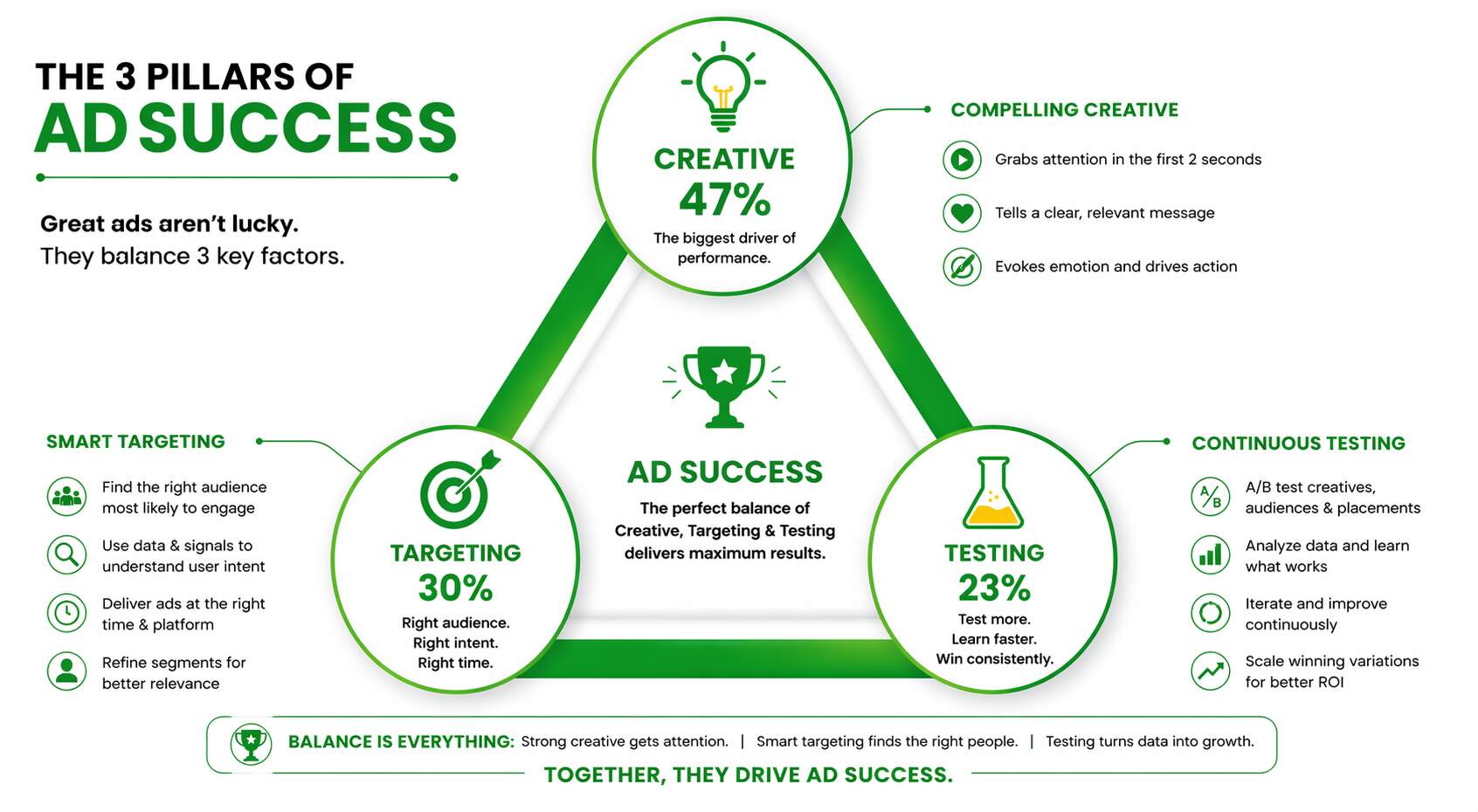
Strong ad engagement signals rarely happen by accident. Three factors consistently separate high-performing campaigns from average ones. Creative quality is the biggest lever. Nielsen research shows it contributes up to 47% of overall ad performance. Visuals and messaging that genuinely connect with your audience’s interests drive far higher interaction rates than generic creative does.
Targeting precision comes next; even strong creative falls flat when it reaches the wrong people. Tracking audience engagement metrics helps you understand whether you’re attracting users who are actually a good fit. Meta ads engagement signals are especially useful here; they help refine targeting based on real social behavior rather than relying solely on demographic assumptions. Ongoing testing is what sustains results over time. Microsoft Advertising found that emotionally resonant ads increase interaction rates by up to 23%. Regular A/B testing and creative refreshes are what prevent performance from plateauing.
What Drives Engagement Consistently
- Strong visuals capture attention quickly and encourage more interaction
- Clear messaging communicates value without requiring extra effort from viewers
- Precise targeting connects your ad with genuinely interested people
- Ongoing testing reveals which creative variations outperform the rest
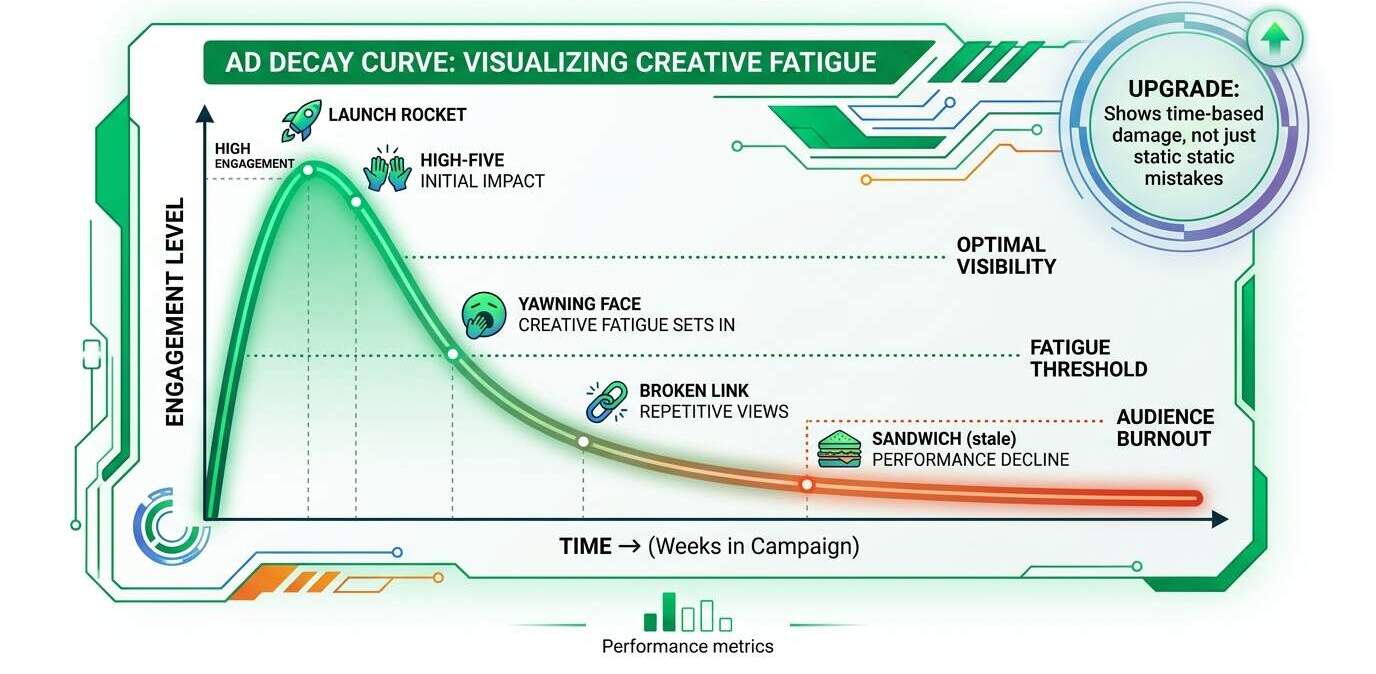
- Fresh creatives prevent audience fatigue and protect your long-term metrics
When creative quality, targeting precision, and testing discipline work together, engagement becomes more predictable, and your PPC optimization strategy becomes significantly more effective.
Common Mistakes That Reduce Engagement
Most engagement problems come from a short list of recurring mistakes. Catching them early saves both budget and time. Intent mismatch is the most common culprit. When an ad doesn’t meet user expectations, through misleading copy, poor landing page alignment, or the wrong offer for the audience, engagement drops fast. You’ll see it reflected in weaker Google Ads performance signals, where impressions hold steady but click and conversion rates quietly fall.
Creative fatigue follows closely. Even accurate targeting loses its edge when users see the same ad too many times. PPC engagement metrics decline predictably when the creative isn’t refreshed. Click-through rate optimization depends on keeping messaging fresh and relevant, not just keeping spend consistent. Overlooking negative signals is the silent budget drain. A poor ad-to-page experience shows up in bounce rates and low view-through rates long before it appears in your spending report. Campaigns that ignore these patterns keep spending without understanding why results are slipping.
Mistakes That Kill Performance
- Misaligned messaging fails to meet users where their expectations actually are
- Repetitive creatives reduce attention and interaction over time
- Broad or inaccurate targeting leads to wasted impressions and weaker ad engagement signals
- Skipping performance data turns optimization into guesswork
- No testing means stronger creative variations never get discovered
Addressing these issues early makes a measurable difference to both efficiency and scalability, especially in competitive markets where attention is hard to earn and easy to lose.
Wrapping it Up
Algorithms don’t guess; they learn. Every interaction your ads receive feeds a system that shapes future delivery, costs, and reach. Strong ad engagement signals give that system a clear, consistent direction. Campaigns that generate them reliably tend to see compounding gains across targeting accuracy, placement quality, and cost efficiency.
Budget still matters, but it’s no longer the deciding factor. The real edge comes from understanding how to improve ad performance in ways that connect directly to how the algorithm learns, and from building campaigns that earn the kind of engagement that compounds into better delivery over time. Treat engagement as a core input, not just a metric to track. When relevance, creative quality, and audience intent are properly aligned, campaigns don’t just perform better; they become easier to scale.
Turn Engagement Into Growth
If your campaigns aren’t delivering the results you expect, the issue is often engagement, not budget. Partner with eSign Web Services to build data-driven campaigns that turn engagement signals into scalable growth, stronger targeting, and measurable business outcomes. Request a quote today and take the first step toward better-performing campaigns.
Frequently Asked Questions (FAQS)
Question: What are engagement signals in digital advertising?
Answer: Engagement signals are user interactions that indicate how audiences respond to advertisements. These include clicks, likes, shares, comments, video views, and conversions. Advertising platforms use these signals to measure relevance and effectiveness. Strong engagement indicates that an ad resonates with users, while weak engagement suggests poor alignment. Algorithms analyze these signals to optimize targeting and delivery. Engagement signals also influence costs and visibility. Businesses that understand and improve these signals can achieve better campaign performance. Focusing on engagement helps ensure ads reach the right audience and generate meaningful results in competitive digital advertising environments.
Question: Why do ad algorithms rely on engagement signals?
Answer: Ad algorithms rely on engagement signals because they provide real-time feedback on user behavior. These signals help platforms understand which ads are relevant and useful. By analyzing interactions, algorithms can refine targeting and improve performance. Engagement data reduces guesswork and ensures ads are shown to interested users. This improves user experience and campaign efficiency. High engagement indicates strong relevance, while low engagement signals the need for adjustments. Algorithms use this data to continuously learn and optimize campaigns. Businesses that focus on improving engagement can benefit from better targeting, lower costs, and improved overall advertising results.
Question: How does click-through rate affect ad performance?
Answer: Click-through rate measures how often users click on an ad after seeing it. A high CTR indicates strong interest and relevance. Algorithms interpret this as a positive signal and prioritize such ads for better placement. This increases visibility and can reduce cost per click. Low CTR suggests poor alignment with the audience, leading to reduced reach. Improving CTR involves optimizing headlines, visuals, and targeting. Strong CTR helps campaigns perform efficiently and achieve better results. It also signals to platforms that the ad is engaging and valuable to users.
Question: What role do conversions play in algorithm learning?
Answer: Conversions represent meaningful actions taken by users, such as purchases or sign-ups. These signals are highly valuable because they indicate strong intent and success. Algorithms use conversion data to identify patterns and target similar users. High conversion rates improve campaign performance and efficiency. They also help optimize bidding strategies and budget allocation. Conversion tracking is essential for measuring effectiveness. Without it, algorithms cannot learn accurately. Businesses should focus on improving conversion rates to maximize return on investment. Strong conversion signals enhance targeting precision and ensure better long-term campaign performance.
Question: Can low engagement increase advertising costs?
Answer: Yes, low engagement can increase advertising costs significantly. When users do not interact with ads, algorithms consider them less relevant. This reduces visibility and increases cost per click or conversion. Platforms prioritize ads that generate strong engagement. Poor performance leads to inefficient budget use. Improving engagement helps reduce costs by increasing relevance and quality scores. Businesses should focus on optimizing creatives, targeting, and messaging. Higher engagement ensures better performance and cost efficiency. Monitoring engagement metrics helps identify issues early and allows timely optimization to improve campaign results.
Question: How do ad platforms use engagement data for targeting?
Answer: Ad platforms analyze engagement data to identify patterns in user behavior. This helps them understand which audiences are more likely to respond positively. Algorithms group users based on interactions and interests. This allows precise targeting and improves campaign effectiveness. Engagement data also helps refine audience segments over time. Continuous learning ensures ads reach relevant users. Businesses benefit from improved targeting accuracy and higher conversion rates. Using engagement insights helps optimize campaigns and achieve better results. Accurate targeting reduces wasted impressions and ensures efficient use of advertising budgets.
Question: What types of ads generate the highest engagement?
Answer: Ads that generate the highest engagement are visually appealing, relevant, and clear in messaging. Creative design, strong headlines, and compelling calls-to-action improve interaction rates. Personalized ads that match user interests perform better. Video content often generates higher engagement due to its interactive nature. Ads that provide value, such as offers or useful information, attract attention. Simplicity and clarity are key factors. Testing different formats helps identify what works best. High engagement ensures better performance and improves algorithm learning. Businesses should focus on creating high-quality, relevant ads to maximize results.
Question: How important is audience targeting for engagement?
Answer: Audience targeting is critical for achieving strong engagement. Even well-designed ads may fail if shown to the wrong audience. Accurate targeting ensures ads reach users who are more likely to be interested. This improves interaction rates and campaign performance. Targeting involves demographics, interests, behavior, and intent. Continuous optimization helps refine audience selection. Businesses should analyze data to improve targeting accuracy. Better targeting reduces wasted impressions and increases return on investment. Engagement improves when ads align with user needs and preferences. Effective targeting is essential for successful digital advertising campaigns.
Question: What are common mistakes that reduce ad engagement?
Answer: Common mistakes include poor targeting, weak creatives, and unclear messaging. Ads that do not align with user intent perform poorly. Overloading ads with information can reduce clarity. Ignoring data and not optimizing campaigns regularly also impacts performance. Lack of testing limits improvement opportunities. Businesses may focus too much on budget instead of quality. Outdated creatives reduce engagement over time. Avoiding these mistakes requires a structured approach and continuous monitoring. Improving design, messaging, and targeting enhances engagement and ensures better campaign results. Strong engagement leads to improved performance and lower costs.
Question: How can businesses improve engagement signals in campaigns?
Answer: Businesses can improve engagement by focusing on creative quality, targeting accuracy, and clear messaging. Testing different ad variations helps identify effective strategies. Using compelling visuals and strong calls-to-action increases interaction. Analyzing performance data allows optimization. Personalization improves relevance and engagement. Regular updates keep campaigns fresh and effective. Monitoring metrics helps identify areas for improvement. Combining data-driven insights with creativity ensures better results. Improving engagement signals enhances targeting, reduces costs, and increases return on investment. Consistent optimization is essential for long-term success in digital advertising campaigns.
Author Details

Ashwani Kumar Sharma
Ashwani has been actively involved in SEO services since 2005. His expertise and distinctive work approaches have made him one of the most experienced and trusted SEO experts in the industry. He is a certified SEO and Google Ads professional. He also has strong business development skills in advanced SEO, PPC, and digital marketing strategies.


