



AEO vs. SEO: What Businesses Should Know About Answer Engine Optimization

Key Takeaways:
- SEO earns discovery through rankings; answer engine optimization earns selection by being quoted as answers.
- AEO vs. SEO isn’t a replacement; it’s layering: rank as a destination, write as a reusable source.
- In answer-first search, the winning unit is the passage that is clear, self-contained, cite-safe, and specific.
- Structure drives performance: answer first, then criteria, proof, and deeper context for clickers.
- Consistent entities strengthen entity-based SEO and improve extraction accuracy across summaries and assistants.
- Measure beyond clicks: impressions, citations/mentions, brand lift, and assisted conversions show real influence.
- Fastest gains come from services, pricing, and comparisons optimized to optimize for AI answers.
Search has quietly changed the rules. It’s no longer just a race for the top blue link; it’s become what you might call a “quote economy”. The winner isn’t always the page with the best backlink profile. More often, it’s the brand that wrote the clearest sentence an AI system feels confident repeating. And that shift changes everything about how you should think about content.
Think about a homeowner who types: “How much does it cost to fix a leaking roof?” If the search results surface a clean price range, the top three factors that drive the cost, and a sensible next step, that person may never open a second tab. That’s where the conversation around AEO vs. SEO stops being theoretical. SEO gets you discovered. Answer-readiness gets you repeated.
Businesses that will lead in the next phase of search must do two things at once: write like strategists and package like editors. That means definitions near the top, criteria readers can scan in seconds, proof attached to every claim, and language consistent enough to survive being lifted out of context. This isn’t about replacing SEO, it’s about raising the standard for it. You still need authority, technical health, and topical coverage. But you also need “quotable clarity”: content that holds up in snippets, summaries, voice responses, and AI-generated answers. If your best insight is buried, it won’t be borrowed. If it’s crisp, credible, and current, it will travel, even on the days when your traffic dips.
What Is SEO vs. AEO and Why It Matters?
At its core, search visibility now has two jobs: earn attention and earn trust, fast. That’s the tension at the heart of AEO vs. SEO. Traditional SEO is how you win discoverability. Your page gets crawled, understood, and ranked based on relevance, authority, and technical quality. When it’s working well, you’re not just “showing up”, you’re positioned exactly where people are comparing options, weighing decisions, and looking for proof.
Answer engine optimization goes one layer deeper. It’s about what happens when an AI-driven interface decides which source it can safely quote as a direct answer. In that environment, the competition shifts from “who has the best overall page” to “who wrote the clearest, most extractable passage.” Your content needs to be easy to pull out, specific enough to stand on its own, and credible enough to cite without the system having to fill in gaps.
Here’s a practical way to see it: a startup founder searches, “best website platform for a local service business with a limited budget.” SEO helps your page appear as a candidate. Answer engine optimization increases the chance that your specific recommendation becomes the line the interface repeats, because you stated the answer early, explained the decision criteria (budget, flexibility, time to launch), and backed it with something verifiable.
Here’s a quick look at what each discipline actually optimizes for:
- SEO: rankings, indexability, topical depth, backlinks, engagement signals
- Answer engine optimization: direct answers, extractable structure, consistent entities, verification signals
Key Differences Between SEO and AEO
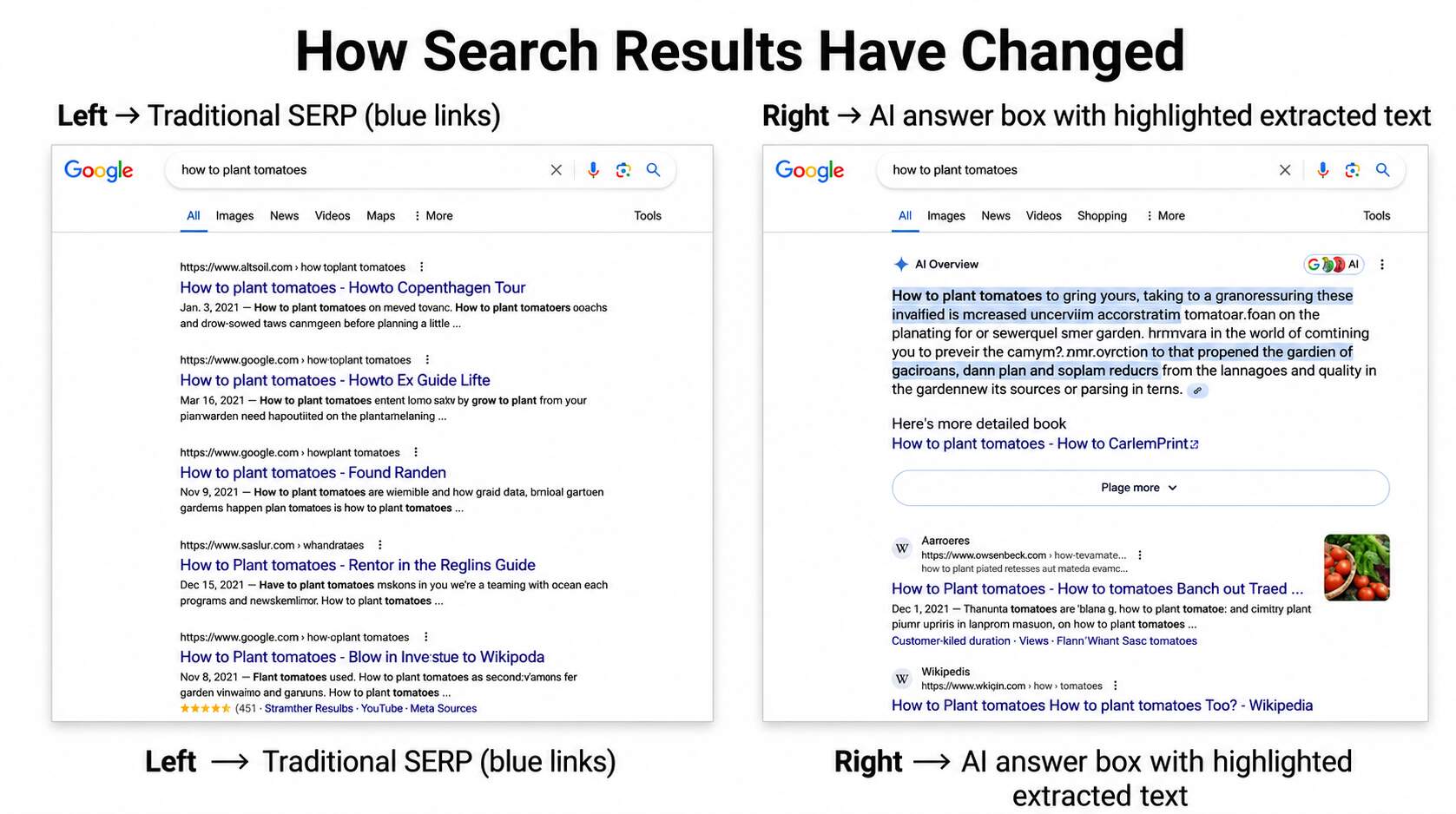
These aren’t small tweaks; the SEO vs. AEO differences genuinely change how you write, how you measure success, and how you win visibility. Think of it as the gap between shelf space and citation. One gets you placed; the other gets you quoted.
Key points worth understanding:
- Ranking vs. selection: SEO aims to be the best page overall. AEO aims to be the best answer right now. A single tight, well-supported paragraph can outperform a 3,000-word page with a buried takeaway.
- Keywords vs. intent clarity: SEO still treats keywords as ranking signals. But when it comes to AI search optimization, the game is about writing in a way that mirrors how real people ask questions, not just what they search for.
- Traffic vs. influence: SEO is built to earn clicks. AEO often earns visibility without the visit. That makes brand recall and assisted conversions increasingly important metrics, especially as zero-click search SEO becomes the norm on more query types.
- Page optimization vs. extraction: SEO improves speed, links, and content coverage. AEO improves scannability, definitions, and what you might call “quote-safety”, the ability for a passage to be lifted and still make sense.
Quick reference — use this when planning content:
| Dimension | SEO Focus | AEO Focus | What to Do |
| Primary goal | Rank in search results | Get selected as the answer | Lead with a direct 2–3 sentence answer |
| Unit that “wins” | Whole page | Extractable passage | Add 3–5 criteria bullets under the answer |
| Best content shape | Comprehensive depth | Clear, self-contained blocks | Use definitions, steps, and “best for” guidance |
| Success signals | Clicks + rankings | Mentions, citations + visibility | Track impressions + assisted conversion paths |
| Common failure | Thin or weak authority | Vague or unquotable wording | Replace fluff with specifics, ranges, constraints |
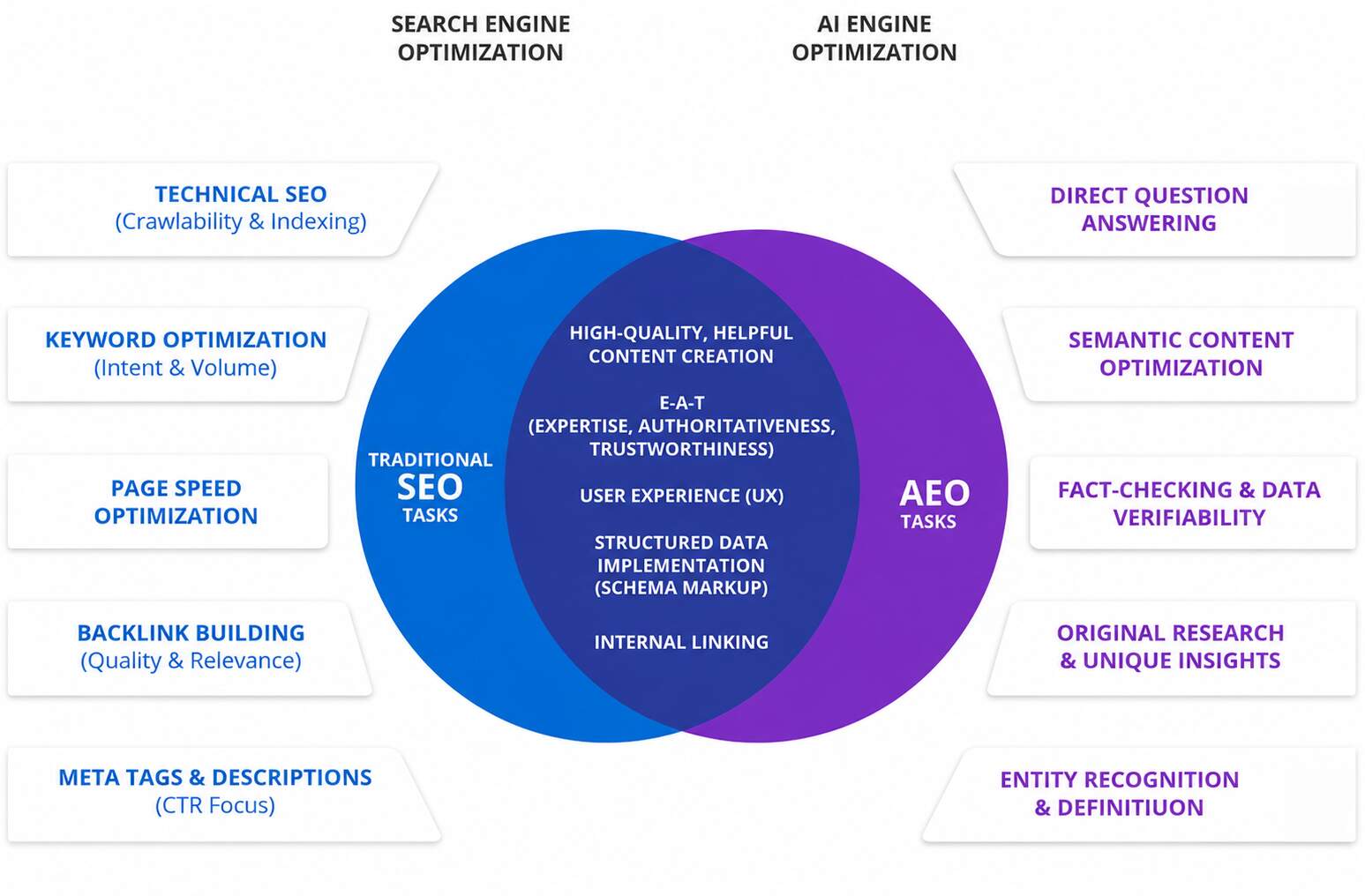
If you only chase rankings, you risk staying visible but missing the moment you’re actually quoted. If you only chase answers, you’re quotable but invisible to people still using traditional search. The play is to blend both: rank with depth, then earn reuse with clarity and proof.
How Answer Engines Evaluate Your Content
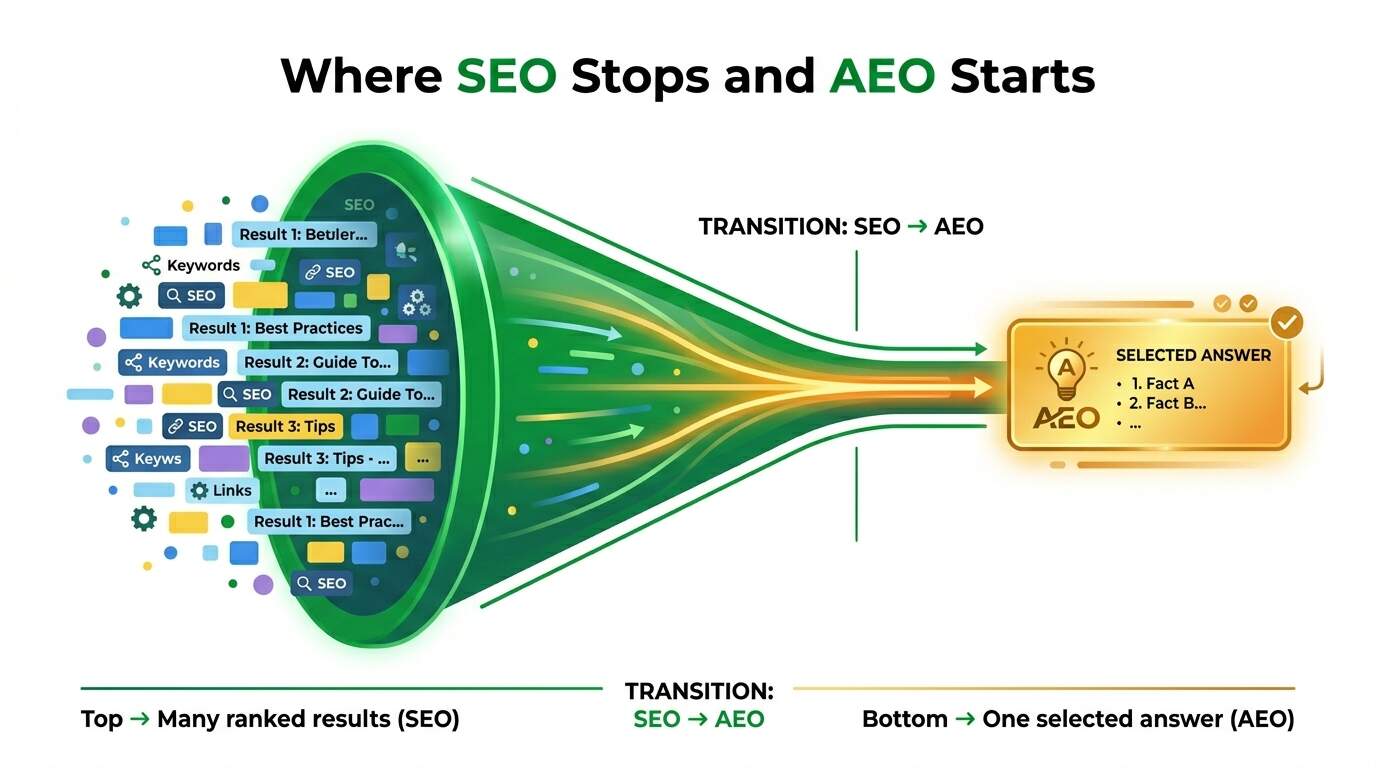
Answer engines don’t browse your page like a curious reader. They scan for a safe, standalone passage they can cite without rewriting it. In the context of AEO vs. SEO, clarity beats cleverness every time. If your answer depends on hidden context elsewhere on the page, the system moves on to the next person.
The selection signals that matter most:
- Lead with the direct answer, then add a one-sentence “because” clause. This keeps the takeaway clean and independently meaningful.
- Keep entities stable; service, audience, outcome, across the page. This reinforces entity-based SEO and reduces the kind of ambiguity that makes systems hesitant to cite you.
- Show real trust signals: expert attribution, cited sources, and accurate ranges outperform vague superlatives. These are core ranking factors for the answer engine that most content teams still overlook.
- Format for extraction: tight paragraph blocks, scannable lists, and clear subheadings. These are the structural choices that influence whether a system can safely use your content.
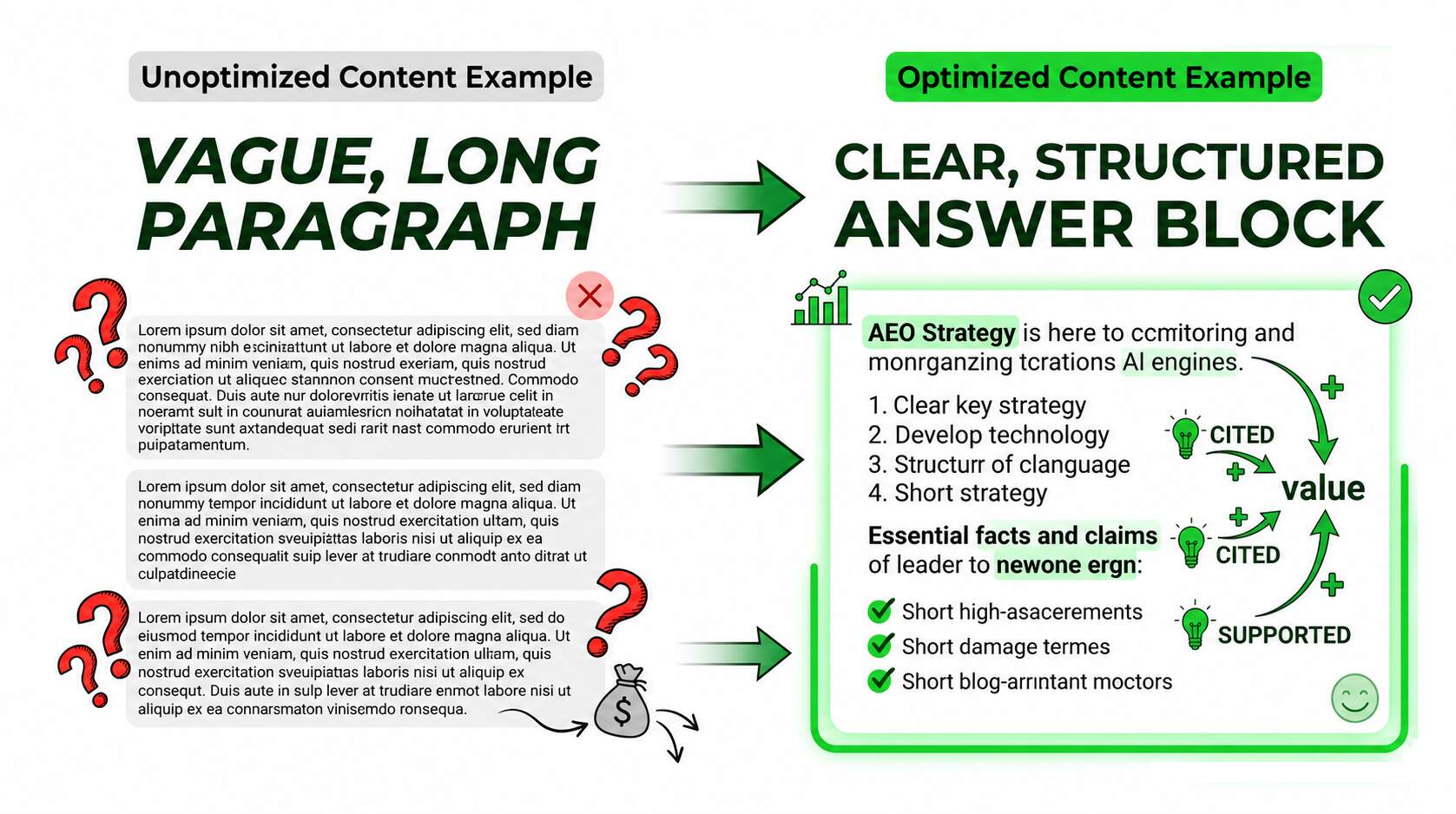
A practical pattern worth building into every page is what you might call an “answer block”: a definition sentence, a number or benchmark, and a next step. For example, state a time-frame range for a service, list the two variables that most affect it, then link to the detailed breakdown. This keeps the excerpt accurate on its own while pulling serious readers deeper for nuance and closer to conversion. These patterns are particularly important for content for AI answers, where structure does as much work as the words themselves.
Why Businesses should Adapt AEO — Now
Buyer behavior is moving faster than most teams realize. According to SparkToro and Datos research, over 58% of Google searches now end without a click; the highest rate ever recorded. Meanwhile, Google’s AI Overviews now appear in an estimated 47% of search queries, according to BrightEdge’s 2024 research. People are asking longer, more specific questions. They expect instant clarity. And they’re often deciding before they ever click.
Here’s why this shift hits the bottom line directly:
- Answer-first layouts compress evaluation. Your definition and criteria may be the only lines a buyer ever sees. If they’re vague, you lose. This is the reality of conversational search optimization; winning the snippet means winning the moment.
- The search generative experience blends multiple sources into a single answer. You’re no longer competing for the blue link; you’re competing to be the cited explanation.
- New surfaces reward concise, decision-ready language. From smart assistants to voice search optimization, the common thread is that shorter, more specific answers win.
- Metrics are shifting. Adobe data shows generative AI retail traffic rose 1,300% YoY in 2024, while BrightEdge reports impressions rising as AI Overviews reshape click behavior across search.
- Execution priority is changing, too. The smart move is to optimize for AI answers on your highest-revenue pages, pricing, comparisons, and service pages, before publishing more volume.
Start with the pages closest to revenue. Standardize your terminology, cite your key claims, and make sure your top passages could be quoted without distortion. This kind of AI search optimization reduces ambiguity for systems and reduces friction for humans, which turns out to be the same goal.
Integrating SEO and AEO: A Practical Strategy
The most useful answer to the AEO vs. SEO debate isn’t “which one?” — it’s “both, done well.” Integration means keeping your classic discovery engine strong while making your key passages genuinely quote-ready. When it works, the same page ranks as a destination and functions as a reference. That’s reach plus reuse; measured in real outcomes.
How to build a dual-purpose page:
- Keep SEO foundations solid: technical health, internal linking, topical coverage. These are still what earn you discovery.
- Open with a two-sentence answer, then add criteria. This is the simplest form of generative search optimization that stays genuinely readable for humans.
- Standardize terms and entities across the site. Use the same name for every service, audience segment, and outcome on every page. A consistent GEO strategy, or generative engine optimization, helps reinforce what your content is actually about and reduces ambiguity.
- Attach proof to every key claim. One benchmark, citation, or mini-result per major statement makes your content harder to dismiss and safer to cite. This is how you build towards AI-generated answers SEO, earning the right to be the source system’s trust.
- Measure both lanes: rankings and impressions, but also mentions and assisted conversions. Add schema markup (FAQ schema on Q&A sections, HowTo schema on step-by-step guides) to reinforce answer-readiness at the structural level.
Blending ranking fundamentals with answer-ready packaging reduces your reliance on any single SERP layout. Build depth for human readers, but place your clearest insight where systems can safely lift it. That balance protects visibility over time, improves lead quality, and turns content into a compounding asset.
AEO Mistakes That Quietly Cost You
Most AEO failures have nothing to do with algorithm changes or technical configuration. They’re communication mistakes. In the context of AEO vs. SEO, selection engines need a clean, citable excerpt, which means fluff and ambiguity get punished faster than they do in traditional search. Here are the most common missteps, and how to fix them before they become habits across your team.
- Keyword overcooking. Repeating a phrase five times in three paragraphs doesn’t signal authority; it reduces clarity and makes passages harder to extract cleanly.
- Late answers. Burying the key point forces systems to guess what your page is actually about. When in doubt, they’ll quote someone who led with it. This is the single biggest mistake teams make when trying to optimize for AI answers.
- Weak authority signals. Missing author credentials, thin sourcing, and vague superlatives like “industry-leading” all undermine the trust signals that make a passage citable.
- Terminology drift. Calling the same service “digital marketing,” “online marketing,” and “web marketing” across different pages signals inconsistency to both humans and AI systems. Consistent naming is foundational to generative search optimization at scale.
- Structure mismatch. Headings that promise one thing and deliver another reduce quote-safety dramatically. Readers feel misled. Systems skip you.
- Missing schema markup. Not implementing FAQ, HowTo, or Article schema on eligible pages is a missed structural signal; one of the most overlooked AEO gaps in most content audits.
A practical guardrail: treat every first paragraph as if it’s the only paragraph someone, or something, will ever read. If it can’t be quoted without distortion, rewrite it as a claim, a constraint, and a supporting fact. That’s the discipline behind strong AI search optimization.
Conclusion: SEO Evolves, AEO Expands
SEO isn’t going away; it’s being asked to share the stage with answer-first experiences. As users get clearer responses directly on the results page, the competition shifts from “who ranks” to “who gets cited.” That’s the shift driving modern content strategy: discoverability plus quote-ready clarity.
Define your answer early. Support it with evidence. Keep your terminology consistent; uses SEO isn’t replacement; it’s the same language for AEO, GEO, and SEO concepts every time; so systems can reuse your content without second-guessing. Strong pages still need depth, internal links, and authority, but they also need clean passages that hold their meaning when pulled out of context.
Measure success beyond clicks: track impressions, brand lift, assisted conversions, and repeat visibility across question-style queries. Add schema markup where eligible. Build for humans. Package for reuse. And your content will stay relevant as search keeps evolving, no matter what the interface looks like next.
Get a Free AEO Audit of Your Top 3 Revenue Pages
Ready to make your pages rank and get quoted? eSign Web Services will audit your pricing, comparison, and service pages; the three most likely to appear in AI-generated answers, rewrite them for answer-ready clarity, and align your technical SEO with citation-friendly structure and schema markup. You’ll get a prioritized action plan with measurable KPIs, so your visibility grows even when clicks drop. Claim your free revenue-page audit today.
Frequently Asked Questions (FAQs)
Question: What is Answer Engine Optimization (AEO)?
Answer: Answer Engine Optimization focuses on preparing content so it can be selected and used by AI systems to generate direct answers. Unlike traditional SEO, which prioritizes rankings and traffic, AEO ensures content is clear, structured, and easily extractable. It helps businesses appear in AI-generated responses across platforms like Google SGE and conversational search tools. AEO emphasizes clarity, context, and authority rather than keyword density. This approach aligns with modern search behavior, where users expect immediate answers. Implementing AEO improves visibility in zero-click environments and strengthens brand presence in AI-driven search experiences.
Question: How is AEO different from traditional SEO?
Answer: AEO differs from traditional SEO in its primary objective. SEO focuses on ranking pages to drive traffic, while AEO focuses on being selected as the direct answer. SEO relies on keywords, backlinks, and technical optimization, whereas AEO prioritizes clarity, structure, and extractability. In AEO, content must directly answer queries and be easy for AI systems to interpret. While SEO encourages users to visit websites, AEO often results in zero-click interactions. Both approaches are important, but AEO reflects the shift toward answer-based search. Businesses must combine both strategies to maintain visibility and relevance in evolving digital environments.
Question: Why is AEO important for businesses in 2026 and beyond?
Answer: AEO is important because search engines are increasingly using AI to generate answers instead of displaying traditional results. This changes how users interact with information. Businesses must adapt to remain visible. Without AEO, even well-ranked content may not be selected by AI systems. AEO ensures content is clear, structured, and aligned with user intent. It improves inclusion in AI-generated responses and enhances brand presence. As AI-driven search continues to grow, businesses that adopt AEO will gain a competitive advantage. It is essential for maintaining relevance and achieving long-term success in digital marketing.
Question: What type of content works best for AEO?
Answer: Content that works best for AEO is clear, concise, and structured. It should provide direct answers to user queries early in the content. Short paragraphs, bullet points, and logical organization improve extractability. Content should also define entities clearly and maintain consistency in terminology. Providing accurate and useful information increases trust. Comprehensive coverage of topics improves authority. Avoiding unnecessary complexity ensures better understanding. Content aligned with user intent performs better. AEO requires content that is easy for both users and AI systems to interpret, ensuring higher chances of being selected for generated answers.
Question: Does AEO replace SEO completely?
Answer: AEO does not replace SEO; it complements it. SEO is still essential for improving visibility, indexing, and organic traffic. AEO builds on SEO by optimizing content for AI selection. While SEO focuses on rankings, AEO focuses on answer inclusion. Both strategies work together to improve overall performance. Ignoring SEO can limit discoverability, while ignoring AEO can reduce selection in AI-generated results. Businesses should integrate both approaches for maximum effectiveness. Combining SEO and AEO ensures visibility across traditional search results and AI-driven platforms, creating a balanced and future-ready strategy.
Question: How do answer engines choose which content to display?
Answer: Answer engines evaluate content based on clarity, relevance, authority, and structure. They analyze multiple sources and select information that best answers the query. Content that provides direct answers, uses clear language, and is well-structured has a higher chance of selection. Authority signals such as expertise, credibility, and external validation also influence decisions. Consistency across content improves trust. AI systems aim to deliver accurate and useful responses, so they prioritize reliable sources. Businesses must focus on quality and clarity to improve their chances of being selected in the generated answers.
Question: What are zero-click searches, and how do they impact businesses?
Answer: Zero-click searches occur when users get answers directly from search results without visiting a website. AEO plays a key role in these interactions. While zero-click searches reduce traffic, they increase brand visibility and authority. Being featured as the answer builds trust and recognition. Businesses must shift focus from clicks to presence. Optimizing for AEO ensures content is included in these results. Measuring success requires new metrics such as impressions and brand mentions. Adapting to zero-click environments helps businesses remain competitive and relevant in modern search landscapes.
Question: How can businesses start implementing AEO strategies?
Answer: Businesses can start by reviewing their content for clarity and structure. Adding direct answers at the beginning improves extractability. Defining key entities and maintaining consistent terminology strengthens context. Using headings, lists, and short paragraphs enhances readability. Creating comprehensive content improves authority. Monitoring performance helps refine strategies. Combining AEO with SEO ensures better results. Starting with high-priority pages allows quick improvements. Businesses should focus on quality and user intent. A structured approach ensures effective implementation and better visibility in AI-driven search environments.
Question: What are common mistakes businesses make with AEO?
Answer: Common mistakes include focusing only on keywords, ignoring content structure, and failing to provide direct answers. Many businesses create content that ranks but is not extractable. Poor formatting reduces clarity. Lack of authority signals weakens trust. Inconsistent terminology confuses AI systems. Another mistake is not aligning content with user intent. Businesses may also overlook the importance of accuracy. Avoiding these mistakes requires a focus on clarity, structure, and credibility. A strategic approach ensures content performs well in AI-driven search environments.
Question: How should businesses measure success in AEO?
Answer: Success in AEO should be measured using metrics beyond traditional rankings. Visibility in AI-generated answers, brand mentions, and inclusion frequency are important indicators. Tracking impressions and engagement helps evaluate performance. Monitoring how often content is selected provides insights into effectiveness. Conversion rates and user behavior also matter. Businesses should focus on authority growth and consistency. Combining traditional SEO metrics with AEO-specific indicators provides a complete picture. This approach ensures strategies align with evolving search behavior and deliver long-term results.
Author Details

Ashwani Kumar Sharma
Ashwani has been actively involved in SEO services since 2005. His expertise and distinctive work approaches have made him one of the most experienced and trusted SEO experts in the industry. He is a certified SEO and Google Ads professional. He also has strong business development skills in advanced SEO, PPC, and digital marketing strategies.


