



LLM Optimization: Preparing Content for AI Search Engines

Key Takeaways
- AI search favors content that answers clearly, early, and with strong supporting context.
- LLM optimization helps content get selected, reused, and trusted in generated answers.
- Clear structure makes pages easier for both readers and AI systems to understand.
- Strong formatting improves extraction, summarization, and visibility in AI-powered search experiences.
- Pages with visible authorship and evidence feel more trustworthy and reusable.
- Answer-first writing reduces friction and improves content usefulness in conversational search journeys.
- Context-rich examples help AI systems interpret advice more accurately and confidently.
- Better trust signals strengthen credibility across articles, service pages, and supporting content.
- Future-ready content must balance readability, specificity, authority, and practical search intent.
Search is changing from a list of links into a layer of guided answers. LLM optimization means shaping pages so AI systems can understand the main point, trust the evidence, and reuse the best passage without distorting it. For marketers, that changes the job from “rank this page” to “make this page selectable.” Google said in April 2025 that AI Overviews had already reached more than 1.5 billion users every month.
That scale changes how content should open. Google also said that AI Mode queries are, on average, twice as long as traditional searches, indicating that people are asking fuller questions and expecting sharper responses. A fluffy intro now does double damage: it slows the human reader and gives the machine less to latch onto. The page has to classify itself faster and state the real takeaway sooner. That is why answer engine optimization is starting to look less like trend-chasing and more like disciplined publishing.
Here is what this looks like in practice. A founder searching “best CRM for a five-person sales team with no admin support” does not need a theatrical warm-up. They need a direct answer, a comparison frame, and a believable reason to trust the recommendation. They also need the page to sound like it understands the business problem, not just the software category. That is where content for AI answers starts to outperform generic blog copy, and where modern pages must earn attention before the click.
What Is LLM Optimization
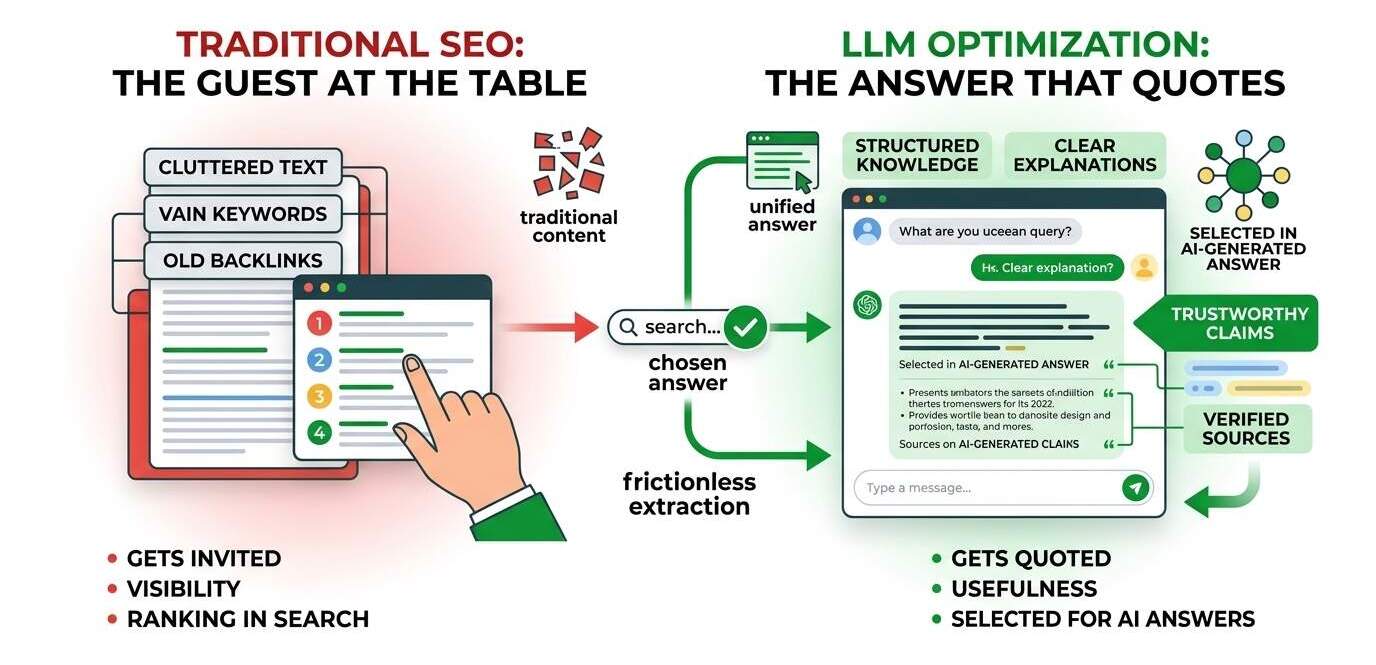
LLM optimization is the process of making content easier for AI-driven search tools to understand, trust, and reuse in generated answers. It is less about chasing a new algorithm and more about making your content clearer, more structured, and more useful when someone asks a detailed question in natural language. When a page explains the topic clearly, supports its claims, and presents information in a format that is easy to extract, it is more likely to be selected in AI-powered search results.
A useful way to think about it is this: traditional SEO helps your page get discovered, while LLM optimization helps your page get chosen. That distinction matters because AI search engines do not simply display links. They interpret intent, compare sources, and assemble responses. If your article buries the answer, over explains simple ideas, or leaves too much unstated, it becomes harder for an AI system to use with confidence. Clearer pages reduce that friction.
Here is what this looks like in practice. Imagine a business owner searches for “best website platform for a local service business with a limited budget.” A weak page gives vague advice like “choose a scalable platform.” A stronger page explains which platform works best for that business type, why it fits, what tradeoffs matter, and when a different option makes more sense. That is where LLM optimization becomes valuable. It turns content from merely searchable into genuinely usable.
Myth vs. Reality:
❌ Myth: LLM optimization means stuffing content with AI terms.
🎯 Reality: It means making your content easier to interpret, verify, and extract.
Definition → Contrast → Example → Analogy → Callout
How LLMs Evaluate Content
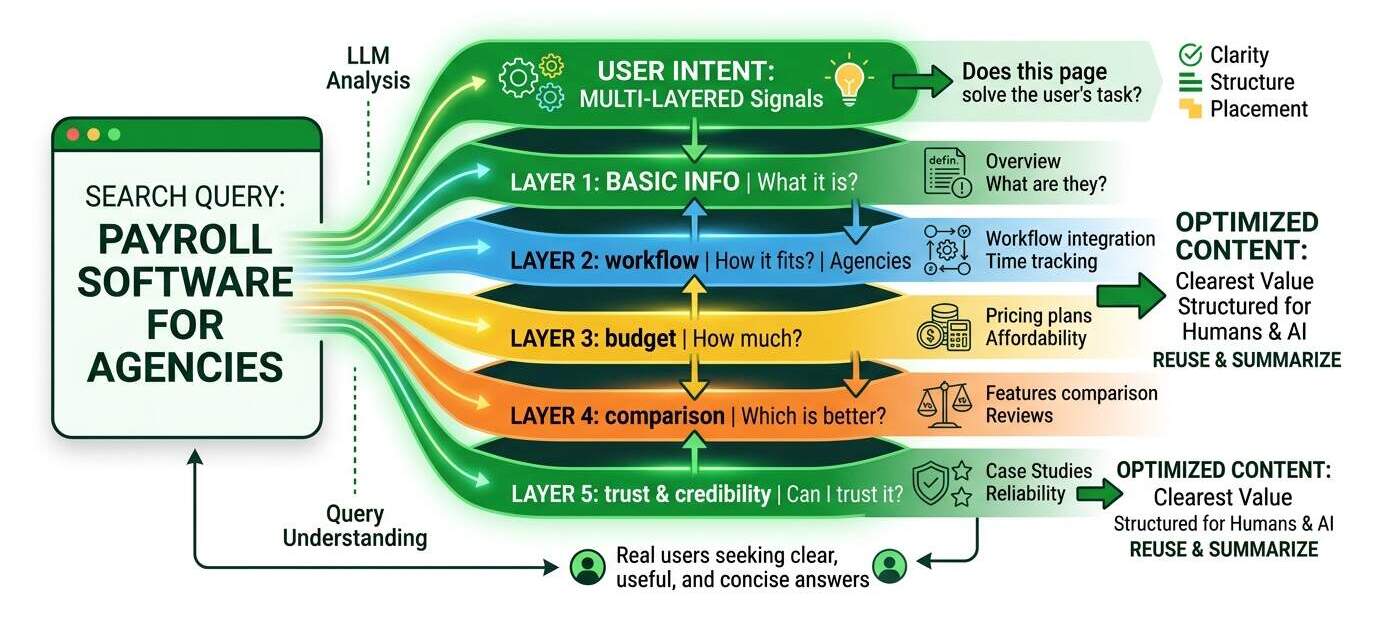
LLMs evaluate content by asking a practical question: Does this page solve the user’s task clearly enough to trust, summarize, and reuse? They look beyond keyword repetition and focus on intent, structure, and usability. That is why pages written for people often perform better than pages written only for rankings.
- Intent matters. LLMs do not just match phrases. They infer what the searcher is trying to accomplish. A query about payroll software for an agency includes budget, workflow, and comparison signals, so the content should reflect the user’s decision behind it.
- Structure matters. Packaging shapes interpretation. Clear headings, definitions, and short paragraphs help models distinguish the main answer from supporting details. In conversational and multimodal search, content must make sense whether the prompt starts as text, voice, image, or follow-up.
- Placement matters. Search Engine Land reported that 44.2% of verified ChatGPT citations came from the first 30% of page content, while 24.7% came from the final third. That does not eliminate nuance, but it does reward clarity and framing earlier.
The practical takeaway is simple: if the answer is buried, vague, or poorly structured, LLMs have less reason to trust and reuse it. Strong content meets intent quickly, explains itself cleanly, and puts the clearest value where both readers and AI systems can find it without doing extra interpretive work.
How to Optimize LLMs: Core Principles
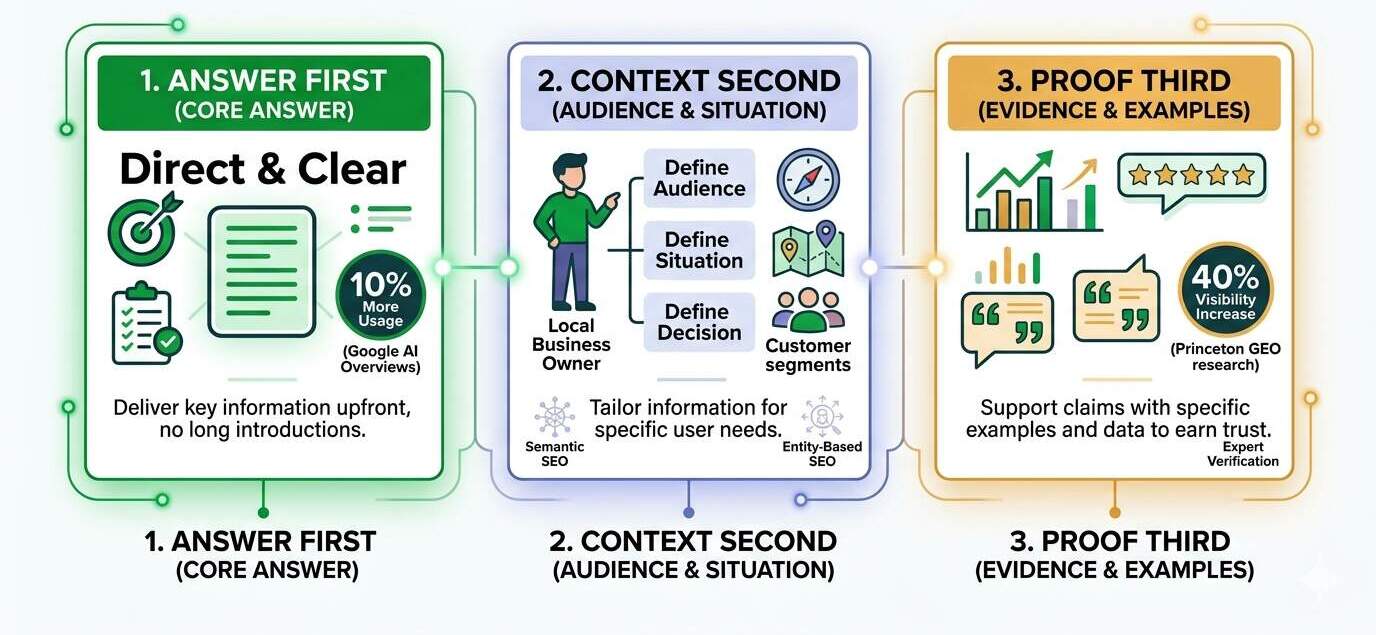
A lot of content loses visibility for a simple reason: it makes the reader work too hard before delivering anything useful. The first principle of LLM optimization is answer-first clarity. If the page already knows the question, it should not hide the answer behind a long setup. Google has said AI Overviews is driving over 10% more usage for the kinds of queries where it appears, across major markets, showing how strongly better answers are shaping search behavior.
The second principle is context, which removes guesswork. To optimize content for LLMs, define the audience, the situation, and the decision being made. A page about the “best website platform” means very different things depending on whether the reader runs a local business, an online store, or a content-heavy brand. That is where entity-based SEO and semantic SEO stop being theory and start becoming useful.
The third principle is proof that earns trust quickly. Broad claims are easy to ignore. Clear examples are harder to dismiss. Princeton-led research on generative engine optimization found that certain improvements could increase visibility by up to 40%, a strong reminder that better structure and specificity can produce measurable gains. A smart GEO strategy usually wins by reducing ambiguity, not by adding noise.
Content Formatting for AI Extraction
Formatting now carries strategic weight because the page may be sampled before it is fully read. That is why AI content optimization should be treated as information design, not polish. Clear headings, short paragraphs, comparison tables, and labeled examples all make it easier for a system to isolate the useful part. They also make it easier for a busy human to scan the page and decide whether the rest is worth their attention.
The traffic math explains why this matters. SparkToro’s 2024 study found that 58.5% of U.S. Google searches ended without a click. Ahrefs’ 2025 study of 300,000 keywords found that the presence of an AI Overview correlated with a 34.5% lower average CTR for the top-ranking page. In simple words, zero-click search raises the value of passages that can influence the outcome even when the visit never happens.
A well-structured document also improves AI content extraction. A comparison table can compress a buying decision faster than three fluffy paragraphs, and a summary block can rescue a page that would otherwise bury the answer. Here is what this looks like: a software comparison that opens with who each option fits best, then shows price, strengths, limits, and best-fit use cases. That kind of page is easier to parse, easier to cite, and easier to trust in a search generative experience.
SERP / Competitor Snapshot Table
| Page Type | Weak Version | Strong Version | Why the Stronger Version Wins |
| SaaS comparison blog | Long intro, vague claims, no table | Direct answer, use-case framing, comparison chart | Easier to extract and summarize |
| Agency service page | Brand-heavy copy, little proof | Problem-solution structure with proof and FAQs | Better trust and reuse value |
| Small business guide | Broad advice, no audience context | Audience-specific scenarios and next steps | Matches intent more precisely |
| FAQ resource | Thin one-line answers | Clear question-answer blocks with examples | Cleaner retrieval and citation |
Authority and Trust Signals
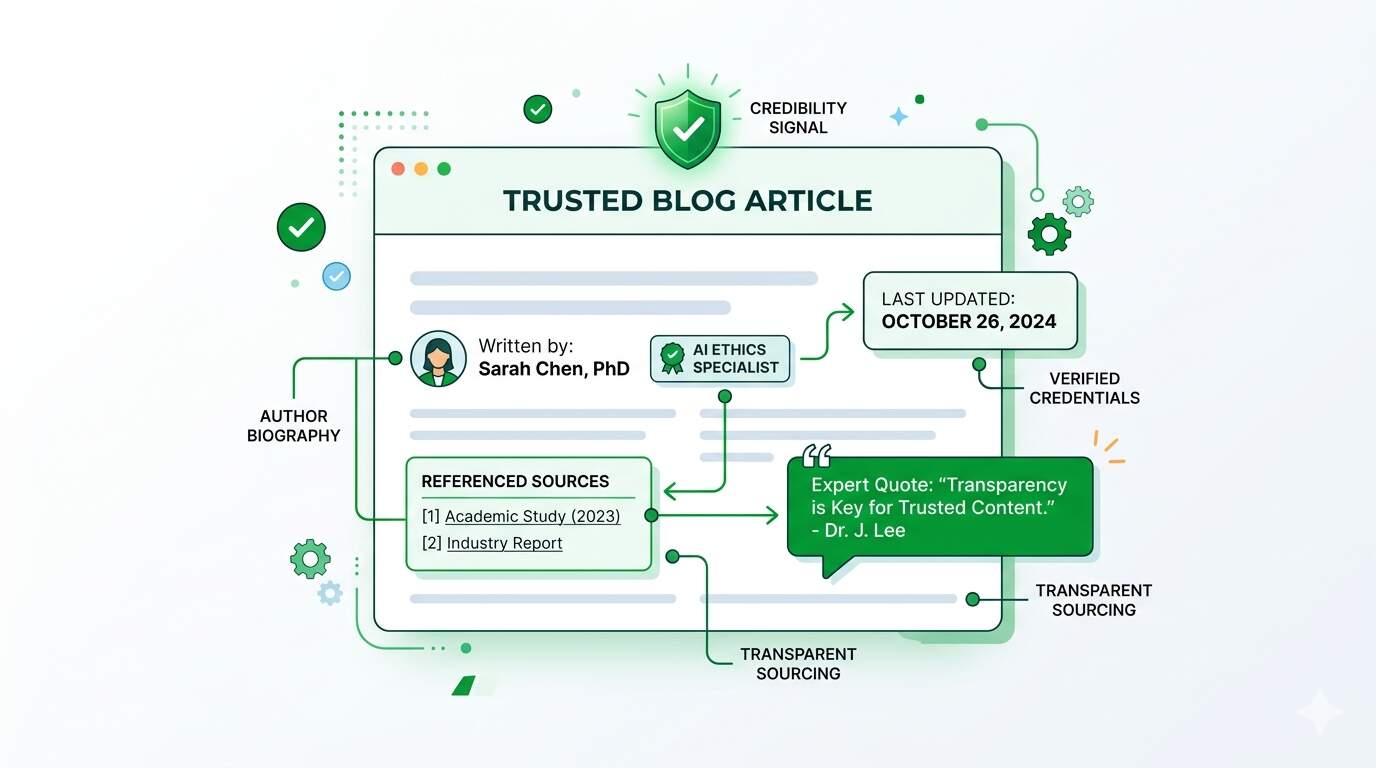
Trust is not a decorative extra in AI-era content. It is part of how a page earns visibility, reuse, and credibility. AI systems are more likely to rely on content that appears attributable, current, and grounded in reality. That does not mean every article needs to sound academic, but it does mean the page should make authorship, recency, and evidence easy to see. When trust signals are weak or invisible, even useful content becomes harder to reuse with confidence.
- Visible authorship builds confidence.
A page feels stronger when readers can immediately see who wrote it, what experience they bring, and when the piece was reviewed or updated. That is where AI search optimization becomes more than a writing exercise. It becomes a credibility exercise. A visible byline, date, and expert context reduce hesitation by helping both readers and AI systems understand where the information is coming from.
- Specific proof beats vague authority.
A line like “we tested this across 12 client sites” carries more weight than “best practices suggest.” That is why LLM optimization works better when it includes examples, references, or real observations instead of polished but unsupported claims. Many so-called AI ranking factors feel less mysterious once you realize they often reflect visible habits of trustworthy publishing.
- Consistency strengthens authority over time.
Authority does not live on one page alone. It compounds across the site. When related articles define terms consistently, cite evidence clearly, and explain tradeoffs without drifting into vague language, the content becomes easier to trust section by section. That is also where conversational search optimization helps, because writing that sounds like a sharp expert usually survives summarization better than writing that sounds overpolished and generic.
The bigger takeaway is simple: authority is easier to trust when it is visible. Strong trust signals do not just support the content after the fact. They shape whether the content feels believable in the first place. In AI-assisted search, that difference matters because pages are increasingly being judged not only on what they say, but on how confidently and transparently they say it.
Common LLM Optimization Mistakes
The biggest mistake is delaying the answer. Many pages still open with padded background, generic trend talk, or self-important throat-clearing that adds no real value. That weakens LLM optimization because selection systems are built to extract the clearest passage, not reward suspense. If the best line arrives late, the page may already have lost to a competitor that got to the point in half the time and proved it with less effort.
The second mistake is confusing topic coverage with topic clarity. A page can mention every adjacent term and still be useless if it never resolves the main uncertainty. That is where AI content optimization gets misread as a word-count contest. Strong pages cut noise, not just add material. They also avoid empty jargon. Mentioning frameworks is not the same as showing what a founder, marketer, or agency should do next with the advice in a real buying or planning moment.
The third mistake is publishing unsupported opinions as if certainty were a substitute for evidence. Good generative search optimization keeps claims grounded, examples specific, and reasoning visible. It also avoids lazy keyword stacking. A smart GEO strategy feels natural because it is built around better explanations, better sourcing, and cleaner structure, not a pile of repeated phrases pretending to be strategy. That compounds faster and reads better on the page.
Quick checklist
- Cut intros that delay the useful part.
- Replace jargon with one clear scenario.
- Audit for clarity, not just term usage.
Conclusion: Optimizing for AI Search
LLM optimization is not just another marketing buzzword waiting to fade. It is a real shift in how content earns visibility, trust, and influence. Search is no longer only about showing up on a page of blue links. It is about being clear enough to be selected, credible enough to be reused, and useful enough to shape the answer before the click even happens. That changes the standard. Content now has to work harder and smarter. It has to explain quickly, support its claims, and make the next step feel obvious. Brands that understand this will not just chase rankings. They will build content that guides decisions, strengthens trust, and stays useful in a search environment that is becoming more conversational, more selective, and far less forgiving of vague, padded copy.
Ready to Be Found, Chosen, and Trusted?
At eSign Web Services, we help businesses create content that does more than fill pages. We build content that connects, convinces, and converts. Request a free quote to discover the right strategy for your business, or call us today and let’s create content built for the way search works now.
Frequently Asked Questions (FAQs)
Question: What is LLM optimization in digital marketing?
Answer: LLM optimization refers to preparing content so large language models can understand, extract, and use it effectively in AI-generated responses. It focuses on clarity, structure, and contextual meaning rather than keyword density. Content must be written in a way that aligns with how AI systems inte rpret information. This includes using clear language, defining entities, and organizing content logically. LLM optimization ensures content is not only discoverable but also usable by AI systems. Businesses adopting this approach improve their chances of appearing in AI-generated answers and conversational search results, making it an essential strategy for modern digital marketing and long-term search visibility.
Question: How is LLM optimization different from traditional SEO?
Answer: Traditional SEO focuses on ranking content using keywords, backlinks, and technical factors. LLM optimization focuses on makig content understandable and extractable for AI systems. Instead of optimizing for search engine rankings alone, LLM optimization ensures content can be selected and used in generated answers. It emphasizes clarity, context, and structured information. While traditional SEO is still important, LLM optimization adds another layer focused on AI interpretation. Businesses need to combine both approaches to remain competitive. This shift reflects how search engines are evolving from ranking pages to generating answers directly for users.
Question: Why is LLM optimization important for future search visibility?
Answer: LLM optimization is important because search engines are increasingly using AI to generate answers instead of showing traditional results. This changes how visibility is achieved. Content must be selected, not just ranked. Without optimization, even high-ranking pages may be ignored by AI systems. LLM optimization ensures content is clear, structured, and authoritative. It improves inclusion in AI-generated responses and conversational search. As AI-driven search continues to grow, businesses that adopt LLM optimization will maintain visibility, while others risk losing traffic and relevance. It is a critical strategy for long-term digital marketing success.
Question: What type of content performs best in LLM-based systems?
Answer: Content that performs best in LLM-based systems is clear, structured, and directly answers user queries. It should provide useful information without unnecessary complexity. Answer-first formatting improves extraction. Content should include well-defined entities and logical structure. Comprehensive coverage of topics improves authority. Short paragraphs and lists enhance readability. Content that aligns with user intent performs better. Accuracy and reliability are also critical. LLM systems prioritize usefulness and clarity over keyword optimization. Businesses should focus on creating informative, easy-to-understand content that delivers value quickly and effectively.
Question: How do entities improve LLM content performance?
Answer: Entities help LLMs understand the meaning and relationships within content. They represent real-world concepts such as brands, people, and topics. Clearly defining entities improves contextual understanding. LLMs use these relationships to generate accurate responses. Strong entity signals increase relevance and selection probability. Consistent terminology strengthens recognition. Entities also help connect related content, improving authority. Without clear entities, content may lack context and be ignored. Businesses should focus on defining key concepts clearly and maintaining consistency across content to improve performance in AI-driven search environments.
Question: Does LLM optimization require technical SEO changes?
Answer: LLM optimization does not replace technical SEO but complements it. Technical SEO ensures content is accessible and indexable, while LLM optimization ensures it is usable by AI systems. Some technical elements, such as structured data and proper formatting, support LLM interpretation. However, the primary focus is on content quality, clarity, and structure. Businesses should maintain strong technical SEO foundations while adapting content strategies. Combining both approaches ensures better performance across traditional search and AI-driven platforms. Ignoring either aspect can limit overall visibility and effectiveness.
Question: How does content structure impact LLM understanding?
Answer: Content structure plays a critical role in how LLMs process information. Well-organized content with clear headings, short paragraphs, and logical flow improves interpretation. Structured formats help AI systems identify key information quickly. Poor structure makes content difficult to understand and reduces extraction efficiency. Answer-first formatting enhances visibility. Lists and sections improve clarity. LLMs prefer content that is easy to navigate and interpret. Businesses should focus on creating structured, user-friendly content that aligns with AI processing patterns. This improves both user experience and AI-driven visibility.
Question: Can small businesses benefit from LLM optimization?
Answer: Yes, small businesses can benefit significantly from LLM optimization. AI systems prioritize relevance and clarity over brand size. Smaller businesses can compete by focusing on niche expertise and high-quality content. Clear, structured content improves selection chances. Building authority within a specific topic increases visibility. LLM optimization allows smaller brands to appear in AI-generated answers alongside larger competitors. Consistency and expertise are key factors. By focusing on value and clarity, small businesses can achieve strong visibility in AI-driven search environments without relying on large-scale resources.
Question: What are common mistakes in LLM optimization strategies?
Answer: Common mistakes include focusing too much on keywords, ignoring content structure, and failing to define entities clearly. Many businesses create content that ranks but is not extractable. Poor formatting reduces clarity. Lack of authority signals weakens trust. Inconsistent terminology confuses AI systems. Another mistake is not aligning content with user intent. Businesses may also overlook the importance of accuracy. Avoiding these mistakes requires a focus on clarity, structure, and credibility. A strategic approach ensures content performs well in AI-driven search environments.
Question: How can businesses start implementing LLM optimization today?
Answer: Businesses can start by reviewing existing content for clarity and structure. Adding answer-first sections improves extractability. Defining entities and maintaining consistent terminology strengthens context. Creating content clusters improves authority. Using structured formatting enhances readability. Ensuring accuracy and credibility builds trust. Monitoring performance helps refine strategies. Combining LLM optimization with traditional SEO provides better results. Starting with high-impact pages allows quick improvements. Businesses should adopt a long-term approach focused on quality and consistency. This ensures strong visibility in evolving AI-driven search environments.
Author Details

Ashwani Kumar Sharma
Ashwani has been actively involved in SEO services since 2005. His expertise and distinctive work approaches have made him one of the most experienced and trusted SEO experts in the industry. He is a certified SEO and Google Ads professional. He also has strong business development skills in advanced SEO, PPC, and digital marketing strategies.


