



Shopify SEO: Optimize Your Store for Better Rankings and Conversions

Key Takeaways:
- Shopify SEO helps your products, collections, and helpful pages show up when people search for things related to your store.
- A well-organized store makes it easier for both shoppers and search engines to find the most important pages.
- Original content on product and collection pages helps your store feel more useful, trustworthy, and relevant.
- Technical SEO checks help catch problems like duplicate pages, broken links, indexing issues, and other hidden errors.
- Faster pages make shopping smoother and more comfortable on both desktop and mobile devices.
- Internal links help connect products, collections, guides, and other useful pages across the store.
- Good SEO should help increase sales and improve the shopping experience, not just improve rankings.
Introduction
A beautiful Shopify store on its own is not always enough to bring people in from search engines. Shoppers need more than good design. They need clear product details, simple categories, fast-loading pages, easy navigation, and a store structure that search engines can understand properly. When these things are missing, even really good products can stay hidden and may not get the attention they deserve.
Shopify SEO helps your products, collections, blog posts, and other important pages show up more easily in search results. It brings together helpful content, smart keyword planning, technical improvements, better store structure, smoother browsing, faster page speed, and changes that support conversions. When all of these elements work together, your store becomes easier to find, easier to explore, and much easier for shoppers to trust.
This blog explains how Shopify businesses can build stronger organic visibility, avoid common optimisation issues, improve the overall shopping experience, and turn more search visitors into real customers. The goal is not just to place search terms across the site. Good shopify search engine optimization helps every page do a clear job. Product pages should explain individual items properly, collection pages should help shoppers compare choices, and blog content should answer questions while guiding readers towards relevant products in a natural way.
What is Shopify SEO?
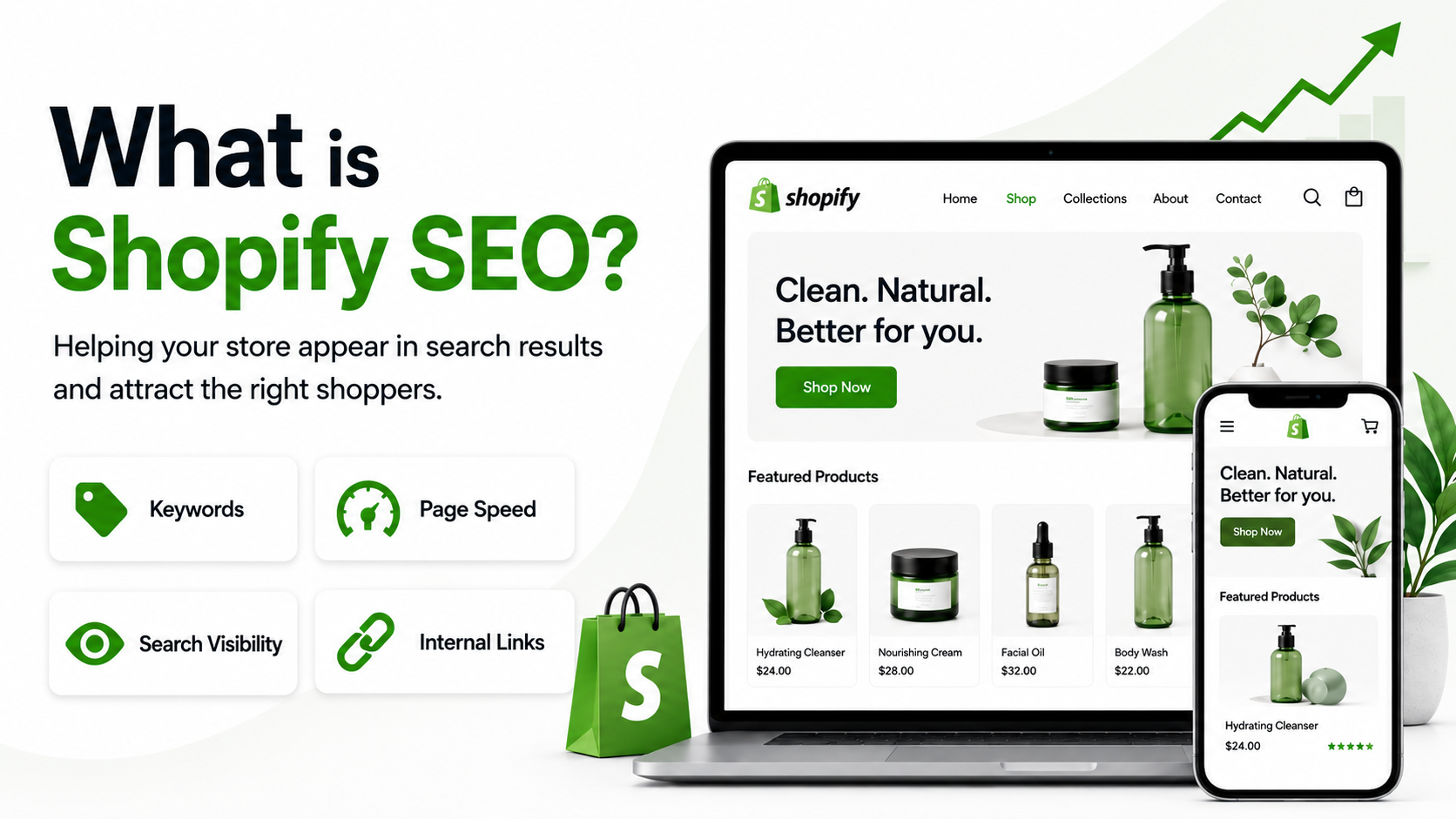
Shopify SEO is the process of improving a Shopify store so that its products, collections, informational content, and business pages have a better chance of appearing in search results. It helps search engines identify what the store sells, how different pages are connected, and which pages are most relevant to specific searches. A strong shopify store SEO plan gives every important page a clear purpose. One page might focus on a specific product, another might be built around a product category, and another might answer a common question shoppers have before they are ready to buy. This makes the store feel more organized and useful. It also stops different pages from trying to rank for the same thing. As a result, shoppers can move more naturally from learning, to comparing, to choosing the right product.
Why Organic Visibility Matters to Online Stores
Running an online store today means competing with all kinds of sellers, from huge marketplaces and popular retail brands to smaller niche shops. Paid ads can help bring people in quickly, but the cost can keep rising, and the traffic often slows down once the ads stop. That is where SEO for shopify stores becomes really valuable. It helps your store show up when people are searching, whether they are just learning, comparing products, or ready to buy. Even if they do not purchase right away, SEO helps your store stay visible and memorable along the way.
Build a Clear Keyword Plan
Keyword research helps store owners understand the words customers use when searching. It can reveal how people describe products, what features matter to them, and whether they want information, comparison, or a place to buy. A broad term may attract a large audience, but it may not always bring the most suitable visitors. More specific searches often reveal stronger intent. A customer searching for a “bag” may still be exploring. Someone searching for a “waterproof cabin backpack with a laptop compartment” has expressed a more precise need.
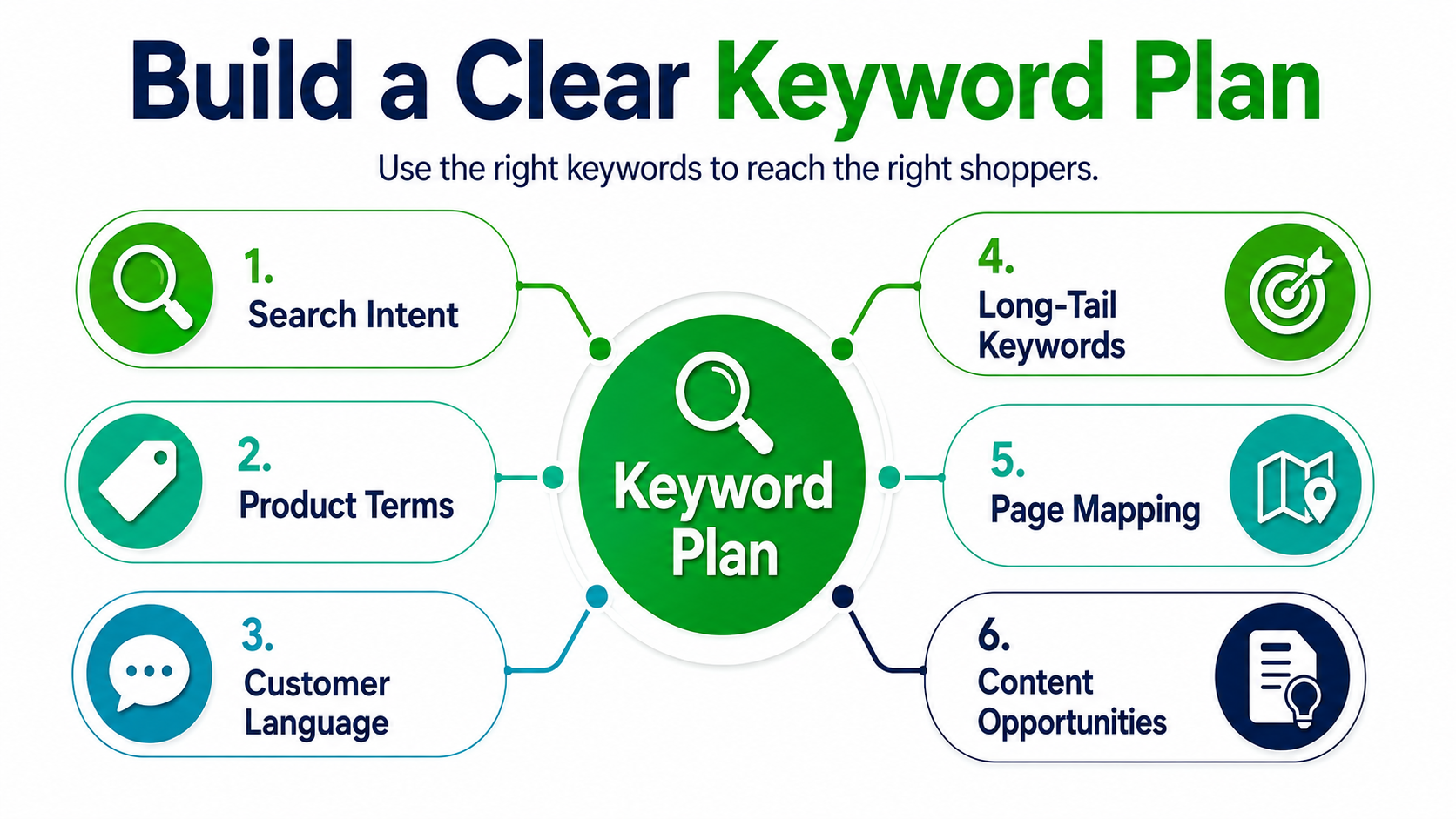
Effective Shopify SEO optimization should consider several details:
- The product type
- Customer language
- Brand and model
- Material or size
- Intended use
- Buying stage
- Competition level
- Page purpose
This approach reduces internal competition. It also helps content teams understand what information belongs on each page. Instead of repeating similar wording everywhere, the website can develop a logical set of pages that support one another.
Match Every Page with Search Intent
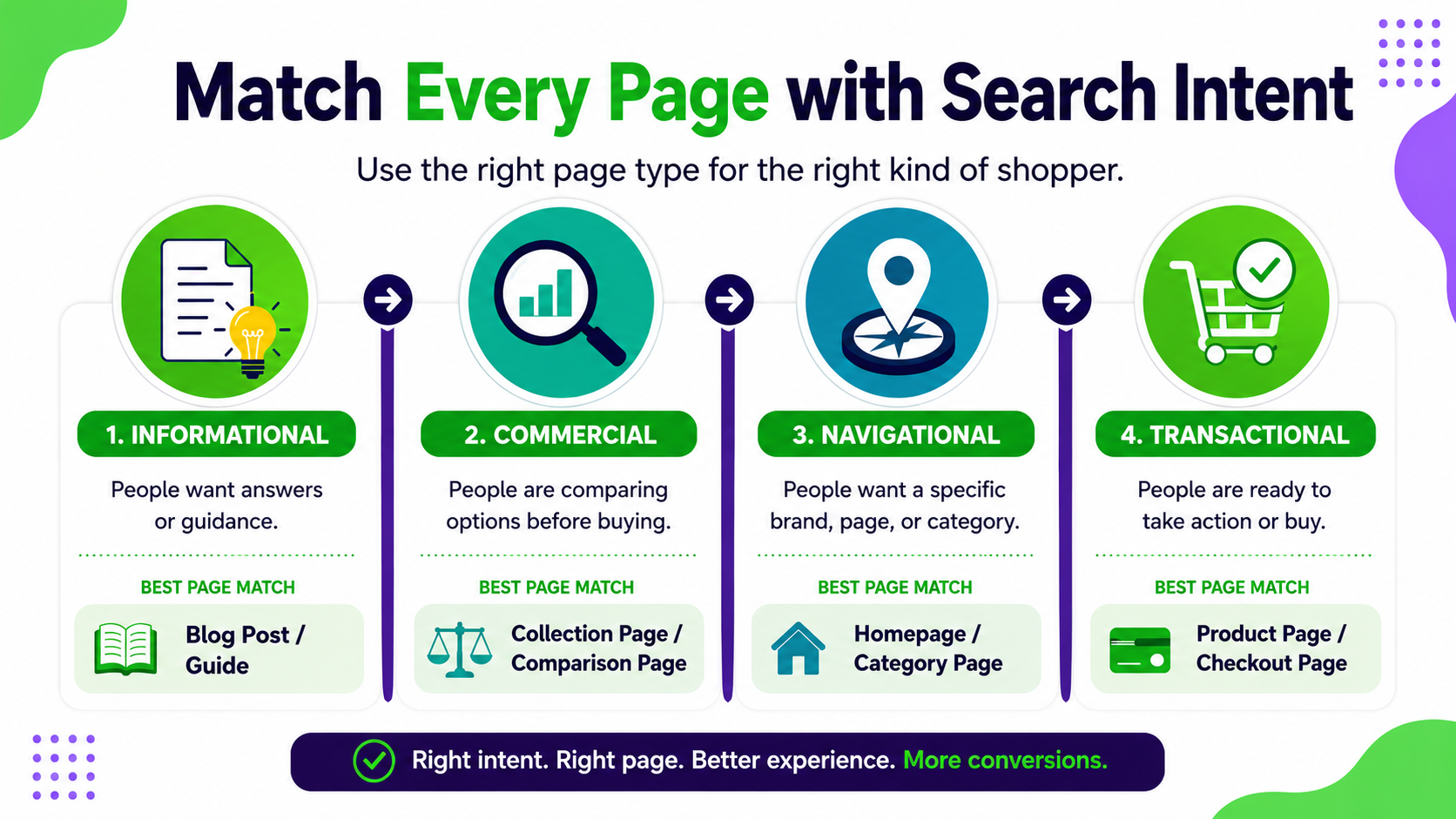
Search intent describes what a person wants to achieve through a search. Some people want quick information. Some want to compare options. Others are ready to place an order. An effective ecommerce SEO strategy separates these page types clearly. It prevents a blog article from competing with a collection and stops several products from targeting the same broad phrase unnecessarily.
Search intent also influences depth. A customer researching an unfamiliar product may need explanations, comparisons, examples, and buying advice. A customer searching for a specific replacement part may need compatibility details, dimensions, delivery information, and availability.
Create a Simple Store Structure
Website structure affects how easily users and search engines can move through the store. A confusing structure can bury important pages, create overlapping categories, and make internal links inconsistent. A simple hierarchy may follow this path:
Homepage → Main Category → Subcategory → Product
The exact structure depends on the catalog, but customers should not need to click through many unrelated pages before reaching what they need. A clear structure can support a stronger shopify website ranking because important pages receive more consistent internal support. Search engines can also understand which pages are central to the store and how supporting pages relate to them. Breadcrumbs can provide additional guidance. They show where a product sits within the store and give users a simple way to move back to a broader category.
Strengthen Product Pages
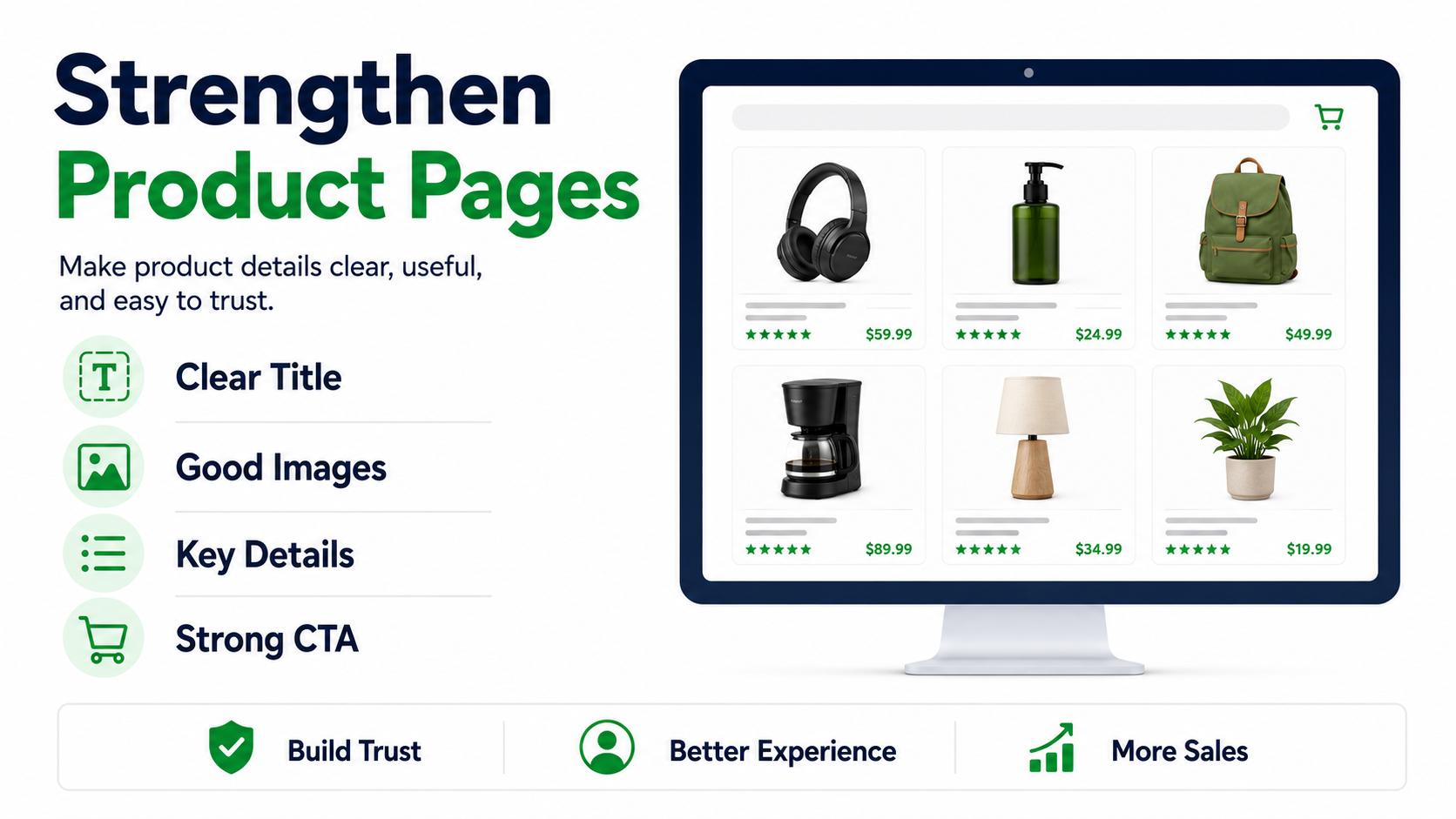
Product pages connect organic discovery with purchasing decisions. They should give customers enough information to understand the item, compare it with alternatives, and feel confident taking the next step. Strong Shopify product page SEO begins with a clear product title. The title should identify the item accurately and may include a model, material, size, or other important detail when relevant.
A useful product description can cover:
- What the product is
- Who is it suitable for
- Key features
- Practical benefits
- Materials or construction
- Size and dimensions
- Colors or variations
- Intended use
- Care instructions
- Delivery or returns
- Compatibility where relevant
A benefit is not the same as a feature. A feature is an aspect that the product possesses. A benefit, on the other hand, explains how that particular feature will help the consumer. Including both features and benefits on the website will make it more meaningful. The website also needs to have clear pictures, visible prices, available stock, shipping instructions, and a clear call-to-action button.
Improve Collection Pages
Collection pages help customers compare related products. They often have greater organic potential than individual product pages because they can match broader category searches. Effective Shopify collection page SEO starts with a descriptive heading and a short introduction. The introduction should explain what the collection includes, who it is designed for, and what customers may want to consider when choosing.
Filters should make comparison easier. Depending on the products, useful filters may include:
- Price
- Size
- Material
- Colour
- Brand
- Rating
- Intended use
- Power or capacity
- Availability
Filters should be tested carefully because they can create many URL variations. Some may be useful to users but unnecessary for search engines to index. Collection pages can also link to related guides and categories. These links help customers continue their research and strengthen relationships across the store.
Write Better Metadata
Page titles and descriptions influence how store pages appear in search results. They help search engines understand the page and help users decide whether to click. Well-written Shopify Meta titles and descriptions should be specific to each important page. Reusing the same wording across many products or collections makes them difficult to distinguish.
Metadata should be reviewed when:
- A product changes
- A collection expands
- A page is repositioned
- Search intent shifts
- Click-through rates remain low
- Several pages use similar titles
Search engines may occasionally display different text from the page, but writing strong metadata still gives them a useful and relevant option.
Control Duplicate Content
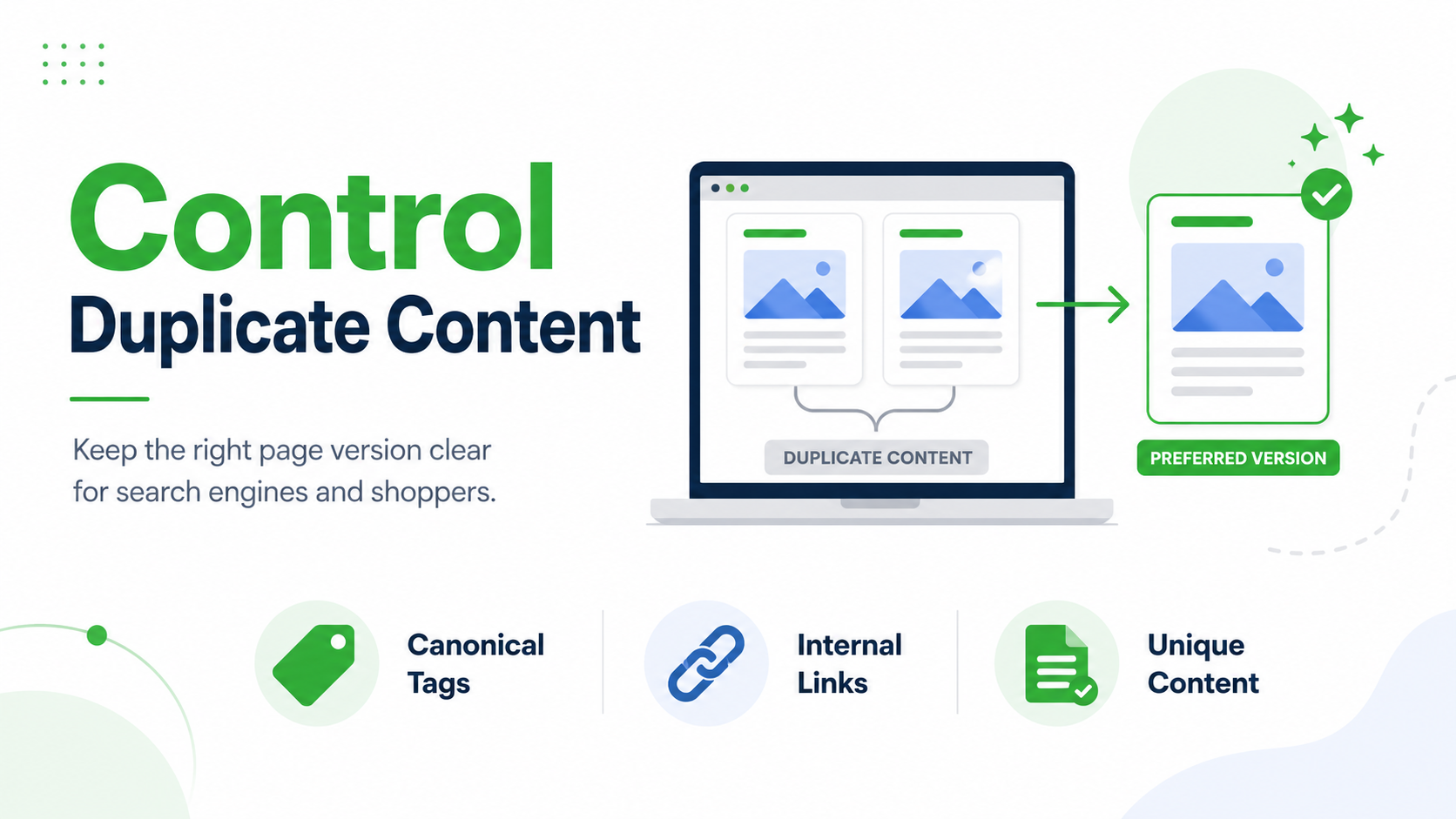
There are many ways Shopify can create multiple URLs that point to the same content. Products may sometimes be accessed through direct URLs as well as through collections. Filters, tags, sorting options, and search functionality can also create different versions of the same content. Having duplicate content does not mean you will be penalized for it, but it can make it harder for search engines to identify your preferred page.
A practical review should examine:
- Canonical tags
- Internal links
- Product URL paths
- Collection filters
- Tag pages
- Search result pages
- Indexed URLs
- Copied descriptions
Canonical tags help decide which URL should be treated as the original one. However, canonical tags work best when internal links consistently point to the preferred URL. Large catalogue pages may need templates, but there should still be space for product-specific information. Using identical paragraphs with only the product name changed is not helpful.
Improve Technical Health
Many website problems are not immediately visible to shoppers. Search engines may encounter broken links, redirect chains, duplicate pages, conflicting instructions, or incomplete structured data, even when the store appears normal. Regular Shopify technical SEO checks can identify these hidden issues. A technical review may include:
- Index coverage
- Canonical tags
- Redirects
- Broken links
- XML sitemap entries
- Robots.txt rules
- Structured data
- Mobile usability
- Page speed
- Crawl errors
- App-generated URLs
The XML sitemap helps search engines identify products, collections, articles, and other important pages. It should be submitted through the relevant webmaster tools and reviewed whenever there are major catalogue updates or migrations. Technical work should always be judged by its impact. Making small fixes to an unimportant page may bring fewer benefits than resolving a template issue that affects many product pages.
Improve Loading Speed
Slow pages can frustrate customers before they view a product. This is especially important on mobile connections, where large images, videos, scripts, and app features may take longer to load. Shopify page speed optimization should focus first on high-value pages, including the homepage, main collections, popular products, cart, and other important stages of the shopping journey.
Common causes of slow performance include:
- Large images
- Heavy themes
- Unused scripts
- Too many apps
- Auto-play videos
- Complex animations
- Too many pop-ups
- Third-party tracking tools
- Leftover app code
A complicated visual theme is not necessarily an advantage. A lightweight design can offer a clearer and more efficient solution. Every visual element should have a purpose. Performance testing should be done after changing themes, installing an application, redesigning the website, or updating any type of content. Mobile testing also requires special attention, since most people use mobile devices for shopping.
Prepare Images Properly
Images are central to ecommerce because customers cannot physically examine the product. Clear photographs can communicate color, texture, size, construction, packaging, and use. However, poorly prepared files can slow the entire store. Shopify image optimization balances visual quality with efficient loading. Modern formats may improve loading efficiency when they are supported appropriately. Filenames should also be descriptive rather than made of random numbers. Alt text should explain what the image shows in simple language. Its main purpose is accessibility, although it can also give search engines useful context. Alt text should not become a place for repeating the same search phrase across every image.
A strong image plan may include:
- Front and back views
- Close-up details
- Scale references
- Product-in-use photographs
- Packaging images
- Size diagrams
- Colour variations
Consistent dimensions and backgrounds can make collection pages easier to compare and create a more professional presentation.
For Example: Page speed can directly affect sales
Page speed is not just a technical issue. It can have a real effect on sales. When a Shopify store loads faster, shoppers are more likely to stay, browse, and complete a purchase. Even small speed improvements can make a noticeable difference. Recent Google-backed findings show that retail websites saw average conversions rise by 8% with just a 0.1-second improvement in speed. Another study also found that cutting load time by one second could increase conversions by as much as 27%. That shows how strongly speed can shape user behavior and sales.
Use Internal Links with Purpose
Internal links help users find relevant information and also help search engines understand how pages are related. A product page could link to the collection it belongs to, related accessories, care tips, or a buying guide. A blog post could direct readers to the appropriate category. A collection could link to products and other supporting information that complements it.
The anchor text should be descriptive enough to give accurate information about the destination. The phrase “click here” gives less information than more descriptive text about where users are being taken. The use of internal links also needs to be considered, especially when products are removed from the store and URLs change. A planned linking structure supports Shopify’s organic traffic growth by helping authority and relevance move through the website rather than remaining isolated on individual pages.
Create Helpful Supporting Content
Blog content gives stores an opportunity to reach customers before they begin comparing specific products. It can answer questions, explain choices, solve problems, and demonstrate expertise.
Useful topics may include:
- Buying guides
- Product comparisons
- Care instructions
- Sizing guides
- Installation instructions
- Gift ideas
- Mistakes to avoid
- Product applications
- Maintenance tips
- Frequently asked questions
Each piece of writing needs to have a clear intention behind it. Publishing nonspecific information without a thorough understanding of the target audience may expand the website without improving visibility or sales. There should be a natural connection between the content and the products and collections. A buying guide could link back to related categories. A maintenance article could link back to relevant replacement parts. Comparison pieces can guide readers towards the options being discussed.
Connect SEO with Conversion Improvements
Traffic is valuable only when visitors can complete meaningful actions. Search visibility and conversion performance should therefore be improved together.
A store can improve Shopify conversions by reducing friction across the buying journey. The page should quickly confirm that it matches the customer’s search. Product information should be easy to scan. Pricing, delivery, returns, and payment details should be visible.
Common conversion barriers include:
- Missing product details
- Confusing navigation
- Slow loading
- Weak mobile layouts
- Hidden delivery costs
- Unclear returns
- Difficult forms
- Distracting pop-ups
- Complicated checkout steps
- Poor-quality images
Calls to action should explain the next step clearly. Depending on the page, this may involve adding an item to the cart, choosing a variation, viewing a collection, checking compatibility, or requesting information. Trust also influences conversion. Reviews, secure payment information, business contact details, delivery guidance, and clear policies can help customers feel more confident. SEO attracts the visitor, but the full website experience determines whether that interest becomes a sale.
Measure Performance beyond Rankings
Keyword positions provide useful information, but they should not be the only measure of success. A page can rank well without generating sales, while another page may produce valuable revenue without holding the first position.
Professional Shopify SEO services should connect search visibility with business performance. Useful measurements may include:
- Organic impressions
- Search clicks
- Landing-page traffic
- Product views
- Collection engagement
- Add-to-cart actions
- Conversion rate
- Revenue from organic visitors
- Assisted conversions
- Mobile performance
- Indexed pages
- Technical errors
The performance of each page needs to be evaluated separately. Different page types have different functions and, therefore, cannot all be evaluated in the same way. A guide might build awareness for future purchases. A collection could help users compare products. A product page is meant to drive a specific action. It is necessary to report what was changed, why it was changed, and what needs to be done next. Otherwise, numbers alone will not be very helpful to store owners.
Avoid Common Store Mistakes
Many optimization problems develop slowly. A store may keep adding products, apps, collections, and content without reviewing how the website fits together.
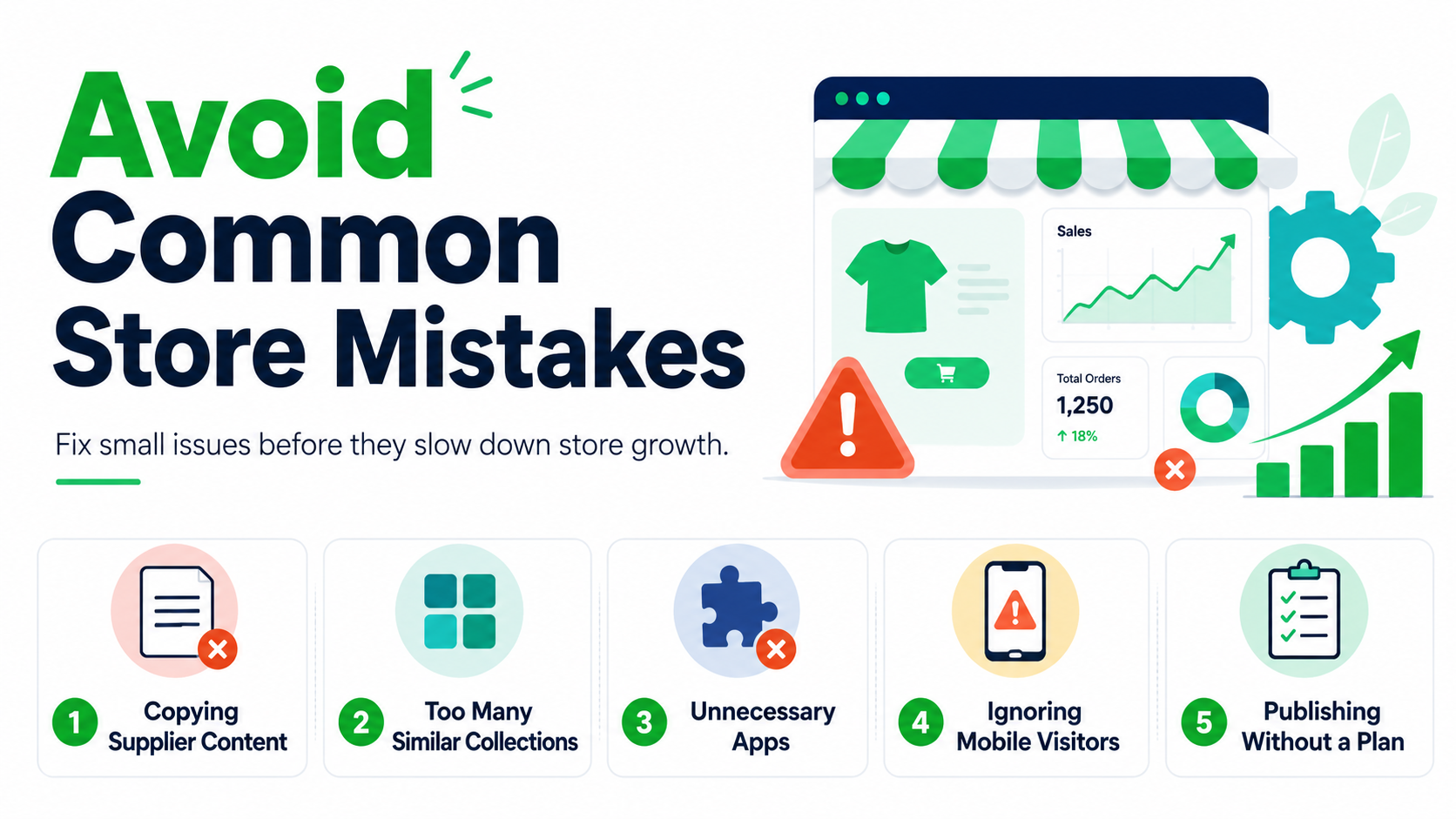
Common mistakes include:
- Copying Supplier Content: Supplier descriptions are often used by many retailers. Original content makes the page more useful and distinctive.
- Creating Too Many Similar Collections: Overlapping categories can confuse users and cause several pages to compete for similar searches.
- Installing Unnecessary Apps: Every app may add scripts, code, or visual elements. Too many tools can reduce speed and usability.
- Ignoring Mobile Visitors: Menus, filters, buttons, images, and forms must remain easy to use on small screens.
- Publishing without a Plan: New articles or pages should support a real customer need and connect with the wider store structure.
- Repeating Search Terms Excessively: Natural writing is more useful than forcing the same phrase into every paragraph.
- Neglecting Old Pages: Outdated products, broken links, weak metadata, and old articles can reduce overall quality.
- Focusing Only on Traffic: The store should attract suitable visitors and help them make decisions, not simply increase visitor numbers.
When Professional Support Becomes Valuable
Store owners often manage inventory, orders, customer service, marketing, suppliers, and daily operations. SEO adds research, content writing, technical monitoring, and performance testing, and reporting to that workload.
A specialist team can be helpful when:
- Organic traffic has stopped growing.
- Important products receive little visibility
- The catalog is expanding quickly
- The store has duplicate content problems
- Technical errors keep returning
- A redesign or migration is planned
- Internal teams lack time or specialist skills
- Traffic increases without stronger sales
A good service provider should clearly explain the priority areas. It should understand the Shopify system and not apply the same checklist to every website. A professional company should also connect optimisation efforts with business goals. It may be more useful to optimise a high-value collection page than to improve a page that does not bring much value. Communication is important. Store owners need to know what will be done and why it is needed.
| Area | What to Review | SEO Value | Customer Value |
| Product pages | Titles, descriptions, images, schema | Improves relevance for product searches | Supports informed purchase decisions |
| Collection pages | Headings, copy, filters, internal links | Strengthens category visibility | Makes product comparison easier |
| Technical setup | Indexing, canonicals, redirects, sitemap | Creates cleaner crawl and index signals | Reduces broken or confusing journeys |
| Performance | Theme, apps, scripts, images | Supports mobile competitiveness | Improves speed and reduces drop-off |
| Content | Guides, comparisons, FAQs, linking | Builds topical relevance and organic reach | Answers questions before purchase |
How to Choose the Right Partner?
Choosing an SEO provider should involve more than comparing promises. Strong providers usually have a transparent process and realistic expectations.
Businesses can ask:
- How will the store be audited?
- Which pages will be prioritized?
- How are duplicate URLs handled?
- How will product and collection content be improved?
- What technical limitations does Shopify create?
- How will results be measured?
- How often will reporting be provided?
- How are rankings connected with sales?
- What happens as the catalog grows?
- How will recommendations be implemented?
A provider should avoid guaranteed ranking claims. Search results are influenced by competition, demand, website history, content quality, and many other factors. The most useful partner is often one who can explain complex issues in clear language. Strategy, prioritization, and accountability are more valuable than an impressive list of activities without a clear purpose.
Conclusion
At the end of the day, Shopify SEO is really about helping the right people find your store and making their experience better once they get there. It is not just about rankings or traffic numbers. It is about making your products easier to discover, your pages easier to understand, and your store easier to use. Things like clear content, better product details, cleaner structure, faster pages, helpful internal links, and mobile-friendly design all play a part in that.
It is also worth keeping in mind that no single change can do all the work on its own. A store may load quickly yet still struggle because of poor product pages. It may have excellent content yet fail to perform because important pages are hidden or technical problems affect how it works. Even high traffic will not lead to conversions if the shopping process does not run smoothly. Real improvement usually happens only when the entire store works more efficiently together.
Connect with ESIGN WEB SERVICES for a detailed store review and a practical growth strategy designed to uncover hidden issues, improve performance, and support meaningful ecommerce results.
Frequently Asked Questions
Question: What is the main purpose of Shopify SEO?
Answer: The ultimate goal of Shopify SEO is to help search engines understand your online store properly, making sure that the relevant pages show up when the right people search for them. As a result, it allows your products, collections, and content to be found in search results, bringing in relevant visitors. In addition to helping with search engine visibility, it also improves user experience through better navigation, clearer pages, better product information, and mobile optimisation.
Question: How long does Shopify SEO take to produce results?
Answer: Shopify SEO tends to be a slow process, meaning that it should not be considered an instant solution. Although some improvements, such as technical tweaks, may provide quick results, it might take a couple of months before the website starts growing significantly. How long it takes to notice changes in your Shopify store will depend on its starting position, competitive environment, content quality, and other factors. Rather than expecting fast results, it is wiser to track steady improvement in visibility and performance.
Question: Is Shopify a good platform for organic search?
Answer: Absolutely, Shopify can become an excellent platform for organic search when everything is done the right way. First of all, it offers many useful tools such as editable page titles, meta descriptions, redirects, canonical tags, sitemaps, and mobile-friendly themes. However, this should not be where the work ends, as there are many other actions that must be taken for successful search marketing. These include content creation, strong product pages, well-built collections, internal linking, image optimisation, and technical analysis.
Question: Which pages should a store improve first?
Answer: The pages that should be worked on first are those that currently carry significant business value or traffic potential. This may include the homepage, major category pages, popular products, profitable products, and even pages that are already receiving impressions through search engines. Improvements in these areas can usually deliver quicker and more meaningful results compared to trying to improve all pages at once. Old blog posts or pages that attract visitors but fail to direct them anywhere worthwhile should also be considered.
Question: Why are original product descriptions important?
Answer: Original product descriptions are important because they help your store sound more useful, more trustworthy, and more different from other sellers. Supplier descriptions are often reused across many websites, which makes it harder for your page to stand out. A good original description can explain the product in a way that feels clearer and more relevant to your customers. It can cover features, benefits, materials, size, usage, and care details in a way that actually helps someone make a decision with more confidence.
Question: Can blog content increase store sales?
Answer: Yes, blog content can help support sales, especially when people are still in the research stage. Many shoppers look for answers, comparisons, or advice before they are ready to buy. Helpful blog posts can meet them at that point and guide them in the right direction. Buying guides, care tips, comparison articles, and problem-solving content can all build trust and make the store feel more useful. Even when a sale does not happen straight away, strong blog content can still help influence future buying decisions.
Question: How does page speed affect customer behavior?
Answer: Page speed affects customer behavior a lot because people usually do not like waiting. If a page loads too slowly, many visitors will leave before they even get a proper look at the product. This is even more important on mobile, where users expect a smooth and quick experience. Heavy images, too many apps, videos, animations, and extra scripts can all slow the site down. Faster pages make the store easier to browse, reduce frustration, and help shoppers move through categories and products more comfortably.
Question: Should every product image include alt text?
Answer: Most important product images should include alt text because it helps with accessibility and gives extra context about the image. Alt text is mainly there to describe visuals for people using screen readers, but it can also help search engines understand the page better. It should sound natural and explain what is in the image clearly. It should not feel stuffed or repetitive. Images that show product size, colour, material, features, or how the item is used should usually have proper alt text.
Question: Why do Shopify stores develop duplicate pages?
Answer: Shopify stores can develop duplicate pages for a few different reasons. Products may appear in more than one collection, and tags, filters, or sorting options can sometimes create extra versions of similar pages. Duplicate content can also happen when supplier descriptions are copied from other websites. This can make it harder for search engines to decide which version of a page should rank. Reviewing internal links, canonical tags, page structure, and indexed URLs can help reduce this problem and keep the store more organised.
Question: Is professional help necessary for every Shopify store?
Answer: Not necessarily. Some Shopify store owners are capable of doing SEO work on their own, particularly when they are running a small store and have enough time to invest in writing content, updating pages, and checking technical aspects. However, as their business grows and the complexity of running it increases, it becomes more difficult for them to handle everything by themselves. If they experience reduced traffic, constant technical issues, or have other tasks they need to take care of, it might be easier for them to delegate.
Author Details

Ashwani Kumar Sharma
Ashwani has been actively involved in SEO services since 2005. His expertise and distinctive work approaches have made him one of the most experienced and trusted SEO experts in the industry. He is a certified SEO and Google Ads professional. He also has strong business development skills in advanced SEO, PPC, and digital marketing strategies.


