



AI in Google Ads: Where Automation Helps and Where Human Strategy Still Matters

Key Takeaways
- AI is now deeply involved in Google Ads bidding, targeting, audience discovery, creative testing, forecasting, and campaign optimization.
- Automation works best when campaigns have clear goals, reliable data, accurate conversion measurement, and enough information for machine learning to make useful decisions.
- Google can automate auction-level decisions far faster than a human campaign manager, but it cannot independently understand whether those decisions are commercially valuable to a business.
- More conversions do not always mean better performance. Lead quality, profitability, sales rates, and customer value still need human evaluation.
- Performance Max and automated bidding can be powerful, but they require quality inputs, appropriate campaign structure, and continuous oversight.
Introduction
Google Ads has become far more automated, with AI now supporting bidding, targeting, ad testing, audience selection, and campaign optimization. This has made it easier for advertisers to manage large amounts of data and react to performance changes faster than before. AI in Google Ads can identify patterns, adjust bids in real time, and help campaigns reach people who are more likely to convert.
Automation still has its limits. AI can only work with the goals, data, and signals it receives. It cannot fully understand business priorities, lead quality, profit margins, customer expectations, or how a brand wants to position itself. These areas still depend on human experience, context, and judgment.
The best campaigns bring both sides together. AI can handle speed, scale, and repetitive work, while marketers guide the strategy, creative direction, measurement, and overall business goals. In this blog, we will look at where automation adds real value and where human thinking still makes the biggest difference.
How Has AI Changed Google Ads?
AI Has Changed the Game for Marketing. Much of the repetitive work, which used to require constant manual attention, can now be done automatically. Advertisers won’t have to spend quite so much time manually adjusting bids, checking audiences, tweaking keywords, or testing each ad variation. It means they have more time to spend on the thinking parts like setting clear goals, understanding what the results actually mean, being more creative, and making sure Google is working with accurate and useful data.
Some of the biggest changes include:
- Bidding is far more automated: Smart Bidding can change bids from one auction to the next based on how likely a person is to convert. Instead of relying on the same bid for every search, Google can respond to each situation differently. This saves marketers from constantly increasing or lowering bids by hand throughout the day.
- More signals can be considered at once: Machine learning can look at device type, location, time of day, past behavior, search context, conversion history, and other signals together. A marketer can certainly review some of these details, but not across thousands of searches at the same speed.
- Targeting is less restrictive than before: Features such as broad match and audience signals allow campaigns to reach beyond tightly controlled keyword lists and audience groups. This can help Google find relevant users whose exact searches or behavior may not have been predicted in advance.
Google Ads specialists still have a role to play. It has shifted to where their time and experience count most. With Google doing more of the routine work, marketers need to spend more time on customer value, measurement, business goals, and overall direction of the campaign.
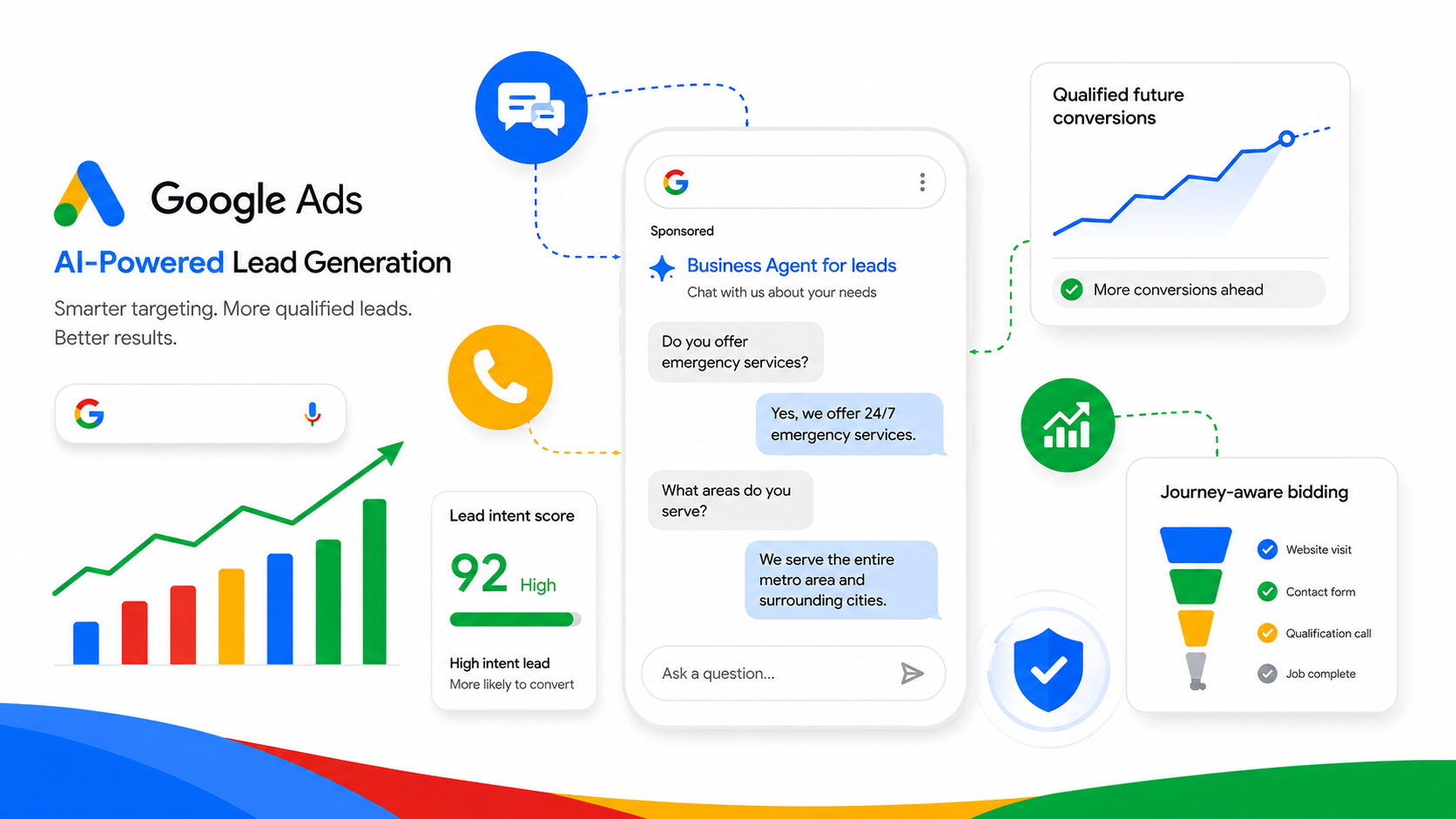
Where AI and Automation Work Extremely Well
The power of automation in Google Ads really shines when you have thousands of tiny decisions to make, and more information than any one person could reasonably review manually. This is where automation really has an advantage. It can react to changing conditions quickly, without having someone monitor each auction as it happens.
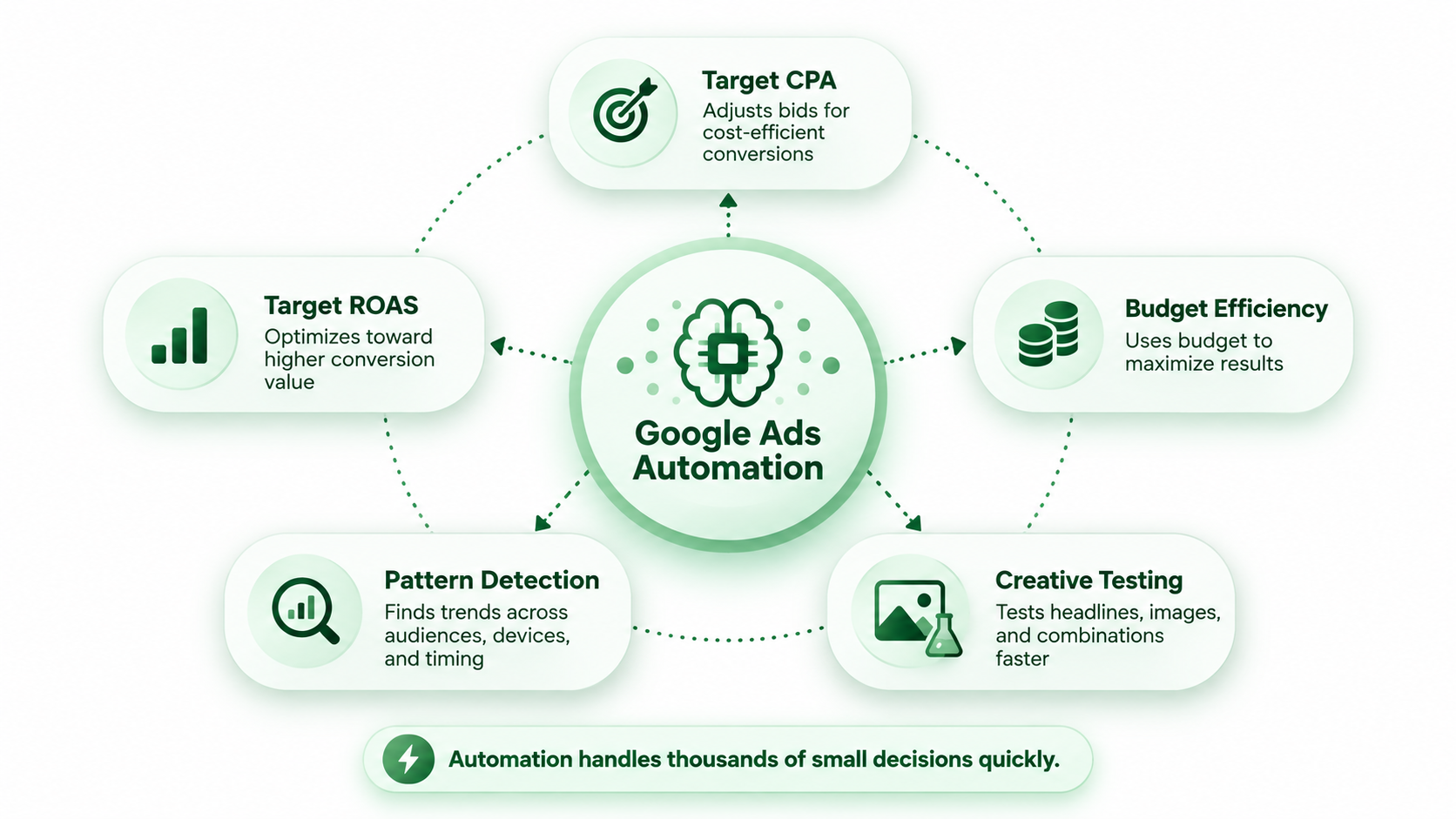
Some areas where automation works especially well include the following:
- Target CPA optimization: Target CPA helps Google work toward generating conversions around a chosen average cost per acquisition. Rather than adjusting keyword bids manually, the system can raise or lower them depending on how likely a search is to produce a conversion.
- Target ROAS optimization: Target ROAS is more focused on value than simply increasing conversion numbers. Google adjusts bids while trying to reach a certain level of conversion value compared with ad spend, which can be useful when different customers or purchases are worth different amounts.
- Making better use of the available budget: Maximize Conversions aims to generate as many conversions as possible within the budget. Maximize Conversion Value takes a slightly different approach by focusing on the total value those conversions may bring, not just the number of them.
- Finding patterns in campaign data: AI can notice changes across devices, locations, audiences, times of day, and user behavior that may be easy to miss during a manual review. These patterns can support better Google Ads optimization and help marketers decide where to focus next.
- Testing creative combinations: Automation can test different headlines, descriptions, images, and other ad creatives without requiring someone to build every version manually. This speeds up testing while still leaving the main message and offer in human hands.
These are the kinds of tasks where letting AI handle the heavy data work usually makes sense. Marketers do not need to compete with an algorithm over thousands of small calculations. Their job is to make sure those calculations are helping the business move toward the right goal.
Performance Max: AI-Driven Google Ads in Action
Performance Max shows how deeply automation is now built into Google Ads. Advertisers provide the goals, budget, creative assets, audience information, and conversion data, while Google uses AI to make many of the campaign decisions automatically.
- How Performance Max Uses Automation: Explain that AI manages bidding, targeting, placements, and creative combinations using campaign data and user signals.
- Asset Groups: Explain what advertisers provide, such as headlines, descriptions, images, videos, and logos, and how Google combines them.
- Automated Bidding: Explain how Google adjusts auction-level bids based on conversion likelihood, goals, and available signals.
- When Performance Max Works Best: Explain that clear goals, reliable conversion tracking, strong creative assets, and enough useful data give automation better inputs.
Performance Max can handle much of the execution, but the campaign still needs human direction. AI can manage scale, bidding, and data processing, while marketers remain responsible for setting the right goals, checking results, improving creative, and making sure the campaign supports the wider business strategy.
Smart Bidding: When You Should Let the Algorithm Work
Smart Bidding usually performs better when Google has enough reliable data for its ad algorithms to recognize useful patterns and make informed bidding decisions. A common mistake is changing campaign settings too often, which can interrupt that learning process before the system has enough time to adjust.
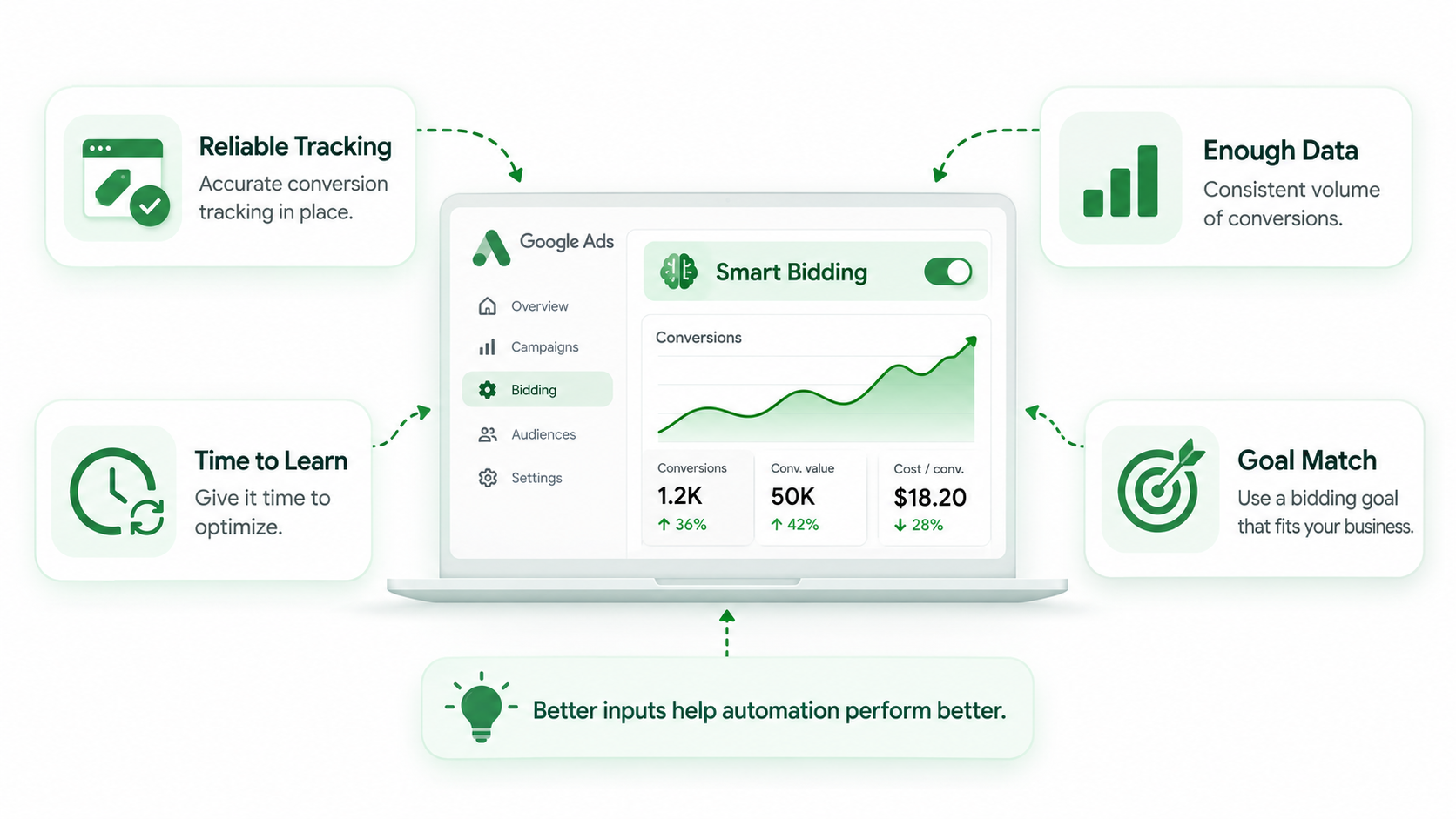
Smart Bidding tends to be in a better position when:
- Conversion tracking is reliable: Accurate conversion tracking helps Google understand which actions should influence bidding. If the tracking is wrong or incomplete, the system may start chasing actions that look useful in the account but do not actually help the business.
- There is enough useful data: Google Ads AI needs campaign activity to identify patterns and make stronger predictions. Very limited or inconsistent data leaves the system with less useful information to learn from.
- The campaign gets time to settle: Constant changes to budgets, targeting, bid strategies, and conversion settings can make performance harder to evaluate. Some stability gives Google a better chance to learn from consistent data.
- The bidding strategy matches the business goal: A business focused on revenue may need a different bidding approach from one mainly trying to increase lead volume. The bidding strategy should support what the company genuinely wants to achieve.
Letting Smart Bidding do its job does not mean walking away from the campaign. It simply means marketers should focus on improving the environment around the algorithm instead of trying to interfere with every single auction.
Where Can Google Ads Automation Go Wrong?
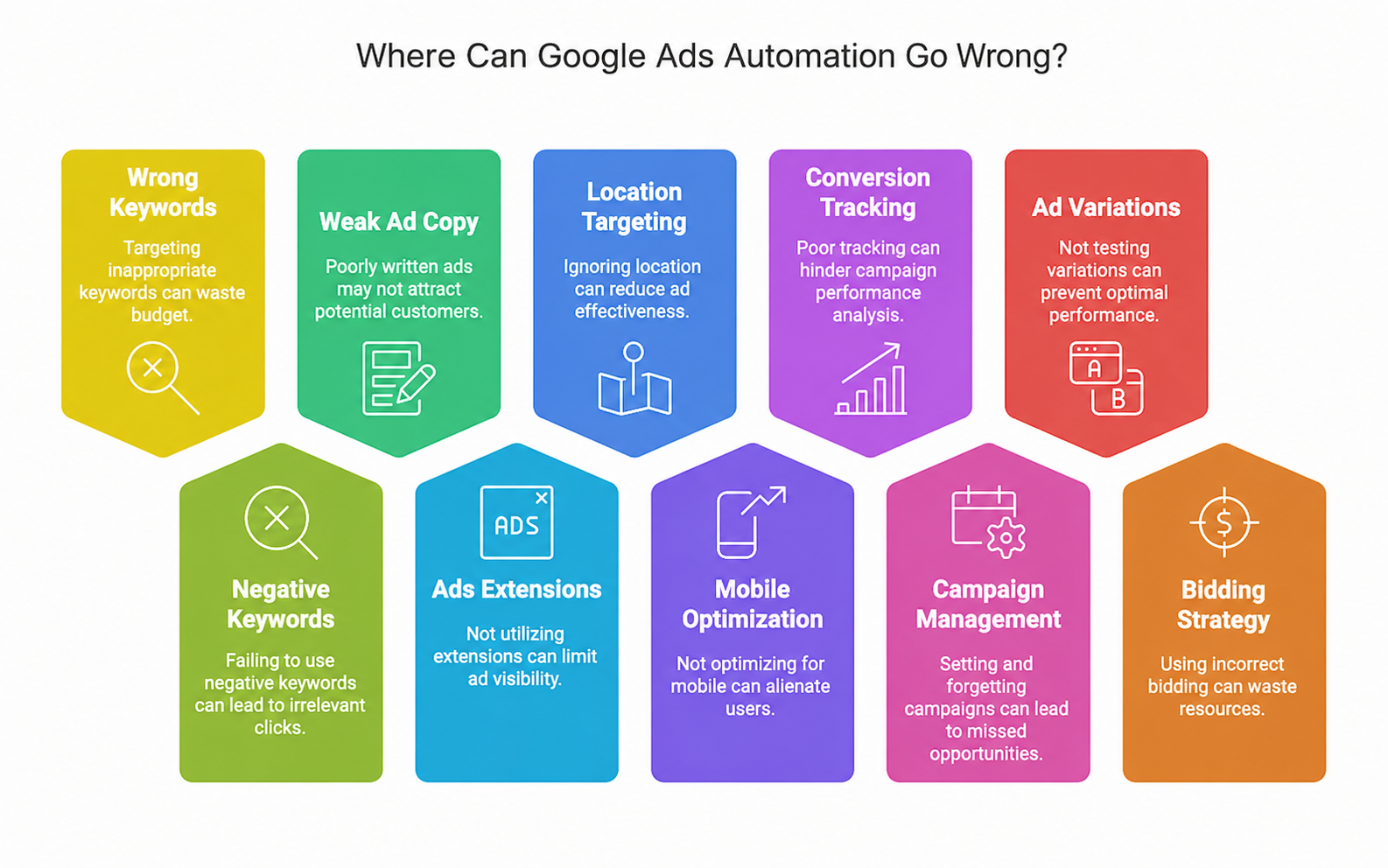
Automation usually creates problems when a campaign is working with poor data, unclear goals, or the wrong idea of what success looks like. Google can be very efficient at reaching a target, but that does not necessarily mean the target is valuable to the business.
Some common problems include:
- Optimizing for the wrong conversion: If brochure downloads, phone calls, forms, and purchases are all treated as equally important, Google may start favoring whichever action is easiest to generate. That can increase the conversion count without improving revenue or customer quality.
- Learning from inaccurate tracking: If conversion tracking is broken or set up incorrectly, the system may make decisions using information that does not reflect what is actually happening in the business.
- Expanding into weak search traffic: Automated matching may bring in search terms that seem related at first but have very little commercial value. Traffic can increase without creating better inquiries or sales.
- Missing useful exclusions: Well-chosen negative keywords can stop a campaign from repeatedly spending money on searches the business already knows are irrelevant or unlikely to convert.
- Working with weak creative: Google can test different combinations of ad creatives, but an unclear offer, bland headline, or generic message still gives the system little to work with.
The biggest risk is not always poor automation. Sometimes automation performs very well at producing the wrong result. Advertisers need to compare what the platform reports with what is really happening in sales, inquiries, and revenue.
Why Conversion Tracking Matters More With AI
Conversion tracking becomes even more important as Google takes over more campaign decisions because those decisions are shaped by the results the system can see. If tracking gives Google an incomplete or misleading picture, the campaign may start chasing the wrong type of outcome.
A stronger measurement setup should look at several areas:
- Primary conversions should represent genuine value: Purchases, qualified inquiries, appointments, and other meaningful actions should normally matter more than smaller website interactions such as page views or simple button clicks.
- Lead quality should not be confused with lead volume: one hundred inquiries can sound impressive, but that number quickly loses its value if only a handful come from suitable customers.
- Conversion values can show important differences: accurate conversion values can help Google understand that one customer, service, or purchase may be worth much more than another.
Better measurement gives automation better information to work with. Instead of simply asking Google to bring in more inquiries, businesses can gradually help the system understand which inquiries are actually more likely to become valuable customers.
Where Does Human Strategy Still Matter Most?
Human strategy matters most when campaign decisions depend on business context, customer behavior, profitability, and longer-term priorities. Advertising data can tell you what happened, but it cannot always tell you whether that result makes sense for the business.
People still play an important role in areas such as the following:
- Setting business objectives: Someone needs to decide whether the real priority is revenue, qualified leads, new customers, market growth, or something else. AI can work toward that target, but it cannot decide which one matters most to the company.
- Understanding acquisition costs: Customer acquisition cost means more when it is compared with profit margins, repeat purchases, sales close rates, and the long-term value of a customer.
- Understanding the customer: Sales conversations, reviews, objections, questions, and industry experience often reveal details that are difficult to see inside an advertising dashboard.
Modern Google Ads management is becoming more strategic, not less important. Google may handle more of the daily execution, but people still decide what all of that automation is supposed to achieve.
Can AI Create Ads Without Human Direction?
Artificial intelligence can help speed up the ad creation process, but handing over the entire message to automation can easily lead to generic or forgettable advertising. Strong ads still come from understanding the customer, the offer, the problem being solved, and what makes a business a genuine reason to be chosen.
Human creative direction still matters because
- Brand voice needs to stay consistent: AI-generated copy should still sound like the company and suit the people it wants to reach. A message can perform well and still feel wrong if it sounds nothing like the brand.
- Customers need a real reason to choose: Phrases such as “high quality,” “trusted service,” or “contact us today” are common. They do not explain why one company is a better option than another.
- Accuracy still needs a human review: Automated copy should always be checked for pricing, service details, claims, compliance, and anything else that could confuse or mislead the customer.
- Testing still needs interpretation: AI can test many versions quickly, but marketers still need to work out why certain messages perform better and what those results say about the audience.
The best use of AI is as part of the creative process, not in charge of the entire process. People can help shape the core idea. Artificial intelligence can be used to generate, test, and improve different versions around the core idea.
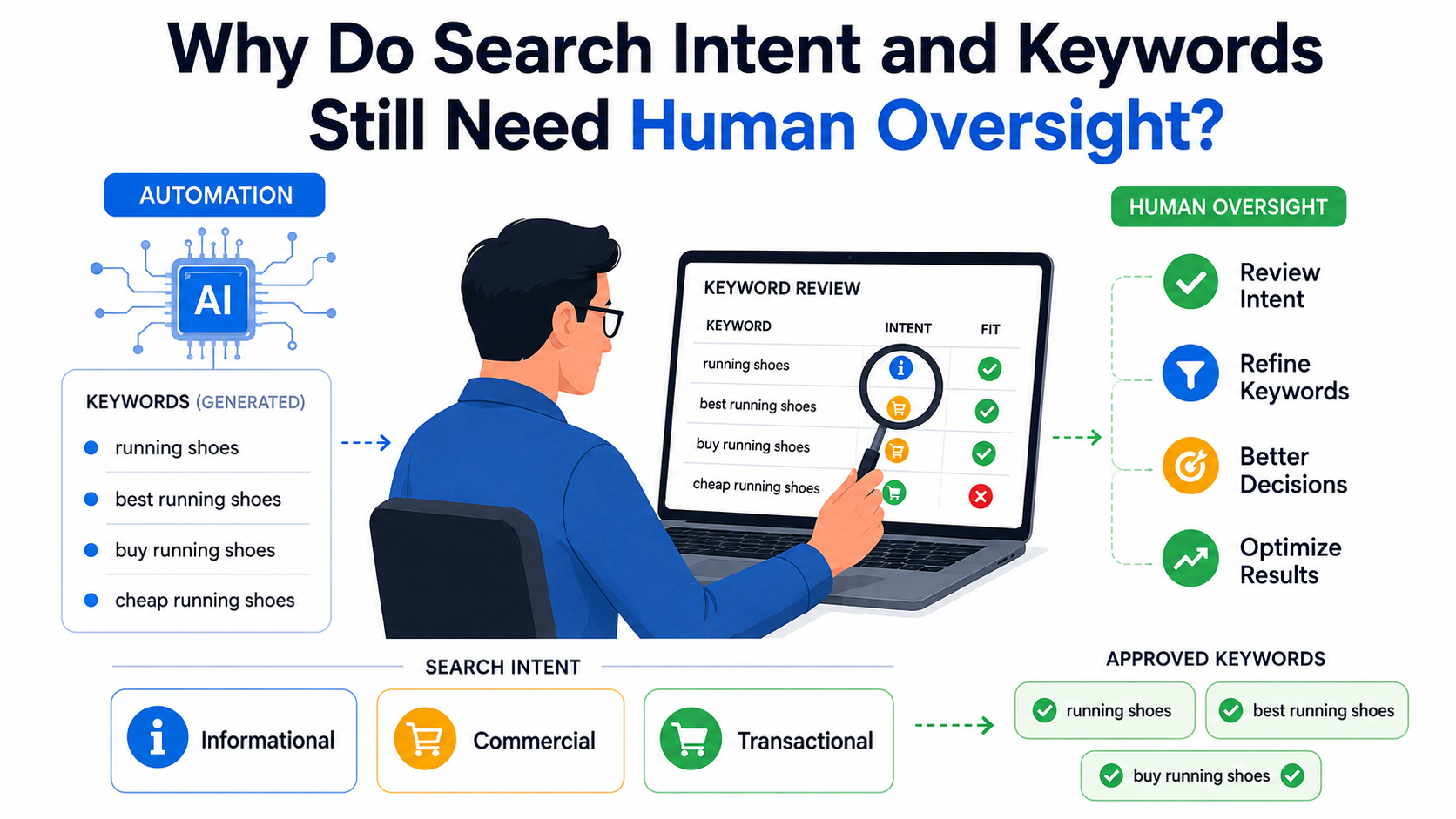
Google is much better at understanding what people mean when they search, not just matching exact keywords. This allows campaigns more time to identify new opportunities, but it also makes routine human review more necessary.
Marketers still add value in several areas:
- Broad match can uncover searches you did not plan for: Broad match can connect ads with related searches that were never included directly in the original keyword list. This can reveal useful opportunities, but it can also bring traffic that deserves a closer look.
- Similar wording can hide very different intent: Two searches may look almost the same while coming from people at completely different stages of the buying journey. One person may simply be researching, while another is ready to make a decision.
- Negative keywords can remove clear waste: Negative keywords can stop ads from appearing for searches that repeatedly bring in irrelevant or low-value visitors.
Automation can spot patterns in search behavior, while people can add commercial meaning to those patterns. Using both together allows campaigns to expand without losing sight of relevance and customer intent.
What Should AI Handle and What Should Humans Control?
A strong Google Ads strategy does not have to choose between full automation and full manual control. AI is better at speed, scale, and repeated data-based decisions, while people are better at interpreting business value, customer context, and commercial priorities. The clearest difference can be seen across these six areas:
| Area | AI Is Better At | Humans Are Better At |
| Auction-Level Bidding | AI can assess signals and adjust bids for individual auctions much faster than a person could manage manually. | People decide the commercial target behind those bids, such as acceptable acquisition cost, revenue goals, or customer value. |
| Data Processing | Machine learning can review large amounts of campaign data across searches, devices, audiences, locations, and other variables at the same time. | People decide which patterns are actually meaningful for the business and which changes deserve action. |
| Predicting Likely Outcomes | Google Ads AI can estimate which users, searches, or situations are more likely to produce a conversion based on available data. | People judge whether those conversions are genuinely useful, qualified, and aligned with the company’s wider goals. |
| Creative Testing and Positioning | Automation can test different combinations of headlines, descriptions, images, and other ad creatives quickly and at scale. | People shape the offer, positioning, customer message, brand voice, and the reasons someone should choose the business. |
| Measurement and Lead Quality | AI can optimize toward the conversions and values that are being tracked inside the account. | People decide which conversions should matter most and compare platform results with CRM data, sales feedback, and real lead quality. |
| Profitability and Strategy | AI is strong at executing toward the goals and signals it has been given, using speed and scale to improve performance. | People assess profit margins, customer acquisition cost, business priorities, and when budgets or strategy need to change. |
Building a Human + AI Google Ads Management Framework
A strong Google Ads setup works best when automation and human decision-making support each other. AI can handle speed, bidding, pattern recognition, and large amounts of data, while marketers guide the campaign with business goals, customer insight, and commercial judgment.
Step 1 – Define Business Outcomes
Start by deciding what the campaign should actually achieve. That may be qualified leads, sales, bookings, revenue, or new customers. Clear business outcomes give both the marketer and Google a better direction than focusing only on clicks or platform conversions.
Step 2 – Establish Accurate Conversion Tracking
Make sure conversion tracking is reliable before asking automation to optimize heavily. The system needs to know which actions matter, whether that is a purchase, qualified enquiry, booked appointment, or another meaningful result. Poor tracking can quickly push automation in the wrong direction.
Step 3 – Choose the Right Campaign Structure
Select campaign types based on the job they need to do. Search, Performance Max, Demand Gen, and other formats serve different purposes. A clear structure makes it easier to control budgets, measure performance, and understand where results are coming from.
Step 4 – Provide High-Quality Data and Signals
Automation performs better when it receives useful inputs. Strong audience signals, first-party data, realistic conversion values, relevant creative assets, and clear campaign settings all help Google make better decisions.
Step 5 – Allow Automation Enough Time to Learn
Avoid making constant changes every time performance moves up or down. Automated systems need time to collect data and identify patterns. Frequent changes to budgets, bids, targeting, or goals can make it harder to understand what is actually working.
Step 6 – Monitor Search and Traffic Quality
Do not look only at traffic volume. Review search terms, user behaviour, conversion patterns, and the quality of visitors reaching the site. This helps identify irrelevant traffic, new opportunities, and areas where negative keywords or tighter controls may be needed.
Step 7 – Evaluate Lead Quality outside Google Ads
A conversion inside Google Ads does not automatically mean a good lead. Use CRM data, sales feedback, phone-call quality, appointments, and closed deals to see whether the campaign is attracting people who are genuinely likely to become customers.
Step 8 – Improve Creative and Landing Pages
Automation can help bring people to the business, but the message and website still need to do their job. Strong ad creatives and relevant landing pages should clearly explain the offer, match user intent, build trust, and make the next step easy.
Step 9 – Reallocate Budget Based on Profitability
Move budget toward campaigns, products, services, and audiences that create real business value. Do not rely only on cheap conversions or high ROAS. Profit margins, lead quality, customer acquisition cost, and revenue should all influence where more money is invested.
Step 10 – Scale What Produces Business Results
Once a campaign consistently delivers qualified leads, sales, or profitable growth, increase investment carefully. Scaling should be based on real business performance, not simply on the fact that automation can spend more.
The goal of a human + AI framework is not to control every small campaign decision manually or hand everything over to automation. It is to let AI handle the tasks it does well while marketers stay responsible for direction, quality, profitability, and long-term business results.
Common Google Ads Automation Mistakes
Google Ads automation can save time and improve efficiency, but it can also create problems when it is used without enough planning or review. Most mistakes happen when businesses trust automation too quickly, give it weak data, or focus on platform metrics instead of real business results.
- Scaling Budgets Too Quickly
- Using Broad Match Without Enough Control
- Giving Automation Weak Audience Signals
- Using Weak Creative Assets.
- Treating Every Conversion as Equal
- Making Too Many Changes at Once
- Ignoring Location Targeting Settings
- Failing to Use First-Party Data
- Ignoring Performance Max Asset Quality
- Scaling Based Only on Conversion Volume
- Not Reviewing Automated Changes
- Relying on Platform Data Alone
The biggest mistake is assuming that automation means no management is required. Google can handle more of the execution, but marketers still need to guide the campaign, check the quality of the results, and make sure automation is helping the business rather than simply increasing activity.
How Should You Measure Whether AI Is Actually Helping?
The most useful question is not whether AI is generating more activity. It is whether the campaign is creating better business results. Advertising metrics are useful, but they become much more meaningful when they are connected with actual sales and financial performance.
Useful measurements include:
- Qualified conversions: Focus on conversions from the type of customer the business genuinely wants rather than treating every action in the same way.
- Customer acquisition cost: Customer acquisition cost shows what it actually costs to win a customer instead of stopping at the initial cost of generating an inquiry.
- Conversion value: Conversion value makes it easier to compare campaigns based on the commercial importance of the results they produce.
- Profitability: In the end, advertising needs to contribute to sustainable commercial growth rather than simply produce attractive numbers inside the platform.
A campaign can sometimes become more expensive and still become more valuable. If higher-cost leads are much more likely to become paying customers, that extra cost may be completely worthwhile. The goal should not always be to help AI find the cheapest possible conversion. It should be to help it find the conversions that are genuinely worth having.
What Does the Future of AI in Google Ads Look like what?
Google Ads will keep becoming more automated as AI takes care of bidding, targeting, testing, and everyday campaign optimization. First-party data will matter more because accurate customer and conversion information gives automated systems stronger signals to work with. As more routine work is handled automatically, marketers can spend less time making constant account changes and more time understanding performance, learning what customers respond to, and making sure campaigns support real business goals.
This change will make strategic PPC skills more valuable. Specialists will need a stronger understanding of customer behaviour, creative testing, measurement, profitability, and Google Ads strategy. AI can process amounts of data and make quick campaign decisions, but people still need to decide what success looks like, judge whether leads and sales are genuinely valuable, and know when the strategy needs to change. The future will rely on AI for execution and marketers for direction, context, and judgment.
Conclusion
AI has made Google Ads faster, smarter, and more automated. Machine learning can analyze huge amounts of data, adjust bids during individual auctions, predict user behavior, test advertising combinations, and identify new opportunities more efficiently than a human marketer could do manually. But AI still needs clear direction. It does not automatically understand your customers, profit margins, business priorities, sales process, or definition of a high-quality lead.
So the best way is to let AI do the things where speed, scale, and data processing matter but keep humans accountable for business strategy, creative direction, measurement, profitability, and customer understanding. Google Ads works best when AI and human skills work together, not against each other.
Are your Google Ads campaigns becoming more automated without delivering stronger business results?
Contact eSign Web Services to build a Google Ads strategy that uses AI efficiently while keeping human judgment at the center of important campaign decisions. Our focus goes beyond clicks and platform conversions. We help align Google Ads campaigns with qualified leads, customer acquisition, revenue, and sustainable business growth.
Frequently Asked Questions
Question: How is AI used in Google Ads?
Answer: AI assists Google Ads with bid management, audience targeting, understanding user intent, testing different combinations of ads, and optimizing campaigns. The artificial intelligence can process much more information than a human, and it can do it faster. But companies need clear goals, reliable conversion tracking, relevant creative material, and an effective campaign strategy.
Question: Can Google Ads be completely automated?
Answer: There is currently an abundance of automation options for Google Ads, including bidding, audience targeting, creative testing, and campaign optimization. However, too much automation can cause issues. It is important for companies to assess their leads, budgets, search traffic, profits, landing pages, and how effective the campaign actually is in growing their business.
Question: Is smart bidding better than manual bidding?
Answer: Smart Bidding can analyze the signals from the auctions and increase/decrease the bids much faster than it could be done manually by people. Smart Bidding may operate well when there is good conversion data available and a certain target is established. Nevertheless, Google cannot always understand that each of the conversions is worth a profit.
Question: Can AI improve Google Ads lead quality?
Answer: The use of AI can facilitate an increase in the quality of leads since Google will have information on those inquiries that convert into paying clients. Such data as CRM data, offline conversions, sales results, and conversion values can be more accurate. In case all form submissions are considered equal, AI will only produce easier-to-obtain leads.
Question: Will AI replace Google Ads specialists?
Answer: AI may take up more of the repetitive tasks in campaigns, but it is improbable that AI can entirely replace Google Ad experts. Instead, marketers will have more time for strategizing, analyzing customer behavior, measuring conversions, creating landing pages, measuring profits, guiding creatives, and expanding their business.
Author Details

Ashwani Kumar Sharma
Ashwani has been actively involved in SEO services since 2005. His expertise and distinctive work approaches have made him one of the most experienced and trusted SEO experts in the industry. He is a certified SEO and Google Ads professional. He also has strong business development skills in advanced SEO, PPC, and digital marketing strategies.


