



Why SEO Content Fails to Rank: Hidden Signals Most Marketers Ignore Traffic

Key Takeaways
- Publishing alone isn’t a visibility strategy; 96.55% of indexed pages get zero organic traffic.
- Keyword presence gets a page indexed. Genuine usefulness is what gets it ranked.
- Intent alignment matters as much as the keyword; format, depth, and answer speed all count.
- Topical authority is built through connected content ecosystems, not isolated standalone posts.
- Bounce rate and scroll depth signal to search systems whether the page delivered on its promise.
- Core Web Vitals and technical SEO must be audited separately from content quality; both matter.
- Real depth means actionable judgment; what matters, what to avoid, what to do next. Not word count.
SEO content rarely fails because the team did not put in the hours. Most of the time, it happens because the page answers the keyword but completely misses what the searcher actually needed. Google’s automated ranking systems evaluate hundreds of signals across hundreds of billions of pages to surface genuinely useful results. That means even a polished, well-structured draft can sit on page four if it lacks intent fit, trust, depth, clarity, or a smooth experience.
This is exactly where hidden SEO signals start doing quiet damage. A page can have the right title tag, a clean meta description, and neatly organized headings; yet still feel incomplete to the real human reading it. Ahrefs found that 96.55% of pages in its index receive zero organic traffic from Google, which proves that publishing alone is not a visibility strategy. The web does not have a content shortage. It has a useful content shortage.
Think of this blog as a ranking X-ray. The real question is not whether the content exists; it is whether it earns the click, answers fast, proves its point, and gives people a genuine reason to stay. For small businesses, startups, marketing managers, and agencies, that difference separates another ignored post from a page that actually pulls its weight.
This is exactly why SEO content fails to rank even when the internal checklist looks completely green, and the deeper problem usually starts well before the publish button gets pressed.
The Myth of “Well-Optimized Content”
Keyword optimization stopped being a differentiator the day every competitor figured out how to use a title tag. Many SEO ranking issues begin when teams treat optimization like decoration instead of diagnosis. A page can include the target keyword, use proper headings, and still read like a slightly polished version of the same advice already sitting at position two. That is a quiet, expensive trap.
Here is what fake optimization usually hides:
- The keyword is present, but the reader’s real question stays unanswered.
- The heading structure looks organized, but the argument underneath feels thin.
- The content is readable, yet offers nothing worth remembering.
- The page chases traffic but ignores the user’s next decision.
- The copy sounds optimized; just not especially worth trusting.
Surface confidence is the real problem. Content optimization SEO can make a draft look finished long before it becomes genuinely useful. A startup might publish a guide on lead generation, define the term, list familiar tips, and then wonder why the content not ranking Google problem refuses to budge. The better question is never “Did we optimize this?” It is “Would a smart reader actually bookmark this?”
One of the most expensive SEO mistakes is assuming search engines reward pages that look optimized rather than pages that are genuinely useful, memorable, and easier to act on than everything else already ranking.
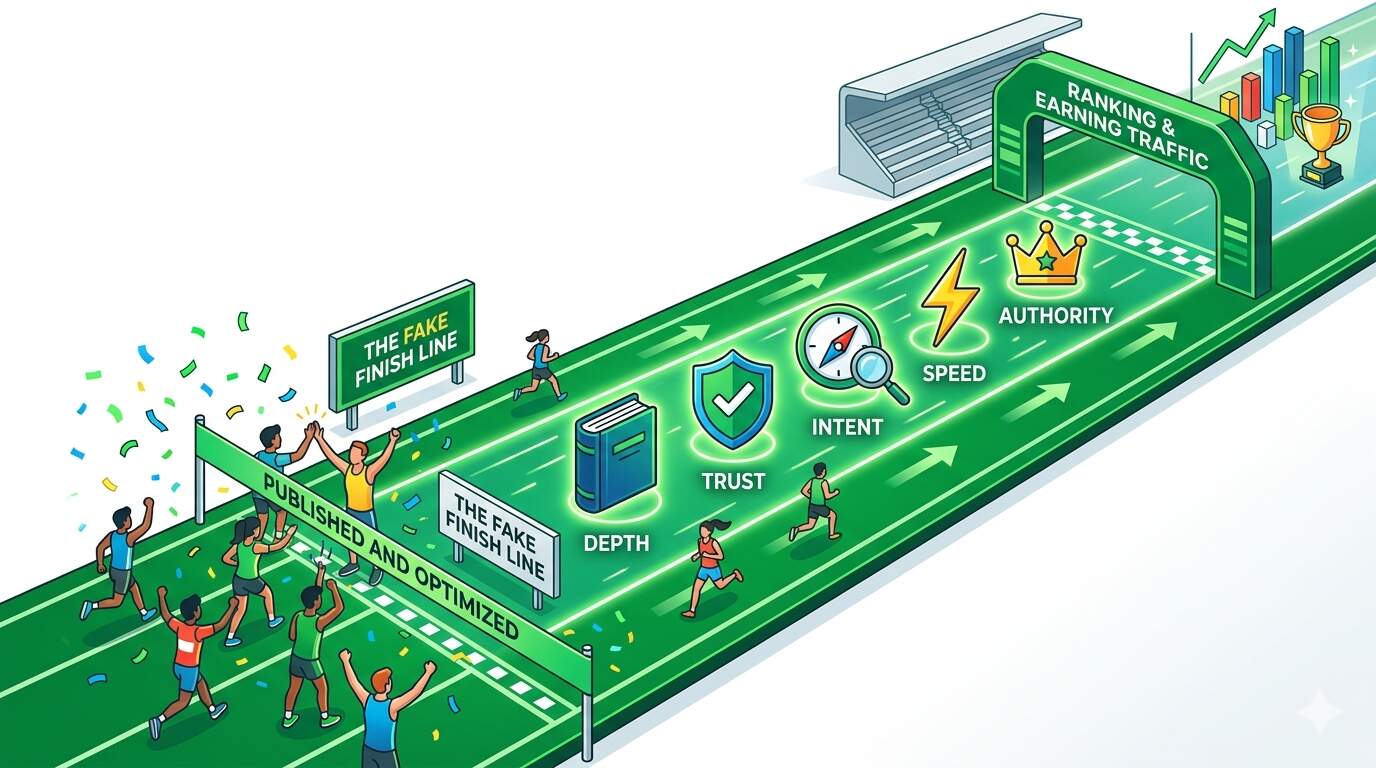
Hidden Signal: Search Intent Mismatch
Search intent mismatch is like showing up to a sales pitch with the wrong presentation. A user searches “how to fix a slow WordPress site” and the page opens with a broad discussion about general performance trends. That gap tells both the reader and the ranking system that the page may not be the right match, and this is a textbook case of user intent mismatch.
This is a significant reason why SEO content fails to rank even when the topic seems relevant on the surface.
Intent problems usually show up like this:
- The page answers the keyword but skirts around the real pain point.
- The introduction delays value when the user wants immediate direction.
- The format does not match what the SERP is visibly rewarding.
- The content speaks to everyone, which means it convinces no one.
- The next step is vague, buried, or more focused on the brand than the reader.
Query context sharpens this problem further. “Best CRM for startups” could mean affordable tools, scalable tools, founder-friendly tools, or a mix of all three. Treating every reader as one generic persona dilutes relevance fast. Pew Research Center found that users clicked a traditional result in just 8% of visits when an AI summary was present, compared with 15% without one; which means Google ranking signals are already rewarding sharper intent alignment than most pages currently deliver.
To improve content rankings, study what the top results are doing, identify the dominant format, and build the page around the user’s most logical next action; not the brand’s preferred talking point. This is exactly where hidden SEO signals separate the pages that rank from the ones that stall.
The 4 Search Intent Types at a Glance
| Intent Type | What the User Actually Wants | Common Mistake | Best Format |
| Informational | A clear, helpful explanation | Turning it into a sales pitch | How-to guide / blog post |
| Navigational | A specific brand or page | Generic landing page instead | Branded landing page |
| Commercial | Comparisons, reviews, pros/cons | Feature dump with no comparisons | Comparison page / listicle |
| Transactional | A direct action: buy, sign up, book | Too many steps or distractions | Product/service page + clear CTA |
Hidden Signal: Weak Topical Authority
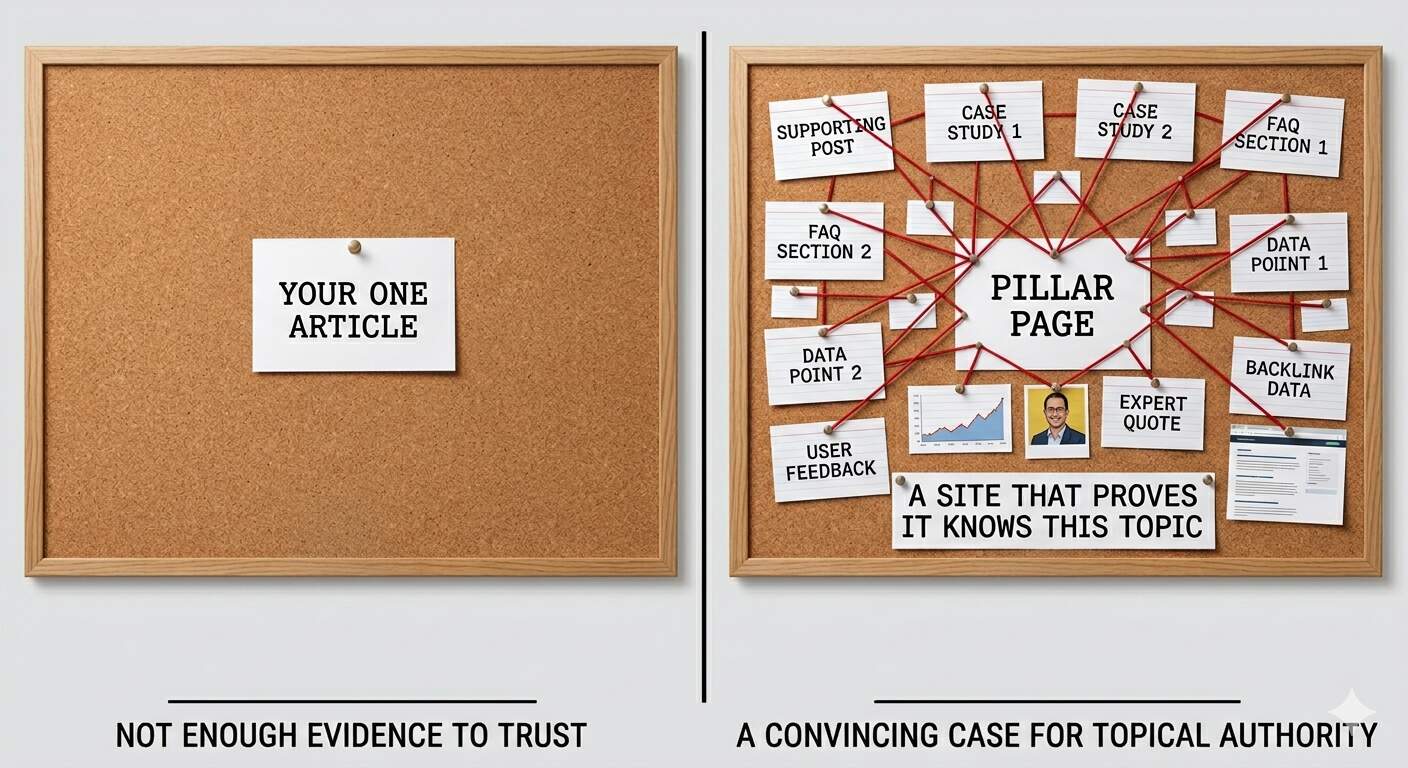
Weak authority happens when a site publishes one well-written article and expects Google to treat it like an established specialist. A single post about local SEO cannot authentically cover reviews, citations, service-area pages, Google Business Profile setup, location intent, and conversion paths — not in any way that builds real credibility. Topical authority SEO is built through connected proof, not isolated effort.
This is another pattern that explains why SEO content fails to rank on blogs that look productive from the outside.
Authority gaps tend to look like this:
- One article targets the core topic, but no supporting pages exist around it.
- Internal links feel random instead of reinforcing topical relevance.
- Related buyer questions are missing from the content ecosystem entirely.
- Older posts sit untouched while competitors keep refreshing theirs.
- The site publishes frequently, but without a clear subject focus.
Limited depth is a quieter leak than most teams realize. An article may explain the subject correctly, but does it address the questions buyers ask right before they decide to trust a brand? Thin surroundings can turn a strong article into a disconnected island. These SEO ranking issues are often overlooked because the article itself looks solid; the problem is everything around it.
Content not ranking Google often has less to do with the quality of the individual post and more to do with the absence of a supporting topic ecosystem. The fix may not be another rewrite. It may be building the connected pages, linking them naturally, and updating older assets so the site proves it understands the topic from every meaningful angle.
What a Strong Topic Cluster Looks Like
| Content Type | Role in Cluster | Example Topic | Update Frequency |
| Pillar Page | Core topic overview | “Complete Guide to Local SEO” | Every 6–12 months |
| Supporting Post | Deep-dive on a subtopic | “How to Get Google Reviews Fast” | Every 6 months |
| Supporting Post | Deep-dive on a subtopic | “Setting Up Google Business Profile” | Every 6 months |
| FAQ / Short-form | Answers adjacent queries | “What Are Local Citations?” | Annually |
| Case Study | Builds trust and proof | “How a Local Plumber Hit Page 1” | As available |
Hidden Signal: Poor Engagement Metrics
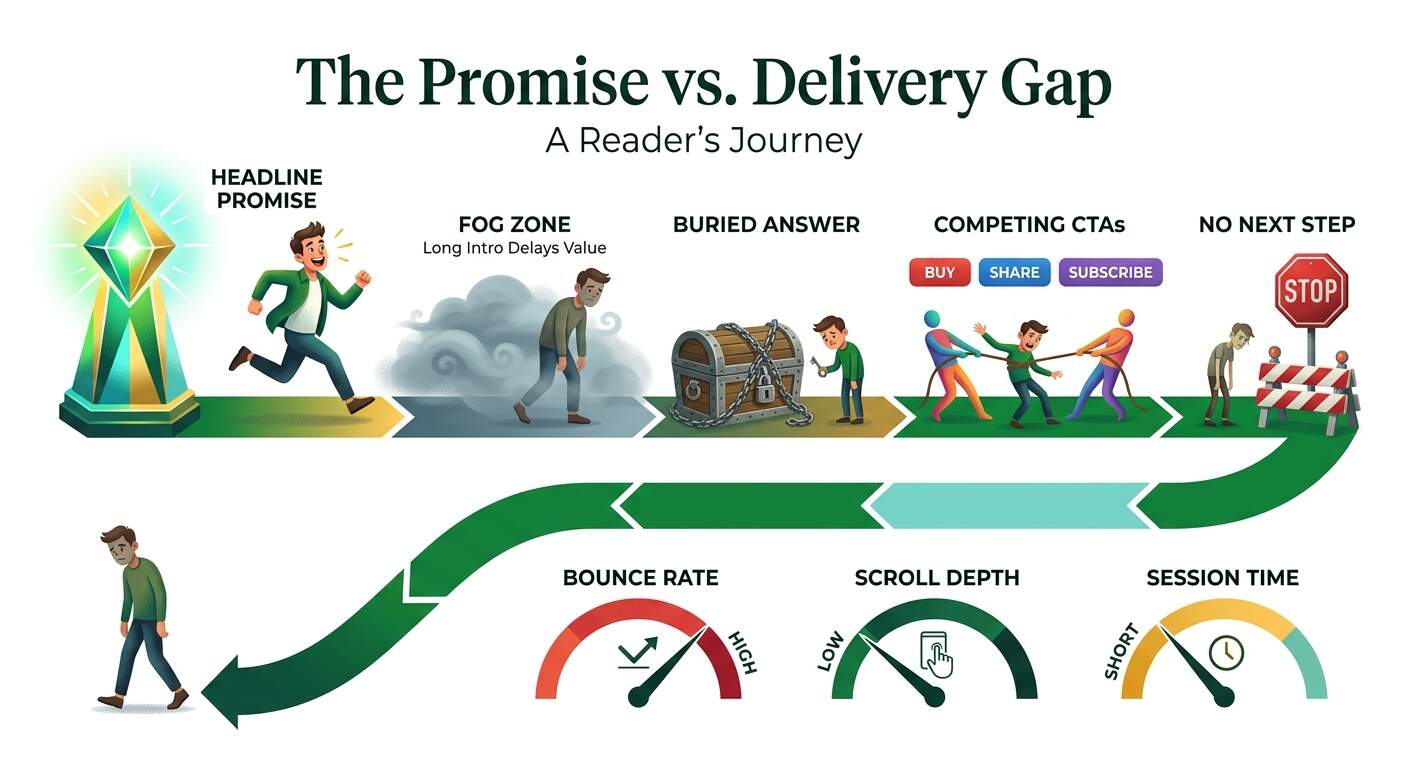
Poor engagement is not always a ranking factor with a clean label, but it is one of the loudest diagnostic signals available. When users land, skim, hesitate, and leave, the page has usually broken a promise. The headline offered a solution; the content delivered a lecture. These content quality signals reveal whether the page actually feels useful after the click, and that gap often explains why SEO content fails to rank after the initial launch excitement fades.
Engagement friction typically feels like this:
- The answer is technically present but far too hard to locate.
- The page looks visually busy before it starts being genuinely helpful.
- The introduction spends three paragraphs building context instead of guiding action.
- The user scrolls through everything without finding a compelling reason to act.
- The content reads as accurate, but not especially satisfying to work through.
High bounce rates, short sessions, and weak interaction patterns all point to friction somewhere in the reading experience. Maybe the answer is buried four scrolls deep. Maybe three competing calls-to-action are fighting for attention on the same screen. Maybe the opening paragraph sounds like it was repurposed from a conference slide deck. These are SEO mistakes because they make the reader work too hard for something they came specifically to find.
Content performance SEO improves when the page feels less like a brochure and more like a focused guide that knows exactly where the reader needs to go next. Sharper introductions, shorter paragraphs, cleaner subheads, proof placed right next to important claims, and obvious next steps are rarely optional on a competitive SERP.
Hidden Signal: Technical SEO Gaps
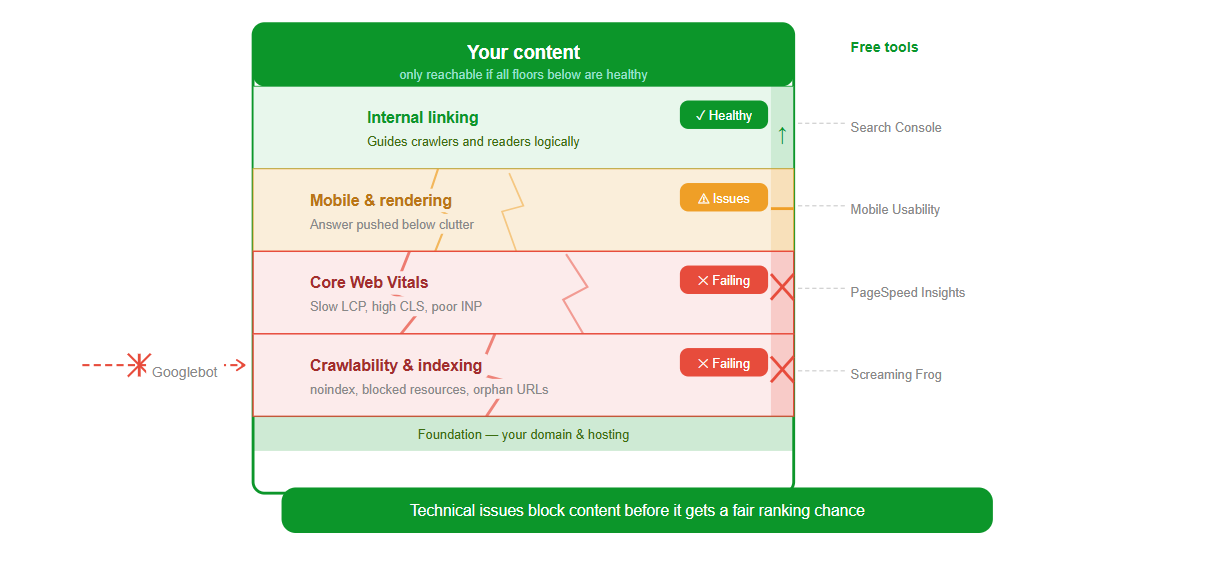
Technical gaps are the ghosts inside the ranking machine. They rarely announce themselves with obvious warnings; they quietly drain performance over time. A page can carry strong advice, clear examples, and a compelling headline, yet still underperform if it loads slowly, shifts while being read, or keeps important content out of reach for crawlers.
Technical SEO issues are a real reason why SEO content fails to rank even when the writing itself is genuinely good.
Technical blockers often hide in places like these:
- The page takes long enough to load that impatient visitors leave before it finishes.
- Important sections are present in the HTML but not easily crawlable or rendered correctly.
- Mobile layouts push the actual answer below cluttered design elements.
- Internal links fail to guide crawlers or readers in any logical direction.
- Small template problems quietly damage the broader content experience at scale.
Speed is consistently underestimated. Google’s Core Web Vitals standards set clear benchmarks: LCP within 2.5 seconds, INP of 200 milliseconds or less, and CLS of 0.1 or less, measured at the 75th percentile. Beyond speed, a misplaced no index tag, an incorrect canonical, a blocked resource, an orphan URL, or an intrusive popup can create search visibility issues before the content ever gets a fair look from search systems.
These are the kinds of hidden SEO signals that a surface-level audit will miss entirely. To improve content rankings, the technical layer; crawlability, rendering, internal links, mobile templates, schema, and page speed, deserves its own dedicated review, not a quick checkbox pass.
Hidden Signal: Content Quality & Depth
Depth is not a word-count competition. A 2,500-word article can still feel thin if every paragraph restates the obvious more slowly. Real depth requires judgment: what matters in this context, what depends on the reader’s situation, what to avoid, what to do next, and what to compare before making a decision.
This is why SEO content fails to rank when the article explains the topic correctly but never actually makes the reader smarter or more confident than before they arrived.
Stronger depth usually includes:
- A clear point of view, not just recycled industry definitions.
- Real examples that show how the advice plays out in practice.
- Practical comparisons that help readers make genuinely better-informed choices.
- Expert-backed reasoning placed close to the most important claims.
- Structure that makes the best answer easy to extract and remember.
Unique insight is the antidote to generic content. Small additions make a real difference: a teardown, a before-and-after observation, a client pattern, a direct expert quote, a practical scoring framework, or a first-party data point. For ranking factors 2026, clarity and originality matter more than volume because AI summaries, featured snippets, comparison results, and time-pressed readers all reward clean, direct packaging.
If a competing page has worked examples and the page in question only has definitions, that page is not deeper; it is only longer. SEO audit insights consistently surface this same gap: pages that underperform are not short on words. They are short on useful decisions the reader can act on immediately. A strong article makes the best answer easy to find, trust, and reuse; without asking the reader to dig for it.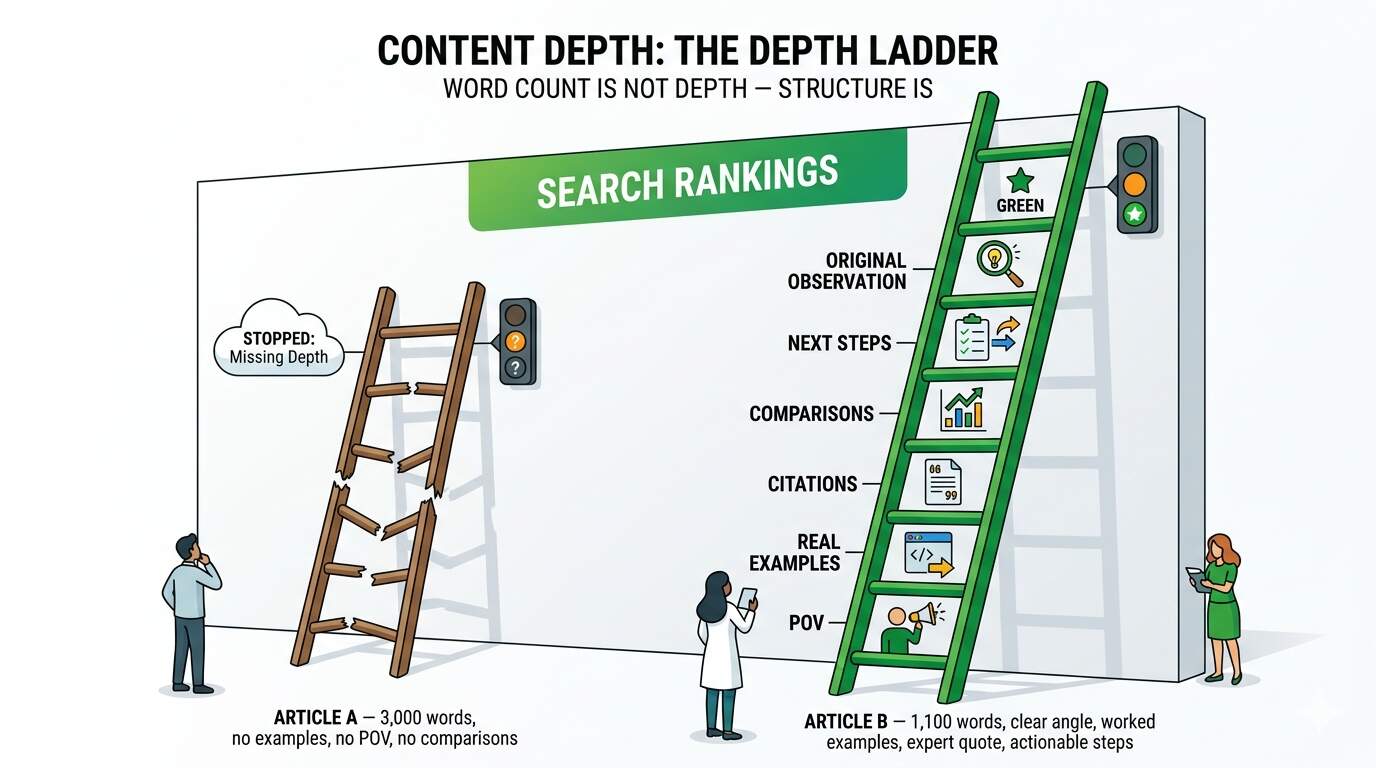
Content Depth Self-Audit Checklist
| Depth Element | Present? | Quick Fix If Missing |
| Clear POV or original angle | Yes / No | Add a short ‘our take’ section |
| Real-world examples or case data | Yes / No | Source one client or industry example |
| Expert quotes or cited sources | Yes / No | Add one credible external citation |
| Practical comparison or alternative | Yes / No | Build a vs. table or option breakdown |
| Clear, actionable next steps | Yes / No | End every section with a micro-action |
| Original data, insight, or observation | Yes / No | Add a first-party state or client pattern |
Wrapping It Up
Modern search is a system, not a checklist with a finish line. A page can fall short because its intent is off, its proof is outdated, its authority is thin, its engagement is low, or technical friction keeps readers from ever experiencing its actual value. The fix is not to panic-edit headlines after one disappointing monthly report. The fix is a proper diagnosis.
Start by comparing the live SERP with the current page. Has the format shifted? Are competitors using stronger examples, expert quotes, fresher data, helpful tools, or cleaner answers? Many persistent SEO ranking issues continue because teams polish copy when the real problems are trust, depth, usability, or discoverability. Understanding why SEO content fails to rank requires looking at every layer, not just the words on the page.
The teams that outrank their competition consistently treat content like a living asset. They track queries, clicks, scroll depth, conversions, internal link movement, and refresh impact. Then they connect those signals back to relevance, usefulness, credibility, and page experience. Ignoring these patterns is one of the quieter SEO mistakes that compounds invisibly over months.
Content not ranking Google is rarely a single-variable problem. Optimization opens the door. Evidence, clarity, and consistency are what actually improve content rankings in a competitive search environment today.
Ready to Fix What Rankings Are Hiding?
The content does not need another cosmetic rewrite. It needs a sharper diagnosis, a cleaner strategy, and targeted fixes that address the actual signals holding it back. If rankings feel stuck despite consistent effort, bringing in expert eyes to find those hidden blockers can turn months of stalled performance into measurable, compounding growth.
Connect with eSign Web Services for a deep SEO content audit and a smarter roadmap to stronger visibility, traffic, and conversions; without burning more publishing effort on the wrong problems.
Frequently Asked Questions (FAQs)
Question: Why does SEO content fail to rank even when optimized?
Answer: SEO content may fail to rank even when optimized because search engines evaluate more than keywords and basic on-page factors. Hidden signals such as user intent alignment, topical authority, engagement metrics, and technical performance play a major role. Content that lacks depth or fails to satisfy user expectations may not perform well. Poor internal linking and weak authority signals also impact rankings. Additionally, competition and algorithm updates influence visibility. Businesses must adopt a holistic approach, focusing on quality, structure, and relevance. Understanding these factors helps identify gaps and improve performance effectively in competitive search environments.
Question: How does search intent affect content rankings?
Answer: Search intent determines what users expect when they perform a query. If content does not align with that expectation, it struggles to rank. Search engines prioritize pages that best satisfy user needs. Informational queries require detailed explanations, while transactional queries need clear offers. Misaligned content reduces relevance and engagement. Understanding intent helps structure content effectively. Analyzing top-ranking pages provides insights into user expectations. Aligning content with intent improves performance and visibility. Businesses should focus on delivering value that matches user needs to achieve better rankings.
Question: What is topical authority and why is it important?
Answer: Topical authority refers to how well a website covers a subject in depth. It is built by creating multiple related pieces of content that demonstrate expertise. Search engines prefer websites that provide comprehensive coverage of a topic. Isolated articles have limited impact. Building authority improves trust and visibility. It also increases the chances of ranking for multiple related queries. Consistent publishing and internal linking strengthen topical authority. Businesses that focus on topic clusters achieve better results. Strong authority signals help content perform better in competitive search environments.
Question: Can technical SEO issues impact content rankings?
Answer: Yes, technical SEO issues can significantly impact content rankings. Problems such as slow page speed, poor mobile experience, and indexing errors reduce visibility. Search engines must be able to crawl and understand content. Technical issues can prevent this process. Even high-quality content may fail if technical foundations are weak. Fixing these issues improves performance and user experience. Regular audits help identify problems early. Businesses should ensure their websites are technically optimized. Strong technical SEO supports content performance and enhances ranking potential across search results.
Question: How do user engagement metrics influence rankings?
Answer: User engagement metrics such as bounce rate, dwell time, and interactions provide insights into content performance. High engagement indicates relevance and value. Search engines use these signals to evaluate content quality. Low engagement suggests that content does not meet user expectations. Improving readability, structure, and value enhances engagement. Content that keeps users interested performs better. Engagement signals help refine ranking decisions. Businesses should focus on user experience to improve these metrics. Strong engagement leads to better visibility and higher rankings over time.
Question: What are common mistakes that prevent content from ranking?
Answer: Common mistakes include focusing only on keywords, ignoring user intent, and creating thin content. Poor structure and lack of internal linking also reduce effectiveness. Many businesses overlook technical issues and fail to optimize for mobile users. Inconsistent publishing weakens authority signals. Another mistake is not analyzing competitors. Content that lacks uniqueness struggles to stand out. Avoiding these mistakes requires a strategic approach. Businesses should focus on quality, relevance, and consistency. Identifying and fixing these issues improves ranking potential and overall performance.
Question: How important is content quality for SEO success?
Answer: Content quality is one of the most important factors for SEO success. High-quality content provides value, answers user queries, and keeps users engaged. Search engines prioritize informative and well-structured content. Poor content fails to attract traffic or backlinks. Quality content builds trust and authority. It also improves engagement metrics. Businesses should focus on originality, clarity, and depth. Regular updates ensure relevance. Investing in quality content improves rankings and long-term performance. Strong content is essential for sustainable SEO success.
Question: Why does content rank initially and then drop?
Answer: Content may rank initially due to freshness or low competition, but rankings can drop over time. As competition increases, search engines reassess content quality and relevance. If content lacks depth or engagement, it may lose position. Algorithm updates also impact rankings. Inconsistent updates reduce performance. Monitoring changes helps identify issues. Improving content and updating information restores rankings. Businesses should treat SEO as an ongoing process. Maintaining quality and relevance ensures stable performance over time.
Question: How can businesses diagnose SEO content performance issues?
Answer: Businesses can diagnose issues by analyzing performance data and identifying gaps. Tools such as analytics and search console provide insights into traffic and rankings. Evaluating engagement metrics helps understand user behavior. Checking technical SEO ensures proper indexing. Comparing content with competitors reveals weaknesses. Regular audits help identify hidden problems. Data-driven analysis improves decision-making. Businesses should focus on continuous improvement. A structured approach ensures better performance and helps fix ranking issues effectively.
Question: What is the best way to improve underperforming SEO content?
Answer: Improving underperforming content requires a combination of optimization and strategy. Updating content with new information improves relevance. Enhancing structure and readability increases engagement. Adding depth and covering related topics strengthens authority. Fixing technical issues ensures proper indexing. Improving internal linking boosts visibility. Analyzing user intent helps refine content. Monitoring performance guides improvements. Businesses should focus on quality and consistency. Regular updates ensure long-term success. A comprehensive approach helps content achieve better rankings and visibility.
Author Details

Ashwani Kumar Sharma
Ashwani has been actively involved in SEO services since 2005. His expertise and distinctive work approaches have made him one of the most experienced and trusted SEO experts in the industry. He is a certified SEO and Google Ads professional. He also has strong business development skills in advanced SEO, PPC, and digital marketing strategies.


