



Organic CTR Benchmarks in 2026: What the Data Really Shows

Key Takeaways:
- Organic CTR benchmarks still matter, but SERP context now shapes clicks more than ranking position alone across searches.
- Ranking first remains valuable, yet AI Overviews, snippets, and visual modules can sharply reduce click potential before evaluation.
- Lower CTR does not automatically signal weak SEO; changing layouts, intent, or trust signals may be responsible instead.
- Zero-click behavior keeps rising, so impressions, visibility, and conversions should complement CTR when judging organic performance overall accurately.
- Benchmark averages become useful only after segmenting branded, non-branded, informational, and commercial queries by SERP environment and intent.
- Stable rankings with falling clicks usually indicate a changed results page, not necessarily weaker content or optimization anymore.
- Better titles and descriptions can lift CTR without higher rankings, especially when they match intent clearly and specifically.
- Modern SEO teams win by diagnosing why clicks changed, not by treating benchmark averages as universal performance verdicts.
Organic CTR benchmarks in 2026 still matter, but they no longer follow a simple ranking curve you can drop into a report and trust without context. Backlinko’s large CTR study found that the top organic result gets 27.6% of clicks, the top three results collect 54.4%, and page-two listings attract only 0.63% of clicks. At the same time, SparkToro reported that 58.5% of U.S. Google searches and 59.7% of EU Google searches ended without a click to the open web.
That changes how CTR should be interpreted. Organic click-through rate is no longer shaped by position alone; it also reflects SERP layout, search intent, brand familiarity, trust, and how much of the answer Google reveals before your page even gets a fair chance to compete. For small businesses, startups, agencies, and marketing managers, that matters more than ever. A lower-than-expected CTR does not automatically signal weak SEO performance.
Sometimes it means the search results page changed faster than your reporting model did. That is why organic CTR benchmarks 2026 work best as a context signal, not a performance scoreboard. The smarter question now is not just, “What position are we in?” It is, “What kind of SERP are we competing inside, and what is that environment doing to our click potential?” In this blog, we’ll unpack what current CTR benchmarks still reveal, where they fall short, and how businesses should interpret them more accurately in 2026.
Why Clicks Are Getting Harder?
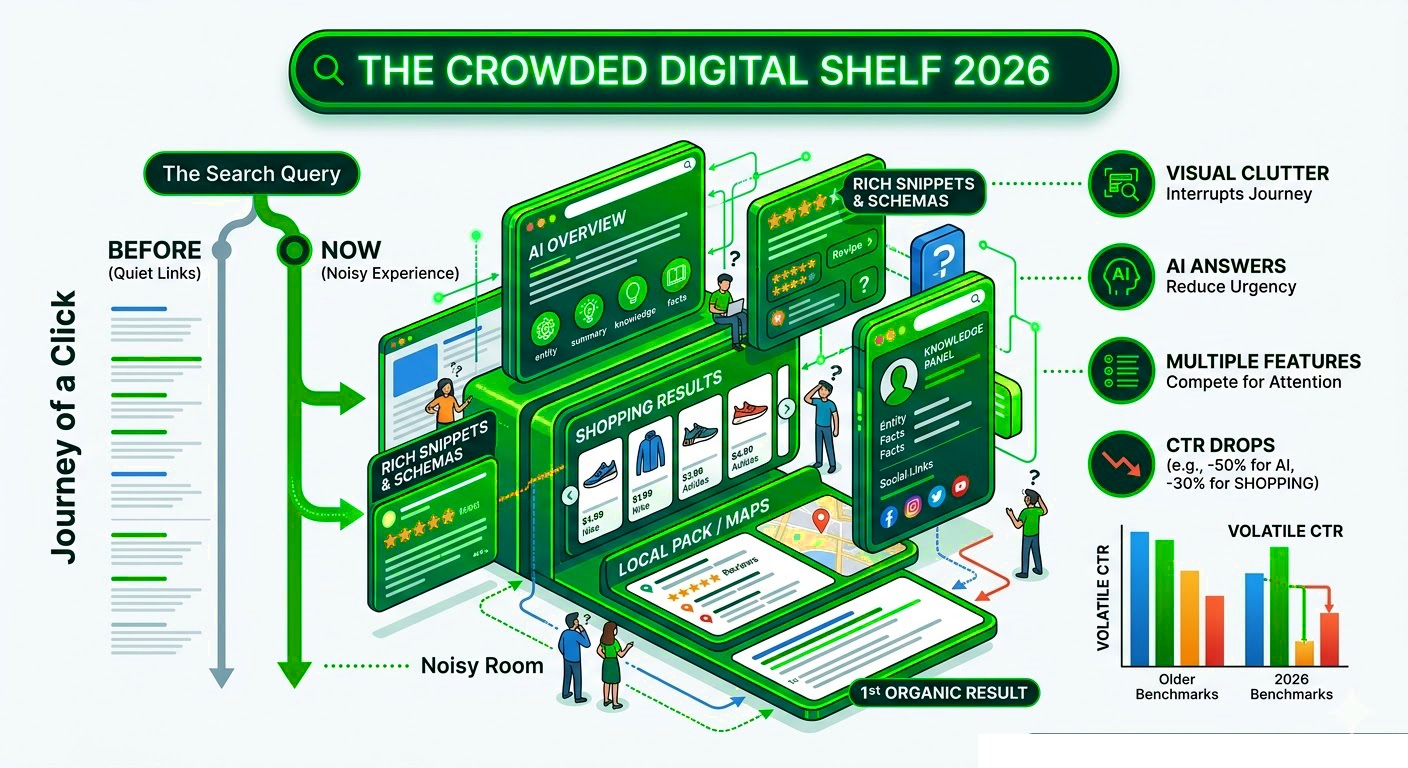
Clicks are getting harder because Google no longer behaves like a quiet list of links waiting to be chosen. It now feels more like a crowded digital shelf, where multiple features compete for attention before the first organic result is even properly noticed. SISTRIX found that the position-one CTR in a purely organic mobile SERP was 34.2%, but dropped to 16.8% when a Knowledge Panel appeared and to 13.7% when Shopping results dominated the page. Then AI Overviews made the experience even noisier. Pew found that when an AI summary appeared, users clicked a traditional search result on just 8% of visits, compared with 15% when no AI summary appeared.
That is where SERP click behavior becomes messier in all the ways that matter. Users are no longer just scanning a clean list and picking the best-looking link. They are skimming answers, scanning visual modules, comparing brands, and sometimes deciding they already know enough.
- Rich SERP features interrupt the journey before standard organic listings get properly noticed.
- AI summaries reduce urgency by answering enough of the query before any click happens.
- Visual clutter still rewards rank, but rank alone no longer dominates attention.
- Brand familiarity and query intent now influence clicks almost as much as position.
In other words, ranking first still matters, but it now matters inside a much louder room. That is exactly why organic CTR benchmarks 2026 feel more volatile than older studies suggest.
What Do CTR Benchmarks Really Mean?
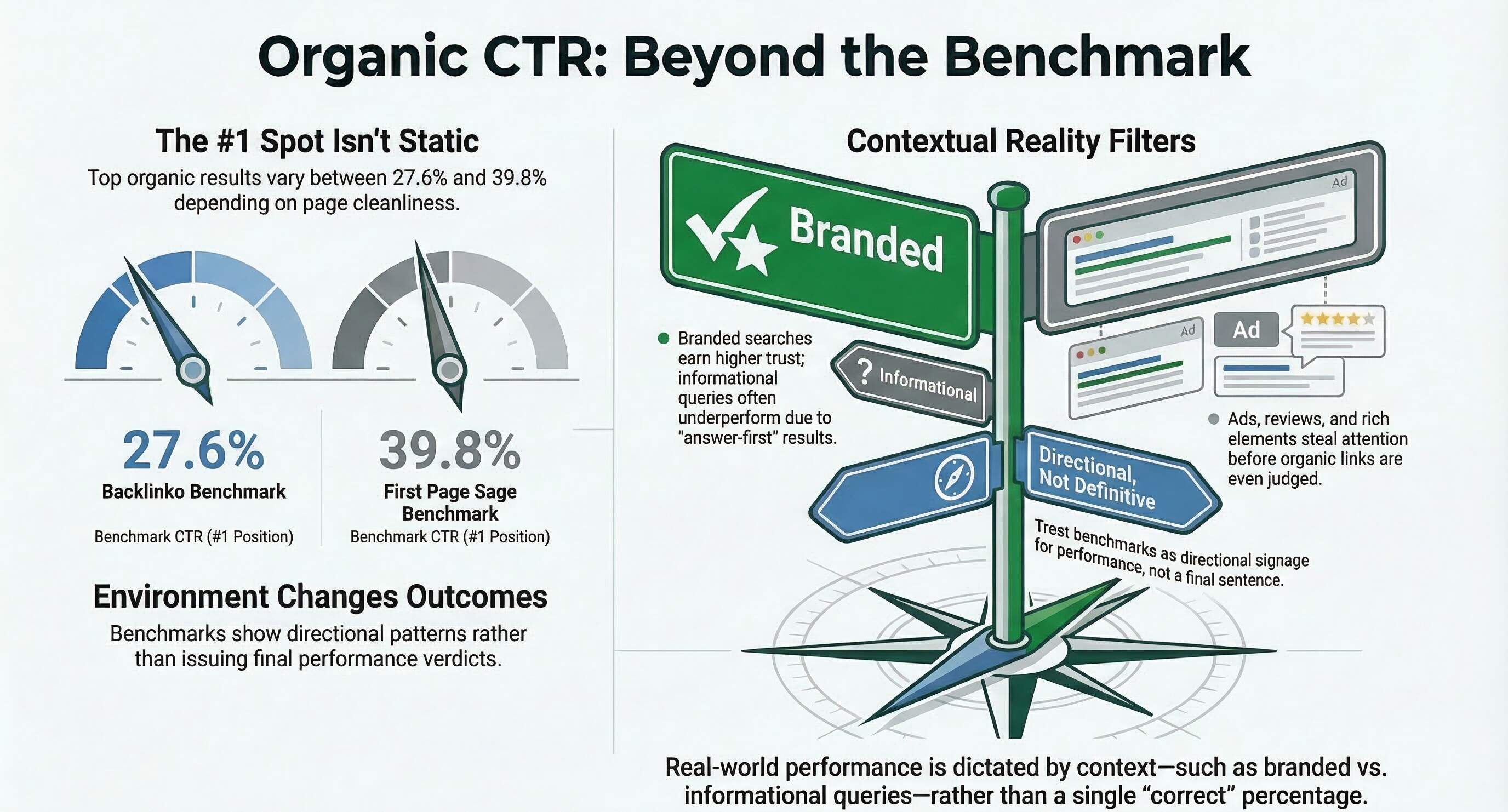
CTR benchmarks are still useful, but only when you stop treating them like universal truth. Backlinko places the number-one result at 27.6%, while First Page Sage’s 2026 benchmark model shows 39.8% for top organic listings on cleaner SERPs. Those numbers are not really in conflict. They are pointing to the same reality: the environment changes the outcome. That is why SEO CTR benchmarks are better at showing patterns than issuing verdicts.
A blended average may look scientific, but it often combines branded, non-branded, informational, and commercial searches into one tidy number that hides what is really happening. A 5% CTR can look weak on a navigational query and surprisingly strong on a feature-heavy informational SERP. Without context, averages flatten the insight instead of improving it.
Here are the filters that make benchmarks more useful:
- Branded searches usually earn stronger clicks because familiarity lowers hesitation and builds trust.
- Informational queries often underperform blended averages because answer-first SERPs reduce urgency.
- Commercial queries fluctuate more because ads, reviews, and comparison modules reshape the decision.
- Feature-heavy SERPs distort averages because richer elements steal attention before organic links are judged.
That is why organic CTR benchmarks 2026 should be treated like directional signage, not a sentence passed on your performance. The benchmark matters, but context determines what that number is really saying.
Are Rankings Telling the Full Story?
Not anymore. Rankings still matter, but they do not explain enough on their own because users do not click positions in a vacuum. They click what feels useful, visible, and trustworthy in the moment. Two pages can rank in the same position and still produce very different CTRs because the pages around them look completely different. One may sit under an AI Overview and a video carousel. Another may appear on a cleaner page with fewer interruptions. That alone can change search ranking and CTR far more than many dashboards admit.
Brand recognition bends behavior in ways most benchmark charts barely capture. In higher-trust or more competitive searches, users often click the familiar brand even when another result has a stronger title. Intent makes it even more complex. Informational searches invite browsing. Commercial searches invite comparison. Branded searches often invite immediate action.
A few realities make this easier to read:
- Position shows placement, not persuasion.
- Familiar brands often win clicks before title copy gets fully considered.
- Intent changes how users interpret the same ranking across different queries.
- A cleaner SERP can outperform a stronger rank on a cluttered page.
That is why organic CTR benchmarks 2026 need interpretation, not imitation. Rankings still tell part of the story, but they no longer explain how persuasive, visible, or emotionally safe your result feels on that specific page. The position is still important. It is just no longer the whole explanation.

Which SERP Features Steal the Clicks?
The biggest click thief in 2026 is often not a better competitor. It is the search page itself. Ahrefs’ updated analysis found that AI Overviews now correlate with a 58% lower average CTR for the top-ranking page on affected queries, a steeper drop than the 34.5% estimate from its earlier study. That is a major shift, especially for informational searches where users often want quick understanding rather than a full page visit.
But AI is not acting alone. Featured snippets, image packs, shopping modules, video results, local packs, and People Also Ask boxes all reshape what users notice first. This is why Google search click patterns now feel less like a clean ranking curve and more like a visual-attention problem. Sometimes the result is visible, relevant, and well written, but still loses clicks because the page has already answered enough or distracted enough before the listing gets judged fairly.
The strongest click-reducing forces are usually these:
- AI Overviews provide enough upfront information to lower urgency for informational clicks.
- Rich features interrupt scanning before users properly evaluate blue links.
- Shopping and local modules take premium screen space above organic results.
- Video and image blocks pull the eye before text results can compete.
- Knowledge panels reduce click momentum by offering instant context and trust.
Pew also found that users clicked a source link inside AI summaries only 1% of the time. So yes, the top result still matters, but it is no longer guaranteed to be the main attraction on the page.
Competitor Snapshot Table
| Query Type | Your Rank | What Dominates the Page | Likely CTR Pressure | Better Benchmark Lens |
| Branded service query | 2 | Sitelinks, minimal clutter | Low | Compare with branded CTR history |
| Informational query | 1 | AI Overview, PAA, videos | High | Compare with similar informational SERPs |
| Local service query | 1 | Map pack, reviews, location cards | High | Compare with local-intent pages |
| Commercial comparison query | 3 | Ads, snippets, shopping modules | Medium-High | Compare with same-category competitors |
A table like this helps because it forces CTR to be read against the actual page environment. Without that layer, the number looks cleaner than the reality behind it.

What Should You Measure Instead?
The answer is not to stop measuring CTR. It is to stop measuring it lazily. Start by segmenting branded and non-branded searches, informational and commercial queries, and cleaner SERPs versus feature-heavy ones. That alone makes organic CTR benchmarks 2026 far more useful because you stop forcing one average across very different types of user behavior. Once that is in place, widen the lens.
A softer CTR does not always mean weaker influence. A page may still appear in AI summaries, featured snippets, or high-visibility result types that improve brand recall, build trust, or support later conversions. That is why organic traffic performance should be read alongside impressions, visibility, and conversion quality rather than as a lonely percentage in a dashboard.
A smarter measurement setup usually includes these checks:
- Segment CTR by intent before comparing pages with different user expectations.
- Pair impressions with CTR so softer clicks do not hide stronger visibility.
- Review page-level trends before reacting to broad benchmark averages.
- Check SERP features before blaming the page for lower engagement.
- Compare similar templates, not unrelated content types, when judging performance.
That turns CTR from a vanity score into a diagnostic signal. One page may drop because AI features appeared. Another may rise because the title became more specific. Same metric, completely different diagnosis. Better measurement almost always beats louder reporting.
Can CTR Improve Without Ranking Higher?
Yes, and this is where SEO still offers a refreshingly practical win. You do not always need a higher ranking to earn a better click. Sometimes you just need a stronger reason to be chosen. Backlinko’s study shows that position matters, but snippet appeal still influences whether users choose your listing over another result in the same rank band. A vague title wastes opportunity. A sharper title creates it.
“SEO Tips for Startups” is functional, but flat. “7 SEO Fixes Startups Should Make Before Scaling Traffic” gives the searcher a reason to care now. That is not clickbait. It is clearer relevance. This is the practical heart of improving organic CTR and strengthening organic click-through rate without waiting for rankings to do all the work for you.
Here are the snippet upgrades that usually help:
- Replace vague titles with specific promises tied to user intent and likely outcome.
- Use meta descriptions to reinforce relevance, not lazily repeat the title.
- Match wording to the query’s urgency, not your internal brand phrasing.
- Prioritize clarity over cleverness on crowded result pages.
- Optimize for qualified clicks, not random curiosity that bounces immediately.
Better snippets do not need to be louder. They need to feel more useful at first glance. On crowded SERPs, that is often enough to shift the click even when the ranking stays exactly the same.

What Does This Mean for SEO Now?
It means SEO has become harder to summarize and much easier to misread if you are still using old formulas. CTR still matters, but it no longer works as a clean proxy for page quality because it now reflects ranking, intent, layout, trust, and answer-first behavior all at once. That is why organic CTR benchmarks 2026 are still valuable, but only when they are interpreted rather than worshipped.
A page can lose clicks because an AI Overview appeared, because a map pack moved higher, or because users got enough reassurance without needing to visit. That does not automatically mean the page itself became weaker. It means the search journey changed. Visibility is now broader than traffic alone. A page may still shape trust, recall, and later branded searches even when the first click never happens.
The teams making better decisions are usually doing three things well:
- Reading CTR with context instead of treating averages like verdicts.
- Looking at visibility and conversion quality alongside raw clicks.
- Asking why the behavior changed before rushing into page edits.
So modern SEO is no longer just about winning the visit. It is about understanding what the visit now has to compete against. The smartest teams in 2026 are not asking only, “What is our CTR?” They are also asking, “Why is it behaving this way, and what changed on the page around us?” That is the shift that replaces panic with diagnosis, and diagnosis is where stronger SEO decisions begin.
The Final Thoughts
The real takeaway is not that CTR has stopped mattering. It is that organic CTR benchmarks in 2026 only become useful when they are read with the right context. Rankings still influence clicks, but they now compete with AI Overviews, rich results, answer-first layouts, brand preference, and changing user intent. That means a softer CTR does not always point to weaker SEO. In many cases, it reflects a noisier search environment and a more selective audience.
Businesses that understand this shift can make better decisions, avoid reacting to the wrong signals, and focus on what is actually changing in search behavior. Instead of treating CTR as a simple score, smart teams use it as a diagnostic clue alongside visibility, impressions, conversions, and SERP conditions. That approach leads to stronger analysis, calmer reporting, and a search strategy built for how organic performance really works in competitive search today for every business.
Turn CTR Insights Into Smarter SEO Action
If your rankings look steady but clicks are slipping, eSign Web Services can help you find out why. We help businesses read CTR in context, understand SERP changes, and build SEO strategies around real search behavior, not outdated assumptions. Contact us today to turn confusing click patterns into clearer insights, stronger decisions, and measurable organic growth that aligns with how search works in 2026 for ambitious brands today..
Frequently Asked Questions (FAQs)
Question: Why are organic CTR benchmarks different in 2026?
Answer: Organic CTR benchmarks are different in 2026 because search behavior has changed. Users now interact with AI summaries, featured snippets, People Also Ask boxes, videos, and other SERP features before deciding whether to click. That means rankings still matter, but they no longer guarantee the same click patterns seen in earlier years. Modern CTR benchmarks need to account for noisier SERPs and stronger zero-click behavior across many query types.
Question: Does ranking number one still guarantee the highest CTR?
Answer: Usually, but not always. The top organic position still gets strong attention, yet SERP features can reduce or redirect clicks even when a page ranks first. For example, AI-generated summaries, featured snippets, local packs, or rich media can dominate visual attention and reduce urgency to click standard listings. Position one remains valuable, but its click advantage is now more conditional than many businesses assume. Ranking first is strong, not automatic.
Question: What is a good organic CTR in 2026?
Answer: There is no single “good” organic CTR because it depends on the query, intent, brand familiarity, SERP layout, and ranking position. A strong CTR for a non-branded informational query may look very different from that for a branded or transactional term. That is why benchmarks should be used carefully. A number only becomes meaningful when you compare it against similar searches, similar pages, and similar search result conditions.
Question: Why can CTR drop even when rankings stay stable?
Answer: CTR can drop even when rankings stay the same because the search environment around your result may have changed. Search engines may add new SERP features, AI summaries, richer media, or competitor listings with more compelling titles. User behavior may also shift if search intent evolves. In other words, stable rankings do not guarantee stable attention. CTR reflects competition, presentation, and context, not just raw ranking position.
Question: How do AI summaries affect organic CTR?
Answer: AI summaries often reduce the urgency to click because they answer part of the user’s question directly on the search results page. This is especially common for informational queries where users want a quick understanding rather than a deep exploration. As a result, organic listings may still rank well but attract fewer clicks. That does not always mean the page lost value. It may still shape visibility and trust even inside a more zero-click search experience.
Question: Can you improve CTR without improving rankings?
Answer: Yes. Better titles, stronger meta descriptions, and clearer alignment with intent can improve CTR even when rankings stay the same. Users respond to relevance and clarity, so a more compelling snippet can attract more attention from the same position. This is one of the easiest ways to improve organic performance without waiting for ranking gains. However, the goal should be qualified clicks, not just more clicks from users who will bounce quickly.
Question: Is low CTR always a sign of poor SEO performance?
Answer: No. Low CTR can reflect many things beyond weak SEO, including SERP clutter, AI summaries, informational intent, poor brand recognition, or changes in how search results are presented. A page may still be visible, relevant, and strategically valuable even if its CTR softens. The key is to understand why the CTR is low before reacting. Treating every drop as a page problem leads to bad decisions and unnecessary optimization work.
Question: What is the best way to analyze organic CTR now?
Answer: The best way to analyze organic CTR now is to segment it by intent, page type, ranking band, brand status, and SERP conditions. Avoid reading one blended average as a verdict on overall SEO health. Compare similar pages over time, look at which search features are present, and review how titles and snippets align with user expectations. Smart CTR analysis is less about a single number and more about reading behavior in context.
Question: Should branded and non-branded CTR be measured separately?
Answer: Yes, absolutely. Branded and non-branded searches behave very differently, so combining them creates misleading averages. Branded queries usually earn higher CTR because users already recognize the business and trust the result more. Non-branded searches are more competitive and often influenced more heavily by SERP features. Measuring them separately gives a clearer view of what is really happening and helps businesses diagnose click behavior more accurately.
Author Details

Ashwani Kumar Sharma
Ashwani has been actively involved in SEO services since 2005. His expertise and distinctive work approaches have made him one of the most experienced and trusted SEO experts in the industry. He is a certified SEO and Google Ads professional. He also has strong business development skills in advanced SEO, PPC, and digital marketing strategies.


