



How to Calculate the Right PPC Advertising Budget

With pay-per-click advertising, businesses have a direct way to reach people who are already looking for products, services or information on the Internet. In a PPC model, advertisers only pay when someone clicks on their advertisement, not when the ad is shown. Average cost per click (in Google Ads) shows what you paid on average for each click in a given period. It is defined by the ratio of total cost of clicks to total number of received clicks.
Average Cost Per Click = Total Cost of Clicks ÷ Total Number of Clicks
For example, if a campaign spends $200 and receives 100 clicks, the average CPC is $2. Individual clicks may cost different amounts, but $2 is the average across all clicks.
Knowing your CPC is only one part of PPC budgeting. The more important question is how many clicks you need to generate enough leads and customers to justify the investment. Instead of choosing a budget because it seems affordable, businesses can work backwards from revenue, customer value, conversion rates, and expected CPC.
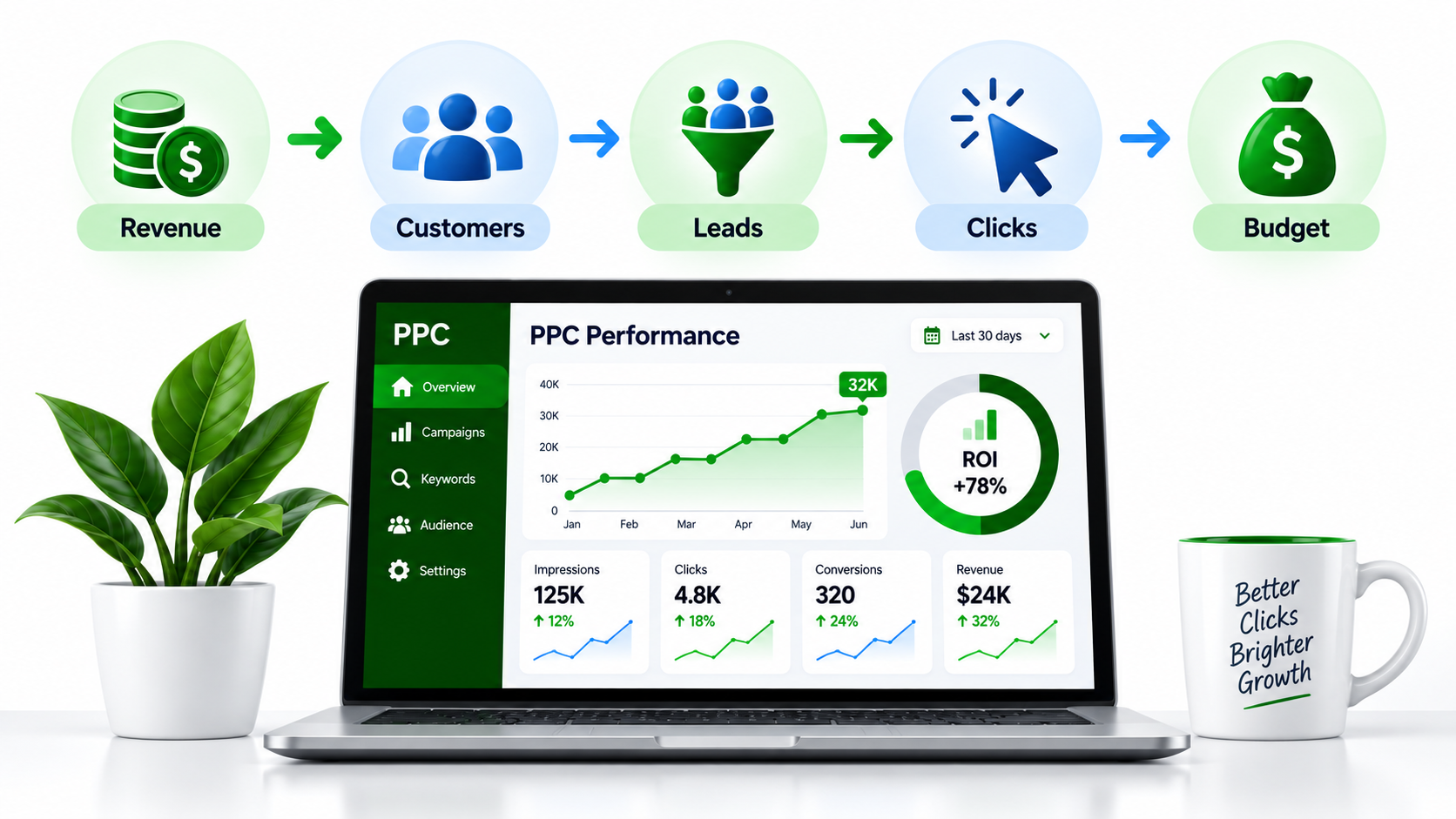
Start with the Revenue PPC Needs to Generate
A PPC budget should begin with a business target. Do not automatically use the company’s total revenue goal. If paid advertising is expected to generate only part of the revenue, calculate the PPC target separately.
Suppose a company wants to generate $1 million in annual revenue, but expects PPC to contribute 30%.
$1,000,000 × 30% = $300,000 annual PPC revenue target
Divided across 12 months:
$300,000 ÷ 12 = $25,000 monthly PPC revenue target
The calculations that follow should therefore be based on $25,000 per month, not the company’s entire $1 million target.
This keeps the PPC budget realistic because other revenue may come from organic search, referrals, repeat customers, email, direct traffic, sales activity, or other marketing channels.
Calculate How Many Customers You Need
Next, determine how many customers are required to generate the PPC revenue target.
If the average new customer generates $1,000, the calculation is:
Customers Needed = PPC Revenue Target ÷ Average Revenue Per Customer
Using the example:
$25,000 ÷ $1,000 = 25 customers
The PPC campaign therefore needs to contribute approximately 25 new customers each month.
Use a realistic average customer value. A business should not base its calculations on its largest or best sale if that amount is unusual. Historical sales data is more useful.
For companies with recurring revenue, repeat purchases, or long contracts, customer lifetime value may also matter. A customer who spends $1,000 initially but another $3,000 over the following year can justify a different acquisition cost from a one-time $1,000 customer.
Work out How Many Leads Are Required
Not every inquiry becomes a customer. This is why the lead-to-sale conversion rate needs to be included in the budget.
Suppose a sales team converts 20% of qualified leads into paying customers.
To produce 25 customers:
Leads Needed = Customers Needed ÷ Lead-to-Sale Conversion Rate
25 ÷ 20% = 125 leads
The PPC campaign therefore needs to generate approximately 125 qualified leads per month.
This calculation also shows why PPC results depend partly on the sales process. If a business generates good leads but follows them up slowly or closes very few of them, increasing advertising spend may not solve the underlying problem.
Calculate How Many Paid Clicks Are Needed
Now determine how many ad clicks are required to produce those 125 leads.
Suppose the PPC landing pages convert 2% of paid visitors into leads.
Clicks Needed = Leads Needed ÷ Click-to-Lead Conversion Rate
125 ÷ 2% = 6,250 clicks
The business would need approximately 6,250 paid clicks per month at a 2% conversion rate.
This is where website performance has a direct effect on advertising cost. If the same landing page improves from a 2% conversion rate to 4%, the business would need roughly half as many clicks to generate 125 leads.
Improving the offer, page clarity, form, call to action, mobile experience, or trust signals can therefore reduce the amount of paid traffic needed to reach the same business goal.
Apply Your Average CPC to Find the Budget
Once the required number of clicks is known, the estimated advertising budget becomes straightforward.
Suppose the expected average CPC is $2.
PPC Budget = Required Clicks × Average CPC
6,250 × $2 = $12,500
Under these assumptions, the estimated monthly PPC media budget is $12,500.
The $2 CPC is only an example. Actual click costs vary by industry, location, keywords, competition, ad relevance, bidding strategy, and demand.
WordStream’s 2020 benchmark analysis covered 15,759 US advertiser accounts between March 16 and May 31, 2020. Across Google Ads campaigns, it reported an average CPC of $2.76, an average conversion rate of 5.63%, and an average cost per lead of $51.50.
Those figures can provide context, but businesses should not use them as universal targets. Costs in legal services, retail, home services, healthcare, and other industries can differ significantly.
Check the Cost of Acquiring Each Customer
The calculated PPC budget still needs a profitability check.
Our example requires $12,500 in monthly advertising spend to acquire an estimated 25 customers.
Customer Acquisition Cost = PPC Spend ÷ Customers Acquired
$12,500 ÷ 25 = $500 per customer
The business would therefore spend approximately $500 in PPC advertising for each new customer.
Now compare that figure with what the customer is worth.
If the average customer generates $1,000 in revenue, a $500 acquisition cost consumes half of that revenue before the company pays for staff, products, fulfillment, software, premises, taxes, and other operating expenses.
For a high-margin business or one with strong repeat revenue, $500 may be acceptable. For a company with narrow margins and few repeat purchases, it may be too expensive.
This is why the right PPC budget cannot be determined from CPC alone.
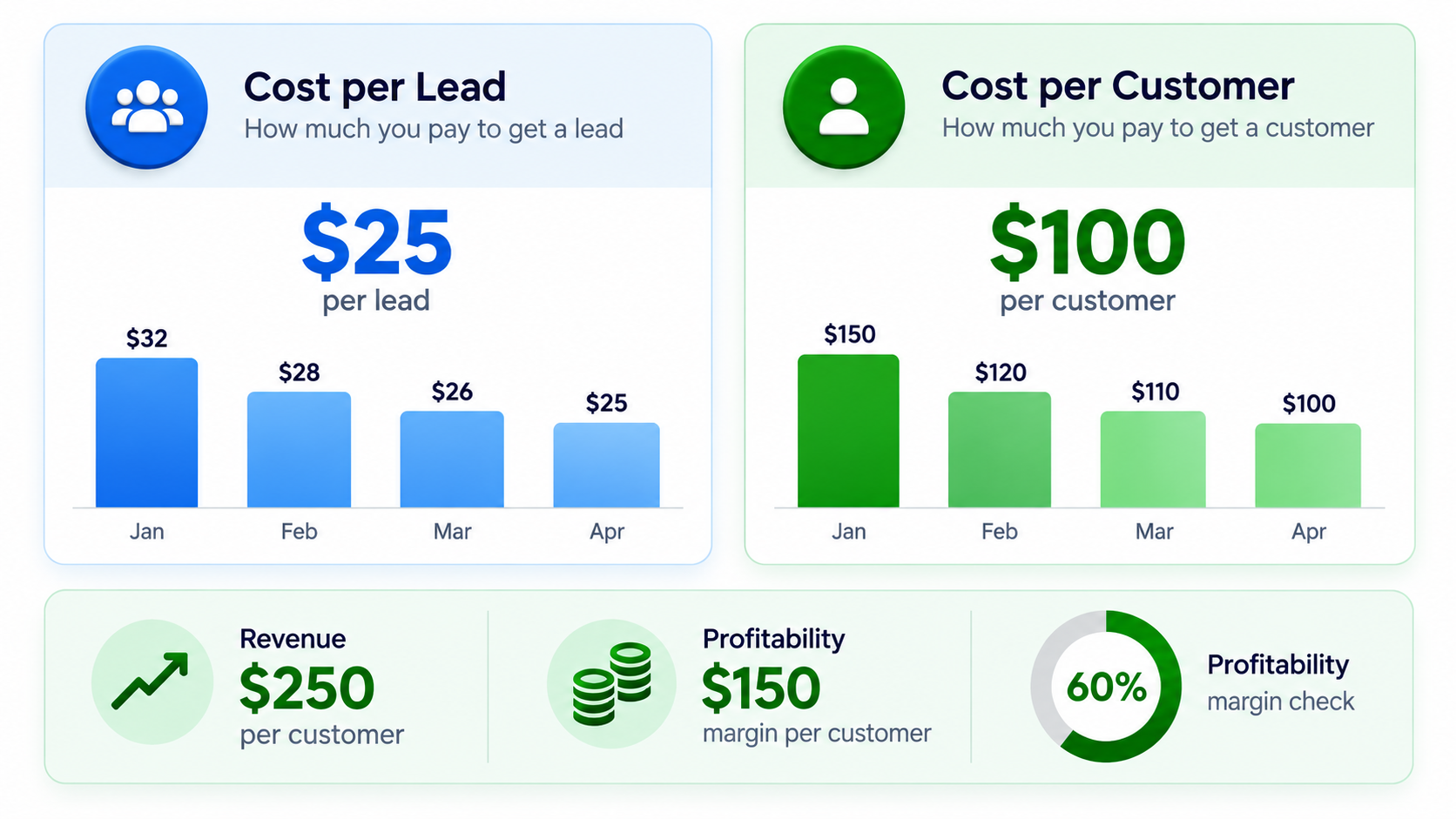
Separate Cost Per Lead From Cost Per Customer
Businesses also need to avoid confusing a cheap lead with a cheap customer.
In our example:
$12,500 ÷ 125 leads = $100 per lead
However:
$12,500 ÷ 25 customers = $500 per customer
The campaign can therefore have a $100 cost per lead while the true advertising cost of acquiring a paying customer is $500.
That distinction becomes important when businesses judge PPC performance. A campaign generating inexpensive form submissions may still perform poorly if those enquiries rarely become customers.
Conversion tracking in Google Ads can measure useful actions such as purchases, calls, sign-ups, and leads. Google notes that this allows advertisers to understand which ads and keywords are contributing to valuable business actions.
Ideally, businesses should go one step further and connect those leads to actual sales wherever possible.
Check Whether Enough Search Demand Exists
A budget formula may say that the business needs 6,250 clicks per month. The market still needs to be capable of supplying those clicks.
A specialised local company may operate in an area where only a limited number of people search for its services each month. A national company may have far more available searches but face much higher competition and CPCs.
This means the theoretical budget should be checked against likely search demand, estimated traffic, geographic targeting, and expected click costs.
Simply increasing the budget does not create more qualified searches.
In July 2020, Google highlighted Performance Planner as a tool advertisers could use to assess opportunities and plan advertising spend while consumer demand was changing rapidly. At that time, Google said the tool was available for Search and Shopping campaigns, with expansion planned for additional campaign types. Forecasting helps answer a practical question: Can the market use this budget efficiently?
Use Real Campaign Data as Soon as It Becomes Available
The first PPC budget contains assumptions. Once a campaign has been running long enough to provide useful data, replace those assumptions with actual results. Businesses launching paid search for the first time should also follow a structured PPC campaign setup guide so initial assumptions about goals, tracking, keywords, landing pages, and budget can later be compared against reliable campaign data.
Suppose the initial plan assumed a $2 CPC, but actual CPC is $2.60. The original budget will buy fewer clicks. The opposite can happen with conversion rate. If the campaign was planned around a 2% lead conversion rate but the landing page actually converts at 4%, fewer clicks may be required to reach the same lead target.
This is why budgeting should be reviewed rather than set once and ignored. The need for regular review was especially relevant in 2020. Google reported rapid shifts in consumer behaviour during the pandemic and recommended tools that helped advertisers respond to changing demand.
Do Not Use More Budget to Fix a Weak Sales Funnel
Increasing PPC spend makes sense when the existing process is working profitably. It is much less useful when there is a problem elsewhere. If advertisements attract relevant visitors but very few become leads, the problem may be the landing page, offer, form, or call to action.
If the campaign generates qualified leads but very few become customers, the issue may be lead quality, pricing, follow-up, or the sales process. Sending more paid traffic into the same weak funnel usually increases cost rather than fixing performance.
Before increasing the budget, identify where potential customers are dropping out.
Calculate the Monthly PPC Budget in One Sequence
The complete calculation can be kept simple.
First:
Customers Needed = PPC Revenue Target ÷ Average Revenue Per Customer
Then:
Leads Needed = Customers Needed ÷ Lead-to-Sale Rate
Then:
Clicks Needed = Leads Needed ÷ Click-to-Lead Conversion Rate
Finally:
PPC Budget = Clicks Needed × Average CPC
Using the example throughout this article:
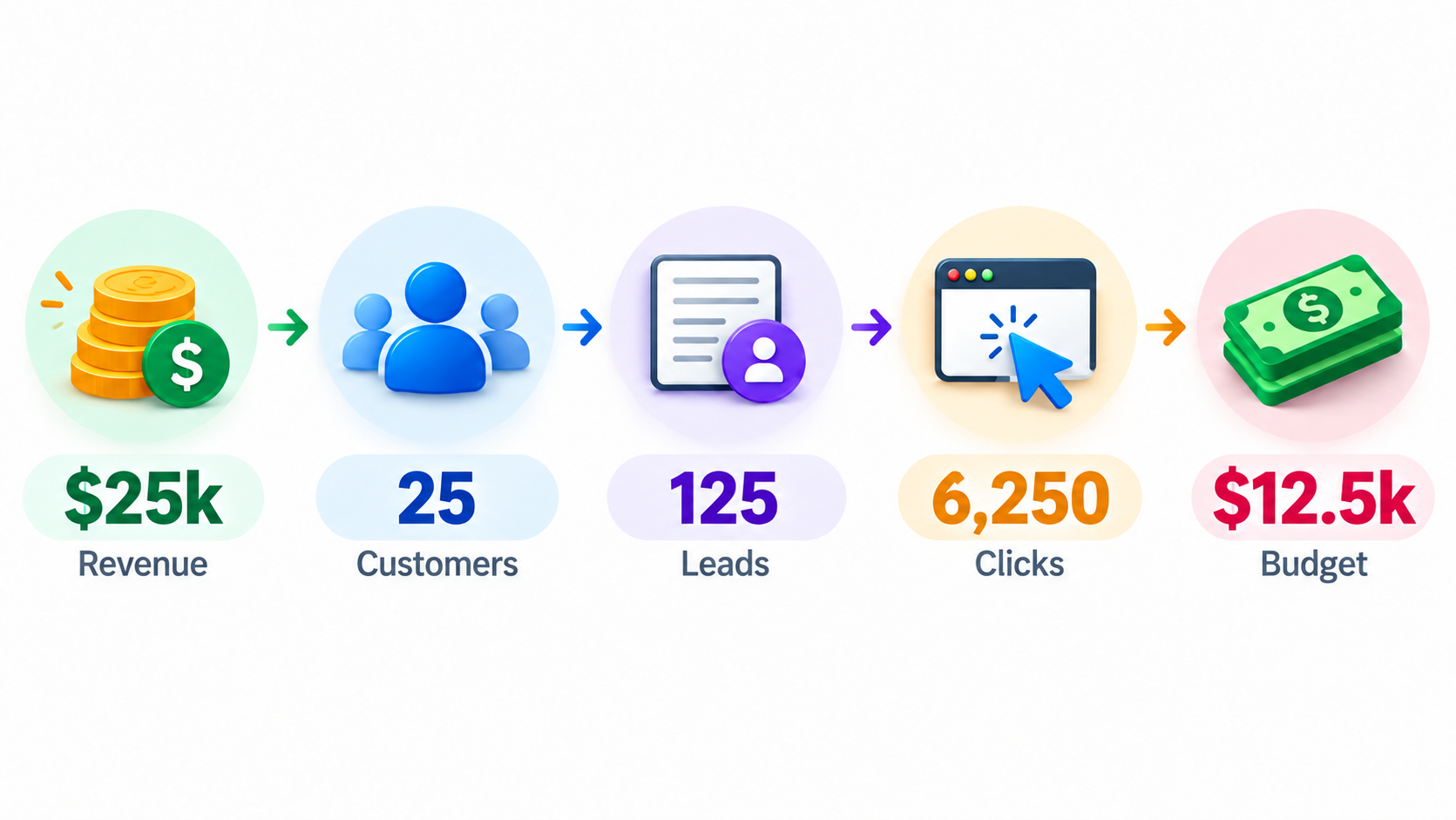
$25,000 revenue target ÷ $1,000 = 25 customers
25 customers ÷ 20% = 125 leads
125 leads ÷ 2% = 6,250 clicks
6,250 clicks × $2 = $12,500 monthly PPC budget
The result is not automatically the amount the company should spend. It is the amount suggested by the assumptions. The final decision still depends on profitability, available search demand, cash flow, and actual campaign performance.
Set Your PPC Budget around Business Results
The right PPC advertising budget is different for every business. It is contingent upon the revenue level PPC needs to generate, what a customer is worth, how efficiently leads convert into customers, how well paid traffic converts, and what each click costs. Start with the revenue you expect to make from PPC and work backward through customers, leads, clicks and CPC. Then check the customer acquisition cost against your margins and customer value.
Once the campaign is live, use conversion data to replace estimates with real performance. Businesses that need support with campaign setup, tracking, optimisation, and budget management can also consider professional PPC advertising services to make more informed decisions about where their advertising spend should go. Need help turning your PPC budget into measurable results? Talk to our PPC experts about a strategy built around your goals, customer value, and campaign performance.
Comments
Author Details

Ashwani Kumar Sharma
Ashwani has been actively involved in SEO services since 2005. His expertise and distinctive work approaches have made him one of the most experienced and trusted SEO experts in the industry. He is a certified SEO and Google Ads professional. He also has strong business development skills in advanced SEO, PPC, and digital marketing strategies.


Hi there! This is my first visit to your blog! We are a group of volunteers
and starting a new project in a community in the same niche.
Your blog provided us valuable information to work on. You have done a marvellous job!