



Intent Mapping Framework: Aligning Content With TOFU–MOFU–BOFU

Key Takeaways
- Intent mapping aligns content with user journey stages to improve conversion efficiency.
- TOFU attracts awareness traffic through educational and informational content strategies.
- MOFU nurtures interest by addressing problems, comparisons, and solution-based queries.
- BOFU converts users through decision-focused, high-intent content and clear calls to action.
- Misaligned content reduces engagement and weakens overall funnel performance outcomes.
- Structured content mapping improves targeting precision and user experience consistency.
- An integrated funnel strategy enhances SEO performance and the effectiveness of paid campaigns.
Most content does not fall short because the writing is bad. It falls short because the page shows up with the wrong message at the wrong point in the journey. That is where an intent mapping framework starts to matter. It helps you align content with what people actually need as they move from early curiosity to evaluation to decision, instead of expecting one page to do every job at once. Someone trying to understand a problem needs clarity, not a sales pitch. Someone comparing options needs proof, not broad advice. Someone close to choosing needs confidence, context, and a clear next step. A strong buyer journey content strategy turns traffic into direction, and that is where a TOFU MOFU BOFU content strategy starts to feel less like a framework on paper and more like a system that supports real business growth.
When that alignment is missing, even well-written content can feel slightly off. A blog post may bring in traffic, but fail to move readers forward. A landing page may look polished but still underperform because it asks for action before trust is built. That is why content funnel mapping matters. It helps connect the page, the message, and the moment more intentionally, so the journey feels useful rather than forced. In this blog, you will learn how to pair funnel stages with a stronger search intent SEO strategy and create content that matches how people actually make decisions. You will also see how content marketing funnel stages work together to turn disconnected assets into a more focused path to conversion.
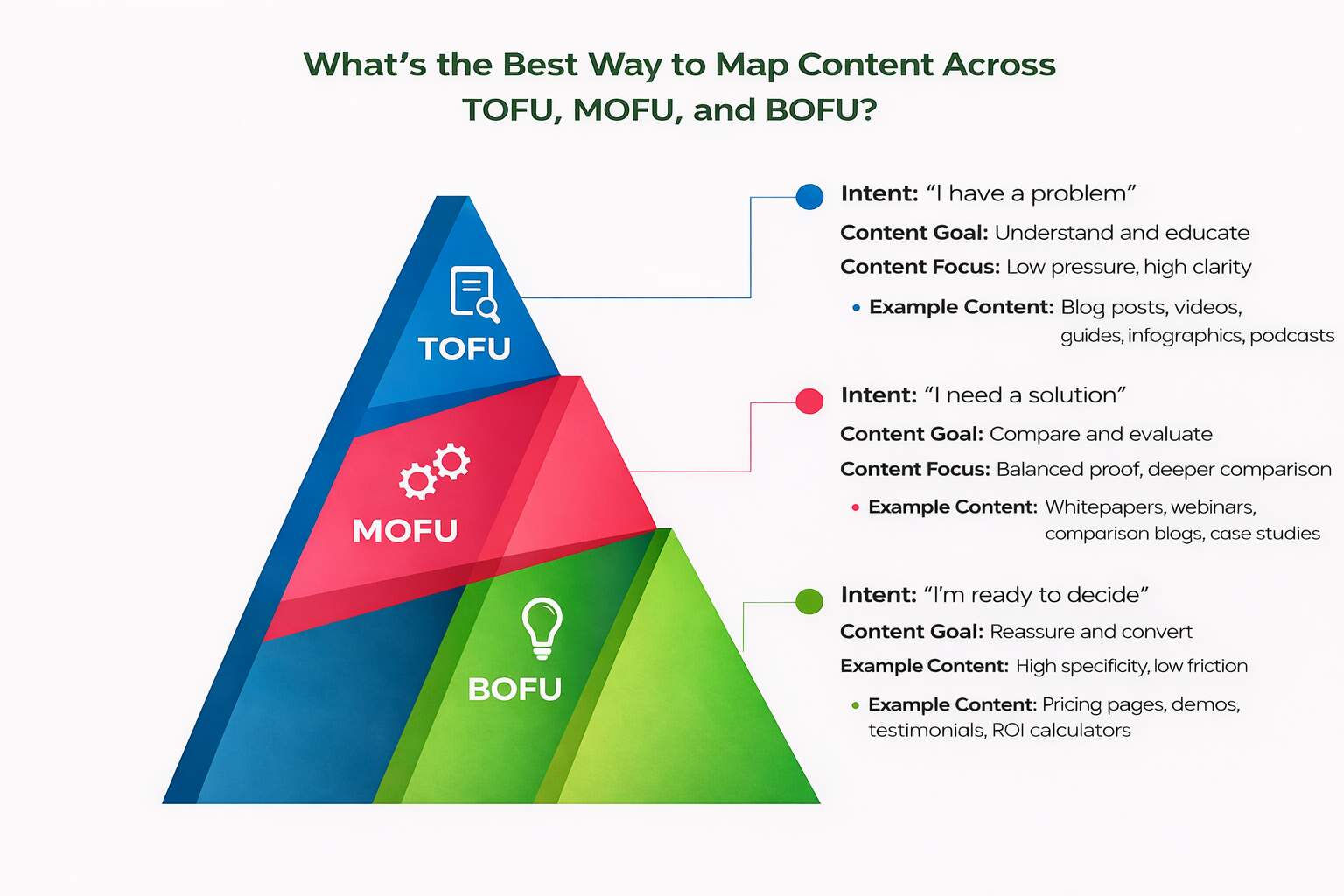
What Are TOFU–MOFU–BOFU Funnel Stages?
Where alignment improves results quickly:
- Cold traffic needs education before being prompted to convert.
- Warm traffic needs comparisons, proof, and stronger trust-building signals nearby.
- Hot traffic needs speed, clarity, and minimal friction between intent and action.
- Better page matching improves traffic quality, not just vanity metrics.
- Relevance usually beats volume when the goal is actual business movement.
This is why intent mapping is not a side task for content teams. It is a performance filter for SEO, PPC, and landing-page planning. When the page type aligns with the searcher’s mindset, engagement becomes more meaningful, and wasted clicks become less common. That makes campaigns more efficient, organic traffic more useful, and optimization decisions much easier, because the funnel starts working like a system instead of a guessing game.
Building an Intent Mapping Framework
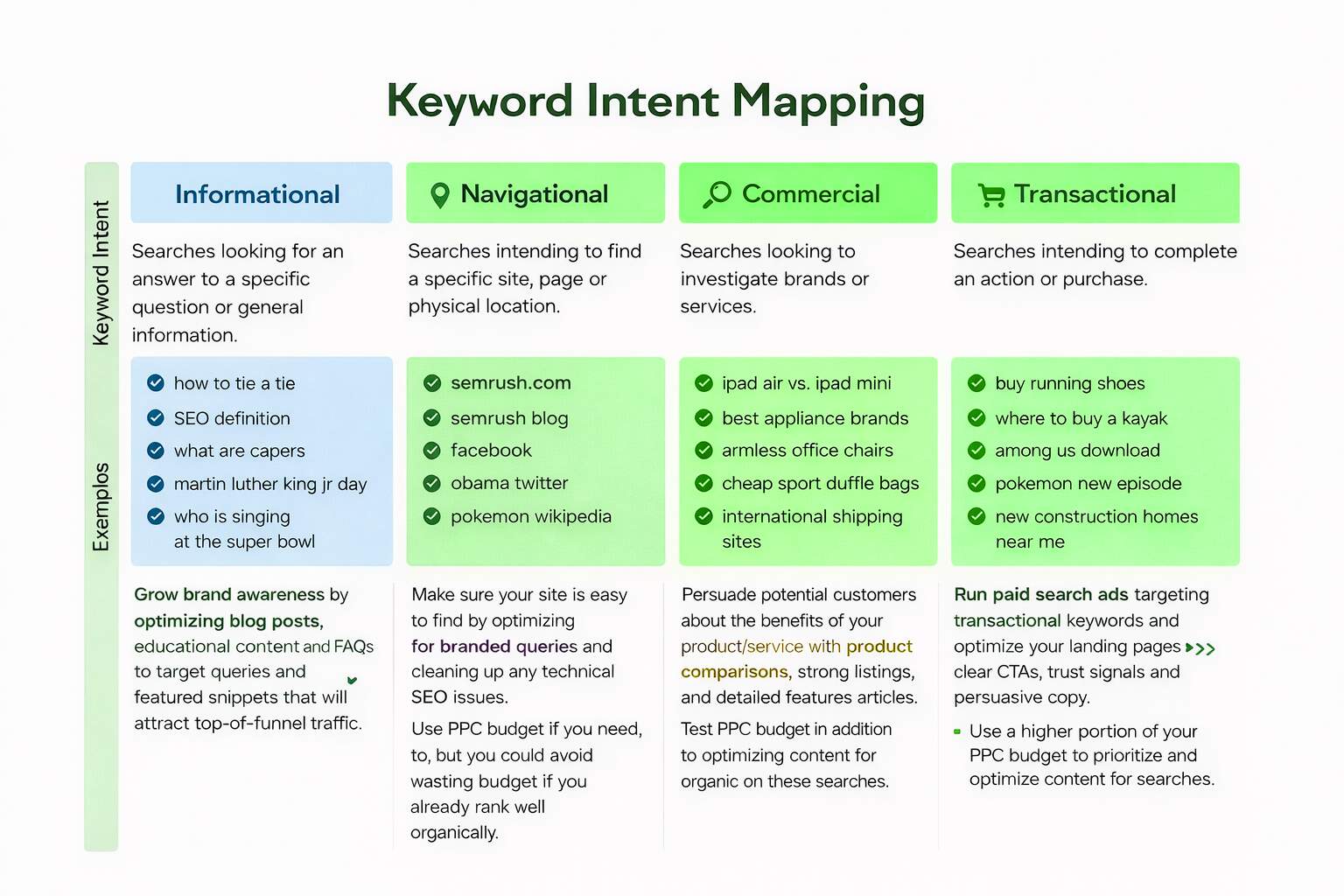
A practical intent mapping framework starts with one correction many teams need to hear: topic mapping is not the same as intent mapping. Too many marketers gather keywords, sort them by theme, and assume one page can somehow satisfy every possible user need inside that cluster. It cannot. Real search intent mapping asks what the searcher wants to do right now: learn, compare, validate, or act. Once that is clear, page formats become easier to choose. This is also where the content clusters strategy becomes much more useful. Instead of creating isolated assets, you build connected paths across the funnel. One page introduces the issue, another sharpens the evaluation, and another supports the final decision. That is how content for sales funnel planning starts acting like a system rather than a spreadsheet full of disconnected ideas.
What makes the framework usable:
- Classify keywords by user purpose before assigning page format or CTA.
- Build pages that support movement, not isolated rankings with no journey.
- Match page depth to stage-specific expectations, not internal assumptions.
- Use internal links to guide readers from curiosity toward evaluation.
- A good framework supports both cleaner decisions and stronger progression.
The real value appears when structure and progression work together. A strong buyer journey content strategy does not leave readers wondering what comes next. It gives them a logical path from education to comparison to action, with each page doing one job well. That kind of clarity helps teams plan better, write better, and measure better because the funnel stops feeling like a pile of content and becomes a guided experience.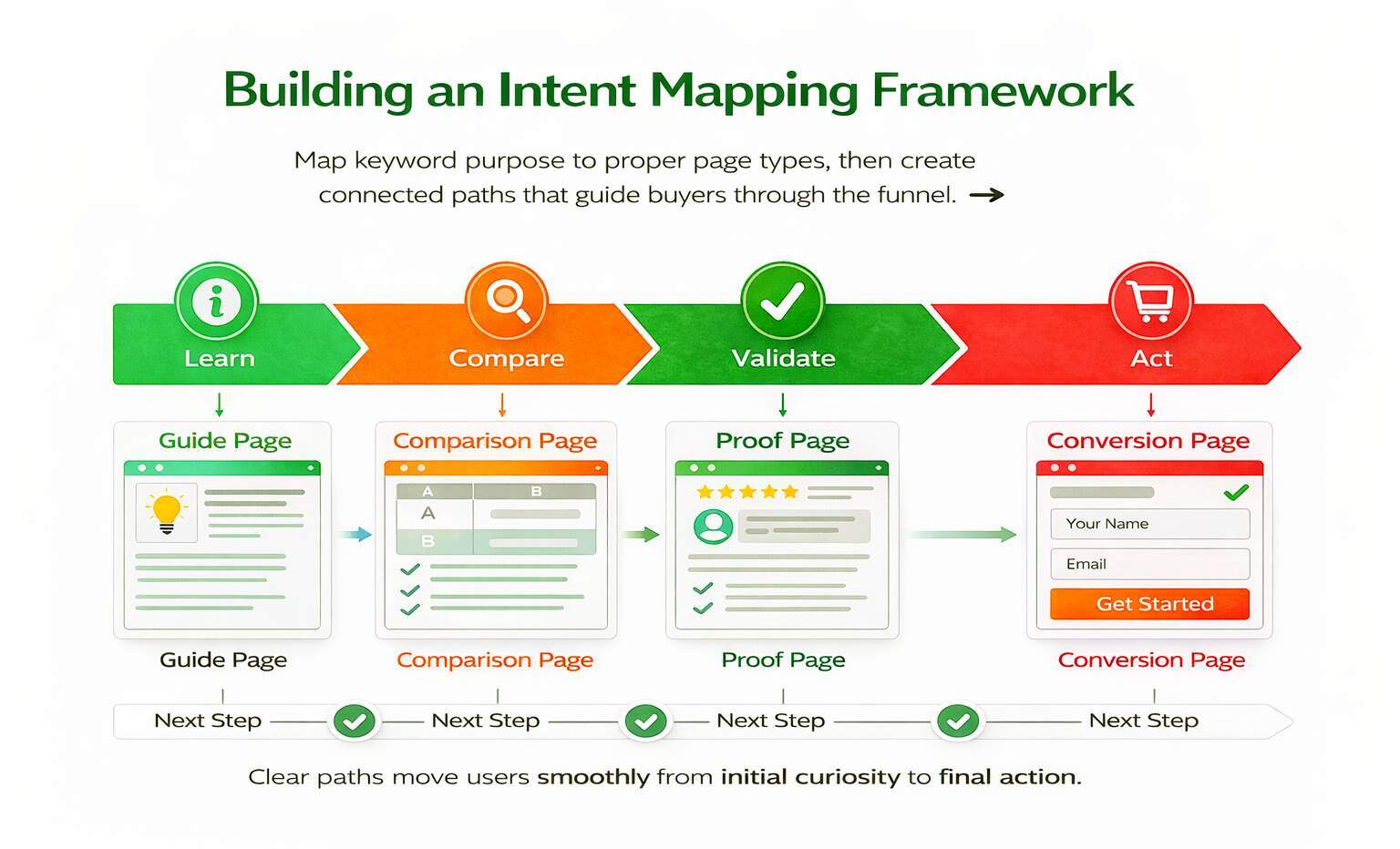
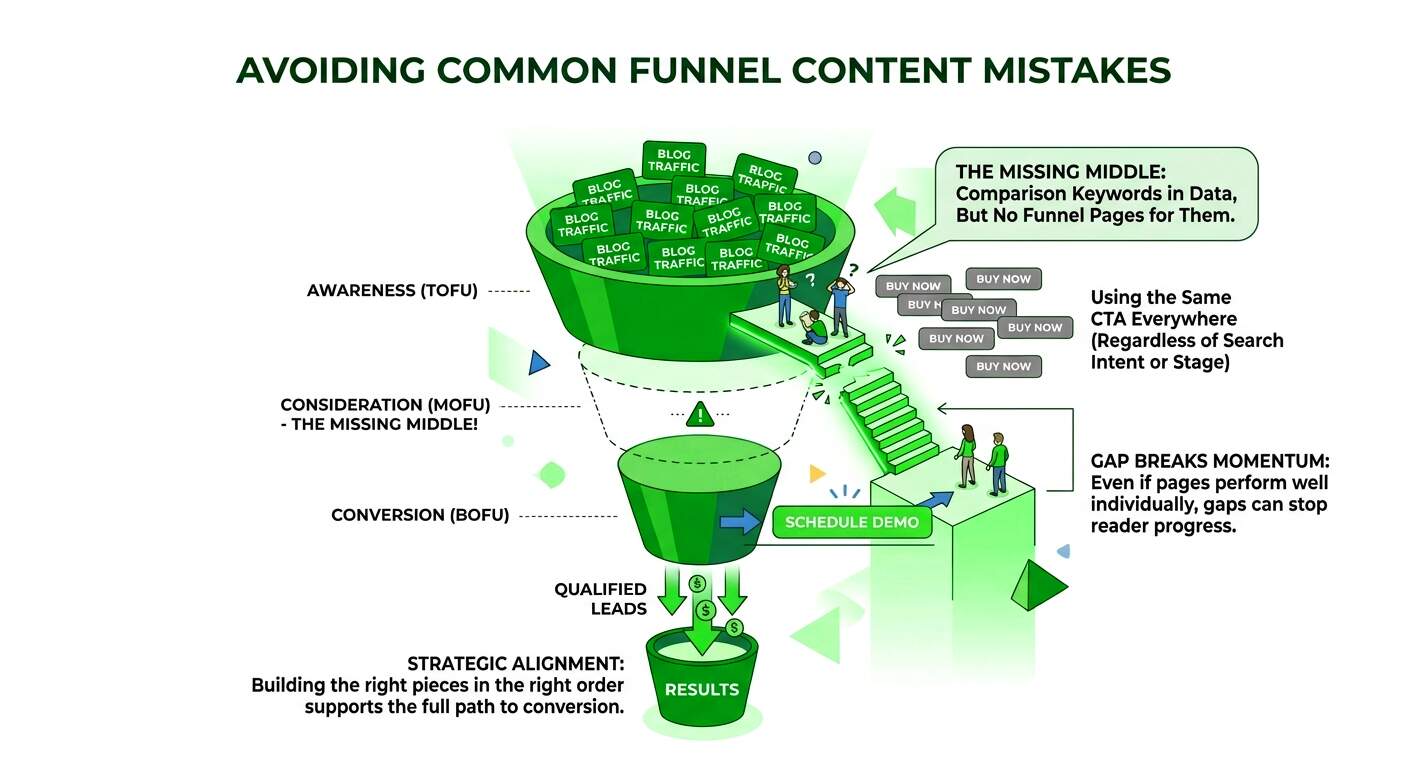
Warning signs worth noticing early:
- Blog traffic grows, but qualified leads remain flat or inconsistent.
- Every page uses the same CTA regardless of stage or search intent.
- Comparison keywords appear in the data, but useful MOFU pages are missing.
- Service pages demand trust, but the rest of the site has not earned it.
- Funnel gaps break momentum even when pages perform well individually.
A strong strategy is not about publishing more and hoping volume fixes structure. It is about building the right missing pieces in the right order. When content supports the full path, readers stop bouncing between disconnected assets and start moving with purpose. That is how a funnel becomes commercially useful instead of cosmetically busy, and why stage balance matters just as much as traffic.
How to Rank Content With AI Optimization
AI-shaped search has made one thing very clear: vague pages are easier to skip than ever. If the answer takes too long to appear, both readers and machines lose patience fast. That is why an intent mapping framework should influence not only what you publish, but also how each page is built. Put the clearest answer first. Use a structure that reflects real questions. Expand with examples instead of filler. A strong search intent SEO strategy depends on making the page’s purpose obvious from the first screen. Is this page explaining, evaluating, or converting? That clarity matters because search systems and human readers now judge relevance almost instantly.
What stronger structure usually includes:
- Clear answers early, before storytelling delays useful information.
- Subheads shaped like the questions people actually ask.
- Real examples that ground ideas in practical business situations.
- Internal pathways that guide progression instead of creating clutter.
- Better structure supports user journey mapping and stronger relevance.
This does not mean writing for robots. It means writing so human meaning is easier to scan, trust, and extract. When content is well-structured, it serves both classic search and AI summaries, as well as human readers. That makes the page more durable, more useful, and more competitive in environments where clarity now competes directly with convenience. Mini Example: A page answering ‘what is lead scoring’ should not bury the definition under four paragraphs of brand storytelling.
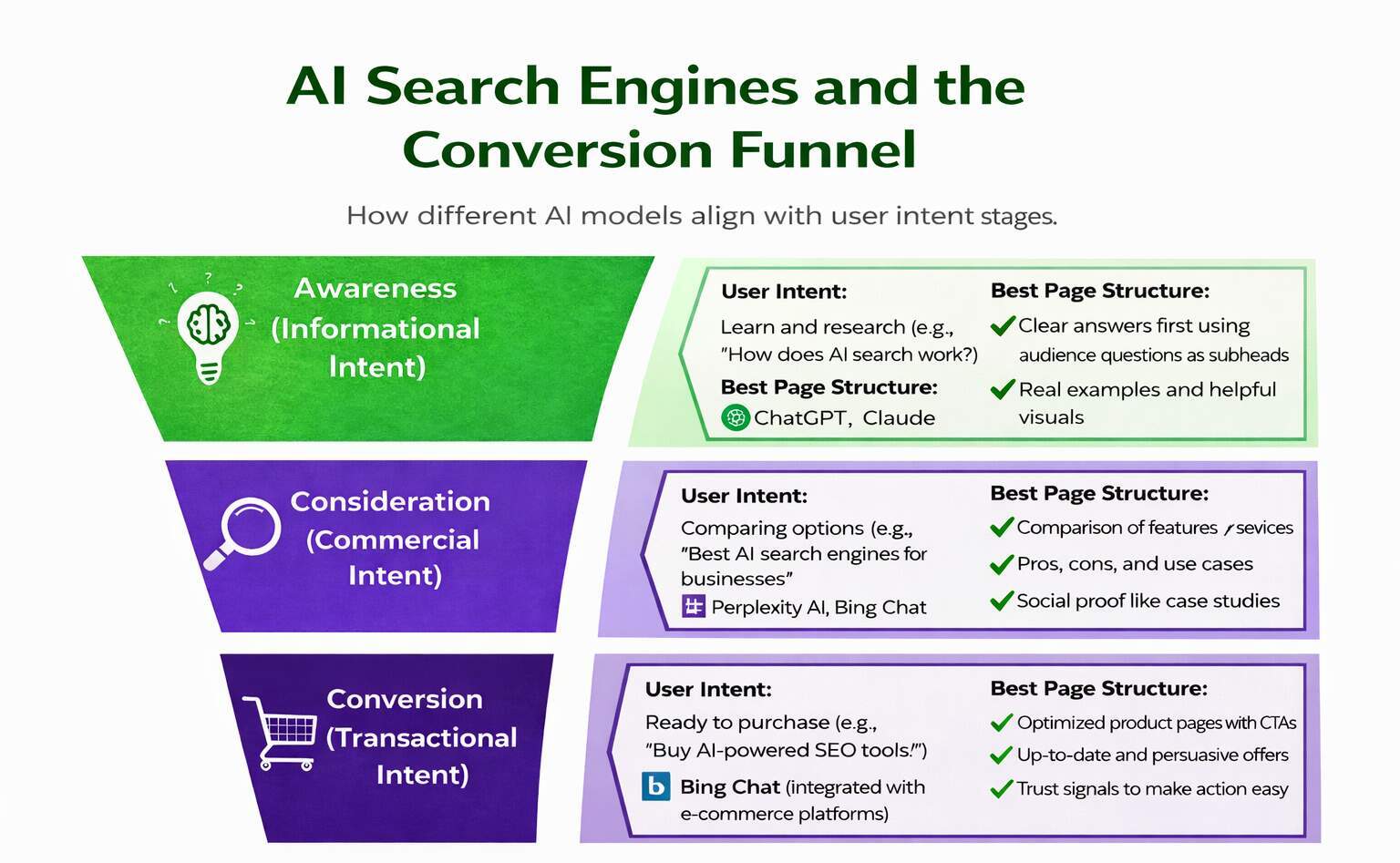
When brands flatten all three stages into a single generic message, they create friction rather than momentum. A better funnel respects timing. It understands that discovery, evaluation, and decision each need their own tone, page format, and job. That is how content becomes easier to trust, easier to follow, and much more likely to move someone forward rather than leave them stuck between interest and action.
Wrapping It Up
Intent mapping works because buyers do not move through the funnel with one mindset. Some are trying to understand the problem, some are comparing solutions, and some are ready to make a decision. When your content reflects those shifts, it becomes far more useful and far more persuasive. Instead of asking every page to do every job, you create a clearer path from discovery to action. That improves traffic quality, supports better engagement, and gives conversions a much stronger foundation. In other words, content starts behaving less like a collection of disconnected assets and more like a system built to guide real buying decisions. That is what makes TOFU, MOFU, and BOFU alignment so valuable for brands that want content to drive measurable growth.
Build a Funnel That Moves People Forward
If your content is attracting attention but not creating enough momentum, it may be time for a smarter full-funnel approach. We help businesses build content that educates at the top, builds trust in the middle, and drives action at the bottom. Request a quote today and let eSign Web Services build an amazing TOFU, MOFU, and BOFU content strategy that turns attention into qualified business growth.
Frequently Asked Questions (FAQs)
Question: What is intent mapping in content marketing?
Answer: Intent mapping is the process of aligning content with different stages of the buyer journey based on user intent. It ensures that content addresses specific needs at awareness, consideration, and decision stages. By categorizing content into TOFU, MOFU, and BOFU, businesses can deliver relevant information that matches user expectations. This approach improves engagement, reduces bounce rates, and increases conversion probability. Intent mapping also supports SEO by aligning content with search behavior. Structured implementation enables businesses to guide users effectively through the funnel, improving both traffic quality and overall marketing performance outcomes.
Question: Why is TOFU content important if it doesn’t convert immediately?
Answer: TOFU content plays a critical role in attracting new audiences and building initial trust. Although it may not generate immediate conversions, it introduces potential customers to your brand and educates them about relevant problems or opportunities. This early engagement creates awareness and positions your business as a reliable information source. Over time, users exposed to TOFU content move into deeper funnel stages where conversion becomes more likely. Without TOFU content, businesses limit their reach and rely only on existing demand. A strong top-of-funnel strategy ensures a continuous pipeline of qualified prospects entering the marketing funnel consistently.
Question: How can I identify whether a keyword is TOFU, MOFU, or BOFU?
Answer: Keyword intent can be identified by analyzing search behavior and language patterns. Informational queries such as “what is,” “how to,” or “guide” typically indicate TOFU intent. Comparison terms like “best,” “vs,” or “review” reflect MOFU intent, where users evaluate options. Transactional keywords including, “buy,” “price,” “service,” or “near me,” signal BOFU intent. Reviewing search engine results pages also provides insight into dominant intent, as content formats reveal user expectations. Classifying keywords correctly ensures content aligns with user readiness, improving engagement, ranking performance, and conversion outcomes across the marketing funnel.
Question: Can one piece of content target multiple funnel stages effectively?
Answer: While some content may overlap across funnel stages, attempting to target all stages within a single piece often reduces clarity and effectiveness. Each stage represents a different user mindset, requiring specific messaging and structure. Combining multiple intents can confuse users and weaken engagement. However, strategic content can include pathways guiding users to deeper funnel stages through internal links or progressive sections. The primary focus should remain aligned with one dominant intent. Clear segmentation ensures content delivers precise value while supporting natural progression toward conversion through structured navigation and linking strategies.
Question: How does intent mapping improve SEO performance?
Answer: Intent mapping improves SEO performance by aligning content with user expectations and search engine evaluation criteria. Modern algorithms prioritize relevance and satisfaction rather than keyword density. When content matches intent accurately, engagement metrics such as click-through rate, dwell time, and interaction improve. These signals strengthen ranking stability and visibility. Additionally, structured intent mapping supports better keyword targeting and reduces competition overlap. By creating content tailored to specific funnel stages, businesses increase their chances of ranking for diverse queries. This approach enhances both traffic quality and long-term organic growth across multiple search touchpoints.
Question: What type of content works best for the MOFU stage?
Answer: MOFU content focuses on helping users evaluate solutions and make informed decisions. Effective formats include comparison articles, case studies, detailed guides, webinars, and product reviews. This stage requires content that addresses specific problems while presenting practical solutions. Users expect depth, clarity, and credibility. Including data, examples, and structured insights strengthens trust and engagement. MOFU content should also subtly introduce your offering without aggressive selling. The objective is to position your business as a reliable solution provider and guide users toward the decision stage through valuable, problem-focused information.
Question: How can I measure the effectiveness of my funnel-based content?
Answer: Effectiveness can be measured using stage-specific metrics aligned with user intent. TOFU content performance is evaluated through traffic, impressions, and engagement rates. MOFU content should be measured using time on page, interaction depth, and lead generation indicators. BOFU content success depends on conversion rates, form submissions, and revenue outcomes. Analyzing user flow between stages reveals progression efficiency. Tools such as analytics platforms and heatmaps provide insights into behavior patterns. Continuous monitoring and optimization ensure content aligns with performance goals and supports consistent movement through the marketing funnel.
Question: What are common mistakes in implementing intent mapping?
Answer: Common mistakes include focusing only on traffic without considering intent, creating excessive TOFU content without conversion pathways, and using the same messaging across all funnel stages. Many businesses also fail to update content based on evolving search intent. Ignoring internal linking and not guiding users through the funnel reduces effectiveness. Another mistake is misclassifying keywords, leading to mismatched content. Successful implementation requires structured planning, continuous analysis, and alignment with user behavior. Avoiding these mistakes ensures a balanced strategy that supports both visibility and conversion objectives.
Question: How does intent mapping support paid advertising campaigns?
Answer: Intent mapping enhances paid advertising by aligning campaigns with user readiness levels. TOFU campaigns focus on awareness and engagement, while MOFU campaigns nurture interest through informative messaging. BOFU campaigns target high-intent users with conversion-focused offers. This segmentation improves targeting precision and reduces wasted spend. Ad copy, landing pages, and bidding strategies become more effective when aligned with funnel stages. Intent-based segmentation also improves quality scores and conversion rates. Integrating intent mapping into paid campaigns ensures consistent messaging and maximizes return on investment across different audience segments.
Question: Is intent mapping relevant for AI-driven search environments?
Answer: Intent mapping is highly relevant in AI-driven search environments where algorithms prioritize context, relevance, and user satisfaction. Generative search systems analyze intent patterns to deliver accurate and meaningful responses. Content aligned with specific intent stages has a higher probability of being included in AI-generated summaries and voice responses. Structured intent mapping improves extractability and semantic clarity, which are critical for AI interpretation. As search evolves toward conversational and personalized experiences, understanding user intent becomes even more important. Businesses that implement intent-based strategies remain competitive and visible in modern search ecosystems.
Author Details

Ashwani Kumar Sharma
Ashwani has been actively involved in SEO services since 2005. His expertise and distinctive work approaches have made him one of the most experienced and trusted SEO experts in the industry. He is a certified SEO and Google Ads professional. He also has strong business development skills in advanced SEO, PPC, and digital marketing strategies.


