



Google Ads vs. Microsoft Ads in 2026: Budget Allocation Strategy

Key Takeaways
- Google brings more search volume, while Microsoft often brings lower click costs.
- Audience behavior differs across both platforms and directly affects lead quality.
- Microsoft can be especially effective for B2B and higher-value audiences.
- Google remains stronger for mobile reach and broad consumer demand.
- Budget diversification reduces platform dependency and improves stability.
- Microsoft can produce stronger conversion efficiency in lower-competition spaces.
- The best results usually come from strategic allocation, not choosing one platform forever.
The smartest 2026 budget split is rarely all-in on one platform. Google Ads vs. Microsoft Ads is not really a fight between good and bad; it is a decision about scale, efficiency, and the kind of buyer behavior your business actually depends on. Google still tends to lead when brands need fast visibility, broad consumer reach, and stronger search volume. Microsoft, meanwhile, keeps attracting advertisers who care more about lower competition, steadier costs, and users who tend to search with more intention.
That is why a strong PPC budget allocation strategy should begin with business context, not platform loyalty. A local service company trying to drive calls will not build the same channel mix as a B2B software brand targeting decision-makers during working hours. One platform feels like a packed freeway at rush hour; the other feels like the quieter route that gets less attention but can sometimes get you there with less friction.
The real advantage comes from knowing when scale deserves a bigger share of the budget, when efficiency should take the lead, and how a sharper PPC search volume comparison mindset can keep marketers from overspending just because the biggest platform feels like the safest choice. This blog will guide you on where each platform performs best, how to split budget more strategically, and when to prioritize reach, efficiency, or a mix of both.
How AI Improves PPC Audience Targeting
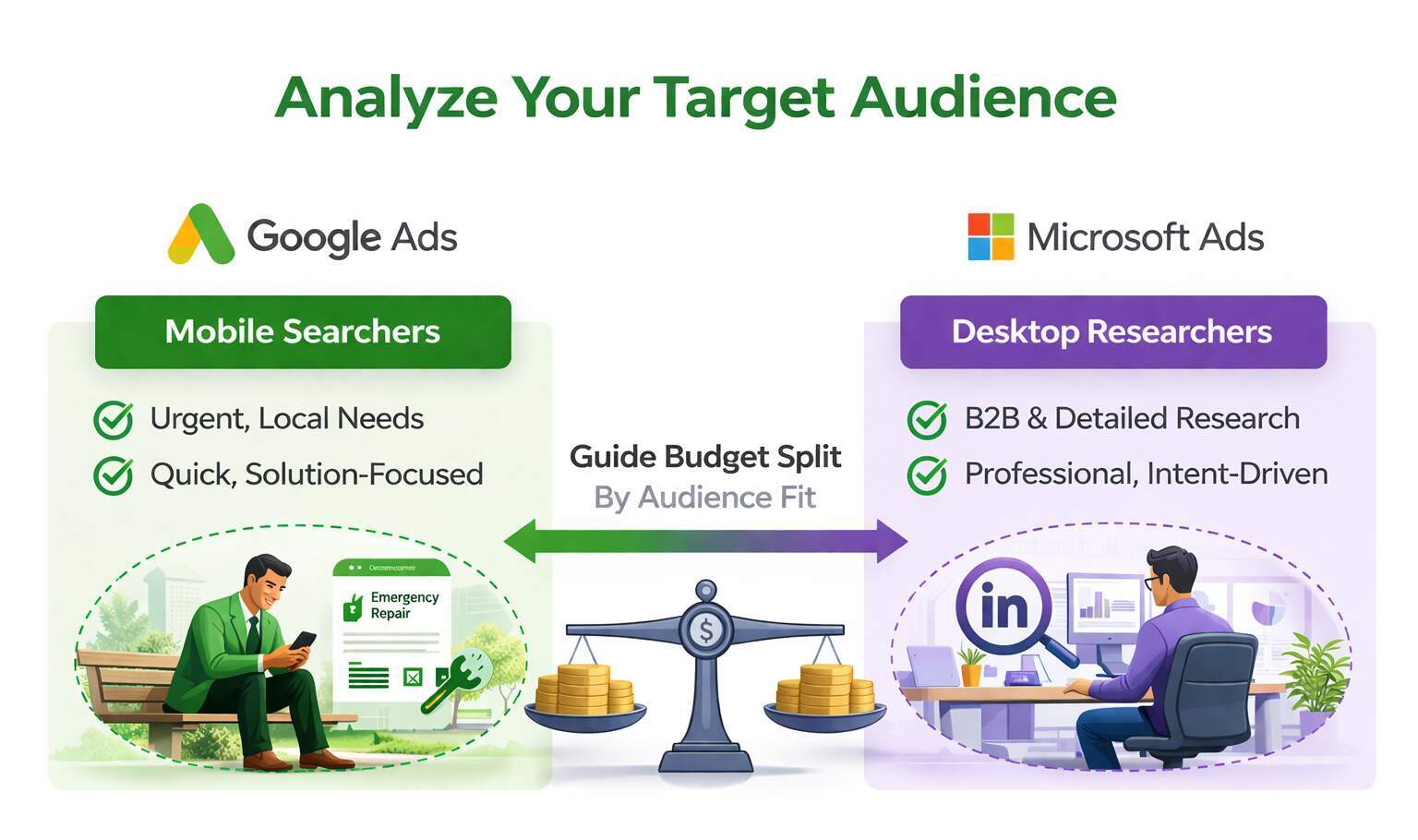
Before you decide how much budget belongs on each platform, take a closer look at the people you are actually trying to reach. This is where many campaigns start to drift. Brands often compare Google Ads and Microsoft Ads based on size, cost, or popularity, but the smarter move is to start with target audience behavior. A homeowner searching on a phone for an urgent repair does not behave like a B2B buyer comparing vendors on a desktop during office hours. When you understand how your audience searches, researches, and decides, budget allocation becomes much more strategic and a lot less guesswork.
Why this matters
- It helps you avoid splitting budget based on platform reputation instead of audience fit.
- It reduces wasted spend from showing ads to the wrong users, on the wrong devices, at the wrong moments.
- It makes your campaign strategy more grounded in real buyer behavior, not assumptions.
What to look for
- Whether your audience is more mobile-first and fast-moving, or desktop-heavy and research-driven.
- Whether they respond better to broad visibility or more deliberate, professionally aligned targeting.
- Which platform is more likely to match their intent before the click even happens.
How to apply it
- Review device trends, lead quality, and conversion paths across both platforms.
- Compare which audience segments bring stronger results, not just more traffic.
- Shift spend toward the platform that attracts the right people, not simply the biggest audience.
That is when your media mix stops feeling like a guessing game and starts working like a real strategy, with budget decisions shaped by audience behavior, platform fit, and the kind of users most likely to turn into qualified leads or customers.
Google Ads: Strengths & Limitations
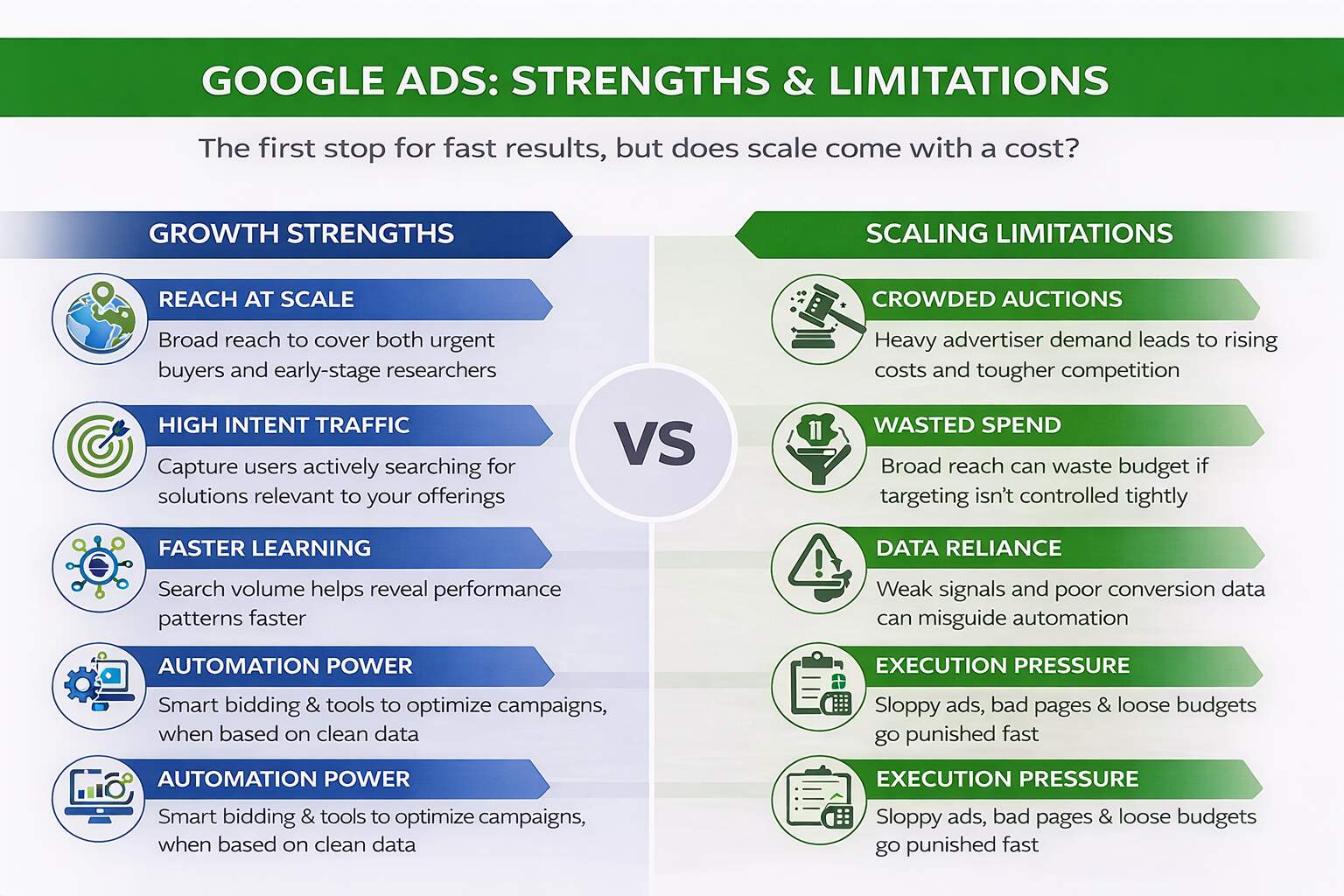
Google is usually the first platform advertisers call when they want momentum fast, and for good reason. It offers something very few channels can deliver at the same time: speed, reach, and intent at scale. When a business needs quick traction, broad keyword coverage, and enough search demand to spot patterns early, Google becomes the natural starting point in the Google Ads vs. Microsoft Ads conversation.
That reach matters because it puts brands in front of everyone from urgent, ready-to-buy searchers to early-stage researchers still weighing their options, which is exactly why the platform often feels like a growth engine that never really sleeps. It is also packed with automation, smart bidding, audience layering, and campaign tools that can make optimization feel smoother when tracking is accurate and the account is built on a solid strategy.
Why Google works so well for scale
- Broad reach helps brands capture both immediate buyers and people still exploring solutions.
- Automation can save time, but only when campaign signals and tracking stay accurate.
- Strong search volume gives marketers faster learning and clearer performance patterns.
- Google rewards disciplined strategy and gives growth-focused brands more room to expand.
Where Google gets harder to manage
- Heavy advertiser demand creates crowded auctions and rising costs.
- Broad reach can lead to wasted spend when targeting is not tightly controlled.
- Automation can go in the wrong direction when the underlying data is weak.
- The platform rarely forgives sloppy creative, weak landing pages, or loose budget control.
That is the real tradeoff. Google’s strength is scale, but scale comes with pressure. It can absolutely outperform, but it rarely rewards careless execution. That is why Bing Ads vs. Google Ads performance becomes a more serious question the moment click per costs rise and margins start feeling tighter.
Microsoft Ads: Strengths & Opportunities
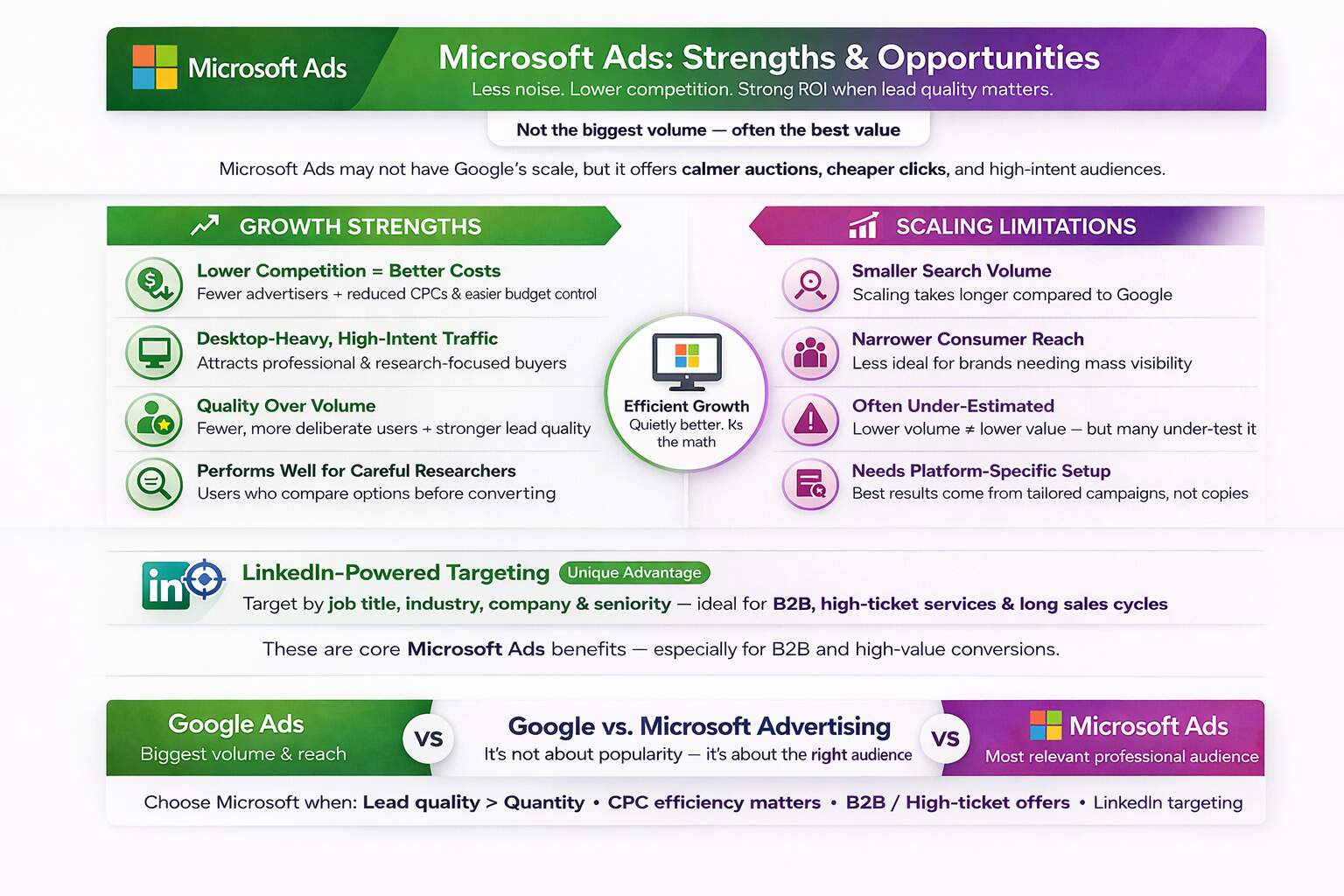
Microsoft Ads usually enters the conversation with less noise, which is exactly why it surprises so many advertisers once performance starts speaking for itself. It may not bring the same raw volume as Google, but it often delivers something just as valuable: calmer auctions, lower competition, and more room to stretch budget without feeling like every click was bought in the middle of a bidding war. For marketers focused on efficient growth, that matters far more than hype.
The platform often performs especially well with desktop-heavy users, professional audiences, and buyers who take more time to compare options before converting, which is why the Microsoft Ads vs. Google Ads ROI conversation becomes much more compelling once lead quality enters the equation. In many cases, Microsoft is not the loudest channel, but it can be the one that quietly improves the math.
Why Microsoft keeps earning more attention
- Lower competition can reduce cost pressure and improve daily budget control.
- Desktop-heavy traffic may feel slower, but it often brings in more serious buyers.
- Audience quality can matter more than volume when lead value is high.
- Microsoft tends to perform best when users research carefully before taking action.
Where Microsoft has natural limits
- Search volume is smaller, so scaling takes longer than it usually does on Google.
- It may not offer the same reach for brands that depend on broad consumer visibility.
- Some advertisers under-test it because they assume lower volume means lower value.
- Results are strongest when campaigns are tailored to the platform, not simply copied over.
Microsoft also stands out for its LinkedIn-based targeting options, which let advertisers reach people by job function, industry, and company in a way that feels especially useful for B2B brands, high-ticket services, and longer sales cycles. Those are real Microsoft Ads benefits, not just bonus features. In that context, Google vs. Microsoft advertising stops being a popularity contest and becomes a much more practical targeting decision: do you want the biggest crowd, or the audience most likely to matter?
Differences That Impact Budget Allocation
Budget decisions get smarter the moment advertisers stop treating both platforms like the same search engine wearing different clothes and start evaluating them based on the kind of demand they actually drive. That is where Google Ads vs. Microsoft Ads becomes a real business decision instead of a platform preference. Google usually wins on scale, broader visibility, and mobile-led discovery, which makes it especially useful when a brand needs reach, awareness, and quicker top-of-funnel momentum. Microsoft, on the other hand, often shines when search behavior is more deliberate, the device mix leans toward desktops, and the buyer is doing careful research rather than impulse-driven browsing.
That difference matters because cheaper traffic only helps when it leads to stronger outcomes, and bigger traffic only matters when it creates enough qualified opportunities to justify the spend. A strong paid search comparison 2026 has to weigh reach, device behavior, audience intent, and conversion quality together, not in isolation. Otherwise, it becomes too easy to overvalue scale and undervalue efficiency. One platform may bring more clicks, while the other brings better conversations. One may generate faster volume, while the other helps protect margin. Once marketers start comparing platforms by role rather than ego, budget allocation becomes clearer, sharper, and much more profitable.
| Factor | Google Ads | Microsoft Ads | Budget Impact |
| Reach and search volume | Broader query volume and faster scale | Smaller but often more focused traffic | Google usually earns more budget when volume is the goal |
| Device behavior | Stronger for mobile and quick consumer intent | Stronger for desktop and work-hour research | Device mix should influence channel weighting |
| Competition level | Higher competition in many industries | Lower competition in many auctions | Microsoft can often improve cost efficiency |
| Audience profile | Wider consumer mix | More professional, desktop-heavy, and B2B-friendly | Microsoft may deliver stronger lead quality in niche markets |
| Cost pressure | Powerful reach, but costs rise faster | Often more economical for testing and secondary scale | Budget should follow conversion quality, not just traffic size |
In simple terms, Google often gives you the bigger audience, while Microsoft can give you better efficiency. The smartest advertisers do not force one platform to do everything; they let each one handle the part of the job it does best.
Budget Allocation Strategy for 2026
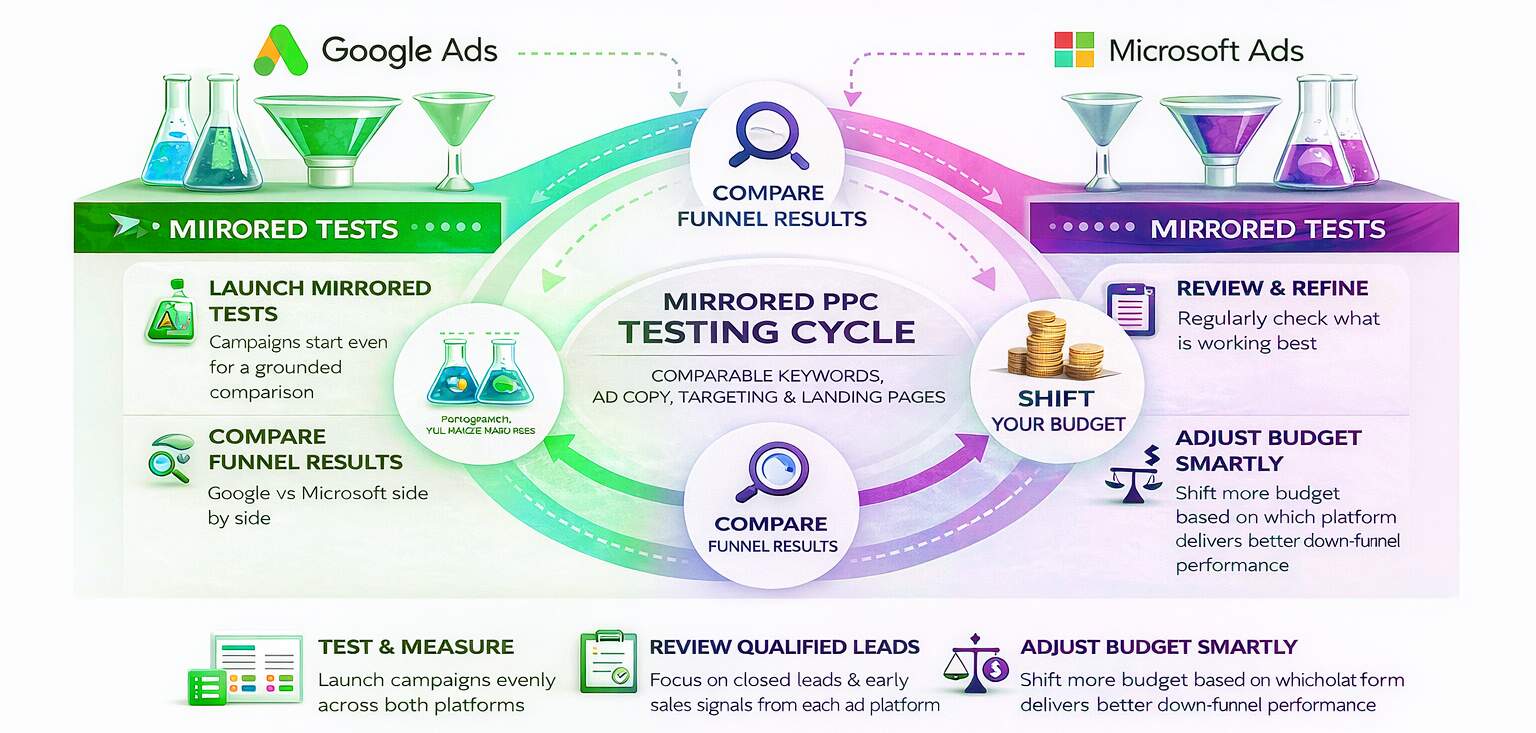
A smart 2026 budget split should behave less like a rigid formula and more like a living system that adapts as real performance data comes in. The strongest teams do not pick a permanent winner before campaigns even launch. They start with controlled testing, comparable landing pages, clean conversion tracking, and enough patience to let qualified results speak for themselves. That is where Google Ads vs. Microsoft Ads becomes genuinely useful, because the real question is no longer “Which platform sounds bigger?” It becomes “Which platform is creating better momentum at each stage of the funnel?” In practice, one platform may drive more volume, while the other improves lead quality, lowers acquisition costs, or stretches budget further in the same market.
Here’s what a smarter budget process looks like in practice:
- Start with mirrored campaigns so the comparison stays fair and useful.
- Measure success through qualified leads, not just cheaper clicks or higher traffic.
- Reallocate budget based on funnel performance, not platform assumptions.
- Keep both channels active enough to preserve learning, flexibility, and backup options.
A simple way to pressure-test your budget split:
Give more weight to lead quality, cost efficiency, and conversion consistency than raw traffic volume alone.
That is what makes a strong PPC budget allocation strategy work in the real world. The goal is not to choose one winner forever. It is to keep adjusting based on business value, sales feedback, and real conversion quality. When marketers do that well, paid search ROI optimization stops being a theory and starts becoming a repeatable system.
When to Prioritize Each Platform
The right platform usually depends less on brand habit and more on what the campaign needs to accomplish right now. If the goal is rapid awareness, broader demand capture, faster testing, and access to a larger pool of active searchers, Google often deserves the first push because it gives brands more room to scale and more chances to build momentum quickly. That is especially true for mobile-heavy behavior, local consumer demand, and categories where visibility matters more than perfect precision. But when the goal shifts toward efficiency, stronger lead quality, tighter audience control, or a more thoughtful research environment, Microsoft becomes much harder to ignore. That is why Google Ads vs. Microsoft Ads works best when the platform choice aligns with the campaign’s purpose rather than a default habit.
A simple way to decide where the budget should lean:
- Prioritize Google when speed, visibility, and broad demand matter most.
- Prioritize Microsoft when audience quality and efficiency matter more than volume.
- Use both when one platform scales and the other improves yield.
- Let campaign goals guide the mix instead of relying on habit.
A startup trying to build awareness may lean more heavily into Google first, while a B2B company targeting decision-makers may find Microsoft more valuable sooner because the audience context lines up better with how people actually buy. In many cases, the strongest results come from sequencing rather than picking a favorite: use Google to create scale, then let Microsoft improve efficiency and yield where the fit is stronger. That is what makes Google vs. Microsoft advertising a strategic timing decision rather than a loyalty test. The best paid search comparison 2026 mindset is simple: let each platform do more of the job it is naturally built to do.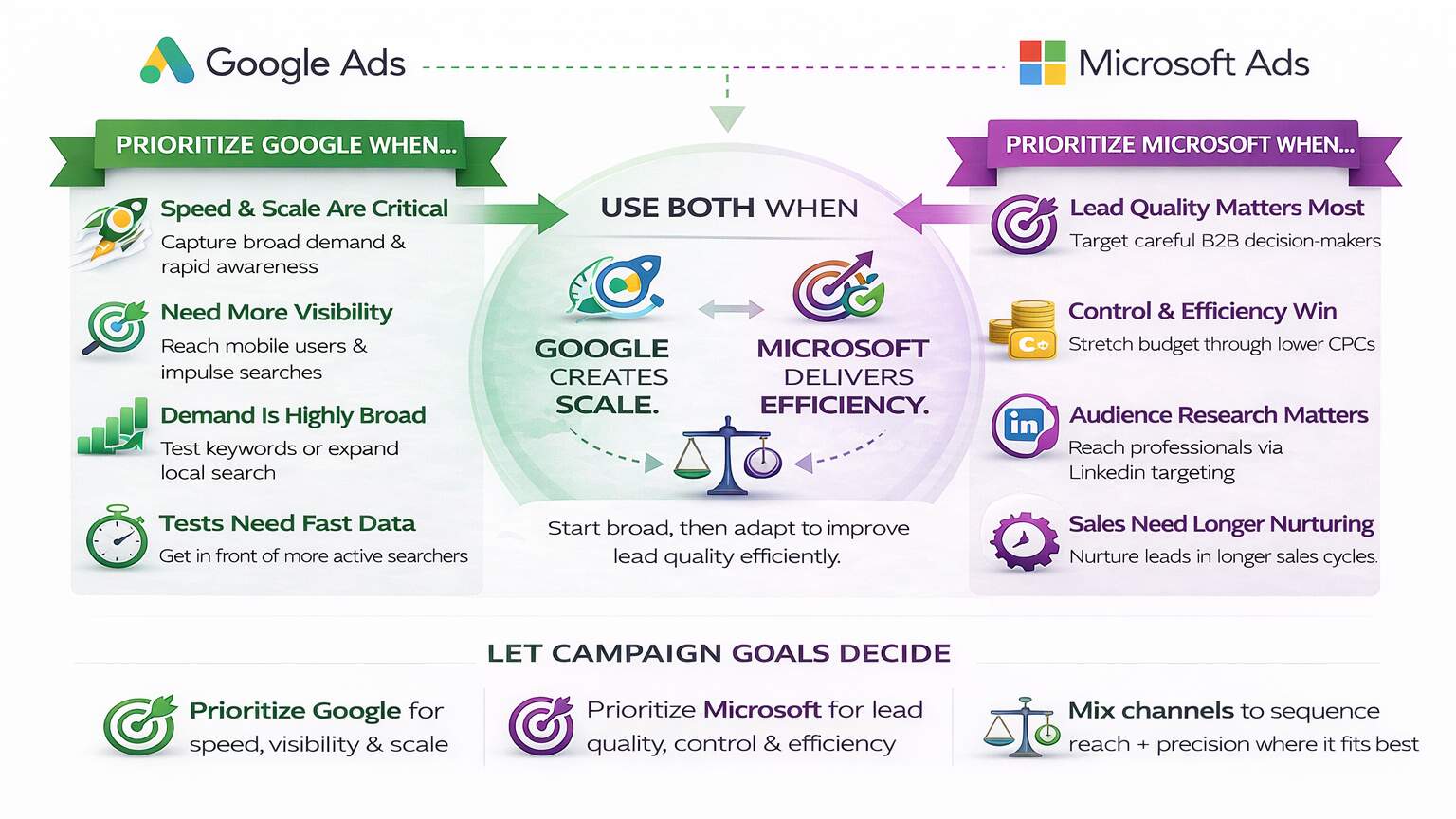
Conclusion: Strategic PPC Allocation Wins
The smartest advertisers in 2026 are not obsessing over which platform deserves the crown. They are focusing on something more useful: building a system where each channel plays to its strengths. That is the real answer to Google Ads vs. Microsoft Ads. Google often brings the reach, the speed, and the ability to generate momentum quickly, while Microsoft often delivers better efficiency, stronger targeting, and traffic that feels more deliberate. When that balance is handled well, the Microsoft Ads vs. Google Ads ROI conversation becomes a lot more practical because the goal stops being “Which one is better?” and becomes “Which one is doing the right job?”
One platform can help fill the funnel, while the other helps improve the quality and efficiency of what comes through it. Together, they create a stronger, more stable PPC strategy. That matters for small businesses, startups, agencies, and in-house teams because relying too heavily on one platform can get expensive fast. Diversification is not about making things complicated. It is about creating a paid media mix that stays flexible, steady, and profitable when the market shifts.
Build a Smarter PPC Mix
If you want a PPC strategy that feels more balanced, more efficient, and less wasteful, eSign Web Services can help. From choosing the right platform mix to improving budget allocation and campaign performance, the team can help you build a smarter approach that supports growth without putting all your spend in the wrong place. Request a free quote or call us today to get started.
Frequently Asked Questions (FAQs)
Question: Which platform is better: Google Ads or Microsoft Ads?
Answer: Neither platform is universally better, as each offers distinct advantages. Google Ads provides larger search volume and broader audience reach, making it ideal for scaling campaigns quickly. Microsoft Ads offers lower competition, reduced cost-per-click, and access to unique audience segments, particularly professionals and higher-income users. The best choice depends on business goals, target audience, and budget constraints. Many successful advertisers use both platforms to balance scale and efficiency. Testing performance across both channels provides data-driven insights, enabling businesses to allocate budget effectively and maximize return on investment.
Question: Is Microsoft Ads cheaper than Google Ads?
Answer: Microsoft Ads is generally cheaper than Google Ads due to lower competition among advertisers. Cost-per-click tends to be lower across many industries, allowing businesses to generate traffic more efficiently. However, lower cost does not always guarantee better performance. Conversion rates, audience quality, and campaign setup also influence results. In some niches, Microsoft Ads can deliver higher return on investment because of its audience demographics. Advertisers should evaluate both platforms based on cost efficiency and conversion performance. Testing campaigns across both channels provides a clearer understanding of actual value rather than relying solely on average cost comparisons.
Question: Which platform is better for B2B advertising?
Answer: Microsoft Ads often performs better for B2B advertising due to its audience composition. Users on Microsoft’s network typically include professionals, corporate users, and higher-income individuals. Integration with LinkedIn data enables targeting by job role, company size, and industry, improving precision. Google Ads still offers scale and reach but may include broader, less qualified audiences. B2B advertisers benefit from combining both platforms, using Google for volume and Microsoft for precision targeting. Evaluating lead quality, conversion rates, and cost per acquisition helps determine the optimal allocation strategy for B2B campaigns.
Question: Can I run the same campaigns on both platforms?
Answer: Yes, campaigns can be replicated across both platforms, but direct duplication is not always optimal. While Microsoft Ads allows importing Google Ads campaigns, performance may vary due to audience behavior and competition differences. Keywords, bids, and ad copy often require adjustments to align with platform-specific dynamics. Testing variations ensures campaigns perform effectively in each environment. Optimizing campaigns individually allows advertisers to take advantage of unique features such as LinkedIn targeting on Microsoft Ads or advanced automation in Google Ads. A tailored approach improves efficiency and maximizes results across both platforms.
Question: How should I split my PPC budget between Google and Microsoft Ads?
Answer: Budget allocation should be based on performance data rather than fixed percentages. A common starting point is allocating 70–80 percent to Google Ads for scale and 20–30 percent to Microsoft Ads for cost efficiency. However, actual distribution depends on conversion rates, cost per acquisition, and audience relevance. Testing both platforms with controlled budgets provides insights into performance differences. Over time, budget should shift toward the channel delivering stronger ROI. Maintaining diversification reduces risk and ensures consistent performance across changing market conditions and algorithm updates.
Question: Does Microsoft Ads have enough search volume to scale campaigns?
Answer: Microsoft Ads has lower search volume compared to Google Ads, but it still offers meaningful scale for many industries. While it may not match Google’s reach, it can deliver consistent traffic, particularly in specific demographics and geographic regions. For niche markets or B2B campaigns, Microsoft Ads often provides sufficient volume with better efficiency. Scaling strategies should consider both platforms together. Using Microsoft Ads as a complementary channel helps capture additional demand while maintaining cost efficiency. Combining both platforms ensures broader reach and more balanced campaign performance.
Question: Are conversion rates higher on Microsoft Ads?
Answer: Conversion rates can be higher on Microsoft Ads in certain industries due to lower competition and more targeted audience segments. Users often include professionals and decision-makers, which improves lead quality. However, conversion performance depends on factors such as campaign structure, landing page quality, and offer relevance. Google Ads may still outperform in high-volume consumer markets. Comparing conversion rates across both platforms provides better insight into effectiveness. Businesses should evaluate performance based on cost per acquisition and return on investment rather than conversion rate alone.
Question: How does device usage impact platform performance?
Answer: Device usage significantly impacts performance across platforms. Google Ads dominates mobile traffic, making it effective for consumer-focused campaigns and on-the-go searches. Microsoft Ads performs strongly on desktop devices, where users often conduct research and business-related queries. Conversion behavior may differ across devices, influencing campaign outcomes. Adjusting bids and optimizing landing pages for device-specific experiences improves results. Understanding how target audiences interact with each platform helps refine strategy. Aligning campaigns with device behavior ensures better engagement and higher conversion efficiency.
Question: Is it necessary to use both platforms for PPC success?
Answer: Using both platforms is not mandatory, but it is highly recommended for maximizing performance. Relying on a single platform increases dependency and limits reach. Combining Google Ads and Microsoft Ads provides access to diverse audience segments and reduces risk associated with platform changes. Multi-platform strategies improve cost efficiency and create additional growth opportunities. Businesses can start with one platform and expand based on performance insights. Diversification ensures more stable results and better long-term scalability in competitive advertising environments.
Question: What is the biggest mistake in PPC budget allocation?
Answer: The biggest mistake is allocating budget based on assumptions rather than data. Many advertisers invest heavily in one platform without testing alternatives. Ignoring performance metrics such as cost per acquisition, conversion rate, and audience quality leads to inefficient spending. Another common mistake is failing to adjust budgets over time based on performance trends. Static allocation limits growth potential. Effective budget management requires continuous analysis and optimization. Data-driven decisions ensure resources are invested where they generate the highest return, improving overall campaign efficiency and profitability.
Author Details

Ashwani Kumar Sharma
Ashwani has been actively involved in SEO services since 2005. His expertise and distinctive work approaches have made him one of the most experienced and trusted SEO experts in the industry. He is a certified SEO and Google Ads professional. He also has strong business development skills in advanced SEO, PPC, and digital marketing strategies.


